About California Ag Today

This author has not yet filled in any details.
So far California Ag Today has created 2014 blog entries.

Almond Export Diversification Helps During Tariff War

Overseas Markets are Vast for Almond Industry

By Patrick Cavanaugh, Editor

Diversification is a strength, Richard Waycott, president of the Almond Board of California, told California Ag Today recently. The Almond Board of California is a nonprofit organization that administers a grower enacted federal marketing order under the supervision of the U.S. Department of Agriculture. When it comes to any losses due to a tariff war in China, the almonds can be redirected to other countries.

“It’s fortunate to be as diversified as we are. Always a strength of this industry is the diversification of our overseas markets,” Waycott said. “I think whatever volume we ultimately do lose—if we do lose volume to China—can be redirected and absorbed by other markets.”

The USDA has opened up a direct payment program to the almond industry if growers were to lose any money in a tariff war.

As those programs were announced, by far the largest piece of the pie, $6 billion, initially was directed to the soybean and corn growers and livestock, while the specialty crops were completely left out of it.

“We got together with the Almond Alliance of California and some of our industry members made a very concerted effort while there was still time to do so before the rules around these programs and those that got to participate were set in stone and were able to convince the powers that be … to open up to the direct payment program to almonds, and the sweet cherry industry did the same,” Waycott explained

Waycott also commented on the epic frost that hit almonds this past spring. And he is not sure of the impact on the crop.

“We realized that we don’t understand the impact of frost on almonds all that well because we saw one side of the street there was quite a bit of damage, while on the other side there was no damage. So I think there’s mother nature at work here that, you know, we don’t necessarily completely understand,” Waycott said.

2018-10-23T14:57:40-07:00October 23rd, 2018|

Wonderful Day for California Farmers Due To President Trump Executive Order

From the White House

President Trump is Working to Promote Reliable Water in California and Other Western States.


REDUCING REGULATORY BURDENS: President Donald J. Trump’s Administration is reducing regulatory burdens that harm reliable water access in the West.

  • President Trump is signing a memorandum to reduce regulatory burdens and promote more efficient environmental reviews of water infrastructure projects in the West.
    • Decades of uncoordinated regulatory actions have diminished the ability of Federal infrastructure to deliver needed water and have increased costs in the West.
    • Court actions dictating water operations have further complicated the regulatory environment.
  • The President is directing the Secretary of the Interior and the Secretary of Commerce to:
    • Streamline regulatory processes and remove unnecessary burdens.
    • Develop a timeline for completing compliance requirements for major water projects.
    • Responsibly expedite ongoing environmental reviews.
    • Convene water experts and resource managers to develop an action plan for improving seasonal forecasts of water availability.
    • Expand the use of technologies to improve the delivery of water and power.
    • Consider the views of local operators during hydroelectric relicensing proceedings.

IMPROVING WATER RELIABILITY: President Trump is working to increase water reliability for families, farmers, and cities across the West.

  • President Trump is committed to ensuring Western communities have the water supplies they need to maintain our economic prosperity.
    • Federal water projects in the West irrigate millions of acres of farmland, provide water and power to millions, and support more than $48 billion in economic activity.
  • The President’s memorandum will benefit major water infrastructure projects in order to more effectively meet the demands of water users in California, Idaho, Oregon, and Washington.
    • The Administration will expedite biological opinions for the Central Valley Project and the California State Water Project in California, Klamath Irrigation Project in Oregon, and the Federal Columbia River System in the Pacific Northwest.
  • Expedited regulatory processes will provide certainty for California farmers who need more water to restore farmlands crippled by drought and regulation.

PROTECTING ENDANGERED SPECIES: The President’s memorandum will ensure a timely review process without compromising environmental protections under the Endangered Species Act.

  • The memorandum establishes timelines for environmental reviews of infrastructure projects, allowing the best information to guide conservation of endangered or threatened species.
    • The timelines allow for robust environmental review processes.
    • Agencies will make determinations regarding endangered and threatened species based on the best available scientific and commercial data.


2018-10-19T15:24:17-07:00October 19th, 2018|

Livestock Owners Asked to Weigh in on Fire Impact

Livestock Owners Should Participate in Fire Survey

By Pam Kan-Rice, UC Agriculture & Natural Resources

Preparing a farm for wildfire is more complicated when it involves protecting live animals. To assess the impact of wildfire on livestock production, University of California researchers are asking livestock producers to participate in a survey. 

People raising cattle, sheep, goats, poultry, swine, horses, llamas, alpacas, aquaculture species or other production-oriented animals in California who have experienced at least one wildfire on their property within the last 10 years are asked to participate in the FIRE survey.

“We will aim to quantify the impact of wildfires in different livestock production systems,” said Beatriz Martinez Lopez, director of the Center for Animal Disease Modeling and Surveillance in the UC Davis School of Veterinary Medicine. “The idea is also to create a risk map showing areas more likely to experience wildfires with high economic impact in California.

“This economic and risk assessment, to the best of our knowledge, has not been done, and we hope to identify potential actions that ranchers can take to reduce or mitigate their losses if their property is hit by wildfire.”

Martínez López, who is also an associate professor in the Department of Medicine & Epidemiology at UC Davis, is teaming up with UC Cooperative Extension livestock and natural resources advisors and wildfire specialists around the state to conduct the study.

“Right now, we have no good estimate of the real cost of wildfire to livestock producers in California,” said Rebecca Ozeran, UC Cooperative Extension livestock and natural resources advisor for Fresno and Madera counties. “Existing UCCE forage loss worksheets cannot account for the many other ways that wildfire affects livestock farms and ranches. As such, we need producers’ input to help us calculate the range of immediate and long-term costs of wildfire.”

Stephanie Larson, UC Cooperative Extension livestock and range management advisor for Sonoma and Marin counties, agreed, saying, “The more producers who participate, the more accurate and useful our results will be.”

“We hope the survey results will be used by producers across the state to prepare for wildfire,” said Matthew Shapero, UC Cooperative Extension livestock and natural resources advisor for Ventura and Santa Barbara counties, “And by federal and private agencies to better allocate funds for postfire programs available to livestock producers.”

The survey is online at http://bit.ly/FIREsurvey. It takes 15 to 30 minutes, depending on the number of properties the participant has that have been affected by wildfire.

“Survey answers are completely confidential and the results will be released only as summaries in which no individual’s answers can be identified,” said Martínez López. “This survey will provide critical information to create the foundation for future fire economic assessments and management decisions.”

2021-05-12T11:17:09-07:00October 18th, 2018|

Crop Protection: U.S. Food System Very Safe

Crop Protection Products are Highly Regulated

By Patrick Cavanaugh, Editor

There’s no need to worry about crop protection products when you consume food, fruits and vegetables, and all the rest, as the materials are highly regulated.

“Chemicals are all around us. In fact, we are all made of chemicals, so the fear of chemicals is unnecessary. Chemicals can actually be very beneficial,” said Dr. Eliza Dunn, Medical Sciences and Outreach Lead for Bayer Crop Science. “Chemicals make antibiotics and vaccines, and all of that is really important because it’s in public health, and they also protect the food supply.”

And here’s a fact: Pesticides a more heavily regulated that antibiotics that we take and those antibiotics and other pharmaceuticals are highly regulated.

“You have to do lots of testing to get your pharmaceutical in the market. Testing and monitoring pesticides are the same way. Pesticides come up for reevaluation every 15 years, and they look at all of the data that’s involved in that 15 years to make sure there’s nothing new that can be concerning for human health,” Dunn explained.

“These agencies have the best interests of people at heart. I wouldn’t feed my kids something that I thought was worrisome. And I feed my kids fruits, vegetables, and other foods, and I don’t worry about the residues because it’s not going to cause harm,” she said.

Dunn also commented on the Environmental Working Group’s Dirty Dozen List that they release each summer.

“It’s very unfortunate because it winds up causing people to get very worried about their food supply, and you can be absolutely reassured that the food supply in this country is safe and healthy and nutritious,” said Dunn. “We are so lucky to have access to such a fabulous food supply because there are other places in the world that don’t have access to that, and it’s because we have things like crop protection products that make sure that we have an access to that kind of food supply.”

As for the EWG’s statements that certain fruits have higher residues?

“That’s misinformation, unfortunately. They’re not toxic. We know that fruits and vegetables are healthy. If you are worried about residues, you can wash them off. It’s really fear-mongering, and that is irresponsible,” Dunn said.

2021-05-12T11:05:09-07:00October 18th, 2018|

Water Board’s Water Grab From Rivers Will Impact Domestic Water

State Water Resources Control Board Plan is “Pseudo-Science”

By Jessica Theisman, Associate Editor

Over one thousand farmers and stakeholders gathered at the California state capital building in Sacramento in August to protest the California Water Resources Control Board’s recent proposed Water Grab.

Ronda Lucas, General Counsel with the Modesto Irrigation District, explained to California Ag Today that the water board’s plan would severely impact Modesto citizens.

Modesto Irrigation District provides surface drinking water to the city of Modesto.

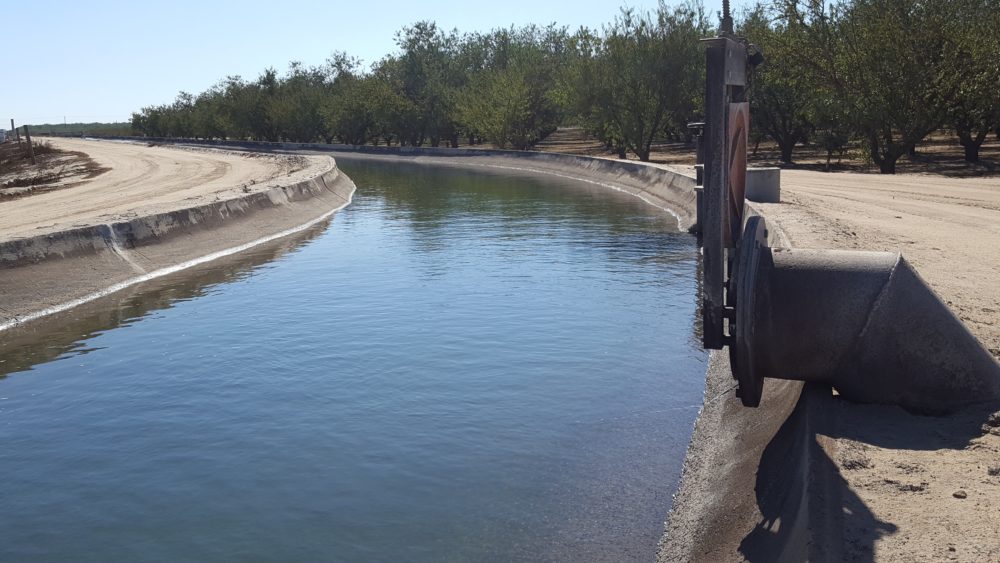
“If you take away Modesto Irrigation District surface water, you take away the domestic water supply for the entire city of Modesto, and they did not consider any of that in there,” Lucas said.turlock irrigation canal

The California Water Resources Control Board seriously underestimated the impact that their water grab would have on surrounding communities.

“Their science is shaky at best; it’s pseudo-science frankly,” Lucas said.

Modesto Irrigation District has spent more than $25 million in studies for over a decade specifically on the Tuolumne River with their partner, Turlock Irrigation District.

“We have presented them with a plan that gives them more fish that is sustainable, that protects groundwater, that protects surface water, and that allows everybody to get better together. This is our river,” Lucas said.

Also, Don Pedro is one of the few reservoirs and facilities that has zero state funding. The residents of Turlock, Turlock Irrigation District, and the Modesto Irrigation District paid 100 percent with a little federal money with Army Corp to build that facility.

“Because of that foresight, the state is going to come and try and take it and it is not theirs to take and we cannot let it happen,” Lucas explained.

2021-05-12T11:05:09-07:00October 17th, 2018|

40 Percent Water Grab Continues to Be Big Concern

Growers Will Fight Back

By Jessica Theisman, Associate Editor

Recently, over one thousand farmers and other stakeholders attended a rally in Sacramento outside the capital building, protesting the California State Water Resources Control Board’s proposed Water Grab, which consists of over 40 percent of the water from Stanislaus, Tuolumne, and Merced rivers to increase flows for salmon. California Ag Today spoke with Ronda Lucas, General Counsel with the Modesto Irrigation District.

Unfortunately, the state does not need to pick this fight, but they are choosing to.

“In ignoring our science in the process, one of the major deficiencies of the plan is the state board’s refusal,” Lucas said.

Rhonda Lucas

Lucas would like the water board to be intellectually honest about the linkage and the impact this will have on groundwater.

“They simply say that we’ll just get more water. There is no more water,” she said.

California is not in a critical overdraft area.

“Our sub base in the Modesto subbasin is in better shape than many, but that’s because we’ve been such good stewards,” Lucas said.

This plan will destroy the health of the groundwater basin.

Lucas says that many communities in the area could be impacted heavily. Some communities’ sole water source is groundwater, and this plan will dry up their drinking water.

“There will be school children that don’t have the basic needs to live, and we know it. And we’ve told the state board that, and they don’t seem to care,” Lucas said.

The bigger problem that is not well known is that the state is trying to come in and run the dam operation long-term.

“If the state is in charge of Don Pedro and the running of our facilities, which we believe to be illegal, we do not know what they are going to do because they have not had a good track record thus far,” Lucas explained.

2018-10-17T15:25:50-07:00October 16th, 2018|

Innovation is Bowles Farming Co.’s #1 Objective

Bowles Farming is Major Innovator in Merced County

By Mikenzi Meyers, Associate Editor

As every industry continues to be pressured by increasing technologies and the expectation to innovate, it is without question that agriculture is no different. With 160 years of experience growing various crops, Bowles Farming Co. in Merced County is not only a leader within the industry but strives to stand on the forefront of innovation.

Danny Royer, Vice President of Technology at Bowles, gave insight to California Ag Today recently as to how his company is using technology to make irrigation more efficient.

“There’s a lot that goes into the irrigation before it even gets to the farm,” he explained. “Our canal company that delivers our water is working on automating their system to meet our automation needs.”

Royer is utilizing water control and data gathering technology through innovative companies such as WaterBit and WiseConn to better regulate how Bowles Farming Co. resources are used.

He is in charge of the technology behind growing various crops, including tomatoes, cotton, wheat, watermelon, and other organic commodities. He said that the key to solving issues is by sharing data within the operation.

“Data is what’s going to provide the solution, but we have to create systems that give the people [the data] who have the competencies to solve the problem,” he explained.

One way Bowles Farming Co. is able to achieve this is by using Google Hangouts on the farm, which enables them to communicate with different sectors of the operation single-handedly.

“We’ve got to be a little more transparent and open about sharing our information with people that are coming from the tech sector trying to help us.”

Royer concluded, “the most important thing when we talk about tech and ag is talking about the impact on the operation … people’s jobs are going to change, how people function is going to change, and if you rule tech out, it’s going to be resisted.”

2021-05-12T11:05:09-07:00October 15th, 2018|

2018 Raisin Price Still in Limbo

Discussions Continue Over Raisin Price

News Release Edited by Patrick Cavanaugh

The Board of Directors of the Fresno-based Raisin Bargaining Association have offered to sell the 2018 Natural Seedless Raisin Crop for $2,250.00 per ton. Also, the board has offered to sell both the 2018 & 2019 crops for $2,150.00 per ton. This 2-year Memorandum of Understanding (M.O.U.) at $2,150.00 per ton has safeguards in it for the second year in case there are changes that could force the raisin price to go higher or lower, with a lower bottom not to fall below $2,000.00 per ton.

Last year, they had 12 signatory packers agree to the M.O.U. negotiated at $1,800.00 per ton. This year, they have been instructed that Sun-Maid has rejected both the $2,250.00 one year contract and the $2,150.00 two year contract. They have also advised the RBA to try and move the 2,000 tons of RBA growers to other packers, which we are in the process of doing.

Of the remaining 11 packers, 6 have agreed to accept the $2,150.00 2-year plan. Those six packers are Central California Packing Company, Chooljian Brothers Packing Company, Inc., Del Rey Packing Company, National Raisin Company, River Ranch Raisins, LLC., and Sun Valley Raisins, Inc.

The 5 remaining packers who have rejected both the one year price at $2,250.00 per ton and the $2,150.00 per ton two-year M.O.U. include: Boghosian Raisin Packing Company, Inc., Caruthers Raisin Packing Company, Inc., Fresno Cooperative Raisin Growers, Inc., Lion Raisins, and Victor Packing Company.

In the discussion with the packers who have not agreed to M.O.U. terms, their arguments were that the $2,250.00 price was too high and the $2,150.00 price was acceptable but not for 2 years. Discussions will continue until Friday, October 12. For updates please go to our website at www.RaisinBargainingAssociation.com and click on the “From the Office” tab.

2018-10-12T16:49:55-07:00October 12th, 2018|

California Walnuts Face Threatening Tariffs

Big Challenges For the Walnut Industry

By Mikenzi Meyers, Associate Editor

It takes one glance at current news headlines to know that agriculture trade is a hot-button issue within the industry. Amongst countless exported crops being hindered by tariffs, the California walnut industry is no different. With California English walnuts making up two-thirds of the world’s trade, the California Walnut Commission is on high alert to ensure that growers are protected from tariffs that could damage their markets.

Pamela Graviet, the commission’s senior marketing director, spoke deeper on this issue.

Pam Graviet

“If you look at the three major markets—China, Turkey, and India—where we have tariff issues,” Graviet said, “that represents twenty percent of our total shipments … it’s over $300 million we’re going to lose.”

Thus far, the walnut industry has avoided paying the full tariff direct to China through the “gray market,” or the sales of walnuts through other countries that feed into China.

“But when you’re tariff constrained or in a trade war” Graviet explained, “they are also cracking down on those other routes, and the gray market has also suffered.”

The California Walnut Commission will continue their work to protect nearly 100 handlers and 4,800+ growers that make up the California walnut industry.

2018-10-11T14:42:10-07:00October 11th, 2018|

Facts Not Fear on Growing Produce

Understanding Salinas Valley Farming Practices

By Jessica Theisman, Associate Editor

Among the mix of registered dietitians conveying the accurate message, California Ag Today concluded our conversation about Facts Not Fear with Teresa Thorn, executive director of the Alliance for Food and Farming, located in Watsonville.

The Alliance hosted the second Facts Not Fear produce safety media tour, in conjunction with Markon Cooperative, for registered dieticians, health and nutrition writers, and bloggers last month in the Salinas Valley. Impacting the customer with the proper information is key.

Teresa Thorn

“We have a mix of writers and bloggers who again have that bullhorn to consumers,” Thorn said.

Social media was also used in conveying the message.

“They’re posting, and we’ve read it and retweeted a lot of their stuff so you can go to our social channels and see some of it,” she explained.

Speaking to growers was very important, and asking industry professionals to attend was vital to cultivating relationships.

“They loved being out in the field. We were always the last ones to get on the bus because they had so many questions,” Thorn said.

The group also does a roundtable discussion where they bring in scientists, shafts, regulators, farmers, and farming companies into the room at Markon’s Produce Expo.

“Building that network was really important,” Thorn said.

2018-10-10T16:43:27-07:00October 10th, 2018|
Go to Top