About California Ag Today

This author has not yet filled in any details.
So far California Ag Today has created 2014 blog entries.

Irrigation Industry Needs Help

Promoting Efficient Irrigation

By Jessica Theisman, Associate Editor

What will affect the irrigation industry in the future? California Ag Today asks Brent Mecham, the industry development director with the Irrigation Association located in Fairfax, Virginia. Promoting effective irrigation is important.

“I work on the things that are going to affect our industry or the future and trying to position ourselves so we can continue to promote efficient irrigation,” Mecham said.

His occupation includes working on codes and standards, new technologies, technical programs, and educational programs. This is becoming popular among policymakers.

Everyone in the world is benefiting from irrigation. Everybody in the world is benefiting from water whether they know it or not.

“It’s something that affects everybody’s life, and they will not notice it until there’s no lettuce for your salad or no tomatoes. So irrigation affects people all around the world,” Mecham said.

There is more demand on water resources in property. Irrigation is very important for a state like California.

“There is more demand on water resources than ever before, and a lot of places where it is very sensitive, like in California, and the water shortages are becoming prevalent,” Mecham explained.

Farmers have been doing their part to be more profitable in their operations. Cities, too, need to do their part to prevent water running down gutters, which is not efficient.

2018-10-09T16:44:05-07:00October 9th, 2018|

Sound Science Funding for Farmers

Funding for Sound Science is Critical

By Jessica Theisman, Associate Editor

Increased funding to make farming easier is a priority, an expert told California Ag Today recently. LaKisha Odom is the science program director for the Foundation for Food and Agricultural Research based in Washington, DC. Funding sound science is a goal for the foundation.

“We are interested in increasing the amount of funding that is available to make farming and decision making easier,” Odom said.

This is all based on sound science. Their foundation base depends on the readily available funding.

“We match public-private dollars and increase that amount of funding available to fund sound science,” she explained.

The funding is for foundations and agencies that will assist farmers.

“The universities, industry partners, foundations and the research that’s funded by those entities can then inform those decision makers to assist those farmers who are making those decisions,” she said.

“We were provided $200 million dollars in the 2014 Farm Bill,” Odom added.

There are seven challenge areas that the foundation focuses on: water scarcity; urban agriculture; food waste; food loss; making my plate your plate, which focuses on nutrition; protein challenge, which focuses on animal sustainability; and innovation pathways.

Fresno State is one of the founding partners.

“I’m working with the irrigation innovation consortium, which is a consortium of university partners as well as industry partners, and Fresno State is one of our partners in that,” Odom said.

They are working with Dr. Davis at Fresno State for ways in which they can make innovations in irrigation and make water issues a little less challenging for farmers.

2021-05-12T11:05:09-07:00October 8th, 2018|

Labor Unions Could Be Cause of Farm Closings

Major Farm Operations With UFW Contracts Have Shut Down

By Patrick Cavanaugh, Editor

Farms operations shutting down due to labor unions and UFW contracts is something that is suspected, but businesses do not outright admit it, said Robert Roy, President/General Counsel at the Ventura County Agricultural Association based out of Camarillo.

“Last year, you had the closure of all of the strawberry operations for Dole,” Roy said. “They shut down all of the strawberry operations in Ventura and Santa Maria and Watsonville, so that was at one time very large UFW-contracted operations. They had over 1,500 workers since the mid-1990s.”

Roy explained that workers see no reason to pay three percent of their wages for many of the things that farmers are now providing that maybe they didn’t previously when UFW was around.

“Farmers have basically caught up with many of these UFW contracts, and selling the union to the workers is a much more difficult proposition, especially when they have to pay three percent of their wages,” he said.

Roy says that most Supreme Court decisions have been pro-worker as of recently, including a recent case involving a Starbucks employee.

“We have been watching some of their decisions over the last 12 months, and they’re very nuanced decisions dealing with wage and hour issues and rounding practices,” Roy said. “They recently issued a decision on a class action case where a Starbucks employee was owed $112 because after he clocked out, he would lock the door, and do other tasks. The California Supreme Court came back and said, ‘well, you know, $112 to some people is a week of groceries. He’s owed it.’ So the California Supreme Court is very pro-worker.”

2018-10-05T17:01:13-07:00October 5th, 2018|

WG Center for Innovation and Tech Celebrates Three Years

WG Center Brings Technology to Ag

By Patrick Cavanaugh, Editor

The Western Growers Association’s WG Center for Innovation and Technology in Salinas is turning three years old. Dennis Donahue, mayor of Salinas from 2006 to 2012 and currently the consulting director at the center, spoke to California Ag Today recently about the anniversary.

This center houses more than 50 ag-tech startup companies and is a hub for new developments in ag-tech with services ranging from infield robotics to renewable energy.

“The reality is you have to be making progress on all these things all the time,” Donahue said.fsma food safety flags in the field mean stop harvest here

The agriculture industry as a whole is facing many problems, including water supply, labor supply, water quality, and crop protection. And that’s why it’s so crucial for these startups to keep coming up with these new innovative solutions.

“Labor is a challenge because it’s getting tougher,” Donahue said. “The cost issues are—the supply issues are—intensifying, so that puts a lot of pressure on the automation piece and proof of concept, particularly in the field.”

“How do you get something crop off the ground, out of an orchard or clipped from a vineyard? That’s going to occupy a lot of time, cost efficiency, and technology. Those things are at best with some focus at three- to five-year play, and our problems may come a little sooner,” Donahue explained.

“California agriculture and the folks we deal with in the Western Growers network are bound and determined to address these problems. We often get a real dose of realism. ‘Look, here are the issues. Here are some of the things that haven’t been working well, and we need to work better, and we need to work faster.’ But, there’s no quittin’ the dog. You know, I think the industry is fully engaged, understands the challenges, and we’ve got a pretty good group of people determined to meet them on both the ag and technology side.”

2021-05-12T11:05:09-07:00October 4th, 2018|

2018 Cotton Crop Proceeding Well

Late Season Pests Can Be a Challenge

By Patrick Cavanaugh, Editor

The 2018 cotton harvest will be starting in the southern part of the Central Valley later this month, and some growers will be facing pressure from pests.

California Ag Today recently spoke about the topic with Dan Munk, a UC Cooperative Extension Farm Advisor in Fresno County specializing in irrigation crop nutrient management and cotton production systems.

“The crop looks very good and loaded with cotton bolls. We don’t have a lot of boll losses, and that’s a real positive thing, so very excited about the potential for fairly high yields in the 2018 season. The biggest concern right now is pest management, press pressures as we approach the latter part of the season,” Munk explained.

The main issue this time of year is the honeydew that pest leave on the cotton. Honeydew is the exudate extracted by the insect as it feeds on the leaves.

“Because we have the bolls on the plant that have opened, we now have exposed lint and need to protect that lint from stickiness that’s created from whitefly and the aphid honeydew, which is basically the added sugars that those insects that feed on the leaves of the plant, and they excrete them and deposit them on the lint,” Munk said.

Munk explained that the big concern right now is dealing with pest pressures in terms of whitefly and aphid—both sucking insects. “The problem right now [is] where we’re seeing pest pressures—particularly from whitefly as we get later in the season—will build in many fields.

There are several approaches to controlling whitefly and aphids. One is to deal with the eggs that they produced. And then there’s a certain class of materials to deal with the eggs.

“There’s another class of materials that deal with the juveniles—that early form of the insect—and then there are ways to control the adults,” Munk said.

“A number of insecticides have been applied to deal with those various levels of insect populations based on the individual field situation,” he explained.

2021-05-12T11:01:53-07:00October 3rd, 2018|

Citrus Research Board Seeks to Hire New President

Nationwide Search Is On

Edited by Patrick Cavanaugh

The Citrus Research Board (CRB) has launched a nationwide search to hire a new president for the organization. A search committee is being formed.

“This year marks the Citrus Research Board’s 50th anniversary,” said CRB Chairman Dan Dreyer. “As we celebrate this milestone, we also are rededicating ourselves to do our utmost to ensure the success of the California citrus growers.” Dreyer said the CRB also is continuing to ramp up its fight against Huanglongbing, the deadliest citrus disease to date, which has devastated crops in other worldwide growing regions and potentially presents a critical threat to California citrus.

Citrus Research Board“Our search committee will be looking for a strong, research-focused senior executive – a consensus builder who can lead the organization and the California citrus industry through this challenging time and significantly contribute to the sustainability of California growers,” Dreyer said.

The CRB administers the California Citrus Research Program, the grower-funded and grower-directed program established in 1968 enabling the State’s citrus producers to sponsor and support needed research. More information about the Citrus Research Board may be found at www.citrusresearch.org.

###
Citrus Research Board
217 N. Encina Street, Visalia, CA 93291
Phone: 559.738.0246 | Fax: 559.738.0607
events@citrusresearch.org | www.citrusresearch.org
Copyright © 2018 Citrus Research Board | All rights reserved.
2018-10-02T19:46:05-07:00October 2nd, 2018|

STK REGEV ‘Hybrid’ Fungicide Named Finalist for Best New Crop Protection Product

TIMOREX GOLD Finalist for Best Marketing Campaign

News Release Edited by Patrick Cavanaugh

STK bio-ag technologies, a global leader in the development and marketing of botanical based and hybrid solutions for food protection, was selected as a Finalist in two Agrow Award categories … REGEV ‘Hybrid’ Fungicide for Best New Crop Protection Product of the Year, and the TIMOREX GOLD Outreach for South American Growers as the Best Marketing Campaign of the Year.

Note that Regev is not registered in California while Timorex Gold is pending registration in California.

REGEV is the first product of its kind in the market. REGEV is a pre-mix hybrid solution that delivers effective and sustainable disease control in a very wide variety of high-value, row and even broad acre crops. This is a breakthrough formulation which creates a bridge to future biologics use, enabling growers in all sectors and geographies to reduce their ecological footprint and thrive economically to better meet the demand for sustainable food protection.

REGEV is a revolutionary and easy-to-use approach to sustainable crop protection. REGEV is a hybrid pre-mix, which is used in exactly the same way growers use their current chemical fungicides. No mixing. No Rotating.

REGEV enables growers who have never used any biological product to try a biologic, experience an effective new tool for combating resistance, increase crop yields, sharply reduce chemical residues and make crops more competitive with consumers and regulators globally,” said Arye Tenenbaum, CEO of STK bio-ag technologies.

The Agrow Awards were developed to recognize excellence in the crop protection and production industries. Entries are evaluated using a wide range of criteria by an independent judging panel consisting of a group of experts from around the world.

Winners of the 11th Annual Agrow Awards will be announced at the Awards Gala scheduled to take place on November 12th at 8 Northumberland in London.

2021-05-12T11:01:53-07:00October 2nd, 2018|

Farmers Launch New Health Advertising Campaign for Grapes

Ad Series Highlights Links Between Grapes and Healthy Heart, Brain, and Colon

News Release Edited By Patrick Cavanaugh

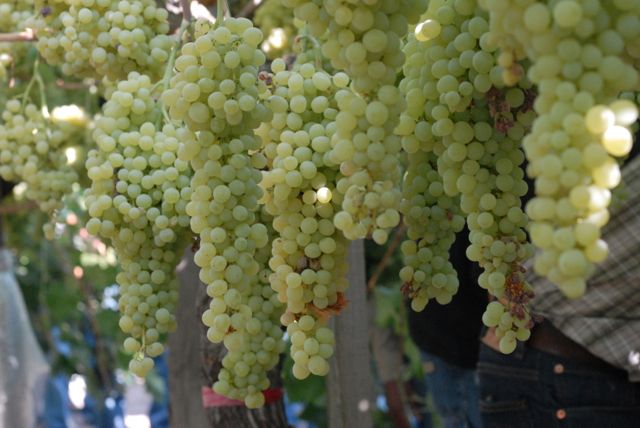
A new ad campaign from the farmers of fresh California grapes highlights how consuming normal amounts of grapes each day may contribute to long-term health by helping to maintain a healthy heart, brain, and colon.

Reaching consumers online and through print and broadcast, the campaign revolves around a series of ads focusing on the power of the whole fruit: grapes contain more than 1,600 documented natural plant compounds, including antioxidants and other polyphenols.

Each ad highlights key research from scientific study in the area of heart, brain, and colon health. Scientists believe it is the combination of natural plant compounds and daily consumption that provides benefit.

Kathleen Nave, California Table Grape Commission president

Kathleen Nave, California Table Grape Commission president

“Consumers have always loved grapes for their great taste, convenience, share-ability, and beauty. Through this campaign, consumers will learn that the health benefits grapes provide go beyond the basics of eating a favorite fruit as part of a healthy diet,” said Kathleen Nave, California Table Grape Commission president. “It is already established that grapes are a heart-healthy food, and now research in the areas of brain and colon health is emerging that suggests that grapes may have an even broader role to play in long-term health.”

Nave noted that research into these three areas of health, and numerous others, will continue.

The campaign will run in magazines and newspapers in both print and online, on health-related websites, on television and radio, and on social media.

2018-10-01T15:35:35-07:00October 1st, 2018|

Karen Klonsky Dies, Thursday, Sept. 27

Klonsky Credited for CA Agricultural Cost and Return Studies


By Patrick Cavanaugh, Editor and Laurie Greene, Founding Editor

Editor’s Note: We extend our deepest condolences to Karen’s family. Below is our interview with Karen upon her retirement in 2015.


This is an exclusive interview with Karen Klonsky, UC Davis Cooperative Extension specialist emeritus, in the UC Davis Department of Agricultural and Resource Economics. Her expertise has been farm management and production, sustainable agriculture and organic agriculture.

CalAgToday: Congratulations on your recent retirement!UCANR 100 years logo

Klonsky: Thanks, Patrick. I retired on July 1, 2015, after 34 years. I started at UC Davis in ’81, straight from graduate school.

CalAgToday: What has been your primary research interest?

Klonsky: My primary research areas are c and organic agriculture. I have approached these subjects from several dimensions, including the economic feasibility of alternative farming practices, the size and growth of organic production in California, and factors influencing the adoption of alternative farming systems.

Karen Klonsky UC Cooperative Extension specialist

Karen Klonsky UC Cooperative Extension specialist

CalAgToday:  Wow, what a great career! I understand your interest in alternative farming systems began with your dissertation work comparing alfalfa systems with integrated pest management.

Klonsky: I studied agricultural economics in graduate school and started working with a professor in my department who had a joint appointment in agricultural economics and entomology. And I just became very interested in that research area.

I worked with entomologists and researchers on a computer model of plants and alfalfa weevils, and their interaction, plus a management component. I studied the plant and bug components, then did the management part and imposed it on top and asked, ‘If you did this, how many bugs would die?’ The plant model showed how much the alfalfa would grow, and at what point you could cut the alfalfa and achieve the desired yield. I never actually did any fieldwork.”

CalAgToday:  Since 1983, you not only directed ongoing Cost and Return Studies, but the development of an entire archived library of Cost and Return Studies for the UC Davis Department of Agricultural and Resource Economics. You recently completed studies on pistachios and walnuts, right?

Klonsky: Yes, both “Sample Costs to Establish and Produce English Walnuts In the Sacramento Valley, Micro sprinkler irrigated” and “Sample Costs to Establish and Produce Pistachios In the San Joaquin Valley-South, Low-Volume Irrigation.”

Our library contains studies about field, tree and vine crops and animal commodities. But since I retired, Dan Sumner, director, University of California Agricultural Issues Center and Frank H. Buck, Jr. Distinguished Professor for the Department of Agricultural and Resource Economics has taken that over and I continue to be peripherally involved.

CalAgToday:  These cost studies have been recognized worldwide.ARE Cost and Return Studies

Klonsky: Yes, and it has been very gratifying work. We decided to put them online routinely, and we have had a million downloads per year. Around 2005, Pete Livingston, my staff research associate, got the idea of scanning in the older studies. All of the newer studies were in electronic file format, so posting was easy. However, most of the older studies were paper copies, so we got a grant to scan and add them to our new online archive.

CalAgToday:  What was the most interesting thing about doing those cost studies?

Klonsky: I loved doing those studies. I really learned a lot because all cost studies are done directly with farmers we met through county farm advisors. I really got to know what farmers were thinking about and what their options were.

CalAgToday:  So those were real costs, not university costs?

Klonsky: Those were not university costs. The farmers tell us what equipment they will use, and then we calculate the cost of using their equipment—the fuel used to operate the equipment and the repair costs—with an agriculture-engineering program.

CalAgToday:  Do you have a math background?

Klonsky: Yes, I got my bachelor’s at the University of Michigan in mathematics. It was very helpful.

CalAgToday:  And you also earned your Ph.D. at the University of Michigan?

Klonsky: Yes.

CalAgToday:  So did you grow up in Michigan?

Klonsky: No, I grew up in New York.

CalAgToday:  And you had an interest in going to Michigan State University?

Klonsky:  I had an interest in agriculture because I had an uncle who farmed corn and vegetables in upstate New York. We would go up there and I thought it was the most wonderful thing in the world.

CalAgToday:  What were some of the highlights of your career?

Klonsky: For many, many years, I was involved in the long-term on-campus sustainable agriculture research on land that is now on Russell Ranch, but it started as Sustainable Ag Farming Systems. We looked at four different farming systems, organic, low input, high-input, and we did a lot of analyses with cover crops and rotations. It was great to work on that project.

CalAgToday: And you worked with USDA on the trends of organic farms?

Klonsky: Then I worked quite a bit with Department of Food and Agriculture on using the registration data for their organic farmers to compile statistics about how many farmers they had, what they grew, and the number of acres they planted with each crop. They had this database, which started in 1992 I believe, but they weren’t using it. Now the most recent registration analysis is available for 2012.

CalAgToday:  Just to try to get more data on the organic movement and organic growth?

Klonsky: Yes, because there was no data at all about it. Now NASS (National Agriculture Statistics Service) conducts a nationwide Organic Census, in addition to the regular Census of Agriculture.

CalAgToday:  I understand you served as an editor of the Journal of American Society of Farm Managers and Rural Appraisers (ASFMRA). What did that entail?ASFMRA

Klonsky: Yes. I did that for many years. ASFMRA is a national organization. The Journal of the ASFMRA comes out annually. As editor, I corresponded with the authors, assigned reviewers, and ultimately, accepted or rejected submissions, like any journal.

CalAgToday:  Did you travel a lot with your work and presentations?

Klonsky: You know, not so much, I went to Spain one time and France once for work. But I did travel around domestically to symposiums and conferences to speak on the economics of growing a lot of different crops, including many presentations at the EcoFarm Conference.

CalAgToday:  You worked and collaborated with some really interesting people.

Klonsky: Most of my important collaborations were conducting trials with people in other disciplines. For instance, at Russell Ranch, I was the only economist involved in the collaboration with plant pathologists and pomologists who ran trials to discover fumigation alternatives in the preplanting of trees.

Then I worked with people at UC Santa Cruz on alternatives for strawberry fumigation. Most of my work has been interdisciplinary.

CalAgToday:  California farming is a tremendously diverse industry. We produce 60% of the fruits and vegetables, and nearly 100 percent of the nut crops that people across the country consume. Any comments on that and on how, valiant and resilient farmers are to get through year after year, particularly lately with the drought and the lack of water deliveries?

Klonsky: When I first started, there was a land price bubble, and there were a lot of bankruptcies because people had these land payments they just couldn’t pay.

It was kind of like the mortgage crisis that housing saw in 2008, agriculture saw in the early 80s.

CalAgToday:  So as you have been editor for the Journal of the American Society of Farm Managers and Rural Appraisers, you see land values going up and that keeps agriculture strong—the high land values, right?

Klonsky: Well, but it keeps it expensive. So now there is more and more leasing of land. As farmers retire from permanent crops, they have an orchard, but they don’t really want to sell it, so they lease it.

CalAgToday:  There you go. Keep it somehow in the family.

Klonsky: Yes, they try to keep ownership in the family. Or what we see also are these development leases where a young farmer can’t afford to buy the land, so they lease the land, but they pay for the trees to be planted.

CalAgToday:  So you are still coming to your office at UC Davis?

Klonsky: I am officially retired, but we have what we call a ‘partial recall’ where you can do things if you have funding. I have a project along with Rachel Goodhue, Professor, UC Davis Department of Agricultural and Resource Economics, with the California Department of Food and Agriculture, funded through the California Department of Pesticide Regulation. The Department of Pesticide Regulations is required by law to do an economic analysis of all proposed new regulations. So that is what I am working on.

CalAgToday:  Give me a couple of examples. VOC regulations?

Klonsky: Yeah, we do VOC.

CalAgToday:  Are you looking at sustainable groundwater legislation?

Klonsky: No, just pesticide regulation. It is funded by the Mill tax on pesticides.

CalAgToday:  Did you work with a lot of graduate students at UC Davis?UC Davis Graduate Studies

Klonsky: Oh yeah, I worked with a lot of graduate students coming through. One of them was on different ways of pesticide management on eucalyptus trees. I said I went to Spain. On that trip, I spoke about growing eucalyptus for firewood.

CalAgToday:  That was an economic study, wasn’t it?

Klonsky: Yes it was. They grow it not for firewood, but for paper. But that never really caught on here.

CalAgToday:  Are you bullish on agriculture? Do you think Ag is going to continue thriving in California?

Klonsky: Oh, sure. Oh, sure. But I think that the water situation is definitely real, and I think agriculture already has definitely made tremendous strides in irrigation systems, especially the subsurface irrigation in vegetables, in particular processing tomatoes, which I worked on.

CalAgToday:  That was a huge improvement in growing tomatoes. And people didn’t think it was going to work, but it turned out to be fantastic.

Klonsky: Yeah, a really win-win on that one. And orchards are getting more efficient. If you look at the water per pound of crop produced, you see major improvements with water efficiency.

CalAgToday:  Absolutely. Of course, most plants transpire most of the water they take up through the roots, up through the leaves and the stomata cells. By the way, do you have any interesting stories regarding your career?

Klonsky: It’s not the highlight, but the weirdest thing of my career is I got an email from somebody in Ministry of Agriculture and Fisheries from the United Arab Emirates. They wanted me to give a live presentation about Cooperative Extension in California and how it’s organized.

So I had to go to this office building in downtown Sacramento at 10:00 at night because of the time difference. I went into a conference room that had a special kind of projector so I could see them and they could see me. And on the monitor I see all these men walked in—they were all men—and half of them were in Western dress and half of them were wearing a Sheik-like headdress, with a band that sits on top and holds it on.

That was crazy, just being downtown after everybody is gone and the whole building was dark and quiet, except the one room that I was in.

CalAgToday:  How long was the presentation?

Klonsky: Gosh, maybe an hour.

CalAgToday:  You needed to do some research for that presentation?

Klonsky: Yeah, I had to do some research, I had to think about Cooperative Extension in a different way—the big picture. 

CalAgToday:  Keep up the good work, and I hope you are enjoying retirement.

Klonsky: Yeah, I come in two days a week, so it is nice to see everybody. I still get a lot of emails, which I need to answer.

2018-10-02T20:13:53-07:00September 29th, 2018|

Aza-Direct Stops Insect Feeding

Aza-Direct Targets Critical Pests

By Patrick Cavanaugh, Editor

Aza-Direct, with the active ingredient Azadirachtin, is one of the most potent, reduced risk insect pest controls among all the natural pesticides.

With four modes of action, Aza-Direct targets critical pests such as spider mites, thrips, whitefly, aphids, and lygus. It’s very safe with beneficial insects, especially bees, to help maintain the natural balance within the crop.

The product has a lot of excellent benefits regarding those four modes of action, explained Patrick Holverson, Director of Ag Business with Parry America Inc., which manufactures the active ingredients for Aza-Direct.

“Because of the four modes of action, you will not get a resistance buildup like you can with standard chemicals,” Holverson said. “What I like about it, many growers in California will apply Aza-Direct in anticipation before the target pest hits because it is not a contact killer; it takes two or three days to get into the pest’s system to reduce the population.”

Furthermore, the material is an excellent repellent and as well as an anti-feeding agent.

“Those pests who stay in the treated field will experience severe feeding cessation due to a locked jaw and digestive system,” Holverson said. “So, the pests that do feed on the plant, the material acts as an insect growth regulator that affects both the eggs and the larva, preventing them from reaching maturity.”

Holverson said that in strawberries, Aza-Direct controls two significant pests—including two-spotted spider mite and lygus—that come in after losing their host crop.

“The product prevents puckered strawberries and increases the value of the crop,” he said. “It can be used on both organic and conventional crops.”

It has a zero-day pre-harvest interval, and four-hour re-entry, which is essential in a crop such as strawberries.

2021-05-12T11:01:53-07:00September 28th, 2018|
Go to Top