About California Ag Today

This author has not yet filled in any details.
So far California Ag Today has created 2014 blog entries.

ALRB Officially Certifies Gerawan Workers’ “No Union” Vote

“No Union” is Official Result

News Release Edited by Laurie Greene

TODAY, the Agricultural Labor Relations Board (ALRB) officially certified that a majority of the valid ballots from the November 5, 2013, election that were counted five years later in Fresno on September 18 were cast as “No Union.” In addition, the ALRB concluded that “the United Farm Workers of America thereby lost its prior status as the exclusive representative of the employees for the purpose of collective bargaining.”

Silvia Lopez, a Gerawan employee at the time, filed the petition on October 25, 2013, to decertify the UFW as the bargaining representative of the agricultural employees of Gerawan Farming, Inc., which led to the sanctioned decertification election a few weeks later. Today, Lopez commented, “I cannot believe what just happened today. The ALRB certified our votes and results. I am speechless and beyond excited and happy because justice was finally done.”

Count our votes Farm workers' rights UFW Endorsement "No Union"

Count the Votes

Said attorney Anthony Raimondo, “This is a great day for farm workers all across the state of California who can finally celebrate the fact that they wll be the ones who decide their future, not a government agency or a politically connected union. The workers will rest easy tonight knowing that their wages belong to them and will not be taken from them by the United Farm Workers union.”

“We are grateful that the ALRB has recognized the undeniable truth of the workers’ will as expressed in the vote,” Raimondo continued, “and relieved that the agency has decided to abandon its alliance with the UFW and work for the rights of California farmworkers rather than the financial health of a failing union.”

Jesse Rojas, spokesperson for Pick Justice, stated, “Pick Justice was started because of the courage, strength and determination of thousands of farmworkers who simply wanted the right to choose and to be treated equally like every other worker in the state and country. We are thankful that the ALRB finally did the right thing after 5 years of suppressing workers’ rights. Today is a historic and huge victory for the Gerawan farmworkers. Pick Justice is just getting started and will continue to advocate for what is right.”

Link: To review the ALRB Certification of the November 2013 Election to Decertify UFW issued TODAY, September 27, 2109, click on 44 ALRB No. 10.
2018-10-09T22:42:51-07:00September 27th, 2018|

“Facts Not Fear” Tour Brings Consumers One Step Closer to the Farm

“Facts Not Fear” Produce Safety Media Tour Helps Bloggers Learn About Ag

By Mikenzi Meyers, Associate Editor

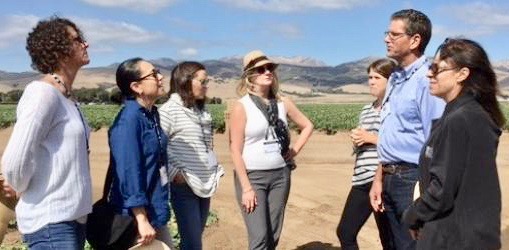
Closing the gap between the consumer and the farm is a continuous work in progress. Teresa Thorne, Executive Director of the Alliance for Food and Farming, is dedicated to making this happen. She helped put on the second “Facts Not Fear” Produce Safety Media Tour for registered dietitians, health and nutrition writers, and bloggers recently in the Salinas Valley, which directly focused on consumer concerns.

The “Fact Not Fear” tour allowed media influencers to see farming practices first hand, in hopes that they would share the information learned with the consumers that follow them.

Teresa Thorne

“We look at them to kind of be the consumer eyes and ears and really learn more about how we produce food,” Thorne explained.

Thorne also noted that one of the main topics brought up during the round table discussion was the great “organic versus conventional farming” debate. “The farmers that were there did a great job of talking about the fact that there’s actually more similarities than differences,” she said.

In a consumer-driven industry, educating people has never been more crucial.

“For them to come out and see firsthand what we do, and then share that back with those consumers and be able to address their concerns directly, it’s just really important for us.”

2018-09-26T15:01:11-07:00September 26th, 2018|

Denham Legislation Brings More Water Storage

Dept. of the Interior Moves forward on the Expansion of Shasta Dam

News Release Edited by Patrick Cavanaugh

 The U.S. Department of the Interior is moving forward on the enlargement of Shasta Dam, a critical water storage reservoir in California. This expansion comes as a direct result of Rep. Jeff Denham’s Water Infrastructure Improvements for the Nation (WIIN) Act language and $20 million in funding approved in March of this year.

“We’re moving forward with building more water storage for the first time in decades,” Denham said. “Real progress and results are what California needs if the next generation wants water.”

Rep. Jeff Denham

The total expansion of Shasta Dam will raise the dam by 18 ½ feet and provide an additional 630,000 acre-feet of stored water for families, farmers, and cities, delivering more water and improving reliability for farmers and communities. The expansion will also help reduce flood damage and improve water quality in the Sacramento River to revitalize fish populations and foster a stronger ecosystem.

According to the Bureau of Reclamation, which is leading the expansion effort, construction contracts for the dam are expected to be issued by December 2019, and the entire project is estimated to cost $1.4 billion. The project is eligible for additional financing through Denham’s New WATER Act, which provides financing opportunities for water infrastructure projects and will reduce the cost to water users.

The Denham New WATER Act language is expected to be signed into law in the coming weeks to make major water infrastructure improvements a reality in the Central Valley. This success comes on the heels of major developments in the fight against Sacramento’s water grab, including Secretary of the Interior Ryan Zinke and Secretary of Agriculture Sonny Perdue voicing support for Denham’s efforts to stop the state’s Bay-Delta plan.

For more information about the enlargement of Shasta Dam, click here. To learn more about what Rep. Denham is doing to fight for water in the Valley, visit www.Denham.house.gov/water, where you can also sign up to receive periodic updates on his work in Washington to improve local water infrastructure, storage and delivery.

2018-09-25T16:40:50-07:00September 25th, 2018|

Federal Milk Marketing Order in California in Effect Nov. 1

Questions Arise Regarding Milk Quota

Edited by Patrick Cavanaugh

Dairymen and women throughout California are working hard to provide milk and other dairy products for consumers in California and the world. Because the industry has struggled over the past decade with price swings that have often landed dairies in red, many dairies have gone out of business. Still, other operations relocated to others states where regulations are a fraction of what they are in California.

In June 2018, California dairy producers voted to establish a new Federal Milk Marketing Order (FMMO) for the state. The vote was a paramount step in a long process that would culminate with the new order taking effect on November 1. The order will adopt the same dairy product classification and pricing provisions currently used throughout the FMMO system.

California accounts for more than 18 percent of U.S. milk production and is currently regulated by a state milk marketing order administered by the California Department of Agriculture (CDFA). Once this new FMMO takes effect, more than 80 percent of the U.S. milk supply will fall under the FMMO regulatory framework.

Western United Dairymen is a trade association based in Modesto. Annie AcMoody is the Director of Economic Analysis. She explained that there have been questions from the industry regarding the upcoming FMMO.

Among the often asked question revolves around when the state switches to FMMO in November, what will happen to their quota if a dairy ships milk out of state?

Annie AcMoody: When our California state system goes away to make way for the Federal Milk Marketing Order (FMMO) in November, the Quota Implementation Plan (QIP) will be the language in place to ensure the quota system’s smooth transition into the FMMO system.

When we enter that new world, all market milk received from California producers at a California plant will be assessed for quota. By “received”, the language defines “to convey milk physically into a milk plant where it is utilized within the plant, or stored within such milk plant and transferred to another plant for utilization. This means that a milk truck driver cannot drive by a plant, wave hello to an operator, and keep on going out of state and still call this milk received in California. Basically, if your California milk leaves the state, you will not be assessed for quota.

But you also will not be paid for it. But, if your milk is 60% quota and only 40% of your milk goes out of state, you will be assessed on 60% of your milk and get paid quota on that same 60%. If your quota covers 100% of your milk and 40% of your milk goes out of state you will be assessed on 60% of your milk and get paid quota on that same 60%. In this instance, one could wonder if it makes much sense to keep your quota.

While it may not make much economic sense to hold on to quota you are not paid for, some reasons may validate that decision (perhaps it is expected milk will be shipped to a California plant in the near future). If you were to decide to hold on to that quota, it is important to keep in mind that “if quota is not made active by shipments of market milk to a California plant or cooperative association or is not transferred within the 60-day period, such quota shall revert to the Department”.

This excerpt from the QIP means that if your quota milk is not paid on for over 60 days, you will lose it, so you better sell it. This is likely going to be an issue if you ship to a proprietary plant and all your milk goes out of state. If you ship milk to a cooperative, there is more flexibility because that coop has the ability to combine quotas assigned to it by its members.

So as long as the quota total within the coop is not larger than the total amount of market milk produced and received in California, then there should be no issue for you as a quota holder.

What 
is 
defined 
as 
market 
milk?


Answer:
 Grade A milk.

If your milk is Grade B, you cannot have quota now and will not be able to under the QIP. You will not be assessed for it either. Currently, only around 3% of the milk in California is Grade B. WUD will keep an eye out on this topic to ensure that percentage does not deviate significantly. As a reassurance, this is not something that could grow from 3% to 50% in a month since fluid milk is not allowed to take in Grade B milk and the three largest coops in the state (CDI, DFA and LOL) committed to not taking in any more Grade B milk after the transition to the FMMO.

2021-05-12T11:17:09-07:00September 23rd, 2018|

$102.7 Million Available to Help Expand Specialty Crops

USDA Funding Program to Help Support Local Projects

News Release Edited By Patrick Cavanaugh

Specialty crop growers in California may be able to use part of the $102.7 million available to support local projects and to help expand markets for specialty crops.

“Every state has agricultural priorities that contribute to the well-being of farm families, consumers and the economic health of rural America,” said Under Secretary Greg Ibach in a recent press release. “These programs target resources to the state, local and regional level where the people who understand the issues best can find solutions that help everyone.”

Resources to be apportioned include:
  • $72.15 million is directed to state departments of agriculture in 50 states, the District of Columbia and five U.S. territories through the Specialty Crop Block Grant Program to support farmers growing specialty crops, including fruits, vegetables, tree nuts, and nursery crops. States use the grant to fund research, agricultural extension activities and programs to increase demand for agricultural goods of value to farmers in the state or territory.
  • $13.35 million is directed to 49 projects supporting direct producer-to-consumer marketing projects such as farmers markets, community-supported agriculture programs, roadside stands, and agri-tourism through the Farmers Market Promotion Program.
  • $13.45 million is directed to 44 projects to support the development and expansion of local and regional food businesses to increase domestic consumption of, and access to, locally and regionally produced agricultural products, and to develop new market opportunities for farm and ranch operations serving local markets through the Local Food Promotion Program.
  • $1.1 million is awarded for nine projects through the Federal-State Marketing Improvement Program to assist in exploring new market opportunities for U.S. food and agricultural products and to encourage research and innovation aimed at improving the efficiency and performance of the marketing system.

For more information about these programs, visit www.ams.usda.gov

2018-09-21T15:24:22-07:00September 21st, 2018|

Worker Transportation Pay is a New Threat to Agriculture

Plaintiff Trial Attorneys Pushing For Ag to Pay for Transportation Time

By Patrick Cavanaugh, Editor

Something serious that could cost growers a lot of money concerns paying for worker transportation to and from a field, which traditionally has not been paid.

Michael Saqui is the principal owner of the Saqui Law Group, with offices in Roseville and Salinas. He specializes in labor and employment in agriculture.

“We’ve been having area meetings around the state regarding what we consider to be the most pressing and catastrophic issue facing agriculture today,” Saqui said. “The macro view is the proliferation of litigation against farmers for wage and hour Private Attorney General Acts.”

Saqui said it’s moved from nonproductive time, which could have bankrupted many companies had there not been a fixed put in through AB 1513.

“However, now the California Rural Legal Assistance and plaintiff attorneys have moved to the next big issue and that’s farm worker transportation.”

Farm worker transportation spins off the fact that we have a serious labor shortage, and we’re transporting workers greater distances than ever before.

And workers in car crews and buses and vans are being transported or transport themselves greater and greater distances.

“And the theory, of course from plaintiff trial attorneys is that even when they’re clearly voluntary mechanisms by which workers get transported on buses and vans, that it’s defacto involuntary because their theory is that farm workers have no position or station in life to make their own free decisions or have no other means, which is simply not the case.”

“Our workers for the last 30 years through car cruise and carpooling arrangements in vans have been getting around in servicing our crop needs and we have the best, most productive workforce on the planet,” said Saqui. “The plaintiff trial attorneys just keep nipping at different issues, and this is an issue that could potentially cost us hundreds of millions of dollars.”

For more information go to www.CAFarmersforFairness.com.

2018-09-20T17:00:38-07:00September 20th, 2018|

Gerawan Votes Were Counted in a Professional Way

Votes Were Announced, Union or No Union

By Laurie Greene, Founding Editor

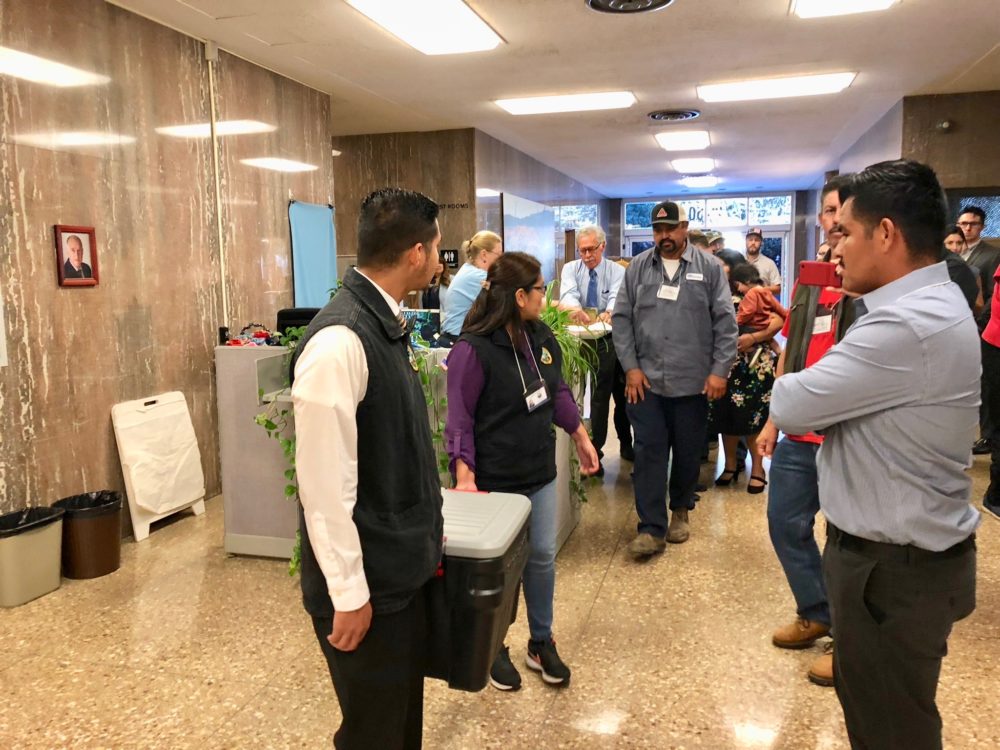
Following Election Protocols, below is a rundown of what happened at 2550 Mariposa Street, Fresno, California. The Gerawan ballots arrived by with ALRB officials carrying them in a black container with red handles. They arrived at the building at approximately 10:15 AM. Watch video here: https://youtu.be/dttdNbUQbG4

Number counted

ON STAGE

1 Veronica Cervantes ALRB Board Agent is running the election
1 UFW voter observer On stage, seated for observation and simultaneous tallying
1 Gerawan farm employee, Angel Lopez. On stage, seated for observation and simultaneous tallying
2 ALRB voter observers On stage, standing for observation
1 Gerawan farm employee On stage, standing for observation
2 ALRB employees On stage, standing for observation in Black Vests with ALRB patches
8 TOTAL ON STAGE

AUDIENCE

100 Silvia Lopez, Jessie Rojas (Pick Justice), Gerawan employees, people in red UFW t-shirts,; media.
2 Lawyers: Tony Raimondo, Ron Barsamian
1 Eduardo Blanco, ALRB
2 Assmb. Jim Patterson, Shannon Dee Grove (Kern County)

Observation Notes

Black cooler with red handles contains ballots.

Cervantes showed 21 large yellow Legal-sized? Envelope packets, each containing blue ballots and yellow #10 envelopes of challenged ballots

  1. Challenged ballots
    1. Cervantes removed ballots in yellow envelopes designating them as “challenged ballots.”
    2. Silvia said even if there are 300 Challenged ballots, “We’ll be OK.”
  2. Challenged ballots were identified during the Nov. 2013 election under the following circumstances:
  3. Farm employees were told to bring a paystub.
  4. Upon arrival, voters picked at random, were asked to show a California ID as well.
  5. If they lacked a second ID, CA ID, their votes were sealed in yellow envelopes designated as challenged ballots.
  6. Many voters told Silvia their vote was challenged. They were upset, angry and intimidated.
  7. TOTAL Contested ballots 634
  8. These contested ballots will be counted today only if necessary after the blue ballots are counted.
  • #10 Yellow envelopes identify and contain one challenged ballot each.
  • Placed in separate gray tote box to isolate them from the blue [non-challenged] ballots
  • See Silvia Lopez’s comments
  1. Blue Ballots
    1. Blue Ballot Rules. If voter:
      • used a check mark instead of an X OK
      • marked in the outer box instead of inner box OK
      • Marked “No” for unwanted option OK
      • Ballot with marking indicated the ID of the voter UNACCEPTABLE
    2. Counted in bunches of 50 2
    3. Read “No Union” in Spanish
    4. Cervantes made announcements in English, then Spanish
    5. 2:36


Union

No Union

Invalid

Challenged ballots

Ballots

197

1098

18

Total

635


7

No markings Unsufficient to affect outcome of ballot count


6

Markings on both boxes

2

Signature reveals ID (separated out)

1

Marked in the middle

1

Contains statement, sticker

1

?

1930 Ballots

Expected from 11/ 2013/

677

1948 Total voters

2645 # Names on list

2018-09-19T16:45:33-07:00September 19th, 2018|

Gerawan Statement on the Results of the November 5, 2013 Decertification Election

The following statement was issued on September 18, 2018, by Gerawan Farming Inc. regarding TODAY’S Decertification Election Ballot Count

Fresno, CA — Our employees have been waiting since November 2013 for their votes to be counted. After a historic struggle, they achieved that right today, in spite of the efforts by the UFW and the millions of taxpayer dollars spent by the Agricultural Labor Relations Board to deny them that right.

The final vote count was 1,098 “No Union,” and 197 for the UFW.  The employees overwhelmingly rejected the UFW as their bargaining representative – by a 5 to 1 margin – in spite of the ALRB’s last-minute, election day refusal to count approximately 640 ballots challenged by the UFW.

A secret ballot election is intended to embody and reflect the workers’ fundamental right to choose their representation. That right is at the heart of what the Agricultural Labor Relations Act is designed to protect and promote. Today’s vote tally leaves no doubt what our employees want.  It is a ringing endorsement of their right to choose, and a repudiation of concerted, unlawful, and anti-democratic efforts to deny them that right.

We call on the UFW and the ALRB to respect the choices of farmworkers, to certify the results of the election, and to decertify the UFW.  We call on the Legislature and the Governor to take immediate steps to ensure that the ALRB’s violation of the basic human rights of farmworkers never occurs again in California.

CONTACT: David Schwarz

(310) 277-1010

DSchwarz@irell.com

Featured Photo:  Silvia Lopez, Gerawan Farm Employee, listens to the Sept. 18, 2018 Ballot Count of Nov. 2013 Decertification Election.

2018-09-18T17:24:54-07:00September 18th, 2018|

2017 Tulare County Crop Report Tops $7 Billion

Tulare Crop Report Shows 10 Percent Growth in Single Year

By Patrick Cavanaugh, Editor

Big numbers announced today from Tulare County Ag Commissioner Marilyn Wright on the 2017 crop year.

“Our value is 10.5 percent up from last year, at 7,039,929,000. So, that’s 669 million more than the previous year,” Wright said.

Marilyn Kinoshita, Tulare County Ag Commissioner

Marilyn Wright, Tulare County Ag Commissioner

And, of course, more water in the system probably helped, as it did in Fresno County, which announced $7.028 billion in its 2017 Crop Report, released earlier this month.

The dairy industry, which is prominent in Tulare County, came in number one again, representing 25 percent of the total value.

“Milk prices were stronger in early 2017, but they went down later in the year. And they continue to go down, but still it was a big part of the Tulare County ag receipts in 2017,” Wright said.

Following dairy were grape products—including juice grapes, raisins, and table grapes. Table grapes had a stellar year.

Navel and Valencia oranges were next. Cattle and calves ranked fourth, down from category number three in 2016, because cattle prices were off last year.

Tangerines, also known as mandarins, were number five, followed by almonds, cling peaches, and freestone peaches.

Lemons, were ninth on the crop list.

We only have just over 10,000 acres of lemons in the County, Wright said.

Wright said the value of this year’s crop report, $7.39 billion, is the third highest value Tulare County has ever reported.

2018-09-18T16:39:21-07:00September 18th, 2018|

Gerawan Worker Votes to Be Counted in Fresno

Historic Day Following Five Years of Vote Count Suppression

News Release Edited By Patrick Cavanaugh

Today, the Agricultural Labor Relations Board announced that it will count the votes of Gerawan Farms workers after five years of illegally refusing to tally the ballots.

Supreme Court

Silvia Lopez, Gerawan farm worker spokesperson

Determined to avoid having union dues taken from their wages by a union that had abandoned the workers for almost two decades, Silvia Lopez and the Gerawan Farms employees courageously organized themselves in opposition to forced union membership. In November of 2013, thousands of Gerawan Farms employees voted on whether or not they would be represented by the United Farm Workers (UFW) in the largest worker election in ALRB history.

For five long years, the ALRB has suppressed the vote by refusing to count the ballots while the workers fought to vindicate their civil rights.   The Fifth District Court of Appeal in Fresno ruled in May that the suppression of the vote violated the workers’ statutory and Constitutional rights, and ordered the votes counted. Only after a dismissal of all appeals by the California Supreme Court did the government finally agree to count the ballots.

At 8:30 am on September 18, 2018, the ballots will be removed from the ALRB safe for inspection by the parties, and transportation to Fresno.

The ballots will be counted at 2550 Mariposa Mall, Room 1036 in Fresno at approximately 10:00 am. This tally represents a victory for farmworker rights over a union and a government agency that has tried to silence them.

2018-09-17T17:56:17-07:00September 17th, 2018|
Go to Top