About California Ag Today

This author has not yet filled in any details.
So far California Ag Today has created 2014 blog entries.

Farmers Frustrated Over SGMA

CA Department of Water Resources Rolls Out SGMA Regulations at Meeting

By Patrick Cavanaugh, Farm News Director

The California Department of Water Resources held a recent workshop in Clovis, CA, to lay out the key components and regulations for the Sustainable Groundwater Management Act, known as SGMA. It’s thought that SGMA could forever change the face of agriculture in the central San Joaquin Valley, as it will limit the amount of groundwater that can be pumped.

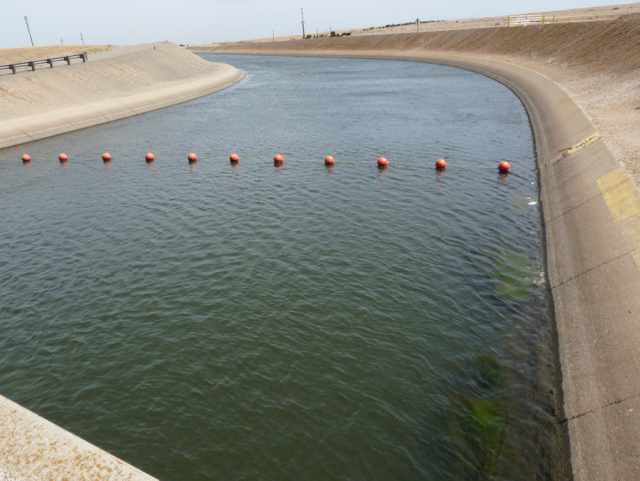
turlock irrigation canal

If surface water was available for growers, the SGMA law would not have been created.

This entire approach of the Department of Water Resources is not sitting well with most farmers. Keith Freitas, who farms lemons on the east side of Fresno County, was at that recent workshop. “How can you call a program fair, but the stakeholders you bring to the table, before they enter the room to negotiate the deal, you cut their legs off?” Freitas asked.

“That’s basically what we have. We have a foot race here, but our legs have been cut off before the race even starts,” he said

And here’s the problem – there’s six deadly sins: lowering ground water levels, reducing ground water storage, increasing sea water intrusion, causing unreasonable water quality degradation, causing land subsidence and depleting surface water supplies that would have a significant and unreasonable adverse impact on beneficial uses of the surface water.

“The reason there’s six deadly sins is ’cause they’re all about the sins of the farmer. Not one of those sins is environmental,” Freitas said. “You think about it. We already have a subsidence and they know it, they don’t blame the environmentalists for subsidence, they blame farming.”

Farmers feel that if environmental water restrictions were not in place, there would be no overdraft of ground water or subsidence.

“How do you think we’re going to sustain overdraft pumping,” asked Freitas, “if they don’t have surface water to recharge the ground basin?”

“My perspective is that like Westlands Water District, who decided to turn down the twin tunnels – that decision was made I think in parallel to the overall consensus of farmers saying that if it’s going to be this way, if these are the rules that you’re going to set and these are the game rules, then we have no choice but to fight back,” Freitas said.
2017-09-29T16:22:43-07:00September 29th, 2017|

Humboldt State Looks for Entrepreneurs to Save Energy & Water

BlueTechValley’s Northern-Most Hub Seeks Innovation

By Patrick Cavanaugh, Farm News Director

Humboldt State University is among the northern-most hubs of the BlueTechValley Innovation Cluster. It’s part of the interconnection of multiple incubators, or entrepreneurship programs spanning the state serving 39 counties. The solid goal of the BlueTechValley initiative was established at Fresno State, and it’s all about managing water and energy resources in agriculture and other industries.

Lonny Grafman

Lonny Grafman teaches in the Environmental Resources and Engineering Department at Humboldt State, and he’s also the Humboldt State managing director of the BlueTechValley hub there.

“It’s a new program, so that’s pretty exciting,” Grafman said. “BlueTechValley has had a lot of success in Fresno, and what we are is their far northern Californian north coast arm. So, we’re seeking to have the type of success that they’ve had in Fresno,” Grafman said. “Specifically, we’re looking for entrepreneurs, inventors, businesses that are working on agriculture, energy and water efficiency projects.”

The university is looking for entrepreneurs and startups that can address saving water and energy.

“Any start up that has the chance of saving California electric rate payers’ money, we want to talk to them and see if we have resources that could help them to bring their product to market. That is that sweet spot that we’re trying to fill, “Grafman said.

BlueTechValley’s all about entrepreneurs, startups, computer hackers.

“It can be an energy project, it can be an agriculture project, it can be a water project, and it can be something at the nexus of all those things. We love those types of projects,” Grafman said. “As long as we can bring it back to how it saves California rate payers’ money, then we’re excited to explore all types of innovative ideas.


2021-05-12T11:05:15-07:00September 27th, 2017|

Almond Board CEO Talks About Group’s Mission

An Ongoing Series on the Value of the Almond Industry

By Patrick Cavanaugh, Farm News Director

Because it takes a while to harvest more than one million acres, the 2017 almond harvest is still going strong. The Modesto-based Almond Board of California is a federal marketing order charged to market those almonds both domestically and globally. A board composed of 10 grower members oversees committees focused on production research, almond quality and food safety, nutrition research and the environment, just to name a few.

Richard Waycott is president and CEO of the Almond Board. He noted that he’s proud to be part of this massively growing industry. “It’s just been a wonderful pleasure for me, and it’s such a great career opportunity to be part of this industry and try and have vision and work with my board of directors on agreeing on that vision and then with the great staff and all of the industry volunteers we have to implement the vision,” he said.

Waycott is suitably biased toward the almond industry. “We do see almonds as being a crop that should be grown in California. It’s producing a product that should be consumed more by humans,” Waycott said.

“Our efforts to farm more sustainably in the future, than we do today, and to provide for more automation in the industry and better grower practices, et cetera, is what our mission is. I think we’re very much on a road to executing that in a very responsible and an innovative way,” he said

This is part of a series on the big value of the California almond industry.

2017-09-25T16:30:34-07:00September 25th, 2017|

Farm Workers Strive For Success

Farm Workers and Dreamers Work Hard To Reach the American Dream

By Patrick Cavanaugh, Farm News Director

Joe Del Bosque is a diversified farmer in western Fresno and Merced counties. At one time, Del Bosque was a farm worker in the field and eventually was able to buy some acreage and expand over time. Now, Del Bosque has his own farm worker employees who are climbing the economic ladder like he did.

“When I see the farm workers on my farm, it’s like looking at my ancestors. It’s like looking at how hard they worked, working in the fields, picking crops, and so forth, and trying to do the best they can to raise their families and give their children a push-up the way I got it,” Del Bosque said.

“I know that my farm workers are trying to do the same thing. They’ve got children, they’re trying to push them up, and I see that happening because a lot of them have children in college right now. They’re getting educated, they’re going to go on to become professionals, and I’m very happy about that,” he said.

“There’s no doubt. They’re definitely climbing the economic ladder. I see on our farm that a lot of our farm workers have bought homes. Even some of the Dreamers, who are now at risk of being deported, have bought homes and they’re worried about what’s going to happen to them,” Del Bosque explained. “Some of them, and other folks in our communities that have invested in small businesses and so forth, have really become members of our society, of our economy, and their efforts are sometimes underappreciated.”

Del Bosque spoke of Dreamers that are working with him. “We have one, for instance – he does maintenance for us. He’s so skilled with repairing equipment and building things and so forth. He’s been with us for a while, and is a very valuable member of our team.”

2017-09-21T15:07:35-07:00September 21st, 2017|

Mills Seek Out California Cotton Crop

California Cotton Crop Has High Quality

By Patrick Cavanaugh, Farm News Director

California Ag Today recently spoke with Dan Munk, Irrigation Soils and Cotton Farm Advisor of the UC Cooperative Extension in Fresno County, about the state’s cotton crop. California farmers have an advantage in that they get a higher price per pound due to the high quality produced.

Dan Munk, UC Cooperative Extension, Fresno County

“The San Joaquin Valley, and really California, does enjoy the production of higher quality cotton,” Munk said. “When mills are looking for the highest quality, extra long staple cotton, oftentimes they’re going to be going straight to California because of the consistency of the crop, the good color, the good strength, the good fiber qualities that typically make up a good and optimum fiber for translating into fabric.”

Munk said that an extended gin period could be implemented due to the increased crop in the Valley. “I’m not aware of any closed gins that are going to be opening up after closure. Although that might be the case for one or two, I imagine we’ll see extended gin period this year to take care of the additional crop.”

And while there is a trend to go with innovative harvesters that produce round bales of cotton, that will only be true for bigger operations, Munk sad.

“It’s going to be popular for the larger growers, and so we are going to see increases in equipment for those round bales, but for the most part, many of the smaller growers will not be converting any time soon to move to those round bale producing pickers,” he said.

Munk explained that the rainstorm coming through the Central San Joaquin Valley in early September had a minimal effect on the cotton.

“Certainly, parts of Fresno, Tulare and Kings County … there’s parts of the Valley that got quite wet, I’m sure. But most of the cotton had not opened, and because of those delayed crops, we’re probably not going to be impacted in a significant way at all by the rains that we saw,” he said.

2017-09-20T19:34:14-07:00September 20th, 2017|

LGMA Partners with Stop Foodborne Illness Group

Leafy Green Marketing Agreement Aids Decline in Citations

By Jessica Theisman, Associate Editor

Scott Horsfall, CEO of LGMA

After a severe E. coli outbreak in 2006, California farmers created the California Leafy Green Products Handler Marketing Agreement (LGMA) in 2007 to help prevent foodborne illness. Scott Horsfall, LGMA CEO, addressed the critical role LGMA currently plays in California agriculture, “If you are going to be in the leafy greens business, in particular, you are going to have to invest in what it takes to put a food safety program in place.”

“LGMA has partnered with a group called Stop Foodborne Illness, a national nonprofit, public health organization dedicated both to the prevention of illness and death from foodborne pathogens and to its victims. These two groups collaborated to create a video that is used in all training workshops. The video not only tells them why food safety is important, it shows them.”

Citations for foodborne pathogens in recent years have declined. Most of the citations are noted as minor infractions or minor deviations.

“They are not threatening public health; sometimes they indicate an oversight in having some documentation on hand, or something along those lines,” Horsfall said.

“Yet, there are still a handful of major deviations that are more significant and are treated differently,” Horsfall said. “Auditors are required to go back out, but if [the situation] is flagrant, they will go back out within a week to make sure that all corrective actions that were submitted are actually put in place.”


Links:

California Leafy Green Products Handler Marketing Agreement (LGMA)

Stop Foodborne Illness


2021-05-12T11:01:58-07:00September 19th, 2017|

Water Reductions Would Devastate Valley

Big Study Shows Loss to Central Valley Economy with Loss of Water

By Patrick Cavanaugh. Farm News Director

A new study entitled, “The Implications of Agricultural Water for the Central Valley,” by Dr. Michael Shires of Pepperdine University, shows the economic implications of water in the Central Valley, and the potential outcome of continued water reductions in agriculture.

Agriculture is a major part of California’s economy, and this study illustrates both the outcome of increased water allocation and the potential growth that would come with it, or what could happen to the economy if this decline continues. This continued loss of water would result in a huge increase in the unemployment rate. Fresno would require 6.2 billion in solar farm investment annually to replace agricultural jobs that would be lost.

Johnny Amaral is the Deputy General Manager of External Affairs of the Westlands Water District. We spoke with him about Dr. Shire’s study, and what it means for the Central Valley. Shires is an economics professor at Pepperdine.

“He’s been involved for years, and has done economic reports and studies for other organizations and other groups with a particular interest in how public policy affects the economy and certain industries,” Amaral said. “And a couple of years ago, we started working with Dr. Shires in this debate over public policy as it relates to water.”

A lot of false information circulates about water use and agriculture. Most of this misinformation leads to a general negative opinion about agriculture, especially when it comes to water use.

“We’re constantly dealing with misinformation, deliberate misinformation about water policy, about agriculture,” Amaral said.

“You hear all the buzz words all the time about ag uses 80% of the water, which is not true. We’re constantly dealing with misinformation, so we thought it would make sense to have a document put together, a study done to show just what agriculture means to the Central Valley and to the state,” Amaral said.

2021-05-12T11:05:15-07:00September 18th, 2017|

Who Safeguards Farm Worker Rights? – Part 8

Pick Justice, Gerawan Farm Workers Protest Forced Unionization


By Laurie Greene, Founding Editor


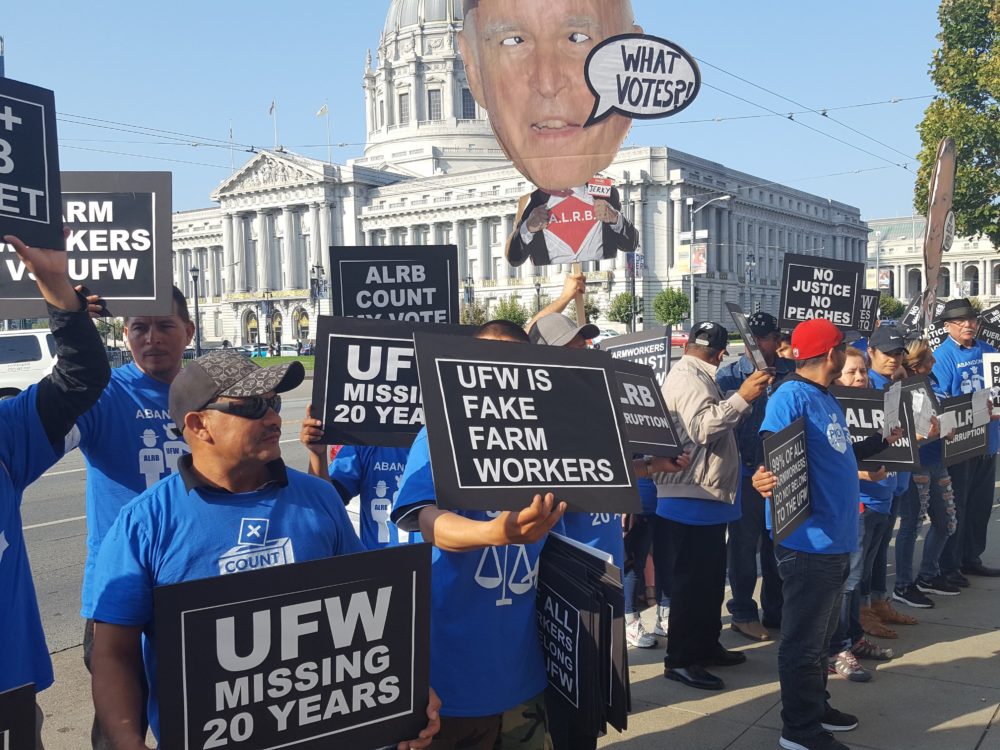
Jesse Rojas, spokesperson for Pick Justice, a farm worker rights group (not a union) organized a rally of farm workers last week at the California Supreme Court building in San Francisco to bring attention to the court hearing on the UFW’s effort to force unionization on farm workers at Gerawan Farming, Inc.—despite having abandoned the workers for nearly 20 years. Over 150 Gerawan workers traveled from the Central Valley to protest the UFW/ALRB team that is pushing for forced unionization of these farm workers via the justice system through Mandatory Mediation and Conciliation (MMC).

Jesse Rojas, spokesperson for Pick Justice (PickJustice.com)

Gerawan workers, dressed in blue Pick Justice t-shirts and armed with company ID cards and pay stubs to demonstrate authenticity, chanted at the UFW protesters who wore red UFW t-shirts. Rojas said the UFW individuals were apparently not Gerawan farm workers and were paid to be there. “All attending [in our group] are employees of Gerawan Farming,” he stated.

“I wish all 3,000 Gerawan workers could have come today like they’ve done in the past,” Rojas said. “But they actually have to work because they are real workers and they don’t get paid to come here. They miss days of work. A lot of them are going to get written up. They are going to get into trouble. They have had to find babysitters to take care of their kids; they are real workers.”

Rojas explained the focus of the demonstration is the need for these employees to choose their own future. “At this point, what is really important for them—not just them, but for all farm workers in the state—is simply to have the freedom to choosefreedom to vote.”

“Why would they have to be forced into a contract without reading it, without negotiating it, without approving it?” Rojas asked. “It’s not the American way. That’s not a democracy. The most fundamental civil right that all employees have is the right to vote if they want a union or not or if they want a contract or not.”

“But they are not getting those rights. Why not them? It is their right to vote and have their votes counted,” Rojas said.

If the Court imposes mandatory mediation, Rojas said the outcome “would affect about every farm worker in the state, almost 800,000 of them. The rights of the workers would be taken away.”

“The way mandatory mediation and conciliation works is the ALRB, the state government, has the right to write and impose a contract on employees without their approval,” Rojas explained. “In the Gerawan case, they will not have the right to strike or protest like they are doing today.”

“On top of that, this so-called contract will actually lower their take-home pay,” said Rojas, because mandatory UFW union dues totaling three percent of their paychecks would be imposed on the workers. If any of them refuse to pay the union as a condition of employment, they will be fired.

The justices of the California Supreme Court have until December 5th to make a ruling.

To see a video of Jesse Rojas speaking to California Ag Today, click here.


PickJustice.com celebrates freedom of choice for farm workers. As posted on their website:

We are concerned citizens who support the rights of workers to choose whether or not they want to have a union represent them. We are standing up for workers who are victimized by a politicized government agency.

Freedom of choice is a human right. People who are not educated are deprived of their freedom by those who are educated.

PickJustice.com exists to educate the public about the corrupt relationship between a once-noble union and the dishonest attorneys at the California Agricultural Labor Relations Board (ALRB). We want to help social change to show that, once a union has violated the trust of those it purports to represent, that union no longer votes for the workers.

As César Chávez himself said, “Once social change begins, it cannot be reversed. You cannot un-educate the person who has learned to read. You cannot humiliate the person who feels pride. You cannot oppress the people who are not afraid anymore.”

A generation ago, many farm workers were afraid of their employers. That isn’t the case anymore.

Thanks to organization against social injustice and a greater consciousness of producers and consumers alike, the plight of thousands of farm workers in America is over.

In César’s words more than three decades ago: “The very fact of our existence forces an entire industry – unionized and non-unionized – to spend millions of dollars year after year on improved wages, on improved working conditions, on benefits for workers.”


Who Safeguards California Farm Employees’ Rights? – Part 9  Court Allows UFW to Force Representation and Dues on Gerawan Employees


2019-12-25T15:48:07-08:00September 14th, 2017|

Farmers Appreciate Leafy Green Marketing Agreement

Leafy Green Marketing Agreement Raises Bar

By Jessica Theisman, Associate Editor

The Leafy Green Marketing Agreement took huge steps in the advancement of food safety.

Scott Horsfall, CEO of the California of the Leafy Green Marketing Agreement, said, “In 2007, there had never been government inspectors on the farm on a routine basis related to food safety.”

Many other regulators such as the Department of Public Health would often check in on businesses. However, there had never been a routine food safety oversight program on the farm.

Farmers joined this agreement voluntarily. “All of these companies that have joined, and been in the program since 2007, they do so voluntarily, and they pay the freight,” Horsfall said. This raises the bar for food safety and provides value to the industry.

Farmers, who were wary at first, came back to Horsfall saying, “They sleep better at night knowing that they’ve got this program in place, that the auditors are going to be there.”

The California Leafy Green Marketing Agreement continues to improve. Every year, the numbers are studied to see what areas have a continuing problem.

“We have used that to decide what to create in a training program. We hope that we’re helping the industry to better comply with these standards as we go along too, by offering the training,” Horsfall said.

For more information, visit the California Leafy Green Marketing Agreement web page.


2017-09-14T16:03:16-07:00September 14th, 2017|

Fresno State’s WET Center Home to BlueTechValley Entrepreneurs

BlueTechValley Series – Part 3

By Patrick Cavanaugh, Farm News Director

We’re continuing our series on California Ag Today regarding the BlueTechValley Initiative, which was established on the Fresno State campus in 2011, and part of an innovation cluster that provides access to commercialization services that will accelerate innovation and growth of water and energy-oriented companies in 39 counties from central to northern California.

We spoke to Helle Petersen, the manager of the Water, Energy and Technology Center – also known as the WET Center – at Fresno State, where BlueTechValley is centered.

“The WET Center is a physical building located on the Fresno State campus, and it has six offices for entrepreneurs that want to grow their water, energy or agricultural business and be around companies that share those same visions and the same business,” Peterson said. “The WET Center also has a testing lab to test different kind of water technologies.

“The WET Center is very unique. I haven’t really seen anything at any university that’s the same. It was built in 2007 as a partnership between Fresno State and what used to be the Central Valley Business Incubator, but now it has rolled in under the International Center for Water Technology, and it’s part of their program,” Peterson said.

Petersen said it is a very busy place. “As I mentioned, we have six offices, but we also have about 30 other company startups … [and] also more mature companies that are members of the center, and they really want to be part of the community, if you will, because there’s something synergetic about working with companies or maybe talking about some of the same problems you have when you work in the same industry.”

Peterson said the WET Center is expanding for those entrepreneurs that may be coming out of town.

“Actually what we’re doing is across the street … there’s another smaller building that we are actually incorporating into the WET Center, and we’re going to build an additional six offices there, plus a plug-and-play space,” she explained. “ Let’s say you have a tech company out of the Bay Area and you’ve kind of outgrown that space, because you’ve realized you need to be in the central San Joaquin Valley if you have anything to do with agriculture. So you can come down here for a few days a week or a month, and you have a workspace. You also will have a conference room that you can all use.”

This is part of an ongoing series on the BlueTechValley Innovation Cluster, which includes entrepreneurs at several California State Universities and the Sierra Small Business Development Center. It’s all about finding efficiencies in water and energy.


2021-05-12T11:05:15-07:00September 13th, 2017|
Go to Top