About California Ag Today

This author has not yet filled in any details.
So far California Ag Today has created 2014 blog entries.

Tony Francois Suggested Duarte Settle

Judge Refused to See New Evidence in John Duarte Trial, Forcing Him to Settle

By Patrick Cavanaugh Farm News Director

Duarte Nursery, its president John Duarte, and legal counsel, Pacific Legal Foundation, agreed to a settlement with the federal government over the Army Corps of Engineers’ nearly five-year enforcement action for Duarte’s routine plowing of his wheat field in late 2012, said PLF senior attorney Tony Francois, who represents Duarte, gratis.

PLF Attorney Tony Francois

Among the main reasons for Duarte’s settlement is the judge’s refusal to consider new evidence regarding the restored condition of the vernal pools on Duarte’s land, which were at the nucleus of the controversy.

“Vernal pools are wet six to eight weeks out of the year due to rainfall,” according to Francois. “They have a kind of hard pan underneath them, so the water stays in place for a bit.”

“On August, 15, the morning of the trial, we intended to provide the judge with current evidence of the good condition of the vernal pools to show there was no significant harm to the environment from plowing the property,” Francois said.

“However, the government persuaded the judge to exclude that evidence,” Francois explained. “The government claimed that vernal pool-specific vegetation would not recover from being plowed.”

“We also were prepared to show how any significant penalty would affect Duarte Nursery and its ability to maintain its workforce. The judge allowed some older evidence, but excluded the most current evidence, basically, of the company’s ability to pay,” he said.

“Both rulings were significant because the court was supposed to consider those two factors in imposing their penalty,” Francois explained. “The judge actually acknowledged that excluding evidence of the current condition of the vernal pools would make a material difference on how large a penalty would be imposed.”

“Nonetheless, the judge excluded evidence on the legal grounds that it would be unfair to the government because they had not asked for or taken any steps to update their own information,” Francois said.

Francois explained how easily they could have demonstrated the vernal pools were undamaged.

“First, the vernal pools themselves are all still there. Second, the government’s own evidence shows that all the vernal pools still exist,” he said. “Our experts went out there last year and this year and showed that, with normal rainfall, the vernal pools are doing fine. The vegetation is healthy and fairly abundant, with all the right types of plants present. Basically, our evidence showed there was no harm done to the vernal pool from plowing.”

“Now, some of the scars to the vernal pools from government’s excavation may still be there,” he continued. “That, I have not seen, myself. But, as far as the plowing, our evidence that it had not harmed the vernal pools, is what the court excluded.”

According to Francois, the government claimed that Duarte’s current evidence was unfair to them because they had not taken any opportunities to update their own experts’ view of the property or to request access for inspection. “The result of the ruling was to cut off consideration of how plowing affected the vernal pools to the time period when California was in the midst of a multi-year drought,” he said.

“We think there were a number of ways the government could have looked at the evidence, if it were admissible, and responded to it, including driving to the property and observing several of the vernal pools from the road. In fact, seeing the vernal pools from the roadside is what lead the Army Corps to claim the violation in the first place,” Francios noted.

Duarte did not get a permit, according to the Clean Water Act, to plow the land, but Francois explained, “That is not really the problem. The problem is, a farmer reads the Clean Water Act that says ‘normal farming practices’ do not require a permit. The farmer knows what normal farming practices are; I would think that everybody knows that plowing is a normal farming practice.”

“You read a little further, and the regulations actually say that plowing to produce a crop is never even a discharge under the Clean Water Act. Plowing, in a very wide general sense, is not even regulated by the Army Corps of Engineers. It’s not a question of the type of plowing or if plowing in this location requires a permit. The law speaks clearly and broadly and says that you do not need a permit.”

“Nevertheless, the U.S. Army Corps of Engineers, backed up by the Justice Department, has reinterpreted what plowing and normal farming practices are in a way that is very unclear as to when they will think you need a permit and when they will think you don’t. So, if they think you needed a permit, and it never occurred to you that you would need one, this is what can happen to you. We deposed several employees and even officials with the Army Corps of Engineers about their understanding of all this. They were pretty clear; there is no way for a farmer to know without asking the Army Corps in advance what a normal farming practice is.”

“The entire U.S. agricultural industry is up against this scenario right now. One of the interesting things about the Army Corps’ approach—‘Just come and ask us’—is what how their press release announced the settlement,” according to Francois. “Anybody who wants to is welcome to come and ask us and we’ll tell you what you have to do.”

“Here is how that works in practice,” Francois explained. “You can go and ask the Army Corps. They are going to say you need to prepare an expensive study on whether there are any navigable waters on your property, and then we’ll tell you whether we agree with it or not. Then, you have to tell us everything you’ve done in the past and everything you plan on doing, and we will tell you whether what you plan to do is normal.”

“They way they view it, ‘normal’ does not mean ‘something that farmers normally do.’ They reinterpret ‘normal’ to mean something done routinely done on this property. If you have not done the particular practice on this property routinely in the past, they think of the practice in terms of conversions, changes in use and zoning. Their view is if you are changing things, you probably need a permit if there is anything they consider navigable waters on the property,” he said.

“So, for example, this property was in the Conservation Reserve Program for a number of years under a prior owner. The Army Corps convinced the judge in this case that because it had not been plowed in several years, plowing was no longer normal on this property. How many farmers who have their land enrolled in the Conservation Reserve Program are aware that the Corps of Engineers is going to expect to get their permission to resume plowing it?”

The United States Department of Agriculture (USDA) Farm Service Agency (FSA) oversees the Conservation Reserve Program (CRP). According to the CRP website, “In exchange for a yearly rental payment, farmers enrolled in the program agree to remove environmentally sensitive land from agricultural production and plant species that will improve environmental health and quality. Contracts for land enrolled in CRP are 10-15 years in length. The long-term goal of the program is to re-establish valuable land cover to help improve water quality, prevent soil erosion, and reduce loss of wildlife habitat,” Francois said.

“Or, let’s say, you have been through a business reorganization, an estate process, or just for market reasons, your land has been fallow for a few years,” Francois said. “Perhaps you have not built something or put the land to grazing. After all those scenarios, the Corps of Engineers told us there is probably a permit required.”

Farmers may view these activities as normal farming practices that do not need a permit, only to learn at the end of this process, a permit was warranted.

Francois believes, “In essence, the Army Corps has taken a protection from permitting in the Clean Water Act and turned it into a permit application in which, randomly, they will tell you, ‘Thanks for filing this expensive and time-consuming permit application. You don’t need a permit.’ ”

“We are optimistic that even though these issues are not properly resolved in this case, we will continue litigating these issues until the courts clearly reinforce and enforce the clear protection for farming in the Clean Water Act. We believe that farmers, and really all citizens, all regulated parties, should be able to rely on the clear text of the law rather than be subject to all this after-the-fact rewriting, reinterpreting and explaining away that the Corps has done in cases like this.”
2017-09-11T22:03:28-07:00September 11th, 2017|

Dave Cogdill Will Be Remembered at Temperance Flat Dam

Dave Cogdill Remembered For His Water Priorities

By Jessica Theisman, Associate Editor

Dave Cogdill, a former state senator (2006 to December 2010) and the California State Senate Republican Leader from 2008-2009, has passed away at the age of 66. Cogdill was instrumental in getting Prop 1 through the state House and Senate and onto the ballot. Mario Santoyo, executive director of the San Joaquin Valley Water Infrastructure Authority, shared his thoughts on the late Dave Cogdill and his influence on California water.

The late Dave Cogdill

“Many thank Cogdill for the success that Temperance Flat Dam has been seeing,” Santoyo said. “He is the guy who made this happen, yet not enough credit has been given to him. Those of us who have been involved know what he contributed.”

“Senator Cogdill initiated some water bonds for water storage when he was in the Assembly. He wrote the water bond in 2009 and facilitated getting it across the table with both Republicans and Democrats. I can safely say Senator David Cogdill was a consistently strong proponent for water service storage and the one individual who had the most to do with the ability to have Temperance Flat built,” Santoyo said.

“Lots of folks could be characterized as being critically helpful; but if it wasn’t for Cogdill, nothing would have happened in terms of developing big water storage,” Santoyo said. “Many wish to memorialize him at Temperance Flat Dam, whether it is a plaque or some portion of it being called Cogdill, because he deserves it”.

OF NOTE:

Cogdill was awarded the Profile in Courage Award from the John F. Kennedy Library Foundation for his actions during the 2009 state budget fight for joining Governor Schwarzenegger in putting the people’s needs above party.

2017-09-11T16:11:56-07:00September 11th, 2017|

SGMA Workshop Features GSA Updates

SGMA Workshop Sept. 20

Clovis Veterans Memorial District

Join the Department of Water Resources (DWR) staff for an interactive workshop to discuss DWR Sustainable Groundwater Management Act (SGMA) implementation efforts and key components of Groundwater Sustainability Plan (GSP) development.

The workshop will feature groundwater sustainability agency (GSA) formation updates, assistance & engagement information; guidance, data, and tools overviews; interactive forums on Groundwater Sustainability Plan development; and information booths on the Proposition 1 Sustainable Groundwater Planning Grant Program (SGWP).

Don’t miss the opportunity to meet DWR’s SGMA Program and Region Office Staff! Information booths will open at 12:30 P.M.

The workshop will be held on September 20, 2017, from 1 PM to 5 PM at the Clovis Veterans Memorial District, 808 Fourth Street, Clovis, CA 93612.

Please RSVP for the workshop by clicking here.  Registration is not required but is appreciated to ensure suitable accommodations for all attendees. This workshop is free of charge and is open to all interested persons and the public.

2017-09-08T16:56:14-07:00September 8th, 2017|

PowWow Energy Thrives Part 2

BlueTech Valley Gives PowWow Energy a Boost

By Patrick Cavanaugh, Farm News Director

The BlueTech Valley Central Valley Regional Innovation Cluster represents an expansion and interconnection of multiple incubators and/or entrepreneurship programs with services located at each of seven designated BlueTechValley Cluster hubscollectively serving 39 counties, covering two-thirds of California’s geographic area.

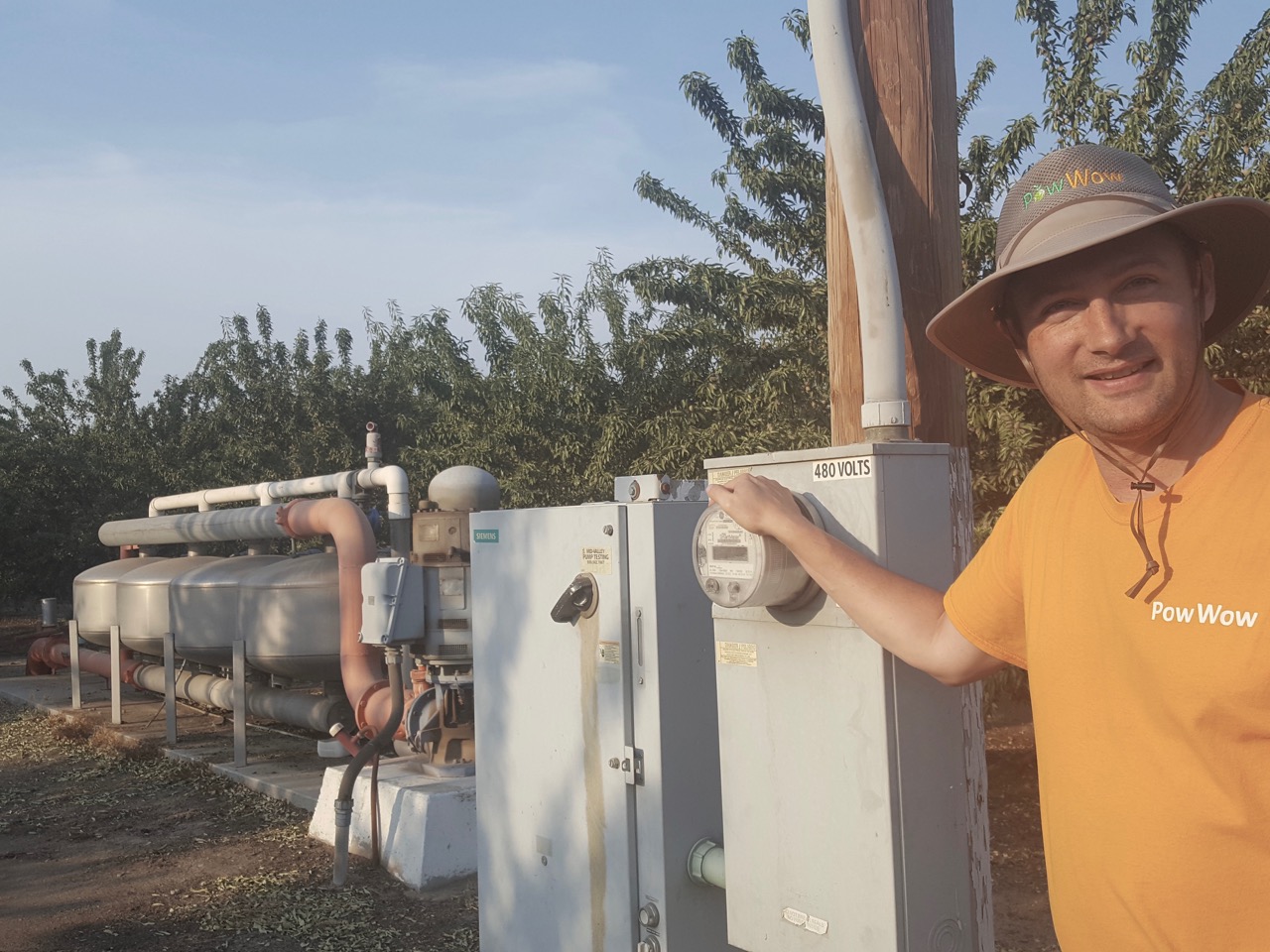
Olivier Jerphagnon with PowWow Energy is part of the community at Fresno State. “We connected with the BlueTechValley community through the water energy technology incubator,” he said. “We came here three years ago and found a great place where we could take the time to meet growers, listen to their needs. At the same time, we benefit from the fact that people trust Fresno State in the economic community,” said Jerphagnon.

A big part of PowWow Energy is pump monitoring. “Our motto is, ‘Answers to farmers. Not more data.‘ We take existing data and work with agencies on large data sets,” said Jerphagnon. “For example, we have access to all the PG&E and Southern California Edison metering information from the pumps. We have weather data for every acre of California. We have historical aero-images for every foot of farmland.”

“We crunch all the data, and we’re able to create a couple of beneficial products,” noted Jerphagnon. “The first one is a simple compliance product. If you have to report your water usage, you can do that without investing a lot in hardware, because that metering infrastructure is already there for the electrical industry, so why not reuse it?”

“The second product is to identify where there could be more productivity. If one field historically has had issues, we locate it and try to diagnose what’s wrong so the farmer can make adjustments to his operational practices,” Jerphagnon asked. “I think we can find the right answers,” he said.

For more information and testimonials from growers, go to PowWowEnergy.com.

2017-09-11T14:57:23-07:00September 7th, 2017|

Who Safeguards CA Farm Workers’ Rights? # 7 – CA Supreme Court

CA Supreme Court Hears Case of Gerawan Farming, Inc. vs. UFW/ ALRB


By Laurie Greene, Founding Editor


Gerawan Farm Workers Show Company IDs and Paystubs (Identification has been blurred out for privacy reasons.)

A significant labor hearing occurred at the California Supreme Court (Court) in San Francisco yesterday, the day after Labor Day, between the team of the United Farm Workers (UFW) and the California Agricultural Labor Relations Board (ALRB or Board) versus Fresno County-based Gerawan Farming, Inc. over self-determination. At stake is the right of farm workers to determine if they want to be represented by the union or not. Under scrutiny is the Mandatory Mediation and Conciliation (MMC) provision of the Agricultural Labor Relations Act that paves the road for the UFW to force unionization on all farm workers.


Anthony Raimondo, of Fresno-based Raimondo & Associates, lawyer for Gerawan farm worker spokesperson, Silvia Lopez

“Although Gerawan farm workers attempted to participate in this hearing, as well as other hearings, they were denied legal participation in the trial by the state of California and by the UFW,” according to Anthony Raimondo, of Fresno-based Raimondo & Associates and lawyer for Gerawan farm worker spokesperson, Silvia Lopez. Nevertheless, hundreds of Gerawan employees in blue t-shirts attended the proceedings and protested outside the courthouse, lending their voices, exercising their free speech and showing their legitimate Gerawan company ID cards and payroll stubs.


Dan Gerawan, who co-owns Gerawan Farming, Inc., with his brother Mike and father Ray, commented on the court hearing just after it ended. “It is frightening to see the deference that the Court gives to the ALRB. Everyone in our industry and all farm workers should be scared by the deference this Court gives to a Board that is clearly not interested in the employees’ best interests.” Describing his perceptions in the courtroom, Gerawan said, “It was Orwellian to hear the government attorneys argue that they are defending self-determination, when in fact, what they are doing is the exact opposite.”


“That said,” he continued, “I am encouraged by the questions I heard from the Court. They obviously are taking this very seriously, and I’m hopeful that they will side with our employees and us.”


Silvia Lopez, Gerawan farm worker spokesperson

Members of the UFW were also present at the Court in red t-shirts, though only one person claimed to be a Gerawan employee. Marc Grossman, spokesperson for the United Farm Workers of America and communications director of the Cesar Chavez Foundation, said that the Gerawan operation should be unionized because the UFW was elected in 1990 by Gerawan farm workers and certified in 1992 by the ALRB.


However, the UFW did not successfully reach a contract for the Gerawan farm workers, and therefore did not collect dues. Furthermore, the UFW abandoned the Gerawan farm workers for nearly 20 years.


Grossman said the Court discussed today the long-standing principle that a union is certified until it is decertified. Workers have a right to decertify the union but it has to be the workers—not the company. It is patently illegal for an employer to have anything to do with determining union representation by his or her employees.

Marc Grossman, spokesperson for the United Farm Workers of America


When asked to account for UFW abandonment of Gerawan farm workers, Grossman said, “Bogus issue! The UFW never abandoned the workers at Gerawan. It repeatedly attempted to negotiate with Gerawan. At every step, it was met with virulent resistance by the company. It became apparent that only a law that would allow neutral state mediators to be brought in to hammer out a union agreement when the grower refused to do so would be the only course, and we followed it.”


Grossman asked us to read the September 5 ‘News from UFW’ press release he provided, entitled, “Giant grower challenging law giving farm workers the union contracts they voted for already owes its workers $10 million under a state-imposed union contract.”  Here are excerpts:


What about Gerawan’s claim the union “abandoned” the workers for 20 years?

Even before the Mandatory Mediation statute was adopted in 2002, the ALRB and the courts consistently rejected employer claims that unions should not be deemed workers’ bargaining representatives if they allegedly “abandoned” them. It is long-established law that a union remains certified as bargaining representative until workers—and only workers—vote to decertify it. At the time of the law’s passage in 2002, Gerawan was one of the 243 companies where farm workers voted for the UFW but the companies never agreed to contracts. (See UFW-Gerawan chronology)

1995-2002: Gerawan workers and the UFW continued working to improve conditions while the ALRB stopped enforcing the farm labor law under Republican political appointees.

2002: The Mandatory Media law was enacted. The agricultural industry mounted a major constitutional challenge.

2006: The Third District Court of Appeals in Sacramento upheld the Mandatory Mediation law. The industry appealed to the state Supreme Court, which refused to take the case. The industry declined an appeal to the U.S. Supreme Court—and the law’s constitutionality was settled.

2012: The UFW sent a new negotiations request to Gerawan. At least 10 bargaining sessions failed to produce a union contract.

March 2013: The UFW requested mandatory mediation at Gerawan with the ALRB.


The above chronology vaguely refers to UFW involvement between 1995 and 2002 that remains unsubstantiated. UFW contact with Gerawan farm workers appears to have been reestablished in 2012.

Dan Gerawan, co-owner Gerawan Farming, Inc.

Dan Gerawan, co-owner Gerawan Farming, Inc.

The ALRB did supervise a sanctioned election for Gerawan farm workers to decertify the UFW on November 5, 2013; however, the ballots were collected, sealed and never counted.

When told that UFW representative Grossman said they never walked away, Gerawan asked, “If they didn’t abandon, then where were they for almost two decades? They did not phone us or send us a fax. They did not show up on our property. They did not inquire on behalf any of our employees. They did not file an unfair labor practice. They did nothing during that time. They abandoned our employees.”

Ron Barsamian, attorney for Gerawan Farming, Inc.


One of Gerawan’s attorneys, Ron Barsamian, managing shareholder of Fresno-based Barsamian & Moody, stated, “I’m very encouraged. I think the Justices’ questions indicated that they understood the issue we were raising. I think they certainly read the briefs. I think they understand the difficulty in how locked-in workers, such as the [Gerawan] ones behind us, can be under the way this law works: if you have an MMC contract, [the workers] never have an opportunity to decertify the union. Even the questions asked by the justices that we expected to be against us were great, and I certainly loved the answers that Mr. Schwartz gave.”

David Schwarz, attorney for Gerawan Farming, Inc.


Barsamian was referring to another Gerawan attorney, David Schwarz, from the law firm, Irell & Manella, who addressed the central issues of the case: “I think it was a full and fair hearing. I think the Court—all members—are deeply concerned about the unaccounted for two-decade [UFW] absence, an unaccountable power given to a mediator [ALRB], and uncheckable power given to the union [UFW] to compel one grower and one group of employees into this process. Ultimately, I think the justices were very much focused on and troubled by the inability of the [ALRB] agency to step in in a situation of gross abandonment where a contract is being imposed by that agency.”


The California Supreme Court typically releases it decisions and commentaries after 90 days.

Protesting are Gerawan farm workers (in blue) and UFW members (in red)

Protesting are Gerawan farm workers (in blue) and UFW members (in red)


Who Safeguards Farm Worker Rights? – Part 8

Pick Justice, Gerawan Farm Workers Protest Forced Unionization


2019-12-25T15:44:52-08:00September 6th, 2017|

LGMA: A Decade of Protection – Part 1

California Leafy Green Marketing Agreement Now 10 Years Old

By Jessica Theisman, Associate Editor

Scott Horsfall, CEO of California Leafy Green Marketing Agreemen

After a severe E.coli outbreak nearly a decade ago, California took steps in ensuring the safety of consumers through the creation of the California Leafy Green Marketing Agreement (LGMA). We met with Scott Horsfall, CEO of the California Leafy Green Marketing Agreement, which is managed by the CDFA, to talk about the topic.

“The Marketing Agreement was actually created February of 2007. The outbreak was in the fall of 2006 and then, for a few months, the industry worked with the government to figure out what to do, and they created this Marketing Agreement,” Horsfall said. “The Marketing Agreement was moving fast and in the right direction. The leaders of the industry came together or appointed to that initial board of directors. With the little staff, it was those people and their internal staffs who did all the heavy lifting.”

The outbreak was the driving force behind the creation of this Marketing Agreement.

“They saw the impact that the tragic outbreak had on businesses, consumers, and on individuals. The will was there on the part of the industry to do something quickly and I think they brought in the people who had the expertise,” Horsfall said. “The California Department of Food and Agriculture (CDFA) were there with the marketing agreement option. Also there was the Western Grower’s Association, Produce Marketing Association and United Fresh. They were all putting up their best people to figuring out a solution.”

2017-09-06T15:05:59-07:00September 6th, 2017|

Who Safeguards CA Farm Workers’ Rights? Part 5

Post-Labor Day, Forced Unionization Hearing at CA Supreme Court


By Laurie Greene, Founding Editor


Forced Unionization Hearing

On Tuesday, Sept. 5, one day after Labor Day, busloads of concerned farmers and farm workers will arrive at the Supreme Court of California in San Francisco to support Gerawan Farming and farm workers—and quite possibly 80,000 family farms in the state—against forced unionization in the first case on the Court’s agenda:  Gerawan Farming, Inc. v. Agricultural Labor Relations Board (United Farm Workers of America, Real Party in Interest) and Consolidated Case, S227243 (Kline, P. J., assigned justice pro tempore).


Gerawan Case History

Explaining the case history, David Schwarz, attorney for Gerawan Farming, Inc. from the Los Angeles-based law firm of Irell & Manella LLP, said, “This case began almost five years ago in mid-October of 2012. The United Farm Workers (UFW) sent a letter to Gerawan Farming demanding that the company resume bargaining over a collective bargaining agreement. The UFW had won an election at Gerawan in 1990 and was certified to represent the workers by the California Agricultural Labor Relations Board (ALRB) in 1992. After one preliminary negotiating session in early 1995, the union disappeared and wasn’t heard from by Gerawan for nearly 20 years.”


“The UFW resurfaced in late 2012 demanding negotiations,” Schwarz stated, “but after ten bargaining sessions, the union abandoned the bargaining table.” This scenario was similar to UFW’s behavior after having won several certification elections by California farm workers employed on separately-owned farms but was unable to obtain first contracts with many growers on behalf of these farm workers.


Farm Worker Rights under the Agricultural Labor Relations Act 

According to the ALRB website, all agricultural employees in California, whether or not they are represented by a labor organization (union), have certain rights under the Agricultural Labor Relations Act (ALRA or Act). The purpose of the Act is to ensure peace in the agricultural fields by guaranteeing justice for all agricultural workers and stability in labor relations. The ALRA became law in 1975.

The Act describes and protects the rights of agricultural employees to make their own decisions about whether or not they want a union to negotiate with their employer about their wages, hours, and other working conditions. Where the employees, through a secret ballot election, have selected a union to represent them, the Act requires that the employer bargain in good faith with the union concerning wages, hours, and other working conditions.

The Agricultural Labor Relations Board (ALRB) is the state agency established to enforce the Act.


Mandatory Mediation and Conciliation (MMC)

“At this juncture, UFW invoked a process known as “Mandatory Mediation and Conciliation (MMC), a euphemism for forced-contracting, passed by the legislature in 2002 at the behest of UFW,” Schwarz explained. “Through MMC, the State of California imposes a contract on the employer and its farm workers at the union’s request. In Gerawan’s case, the failure to reach a contract can be explained by the failure of the UFW to show up and attempt to negotiate; however, that failure to bargain—or for that matter, the union’s complete abandonment of the Gerawan farm workers—was deemed irrelevant in the eyes of the ALRB.”

Count our votes Farm workers' rights UFW Endorsement

“The ALRB argued that the union certification in 1992 means the UFW remains the perpetual representative of Gerawan workers now and forever,” said Schwarz, “and until such time as the workers vote the union out through a petitioned election process known as decertification.” The ALRB disregarded both UFW’s failure to represent Gerawan farm workers in any successful contract negotiation and the UFW’s failure to qualify to collect union dues from Gerawan farm workers. Most significantly, the ALRB disregarded the legally-sanctioned and ALRB-supervised election on November 5, 2013, in which Gerawan farm workers had the opportunity to vote to decertify the UFW or not—the ballots of which have never been counted and are believed to be stored in an unknown, unsecured location.


“Let’s be clear,” Schwarz explained, “at no point after this union was certified until this union invoked the MMC process, was there an allegation that Gerawan refused to show up or refused to negotiate the terms of the contract. So this is not a case about a grower refusing to show up at the bargaining table or a grower inserting that the abandonment forfeits the right of the union to bargain.”


“Rather, this is a case about whether or not the union’s abandonment means that it forfeits the right to compel the State of California to force a contracting process on the workers. And that’s the key difference: between duty to bargain, which is a continuous bargain, and the right, as the union claims, to impose a state-ordered contract.”


What is at Stake for Farm Workers?


Tal Cloud, president and co-founder of Fresno-based family-owned Paper Pulp & Film, Inc., a converter of printing and industrial papers, including raisin (drying) trays, is part of the team that organized the trip. Cloud said, “The UFW and the California ALRB are hoping the California Supreme Court will rule in their favor by forcing unionization on California farms and farm workers—the next flash point in the two-decade long battle between Gerawan Farming and the UFW.”


“People don’t understand that this is incrementalism,” Cloud said. “If the California Supreme Court rules against Gerawan, it literally puts every agricultural operation of any size in the state right in the “bulls-eye” for mandatory UFW unionization, and that is what is so concerning. And although people do not understand it, the laws are already all there; they just need to be formalized. So, yes, it is really scary.”


“The ALRB has power in these courts due to California legislators who have given the ALRB all these powers, but without checks or balances,” said Cloud. “So, you have an agency that basically plays god with people’s lives and there are no legitimate governmental organizations or courts looking at it, until now that [the forced unionization case] has come to the California Supreme Court.”


The upcoming California Supreme Court hearing follows the UFW’s appeal of a lower court ruling in favor of Gerawan on the same issue in 2015. “We are hoping that the Court goes by the law, and does not give [the ALRB and UFW] this kind of opportunity to really put all of our operations in California at risk for forced unionization and forced contracts,” Cloud said.


“The bus trip on Tuesday is to make a statement and not sit by silently. The hearing is at 9:00 A.M., and more than 300 people from the Valley are going. We are leaving at 3:30 AM, providing food for our passengers and protesting outside the Supreme Court. The UFW also will be rallying at the Supreme Court.


It remains uncertain if farm workers will be allowed inside the courtroom. Cloud said, “There has already been a lot of back and forth about not allowing any farm workers, or Silvia Lopez (the Gerawan farm worker spokesperson) into the courtroom. The attorneys are still fighting on that. But there will be a big protest, so to speak, outside.”


“There are public areas for us to be in, and we will be peaceful like all the other demonstrations that we have done,” Cloud said. “My hope is that everyone stays safe and we do not have extremists or rabble-rousers there who try to cause problems.”


Cloud said there is a glimmer of hope for the farming industry because the UFW lost to the lower courts. “But, you just don’t know. We are hoping these farmers, farm workers and protesters will bring attention to this issue,” he said.


Once the California Supreme Court hearing is completed, the court will have 90 days to make its ruling. “The reality is:  If agriculture does not get behind the effort against MMC now, and the California Supreme Court reverses the lower court’s decision, literally every farming organization in California could face unionization. And that is a scary thought,” said Cloud.


“Likewise, if the ruling goes against the UFW,” Cloud said, “I am sure the case will go to United States Supreme Court, which would certainly be a do-or-die point for agriculture.”


Who Safeguards CA Farm Workers’ Rights? Part 6 – Facts vs. PR


2019-12-25T15:36:31-08:00September 4th, 2017|

Real California Dairy Stories Told

California Milk Advisory Board Rolls Out New Social Media Series

By Aiden Glaspey, Editorial Intern

The California Milk Advisory Board, based in Tracy, recently released a new social media series called Real California Dairy Stories. California Ag Today spoke to Jennifer Giambroni, the director of communications with the California Milk Advisory Board, about the project.

“It’s a series of short, analyzed videos with our dairy families because when we talk to consumers, it’s really sharing the story, not just about the food, but about the families. So it’s all about returning to real. Real foods from real families, kissed by the California sun.”

Giambroni said the dairy food story is easy to tell.

“Obviously everyone loves dairy products. They love dairy foods. But we really want to get to know the farmers behind the seal. Why do you care if you buy that Real California Milk product? It’s because you’re supporting actual dairy families.”

“So Real California Dairy Stories goes into the field with our California Dairy Families, and just tells little ‘moment in time’ stories. We just launched this on our social media platforms. They’re all on our YouTube channel at Real California Milk,” Giambroni said.

And another place to view those unique videos is at the RealCaliforniaMilk.com website.

2017-09-02T23:11:57-07:00September 1st, 2017|

Cannabis Regulations Needed

Regulations Needed to Protect Consumers, Workers

By Jessica Theisman, Associate Editor

Brian Leahy, Director of the California Department of Pesticide Regulations

With Cannabis being voted in to be legalized in California, regulations will need to be made to keep consumers and workers safe. California Ag Today met with Brian Leahy, Director of Pesticide Regulation out of Sacramento, about Cannabis.

“It is very complicated, but at the end of the day, our job is to help the growers create a crop that is safe for the consumer, safe for the environment and safe for the worker,” Leahy said. “This will all be done in conjunction with all of the other state departments that are working on this. It is the goal for the Cannabis growers to be just like any grower.”

Research is being done with the current Cannabis industry. New health protective guidelines are in the making. One major concern about the Cannabis industry is the amount of pesticide residue. This means that there worker safety issues along with human consumption issues. The industry is already taking steps to resolve this problem.

“The federal government does not recognize it; it’s not a crop. The producers have to remember it’s not a crop, so their laws even on worker safety, overtime, are not the same as agriculture,” Leahy said.

2017-09-19T17:41:56-07:00August 31st, 2017|
Go to Top