Farmers Encouraged to Fill Out Ag Census

2017 Ag Census Under Way

By Jessica Theisman, Associate Editor

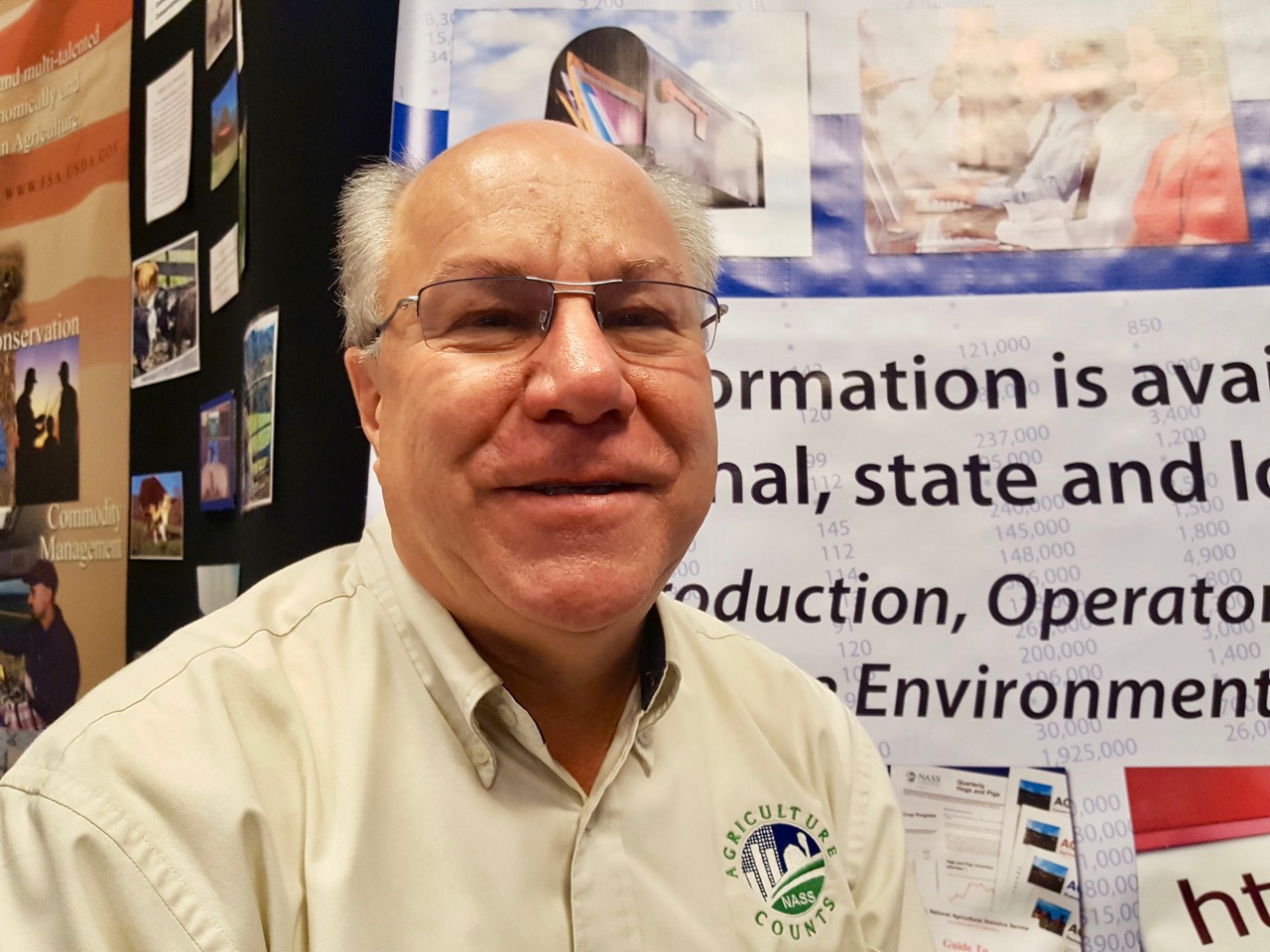
California Ag Today recently spoke with Scot Rumburg, the Nevada State Statistician for the USDA National Agricultural Statistics Service. He stressed the importance of the 2017 Ag Census, which has recently been mailed out to anyone who makes a $1,000 or more from any agricultural enterprise.

“USDA has mailed four million copies of the census that will cover what we suspect is about three million farms. We have an over coverage of about one million trying to find everybody, trying to turn over every rock,” Rumburg said.

The Ag Census is conducted once every five years. The census is based off of any ag commodity, from bees and honey to crops, fruit and nuts to livestock of any type. If you produce or have the potential to produce $1,000, the statistic service wants to hear from you. There are people out there planting permanent plantings that are not up and running yet, but they are still considered.

The census is one of the only ways that the USDA can collect data.

“We have to try and get agriculture across the entire U.S. We do a lot of surveys between the five-year census,” Rumburg explained. “This is the only census where we go out and find every agricultural operator in the U.S., and it provides numbers and data that we cannot get on a regular survey.”

“There are people that want many different kinds of data to provide a near complete picture of what is going on in agriculture at nearly every level. The census is all- encompassing,” he said.

Many of the paper censuses arriving to farmers will direct them to an online digital census, by using a code that is given with the census. Operators are encouraged to use the online version.

The 2017 Ag Census is a reflection on 2017; it is not a future forecast. The census asks age, ethnicity, veteran status and many other items that give more information on American farms and farmers.

All farmers and those related to farms, including beekeeping operations, are encouraged to complete the census.

“Money for conservation programs and many other areas to be distributed at the national level is based on this data. It’s important for every operation to get the funding at, a minimum, the state level. All information is private and will not be disclosed to anyone,” Rumburg said.

2021-05-12T11:05:14-07:00December 18th, 2017|

David Brassard on Understanding Hard Data In Crop Protection

Reliable Answers Needed In Benefit Assessments

By Patrick Cavanaugh, Farm News Director

David Brassard of Brassard Pesticide Regulatory Solutions has many years of experience working with the EPA. Based in Washington D.C., Brassard, along with his wife, Candy, now assist in getting new products registered for use with the EPA.

Brassard spoke with us about benefit assessment in regards to the EPA and pesticide regulation and how real data collection is a much stronger source of information.

“So there’s several ways of doing benefit assessment. For instance, back in the day, we used to have the National Agricultural Pesticide Impact Assessment Program (NAPIAP) getting farm advisers’ opinions and county extension agents’ opinions about what would happen if, say, we canceled chlorpyrifos,” Brassard said.

Brassard explained that when looking at benefit assessments alone, this testing could vary greatly from area to area. Compared to concrete data, benefit assessment can look unreliable in comparison.

“Frequently, you’d go to, say, Arizona. The guy from Arizona goes: ‘Oh, we get by without it just fine.’ Then right across the border in California, they’ll say ‘Oh, no. We can’t live without it. There’d be a 20% yield loss.’ There’s a lot of discrepancies in the kind of information that we would get,” Brassard said.

“When we actually dug into it, what we found was that if you actually relied on the hard data — the product performance data, the efficacy testing, what the yield difference is — you can get much more reliable answers,” he said.

These more reliable answers are important when producers are trying to maintain access to these products.

“There was a big movement in the ’90s, and I was at the forefront of it, of moving NAPIAP from the process of just asking expert opinions about what would happen to actually getting experts to pony up some data that would support their opinions,” he said.

2021-05-12T11:05:14-07:00December 13th, 2017|

Cover Crops Help Bees and Soil

Flowering Cover Crops Stimulates Bees

By Patrick Cavanaugh, Farm News Director

California Ag Today recently interviewed Billy Synk, director of pollination programs for Project Apis m and manager of the Seeds for Bees Project. The Project Apis m mission is to fund and direct research to enhance the health and vitality of honeybee colonies while improving crop production. He spoke on the benefits of cover crops for honeybee health.

“It’s an amazing project and an exciting project to work on and manage because it’s doing two good things at once. It’s a win-win situation. It’s helping out the soil and helping out bees,” Synk said.

When Synk speaks to growers, he mentions those two good reasons.

“Do it to help the bees that are in your orchard become stronger, and do a better job pollinating, but then also help your soil with organic matter and improved water infiltration.”

There are about two million beehives, coming to California from every corner of the United States, and the bees are very hungry.

“Not only are they very hungry, they’re the hungriest they have been all year, and their most important job is to pollinate almonds. Well, if you can have a cover crop blooming before those almonds bloom, you can stimulate them a lot better and create a positive feedback loop,” Synk said.

Synk explained that as more pollen comes into the hive, they rear more bees.

“That brood has a pheromone that tell the adult bees to leave the hive and go collect pollen. That stimulation is just going to make that hive excited and strong and ready to go the day that those almonds bloom,” he said.

Contact Project Apis m for more information and to possibly get cover crop seeds to plant this season.

https://www.projectapism.org/


2021-05-12T11:05:14-07:00December 12th, 2017|

Measuring Crop Protection Material Tolerances

Biological Tolerances May Be Needed

By Patrick Cavanaugh, Farm News Director

California Ag Today recently spoke with Gabrielle Ludwig, Director of Sustainability and Environmental Affairs for the Almond Board of California, about the issue of crop protection in almonds. Almonds are the number one specialty crop export. Almonds also remain the number one nut in global production and are California’s number two agricultural crop.

Ludwig explained that pesticides are used and necessary in today’s almond production. Pesticide residue is a concern for not only domestic production, but also for international distribution. And with biological products such as friendly fungi and bacteria, the biological industry noted that they are safe and free of residue tolerance.

“I would say for this industry, there’s a couple of things going on in parallel, and they don’t have exactly the same problems. So one is you have the sector where it is still a chemical that you’re applying, but it may not have very much toxicity or the residues are, for whatever reason, vanished,” Ludwig said.

“In the United States, we can get an exemption from a tolerance, where EPA has looked at and said there’s no health risk, and there’s no need to set a maximum residue limit. For those products then the question becomes: Do you have the same standards in other markets?” Ludwig asked.

“And again, one example is that the EU does have an exemption for tolerance process, but they don’t always have the same standards so EU is more likely to set a number than United States. And we have also seen examples where the United States is setting a number and the rest of the world says there’s no need to set a number because it’s a natural occurring compound.”

“So if you look at a pheromone, which falls into a natural occurring arena, there, you’re not even spraying the trees so it’s a totally different ball game,” Ludwig said.

“With biologicals, again, it’s a different ball game. You still need to have someone say, look at it, say it’s safe; because it’s going to be exempt from a tolerance.”

“But currently, there’s no testing for it,” Ludwig said. “With DNA technology, it probably wouldn’t be that hard to start testing for biological products’ lack of residue, especially ones that go on the produce that is eaten.”

“So again, what we’re saying here is, don’t rely on the fact you can’t be tested for it because we did that in the conventional pesticide arena and it’s caught up with us,” Ludwig said.

2021-05-12T11:05:14-07:00December 11th, 2017|

Breeding for Pierce’s Disease Resistance Has Sped Up

Traditional Breeding Helps Find Resistance to PD

By Patrick Cavanaugh, Farm News Director

The glassy-winged sharpshooter is a major vector of Pierce’s Disease, which kills grape vines. Pierce’s Disease devastated the grape industry in southern California and lead to the creation of the Pierce’s Disease/Glassy-Winged Sharpshooter Board (PD/GWSS Board). Government programs to fund research on glassy-winged sharpshooters and Pierce’s Disease invest nearly $20 million annually.

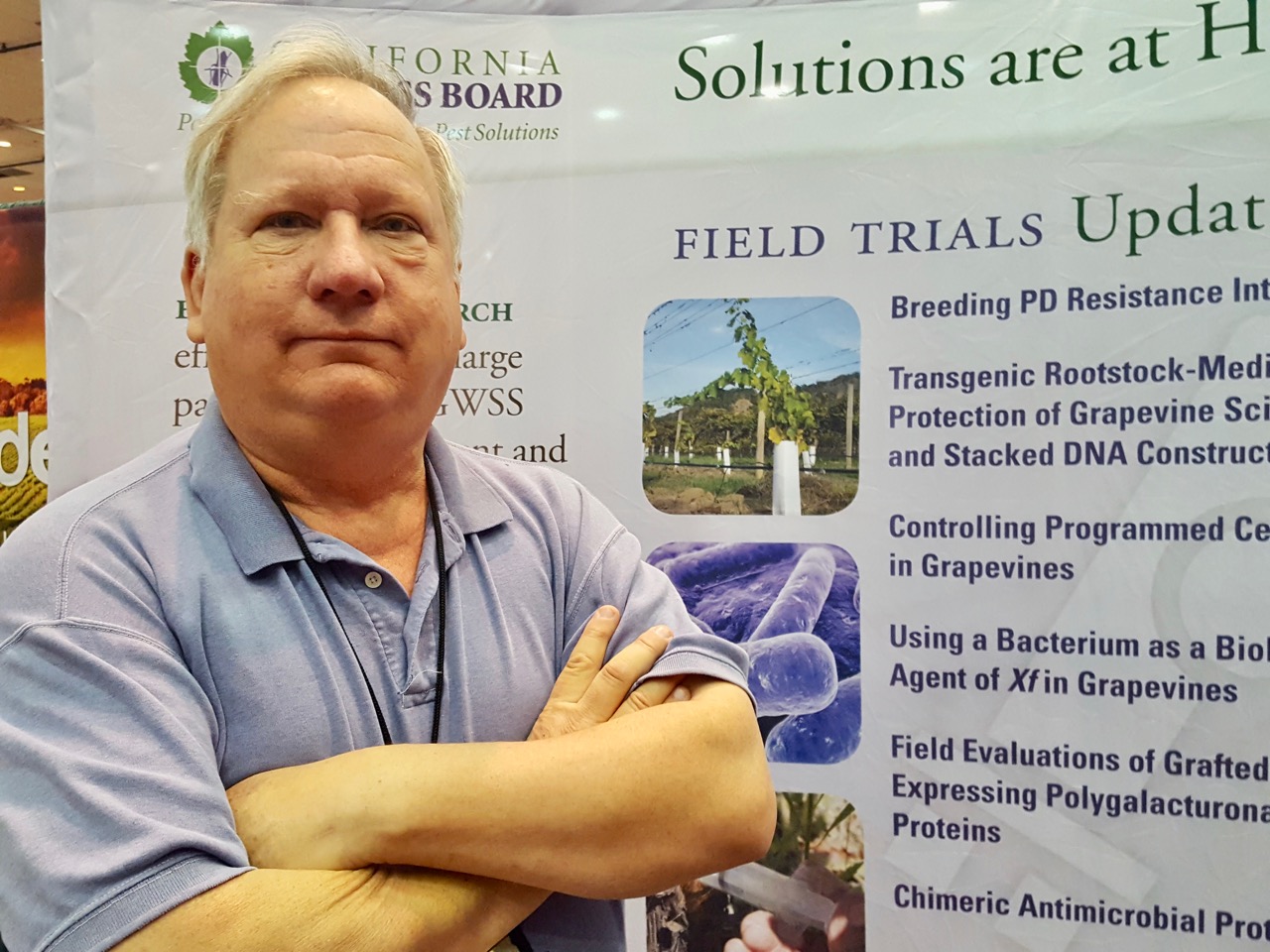
California Ag Today recently spoke with Ken Freeze, the outreach and education director for PD/GWSS. He told us about two major methods of control and prevention that the board is funding.

“There’s the area-wide control program, which does everything it possibly can to pretty much keep the glassy-winged sharpshooter confined to basically the southern part of the state,” Freeze said.

This control program prevents the further spread of Pierce’s Disease into other parts of the state, which could devastate wine growers. In addition to preventing the further spread of Pierce’s Disease, the board is also funding additional research into hopefully finding a cure.

“We’ve got UC Davis Genetics Professor Andy Walker working on Pierce’s Disease resistant grapevine before the program, and he just released some of those vines to the UC Davis Foundation Plants Services.”

Freeze said this development has been done through traditional breeding, with the assistance of some new technology.

Walker’s traditional breeding is sped up by a lot of high tech tools. Previously growers would crossbreed, however they’d have to infect the vine and see if it got Pierce’s Disease.

“That could take a year or two. Now they know the genetic markers, so when the plant has only two or three leaves on it, researchers pull a leaf, do a DNA track on it, and look for that marker,” Freeze explained.  “Depending on the marker, the vine either goes to the next step in breeding or it ends up in the trash heap. So that has just sped up that process incredibly.”

“Again, that’s all just using traditional breeding,” Freeze said.

2021-05-12T11:05:15-07:00December 4th, 2017|

Pierce’s Disease Research Advancing

Many Projects Under Way To Reduce Pierce’s Disease in Grapes

By Patrick Cavanaugh, Farm News Director

The glassy-winged sharpshooter vectors Pierce’s Disease, which has been devastating grape growers in California for the last few years. California Ag Today recently spoke with Ken Freeze, the Outreach and Education Director for the Pierce’s Disease/Glassy-Winged Sharpshooter Board, a program that uses winegrower’s assessments to fund research. He spoke with us about research that’s been carried out to hopefully find a cure for Pierce’s Disease.

Pierce’s Disease is caused by a bacterium, Xylella fastidiosa, that reduces the vascular function of the vine. The sharpshooter insect vectors the bacteria.

“Andy Walker, with the Department of Viticulture and Enology, UC Davis, has been working on Pierce’s Disease-resistant grapevines. We just released some of those vines to the Foundation Plant Services at UC Davis,” Freeze said. “There are 14 more that are in the wings about ready to go. Some nurseries will be able to get that pretty soon, but already there are about 4,000 of his vines planted. Some of them have been planted in Georgia and Texas, which are real hotspot for the glassy-winged sharpshooter and Pierce’s Disease.”

“Here in California, 2,000 vines were planted in Napa Valley right along the Napa River. Those vines are doing great,” Freeze said.

“We’ve got another project. University of Florida plant pathologist Dr. Don Hopkins has found a benign stain of Pierce’s Disease. It’s like inoculating a vine with a smallpox vaccination. That’s actually a company that’s working on commercializing that now,” Freeze explained.

“We’ve got another project that involves a modified root stalk that sends either a protein or a molecule up into the vine – a non-modified scion – five different ways that stops the Xylella fastidiosa bacteria literally in its tracks before it can cause Pierce’s Disease in the vine. That’s just a small sample of some of the really good projects.”

“One grower told me: ‘It’s not the end of the tunnel, but we can see it,’” Freeze said.

2021-05-12T11:05:15-07:00December 1st, 2017|

New Aerial Images to Help Almond Farmers

Aerial Image Tools Help Almond Irrigation

By Patrick Cavanaugh, Farm News Director

Aerial images of orchards can effectively tell farmers which almond trees aren’t getting enough water, according to the preliminary results of a five-year study by almond researchers at the University of California Cooperative Extension (UCCE), with funding support from the USDA.

Researchers from the UCCE are confirming the utility of Ceres Imaging’s new-to-the-industry aerial views of farmland that helped the startup win a water innovation competition last year. The preliminary results follow four years of replicated research plots in a large commercial almond orchard.

Why does almond irrigation matter? California only recently emerged from a major drought, and for almond growers, water efficiency is a top priority. Since 1990, California farmers have increased the use of sprinklers and micro-irrigation systems from 33 percent to 57 percent of total acreage. But micro-irrigation, the method that usually offers the highest water use efficiency (crop per drop) is prone to clogging and other maintenance problems, which can stress crops and reduce yield.

“Water is the number one input for most growers and is managed carefully in terms of how much is used and when,” said Ashwin Madgavkar, CEO and founder of Ceres Imaging. “This study shows that Ceres imagery can be used with high confidence to monitor if your crop is getting sufficient water or if the crop is in a water-stressed condition, so you can make timely corrective actions. Ultimately, the tool can be used to help catch issues before they result in crop losses.”

Maintaining ideal irrigation levels is a huge challenge for farmers, as is predicting the final harvest tonnage, which is why the study examined the usefulness of Ceres aerial images in those areas. Detecting deficient irrigation quickly is one way Ceres images offer early warnings to growers.

“Findings over the last four years show that the average Ceres conductance measurement from their imagery over the season has provided the best correlation with applied water,” reported Blake Sanden, UCCE Farm Advisor for Kern County. “While there’s no perfect predictor of final yield, Ceres aerial sensing of canopy plant stress has a significant relationship with final yield.”

This UCCE study has been under way since 2013 and will end after results for 2017 are recorded.

2021-05-12T11:05:15-07:00November 30th, 2017|

Facing Confusion About Food Choices?

Majority of Consumers are Confused About Food

By Patrick Cavanaugh, Farm News Director

A major survey of 1,000 Americans, from 8 to 80, found that consumers are confused about food. California Ag Today recently spoke with Tamika Sims the director of food technology communications for the International Food Information Council, based in Washington. She said consumers are indeed confused about food choices.

“While they trust a registered dietician, or healthcare professional, they often don’t rely on these people for their information. They rely on friends and family. They rely on social media. So, they often receive a lot of conflicting information about what foods they should eat, and or avoid,” Sims said.

“When we asked consumers if they agreed with the statement that they’re confused about the choices they make, we had almost 80% of consumers say that they were confused, and then we asked a question about whether or not they doubt the choices they make when they’re in the store, and over 50% said yes, they do doubt their choices,” Sims noted

Boomers are a bright spot on the survey as the more confident in the choices that they make when they’re making a food and beverage purchase or a choice in a restaurant.

Sims explained what the California ag industry can do to help consumers.

“It’s an interesting time right now, because in the age of social media, consumers to receive a lot of information from even more different places than before,” she said.

“It’s important to be part of the conversation and certainly organizations like IFIC take that to heart, and that’s what we do,” Sims said. “So, we’re part of the conversation in social media, traditional media, as well as outlets where you are looking at people who are the major buyers of food, such as moms, other parents, and then also our younger generations, millennials, and so on. We are part of the conversation in many different ways.”

2021-05-12T11:05:15-07:00November 9th, 2017|

Hundreds of Studies Point to Glyphosate Being Safe

Herbicide is Non-Toxic if Used Correctly, Expert Says

By Joanne Lui, Associate Editor

Glyphosate herbicide, produced under the well-known brand of Roundup, or any of its generic labels, has been studied around the world with absolutely no findings showing it to be toxic if used correctly. California Ag Today recently interviewed Liza Dunn, an emergency medical doctor, and also a medical toxicologist on the faculty of Washington University in St. Louis, about the herbicide. She’s been working with Monsanto for about a year.

Monsanto has done lots and lots of studies, and not only Monsanto, but there are six full data packages that review using very, very, very intensive laboratory and epidemiologic techniques to look and see if something is actually causing a problem,” Dunn said.

But according to media reports, glyphosate does cause big problems.

“We have never found any problem with any health claim with glyphosate, and this is both independent researchers and researchers who are based with industry, so when you look at the evidence objectively, there is no health claim that has ever been demonstrated with glyphosate. If you use it as directed, it is incredibly, virtually non-toxic,” Dunn explained.

According to Dunn, that’s been proven by more than 100 toxicology studies.

“There are different levels that you have to study when you’re bringing your product to market, so different things that you have to look at. We have produced multiple, multiple studies, way in excess of what regulatory agencies have required, in order to demonstrate the safety and virtual non-toxicity of our product,” Dunn said.


2021-05-12T11:05:15-07:00November 1st, 2017|

Humboldt State Looks for Entrepreneurs to Save Energy & Water

BlueTechValley’s Northern-Most Hub Seeks Innovation

By Patrick Cavanaugh, Farm News Director

Humboldt State University is among the northern-most hubs of the BlueTechValley Innovation Cluster. It’s part of the interconnection of multiple incubators, or entrepreneurship programs spanning the state serving 39 counties. The solid goal of the BlueTechValley initiative was established at Fresno State, and it’s all about managing water and energy resources in agriculture and other industries.

Lonny Grafman

Lonny Grafman teaches in the Environmental Resources and Engineering Department at Humboldt State, and he’s also the Humboldt State managing director of the BlueTechValley hub there.

“It’s a new program, so that’s pretty exciting,” Grafman said. “BlueTechValley has had a lot of success in Fresno, and what we are is their far northern Californian north coast arm. So, we’re seeking to have the type of success that they’ve had in Fresno,” Grafman said. “Specifically, we’re looking for entrepreneurs, inventors, businesses that are working on agriculture, energy and water efficiency projects.”

The university is looking for entrepreneurs and startups that can address saving water and energy.

“Any start up that has the chance of saving California electric rate payers’ money, we want to talk to them and see if we have resources that could help them to bring their product to market. That is that sweet spot that we’re trying to fill, “Grafman said.

BlueTechValley’s all about entrepreneurs, startups, computer hackers.

“It can be an energy project, it can be an agriculture project, it can be a water project, and it can be something at the nexus of all those things. We love those types of projects,” Grafman said. “As long as we can bring it back to how it saves California rate payers’ money, then we’re excited to explore all types of innovative ideas.


2021-05-12T11:05:15-07:00September 27th, 2017|
Go to Top