Almond Achievement Award Nominations Being Accepted

Deadline for Almond Achievement Award Nominations is Oct. 19

News Release

Since 2011, the Almond Achievement Award has honored an industry or allied-industry member who has added value to the California Almond industry through long-term service, contributions or innovations.

Nominations for the Almond Achievement Award are being accepted now. Winners must:

  • Be an individual with long-standing and direct involvement with the California Almond industry.
  • Demonstrate lasting impact on and commitment to the California Almond industry.
  • Have a record of proven service to the visibility and growth of the industry.
  • Contribute to California Almonds becoming a Crop of Choice and supporting California Almonds becoming the Nut of Choice.

Almond Board of California’s (ABC’s) Industry Services Sub-Committee will evaluate the candidates and make a recommendation to the Board of Directors. The 2017 recipient will be selected by ABC’s Board of Directors and recognized during the gala dinner at The Almond Conference by ABC President and CEO Richard Waycott.

The names of the award winners are placed on the wall of the Nonpareil Conference Room at the Almond Board of California office.

Nominating an almond industry professional for the 2017 Almond Achievement Award is easy. Simply email Jenny Nicolau (jnicolau@almondboard.com) and state your nominee’s name and company, as well as your reasons for the nomination. Applications must be received on or before October 19 for consideration.

2017-10-02T16:40:01-07:00October 2nd, 2017|

Chlorpyrifos Under More Scrutiny in California

California Regulators Pursuing Health Protections for Chlorpyrifos

News Release

The California Environmental Protection Agency (CalEPA) announced recently that both the California Department of Pesticide Regulations and the Office of Environmental Health Hazard Assessment are pursuing health protections on one of the most widely used agricultural pesticides in the nation, chlorpyrifos.

The Department of Pesticide Regulation (DPR) released an updated draft risk assessment for public comment. This action marks the start of a public and scientific review of the document, which could lead to increased restrictions on chlorpyrifos statewide. DPR is currently developing interim restrictions on use of the pesticide and recommendations will be made to county agricultural commissioners next month.

In addition, the Office of Environmental Health Hazard Assessment (OEHHA) is referring chlorpyrifos for potential listing as a developmental toxicant under Proposition 65. OEHHA recently posted an announcement that the state’s Developmental and Reproductive Toxicant Identification Committee will consider the listing of chlorpyrifos at its next public meeting.

 “While chlorpyrifos has been protecting crops for more than 50 years, new information in the scientific community leads us to believe the level of risk it poses is greater than previously known,” said CalEPA Secretary Matthew Rodriquez. “We need to better understand the science to ensure our actions protect public health. The actions we are taking today reflect our commitment to the health and safety of all Californians, and the environment.”

Department of Pesticide Regulation

DPR scientists believe chlorpyrifos may pose a public health risk as a toxic air contaminant based on its assessment of the latest studies in the scientific community. However, this new finding, indicated in the updated draft risk assessment has not been peer reviewed and must go through a public comment period and be independently evaluated by other scientists.

On September 15, DPR will hold a public workshop on the updated draft risk assessment at the Pesticide Registration and Evaluation Committee meeting in Sacramento.

After the 45-day written public comment period, which began August 18, DPR’s updated draft risk assessment will go before an independent panel of nine scientists known as the Scientific Review Panel (SRP). The thorough review process, which may ultimately lead to more restrictions on use, may conclude in December 2018.

Next month, DPR will provide county agricultural commissioners with specific interim recommendations, including:

  • Increasing distances between sites where the chemical is applied and sensitive locations, such as homes and schools. These would be specific to each type of application method.
  • New restrictions on methods used to apply chlorpyrifos.

Office of Environmental Health Hazard Assessment

OEHHA will soon open a written public comment period on scientific materials that describe the evidence for the developmental toxicity of chlorpyrifos.  OEHHA will provide the materials and the written public comments to the Developmental and Reproductive Toxicant Identification Committee. The committee is an independent panel of 10 scientific experts that determines whether chemicals are added to the Proposition 65 list as causing birth defects and other reproductive harm. The committee will also consider public comments presented at its November 29 meeting.

If the committee adds chlorpyrifos to the Proposition 65 list as a developmental toxicant, businesses that knowingly cause exposures above minimum levels must provide a Proposition 65 warning.

DPR’s updated draft risk assessment and other documents relating to chlorpyrifos are available at:http://www.cdpr.ca.gov/docs/whs/active_ingredient/chlorpyrifos.htm

OEHHA’s notice of the November 29 meeting of the Developmental and Reproductive Toxicant Identification Committee concerning chlorpyrifos is available at: www.oehha.ca.gov.

2021-05-12T11:05:16-07:00August 21st, 2017|

Drought Takes Big Toll on Sierra Nevada Mountains

New Aerial Survey Identifies More Than 100 Million Dead Trees in California

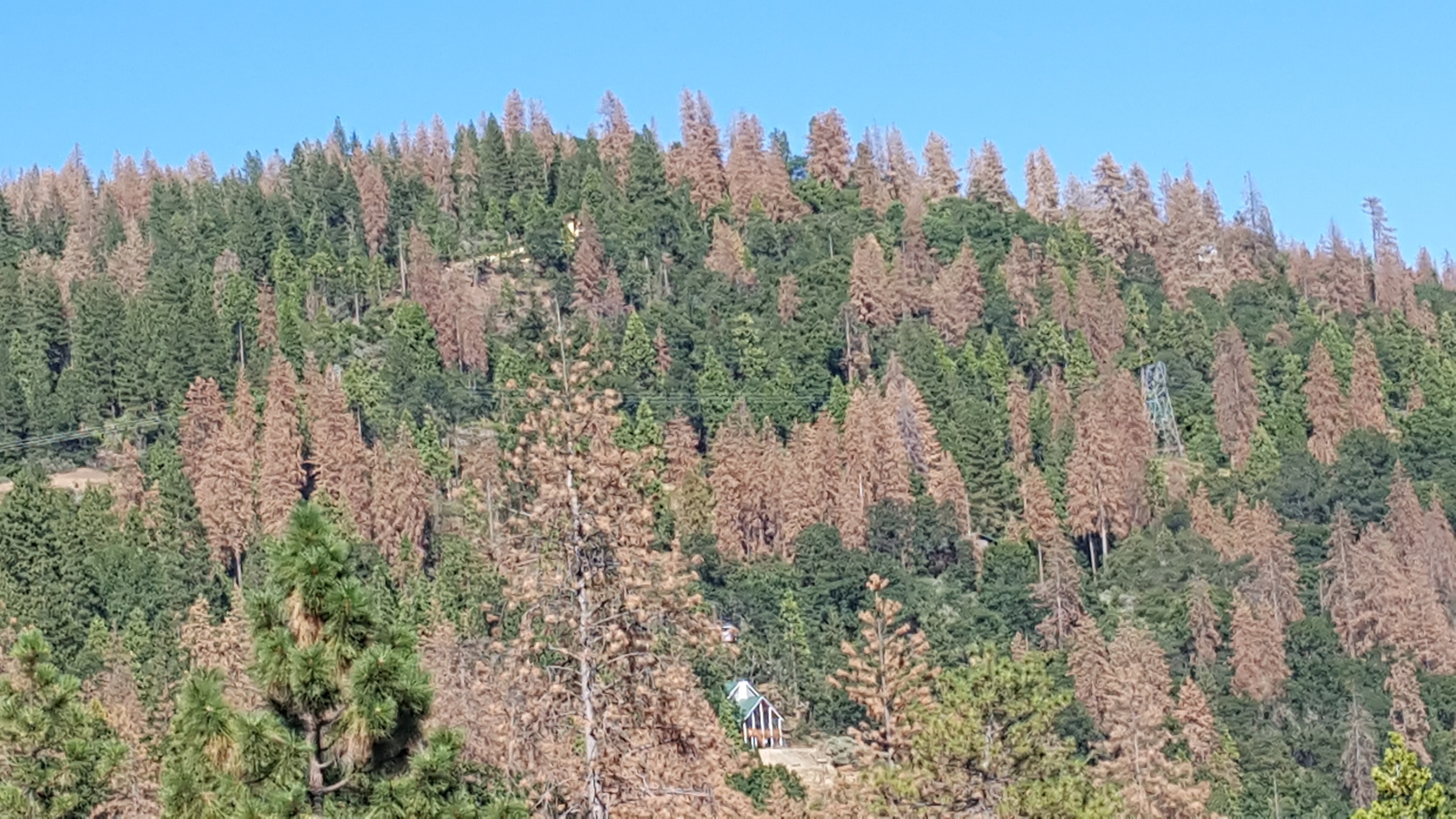
The U.S. Department of Agriculture (USDA) recently announced the U.S. Forest Service has identified an additional 36 million dead trees across California since its last aerial survey in May 2016. This brings the total number of dead trees since 2010 to over 102 million on 7.7 million acres of California’s drought-stricken forests. In 2016 alone, 62 million trees have died, representing more than a 100 percent increase in dead trees across the state from 2015. Millions of additional trees are weakened and expected to die in the coming months and years.

With public safety as its most pressing concern, the U.S. Forest Service has committed significant resources to help impacted forests, including reprioritizing $43 million in California in fiscal year 2016 to conduct safety-focused restoration along roads, trails and recreation sites. However, limited resources and a changing climate hamper the Forest Service’s ability to address tree mortality in California. USDA Secretary of Agriculture Tom Vilsack and Forest Service officials are seriously hampered not only by short-term budgets passed by Congress, but also a broken budget for the Forest Service that sees an increasing amount of resources going to firefighting while less is invested in restoration and forest health, Vilsack said.

“These dead and dying trees continue to elevate the risk of wildfire, complicate our efforts to respond safely and effectively to fires when they do occur, and pose a host of threats to life and property across California,” Vilsack said. “USDA has made restoration work and the removal of excess fuels a top priority, but until Congress passes a permanent fix to the fire budget, we can’t break this cycle of diverting funds away from restoration work to fight the immediate threat of the large unpredictable fires caused by the fuel buildups themselves.”


dead trees sierra nevada california drought

Bark Beetles have contributed to tree die-off in the Sierra Nevada forest due to the drought in California

The majority of the 102 million dead trees are located in ten counties in the southern and central Sierra Nevada region. The Forest Service also identified increasing mortality in the northern part of the state, including Siskiyou, Modoc, Plumas and Lassen counties.

Five consecutive years of severe drought in California, a dramatic rise in bark beetle infestation and warmer temperatures are leading to these historic levels of tree die-off. As a result, in October 2015, Governor Jerry Brown declared a state of emergency on the unprecedented tree die-off and formed a Tree Mortality Task Force to help mobilize additional resources for the safe removal of dead and dying trees.

This year, California had a record-setting wildfire season, with the Blue Cut fire alone scorching over 30,000 acres and triggering the evacuation of 80,000 people. In the southeastern United States, wildfires have burned more than 120,000 acres this fall. The southeast region of the Forest Service is operating at the highest preparedness level, PL 5, reflecting the high level of physical resources and funding devoted to the region. Extreme drought conditions persist, and many areas have not seen rain for as many as 95 days.

Longer, hotter fire seasons where extreme fire behavior has become the new norm,] – as well as increased development in forested areas – is dramatically driving up the cost of fighting fires and squeezing funding for the very efforts that would protect watersheds and restore forests to make them more resilient to fire. Last year, fire management alone consumed 56 percent of the Forest Service’s budget and is expected to rise to 67 percent in by 2025.

As the situation in the southeast demonstrates, the problem of shrinking budget capacity is felt across the U.S., not only in the western states. The health of our forests and landscapes are at risk across the nation, and the tree mortality crisis could be better addressed if not for the increasing percentage of the Forest Service budget going to fight wildfire. “We must fund wildfire suppression like other natural disasters in the country,” Vilsack said.

Forest Service scientists expect elevated levels of tree mortality to continue during 2017 in dense forest stands; stands impacted by root diseases or other stress agents; and in areas with higher levels of bark beetle activity. Photos and video of the surveys are available on the Forest Service multimedia webpage.

Learn more about tree mortality and the work to restore our forests in California at the Forest Service’s web page by clicking here.


U.S. Department of Agriculture (USDA)

U.S. Forest Service

2021-05-12T11:02:56-07:00November 22nd, 2016|

Fear-Based Messaging Reduces Produce Consumption – Both Organic and Conventional

New Study Finds Fear-Based Produce Safety Messaging Negatively Impacts Low Income Consumers’ Produce Consumption


New peer reviewed research, “Low-Income Shoppers and Fruit and Vegetables: What Do They Think?” published in Nutrition Today, shows fear-based messaging tactics used by activist groups and some organic marketers that invoke safety concerns about non-organic produce may be having a negative impact on produce consumption—fruits and veggies—among low income consumers, according to the Alliance for Food and Farming (AFF).Alliance for Food and Farming logo

Researchers at the Illinois Institute of Technology’s (IIT) Center for Nutrition Research surveyed low income consumers to learn more about what terms and information about fruits and vegetables may influence their shopping intentions. Among the key findings, misleading messaging which inaccurately describes certain fruits and vegetables as having “higher” pesticide residues results in low income shoppers reporting that they would be unlikely to purchase any fruits and vegetables – organically or non-organically grown.

illinois-institute-of-technology-institute-for-food-safety-and-health“We were surprised to see how informational content that named specific fruits and vegetables as having the highest pesticide residues increased the percentage of shoppers who said they would be unlikely to purchase any type of fruits and vegetables,” says Britt Burton-Freeman, associate professor of food science and nutrition, ITT’s Center for Nutrition Research. “The concern is that depending on the structure of the communication about pesticides and fruits and vegetables, this could turn people away from wanting to purchase any fresh produce.”

“Despite efforts by the health community, consumption of fruits and vegetables is stagnating,” says Elizabeth Pivonka, Ph.D, R.D. and president, Produce for Better Health Foundation. “This new study shows what we have been concerned about for some time, that safety fears may be another barrier to consumption of these healthy and nutritious foods. The impact of the fear-based messaging on low income consumers is especially troubling since many don’t have access or can’t afford non-Produce for Better Health, produce consumptionorganic produce.”

The findings are also concerning since the safety claims carried predominantly by groups like the Environmental Working Group (EWG) and Only Organic about pesticide residues have been repeatedly proven to be scientifically inaccurate. For the last 20 years, EWG annually releases a so-called “dirty dozen” list which urges consumers to eat only organic versions of popular produce items accompanied by misleading and unscientific claims regarding pesticide residue levels. A peer reviewed analysis of EWG’s list entitled, Dietary Exposure to Pesticide Residues from Commodities Alleged to Contain the Highest Contamination Levels and published by AFF showed that substitution of organic forms of produce for non-organic produce did not result in any decrease in risk because residue levels are so minute on these fruits and vegetables, if they are present at all.

“Their tactic clearly isn’t working and it’s actually backfiring since this research shows that consumers may react to their message by deciding not to buy any produce at all – organic or non-organic,” says Teresa Thorne of the AFF. “For the benefit of consumers, especially low income consumers, this study shows it is time for groups like EWG to rethink their strategy for promoting organics and move away from tactics intended to scare consumers from buying the more affordable and accessible produce items,” Thorne says.

john-hopkins-bloomberg-school-of-public-healthThis IIT research compliments the peer reviewed study by John Hopkins University’s Center for a Livable Future, They Just Say Organic Food Is Healthier”: Perceptions of Healthy Food among Supermarket Shoppers in Southwest Baltimore,” published in January 2015 [orig. Dec. 2014] in the journal, Culture, Agriculture, Food and Environment. Those researchers conducted interviews with study participants to learn more about the way organic food is understood within consumers’ definitions of healthy food. John Hopkins researchers also focused on low income consumers because “this group is particularly important demographically given the disparate burden of diet-related diseases they carry and the frequency of diet-related messages they receive.”

The study authors also found conflicting health and safety messages, including those about pesticide residues, were having a negative impact on consumers. Among their findings and recommendations: “The issue of organic can swamp or compete with other messages about nutrition, as evidenced by the data presented here. Perceiving that there is an overwhelming amount of sometimes contradictory information about healthy eating could make some consumers defeatist about trying to eat healthily. Given the potential implications of competing messages about healthy eating, it is important that those who want to improve food production techniques and those who want to improve nutrition cooperate to create consistent messaging about healthy eating.”

Dr. Burton-Freeman reached a similar conclusion. “Hearing that the majority of shoppers in this survey trust dietitians/nutritionists, scientists and physicians for health and safety information about fresh fruits and vegetables, this is an important opportunity for these professionals working in low-income populations. It is an opportunity to educate shoppers about organic and conventionally grown produce, particularly about best practices for washing, storing and preparing all fruits and vegetables to maximize their enjoyment and nutritional value and minimize their confusion and safety concerns.”

“Hopefully the peer-reviewed research from IIT and John Hopkins will have an impact on groups like EWG especially since the science clearly shows both organic and non-organic produce is very safe and can be eaten with confidence,” AFF’s Thorne says. “And, decades of nutritional research primarily conducted using non-organic produce shows that a plant rich diet leads to better health and a longer life. So choose either or both organic or non-organic produce, but choose to eat more every day.”


The Alliance for Food and Farming (AFF) is a non-profit organization formed in 1989 which represents organic and conventional farmers and farms of all sizes.  Alliance contributors are limited to farmers of fruits and vegetables, companies that sell, market or ship fruits and vegetables or organizations that represent produce farmers.  AFF’s mission is to deliver credible information to consumers about the safety of all fruits and vegetables.  AFF does not engage in lobbying nor does it accept any money or support from the pesticide industry.  In the interest of transparency, AFF’s entire 2011 tax return is posted on safefruitsandveggies.com.


See also:

Scared Fat: Are Consumers Being Scared Away from Healthy Foods?

Individuals May Consider Organic an Important Factor When Defining Healthy Food

University College of London: Eating 7 or More Servings Reduces Risk of Premature Death by 42%

2021-05-12T11:05:46-07:00October 3rd, 2016|

Agricultural Water Use Efficiency & State Water Efficiency and Enhancement Program

Agricultural Water Use Efficiency Grant Program


Through a competitive grant program, the Agricultural Water Use Efficiency & State Water Efficiency and Enhancement Program, the California Department of Water Resources (DWR) and the California Department of Food and Agriculture (CDFA) jointly intend to demonstrate the potential multiple benefits of conveyance enhancements combined with on-farm agricultural water use efficiency improvements and greenhouse gas reductions.

The grant funding provided in this joint program is intended to address multiple goals including:

  1. water use efficiency, conservation and reduction,
  2. greenhouse gas emission reductions,
  3. groundwater protection, and
  4. sustainability of agricultural operations and food production.

It is also anticipated that there will be benefits to water and air quality, groundwater security, surface water conservation, and improved nutrient management and crop health through this program. Excellent proposals will demonstrate the specific regional needs and benefits of their proposals.

Deadline for submitting public comments is September 30, 2016.

Agricultural Water Use Efficiency & State Water Efficiency and Enhancement Program – DWR/CDFA Joint RFP public-workshops

Agricultural Water Use Efficiency & State Water Efficiency and Enhancement Program – DWR/CDFA Joint RFP Public Workshops

The program will be administered as a competitive grant program and will include a joint application process involving agricultural water suppliers and agricultural operators within the service area.

Projects that enhance and upgrade the supplier’s water conveyance, delivery and water measurement system to allow on-demand and flexible farm-gate deliveries, reduce spills and losses, increase the efficiency, and improve water management. A water supplier’s proposed project must generate State benefits to be eligible for grant funding.

Benefits to the State include:

  • water savings
  • increased in-stream flow or improved flow timing
  • improved water quality; increased energy conservation
  • reduction of greenhouse gas (GHG) emissions
  • increased local water supply reliability.

The project must be located within California.
On-farm agricultural operations must achieve both GHG emission reductions and water savings to be eligible for funding. In addition, projects must: (i) use the associated improvements made to the surface water conveyance system proposed by the associated agricultural water supplier as part of the joint application, and (ii) eliminate on-farm groundwater pumping.

To be eligible for funding, projects are not required to be in an adopted Integrated Regional Water Management Plan or to comply with that program, but preference will be given for projects that are.

Save-our-waterThe following entities involved with water management are eligible to apply:  Public agencies, public utilities, federally recognized or state Indian tribes on California’s Tribal consultation list, nonprofit organizations, mutual water companies, and investor-owned utilities regulated by the California Public Utilities Commission.

Applicants that are agricultural water suppliers and/or urban water suppliers should inquire for further information.

DWR has set aside $3 million from Proposition 1 to incentivize the water conveyance component of this joint agricultural water use efficiency and enhancement program. Proposition 1 requires that agricultural water suppliers provide a 50% cost share of total project costs.

CDFA has also set aside $3 million from the Southwest Energy Efficiency Project (SWEEP) to incentivize the installation of irrigation systems that save water and reduce greenhouse gases on farms in the area that will directly benefit from the conveyance system incentivized by DWR. The maximum grant award per agricultural operation is $200,000 with a recommended, but not required, 50% match of the total project cost. CDFA reserves the right to offer an award different than the amount requested.

Separate contracts with each department will be necessary to receive both sets of funds. A joint proposal may include a request for up to $3 million for the water supplier’s conveyance upgrades (to be funded by DWR) and up to $3 million for enhancements of on-farm agricultural operations to be funded by CDFA (with a cap of $200,000 per operation). This would allow for 15 agricultural operations (at $200,000 each) to partner with the water supplier to submit the joint proposal at the maximum award amount of $6 million. More than 15 agricultural operations could be funded if amounts lower than the cap are requested in individual agricultural operator applications.


2021-05-12T11:05:47-07:00September 23rd, 2016|

Tulare County Ag is Down But Strong

Tulare County Annual Crop Report is Down But Still Strong


By Patrick Cavanaugh, Farm News Director


The numbers are in for the 2015 Tulare County Annual Crop and Livestock Report.  Marilyn Kinoshita, Agricultural Commissioner/Sealer of Tulare County, reported, “We had an overall value of $6.9 billion, compared to last year, which was more than $8 billion,” which means the County led the nation in total crop value and dairy production, despite a decrease of nearly 14% in one year.

Tulare County’s top ten crops [crop value] in 2015 were:

  1. Milk
  2. Cattle & Calves
  3. Oranges- Navels & Valencias
  4. Grapes
  5. Almonds Meats & Hulls
  6. Tangerines – Fresh
  7. Corn – Grain & Silage
  8. Silage – Small Grain
  9. Pistachio Nuts
  10. Walnuts

Kinoshita explained, “Dairy is our number one industry here. Our milk production was off a little bit. We have fewer dairies in business now because of the low milk prices. Anytime your fresh market milk is off, that’s going to affect our overall value. A good 2/3 of that billion-dollar decrease came from the dairy industry. The price was low the entire year, as opposed to the year before.”

Marilyn Kinoshita, agricultural commissioner, Tulare County

Marilyn Kinoshita, Tulare County Ag Commissioner


Thus far, the reported 2015 county crop reports in the Central Valley are down this year. “Fresno County, for instance, was down 6.5% off its record $7 billion in 2014,” Kinoshita said.


“It has a lot to do with low water deliveries in Fresno and Tulare Counties,” she continued. “The smaller the water deliveries, the more efficient those growers have to be with that water. Anytime you’re pumping water out of the ground, it’s terribly expensive,” she noted.


“Some of our growers have had to decide, ‘All right, I’ve got this much water; I’m going to keep those blocks alive and I’m going to push an older block that isn’t producing as well.’ The returns aren’t as good as some of the newer plantings,” said Kinoshita.


Despite all of that, Kinoshita said agriculture does sit at the head of the table in Tulare County. “Yes, and we need a successful Ag industry to thrive here,” she said.


To view a video of the interview, click HERE.


Tricia Stever Blattler, executive director of the Tulare County Farm Bureau, noted the crop report demonstrates the strength of the agricultural industry. “I think every year when this crop report comes out, it is always a testament to the resiliency of this industry. This industry takes hard knocks, gets knocked down, then steps right back up to the plate and keeps swinging,” Blattler said. “The agricultural sector has a lot of outside challenges that impact the number that we see reported every year.”


Tricia Stever Blattler

Tricia Stever Blattler, executive director , Tulare County Farm Bureau

Blattler acknowledged the crop value numbers do not reflect net revenue for growers. “It’s always really important for our listeners to know that the crop value is a gross revenue number. When our Ag Commissioner steps to the microphone and speaks to our Board of Supervisors about this report each year, she’s reflecting values that are attributed to all of the gross revenue, and it’s not only the field value,” Blattler said.


“That gross number reported each year also represents our packing houses, our milk processing facilities—the creameries, the butter plants—the packing shedsall those other parts of our industry that [create] value in our industry,” said Blattler.


Blattler noted up or down, it’s all about the resiliency of farmers. “The industry has its years that are really blockbuster and it has its years when it falls back and we see a reduction acreage. We see reductions in surface water deliveries. The drought is still certainly playing a significant role in the numbers we’re seeing,” she explained.


With regard to surface water, Tulare County is in a bit of a unique position. “As an Eastside county, some of our water deliveries are not as subject to the situation that the Westside is in. In the same sense, we have some significant cutbacks that have been attributed to the San Joaquin River’s restoration and the biological opinions in the Delta—all have had an impact on the Central San Joaquin Valley [water] deliveries regardless of whether you’re Eastside or Westside.


“Also, as the exchange contractors either take greater deliveries of water or give up water, that also impacts the amount available to Eastside growers here in Tulare County,” she said.


In summary, 2015 Tulare Crop Report covers more than 120 different commodities, 45 of which have a gross value in excess of $1 million. Although individual commodities may experience difficulties from year to year, Tulare County continues to produce high quality crops that provide food and fiber to more than 90 countries worldwide.


Featured photo: Tulare County 2015 Crop Report

2021-05-12T11:17:12-07:00August 31st, 2016|

BREAKING NEWS: Historic Monterey County Farmworker Safety Initiative

BREAKING NEWS

Ag Commissioner & Farmworker Advisory Committee Announce Historic Pesticide Initiative for Farmworker Safety


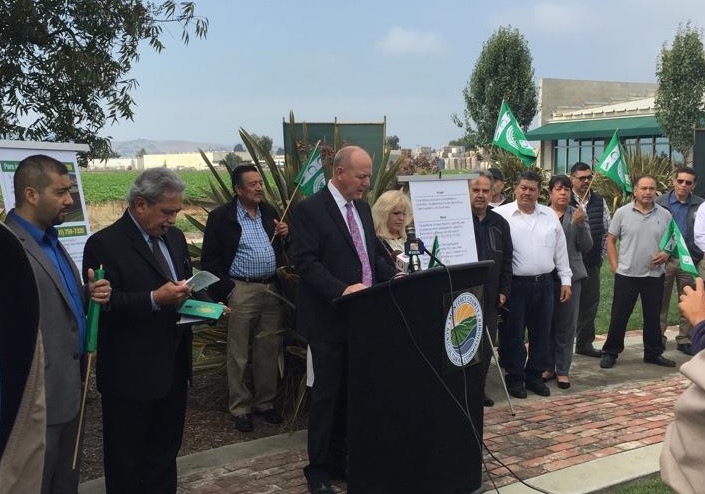
Monterey County Agricultural Commissioner, Eric Lauritzen and the Farmworker Advisory Committee, formed with the assistance of the Center for Community Advocacy (CCA), announced an historic initiative TODAY aimed at providing additional pesticide protections for farmworker safety. The initiative launches a pilot program with leading growers to enhance worker notification through warning signs when pesticides are used in the fields.


“California has the toughest farm pesticide restrictions in the nation, and Monterey County already imposes local rules that further protect farmworkers,” said Lauritzen at TODAY’s press conference. “But we are going to do even more to communicate our commitment to safety in the fields.”


“We are excited about this initiative that adds an additional element of protection for farmworkers by providing the time and date when it is safe to reenter the fields that require posting,” said Lauritzen. “Farmworkers are the backbone of Monterey County’s $4.8 billion Ag industry, and they are entitled to the highest standard of pesticide safety.”


Eric Lauritzen, Monterey County Ag Commissioner

Eric Lauritzen, Monterey County Ag Commissioner, speaking at Press Conference TODAY on Historic Farmworker Safety Initiative

Intended to protect farmworkers, the initiate “has created a relationship between our office, the regulators and the farm worker community,” said Lauritzen. “And it’s really building trust and confidence with our office and the regulatory program there to protect farmworkers,” noted Lauritzen.


Additionally, every farmworker in Monterey County (approximately 50,000) will receive a business-card-sized information card (in Spanish) advising them to call the Agricultural Commissioner’s Office if they suspect violations of safety rules. The cards also advise employers that it is illegal to retaliate against farmworkers who seek the help of the Agricultural Commissioner’s Office.


The information card reads:

If you have questions or complaints on pesticides, the Monterey County Agricultural Commissioner’s Office will help.

The card includes phone numbers and advises workers that state law also protects them against retaliation if they report a pesticide problem.


Currently, regulations for posting pesticide warning signs do not require information indicating the date or time when it is safe for farmworkers to re-enter the fields. The pilot program will include the addition of one sign that will be prominently marked with a red flag and include the date and time that the law allows workers to safely reenter the field. Only the grower or his/her officially designated representative may remove the signs, after first showing the crew leader proof that the re-entry restrictions have expired.


Osvaldo Cisneros, a lettuce worker and member of the Farmworker Advisory Committee, feels that the change is very important. “Some farmworkers have been showing up for work and have been told by their mayordomos (supervisors) to re-enter fields even though warning signs are still up,” said Cisneros. “They have to depend on the word of the mayordomos even though they have no way to verify what they are told. This change will allow farmworkers, themselves, to tell when it is safe to enter fields.”


The posting and information card initiatives were developed in cooperation with the Farmworker Advisory Committee, a group formed jointly by Lauritzen and the non-profit Center for Community Advocacy. “Many farmworkers are unaware of their right to a safe working environment,” said CCA Executive Director Juan Uranga. “That’s why it is important to provide farmworkers with the information they need to both protect themselves and also gain access to the agencies, like the Monterey County Agricultural Commissioner’s Office, that exist to protect them.”


A second member of the Farmworker Advisory Committee, Maria Elena Andrade, added: “It is important for our community to know that the Agricultural Commissioner’s Office exists to serve us, as well as the other parts of the agricultural industry. We are trying to create that message through the Farmworker Advisory Committee, even as we work with the Ag Commissioner and his staff to improve safety for farmworkers.”


Growers involved with the initiative include Sea Mist Farms, Tanimura & Antle, Bayview Farms, Scheid Vineyards and Costa Family Farms. Lauritzen recognized these leading growers for their, support, innovation and dedication in their effort to provide additional protections for farmworkers.


Lauritzen briefed officials at the state Department of Pesticide Regulation (DPR) on the pilot warning sign program and the information card campaign. DPR Director Brian Leahy praised the Monterey County initiative. “We all know that farmworkers are the most vulnerable population in terms of potential exposure to pesticides,” said Leahy. “When we protect farmworkers more effectively, we also enhance protection for the environment and the community at large. This initiative represents an important step forward for farmworker safety, and it underscores California’s leadership in environmental protection.”


Historic Note:

The accord reached two years ago between the Office of the Monterey County Agricultural Commissioner, the agency that oversees pesticide regulations and other worker safety matters, and the Center for Community Advocacy (CCA), a farmworker advocacy group, established the Farmworker Advisory Committee for the Office of the Agricultural Commissioner of Monterey County—the first of its kind in the State Of California.


2021-05-12T11:05:48-07:00August 29th, 2016|

Nisei Farmers League and African American Farmers of Calif in Sacramento TODAY to Oppose AB 1066

Nisei Farmers League and African American Farmers of California Discuss Disastrous AB 1066 in Sacramento Today


EDITOR’S NOTE: SEE TEDX TALK VIDEO BELOW OF WILL SCOTT, JR., PRESIDENT OF AFRICAN AMERICAN FARMERS OF CALIFORNIA.


TODAY, Manuel Cunha Jr., president of the Nisei Farmers League and Will Scott, Jr., president of the African American Farmers of California are meeting in Sacramento with members of the California Assembly to explain the disastrous consequences of AB 1066, referred to as Agricultural workers: wages, hours, and working conditions, on small and minority farmers.

African American Farmers of California logo


The effects of this legislation, particularly the Phase-In Overtime for Agricultural Workers Act of 2016,  will be detrimental not only to the farmworker who counts on the extra hours, but to the farmer who, with the increasing costs of regulations and the lack of water, will be forced to cut back on crops and their workforce, according to their joint press release.


Manuel Cunha, Jr.

Manuel Cunha, Jr., president, Nisei Farmers League

“The small and minority farmer will be adversely affected by this ill-conceived legislation,” said Manuel Cunha Jr. “The small farmer works hand in hand with their workforce in the fields and [is] in a better position —with direct input from the workers—to determine schedules rather than politicians in Sacramento looking for a soundbite,” he explained. “Without meeting with our small and minority farmers and farmworkers, these politicians pass legislation that will cost our workforce money, our farmers crops, and the residents of California the fresh fruits and vegetables they enjoy everyday.”


Both Manuel Cunha Jr. and Will Scott believe the Legislators need to consider the small and minority farmers when casting their votes. “We are confident that after we meet with the Assembly members,” said Will Scott, Jr., they will understand how harmful this legislation is to our farmers and farmworkers. It is our hope that by educating the members, they will understand the importance of this bill and vote No on AB 1066.”


Nisei Farmers League

The League continues to inform grower members about ever changing regulations and policies providing legal assistance for labor and workplace related issues. Our leadership and staff maintains a close working relationship with local, state and federal agencies and legislators to assure grower interests are adequately understood and defended.

The NFL also collaborates with other grower and agricultural organizations in both California and other states to help provide a powerful, unified voice for the agricultural commNisei Farmers League logounity.

Grower members are kept informed through meetings, seminars, newsletters and special bulletins.

Strength, clear focus and growers looking out for growers and farm workers… that is what the Nisei Farmers League is all about.

African American Farmers of California


The Fresno-based African American Farmers of California organization has doubled its membership since it opened a 16-acre demonstration farm in Fresno County, which serves as a testing area where new farmers can get hands-on experience growing a variety of produce.

View Will Scott, Jr. present a TEDx Fruitvale Talk (Uploaded on Oct 20, 2011) Here.


One of Scott Family Farms primary goals is to reintroduce Southern specialty crops, part of the traditional African American diet, into black communities, to help stop the obesity and diabetes epidemics. Crops include: black-eyed peas, crowder peas, purple hull peas, field peas, collard greens, turnip greens, mustard, corn, tomatoes, okra and sweet potatoes.

2016-08-29T10:27:40-07:00August 29th, 2016|

American Pecan Council Begins with Nominations

NOMINATIONS TO THE AMERICAN PECAN COUNCIL TO BEGIN SOON

UPDATE:  September 1, 2016. The U.S. Department of Agriculture’s (USDA) Agricultural Marketing Service (AMS) is seeking nominations of 15 growers and shellers (handlers) to serve on the American Pecan Council.  Members of the council will be appointed by the Secretary of Agriculture to administer the federal marketing order with oversight by AMS.

Nomination forms are available on online at https://www.ams.usda.gov/rules-regulations/moa/986-pecans or by contacting AMS at (863) 324-3375.

Completed nomination forms must be received by AMS no later than Sept. 6, 2016.

Forms may be submitted by mail to USDA, AMS, Marketing Order and Agreement Division, 1124 First Street South, Winter Haven, Fla. 33880 or email Jennie.Varela@ams.usda.gov.


The Final Rule for the Federal Marketing Order for Pecans was published in the Federal Register on Thursday, August 4, 2016. Posted by the , the historic event culminated a three year grassroots effort of pecan stakeholders who collaborated with USDA to write and support the order that is now federal law. This action initiates the process of nominating, selecting, and seating of the administrative body of the FMO, the American Pecan Council. A likely schedule over the next few weeks is as follows:

Week of August 8

  • OMB approves Nomination Forms
  • Call for Nomination Press Release; nomination forms mailed to Shellers and Growers, electronic versions available to download

Week of August 22

  • Deadline for Nominations to be returned to USDA

Week of August 29

  • USDA to mail ballots to growers and shellers to vote on Nominees

Week of September 19

  • Deadline for Ballots to be returned to USDA
  • Deadline for background statements (Nominator should seek to gather this document from the Nominees as soon as someone agrees to be nominated.) Only those with completed background statements can be sent forward on the selection order to the Secretary.

Month of October

  • Selection Press Release for the new Council
  • Conference call with USDA Staff and new Council Members (1/2 day) for FMO Orientation
  • Council meets in person

UPDATES WILL BE POSTED TO THE APB WEBSITE AS THEY BECOME AVAILABLE

FAQ about the Nomination Process:

  1. HPecan Cluster Royalty Farmsow will Nomination Forms be made available? Upon approval by OMB, official forms will be posted on the USDA website, mailed to growers and shellers on current USDA lists, and posted on the American Pecan Board website.
  2. Who can nominate? Any grower within a region can nominate another grower within the same region. Any sheller within a region can nominate another sheller within the same region.
  3. Who is a grower? A person who has produced an average of 50,000 lbs. of inshell pecans over the last four years or who has 30 pecan acres. All production or acreage must be within the 15 state production area (domestically produced).
  4. Who is a sheller? A person (entity) who has shelled at least one million lbs. of domestically produced inshell pecans in the prior fiscal year.
  5. What determines a large grower and small grower? A large grower is defined as having pecan acres equal to or more than 176 acres, and a small grower has less than 176 acres.
  6. What determines a large sheller and a small sheller? A large sheller is defined as having handled 12.5 million lbs. or more of domestically produced inshell pecans in the prior fiscal year, and a small sheller is defined as having handled less than 12.5 million lbs. of domestically produced inshell pecans in the prior fiscal year.
  7. Can a large grower nominate a small grower and can a small grower nominate a large grower for the appropriate seat? Yes
  8. Can a large grower second the nomination of a small grower, and can a small grower second the nomination of a large grower? Yes
  9. Can a large sheller nominate a small sheller and can a small sheller nominate a large sheller for the appropriate seat? Yes
  10. Can a large sheller second the nomination of a small sheller, and can a small sheTree Shaker Royalty Farmsller second the nomination of a large sheller? Yes
  11. If a grower grows pecans in more than one region, in which region can he/she be nominated? In the region in which he/she grows the largest volume of their production.
  12. If a sheller handles pecans in more than one region, in which region can he/she be nominated? In the region in which he/she handled the largest volume of domestically produced inshell pecans within the preceding fiscal year.
  13. Can a vertically integrated pecan operation (grows and shells) be nominated as a grower and a sheller? No, a decision must be made by the person (entity) being nominated whether to be nominated as a grower or a sheller.
  14. Who nominates the candidates for the accumulator and public member seats? Once the 15 member Council is seated, they nominate candidates for the accumulator and public member seats.

(Source: )

2016-09-01T17:31:06-07:00August 12th, 2016|
Go to Top