Crop Protection

Walnut Blight Protection is Important

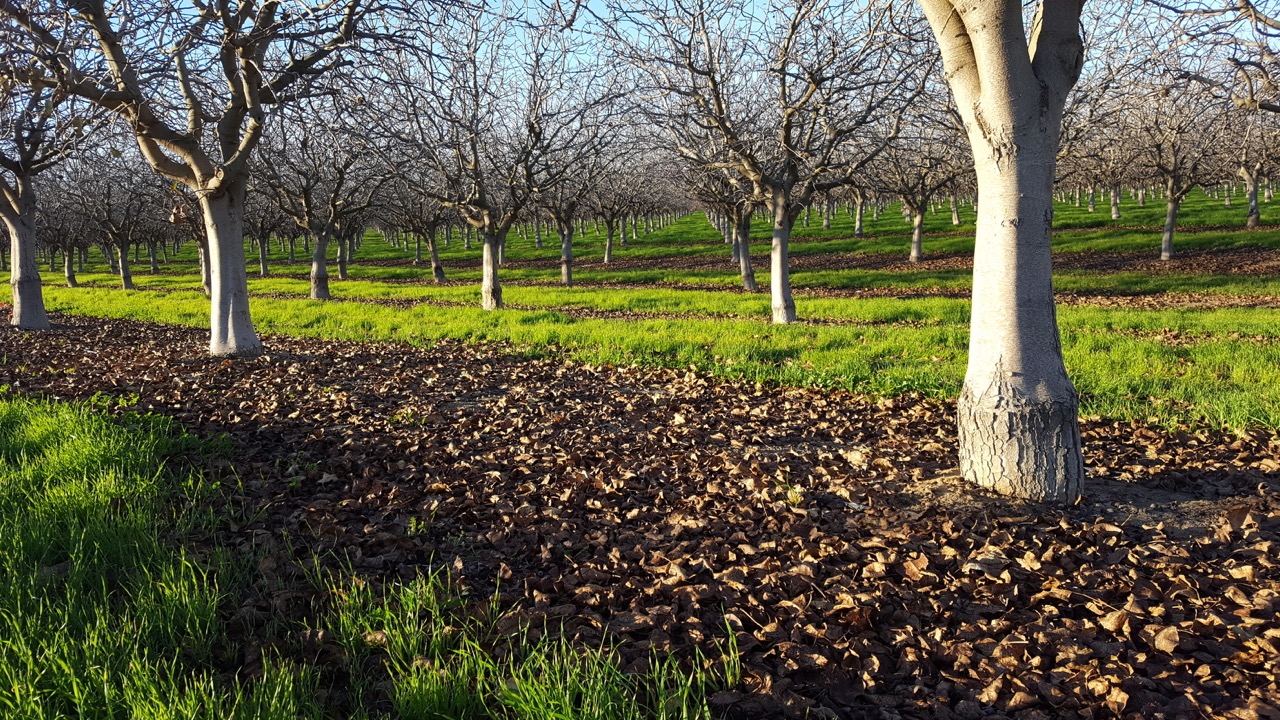
Disease Prevention in Walnut Orchards

By Brianne Boyett, Associate Editor

California Ag Today recently spoke with Jim Adaskaveg, professor of plant pathology at UC Riverside. He’s a plant pathologist, microbiologist and epidemiologist. He discussed the importance of protecting walnut trees from walnut blight.

Adaskaveg explained how walnut blight is problematic due to the higher rainfall in the northern part of the state.

“We’ve been working on this for a number of years, and overall, the northern part of the state is always higher at risk because of the higher rainfall in Glenn County,” he said. “There is much higher risk for disease in Northern California, so a lot of the growers have planted later blooming varieties such as Chandler to avoid the blight infections.”

“Rick Buchner [at UC Cooperative Extension] Tehama County and his group called that the prayer stage, which is when the female flower becomes exposed as it emerges from the bud. Those two timings would be for high disease pressure. If you had a history of the disease and you know that the disease is in your orchard, then we would suggest that timing,” Adaskaveg said.

“If you don’t have disease, and you still want to protect yourself, we say just spray at the pistillate flower emergence or the prayer stage. That sets a good way to initiate the spray program,” Adaskaveg explained.

Growers must keep in mind canopy expansion when applying materials.

“Walnuts are big trees, and as they go through bloom, all the leaves started emerging almost weekly. The tree canopy in that first three weeks of the season is doubling in size. By the time you get three or four weeks after that, the catkin flowering trees in full canopy will require a reapplication of materials,” Adaskaveg said.
2021-05-12T11:01:57-07:00December 29th, 2017|

Higher Caution Will Be Required when Spraying Near Schools

New Regs on Pesticide Spraying Near Schools Begin Jan. 1

By Brianne Boyett, Associate Editor

Starting Jan. 1, new regulations will prohibit pesticide spraying near schools and licensed child day-care facilities within a quarter mile Monday through Friday between the hours of 6:00 AM and 6:00 PM.

In addition, most dust and powder pesticide applications, such as sulfur, will also be prohibited during this time.

California Ag Today spoke with Milton O’Haire, Ag Commissioner for Stanislaus County, about these new regulations.

“With these new regulations and even with our permit conditions, growers have been restricted as far as spraying around schools,” O’Haire said. “It’s making it harder for growers to actually practice agriculture because their windows for applying crop protection has shrunk even more.”

Milton O’Haire

“Previously, a grower could actually start spraying at 5:00 p.m. if school’s out already, or if the school was on a half-day, an operator could start spraying in the afternoon. These new regulation will prohibit that,” O’Haire said.

“The new regulations are slightly different than what we’ve had in place for a number of years. Since 2010, we’ve had permit conditions on all of our restricted materials permits, which are more acute or toxic materials where there was already a one-quarter mile restriction around schools. And during that time, we really haven’t had any violations or any incidents, so the growers have been following that very well,” O’Haire explained.

The new regulations target all crop protection materials, both restricted or not.

Growers will have to be more diligent about their pesticide applications and continue to monitor the spray operation to prevent drift.

“They have to be on top of the pests so they catch them very quickly, because if you have a pest infestation where before you might have been able to go out and start spraying the next day, you may not be able to do that,” O’Haire said.

“If you’re near a K-12 school, and it’s Monday for instance, now you’re going to have to wait for a window to open or come in at nighttime to actually spray,” he explained. “It is going to affect those growers that have crops near schools, and we have more than 200 growers that are going to be affected in our county.”

Previous drafts of these new regulations required parents to be notified anytime a grower would be spraying pesticides near K-12 schools or licensed daycare centers.

“There was a modification of that. What has changed in the draft regulations: now the grower must notify the school annually with a list of what would be applied during the year,” O’Haire said.

If a material is to be used that was not on the list, then the school must be notified 48 hours before application. The material must be added to the list at the school as well as notifying the Ag Commissioner.

2021-05-12T11:01:57-07:00December 27th, 2017|

Orchard Sanitation is Critical This Season

Orchard Sanitation to Push Back on NOW Underscored

By Mike Stevens, Associate Editor

We are completing our coverage of the importance of orchard sanitation to push back on Navel Orangeworm (NOW) pressure for 2018.

We recently spoke with David Haviland, UC Cooperative Extension entomologist and farm advisor for Kern County. He spoke about how sanitation is the most important practice that needs to be implemented.

David Haviland on Pyrethroid Review

David Haviland

“Yes, 2017 was a really interesting year on NOW. It was a bad year overall. Several things led up to that. The first one was sanitation was an issue,” Haviland explained. “There is not much of an excuse in the southern half of the almond industry, but with all the rain up north and the flooded orchards, yes, it was very difficult to get in and do sanitation, and we know that that is the absolute backbone of navel orange worm programs.”

Pistachios were also a concern when it comes to NOW.

NOW was right on schedule in pistachios. The pistachio crop was a little behind and so it was common to do a normal monitoring, normal spray program, and set up for a normal harvest. But then the crops sat out there for another 10 days or two weeks, which, of course, makes it very vulnerable to NOW worm damage.

“The longer you get away from your insecticide sprays, the more damage that’s going to occur, and a lot of the crop was harvested after the fourth flight occurred,” Haviland said. “When you put in the concerns with sanitation this year, and with the increased degree day accumulation, there were plenty of moths and then the crop got delayed. The overall effect was that this was a worse than normal year.”

At the same time, the industry is full of examples of growers that had very acceptable damage.

“Growers that did follow in greater pest management practices … did get their sanitation done. They documented that those things are really important, they are very effective, and the growers that weren’t able to get that sanitation done hopefully got a case study, personal experience in the value of sanitation,” Haviland said.

Every grower needs to do their part by incorporating sanitation, noted Haviland. “Obviously, if you’re the only one sanitizing amidst a bunch of growers that aren’t, that’s a concern,” he said.

2021-05-12T11:01:57-07:00December 19th, 2017|

David Brassard on Understanding Hard Data In Crop Protection

Reliable Answers Needed In Benefit Assessments

By Patrick Cavanaugh, Farm News Director

David Brassard of Brassard Pesticide Regulatory Solutions has many years of experience working with the EPA. Based in Washington D.C., Brassard, along with his wife, Candy, now assist in getting new products registered for use with the EPA.

Brassard spoke with us about benefit assessment in regards to the EPA and pesticide regulation and how real data collection is a much stronger source of information.

“So there’s several ways of doing benefit assessment. For instance, back in the day, we used to have the National Agricultural Pesticide Impact Assessment Program (NAPIAP) getting farm advisers’ opinions and county extension agents’ opinions about what would happen if, say, we canceled chlorpyrifos,” Brassard said.

Brassard explained that when looking at benefit assessments alone, this testing could vary greatly from area to area. Compared to concrete data, benefit assessment can look unreliable in comparison.

“Frequently, you’d go to, say, Arizona. The guy from Arizona goes: ‘Oh, we get by without it just fine.’ Then right across the border in California, they’ll say ‘Oh, no. We can’t live without it. There’d be a 20% yield loss.’ There’s a lot of discrepancies in the kind of information that we would get,” Brassard said.

“When we actually dug into it, what we found was that if you actually relied on the hard data — the product performance data, the efficacy testing, what the yield difference is — you can get much more reliable answers,” he said.

These more reliable answers are important when producers are trying to maintain access to these products.

“There was a big movement in the ’90s, and I was at the forefront of it, of moving NAPIAP from the process of just asking expert opinions about what would happen to actually getting experts to pony up some data that would support their opinions,” he said.

2021-05-12T11:05:14-07:00December 13th, 2017|

Measuring Crop Protection Material Tolerances

Biological Tolerances May Be Needed

By Patrick Cavanaugh, Farm News Director

California Ag Today recently spoke with Gabrielle Ludwig, Director of Sustainability and Environmental Affairs for the Almond Board of California, about the issue of crop protection in almonds. Almonds are the number one specialty crop export. Almonds also remain the number one nut in global production and are California’s number two agricultural crop.

Ludwig explained that pesticides are used and necessary in today’s almond production. Pesticide residue is a concern for not only domestic production, but also for international distribution. And with biological products such as friendly fungi and bacteria, the biological industry noted that they are safe and free of residue tolerance.

“I would say for this industry, there’s a couple of things going on in parallel, and they don’t have exactly the same problems. So one is you have the sector where it is still a chemical that you’re applying, but it may not have very much toxicity or the residues are, for whatever reason, vanished,” Ludwig said.

“In the United States, we can get an exemption from a tolerance, where EPA has looked at and said there’s no health risk, and there’s no need to set a maximum residue limit. For those products then the question becomes: Do you have the same standards in other markets?” Ludwig asked.

“And again, one example is that the EU does have an exemption for tolerance process, but they don’t always have the same standards so EU is more likely to set a number than United States. And we have also seen examples where the United States is setting a number and the rest of the world says there’s no need to set a number because it’s a natural occurring compound.”

“So if you look at a pheromone, which falls into a natural occurring arena, there, you’re not even spraying the trees so it’s a totally different ball game,” Ludwig said.

“With biologicals, again, it’s a different ball game. You still need to have someone say, look at it, say it’s safe; because it’s going to be exempt from a tolerance.”

“But currently, there’s no testing for it,” Ludwig said. “With DNA technology, it probably wouldn’t be that hard to start testing for biological products’ lack of residue, especially ones that go on the produce that is eaten.”

“So again, what we’re saying here is, don’t rely on the fact you can’t be tested for it because we did that in the conventional pesticide arena and it’s caught up with us,” Ludwig said.

2021-05-12T11:05:14-07:00December 11th, 2017|

Making Comments with Data Carries Weight in Crop Protection

Make Comments When Needed

By Patrick Cavanaugh Farm News Director

Dave Brassard of Brassard Pesticide Regulatory Solutions, based in Washington D.C., regularly assists with getting new products registered with the EPA. California Ag Today spoke with him about making comments regarding the registration status of crop protection products.

“We’re pesticide consultants, and we basically assist registrants into getting everything registered, and getting through a lot of the data requirements, data waiver processes, that they need to go through,” he explained.

Brassard and his wife have a combined total of 73 years experience working in the EPA’s office of pesticide programs.

“The importance of data collection in pesticide regulatory reform, and the need for real data collection to be used in growers defense. Especially when growers reach out for support, the data is the most important, and the most reliable, form of evidence to present to the EPA,” he said.

“What typically happens is we will keep track and count the number of comments. But a lot of comments are very generic, and are not supported by data,” Brassard said

Simply having a large number of comments is not enough; it’s the quality content that really matters.

“So a lot of times it just becomes a little blurb that we had 10,000 comments from stakeholders worried about a concern, but what really, I think, makes a big difference, is if it’s somebody sends in data that can change EPA’s opinion on something,” Brassard explained.

“Let’s say that the EPA is going to regulate a chemical that is the only chemical to control, say, an obscure pest that we didn’t even consider in our original analysis. Somebody sends in that studies, and boy that stops the presses! It’s, ‘Let’s review this,’ ” Brassard said. “Does this change our opinion on anything? Can we make an exception for this particular use-pattern? Is there a different kind of risk-mitigation that we can impose?”

“Sending in real data are comments that make a real difference,” he said


2017-12-08T16:09:09-08:00December 8th, 2017|

Cannabis Growers Not Following Regs

Cannabis Growers Must Adhere to Crop Protection Regulations

By Patrick Cavanaugh, Farm News Director

There’s a whole lot of trouble going on for California cannabis growers. They need crop protection products for pests – such as mites, aphids, thrips, and mealybugs – and diseases, including powdery mildew, alternaria and pythium.

Now legally grown in the state, cannabis meets the definition of an agriculture crop and must adhere to all agricultural regulations and best management practices. This includes all Pest Control Advisor-written recommendations. As few products are approved for application on cannabis in the state, as well as nationwide, a PCA can now be cited for recommending a product that has not been officially registered and approved for a use on cannabis, specifically. With legal cannabis production going mainstream in California, PCAs face this risky predicament regularly.

“I discussed this point with Department of Pesticide Regulation (DPR) Director Brian Leahy this past week,” said Rachel Kubiak, DPR Pesticide Programs Division, Cannabis Program Supervisor. “I think we are at a point now where it’s important that we make policy decisions so PCAs know, as stakeholders, what our expectations are. PCAs deserve for us to do that, so we are working internally right now to try to get a lot of answers to these questions.”

Cannabis growers will have to buy products from licensed agricultural dealers.

“I understand, in talking to different folks, that many companies are not comfortable with the liability of attaining DPR registration approval for cannabis application and are therefore advising not to sell product to cannabis growers,” Kubiak said. “I completely understand that.”

“Going forward as a department, the concern, I think, is to bring as many farmers into the legal crop protection market as possible,” Kubiak said. “They are going to go exactly where they have been buying the products from, right? And if PCAs do not sell to them, but the cannabis growers must buy from them, these growers will have to purchase their crop protection products online, from Home Depot, or anyplace else. I can almost guarantee you that 95% or probably more of the cannabis farmers I’ve talked to over the last couple of months have no idea what we are talking about regarding applying registered materials to registered crops.”

“They have no idea that you cannot buy product anyplace and apply it as a pesticide,” she explained. “They do not know how to store it. So we have a lot of work to do in a very short period of time to bring these people into compliance and understanding.”

The scenario is even dicier for California County Agricultural Commissioners. These commissioners are required to enforce regulations on cannabis, as they are for any other commodity.

“We are working with the county ag commissioners to figure out how we need to proceed with and advise on this,” Kubiack said.

“I will tell you, usually as a department,” Kubiak explained, “we are inundated by the environmental justice community. Yet, they have been completely absent to this point on this particular commodity. So it’s almost bizarre and unusual not to be hit continuously from the left. But understandably, again, we’re now getting into these forums in which the Ag community has a voice and an interest,” Kubiak said.

“I’ve heard from both sides,” she continued. “I have heard from different Ag groups and PCAs who have said, ‘You know, we see a need for this—by a whole industry of people,’” she said.

And that whole industry, the cannabis growers of California, is crossing the regulatory line in crop protection. It has been reported that cannabis growers are creating a lot of environmental damage as well as worker safety concerns. Cannabis is grown primarily indoors, and according to Kubiak, “People are using pesticides without any concept of what they’re doing. Normally we would recommend that they talk to a professional, but that puts licensed PCAs in a hard spot because they cannot write a recommendation for a product that is not legally approved for use on that product.”

Kubiak said DPR is trying to bring as many of cannabis growers into the light as possible, “so that we have some regulation. Again, clearly this has been going on for a really long time, but at least now we are trying to go into areas in which we have some regulation but where people are not necessarily informed. So we bring crop protection management more into the light than ever before,” she said.

Is the DPR at a big turning point in working with county Ag commissioners?

“In the absence of putting up a product list,” Kubiak asked, “what is quasi-legal and what is not quasi-legal? We are trying to come up with solutions to some of these dilemmas.”

“There are counties that want the flexibility. Boards of supervisors and their counties are economically dependent upon this newly emerging industry that’s been in the North Coast for decades. They want the ability to use discretion. Nevertheless, Ag commissioners in other counties clearly are not comfortable with that whatsoever,” Kubiak said.

2021-05-12T11:01:57-07:00December 5th, 2017|

Pierce’s Disease Research Advancing

Many Projects Under Way To Reduce Pierce’s Disease in Grapes

By Patrick Cavanaugh, Farm News Director

The glassy-winged sharpshooter vectors Pierce’s Disease, which has been devastating grape growers in California for the last few years. California Ag Today recently spoke with Ken Freeze, the Outreach and Education Director for the Pierce’s Disease/Glassy-Winged Sharpshooter Board, a program that uses winegrower’s assessments to fund research. He spoke with us about research that’s been carried out to hopefully find a cure for Pierce’s Disease.

Pierce’s Disease is caused by a bacterium, Xylella fastidiosa, that reduces the vascular function of the vine. The sharpshooter insect vectors the bacteria.

“Andy Walker, with the Department of Viticulture and Enology, UC Davis, has been working on Pierce’s Disease-resistant grapevines. We just released some of those vines to the Foundation Plant Services at UC Davis,” Freeze said. “There are 14 more that are in the wings about ready to go. Some nurseries will be able to get that pretty soon, but already there are about 4,000 of his vines planted. Some of them have been planted in Georgia and Texas, which are real hotspot for the glassy-winged sharpshooter and Pierce’s Disease.”

“Here in California, 2,000 vines were planted in Napa Valley right along the Napa River. Those vines are doing great,” Freeze said.

“We’ve got another project. University of Florida plant pathologist Dr. Don Hopkins has found a benign stain of Pierce’s Disease. It’s like inoculating a vine with a smallpox vaccination. That’s actually a company that’s working on commercializing that now,” Freeze explained.

“We’ve got another project that involves a modified root stalk that sends either a protein or a molecule up into the vine – a non-modified scion – five different ways that stops the Xylella fastidiosa bacteria literally in its tracks before it can cause Pierce’s Disease in the vine. That’s just a small sample of some of the really good projects.”

“One grower told me: ‘It’s not the end of the tunnel, but we can see it,’” Freeze said.

2021-05-12T11:05:15-07:00December 1st, 2017|

Glyphosate Does Not Cause Cancer, Study Finds

Glyphosate Cancer Study Turns up Nothing

By Patrick Cavanaugh, Farm News Director

With all the clamor that glyphosate herbicide is a cancer causing material, let the facts tell the real story.

Liza Dunn is an emergency medical doctor and also a medical toxicologist on the faculty at Washington University in St. Louis. And she’s also been working with Monsanto on anything that could show that glyphosate herbicide could not be safe when used correctly.

She discussed a robust study showing no evidence that glyphosate is cancer causing. None!

“The Ag Health Study is a study of more than 57,000 farmers with their pesticide applicators, and they had followed them since the mid ’90s to look at effects of pesticides exposure. And one of the pesticides that they’ve looked at is glyphosate,” Dunn explained.

“In 2005, there was even a journal article that demonstrated that there was no association between glyphosate in any kind of cancer whatsoever. That data was refreshed in 2013, and once again, the data demonstrated unequivocally that there was no association between glyphosate and any kind of cancer,” she said.

However, that second set of data was never published.

“Which is just incredible because the person who had that data said that it would have changed the outcome of the France-based International Agency for Research on Cancer (IARC) decision.”

“That was in 2015, and why the research was not published is beyond me,” Dunn said.

According to her, IARC is going completely in the wrong direction.

“The IARC have gotten much more involved in looking at things that are not carcinogens, and out of abundance of caution, I guess – I’m not sure what their motivation is – they’ve decided to classify them as carcinogens anyway,” Dunn said.

2017-11-08T20:26:58-08:00November 6th, 2017|

Hundreds of Studies Point to Glyphosate Being Safe

Herbicide is Non-Toxic if Used Correctly, Expert Says

By Joanne Lui, Associate Editor

Glyphosate herbicide, produced under the well-known brand of Roundup, or any of its generic labels, has been studied around the world with absolutely no findings showing it to be toxic if used correctly. California Ag Today recently interviewed Liza Dunn, an emergency medical doctor, and also a medical toxicologist on the faculty of Washington University in St. Louis, about the herbicide. She’s been working with Monsanto for about a year.

Monsanto has done lots and lots of studies, and not only Monsanto, but there are six full data packages that review using very, very, very intensive laboratory and epidemiologic techniques to look and see if something is actually causing a problem,” Dunn said.

But according to media reports, glyphosate does cause big problems.

“We have never found any problem with any health claim with glyphosate, and this is both independent researchers and researchers who are based with industry, so when you look at the evidence objectively, there is no health claim that has ever been demonstrated with glyphosate. If you use it as directed, it is incredibly, virtually non-toxic,” Dunn explained.

According to Dunn, that’s been proven by more than 100 toxicology studies.

“There are different levels that you have to study when you’re bringing your product to market, so different things that you have to look at. We have produced multiple, multiple studies, way in excess of what regulatory agencies have required, in order to demonstrate the safety and virtual non-toxicity of our product,” Dunn said.


2021-05-12T11:05:15-07:00November 1st, 2017|
Go to Top