Associations, Organizations, Educational and Research Institutions
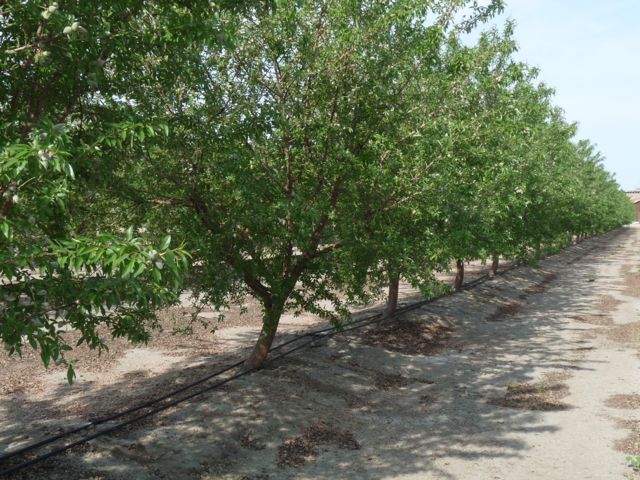
CROPS ACTUALLY BORROW WATER VIA TRANSPIRATION

Almonds and All Other Crops Borrow Water Via Transpiration

By Patrick Cavanaugh, Associate Editor

Editor’s note: We interviewed Allan Fulton, UC Cooperative Extension Irrigation and Water Resources Farm Advisor, Tehama County, on an important, yet overlooked, process of a plant’s water use in agriculture. We zeroed in on a major process all plants have called transpiration in which crops borrow water.

Allan Fulton

Allan Fulton, UC Cooperative Extension Irrigation and Water Resources Advisor,
Tehama County

California Ag Today (CAT): We hear in the media that our crops are using too much water. And while all plants need water to grow food, we also know that a big percentage of the water taken up by all plants actually transpires out of the plant, back into the atmosphere, to form clouds and precipitation, right?

Fulton: Yes, the water just returns to the hydrologic cycle.  Most of the crops we are distributing, whether within the US or globally, are actually very low in water content.

CAT: When we think about transpiration, the plants are actually borrowing the water. Isn’t that true?

Fulton: We get a lot of questions from the general public about why we irrigate our crops so much.

The truth is, plant transpiration is a necessary biological process. The water cools the tree so it stays healthy. The water exits the leaves through special cells called stomata. While they are open, stomata allow water to transpire and carbon dioxide to enter the plant for photosynthesis, making sugars and carbohydrates, which, in turn, are used to make the fruits and the nuts that we eat.

So if we don’t have an adequately watered plant that is allowed to transpire, the plant won’t get enough carbon dioxide. The plant will grow defective fruits, and nuts—smaller, shriveled, cracked, all the things that the typical consumer does not want to buy.

CAT: Now, when we are talking about transpiration, can we say  most of the water taken up by the plant ends up being transpired back to the environment for reuse? So the water transpired by the plant is definitely not being wasted?

Fulton: Definitely. Since we converted to pressurized systems, micro-sprinklers and mini-sprinklers, we have a lot more control over how much water we apply at any one time. We no longer measure water output in depths of acre-feet, or even 4-6 inches at a time anymore. Much like rainfall, we measure it in tenths of an inch, or 1 or 2 inches at most.

As a result, we use less water, so it doesn’t penetrate the soil very deeply, maybe only 1 or 2 feet each irrigation. We are very efficient with the water; but, we have to irrigate very frequently because we apply it in small doses, and we run our irrigation systems a lot. So,   we are definitely using systems that stretch the water supply, not waste it.

CAT: But again, the vast majority of the water that the tree takes up is transpired, right?

Fulton: Yes. Most of the time, at least 90% of the water we apply is taken up through the tree and transpired for photosynthesis to occur.

CAT: Does transpiration increase on a hot day?

Fulton: Yes, plus the plant looses a bit from surface evaporation  from the wet soil, but we try to control that with smaller wetting patterns and drip-confined wetting patterns.

When you think about it, the heat of the day occurs in the afternoon, and many systems don’t run because of energy costs.  There are incentives not to pump in the middle of the afternoon; but for those who do, try to confine the wetted area to limit evaporation. The hot hours of a day comprise about 4 hours of a 24-hour cycle, so a lot of irrigation occurs at night-time or in the early morning hours to lesson evaporative loss.

CAT: Growers are doing everything they can to conserve water. If the trees and vines are all transpiring most of the applied water, what is the problem with using water to grow food?

Fulton: I think the concept throughout the United States has always been to secure our food supply. That security has many benefits—economically and politically. In the end, we are trying to provide the general public with great quality, safe food, at the best price possible.

CAT: And nutritious food. We are growing the food people need more of.

2016-05-31T19:28:11-07:00July 10th, 2015|

UC Cooperative Extension Farm Advisor in Ventura County

UC Cooperative Extension Farm Advisor in Ventura County

By Laurie Greene, Editor California Ag Today

Ben Faber, UC Cooperative Extension Farm Advisor in Ventura County, works with growers who farm a variety of different crops including blueberries, raspberries, blackberries and strawberries as well as lemons and avocados.

Faber is developing new approaches for better avocado pruning to increase yield. “We have not done a lot of pruning on avocados in the past,” Faber said, “because this plant species responds to pruning in a very rapid fashion with a lot of shoots and water sprouts, so people have been scared to prune avocados. Over time, we have learned how to prune avocados somewhat differently than other tree crops.”

Faber said the two pruning choices are a heading cut and a thinning cut. “A heading cut,” he explained, “is often what you see peach growers doing, indiscriminately cutting into a branch. Well, they are actually doing is selecting the branches that will be the fruiting branches for the next year. Whereas, if you do that in avocados, you just get a lot of wild regrowth.”

So Faber believes the strategy in avocados has to be a thinning cut, “where you prune back to a sub-tending branch or a crotch so the remaining branch continues growth. This method controls growth lower down in the branch. It has taken a long time to discover this, though it seems simple now.”

He added, “Thinning cuts are all about keeping the tree from ‘crowning out,’ which reduces yield. As neighboring trees start shading each other, the flowering and fruiting spreads to the very top of the tree.  This is where you see significant yield reduction because instead of having fruit form all over the tree’s canopy, fruit and flower production forms only on the very top of the canopy.” Faber said.

“Keeping the avocado fruit lower in the tree is better for harvesters to grab,” Faber commented. “So, growing fruit high in the tree presents not only yield loss, but a worker safety issue as well.”

2016-05-31T19:28:11-07:00July 9th, 2015|

Almond Growers Conserve Water

Almond Growers Conserve Water…Period!

By Laurie Greene, Editor, California Ag Today

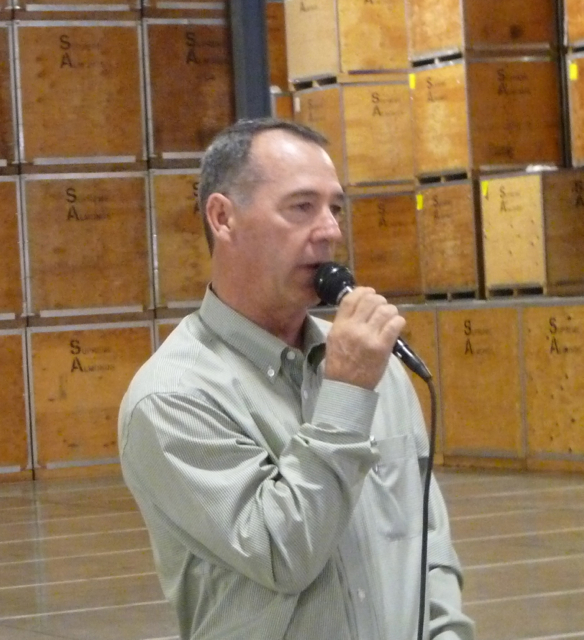
At a recent drought forum, California Ag Today spoke with Mike Mason, an almond grower and partner with Supreme Almonds near Wasco, as well as  chairman of the Almond Board of California. Noting breakthroughs in the almond industry, Mason said, “Facts bear out that we use 33 percent less water today than we did 20 years ago for every pound of almonds grown. There’s no reason  not to expect a similar result over the next 20 years given the ongoing research and funding we do through the Almond Board. We will continue to become more and more efficient, not just with water use, but with fertilizer and everything else we do in farming as well,” said Mason.

“Keep in mind that almonds, like all flowering plants, transpire 95 percent of the water they take up,” said Mason. “Water moves through the vascular system of the plant and exits the stomata of the leaves. When the stomata open, pure water exits and carbon dioxide enters the leaves. The carbon is used in photosynthesis to make carbohydrates that enable the almond almond tree to produce almonds. It’s all part of the universal water cycle that enables life to exist on the earth!”

Though current public opinion on water use seems to focus on almonds primarily, Mason remains confident that the facts will speak for themselves. It is simply a matter of getting the information out there. Mason elaborated, “We’ve got to go back to education because there are so many ways of comparison, and it is pretty hard to refute some of the things people are saying out there. But I think, over time, as we get the facts out there, public perception will be different.”

Because almonds are proving to be profitable at the moment, other countries are starting to take notice and planting more almond orchards of their own. Currently, California accounts for about 80 percent of the world’s supply of almonds. Mason believes, in spite of increased international competition, California will remain a world leader. “I wouldn’t call it a threat;” he said, “it is more like an opportunity than anything else. I think California will continue to be the world’s supplier, but there are other areas around the world where almonds can be grown, and that’s perfectly fine,” said Mason.

American consumption of almonds has increased roughly 220% since 2005. As a result, almonds have become the most-consumed nut in America, after  surpassing that of peanuts. This explosive increase in demand has been the driving force for almond production expansion.

Now, almonds cover about one million acres in California. On maintaining this level of success, Mason commented, “Markets go up, and markets go down. There are all kinds of different factors that cause these fluctuations, from oversupply to environmental issues. We think we have a bright future with a healthy product. Time will tell,” he said.

2016-05-31T19:28:11-07:00July 7th, 2015|

Happy Fourth to All

Our Third President on This Fourth of July

On this Fourth of July, it’s fitting to focus on Thomas Jefferson, the nation’s Agrarian President and signer of the Declaration of Independence 239 years ago.

Yes, our third President was Thomas Jefferson an agronomist, an educated man of the land. So, unique in his time, he believed in proper land stewardship for posterity.

Jefferson understood that humanity affected the environment, so he practiced crop rotation with an extensive seven-year plan, using wheat, turnips, corn, potatoes, peas, rye and clover, buckwheat, and livestock grazing.

He tested to determine the exact number of cattle required to fertilize a given area of land and compared grain yields on manure vs. unfertilized fields.

“Agriculture … is our wisest pursuit, because it will

in the end contribute most to real wealth, good

morals & happiness.”


Jefferson developed scientific plowing of “least resistance,” which lifted and turned the sod to a depth of about six inches, enabling farmers to contour-ridge erodible fields, plow out shallow ditches, and ridge poorly drained flat lands.

He terraced his vegetable garden, orchard, and vineyard sites, and planted native ground cover to stop erosion.

He conserved timber by not cutting trees for any purpose as long as cut wood was available.

As U.S. envoy to France, he sent seeds of various grasses, fruits and vegetables, acorns, olive plants to agricultural societies, farmers, and botanists back home.

He brought Italian rice to South Carolina, pecan trees to the eastern United States and was first to introduce Brussels sprouts, eggplant, cauliflower, and broccoli.

He encouraged agricultural societies, agricultural education and university-level research.

Jefferson kept extensive farm journals for nearly six decades on the 170 varieties of fruits and 330 different kinds of vegetables he cultivated, and on his experiments with viticulture and beer brewing.

Another July 4th notation

Presidents John Adams (who lived to 90 years old) and Thomas Jefferson (who lived to 82) both died on the same day July 4 1826, 50 years to the day of the signing of the signing of the Declaration of Independence.


Quote from © 2015 Thomas Jefferson Foundation

2016-05-31T19:28:12-07:00July 4th, 2015|

MRLs and Crop Protection Materials are Improving but Complicated

MRLs and Crop Protection Materials are Improving but Complicated!

By Laurie Greene, Editor and Patrick Cavanaugh, Associate Editor

Rachel Kubiak, Environmental & Regulatory Affairs director with the Western Plant Health Association, based in Sacramento, commented that crop protection materials are improving. They target specific pests and they are set to maximum residue levels (MRL’s) when sold domestically or internationally. Yet, they are quite complicated.

“The materials are getting better,” Kubiak said, “but I would say that there is a large component that I don’t believe the activist community understands,” noted Kubiak.

Richard Cornett, director of communications for WPHA, blogged, “What most people are unaware of is that there is a highly integrated and multi-layered process of safety procedures to assure that pesticides are accessed for their safe use around humans and in the environment.”

U.S. EPA (a) scientifically reviews all pesticides for safety before registration, (b) involves EPA scientists at the Office of Pesticide Programs, the Department of Fish and Wildlife, as well as other departments, (c) guarantees that any pesticide used in the U.S. has been accessed and is safe and (d) applies tolerances only to produce grown in or imported into the United States.

In California, the Department of Pesticide Regulation (DPR) enforces EPA tolerances by sampling produce for pesticide residues from throughout the channels of trade, both domestic and imported, including wholesale and retail outlets, distribution centers, and farmers markets.

“There are complications in making those products available to our growers,” Kubiak said, “because so much of what we produce in California is exported to other countries, and this MRL issue complicates things.”

Foreign countries follow an international standard called CODEX Alimentarus which contains a list of pesticide MRLs. EPA tolerances and International Codex MRLs are not harmonized; residue on an imported commodity can trigger a no-tolerance-established assessment and removal by California DPR while being a legal residue in other countries.

“I think this is a large area in which we could do better. Educating those who don’t live in our world on the difficulties in bringing new products to market isn’t as simplistic as they like to make it seem,” said Kubiak.

2016-05-31T19:28:12-07:00July 2nd, 2015|

Mario Santoyo: Hold Environmental Water Use Accountable!

Mario Santoyo: Hold Environmental Water Use Accountable!


By Laurie Greene, California Ag Today Editor


California Ag Today met with Mario Santoyo, executive director for the California Latino Water Coalition at the recent Clovis drought forum organized by Assemblymember Jim Patterson to talk about how serious the current drought situation has become.

We are definitely in one of the worst drought situations that has happened in recent times. But the fact is, the 1977 drought was actually worse than where we are now. But this year, we’re at a zero water allocation and in ’77 we were at 25% for both the Eastside and Westside. So what’s the difference? Well, it boils down to the differences that are now dedicating a whole bunch of water to environment use, but the environment is not being held accountable for its usage,” Santoyo said.

“Cities and agriculture have had to be very accountable for their water usage and efficiency. It’s not the same for the environment, and so I’m hoping people will understand this discrepancy when we push to reallocate some of the water back to the cities and farms. We must hold environmental water use accountable!”

Santoyo noted the critical importance of building new water storage projects. “We have been working on this for a long time, and we just can’t afford to continue losing millions and millions of acre-feet of water to the ocean during times like this, when we could use that water. We need everyone to understand they have a role in communicating to the state government that we must advance our storage capacity.

Santoyo noted, “Farmworker communities are doing a lot worse because, again, zero allocation on both the Eastside and Westside quickly translates into fallowed land, which means there are fewer jobs available. So farmworkers now find themselves in an extremely difficult position in which they either stick around and hope for the best or they leave. But once they leave, they aren’t coming back,” he said.

And, that makes life tough for the farmworkers, but it also makes it tough for the farmers because they need water and labor. You can’t do without both, and the lack of one causes problems with the other; if you don’t have water, you lose the labor, and then what do you do? So, it’s unfortunate that some changes in the way we are using water today have changed the entire landscape of agriculture here in the Central Valley.”

In terms of what we can do, Santoyo urged Californians never to give up. “There’s no reason why we all cannot write letters to our representatives and to the governor! Wake him up! Tell him, ‘Hey by the way, you’re supposed to represent us and step to the plate. Have better control over State Water Resources Control Board because they are making tons of mistakes.’ Governor Brown must start making the right decisions for the people.”

2016-05-31T19:28:12-07:00July 1st, 2015|

WADE: LET THE WATER FLOW!

Let The Water Flow:

Mike Wade Urges Water Board To Let Reclamation Pay Back Borrowed Water

By Laurie Greene, California Ag Today Editor

Mike Wade, executive director of the California Farm Water Coalition, discussed with California Ag Today, his article for the Coalition’s Blog, entitled, “State Water Resources Control Board Could Cost California’s Agricultural Economy $4.5 Billion.”

“A number of San Joaquin Valley farmers have been working the last couple of years to set aside emergency water supplies through conservation and water purchases on the open market,” began Wade. “That water is set aside in the San Luis Reservoir and currently being borrowed, if you will, by the Bureau of Reclamation to help meet their obligations and ultimately the temperature management plan for winter run Chinook salmon.”

Wade said the Bureau’s water obligations also include provisions for summer agriculture south of the Delta, as well as refuge management for numerous listed terrestrial species like the Giant Garter Snake.

Wade estimates the loaned water is worth hundreds of millions of dollars. Lending farmers include those who own land on the Westside of the San Joaquin Valley, Sacramento Valley rice farmers who fallowed land this year to make supplies available for transfers and Friant-area farmers seeking to augment a zero water allocation for the second year in a row.

“We believe the Bureau has an obligation to pay that water back this fall, and we’re urging the State Water Resources Control Board to let that payback happen.” In his article, Wade reported that Reclamation would pay back the water from supplies stored in Lake Shasta as soon as temperature goals for winter run Chinook salmon were met.

Regarding accountability, Wade said, “I believe the Bureau intends to pay it back, but we want the public to understand what’s happening. We want transparency so we can follow this obligation and make sure this fall, when water becomes available, the Bureau follows through to pay it back. People don’t forget.”

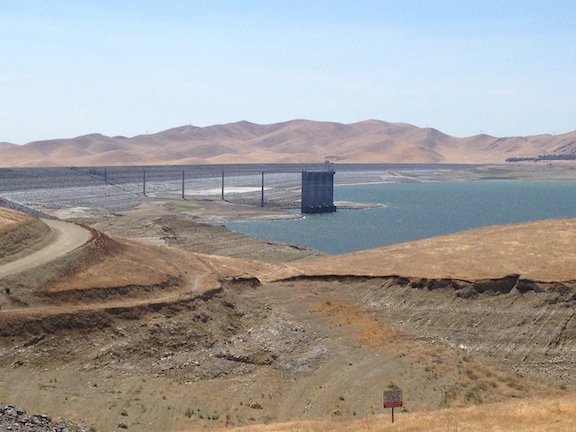
Built and operated jointly by the Bureau of Reclamation and the State of California, the San Luis Reservoir is at 44% capacity today, according to the California Department of Water Resources’ California Data Exchange Center, but the supply is already divided and allocated. Wade explained, “The water that is currently in San Luis Reservoir under the Bureau of Reclamation’s control is almost exclusively owned by growers who have conserved it or purchased it on the open market. The remainder belongs to the State Water Project and its users. So, there is little or no federally-owned water in San Luis at this time.”

Wade said, “There are a number of factors that contribute to the 4.5 – 4.9 billion dollar projected cost for San Joaquin Valley farmers. First is the actual value of the water that farmers have already set aside. Second is the monetary obligations farmers have contracted to pay Sacramento Valley rice growers for transferred water. The third component is the actual value of potential crop and orchard losses if that water isn’t paid back and farmers lose out on their ability to keep their farms going.”

Wade urged the State Water Resources Control Board, “to facilitate this complex and unprecedented collaboration” and allow Reclamation to release compensatory water as soon as possible.

Let the water flow!


Sources: Interview with Mike Wade, California Farm Water Coalition; “State Water Resources Control Board Could Cost California’s Agricultural Economy $4.5 Billion,” by Mike Wade, California Farm Water Coalition; Bureau of Reclamation; California Department of Water Resources

Featured Image: San Luis Reservoir-Empty, California Farm Water Coalition

2016-05-31T19:28:12-07:00June 26th, 2015|

Sakata Seed America Awarded Title of ‘Water Saving Hero’

Sakata Seed America Awarded Title of ‘Water Saving Hero,’ Sets Example during Severe California Drought

Sakata Seed America is doing their part to ‘Go Green’ and conserve water during the severe California drought. The drought has taken a huge toll on the entire state; however, it has hit both the Agricultural and Horticultural industries particularly hard. According to a study by the UC Davis Center for Watershed Sciences, “the drought is expected to be worse for California’s agricultural economy this year because of reduced water availability…Farmers will have 2.7 million acre-feet less surface water than they would in a normal water year – about 33 percent loss of water supply. Individual farmers will face losses of zero to 100 percent.” In response, Sakata has made it a priority to focus on ways to reduce their water usage and boost long-term sustainability for the future.

In 2014, two main projects were completed to conserve water at the Morgan Hill office headquarters. First, 12,500 square feet of turf was removed and replaced with drought-tolerant plants and landscape coverage. In addition, the overhead sprinklers were removed and replaced with a low-volume drip system. The estimated water savings for the 2014 updates totals to 300,000 gallons of water annually. For the remaining turf, complete irrigation updates were implemented, and over 275 sprinkler nozzles were upgraded to a weather track system which reduces water when it’s not needed, resulting in an additional 50,000 gallons of water conserved annually.

This year, Sakata has already begun their next phase of water reduction. Thus far, 16,088 additional square footage of turf has been removed from the front of the company’s headquarters and replaced with a new, drought-resistance landscape and low-volume drip systems. And it doesn’t stop there, Sakata’s internal committee, ‘GreenUp,’ which is solely dedicated to creating a greener work environment has a lot more in store for the future – some immediate plans for facility upgrades include water-saving restroom updates such as touchless faucets. In addition, the committee is distributing free shower buckets to all interested employees.

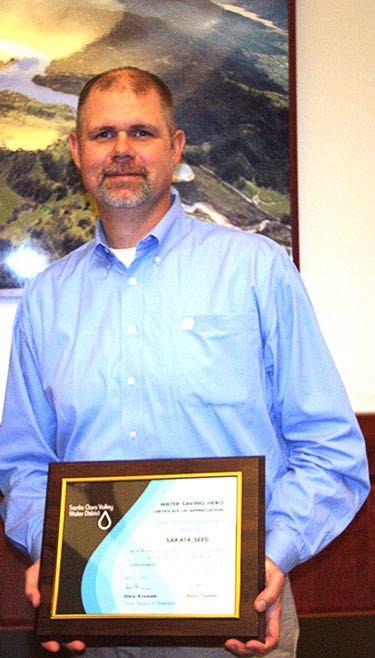
Sakata’s water conservation efforts have not gone unnoticed. In September 2014, Sakata was deemed the title of a ‘Water Saving Hero’ and presented a plaque by the Santa Clara Valley Water District, who have been encouraging water conservation all over Santa Clara County with their ‘Brown is the New Green’ campaign, which distributes free ‘Brown is the New Green’ lawn signs, shower buckets, moisture meters, shower timers, shower heads and hose nozzles for Santa Clara county residents.

“It’s part of our responsibility to the community and the industry to conserve water and lower our carbon footprint. We are proud of our efforts thus far, but are determined to take it further and become a role model for other companies,”states Tye Anderson, Senior Logistics & Operations Manager for Sakata.

Sakata’s GreenUp committee’s future plans stretch far beyond lessening water usage and focus on sustainability as a whole. Long-term goals include such workplace additions as bike racks and charging stations for electric cars.

For more information on how you can help conserve water during the California drought, please visit: www.saveourwater.com. For more on Sakata’s contribution, read the full article.

#

Headquartered in Morgan Hill, CA, Sakata Seed America is a major research, seed production and marketing-distribution subsidiary of Sakata Seed Corporation, established in 1913.   Sakata Seed America serves as the headquarters for the North American operations.  

Featured Photo: Sakata’s Tye Anderson accepts Water Saving Hero Award

2016-05-31T19:28:13-07:00June 25th, 2015|

Apple Growers Stuggle

As Temps Heat Up, Apple Growers Struggle

By Courtney Steward, Associate Editor

As temperatures of early summer grow hotter, farmers of permanent crops, such as apple growers, are starting to struggle due to the lack of adequate water  to keep crop production where it needs to be. Alex Ott,  executive director of the California Apple Commission, based in Fresno, shared part of struggle.

“It’s always a challenge, especially when you are in your 4th year of drought,” Ott began. “Our biggest concerns, obviously, are about excessive heat and lack of water for the trees that are in the ground. But we’re also concerned that, first, we have a crop; and second, that the crop sizes well.”

Yet, despite the drought challenges, Ott noted the crop looks good. “The crops have good quality and look like we’re definitely going to be up—compared to last year—which is good. Last year, the crop was very light. It was a tough year for growers.”

“I think that the trees came back with some good vigor and were able to set a nice crop this year,” he said. “The conditions this spring were perfect for bloom, So, we are excited to see a good size crop,”


2016-05-31T19:28:13-07:00June 24th, 2015|

IR-4 Update

IR-4 To Focus on New Strategic Plan

By Courtney Steward, Associate Editor

At a recent meeting, California Ag Today met up with Dan Kunkel, associate director of the IR-4 Project for The Food and International Program at Rutgers University in New Jersey.

IR-4 Project LogoSince 1963, the IR-4 Project has been a major resource for supplying pest management tools for specialty crop growers by developing research data to support EPA tolerances and labeled crop protection product uses. The main goal of the IR-4 program, according to Kunkel, is to help specialty crop growers in California, but with a new emphasis on crop exportation.

Commenting on this new strategic plan for the IR-4 program, Kunkel said, “We are going to be doing a lot of the same things, like residue work, efficacy testing and our biopesticide and ornamental programs. But we are taking a larger focus on international harmonization of the pesticide residue limits for our grower exporters so they can feel more confident that their commodities won’t have issues in foreign trade.

“Of course we submit crop protection registration to the EPA for our growers. But when the commodities go abroad, we also submit the data to CODEX, an international database with maximum residue limits (MRLs), a type of tolerance standard, for pesticides,” said Kunkel.

“We also share data with some of the U.S. commodity groups to submit to the Asian and European markets so our growers’ exports can meet these residue limits as well,” he said.

2016-05-31T19:28:13-07:00June 23rd, 2015|
Go to Top