Associations, Organizations, Educational and Research Institutions

Bean Seed Moisture Content Important

Bean Seed Germination Issues

By Patrick Cavanaugh, Farm News Director

Statewide, there has been a problem with bean seed germination. In other words, when growers plant the seed, it does not germinate well. This is seed that is being grown to be planted as bean seed for a crop to be consumed.

Rachel Long—a UC Cooperative Extension Farm Advisor based in Woodland serving Yolo, Sacramento and Solano counties—is studying the problem.

“We had a big meeting last year with the California Dried Bean Advisory Board to discuss this, and one of the thoughts that came up is that maybe because of the drought that we’re letting the seed dry down a little bit too much, and then when it’s harvested, it’s getting internal injury by the combine and therefore that internal injury is causing these seeds to not germinate real well,” Long said.

“So I started a project to try to figure out, whether or not there’s some relationship between seed moisture at harvest and the quality of the seed,” Long said. “We are seeing some differences in particular if you do a harvest, certainly in the morning where you have a little bit higher moisture content, that you end up with better seed germination.”

“So even though they are planting seed for a seed crop, the seed is not treated any different than if it were being planted for consumption, and they are harvested in the same way,” Long explained.

“But what we think is that if you’re harvesting beans or seed stock, then you have to be much more careful and really watch the moisture content, so growers would want to harvest them in the morning rather than the afternoon, when there is more moisture content,” she said.
2021-05-12T11:05:14-07:00January 30th, 2018|

Band Canker Affecting Younger Almonds

Almond Band Canker Becoming a Big Problem

By Patrick Cavanaugh, Farm News Director

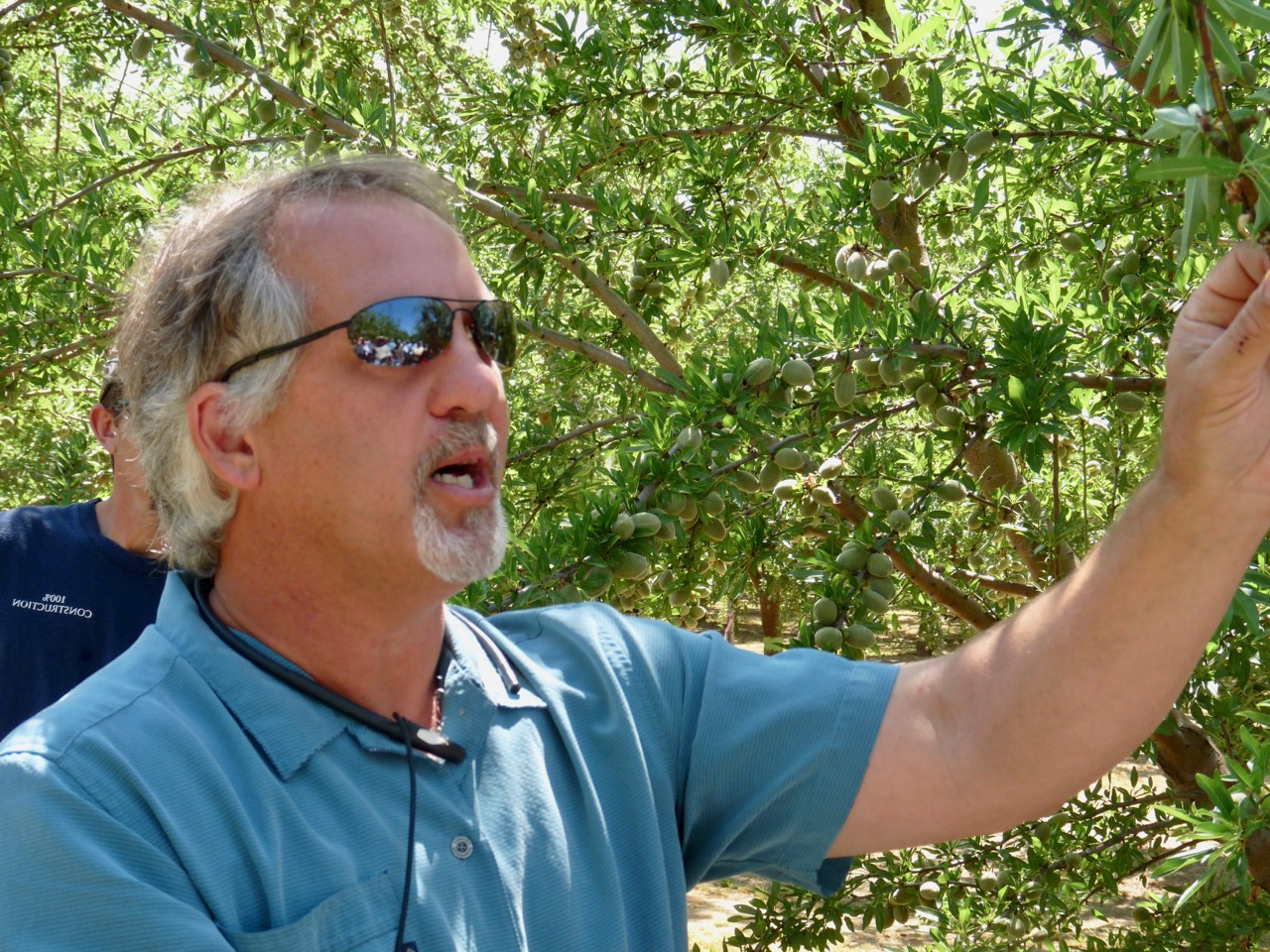
Brent Holtz is a UC cooperative extension Pomology Farm Advisor for San Joaquin County. He recently told California Ag Today about how the fungus band canker on almonds is becoming more prevalent in the San Joaquin Valley.

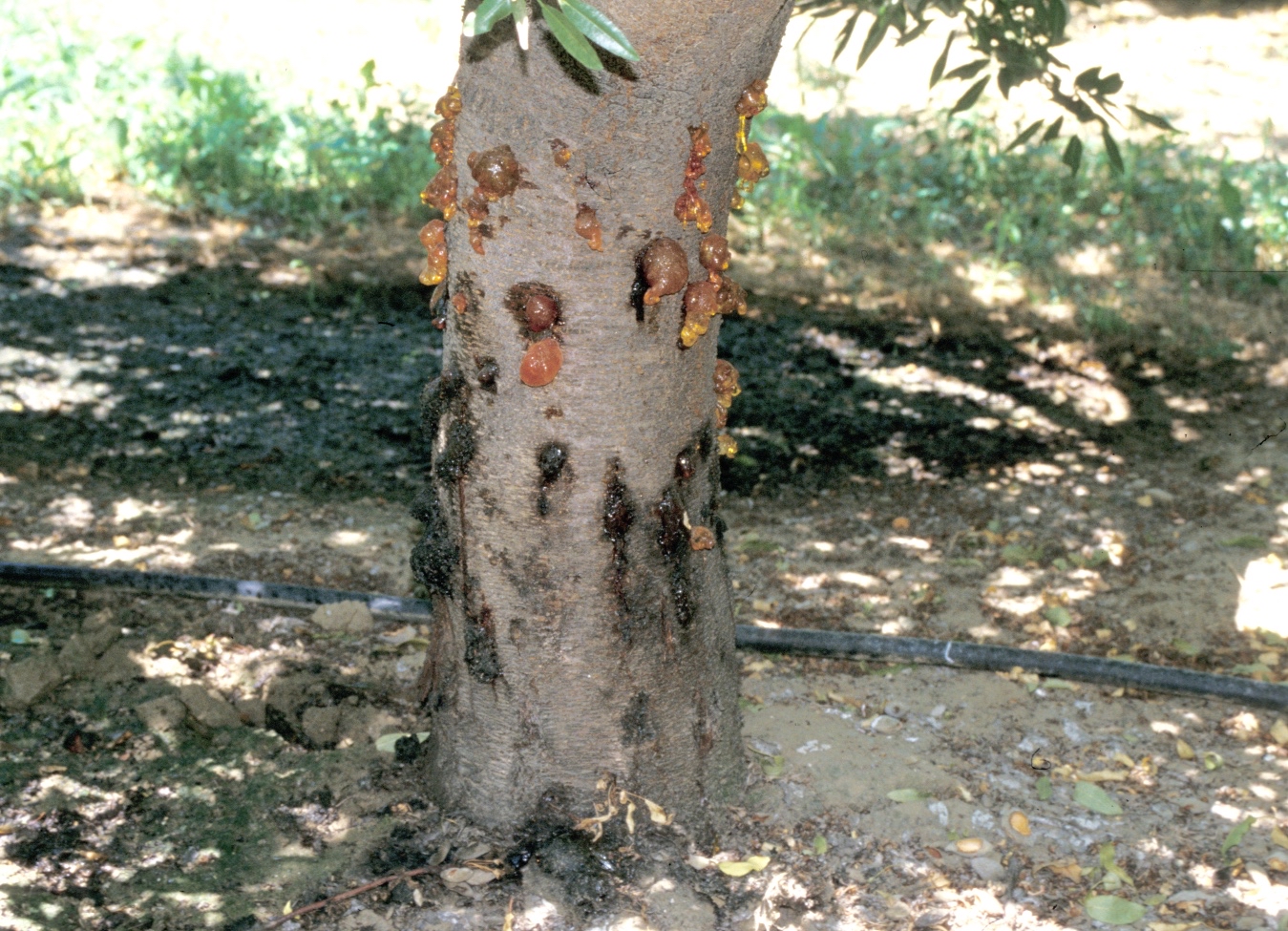
“I’ve seen a lot more band canker, which is caused by a pathogenic fungus, Botryosphaeria dothidea, and we’re seeing it on young orchards, especially in in San Joaquin county,” said Holtz.  “We’ve seen that a lot out in the delta and we’ve seen it in eastern San Joaquin county where the soils tend to be a little heavier, maybe old dairy ground and richer and we don’t really know why.”

“We’re seeing so much more, but it’s a fungus that infects usually the trunk or the main scaffolds, and we call it band canker because sap balls will come out at the site of the infection and create a band that circles around the trunk or the scaffold,” Holtz explained. “That’s why we call it band canker.”

It’s starting to show up in the orchards that have not been shaken yet, as a wound needs to happen before the infection sets in.

“We think it’s showing up in a lot of orchards before we start shaking the trees and usually in most cankers, we would have to have a wound that would have to happen first before the infection would take place either through a wound or a wound from shaking the tree,” Holtz said.

“Some of these orchards with symptoms tend to be trees that are growing very vigorously, and we suspect maybe that they’re growing so fast, growth cracks are created that the fungus may have got in and caused the infection.”

Trees with band canker on the trunk may not survive. And band cankered scaffolds have to be removed, which affects the tree’s architecture and will reduce yields.

There is evidence that micro sprinklers hitting the trunk could also increase the start of an infection.

“It seems to be showing up a little higher concentration where it was on a micro sprinkler irrigation system, where the sprinkler was actually hitting the trunk,” Holtz said. “We don’t seem to see it as much in orchards with a drip irrigation, so we are advising growers to consider drip or to put a splitter in their micro sprinklers so it can avoid wetting the trunk repeatedly with each irrigation.”

2021-05-12T11:01:56-07:00January 24th, 2018|

Survey Coming To Gauge Nitrogen Fertilizer Use

Understanding How Growers Are Using Nitrogen Fertilizers

By Brianne Boyett, Associate Editor

Nitrogen fertilizer applications are an important topic for growers. They’re expensive, and farmers only want to give crops what they need. UC Davis researchers want to know more about how growers are using nitrogen, and they’re sending out a survey to growers throughout the state at the end of January.

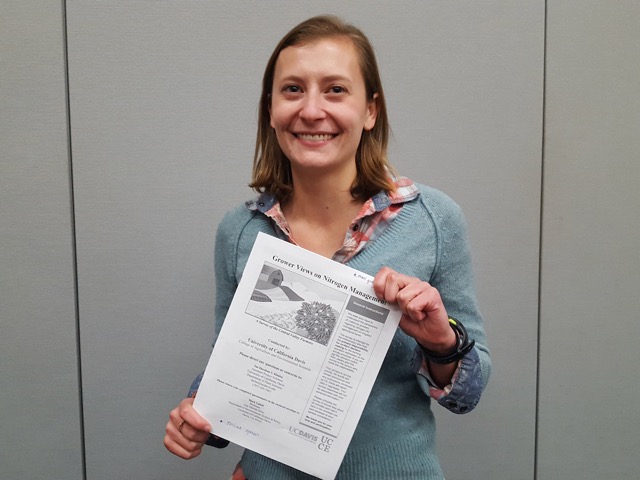
Jessica Rudnick is a third year Ph.D. student in the Graduate Group of Ecology at the UC Davis Center for Environmental Policy and Behavior, and she is overseeing the survey.

“UC Davis is sending out a survey to about 8,000 growers in the Sacramento and San Joaquin Valley [areas]. We’re asking about perspectives and attitudes on nitrogen management. This is really to understand what the education and outreach resources that are available around nitrogen, how people are understanding the new policies that are coming down the pipeline and how we can optimize both the extension and outreach around nitrogen,” Rudnick said.

“They’re looking for ways to optimize infield use of nitrogen, which is increased efficient production and protection and stewardship of the land and water resources,” Rudnick explained.

Of course, all this stems from new nitrogen regulations and the nitrogen budgets that growers are forced to put together. UC Davis wants to find out how growers feel about all this.

“ I frequently hear from growers that nitrogen regulations are a lot of paperwork. They’re taxing for their valuable time. I know that there’s file cabinets full of paperwork for various pesticides, nitrogen and farm employee information. The list goes on, and from a regulatory burden perspective, it’s another piece of paper that everyone hates filling out.

“However, we are trying to tighten up our systems so that we’re spending resources in the most efficient way, and that we’re producing food efficiently, saving money where we can, cutting costs and not overly applying fertilizer,” Rudnick said.

These surveys will be arriving in the growers’ mailboxes later this month. Please take the time to fill it out and send it back. It’s all self-stamped for growers so that these researchers can find out just how growers are using these regulations.

2021-05-12T11:05:14-07:00January 22nd, 2018|

Walnut Blight Protection is Important

Disease Prevention in Walnut Orchards

By Brianne Boyett, Associate Editor

California Ag Today recently spoke with Jim Adaskaveg, professor of plant pathology at UC Riverside. He’s a plant pathologist, microbiologist and epidemiologist. He discussed the importance of protecting walnut trees from walnut blight.

Adaskaveg explained how walnut blight is problematic due to the higher rainfall in the northern part of the state.

“We’ve been working on this for a number of years, and overall, the northern part of the state is always higher at risk because of the higher rainfall in Glenn County,” he said. “There is much higher risk for disease in Northern California, so a lot of the growers have planted later blooming varieties such as Chandler to avoid the blight infections.”

“Rick Buchner [at UC Cooperative Extension] Tehama County and his group called that the prayer stage, which is when the female flower becomes exposed as it emerges from the bud. Those two timings would be for high disease pressure. If you had a history of the disease and you know that the disease is in your orchard, then we would suggest that timing,” Adaskaveg said.

“If you don’t have disease, and you still want to protect yourself, we say just spray at the pistillate flower emergence or the prayer stage. That sets a good way to initiate the spray program,” Adaskaveg explained.

Growers must keep in mind canopy expansion when applying materials.

“Walnuts are big trees, and as they go through bloom, all the leaves started emerging almost weekly. The tree canopy in that first three weeks of the season is doubling in size. By the time you get three or four weeks after that, the catkin flowering trees in full canopy will require a reapplication of materials,” Adaskaveg said.

2021-05-12T11:01:57-07:00December 29th, 2017|

Temperance Flat to help with Above and Below Ground Storage

Water Storage is Needed, Above and Below Ground

By Jessica Theisman, Associate Editor

California Ag Today recently spoke with Ryan Jacobsen, CEO and executive director of the Fresno County Farm Bureau, about the importance of below ground and above ground water storage, and how Temperance Flat Dam will help.

“I am first and foremost to say we need both. They go hand in hand. You can’t capture all this water at one time and stick it in the ground. You’ve got to have above ground storage,” Jacobsen said. “The water has to be allowed to percolate back into the ground level.”

“We need both types to go hand in hand, and I think anybody that knows the success of what Temperance Flat Dam is going to bring to this area knows that this is good,” he explained.

Ryan Jacobsen, Fresno County Farm Bureau CEO

Farmers are trying to get their voice heard when it comes to new water policy. Jacobson says the best way is through personal letters. They are getting hundreds upon thousands of emails.

“If you get that handwritten letter or that personal letter coming from somebody through the old school snail mail, it makes a difference when it comes to the commissioners,” he said.

“The more the commissioners can hear about the support and potential successes of this project or in the local community, the more attention it will get. It’s important to our region,” Jacobsen said. “Because agriculture is a large portion of the San Joaquin Valley economy.”

Send your personal letters to the California Water Commission at PO Box 9428 Sacramento, California.

2017-12-28T16:30:46-08:00December 28th, 2017|

Almond Band Canker has No Cure

Almond Band Canker Creeping up Again

By Patrick Cavanaugh, Farm News Director

Themis Michailides, a UC Davis Plant Pathologist based at the Kearney Agricultural Research and Extension Center, recently told California Ag Today that almond band canker is becoming a big problem.

“This was a very old disease, and almost forgotten, but now we have major problems, particularly in the young orchards, first leaf, second leaf, third leaf, and it can also be found in six year old trees,” Michailides said.

Band canker is a fungal disease caused by a group of Botryosphaeria fungi that are very common in major crops like grapes, almonds, pistachios, walnuts, avocados, citrus and other crops, so they have a large range.

Band canker establishes itself as a spore inoculum that resides outside and also inside of orchards and waits for the right conditions, which are wetness and also high temperatures.

“It develops first like a ring, a canker that is a horizontal canker on the trunks of the trees and decays the wood and produces sap. It’s a disease that can kill young trees in the orchards,” Michailides said.

“Once you have the cankers developed in the trunks of the trees, there’s no cure, but we can prevent it by managing irrigation, trying to keep the trunks of the trees dry,” he said. “We need to develop protective sprays in order to avoid the development of the disease in young trees.”

“Once we have the water and the temperatures rise above 50 degrees Fahrenheit, the conidia – the spores of this fungi – will germinate and infect vigorous varieties we have now through the growth cracks,” Michailides said.

“It’s getting more serious, especially now, because we see that the disease is uniformly distributed throughout the orchard, which indicates to me perhaps that the inoculum is in the trees and not coming from the outside sources. We don’t see the patterns we saw years ago, where we had the source and then a center of disease close to the source,” Michalides explained.


2021-05-12T11:01:57-07:00December 26th, 2017|

Orchard Sanitation is Critical This Season

Orchard Sanitation to Push Back on NOW Underscored

By Mike Stevens, Associate Editor

We are completing our coverage of the importance of orchard sanitation to push back on Navel Orangeworm (NOW) pressure for 2018.

We recently spoke with David Haviland, UC Cooperative Extension entomologist and farm advisor for Kern County. He spoke about how sanitation is the most important practice that needs to be implemented.

David Haviland on Pyrethroid Review

David Haviland

“Yes, 2017 was a really interesting year on NOW. It was a bad year overall. Several things led up to that. The first one was sanitation was an issue,” Haviland explained. “There is not much of an excuse in the southern half of the almond industry, but with all the rain up north and the flooded orchards, yes, it was very difficult to get in and do sanitation, and we know that that is the absolute backbone of navel orange worm programs.”

Pistachios were also a concern when it comes to NOW.

NOW was right on schedule in pistachios. The pistachio crop was a little behind and so it was common to do a normal monitoring, normal spray program, and set up for a normal harvest. But then the crops sat out there for another 10 days or two weeks, which, of course, makes it very vulnerable to NOW worm damage.

“The longer you get away from your insecticide sprays, the more damage that’s going to occur, and a lot of the crop was harvested after the fourth flight occurred,” Haviland said. “When you put in the concerns with sanitation this year, and with the increased degree day accumulation, there were plenty of moths and then the crop got delayed. The overall effect was that this was a worse than normal year.”

At the same time, the industry is full of examples of growers that had very acceptable damage.

“Growers that did follow in greater pest management practices … did get their sanitation done. They documented that those things are really important, they are very effective, and the growers that weren’t able to get that sanitation done hopefully got a case study, personal experience in the value of sanitation,” Haviland said.

Every grower needs to do their part by incorporating sanitation, noted Haviland. “Obviously, if you’re the only one sanitizing amidst a bunch of growers that aren’t, that’s a concern,” he said.

2021-05-12T11:01:57-07:00December 19th, 2017|

Measuring Crop Protection Material Tolerances

Biological Tolerances May Be Needed

By Patrick Cavanaugh, Farm News Director

California Ag Today recently spoke with Gabrielle Ludwig, Director of Sustainability and Environmental Affairs for the Almond Board of California, about the issue of crop protection in almonds. Almonds are the number one specialty crop export. Almonds also remain the number one nut in global production and are California’s number two agricultural crop.

Ludwig explained that pesticides are used and necessary in today’s almond production. Pesticide residue is a concern for not only domestic production, but also for international distribution. And with biological products such as friendly fungi and bacteria, the biological industry noted that they are safe and free of residue tolerance.

“I would say for this industry, there’s a couple of things going on in parallel, and they don’t have exactly the same problems. So one is you have the sector where it is still a chemical that you’re applying, but it may not have very much toxicity or the residues are, for whatever reason, vanished,” Ludwig said.

“In the United States, we can get an exemption from a tolerance, where EPA has looked at and said there’s no health risk, and there’s no need to set a maximum residue limit. For those products then the question becomes: Do you have the same standards in other markets?” Ludwig asked.

“And again, one example is that the EU does have an exemption for tolerance process, but they don’t always have the same standards so EU is more likely to set a number than United States. And we have also seen examples where the United States is setting a number and the rest of the world says there’s no need to set a number because it’s a natural occurring compound.”

“So if you look at a pheromone, which falls into a natural occurring arena, there, you’re not even spraying the trees so it’s a totally different ball game,” Ludwig said.

“With biologicals, again, it’s a different ball game. You still need to have someone say, look at it, say it’s safe; because it’s going to be exempt from a tolerance.”

“But currently, there’s no testing for it,” Ludwig said. “With DNA technology, it probably wouldn’t be that hard to start testing for biological products’ lack of residue, especially ones that go on the produce that is eaten.”

“So again, what we’re saying here is, don’t rely on the fact you can’t be tested for it because we did that in the conventional pesticide arena and it’s caught up with us,” Ludwig said.

2021-05-12T11:05:14-07:00December 11th, 2017|

Cannabis Growers Not Following Regs

Cannabis Growers Must Adhere to Crop Protection Regulations

By Patrick Cavanaugh, Farm News Director

There’s a whole lot of trouble going on for California cannabis growers. They need crop protection products for pests – such as mites, aphids, thrips, and mealybugs – and diseases, including powdery mildew, alternaria and pythium.

Now legally grown in the state, cannabis meets the definition of an agriculture crop and must adhere to all agricultural regulations and best management practices. This includes all Pest Control Advisor-written recommendations. As few products are approved for application on cannabis in the state, as well as nationwide, a PCA can now be cited for recommending a product that has not been officially registered and approved for a use on cannabis, specifically. With legal cannabis production going mainstream in California, PCAs face this risky predicament regularly.

“I discussed this point with Department of Pesticide Regulation (DPR) Director Brian Leahy this past week,” said Rachel Kubiak, DPR Pesticide Programs Division, Cannabis Program Supervisor. “I think we are at a point now where it’s important that we make policy decisions so PCAs know, as stakeholders, what our expectations are. PCAs deserve for us to do that, so we are working internally right now to try to get a lot of answers to these questions.”

Cannabis growers will have to buy products from licensed agricultural dealers.

“I understand, in talking to different folks, that many companies are not comfortable with the liability of attaining DPR registration approval for cannabis application and are therefore advising not to sell product to cannabis growers,” Kubiak said. “I completely understand that.”

“Going forward as a department, the concern, I think, is to bring as many farmers into the legal crop protection market as possible,” Kubiak said. “They are going to go exactly where they have been buying the products from, right? And if PCAs do not sell to them, but the cannabis growers must buy from them, these growers will have to purchase their crop protection products online, from Home Depot, or anyplace else. I can almost guarantee you that 95% or probably more of the cannabis farmers I’ve talked to over the last couple of months have no idea what we are talking about regarding applying registered materials to registered crops.”

“They have no idea that you cannot buy product anyplace and apply it as a pesticide,” she explained. “They do not know how to store it. So we have a lot of work to do in a very short period of time to bring these people into compliance and understanding.”

The scenario is even dicier for California County Agricultural Commissioners. These commissioners are required to enforce regulations on cannabis, as they are for any other commodity.

“We are working with the county ag commissioners to figure out how we need to proceed with and advise on this,” Kubiack said.

“I will tell you, usually as a department,” Kubiak explained, “we are inundated by the environmental justice community. Yet, they have been completely absent to this point on this particular commodity. So it’s almost bizarre and unusual not to be hit continuously from the left. But understandably, again, we’re now getting into these forums in which the Ag community has a voice and an interest,” Kubiak said.

“I’ve heard from both sides,” she continued. “I have heard from different Ag groups and PCAs who have said, ‘You know, we see a need for this—by a whole industry of people,’” she said.

And that whole industry, the cannabis growers of California, is crossing the regulatory line in crop protection. It has been reported that cannabis growers are creating a lot of environmental damage as well as worker safety concerns. Cannabis is grown primarily indoors, and according to Kubiak, “People are using pesticides without any concept of what they’re doing. Normally we would recommend that they talk to a professional, but that puts licensed PCAs in a hard spot because they cannot write a recommendation for a product that is not legally approved for use on that product.”

Kubiak said DPR is trying to bring as many of cannabis growers into the light as possible, “so that we have some regulation. Again, clearly this has been going on for a really long time, but at least now we are trying to go into areas in which we have some regulation but where people are not necessarily informed. So we bring crop protection management more into the light than ever before,” she said.

Is the DPR at a big turning point in working with county Ag commissioners?

“In the absence of putting up a product list,” Kubiak asked, “what is quasi-legal and what is not quasi-legal? We are trying to come up with solutions to some of these dilemmas.”

“There are counties that want the flexibility. Boards of supervisors and their counties are economically dependent upon this newly emerging industry that’s been in the North Coast for decades. They want the ability to use discretion. Nevertheless, Ag commissioners in other counties clearly are not comfortable with that whatsoever,” Kubiak said.

2021-05-12T11:01:57-07:00December 5th, 2017|

Breeding for Pierce’s Disease Resistance Has Sped Up

Traditional Breeding Helps Find Resistance to PD

By Patrick Cavanaugh, Farm News Director

The glassy-winged sharpshooter is a major vector of Pierce’s Disease, which kills grape vines. Pierce’s Disease devastated the grape industry in southern California and lead to the creation of the Pierce’s Disease/Glassy-Winged Sharpshooter Board (PD/GWSS Board). Government programs to fund research on glassy-winged sharpshooters and Pierce’s Disease invest nearly $20 million annually.

California Ag Today recently spoke with Ken Freeze, the outreach and education director for PD/GWSS. He told us about two major methods of control and prevention that the board is funding.

“There’s the area-wide control program, which does everything it possibly can to pretty much keep the glassy-winged sharpshooter confined to basically the southern part of the state,” Freeze said.

This control program prevents the further spread of Pierce’s Disease into other parts of the state, which could devastate wine growers. In addition to preventing the further spread of Pierce’s Disease, the board is also funding additional research into hopefully finding a cure.

“We’ve got UC Davis Genetics Professor Andy Walker working on Pierce’s Disease resistant grapevine before the program, and he just released some of those vines to the UC Davis Foundation Plants Services.”

Freeze said this development has been done through traditional breeding, with the assistance of some new technology.

Walker’s traditional breeding is sped up by a lot of high tech tools. Previously growers would crossbreed, however they’d have to infect the vine and see if it got Pierce’s Disease.

“That could take a year or two. Now they know the genetic markers, so when the plant has only two or three leaves on it, researchers pull a leaf, do a DNA track on it, and look for that marker,” Freeze explained.  “Depending on the marker, the vine either goes to the next step in breeding or it ends up in the trash heap. So that has just sped up that process incredibly.”

“Again, that’s all just using traditional breeding,” Freeze said.

2021-05-12T11:05:15-07:00December 4th, 2017|
Go to Top