About California Ag Today

This author has not yet filled in any details.
So far California Ag Today has created 2014 blog entries.

Litigation Changes IDD Water Rights

California’s Colorado River Water Users do not have Traditional Water Rights

By  Sean Hood, attorney of Fennimore Law

Farmer Michael Abatti v. Imperial Irrigation District is a landmark decision by the California Court of Appeals concerning the millions of acre-feet of Colorado River water used annually to meet the needs of Southern California’s agricultural empire.

The issue was the nature of landowners’ rights to use Colorado River water to irrigate their fields. The plaintiff, a farmer and landowner in the Imperial Irrigation District (“IID”), asserted that the farmers possess appropriative water rights to the Colorado River water delivered by IID, and are entitled to receive the quantities of water they have historically used on their fields. The Court of Appeals disagreed with most aspects of the plaintiff’s claims. The California Supreme Court recently declined to review the dispute making Abatti the law of the land.

The Abatti litigation arose from IID’s adoption of an “Equitable Distribution Plan” (the “EDP”) to govern allocation of water during times of shortage. IID is a California special district that delivers Colorado River water for numerous purposes including agriculture, municipal, and industrial uses, uses supporting feed lots, dairies, and fish farms, and environmental water uses.

Allocation under the EDP is dependent on the category of water use, and there is a stark distinction between agricultural water uses versus all others.  During times of water shortage, the EDP is far more favorable to non-agricultural water users, who are apportioned water based on criteria such as current and past uses, and future needs.

Agricultural water users, on the other hand, are restricted to the remaining available supply. In times of water shortage, the EDP would result in curtailment of agricultural water uses. In fact, the EDP imposes nearly the entire burden of water shortage on agricultural water users and the Abatti plaintiff contended that the EDP is inequitable in its treatment of farmers.

Under a traditional system of appropriative water rights, longstanding agricultural uses like the Abatti plaintiff’s would have senior priority over other uses. This means that, in times of water shortage, newer non-agricultural uses would be curtailed, whereas the senior irrigators would continue to receive their water supplies. Accordingly, allocations pursuant to the EDP are a significant departure from the manner in which allocations would be made following traditional principles of appropriative water rights.

The reason that senior agricultural water users in IID are not protected from curtailment is that they do not possess a water right to a particular quantity of water. In fact, according to the Court of Appeals, these Colorado River users do not possess a water right at all.

The Court of Appeals held that the water rights are held by IID, not by the farmers.  Instead, the farmers possess equitable and beneficial interests in IID’s water rights. A farmer’s interests are not water rights, but, rather, rights to water service.

This distinction is significant. It empowers IID to exercise discretion in allocating water.  Specifically, the Court of Appeals held that IID has discretion to modify water deliveries in furtherance of its duties to equitably distribute and conserve water for all users.

Because IID has discretion in how it allocates water among its users, landowners’ rights to water service are less protective than traditional water rights.

The good news is that farmers are not subject to the arbitrary whims of district decisionmakers. The Court of Appeals confirmed that farmers’ rights to water service are constitutionally-protected property rights, and that IID’s allocations must be consistent with the district’s purposes. The court made clear that IID’s allocations must provide for equitable distribution of water, and the allocations must be reasonable.

In this regard, the court held that it was not reasonable for IID to adopt a plan that singled out agricultural water users to bear nearly the entire brunt of water shortages. Accordingly, while the Court of Appeals disagreed with most aspects of the lower court’s analysis, it affirmed the lower court’s determination that IID abused its discretion by singling out agricultural water users for curtailment.

IID withdrew the EDP during the pendency of the Abatti litigation, and IID will presumably develop a new plan for water allocation. How IID will impose curtailments among the various categories of users remains to be seen. Abatti provides only general guidance. The Abatti decision stands for the proposition that IID has the discretion to develop an allocation plan as long as (1) it is consistent with the district’s purposes, (2) it is reasonable, and (3) it treats all categories of users equitably. Abatti strongly suggests that IID has the discretion to treat user groups differently, although requiring one class of users to bear the entire burden of water shortages is inequitable and unreasonable. That leaves a wide range of potential allocations, because Abatti otherwise does little to define the extent of IID’s discretion in making allocation decisions between and among different user groups.

The upshot is that, unless IID can achieve stakeholder buy-in, IID’s forthcoming plan will be fertile ground for additional litigation. IID should be motivated to find a balance that is acceptable to all categories of users, and agricultural water users will be wise to engage as stakeholders throughout the entire plan development process.

What Does This Mean for California’s Agricultural Colorado River Water Users?

The Court of Appeals was careful to note that its holding is specific to IID. However, the Abatti reasoning would seem to apply to Colorado River water users served by other special districts in Southern California.

The high-level takeaway from Abatti is that farmers’ rights to delivery of Colorado River water are less certain than traditional appropriative water rights. Longstanding water uses may be subject to curtailment at the same time that newer water uses are unaffected by water shortage.  Similarly, water uses that don’t exist today may in the future place additional constraints on the available supply, and, to a large degree, the allocation preferences afforded to these competing uses will be determined by the discretionary judgment of the users’ special district.

In other words, water supply allocation under a water rights priority system has been supplanted by political decision-making. It is therefore important for water users to exercise great care in selecting their districts’ boards of directors, and for these water users to be actively engaged in all phases of plan development and review.



2020-12-07T13:09:31-08:00December 7th, 2020|

Cattle Grazing Reduces Wildfires


Cattle Grazing Reduces Wildfire Fuel

By Tim Hammerich, with the Ag Information Network

Our state has experienced three serious wildfire years recently, and managing the amount of fine fuels can certainly help reduce these risks in the future. This leads some ranchers and scientists to ask the question: just how much of these fine fuels are cattle eliminating when grazed properly? The study still needs to pass peer review, but here’s Devii Rao, a UCCE Livestock and Natural Resources Advisor with what they found.

“Across the state of California cattle – at least in 2017, which is the year that we used for our analysis – they grazed across 19.4 million acres of rangeland, and consumed 11.6 billion pounds of fine fuels,” said Rao.

Rao says they collected data across multiple regions to also look at the variance of cattle consumption of these fine fuels.

“On average across the entire state, we found that livestock consumed about 596 pounds per acre. And then when you break it up by region, it really varied from, you know, 174 pounds per acre in some parts. Which, you know, that would be the more drier desert regions where there’s just not that much forage or fine fuels being produced. And then on the higher end, cattle were consuming a little bit over a thousand pounds per acre,” noted Rao.

With cattle found in almost every county of the state, it’s just a matter of finding creative ways to graze more of these fire fuel reducers.

2020-12-03T19:04:01-08:00December 3rd, 2020|

Jose Dias A New UCANR Agronomy/Weed Advisor


Jose Dias Named UCANR Agronomy and Weed Management Advisor

José Luiz Carvalho de Souza Dias joined UC Cooperative Extension (UCCE) on Nov. 2, 2020, as an area agronomy and weed management advisor in Merced, Stanislaus and San Joaquin Counties.

Jose Dias

Prior to joining UCCE, Dias was a postdoctoral researcher at the University of Wisconsin – Madison, where he worked with Mark Renz and John Grabber on projects focused on identification of management practices and environmental factors to ensure successful establishment of alfalfa interseeded into corn silage; sustainable management of waterhemp in established alfalfa for dairy systems; and weed control, clover selectivity and resulting yield of grass-clover mixed swards treated with florpyrauxifen-benzyl + 2,4-D in Wisconsin.

Dias earned a Ph.D. in agronomy with focus in weed science from the University of Florida and an M.S. in crop protection and B.S. in agronomy from São Paulo State University in Brazil. He is fluent in Portugese.

His Ph.D. research focused on developing and implementing integrated management practices to reduce giant smutgrass populations in bahiagrass pastures. His M.S. research focused on investigating the selectivity of several residual herbicides applied preplanting of prebudded seedlings of different sugarcane cultivars.

2020-12-03T09:05:40-08:00December 3rd, 2020|

Navel Orangeworm Control Strategies

Climate Change and Navel Orangeworm


By Tim Hammerich, with the AgInformation Network 

Navel Orangeworm is a major pest of crops like almonds, walnuts, and pistachios. Dr. Tapan Pathak with the UC Cooperative Extension recently completed a study on how climate change might impact the pest.

“Navel orangeworm, when they finished their first generation, their population number is low. But for every additional generation they can complete during the growing cycle, their population increases significantly,” said Pathak.

This is a concern because the study reveals that earlier springs and warmer falls are likely to increase these Navel Orangeworm populations.

“In the past, we used to see two to four generations of navel orangeworm, depending on the location. If it is in the southern part of the central valley, that would be more generation compared to the north. But on an average, two to four generations are typical for navel orangeworm,” said Pathak.  “

But what we are seeing with this climate change study is that under future climate, the fifth generation of navel orangeworm is more likely in many, many counties. And especially by the end of the century, it’s present or expected to be present in the entire central valley,” Pathak

Pathak says orchard sanitation and integrated pest management will continue to be critical to remain resilient under these conditions.

2020-12-02T08:17:26-08:00December 2nd, 2020|

Canada Thistle Alert!

Canada Thistle: A Very Prickly Problem in Row Crop Ground


By Rachel Freeman Long, UCANR Farm Advisor, Field Crops

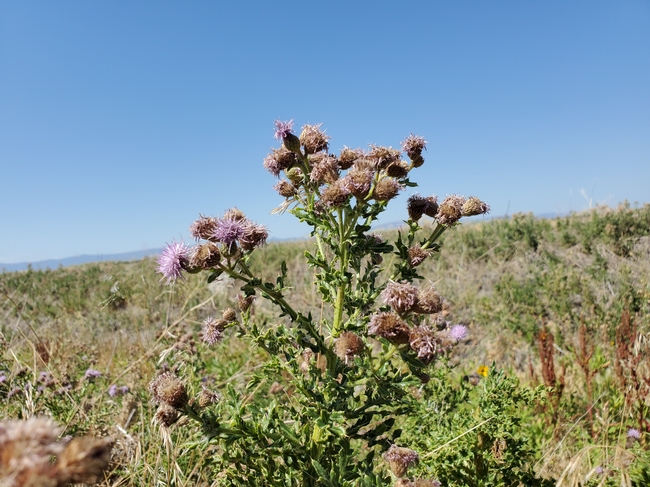
A very spiny plant was dropped off at my office here in Woodland, CA that turned out to be Canada thistle, a noxious weed.

This plant is commonly found in the Intermountain area in northern California where it has overtaken fields, but my first encounter here in the Sacramento Valley. It was found in row crop ground and the landowner was having trouble controlling it. He cut it 6-in below ground, but it resprouted and grew back more shoots. He spot-sprayed it with glyphosate and 2,4D, but the plants recovered (likely burned back the plants before good translocation happened).


Canada Thistle overtaking a ditch bank in Intermountain area of CA

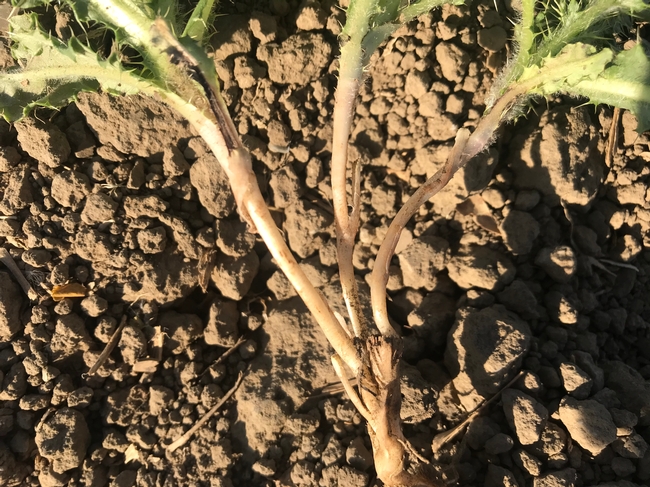
Canada thistle is difficult to control because it is a perennial plant with a deep taproot (Photo 6). It also has the ability to spread by the root forming dense patches in agricultural land or natural areas. Like other rhizomatous perennial weeds, tillage can break up Canada thistle roots into fragments spreading them thought a field making patches larger! Herbicides are typically needed to kill the deep extensive roots of the plants.

Canada thistle spot sprayed with Glyphosate and 2,4 D

In rangelands research has shown that Canada thistle control can be achieved with applications of Milestone (aminopyralid); Stinger/Transline (clopyralid) can offer suppression. However, both of these herbicides have a very long residual activity restricting what can be planted into a treated area after application. There are few options for controlling Canada thistle in row crop ground. One can rogue it, but one has to be sure to pull up the entire root or it will regrow. One can also spray with glyphosate in the fall when Canada thistle is translocating carbohydrates down to the roots. A spring application when Canada thistle is actively growing in the bud stage is the next best time to hit it with glyphosate, but that is not possible if a crop is planted. Multiple years of treatment with glyphosate are often needed to eradicate a thick patch once established.

Canada thistle regrowing from a root that was cut 6-inches underground

Canada thistle also needs to be actively growing at time of application for good herbicide translocation. Dust on the leaves can also affect the application (watch for all that ash that was deposited on plants this year from the fires). If one is making a spot treatment be sure that the glyphosate concentration in the backpack sprayer isn’t too high or you’ll likely get burn back but less translocation down to the root and less control. A slow death is generally desired for those deep-rooted noxious weeds (and perhaps more satisfying!)

Keep this weed out of your fields!

Canada thistle is a prohibited weed in certified seed production, so check your fields regularly and keep it out. Don’t let it get established! The California Crop Improvement Association (CCIA) charged with certifying seed fields states the following: “We have a zero tolerance for prohibited weeds in any class of certified fields. If the grower does not remove the plants from the field, then that field is automatically rejected, no matter the stage of said plant.”

Other troublesome thistle species commonly found in the Sacramento Valley include Italian thistle (Carduus pycnocephalus) and slenderflower thistle (Carduus tenuiflorus); see the UC IPM resources below. Both Italian and slenderflower thistles are annual, or sometimes biennial species, different than Canada thistle which is a perennial. Additionally, we created Table 1 comparing key common traits to help with identification of these three thistle species. Both Italian and slenderflower thistles are classified as restricted weeds. CCIA states, “For restricted weeds there can be a number of those plants in the field. However, if any of the restricted weed seeds are found in the seed analysis then the lot is rejected.”

Tomas Getts, and Jose Carvalho de Souza Dias assisted Long in writing this report.


2020-12-01T17:22:26-08:00December 1st, 2020|

Virtual Almond Conf. Dec. 8-10

Virtual Almond Conf. 2020 Coming

By Patrick Cavanaugh

The big virtual almond conference, 2020 is coming up in less than a week. And you can still register to attend

Ashley Knoblauch is a communication specialist with the almond board of California. The virtual almond conferences is December 8th, through the 10th.

“You have the opportunity to have a variety of speakers from across the world. People who perhaps didn’t have the time to fly in before,” Knoblauch said. “You have the option as an attendee to watch a session in the morning, maybe go take care of some business later, come back and watch another one,” she noted.

“There’s a lot of agility with a virtual conference. And so while there are some downsides, there’s a lot of upside to it too. And we’re really excited to get participation from the industry.

“There’s so much opportunity for us to get a lot of different participants from around the world to learn more about the industry and what we’re doing and to hear the news, but it is still very much a California almond industry industry-focused conference,” Knoblauch said.

“We’re very excited about it. We’ll have a lot of the same things as we’ve had in the past. Of course, we’ll have sessions. There’s going to be a trade show that we heavily encourage industry members to check out. The booth setup is going to be very cool. “We will have the chance to share research, with the research sessions and different updates, and so there will be lots of different opportunities for people to get plugged in,” she said.

For free conference registration, go to AlmondConference.com

2020-12-01T19:46:05-08:00December 1st, 2020|

World Ag Expo Will be Virtual

2021 World Ag Expo Will Be Online

For the first time in show history, the 2021 World Ag Expo® will be an online event February 9-11. Officials at the International Agri-Center® announced the cancellation of the live event on September 14, and spent the next month carefully weighing the implications of a digital show.
“A digital show is not a replacement for a live event like World Ag Expo,“ said Jerry Sinift, International Agri-Center® CEO. “But the ag industry has never stopped working, and neither will we. Ag is essential and so is our job as a trade show to bring buyers and sellers together. We’re just going to do it a little bit differently in 2021.”
World Ag Expo® will work with Map Your Show, an industry leader in event and conference management software. The Map Your Show team has executed more than 120 digital trade shows since March.
While most digital trade shows have limited their online show to their traditional dates, the World Ag Expo® team is taking a year-long approach.
“Instead of just a one-week show, we will be supporting our exhibitors and the online site throughout 2021,” said Jennifer Fawkes, International Agri-Center® Marketing Manager. “Each exhibitor has a micro-site within the show to share information and hold live chats, along with many other options. These can be changed during the year. As organizers, we will have online seminars, the Top-10 New Products Contest, and more new content being released throughout the year.”
World Ag Expo® Online will kick off February 9-11, 2021 – the original show dates. Live events and seminars will be scheduled 9:00 a.m. – 4:00 p.m. PST each day, but content will be available on-demand at no charge to attendees around the clock.
Seminars will be presented online by exhibitors, California State University – Fresno, Irrigation Association, Center for International Trade Development, and many more. The schedule will be finalized in January and will be available for attendees to begin planning their viewing schedule.
One feature World Ag Expo® will carry over from the live show is the Exhibitor Guide.
“Many of our attendees like to have a catalogue of the show to keep after World Ag Expo is over,” said Wally Roeben, International Agri-Center® Show Manager. “It’s a great resource and we’re excited to make it available nationwide.”
New Holland dealers across the United States will have copies of the 2021 World Ag Expo® Online Exhibitor Guide available for pick-up beginning January 25, 2021. Additional copies will be mailed to past show attendees. To make sure you are on the mailing list, please complete the form at https://bit.ly/WAE21Mail.
Exhibitors are adding content to their microsites now through February 5, 2021. Attendees can preview the platform at https://bit.ly/WAE21Online. To have free access to all content, users can register for their My Show Planner to save their must-visit exhibitor list, set reminders for events, download content, email exhibitors, and more. To stay up-to-date on World Ag Expo® information year-round, join the email list at https://bit.ly/WAEupdates.
2020-11-30T07:49:44-08:00November 30th, 2020|

Thanks California Farmers!

We are Grateful for the California Farmer


By Patrick Cavanaugh, Editor

 It’s morning, and as the sun rises over the Sierra Mountains, the California farmer rouses early to plan the day and greet his or her employees alongside their pickup trucks.

Side-by-side, they

  • Walk the orchards of almonds, walnuts or pistachios;
  • Peruse the groves of citrus, peaches, plums, and nectarines;
  • Inspect the vineyards of table, raisin or wine grapes;
  • Survey the fields of lettuce, spinach, broccoli, celery or strawberries;
  • Raise forage to feed their healthy dairy cows.

We are grateful for the dedication of the California farmer:

Who may also be a rancher or dairyman.

Who takes NO days off from caring for their livestock and poultry.

Who follows the legacy of prior generations on the family farm.

Who contributes to our nation’s security by providing abundant, nutritious and safe homegrown food to eat.


We are grateful for the lawful vigilance of the California farmer:

Who checks their email for newly registered crop protection materials to prevent pests and diseases from destroying her crops.

Who adapts to ever-changing, complicated and costly regulations.


We are grateful for the responsible “buck-stops-here” accountability of the California farmer:

Who appreciates the dedication and experience of his employees.

Who follows preventive safety measures, such as providing work breaks, ample water, and shade from the heat.

Who pays her employees well and provides training for them.

Who ensures all equipment is well maintained and furnished with all safety features.

Who follows all best management practices whether industry-recommended or regulator-mandated.

Who adheres to all food safety laws and regulations to prevent food-borne illnesses.

Who tracks her produce every step in the process from seed to farm to fork.


We are grateful for the versatility of the California farmer:

Who farms more than 450 different crops—from artichokes, asparagus, and avocados, to

zucchini—which we all need to eat for great nutrition and vibrant health.

Who raises the wholesome foods that ought to dominate our plates to prevent obesity and other chronic diseases.

Who produces most, if not all, of the nation’s almonds, walnuts, pistachios, processing tomatoes, dates, table grapes, raisins, olives, prunes, figs, kiwi fruit, and nectarines.

Who leads the country’s production of avocados, grapes, lemons, melons, peaches, plums, and strawberries.

Who tends to his fields of stunning and delicate flowers that make so many people happy.


We are grateful for the ambitiousness of the California farmer:

Who produces award-winning, world-renown wine grapes, and vintages.

Who meets consumer demand for organic, gluten-free, low-fat, locally sourced, family-owned and farmed food.

Who increases the contributive value of California agriculture to the economy by stimulating secondary industries and jobs.

Who increases her yields to feed a hungry and growing world population.

Who contributes towards California’s 15% share of all U.S. agricultural exports (2015).


We are grateful for the conservation-minded California farmer:

Who uses drip or micro-sprinklers to conserve every drop of California’s water resources.

Who spends hundreds of thousands of dollars to invest in turnouts and valves to move floodwater onto their land, to build checks around open fields to capture runoff—all in an effort to recharge groundwater basins.

Who uses integrated pest management practices by following regulations and approved crop product directions, with an understanding of residues and the risk of pest and disease resistance.

Who uses fertilizers judiciously at the right time, for the right crop, in the right place, in the right amount, using the right methods.

Who installs solar panels to harness the abundant sunshine to power her operation.

Who floods her rice fields to conserve flyways for migrating birds and water for fish to thrive.


We are grateful for the savvy and social-minded California farmer:

Who advocates for his business and understands financing, accounting, insurance, and business and risk management planning.

Who reaches out to consumers (in her spare time) through social media to reassure excellent quality and safety control of their crops and to share their family’s farming legacy.

Who relays her challenges and achievements—the transparent, complex information that consumers want to know.


We are grateful for the accessible California farmer:

Who answers his phone to give directions on crop pruning, thinning and spraying.

Who responds to employee concerns with mutually beneficial solutions.


We are grateful for the generous California farmer:

Who contributes funding for local school gardens, agricultural curricula, harvest festivals, sports teams, Farm Bureaus, political action committees, and AgSafe.

Who donates to local food banks and homeless shelters.


We are grateful for the intelligent, knowledge-seeking California farmer:

Who regularly attends continuing education training on best practices, pest and disease management, and improved food safety practices.

Who stays current on scientific research and recommendations, and who chooses to fund such endeavors, plus industry associations and trade.


We are grateful for the deeply invested California farmer:

Who sends a text to her PCA to schedule a lunch meeting, then gets out of the truck and grabs a shovel to check soil moisture.

Who knows his field and weather conditions, trade and market variables, and employee concerns on a regular basis.

Who sustains the “California” brand known for exceptional quality, nutrition and safety.


We are grateful for the determination, stamina and perseverance of the California farmer:

Who stubbornly, painstakingly pushes for a good harvest despite growing challenges to his livelihood and way of life.

Who knows when to fallow a field, change a crop, or sell her business.

Who stewards her crop as best she can despite stormy weather, droughts, and floods.

Who relies on one paycheck per year, generally, which may or may not cover the cost of his operations.


We are grateful for the integrity of the California farmer:

Who checks his watch to make sure he arrives on time to his children’s parent-teacher meetings and extra-curricular activities.

Who is dedicated to her family, friends, and community.


We are grateful for the Optimistic California farmer:

Who realizes that hard times don’t last forever.

Who anticipates that next year could be better.

Who never gives up.

Who makes every effort to preserve his soil’s health, so it can produce the crop … for next year.


2020-11-25T06:58:34-08:00November 25th, 2020|

4-H Members Raise Turkeys for Future College

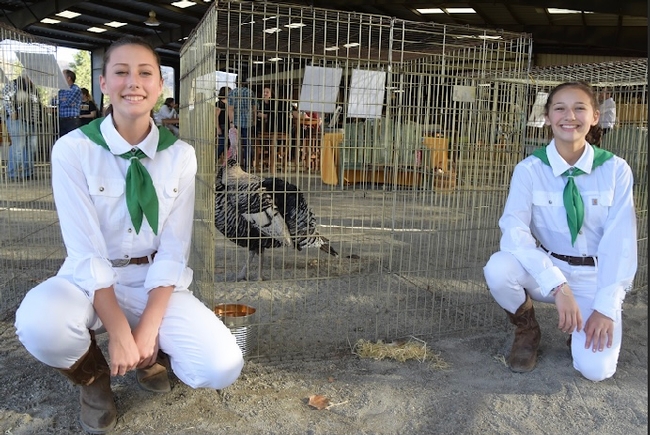
Photo is of 4-H Turkey Growers Brylee Aubin, left and Yaxeli Saiz-Tapia

4-H Youths Raise Turkeys to Save for College and Learn About Farming


By Pam Kan-Rice, UCANR Assistant Director, News and Information Outreach

While most Americans choose their Thanksgiving turkeys from the meat department at the local grocery store, Brylee Aubin and Yaxeli Saiz-Tapia can tell you the life histories of their holiday birds. The Sonoma County teenagers raise heritage turkeys together as part of a 4-H youth development project and sell them for Thanksgiving. For the last two years, Yaxeli’s older brother Uli has joined the project and, between the three of them, they raised 47 turkeys this year.

The Heritage Turkey Project in Sonoma County has about 15 members of the UC Cooperative Extension’s 4-H youth development program and the National FFA Organization growing more than 200 heritage turkeys this year, according to Catherine Thode, who has been leading the project for 15 years.

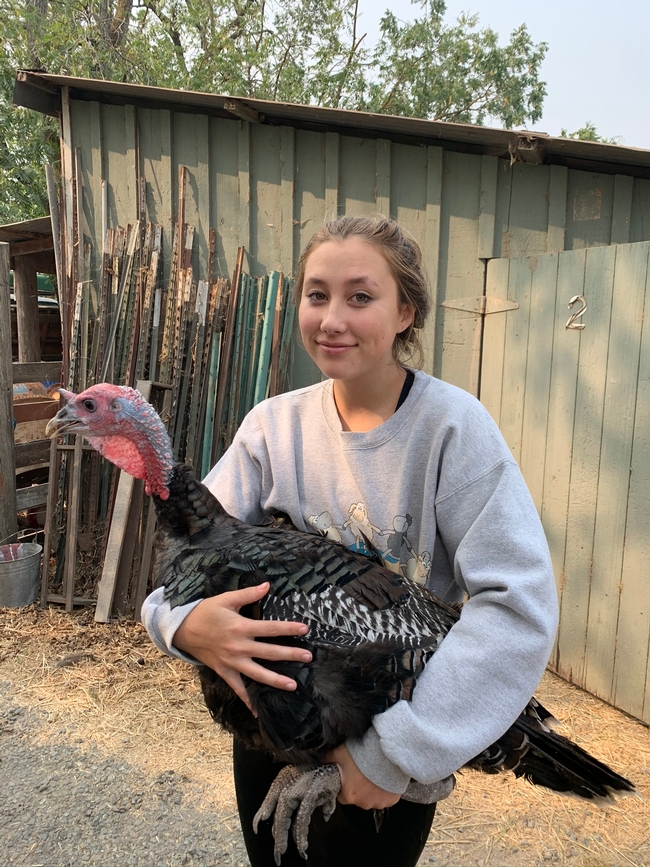
Brylee Aubin holds a heritage breed Turkey

“Our project leaders are active breeders of heritage turkeys and some of our 4-H and FFA youth are now raising breeding pairs and hatching their own birds,” Thode said. “Each project member raises their small flock of birds on their own property and shoulders the responsibility of providing their feed and care.” 

The Heritage Turkey Project promotes the preservation of heritage turkey breeds, sustainable farming and responsible animal husbandry. While raising the animals, the youths learn life skills and earn money for their work.

“The money I raise from raising and selling turkeys goes towards my college fund and to more 4-H projects like market goats or sheep,” said 15-year-old Brylee, who sells her turkeys for $9.50 per pound.

Three years ago, Brylee’s neighbor, Yaxeli joined her in the heritage turkey project.

“I have learned how to care for animals, the importance of raising organic and the costs involved,” said Yaxeli, 14. “I have gained a firm understanding of how my birds are raised and processed versus corporate methods. Having the opportunity to participate in this project has strengthened my value for the importance of where my food comes from.” 

Consumers benefit by getting turkeys that are farmed organically, fed high-quality grains, and never frozen, said Brylee. 

“There are so many benefits to raising these beautiful birds,” said Uli Saiz-Tapia, 17. “First, you learn the cost of running a business, how to reinvest for the next year, the different stages of turkey growth and how to manage issues that arise such as the turkeys fighting, how they react to fluctuating temperatures, how to keep them safe and nourished properly. Learning about the process of getting our turkeys ready to be purchased has really benefitted my understanding of anatomy, the amount of work it takes in preparing them and the importance of not wasting food.” 

The group sold out of turkeys in early November. 

“Back in March, we really wondered if we should even do the project this year, not knowing what was going to happen with COVID restrictions and the impact on the economy,” Thode said. “We ended up with more project members than we’ve ever had, and over 200 turkeys to be sold for the Thanksgiving market.” 

The 4-H members started the season with more turkeys, but lost some birds to predators. Wildfires seemed to drive more predators to the Sonoma County farms this year, she said. 

“Things are fast and furious right now,” Thode said a week before Thanksgiving as the group prepared their turkeys for processing and distribution to people who placed orders. “I’m about to enter the busiest seven days of our year. It will take all weekend to have the birds processed, weighed, labeled. Then, we hunker down to sort and assign turkeys to our customer list.” 

While selling turkeys, the group encourages customers to meet the farmers and to visit https://livestockconservancy.org/index.php/heritage/internal/conservation-priority-list#Turkeys to look up the history and breed characteristics of the turkey they are purchasing. In past years, some customers have taken photos of themselves with the person who raised their bird.

“We not only have a master list of customers and their desired sizes, but we create a spreadsheet for every project member with a list of the turkeys they’ve grown that year,” Thode said. “Each turkey is identified in the spring or early summer with a small metal wing band that lists the grower and an individual number for that turkey. When the turkey is sold, the buyer knows which project number grew their turkey, and the variety of turkey that they are purchasing. We think it’s important that our customers know this. In fact, when they come to pick up their turkey, they write their check to the actual grower of their turkey.”

2020-11-24T14:12:46-08:00November 24th, 2020|

Jim Costa for Ag Committed Supported

U.S. Citrus Industries Support Congressman Jim Costa for Chairman of the U.S. House Agriculture Committee


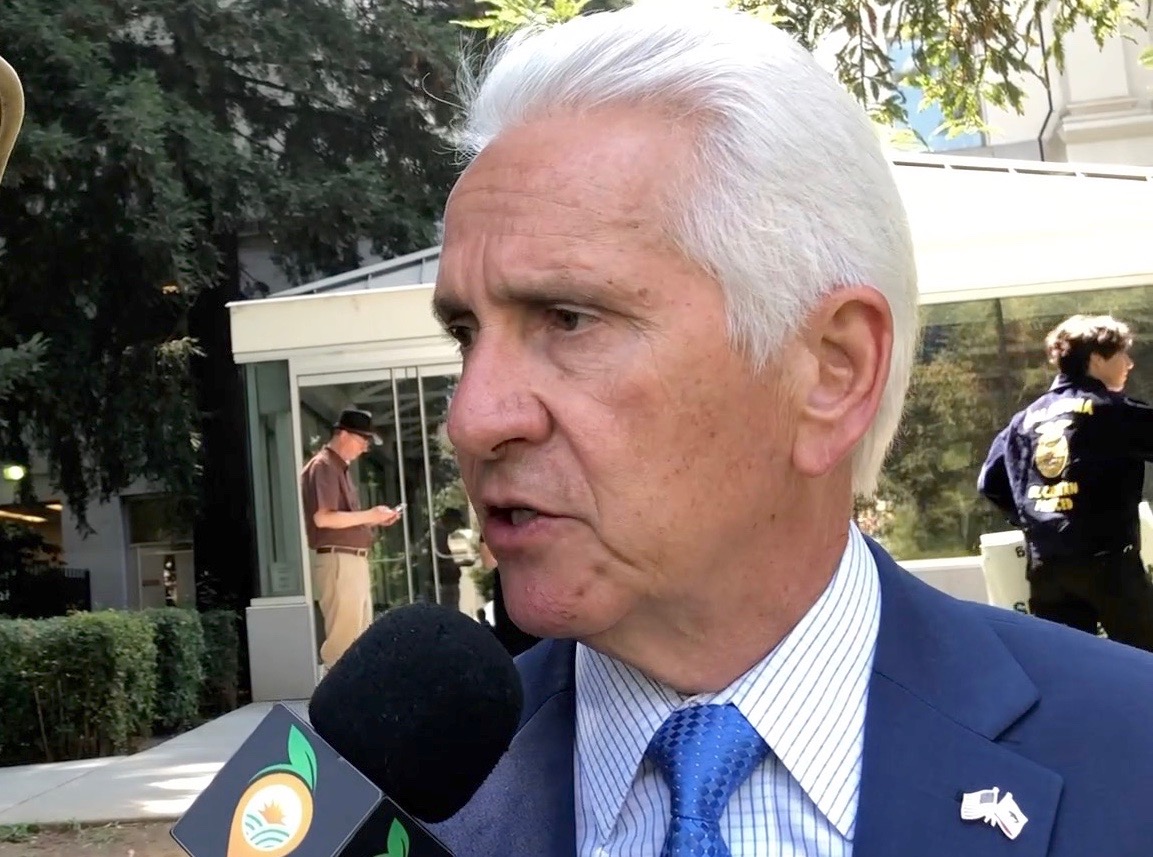
 In a letter dated November 11, 2020, to U.S. House Speaker Nancy Pelosi, California Citrus Mutual (CCM), Florida Citrus Mutual (FCM), and Texas Citrus Mutual (TCM) formally asked that Congressman Jim Costa, D – Fresno, be appointed as the new chair of the House Agriculture Committee.


As a farmer himself, Congressman Costa understands the industry’s issues, such as pest and disease, trade, water, and immigration. Notably, Congressman Costa was instrumental in securing federal funding to support research to find a cure for the devastating citrus disease Huanglongbing.


Congressman Costa’s track record of support for the citrus industry and specialty crops is indisputable. He has led countless bipartisan efforts on behalf of agriculture and rural America.


“The House Agriculture Committee needs a leader who understands its importance not only for our farmers, but for underserved communities, and national security,” says CCM President/CEO Casey Creamer. “Congressman Jim Costa is that leader, and we are proud to offer our strong support.”


“U.S. agriculture, especially fruit and vegetable growers, are at a crossroad. Increasing production costs coupled with unregulated imports, place the U.S. grower in a desperate situation. I am confident that if appointed Chair, Congressman Jim Costa will be a leader for agriculture in addressing these and other critical issues that affect growers and rural communities across the country,” said  Michael W. Sparks, CEO of Florida Citrus Mutual.


“The agricultural industry within Congressman Jim Costa’s district is very similar to specialty crops, including citrus within Texas, making him well versed in many of the issues that affect our growers,” says Dale Murden, President of Texas Mutual. “Citrus Greening is a major concern for the Texas citrus industry, and we know Congressman Costa understands the issue well, and we are proud to support him.”


We trust that Congressman Costa will lead the committee with his years of experience and dedication to agriculture in California and the United States.

2020-11-19T13:45:29-08:00November 19th, 2020|
Go to Top