About California Ag Today

This author has not yet filled in any details.
So far California Ag Today has created 2014 blog entries.

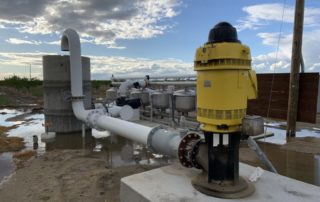
Dairy Waste Turns To Electricity


Dairy Generates Electricity

By Tim Hammerich with the Ag Information Network

A lot of great things come from your local dairy: milk, cheese, and ice cream, just to name a few. But some dairy producers like Modesto-based Brian Fiscalini are also supplying their community with electricity.

“What we do is we collect the waste from our farm. So we collect all of the cow manure, we collect any spoiled feed, and then we also bring in a few waste streams from other industries that would normally either go into a landfill or would have to travel quite far for someone to be able to process,” said Fiscalini.

This waste is stored in concrete tanks and the lid captures methane gas.

“Then what we do is we convert that methane gas, with the help of an internal combustion engine, into electricity. So that electricity is used to power our facility as well as selling electricity to our local utility, which equates to enough power to take care of 300 homes in our community,” noted Fiscalini.

This is one more way that our California farmers are providing us with delicious food, and a whole lot more.


2021-01-11T16:47:17-08:00January 11th, 2021|

SGMA Workshop Jan. 13 and 14

SGMA Workshop To Voice Concerns

There will be a SGMA and Land Use Workshop (via Zoom) January 13 5PM for English speakers and January 14 5pm for Spanish Speakers.

This is for San Joaquin Valley farmers and community members to voice concerns about SGMA and share their visions of future landscapes in their community.


2021-01-10T12:46:01-08:00January 8th, 2021|

The Quick Math on Navel Orangeworm

The Math on Navel Orangeworm Sanitation

By Patrick Cavanaugh, with AgInformation Network

Get a napkin out. Let’s do some math on navel orangeworm sanitation. The numbers really matter.

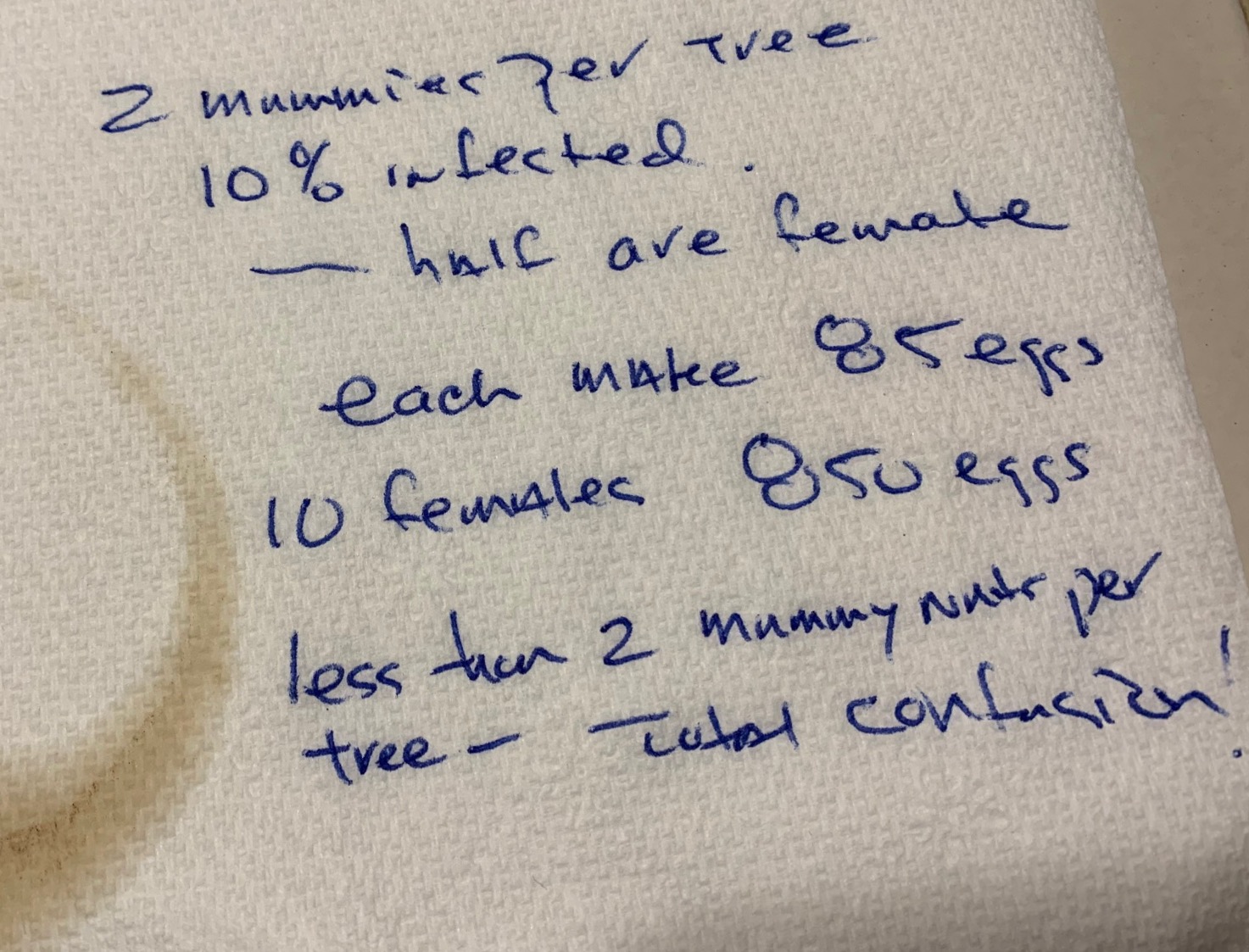
David Haviland is a UCANR Cooperative Extension Entomologist in Kern County. “I just want to do a little bit of a back of a napkin math. Just think about this scenario. If you’re down to two mummies per tree, if 10% of those were infested, you assume that half of any worms in there are going to be females. And each of those females, when it comes out, it’s going to make 85 eggs. Just roughly look at that scenario,” noted Haviland.

“In that case within an acre, you’re going to have 10 females that are all coming out at different times that are all competing to lay 850 eggs. And they’re trying to do that in 200 nuts. They’re also trying to find mates in the process,” explained Haviland.

“And if you think about it, each one of those females, in order to lay 85 eggs, they have to find a nut in a tree, fly around the tree, find another nut, lay an egg, and so on. They literally have to fly to 42 different trees to lay one egg in each nut, if you’re down to two nuts per tree,” he said.

And that’s the goal with sanitation, no more than two mummy nuts per tree. “So, you know, all that’s being done uncoordinated, of course, sometimes they’re flying back to the same nuts. Sometimes there’s a nut that isn’t even suitable. Sometimes there’s already an egg in that nut,” Haviland said.

Haviland noted: You’re just creating a lot of chaos! “When you can get under two mummies per tree,” he said.

“And when you think about it, any egg that you prevent from being laid in May is one less moth at hull split. So, sanitation is extremely important and we do recommend that everybody do their best attempt,” he said.

2021-01-07T18:13:24-08:00January 7th, 2021|

Lower Almond Prices Will Promote Big Sales

How to View Lower Almond Prices

By Patrick Cavanaugh, with the AgInformation Network

Lower prices should help move them quickly around the world, said Dan Sumner a Distinguished Professor in the Department of Agricultural and Resource Economics, and the director of the UC Agricultural Issues Center at UC Davis. He thinks that lower price of almonds will not last long, but in the meantime, it’ll help move the crop around the world—a hungry world for almonds!

“A little price moderation will help you move the crop. And we’ve got a big world out there,” said Sumner. “We’ve got income growth in other countries over the longer haul. We’ll see how tough it is over the next few years,” he said.

“We think about our problem with COVID and our economy and our government spent….. If I can say it….trillions keeping money in the hands of consumers, keeping people employed to the extent that it was possible, but the rest of the world who can still buy some of our almonds have also been hit. So, if you look at Europe, their economy’s been hit as bad as ours. That’s a big market for our almonds,” said Sumner.

Sumner spoke about India, new big market for California almonds

“Of course only the higher income Indians can afford almonds, the very poorest to the Indians couldn’t buy our almonds, but you know, you get well over a billion people and you can get a few hundred million in a kind of a middle-class that can buy our crops, and so India is a good market,” Sumner noted. “But they’ve been hit by the COVID pandemic as well.”

“Regarding almond pricing? It’s going to be tough over a year or two. It seems to me,” Sumner said.

2021-01-06T18:31:33-08:00January 6th, 2021|

High Density Avocado Farming

New Avocado Study Outlines Costs/Returns of High-Density Plantings

By Pam Kan-Rice  UCANR Assistant Director, News and Information Outreach

Growers considering producing avocados in San Diego County with high-density plantings now have help to determine the economic feasibility. A new study on the costs and returns of establishing and producing avocados in San Diego County has been released by UC Agriculture and Natural Resources’ Cooperative Extension, UC Agricultural Issues Center and the UC Davis Department of Agricultural and Resource Economics.

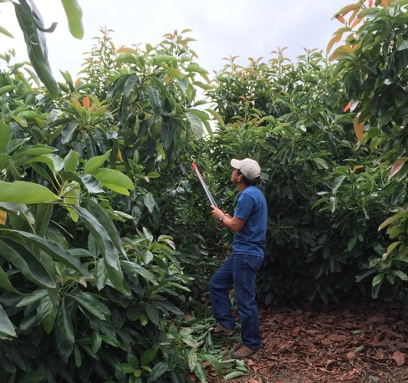
UCANR Cooperative Extension Advisor Gary Bender, checks sunlight penetration in a high-density avocado orchard.

Avocado has been one of the prominent crops produced in Southern California since the early 1950s. California avocado production peaked in 1987-88 with about 76,300 acres. San Diego had been the leading producer accounting for about 60% of the acreage.

“Beginning in the early 1980s, there has been a continuous decline of acreage and production of avocados in San Diego County, said Etaferahu Takele, UC Cooperative Extension farm management advisor for Southern California and co-author of the study. “This is mainly because of the expansion of urban development that has increased the cost of producing the crop and especially the cost of water, reaching to up to $2,000 per acre feet in 2020.”

High-density planting increases profitability of avocado production given there is suitable land for high-density orchard development.

Although the cost of water accounts for 44% of the total production cost in the high-density planting, the water cost is proportionally less than in the conventional planting of 145 trees per acre when distributed over a higher yield per acre, the authors write.

Their cost analysis describes production operations for avocados planted at 430 trees per acre, with an expected life span of 40 years. The study includes a detailed summary of costs and returns and a profitability analysis of gross margin, economic profit and a break-even ranging analysis table, which shows profits over a range of prices and yields. Growers can identify their gross margin and returns to management based on their yield and prices received.

Input and reviews were provided by a UC Cooperative Extension farm advisor and grower cooperators in San Diego County. The authors describe the assumptions used to identify current costs for avocado establishment and production, material inputs, cash and non-cash overhead.

The new study, “Avocado  Establishment and  Production Costs and Profitability Analysis in High Density Planting, San Diego County-2020,” can be downloaded for free from the UC Davis Department of Agricultural and Resource Economics website at http://coststudies.ucdavis.edu and UCCE Riverside County Farm Management website at https://ucanr.edu/sites/Farm_Management/Costs_and_Returns. Sample cost of production studies for many other commodities are also available on the websites.

For additional information or an explanation of the calculations used in the studies, refer to the “Assumptions” section of the report or contact Takele at (951) 683-6491 Ext. 243 or ettakele@ucanr.edu or Donald Stewart at the UC Agricultural Issues Center at destewart@ucdavis.edu.

2021-01-05T19:11:54-08:00January 5th, 2021|

Farmwise Bringing Automation to the Vegetable Field

Automation in Vegetable Crops

By Tim Hammerich with the AgInformationNetwork

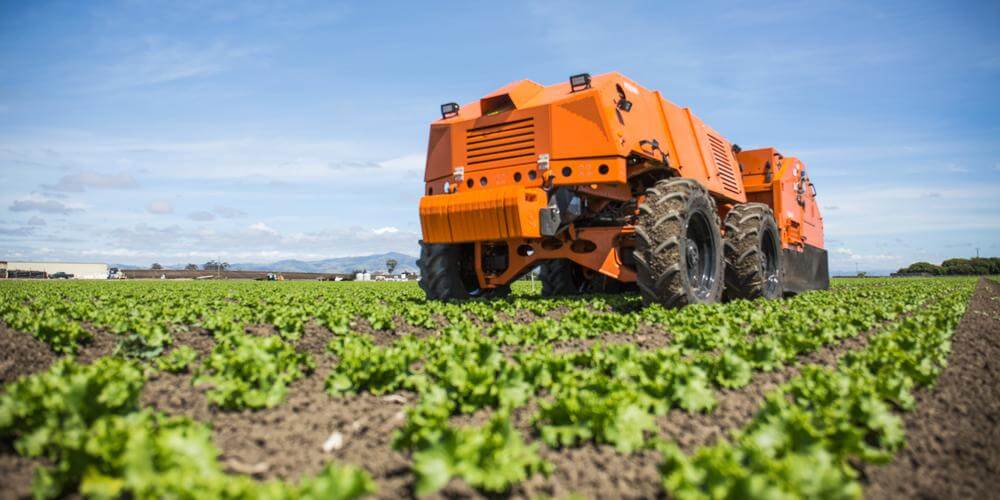
Farmers are being squeezed between the scarcity of labor and the regulation of tools to try to do their job most efficiently. Some companies, like San Francisco-based Farmwise, think automation is the answer. Here is co founder and CEO Sebastian Boyer.

“The number of people willing and able to do manual tasks on the field is obviously shrinking. And that’s a big concern for most of U.S. farmers today. Automation can play a big role in making every one of these workers much more productive. And that leads to more productivity in the field, but also better jobs and better wages for these workers,” noted Boyer

Boyer says a more automated farm will also enable more data collection which could lead to further efficiencies.

“And a lot of that that has to do with the ability for machines to capture data on crops. And we’re actually at Farmwise, leveraging that technology to make every one of our machines not only automating the tasks that we’re here to automate, but using that as a way to capture unique data about the crops,” Boyer said.  “And that’s becoming increasingly relevant for farmers. We can use that data to make better decisions at the strategic level, and at the field level.”

Farmwise offers automation technology to vegetable growers in California and Arizona. Learn more at Farmwise.io.

2021-01-04T09:56:21-08:00January 4th, 2021|

Improving Food Safety

Government, Academia and Farmers Join Forces to Improve Food Safety

By  April Ward, LGMA Director of Marketing and Communication

On November 19, 2020 the U.S. Food and Drug Administration announced the launch of a longitudinal study in partnership with the California Department of Food and Agriculture (CDFA), University of California Davis, Western Center for Food Safety (WCFS) and agricultural stakeholders in the Central Coast of California.

In recent years several E. coli O157:H7 outbreaks have been linked to lettuce. In an effort to find the cause of these outbreaks and arm farmers with a way to prevent them, this multi-year project will examine how pathogens survive and move through the environment and possibly contaminate produce. FDA will work closely with water quality, food safety, and agricultural experts, representatives from various agriculture industries, and members of the leafy greens industry.

As a part of the project, research teams will aim to determine potential sources of contamination by collecting and examining samples from the environment including adjacent lands, well and surface waters, soil inputs that include compost, dust and animal fecal samples.

U.S. FDA:

The findings from this study will contribute new knowledge on how various environmental factors may influence bacterial persistence and distribution in this region, and how those factors may impact the risk of leafy greens becoming contaminated. Results from this collaboration will lead to improved practices to prevent or mitigate food safety risks, and ultimately enhance the safety of leafy greens grown in California.

CDFA Secretary Karen Ross:

California leads the world in leafy greens production and innovation. Industry and food safety officials are proud to partner on this in-depth scientific study protecting public health.

Dan Sutton, Chairman of the California LGMA and General Manager of Pismo Oceano Vegetable Exchange:

The California LGMA completely supports this joint effort spearheaded by the U.S. Food and Drug Administration. LGMA members are committed to safe leafy greens and look forward to any findings that will help to make our crops safer for consumers. We are pleased to see wide participation from industry, academia and regulators. All of these stakeholders bring different strengths to the project and share a common goal of improving food safety for lettuce and leafy greens.

A similar study is being conducted in the Yuma, Arizona growing region.

2021-01-06T18:27:55-08:00December 30th, 2020|

Food Systems Continue for Consumers

Food Systems Remain Flexible Through the Pandemic


By Tim Hammerich with Ag Information Network

Throughout the pandemic we have occasionally been bringing you updates on how our agricultural and food systems are impacted. Here is another update courtesy of the California Farm Bureau Federation.

As the food system continues adjusting to changes caused by the COVID-19 pandemic, marketers say the system has proven resilient so far. Supply chains have had to adapt as restaurants and other food-service facilities have been restricted or closed. The changes have tested food supplies and forced farmers and marketers to reconfigure some operations. But people involved in the food system say they’ve remained flexible to try to match demand and supplies.

The vitamin C content of citrus fruit has helped boost its popularity during the pandemic, and farmers who grow mandarins say they’ve seen more demand for their fruit. California Citrus Mutual says it expects increased volumes for this year’s mandarin harvest, which began last month and will continue for several more weeks. Recent cool, wet weather has helped the fruit gain color, and farmers say they’re expecting a good mandarin season.

College graduates with degrees in agriculture can expect strong job demand, according to a new report. The study estimates steady growth in job opportunities for agricultural graduates, and that employer demand for the available graduates will exceed supply. Although the study began before the pandemic, the report’s authors say they’re confident demand for agricultural graduates will remain “strong and steady.”

2020-12-29T18:02:21-08:00December 29th, 2020|

Jeff Dahlberg Retires from KARE

Director of the UC Kearney Research and Extension Center retires

UC Cooperative Extension specialist Jeff Dahlberg, also the director of the UC Kearney Agricultural Research and Extension Center (KARE) in Parlier, invoked his 35 years of sorghum expertise to increasing interest in growing the crop in California and to better understanding plants’ ability to tolerate drought. Dahlberg retires Jan. 8.

As a Peace Corps volunteer in Niger in the early 1980s, Dahlberg was intrigued by sorghum, a staple food being cultivated by the country’s vast population of subsistence farmers.

“I was impressed with the fact that sorghum was so drought tolerant,” Dahlberg said. “Nigerien farmers relied solely on rain for their sorghum and millet crops.”

Upon returning to the U.S., he earned a master’s degree at the University of Arizona and a Ph.D. at Texas A&M, where his research focused on sorghum. He worked with the USDA Agricultural Research Service in Puerto Rico for 7 years and then spent the next 10 years as research director with the National Sorghum Producers in Lubbock, Texas.

When Dahlberg took the helm of the 330-acre UC agricultural research center in 2010, he and colleagues at the UC West Side Research and Extension Center and at UC Davis began conducting sorghum forage variety trials. Sorghum wasn’t new to California. In the past, it had mainly been used for animal feed. But Dahlberg believed the crop’s adaptability – excellent for forage, biofuels and gluten-free human food – offered the grain a rosy future in the Golden State.

“With our research, we have provided California farmers who are thinking about growing sorghum access to locally generated, research-based information to help them make the decision,” Dahlberg said.

In 2015, Dahlberg and UC Berkeley specialist Peggy Lemaux launched a sweeping drought research project at KARE. The five-year study, funded with a $12.3 million grant from the Department of Energy, researched the genetics of drought tolerance in sorghum and how soil microbial communities interacted with sorghum roots to battle drought stress.

A journal article published in Proceedings of the National Academy of Sciences in 2018 presented the first detailed look at the role of drought in restructuring the root microbiome. The plant switches some genes on and some genes off when it detects water scarcity and access to water.

“That has implications for feeding the world, particularly considering the changing climate and weather patterns,” Dahlberg said.

In recent years, Dahlberg helped reestablish tea research at Kearney, initiated nearly 60 years ago in a study funded by Thomas J. Lipton, Inc. At the time, Lipton was seeking to grow tea for the instant tea market. When the Kearney tea research program was scrapped in 1981, a researcher had a handful of the best tea clones planted in the landscape around buildings at Kearney.

Those shrubs became the basis for a new tea research trial planted at Kearney in 2017 with UC Davis professor Jackie Gervay Hague to determine whether drought stress impacts the production of phenolics and tannins in the tea.

“We know we can grow good tea here and we can grow high tonnage,” Dahlberg said. “We want to determine if we can do that on a consistent basis and whether we can improve tea quality through irrigation management.”

In retirement, Dahlberg plans to relocate to Lake Ann, Mich., to be close to family. UC Cooperative Extension irrigation specialist Khaled Bali will serve as interim director of the UC Kearney Agricultural Research and Extension Center.

2020-12-28T18:21:37-08:00December 28th, 2020|

Technology Helping Calif. Wineries Thrive

Technology is Paving the Way for Better California Wines

By Erica Smith, California Ag Today Contributor

California makes great wine every year. In fact, the state is the world’s fourth-largest producer of wine. Eighty percent of American wine is produced in California. Many of the most coveted wines are made in California. As such, when it comes to innovations in winery and grape harvest, California also has that handled.

Here’s how technology is helping California create better wines.

Drones

One of the first drones to hover over Californian vineyards was seen above the Santa Lucia Highlands in 2016. It’s the location of the Hahn Estate Winery. Equipped with multispectral sensors, the drone monitored the vineyard’s health, gathering data in aspects like canopy cover, temperature, and moisture. And they’ve long since improved their drones’ capabilities, as they can now analyze pathogens and yield estimates. In recent months, other vineyards like Bennett Valley and Jackson Family Wines have begun to adopt drone technology as well.

Mechanized Vineyards

Humans are able to discern which grapes are ripe enough for the picking. However, mechanized vineyards can also do this to an extent, and without the added labor costs. With the vintner’s knowledge on optimum ripeness (which tools like drones can help them arrive at), they can order the mechanized picking of their grapes. Wilson Vineyards in Clarksburg does this and even found that the hot weather didn’t affect their yields as much. This is because the machines can harvest at night when it’s cooler, giving the grapes a more pleasant taste.

Self-Driving Tractors

Self-driving vehicles don’t just belong on the public roads. The world’s first autonomous electric tractor is proof of this. This smart vehicle can be trained to plow, cultivate, and fertilize vineyard areas automatically. And since it’s automated, the cultivation is more standardized. It’s taught and controlled via an app until it eventually remembers the patterns. Monarch Tractor, the Californian startup responsible, is starting production and releasing it to the market next year.

Incidentally, these technologies are not only boosting the quality and production of existing vineyards—but they’re also encouraging aspiring vintners to invest in their own winery. As mentioned, between staff training and the number of people needed to harvest quality grapes, labor is one of the biggest expenses involved in launching and operating a vineyard. In fact, startup costs range from $560,000 to over $2 million, making the industry intimidating to those just starting out. Fortunately, while machines do require a big initial cost, their efficiency saves vintners more in the long-run.

Similarly, with state vineyards being significantly affected by droughts, wildfires, and the COVID-19 pandemic, technology’s subsequent boosts in business, productivity, and savings are more important than ever. For example, a mechanized harvested vineyard can also help vintners quickly harvest their grapes before a big storm hits.

Overall, even with more competition, the quality wines produced by California vintners  is allowing them to increase their presence in the global wine industry.

2020-12-23T18:38:28-08:00December 23rd, 2020|
Go to Top