About California Ag Today

This author has not yet filled in any details.
So far California Ag Today has created 2014 blog entries.

CA Table Grapes Projects 109 Million Boxes in Volume into January 2020

Normal Volume Projected for California Table Grape Crop, Supplies into January

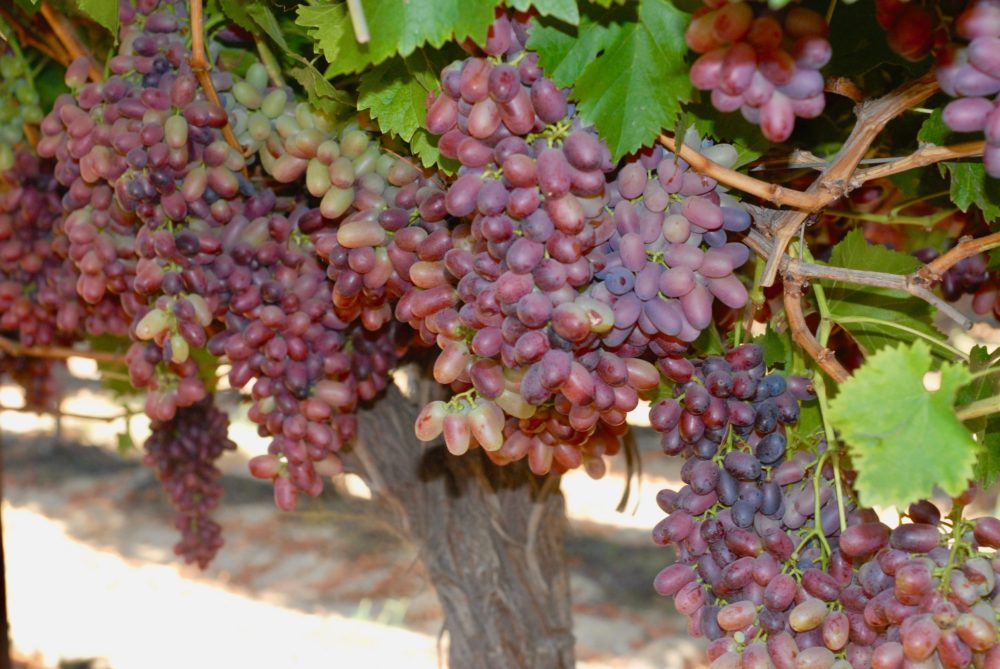
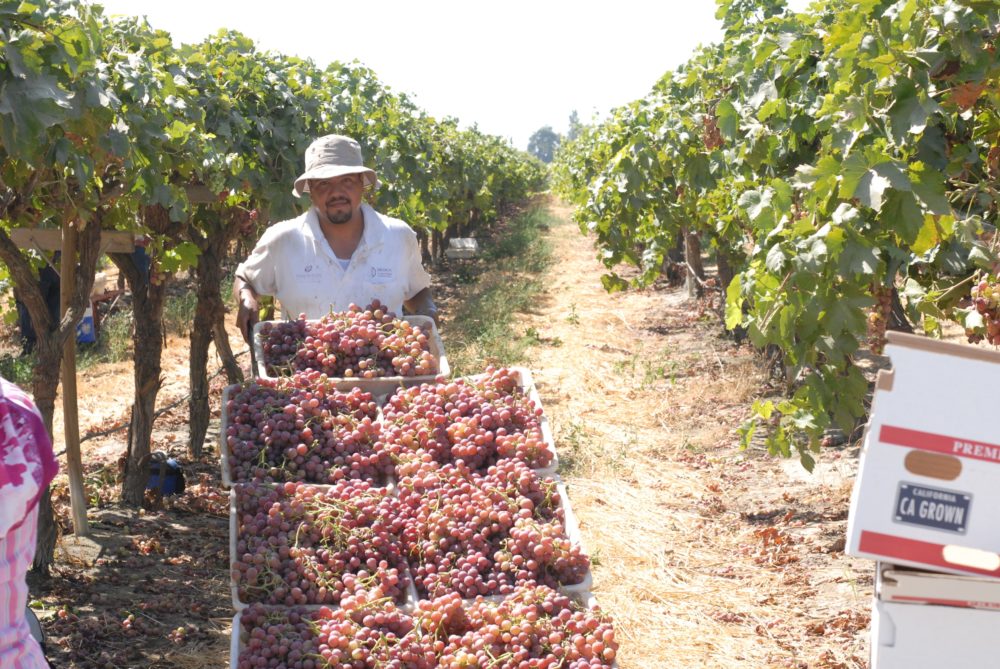
The California Table Grape Commission recently assessed crop volume and projected a final total of 109 million 19-pound boxes with shipments continuing into January. With 40 to 50 percent of the California table grape crop typically shipping after October 1, Kathleen Nave, president of the commission, notes that grapes are very definitely a fall and early winter fruit.

“Grapes from California are stunningly beautiful, full of flavor and phytonutrients, and are both a healthy, anytime snack and a simple, awe-inspiring ingredient,” said Nave. Suggesting that fall is the time to search out new uses and try varieties that are unfamiliar, Nave recommends checking out the extensive collection of traditional and on-trend usage ideas at www.grapesfromcalifornia.com.

In speaking about the crop, Nave noted that in July California table grape growers thought they had the third-largest crop in history hanging in their vineyards but, recent assessments indicate the crop is in the normal range of 109 million 19-pound boxes, similar in size to the crops of 2014 through 2017.

Noting that there comes a point when retailers can offer imported grapes to their customers instead of sticking with California-grown grapes, Nave said the commission will continue working with retailers to promote the crop and will encourage them to carry California grapes into January.
2019-10-09T16:57:48-07:00October 9th, 2019|

A call To Trump Administration to Reduce Swamp Rats

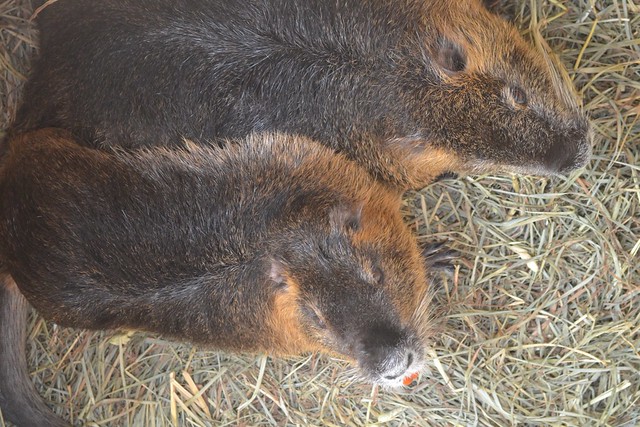
Central Valley Faces Threat from Invasive Swamp Rats: Without Action, State Could be Infested Within Five Years


Representative Josh Harder (CA-10) is calling on the Trump Administration to reverse its plan to disband the National Invasive Species Council (NISC), which unifies all federal efforts to combat invasive species into a single body.

Over a dozen federal agencies and organizations share responsibility for combating invasive species, making the NISC one of the most important tools in the fight against these threats. In a letter, Rep. Harder noted the mounting challenge his district faces regarding the nutria, an invasive species and giant rodent – originally from South America – which can cause substantial economic and ecological damage.

The text of the letter is below, and an original copy is available here.

I write today regarding reports that the administration plans to defund and disband the National Invasive Species Council (NISC). I urge the Administration to reconsider this course of action given the importance of this council for combatting invasive species, including nutria in California and across the country in other nutria-impacted states.

My district in California’s Central Valley is facing an invasion by the nutria, an invasive species of rodent originally from South America.  Disbanding this important committee may have detrimental effects on the local and national effort to stop the nutria.

Nutria threaten local farmers, water infrastructure, and indigenous wildlife. They can weigh up to forty pounds, eat a quarter of their body weight every day, and reproduce at a shocking rate. One female nutria can result in 200 offspring in a single year. The California Department of Fish and Wildlife reports that without aggressive action to contain the species, the population of nutria in California could explode to 250,000 nutria within five years.


The ramifications of undermining or slowing down this effort could be costly for the state and federal government. This is an extreme situation. We require the full force of all federal partners in this fight. Disbanding the NISC when we face such an imminent threat is imprudent.

As you know, over a dozen different agencies and organizations within the federal government are responsible for sharing the fight on invasive species.  The NISC unifies all of these disparate efforts and also provides high-level expertise through the NISC’s Secretariat. The full-time professional staff at the Secretariat produce high-quality training materials that help partner departments in their efforts to stop invasive species. This is all done at a low-cost to the taxpayer that yields a valuable impact to local communities.

California is in the fight of its life against a giant, invasive swamp rat. This is not the time to disband the federal body charged with leading the charge against invasive species. I respectfully ask you to reconsider this decision without delay.

Rep. Harder is leading federal efforts to stop the onslaught of nutria in California’s Central Valley. In June, he introduced legislation to reauthorize the Nutria Eradication and Control Act of 2003, which was considered successful in the Chesapeake Bay. The bill would direct $7 million in funding towards management of the species in California. Programs supported by the bill encourage habitat protection, education, research, monitoring, and capacity building to provide for the long-term protection of wetlands from destruction caused by nutria. 

Without help, it’s estimated that there could be up to 250,000 Nutria in California within five years. Nutria were originally introduced to the United States as part of the fur trade in the late 1800s but were eradicated from California in the 1970s. The species was rediscovered in the Central Valley in 2017. Nearly 700 nutria have been removed from the Central Valley since this first sighting. They can devour up to 25 percent of their body weight daily and have up to 200 offspring per year.


2019-10-03T11:58:50-07:00October 9th, 2019|

Summer Annual Weeds Need Control Now

Avoid Allowing Summer Annual Weeds Going to Seed

By Chris McDonald UCANR Inland and Desert Natural Resources Advisor, San Bernardino County

As the summer heat is finally nearing its end, and its officially fall on the calendar, there unfortunately is a new crop of weeds flowering right now. Some of our summer annuls have started to go to seed, others are just about ready, and others are already starting to senesce. In order to manage these weeds, managers must stop the plants from reproducing. With our summer annuals that means stopping the plants from producing seeds, right about now, (or maybe three weeks ago).

However, treating a giant tumbleweed right now isn’t really my favorite activity. I’d rather spend my time treating small tumbleweeds and working more effectively and also using less labor and/or herbicides to do it in the process. (Well I’d rather not have any tumbleweed in the first place.)

If treating the weeds when they are small is more efficient and uses less pesticides, when can we treat them at the smallest? To answer this, we need to know when our summer annuals germinate. When do our summer annuals germinate? There are several different germination periods for ‘summer’ annuals. Some of our summer annuals actually germinate in the winter to early spring from January to March, others germinate in the spring from March through May.

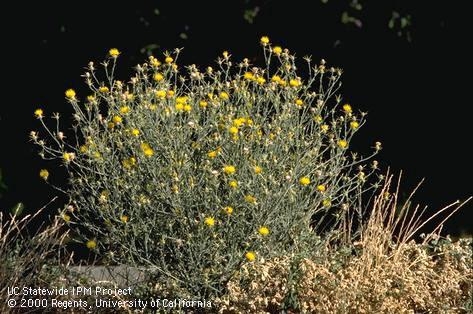
Weeds like yellow star thistle and stinkwort germinate in the winter from January to March. Tumbleweed and goat’s head germinate in the spring (March to May). Despite their different starting times, they will all grow during the late spring and summer as small plants hiding under a crop of larger weeds or in open areas, until they get large enough in the mid-summer to grow tall and more noticeable than our long dead winter weeds.

Other summer annual weeds, like spurges (such as spotted spurge,Euphorbia maculata, and also some other spurges), can germinate throughout the spring and summer as long as the soil is moist and warm. This summer annual can be much shorter lived than the other summer annuals mentioned above. In the desert, spurges might germinate after a monsoon, in other locations they might germinate in areas that have been irrigated or receive a little extra moisture or where the soil is moist.

The summer annuals on your property might be growing right now because of insufficient weed management in the winter and the spring! Other summer annuals might have germinated with the onset of high temperatures and need to be controlled in the early summer.

This pattern does not hold true for all species and all conditions, especially if irrigation continues throughout the spring and summer, or if there is a late spring storm or if summer monsoons deliver rains early. Sometimes even some of our winter annuals which should have flowered in February to April, germinate late in the season, and flower in June. It’s unusual and it does also happen.

If you can figure out what species of summer annual weed you have, then you may be able to figure out when it germinated and prioritize your weed treatments for that time period, in the winter and spring for some species and in the heat of summer for other species. Hopefully you will save yourself some time instead of letting them all grow into bigger and harder to treat summer annuals.

2021-05-12T11:01:46-07:00October 8th, 2019|

Seeking a Better Understanding Regarding Cannabis Production

Survey Helps UC  Understand Cannabis Production Challenges in State

By Patrick Cavanaugh, Editor

Results from a UC Cooperative Extension survey of registered and unregistered marijuana (cannabis) growers in California will help researchers, policy makers and the public better understand growing practices since cannabis sales, possession and cultivation first became legal for recreational use.

“This survey is a starting point from which UC scientists could build research and extension programs, if possible in the future,” said lead author Houston Wilson, UCCE specialist with UC Riverside. A report on the survey results was published in the July-December 2019 issue of California Agriculture journal, the research publication of UC Agriculture and Natural Resources.

Houston Wilson, UC Riverside Entomologist

The idea of the online survey, during the summer of 2018, was to characterize broadly the production practices that were being employed,” said Wilson

Wilson noted that since he is an entomologist, there were certainly questions about pest management, so the survey was more broad. “It included questions about style of production, plant density, harvest frequency, water use, diseases, and even labor and licensing,” Wilson said.

The survey was conducted by a collaborative group of scientists. Project co-authors were UC Berkeley visiting scholar Hekia Bodwitch, Nature Conservancy senior scientist Jennifer Carah, UCCE biocontrol specialist Kent Daane, UCCE natural resources specialist Christy Getz, UCCE climate and water specialist Theodore Grantham and UCCE land use science specialist Van Butsic. Daane, Getz, Grantham and Van Butsic are affiliated with UC Berkeley.

The survey went to numerous growers via large grower organizations that are present in California. There were more than 100 respondents, and the researchers were able to use that data to characterize some of the production practices.

“As an entomologist, I was interested in the pest management aspects, and we got a kind of array of different insects that growers are dealing with and how they’re dealing with it,” said Wilson.

UC is Restricted To Help Cannabis Growers

The big limitation that’s on the university right now is it’s ability to actually physically visit farms, and talk to growers, and collect insects and sample plant materials. It’s not legal for research institution because of the federal support that the university receives. “So a remote online survey, was the best approach that we found to do this, at least at this stage,” said Wilson.

We’ve shown the data to the grower groups that we’re in contact with, and for the most part they’ve agreed that that it matches what they’re seeing. “We don’t think it’s a really skewed dataset, but we certainly need more detail in each of those areas of emphasis,” said Wilson. “What I’d like to do now is figure out a way to actually collect insects from some of these cannabis operations to confirm or deny the pest species that were indicated by the survey.”

One way to do that is find some opportunities with grower collaborators to have them collect the insects themselves and then bring that back to researchers. “We’re allowed to handle the insects, but we certainly can’t have any plant material on campus right now,” Wilson said.

“Like any cropping system you’re going to have insect problems. Generally speaking, cannabis production takes place indoor and outdoor, and those are in and of themselves going to have different pest complexes and different management options available to them,” noted Wilson. “But again, this similarly applies to other crops that are grown in or outdoors. So there’s kind of gray literature or white literature, whatever you want to call it, about cannabis production and pest management in particular.”

There is cannabis production information in books and online forums that have been published by non-university personnel. “There’s some good information, and there’s a lot of misinformation. However many of these growers have a lot of experience as they they’ve been growing, in some of these areas, for over 40 years,” Wilson said.

Ironically, cannabis is seen as new crop for university researchers, as if it’s a new type of apple. “So in that regard, we’re just trying to characterize how the crop is produced, and find out what are some of the basic agronomic features of it, what are the pest pressures, and how would you manage that,” said Wilson.

“The fact that it’s been this underground production model for so long is that when we come into the situation, and in my interactions with growers to date, I immediately acknowledge that I understand that they have a lot of experience with this crop. And I think these growers have a lot of knowledge about agronomic features, including the entomology aspects of it,” said Wilson.

As for the future UC work in the cannabis world—it’s to be determined.It certainly a secondary if not tertiary objective for me, he said.I work in perennial orchards and vineyard, so cannabis is very much outside what I am focused on, he said.But there was an opportunity to do a survey and so we did it.

The article in the UC California Agriculture journal is comprehensive look at who is doing what in the state right now with cannabis production. “Our production survey was certainly front and center in there as a background piece. And there were other articles that were getting into a specific issue with labor, or licensing, or other areas. Water use is a huge issue, as it is with any crop in California,” said Wilson.

Wilson noted that if cannabis were to become legal at the federal level, you might envision a future where UC creates a position that includes cannabis or is even specifically focused on that in terms of agronomic issues.

Highlights of Survey Findings

  • Growing outdoors in open air with sunlight was the most common practice (41%). Twenty-five percent of growers combined outdoor and greenhouse production. Just 10% said they grow the crop entirely within greenhouses.
  • Total yield per plant varied by growing location. Outdoor crops yielded on average 2.51 pounds per plant (about 40 ounces per plant), greenhouse crops yielded about 10 ounces per plant, while plants grown indoors with artificial light averaged about 3 ounces per plant.
  • The average growing season for outdoor growers was 190 days and they harvested one crop per year.
  • In the fall of 2017, the average cannabis sales price was $853 per pound for flowers and $78 per pound for leaves and other non-flower parts.
  • The respondents reported using no synthetic pesticides in their cultivation of the crop, suggesting reliance on organic pesticides, biologicals and biocontrol.
  • Most growers reported that groundwater was their primary water source for irrigation. Of those, 97% of the water extraction happened from June to October. Many growers said adding water storage was either cost prohibitive or limited by regulatory constraints.
  • Growers reported using more than 30 different soil amendments and foliar nutrient sprays. The most common was organic fertilizer, followed by composts and various animal manures and meals, compost tea and worm castings.
  • Growers are dealing with 14 different insect pests, 13 diseases and nine vertebrate pests, including gophers, mice, rats, deer and wild boars.
  • Powdery mildew was the most commonly reported disease, and mites, thrips and aphids were the most commonly reported insect pests.
  • Growers who hired laborers for harvest paid a per-pound piece rate from $50 to $200. The growers who hired seasonal hourly workers offered a starting pay of $15 to $20 per hour.

2021-05-12T11:01:46-07:00October 7th, 2019|

Table Grape Commission Adds Montalvo

California Table Grape Commission Adds Maria Montalvo as New Marketing Director

Maria Montalvo is the new marketing director of retail and foodservice promotion for the California Table Grape Commission. Montalvo’s responsibilities include leading the in-store promotion initiatives and communication strategies needed to help move California table grapes through the U.S. and Canadian markets.

“We are very excited Maria has joined the team,” said Kathleen Nave, president of the commission. “Maria’s background and experience in promotion and sales, and her extensive work promoting products in the Hispanic community will be key to the development of retail promotional campaigns in the seasons to come.”

Maria Montalvo

Montalvo has 15 years of experience in marketing, promotion, and sales. Maria joins the commission from Sinclair Systems International where she served as the global marketing manager. According to Nave, Montalvo will primarily focus on developing retail promotion and communication strategies to drive California table grape sales. Montalvo will be part of a four-member retail team and will manage numerous retail accounts.

Montalvo is a California native, born and raised in the San Joaquin Valley. She is a graduate of Fresno State University, with a Bachelor of Science degree in business administration with a focus in international business.

2019-10-04T14:24:56-07:00October 4th, 2019|

New HLB Research Lab Opening For Citrus

Citrus industry, UC Riverside Celebrate Opening of New Research Lab 

 By Alyssa Houtby, CA Citrus Mutual Director of Government Relations
Recently, leaders from the California citrus industry and the University of California, Riverside gathered to celebrate the grand opening of a Biosafety Level-3 Lab that will be used by researchers to identify a cure for the devastating citrus plant disease Huanglongbing, or HLB.
The state-of-the-art lab is the product of a partnership between the State’s citrus growers and UC Riverside aimed to protect California citrus trees from the deadly citrus plant disease Huanglongbing, or HLB.
“HLB is the single greatest threat to the future of the California citrus industry,” says CCRF Board Chairman and General Manager Booth Ranches LLC, Dave Smith. “The Biosafety Level-3 Lab is a testament to the industry’s proactive and optimistic spirit. In a matter of months, the citrus industry raised over $8 million to fund the construction of this facility and now, together with our partners at UC Riverside, we are one step closer to finding a cure for HLB.”

Located just 2-miles off campus on Marlborough Avenue, the lab will allow researchers to conduct work with plant pathogens that previously couldn’t be done in Southern California.

ACP UC IPM

ACP (Source: ACP UC IPM)

Construction of the $8 million lab began in 2016 and was entirely funded by the California Citrus Research Foundation through donations by citrus growers and packers.
The grand opening was marked by a ribbon-cutting ceremony and Citrus Industry Appreciation Luncheon at which several university, government, and citrus industry leaders spoke about the significance of the lab to the future of the California citrus industry.
The disease, spread by an invasive insect called Asian citrus psyllid, has been detected in over 1,500 backyard citrus trees in Los Angeles, Orange, and Riverside Counties. Citrus growers are proactively working to keep the disease out of commercial citrus groves until research finds a cure.
Casey Creamer, President of the non-profit grower advocacy group, California Citrus Mutual outlined the scope of the challenge and the extensive effort by citrus growers, federal, state, and local governments, and homeowners to protect all citrus trees.
“California is the largest citrus-producing region in the world that has not been ravaged by HLB. For over a decade, growers have worked proactively to protect the state’s $3.3 billion citrus industry and the millions of citrus trees in backyards. The construction of this lab and the partnership with UC Riverside is a significant milestone in the fight to save California citrus,” said Creamer.
Also represented at the event was the industry-funded Citrus Research Board (CRB). “The industry has invested millions of dollars over the past 10 years into research on Asian citrus psyllid and HLB,” said CRB Chairman Dan Dreyer. “However, research is useless without partners. I’m confident that the partnership between the Citrus Research Foundation, UC Riverside, California Citrus Mutual, and the Citrus Research Board will deliver actual solutions to the industry’s greatest challenge.”
UC Riverside has a long history of collaboration with the citrus industry and is home to the Citrus Variety Collection, the Citrus Clonal Protection Program, and the Citrus Experiment Station which was founded in 1907. 
“We are proud to continue the tradition of collaboration and partnership with the citrus industry as we work together to find solutions to HLB,” said UCR Chancellor Kim Wilcox. “Citrus is an iconic part of California’s history, and the Biosafety Level-3 Lab is a natural extension of the mission of UC Riverside to enrich the state’s economic, social, cultural, and environmental future.”
 
The event was emceed by the Citrus Research Foundation Executive Director Joel Nelsen who praised the industry for its foresight and investment in research. “For over 10 years, citrus growers have partnered with government, homeowners, and the University to prevent HLB from taking hold. The construction of the Biosafety Level-3 Lab and our partnership with UC Riverside is an investment in the future of California citrus. I’m confident now more than ever that our future is bright.”
The collaboration between citrus growers and UCR drew praise by a number of local elected officials as well as State and Federal representatives in attendance.
“Not only does this lab pay homage to Riverside’s rich history in citrus cultivation and research dating back to the establishment of the Citrus Experiment Station in 1907, it builds upon that history to push us to the forefront of research critical to the survival and success of citrus cultivation in the state and nation,” stated Senator Richard D. Roth. “Thank you to UC Riverside, the California Citrus Research Foundation, and others in the industry for your partnership in this critical investment!”
Congressman Ken Calvert, unable to attend the event in person, said in a prepared statement, “The threat Huanglongbing poses to California’s commercial citrus industry cannot be overstated. The opening of the Biosafety Level-3 Laboratory for Huanglongbing Research at UC Riverside is welcome news and a critical step towards protecting our citrus from this devastating disease. All of our citrus stakeholders, including the federal government, must continue to provide the research resources necessary to end this existential threat.”
Four researchers have been approved to begin work in the Biosafety Level-3 Lab. The Citrus Research Foundation and UC Riverside will oversee the current projects as well as the selection of future projects.
2021-05-12T11:05:01-07:00October 3rd, 2019|

Trump Tarriffs Outrage Farmers In Midwest and South

Farmers From Iowa, to Alabama, to Wisconsin, Outraged Over Trump Trade War Continue to Make Headlines 

Alabama GOP SENATE CANDIDATE TAKES ON TRUMP TARIFFS:

After talking with Alabama farmers, Tommy Tuberville, a prominent GOP Senate candidate in that state yesterday offered this assessment of how President Trump’s tariffs have impacted farmers:
“You know, there’s no bigger supporter of President Trump, even though he’s putting a noose around their neck a little bit in terms of choking them out and keeping that price down,” Tuberville said on The Matt Murphy radio show on Alabama station 99.5. “And they’re not making the money. And I just hope that we get this thing over with because they’re great people.” (The Hill)
 – MCCONNELL SAYS FARMERS HURTING:
Earlier this week, Senate Majority Leader Mitch McConnell frankly discussed how farmers are being hurt:
“It’s been very tough on American agriculture … I hope we can get a conclusion to this sometime soon because rural America really needs it.” (Business Insider)
– U.S. AG SECRETARY SAYS SMALL DAIRY FARMERS MAY NOT SURVIVE 

U.S. Ag Secretary Sonny Perdue told reporters following an appearance at the World Dairy Expo in Madison, Wisconsin yesterday that dairy farmers will continue to struggle. Dairy farmers face numerous problems, including the trade war.

“In America, the big get bigger and the small go out,” Perdue said. “I don’t think in America we, for any small business, we have a guaranteed income or guaranteed profitability.” Perdue’s visit comes as Wisconsin dairy farmers are wrestling with a host of problems, including declining milk prices, rising suicide rates, the transition to larger farms with hundreds or thousands of animals and Trump’s international trade wars.  (Associated Press

These politicians are hearing the calls of real American farmers who are increasingly speaking out about their discontent with the administration’s tariffs. Recent examples include:
IN IOWA: Jolene Riessen, who grows corn, soybeans and alfalfa in Ida and Sac counties in Iowa:
“Something needed to be done with China. It always felt like we were being taken advantage of,” said. “But President Trump always talks about ‘The Art of The Deal.’ Well, it’s time to make the close. It’s time to get something done.” (Washington Post 10.2)
IN IOWA: Kelly Nieuwenhuis, Corn and soybean farmer in Primghar, IA:
“I supported Trump in the last election. Today, if the election were held, I don’t think I could vote for him,” said Kelly Nieuwenhuis, 60, a corn and soybean farmer in Primghar, about 40 miles east. “It’s definitely growing, the displeasure with the Trump administration.” (Washington Post 10.2)
More here – Farm-state fury creates pressure for Trump as trade, energy pain collide. Washington Post 10.2
IN PENNSYLVANIA: Rick Telesz, a soybean farmer in Lawrence County, Pennsylvania – WATCH –  Farmer who voted for Trump: I’m angry at him (CNN) Three experienced farmers in Pennsylvania voted for Trump in 2016, but as the trade war continues to cut their profits, the Telesz family says they can’t afford to vote for President Trump again.
ADDITIONAL EXAMPLES OF FARMER ANGER BOILING OVER:
“Farmers are encouraging Trump to “find some end to this trade war and do it sooner than later,’ Farm Bureau President Duvall told the FOX Business Network’s ‘Cavuto: Coast to Coast’ during the Farm Progress Show. ‘If you’re on the edge financially, this is a very difficult time and you got to have it done today,’ Duvall said. ‘If there’s more mitigation payments coming down the road to them, they might stretch it out a little bit.’ “
“American farmers have become collateral damage in a trade war that Mr. Trump began to help manufacturers and other companies that he believes have been hurt by China’s ‘unfair’ trade practices. More than a year into the trade dispute, sales of American soybeans, pork, wheat and other agricultural products to China have dried up as Beijing retaliates against Mr. Trump’s tariffs on Chinese imports.”
“Amid increasing tariffs and controversial biofuels policies, farmer support for President Donald Trump is waning. That’s according to a Farm Journal Pulse poll conducted this week.”
Dried up exports bring Minnesota farmers to breaking point (Minneapolis Star-Tribune Op-Ed -Tim Dufault, MN wheat and soy farmer) 9.4.19
“We are now over a year into the trade war. And while for most Americans the fallout is spread out and sometimes barely registered, the opposite is true for much of rural America. Exports are the lifeblood of American agriculture. When those exports slow or even stop, as they have over the past year, the ripple effects spread from the farm, to rural Main Streets, to entire regions of the country….Here in Minnesota we have reached the breaking point. If the President fails to listen to farmers now we should break with him.”
“Farmers’ discontent over President Donald Trump’s escalating trade war with China erupted into the open Wednesday as his agriculture secretary was confronted at a fair in rural Minnesota. Gary Wertish, president of the Minnesota Farmers Union, drew applause as he leveled criticism of the administration’s trade policy at a forum with Agriculture Secretary Sonny Perdue in front of thousands of farmers gathered in a metal barn for a panel discussion.”
“China’s exit piles on to a devastating year for farmers, who have struggled through record flooding and an extreme heat wave that destroyed crop yields, and trade war escalations that have lowered prices and profits this year. ‘It’s really, really getting bad out here,’ said Bob Kuylen, who’s farmed for 35 years in North Dakota. ‘Trump is ruining our markets. No one is buying our product no more, and we have no markets no more.’ “
“Well, it turns out Trump has no magic, and farmers know exactly what the president is doing to them. MSNBC on Monday interviewed Bob Kuylen, vice president of the North Dakota Farmers Union, who explained that his wheat farm, which depends on overseas markets, has lost $400,000 because of the administration’s withdrawal from the Trans-Pacific Partnership and subsequent trade wars.”
“In just 16 months Trump’s trade policies have caused long-term damage to the U.S. farm economy. In March 2018 my soybeans were selling for a local cash price of $10.50 per bushel. Now, the same soybeans are selling below the cost of production at $8.50. The president’s trade war lost my biggest and best soybean customer — China. President Trump said that ‘trade wars are easy to win.’ The hard truth is there is no win for agriculture just around the corner regardless of how many multibillion-dollar taxpayer bailouts are raided from the Treasury. Mr. President, I beg you to quit losing.’“
“Thom Peterson, Minnesota Commissioner of Agriculture says, ‘I think there is a lot of fatigue out there in trade that I can see it here in the faces of farmers when they looked at today again another announcement from China on soybeans, it’s just like oh it’s exhausting.’ Kevin Paap, Minnesota Farm Bureau president adds, ‘We want to make sure that he is tough on trade, but he needs to understand that this is having an effect on our bottom line. We’ve seen our prices down 25% in many cases and we cannot survive where we are.’
“Agriculture is in one hell of a bad situation right now. The government put us in this situation, and they need to help us get out of it,’ Vic Miller, a corn farmer from Fayette County, said in a statement.”
“Republican senators have been warning for months that farmers can’t take much more of this. Sen. Roy Blunt (Mo.) told Politico in May: ‘They can feel it. The farm community up ‘til now has really supported the president without flinching. But eventually you flinch.’
Now, farmers’ concerns are no longer a murmur. The National Farmers Union issued a statement about Trump’s trade war that sounded as if it could be coming from his political opponents.”
2019-10-02T15:04:33-07:00October 2nd, 2019|

Central Valley Farmer is Honored

Harold McClarty to be honored with an Award of Distinction at UC Davis


Harold McClarty, a fifth-generation California farmer who built the international tree fruit and grape-growing business HMC Farms, will be honored Friday, October 4 with an Award of Distinction from the UC Davis College of Agricultural and Environmental Sciences (CA&ES).

The award is presented annually to individuals whose contributions and achievements enhance the college’s ability to provide cutting-edge research, top-notch education and innovative outreach. McClarty is being honored as a friend of the college.

The McClarty family has been farming in the Central Valley since 1887. One hundred years later, after graduating from UC Santa Cruz, McClarty established the HMC group of companies on the family’s original 40 acres. A commitment to innovation has helped grow the family business into a vertically integrated tree fruit and table grape supplier with locations in California, Chile, Mexico and Peru.

McClarty’s wife, Deborah, is a UC Davis alumna. Today, the family business includes their two children and spouses. The McClarty family believes in the value of education and giving back to the community.

Harold served as a UC Davis Foundation Trustee for six years. The family supports many UC Davis projects, including the Agricultural Sustainability Institute’s Adopt-an-Acre program. They also support school garden programs, invest in their local community college in Reedley and give to the California Agricultural Leadership Foundation.

The Award of Distinction ceremony starts at 5:30 p.m. on Friday, October 4, in the ARC Pavilion on the UC Davis campus with a reception to follow. To learn more and register, visit the College Celebration website at https://caes.ucdavis.edu/news/events/college-celebration.

2019-10-02T10:15:45-07:00October 2nd, 2019|

Almond Board Schedules Market Facilitation Program Workshops

2019 Market Facilitation Program Workshops October 7 | October 11 | October 15 | October 16

USDA’s Market Facilitation Program (MFP) is continuing for the second year, providing almond growers with an opportunity to apply for direct payments to help alleviate the damage resulting from the global trade situation.

Unlike the 2018 program when payments were based on delivered pounds, the 2019 MFP program is based on bearing acreage. To learn more about the changes to the 2019 program, and how you can also apply for 2018 payments, the Almond Alliance of California and Almond Board of California are co-hosting workshops with local USDA Farm Service Agency offices.

Come learn about the program and how you can apply!

Chico, October 7, 2019 1:00 p.m. to 3:00 p.m. Manzanita Place at Chico Elks Lodge #423 1705 Manzanita Avenue Chico, CA 95926 RSVP: MFP-Chico@almondboard.com 209-343-3220 Seating is limited.

Fresno, October 11, 2019 9:30 to 11:30 a.m. Fresno County Farm Bureau 1274 W. Hedges Avenue, Fresno, CA 93728 RSVP: MFP-Fresno@almondboard.com 209-343-3220 Seating is limited.

Bakersfield October 15, 2019 9:30 to 11:30 a.m. UC Cooperative Extension Kern County 1031 S. Mt. Vernon Avenue, Bakersfield, CA 93307 RSVP: MFP-Bakersfield@almondboard.com 209-343-3220 Seating is limited.

Modesto, October 16, 2019 9:30 to 11:30 a.m. Almond Board Of California  1150 9th Street, Modesto CA 95354 (15th floor of Double Tree Hotel) RSVP MFP-Modesto@almondboard.com  209-343-3220 Seating is limited.

For more information contact Toni Arellano at 209.343.3220; tarellano@almondboard.com

2019-09-30T21:19:46-07:00October 2nd, 2019|

The Wonderment Elderberries

Elderberies Have Rich Benefits for Farms and Diets

By Jeannette Warnert, UCANR Communications Specialist

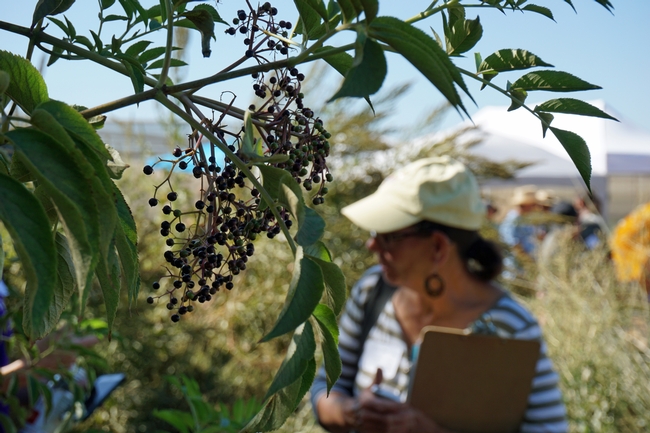
Native California elderberries can be found at the intersection of sustainable farming, super nutrition and economic viability. Naturally drought tolerant, flavorful and packed with nutrients, they are capturing the interest of farmers, health-conscious consumers and scientists.

Elderberries were the focus of a field day offered by UC Agriculture and Natural Resources Sustainable Agriculture Research and Education Program (SAREP) in September at Cloverleaf Farm, an organic berry and tree fruit operation in Dixon.

Elderberries occur naturally around the world. In California, Native Americans used the tree’s stems for making flutes, berries for food and purple dye, and bark, leaves and flowers for their purported anti-inflammatory, diuretic and laxative properties.

“They had a relationship with the plant for food, medicine and music,” said SAREP academic coordinator Sonja Brodt. “We wish to honor the elderberry’s history here and thousands of years of management by California native tribes.”

UCCE Farm Advisor Rachael Long said elderberries can be used in a hedgerow designed to attract beneficial insects.

UC Cooperative Extension advisor Rachael Long said elderberries are her favorite native plant.

“They’re pretty in the spring and summer. The flowers smell like cloves. It’s a wonderful fragrance,” she said.

But perhaps the best attribute of elderberries for Long, a proponent of planting hedgerows on the edges of farmland, is the tree’s ecological benefits. Elderberries can be among the rows of trees, shrubs, grasses and sedges in hedgerows that attract beneficial insects and pollinators to farms to help with biocontrol of pests and pollination of plants in adjacent crops.

“Flowering native plants like elderberries, toyon, Christmas berry, coffee berry, manzanita and coyote brush provide nectar and pollen for native bees, honey bees and other insects,” Long said. “I see a lot of green lace wings (predators of aphids, spider mites and other pests) in elderberry.”

Long reported that a tomato farm didn’t have to spray as much for aphids because of the beneficial insects attracted by the hedgerow. “They saved $300 per acre each year,” she said.

Hedgerows require long-term planning and care, including weed control. Establishing a hedgerow costs about $4,000 for a 1,000-foot-long planting with a single row of shrubs and trees bordered by native perennial grasses. At that rate, Long has calculated that a return on investment in pest control takes about 15 years. For pollination, the return on investment is about 7 years.

Installation of hedgerows can be eligible for cost sharing with USDA’s Natural Resources Conservation Service Environmental Quality Incentives Program. Costs can also be offset by harvesting the elderflowers and elderberries in the hedgerow and making value-added products – such as syrups and jams – or selling the flowers or berries to a processor.

Processing the mature elderberries with sugar allows small-scale producers to make deep purple elderberry syrup.

Farmer Katie Fyhrie shared how Cloverleaf Farm is managing elderberries in a hedgerow, harvesting flowers in the spring to make and bottle elderflower cordial, and harvesting berries in the fall to produce and bottle deep purple sweet-tart syrup. Sixteen ounce bottles of cordial and syrup sell for $12 each. The cordial and syrup are ideal for serving with seltzer and ice for a fruity and uniquely wild-tasting drink.

Elderberry Farmer Katie Fyhrie.

Fyhrie is also working with Brodt of SAREP to gather data for research on best production practices, farm and processing labor costs, and yield comparison between native plants and named varieties from the Midwest. The study includes data from three California farms.

The project is a collaboration among the UC Sustainable Agriculture Research and Education Program (a program of the Agricultural Sustainability Institute at UC Davis), the UC Agricultural Issues Center, the UC Davis Department of Food Science and Technology and four farmers to assess the farm management practices, cost, nutritional content, and market potential of California elderberries.

While laboratory research comparing the nutritional characteristics of the California blue elderberry with the North American black and the European black is continuing at UC Davis, food science professor Alyson Mitchell and her graduate student Katie Uhl were able to share what is already known about the nutritional benefits of the fruit.

They said elderberries are high in vitamin C, dietary fiber, phenolic acids and anthocyanins. Elderberries contain antibacterial, antioxidant and anti-inflammatory agents. While they have a strong history as a treatment for colds and flu, more studies are needed to understand their medicinal use, Mitchell said.

The field day in Dixon was among the first outcomes of the two-year project. A growers’ production guide, cost of production study, an assessment of market demand and nutritional analyses are also planned. The information will be made available, along with other resources on elderberry cultivation and processing, on the ASI website.

2019-10-01T10:34:05-07:00October 1st, 2019|
Go to Top