Manufacturing Consortium

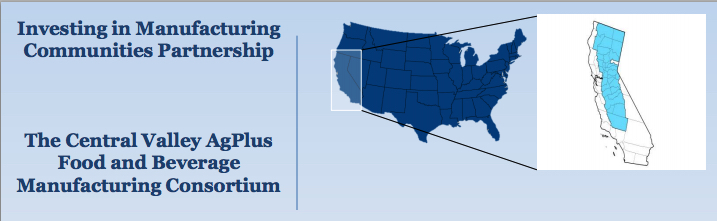
U.S. Secretary of Commerce Penny Pritzker announced late last week that The Central Valley AgPlus Food and Beverage Manufacturing Consortium, led by Fresno State, was one of 12 new communities designated this year under the Obama Administration’s Investing in Manufacturing Communities Partnership (IMCP) initiative. IMCP was designed to accelerate the resurgence of manufacturing in communities nationwide by supporting the development of long-term economic development strategies.

Consortium members represent major Central Valley public and private institutions from the education, business, economic and workforce development and civic sectors joining forces to foster the growth and creation of food and beverage businesses and middle-skills manufacturing jobs in the Central Valley.

“An IMCP designation is an important signal to potential investors that these communities are a good place to spend their money, and this is smart government at work,” Pritzker said. “By breaking down silos and encouraging communities to take a more thoughtful, comprehensive approach to their strategic plans, we are ensuring that precious federal dollars are used on the most high impact projects and in a way that maximizes return on investment.”

The new communities were selected by an interagency panel based on the strength of their economic development plans, the potential for impact in their communities and the depths of their partnerships across the public and private sectors to carry out their plans.

Consortium members worked together to identify a sector of manufacturing where their community has a comparative advantage and drafted a strategic plan that addresses workforce and supply chain challenges; infrastructure; research and innovation; trade and investment; capital access; and operational improvement for manufacturing companies.US EDA Logo

The 12 designated manufacturing communities will receive:

  • coordinated support for their strategies from 11 federal agencies with more than $1 billion available in federal economic development assistance.
  • a dedicated federal liaison who will help them navigate available federal resources.
  • recognition on a government website, accessible to prospective private foreign and domestic investors, looking for information on communities’ competitive attributes.

Mike Dozier, director of Fresno State’s Office of Community and Economic Development, the lead office for the project, said the opportunity and challenge facing the Central Valley is to claim more value from agricultural production through the food processing industry, along with its supply and distribution chains.

“California’s food system is the largest agricultural economy in the U.S. and among the top 10 globally,” Dozier said in the application. “It produced nearly $105 billion in economic output in 2012, and it was responsible for over 198,000 jobs tied directly to manufacturing.”

With 28 counties located in California’s heartland, the Central Valley plays a dominant role in this economy as America’s “Farm to Fork Capital.”

“Production agriculture has been the Central Valley’s mainstay and competitive advantage, fueling growth in the food manufacturing sector as those industries are part of a highly integrated supply chain,” he said.

The AgPlus implementation strategy will build upon the Central Valley’s unique asset base, committed partnerships and networks to:

  • capture more value-added cluster manufacturing and supply chain activity within the region, including to meet new demand and for local specialty products such as through the Farm to Fork efforts;
  • provide the workforce with the needed skills through successful career pathways models;
  • accelerate the development and adoption of innovative technologies so the Central Valley’s food and beverage manufacturing industry is the most efficient, safe, healthy, viable and sustainable national and global center of innovation for next-generation processing and supply chains;
  • facilitate the transformation of the industry to adapt to the short- and long-term impacts of drought and climate change; and
  • strengthen business operations and access to capital.

Consortium members are: 

Higher Education: Fresno State; California State University, Chico; University of California, Davis; Central/Mother Lode Regional Consortium; Fresno State’s Water, Energy and Technology Center; Los Rios Community College District; NextEd; and UC Merced Small Business Development Center.

Government Entity: Tuolumne County Economic Development Authority; City of Avenal; City of Fresno; City of Winters; and Sacramento Area Council of Governments.

Nonprofit: Valley Vision; Center for Land-Based Learning; Fresno Community Development Financial Institution; Northern California World Trade Center; Sacramento Employment and Training Agency; Sacramento Metropolitan Chamber of Commerce; and Solano Economic Development Corporation.

Private Sector: AgTech Innovation Fund; CalAsian Pacific Chamber of Commerce; Davis Chamber of Commerce; JBT FoodTech; and PackageOne, Inc.

For more information, contact Mike Dozier at 559.278.0727 or mdozier@csufresno.edu.

 

2016-05-31T19:28:10-07:00July 16th, 2015|

Viticulturist Mark Greenspan Confirmed as ASEV President

Announced TODAY, Mark Greenspan, president of Advanced Viticulture Inc., has been confirmed to serve as the American Society for Enology and Viticulture (ASEV) 2015-2016 president. Greenspan succeeds Lise Asimont of Francis Ford Coppola Presents to lead ASEV’s 12-member board.

mark greenspan

Mark Greenspan, president of American Society for Enology and Viticulture

“Throughout my career, ASEV has been the go-to source for reliable, thoughtful research and science that has been critical to my success and that of my vineyard clients. It’s a real honor to serve as the Society’s new president and to hopefully carry on the impressive work of Lise and the other dedicated ASEV past presidents,” said the new ASEV president. 

Greenspan, a Sonoma County resident, provides premiere vineyard consultation in water management, nutrient management, precision viticulture and vineyard design, establishment and management. He has operated Advanced Viticulture for over 10 years. Previously, he was the viticulture research manager at E&J Gallo, responsible for viticulture experiments in the north coast vineyards and collaborative projects throughout the state of California. He is a monthly contributor to Wine Business Monthly and periodic contributor to other trade publications. He presents at local, national and international events, and is a certified crop advisor (CCA) and certified professional agronomist (CPAg). Mark has served on review panels for the American Vineyard Foundation and Viticulture Consortium – West and Viticulture Consortium – East. He is a member of Sonoma and Napa Viticulture Technical Groups, Sonoma County Farm Bureau and Napa Valley Grape Growers Association. He’s a former director of the UC Davis Trellis Alliance and sponsor of the Sonoma County Winegrape Commission.

As an active 25-year ASEV member, Mark has held several ASEV positions and served as a reviewer for the American Journal of Enology and Viticulture (AJEV). He has served on the best paper review committee, annual meeting technical abstract review committee, annual meeting program committee, and as sessions chair. He received the ASEV Best Viticulture Student Paper Award in 1991. 

ASEV has also confirmed two new directors: Patty Skinkis, associate professor at the Department of Horticulture at Oregon State University, and Hans Walter-Peterson, viticulture extension specialist at Cornell Cooperative Extension. In addition, the Society has announced its 2015-2016 executive team members: Nichola Hall of Scott Laboratories, confirmed as first vice president; James Harbertson of Washington State University, elected as second vice president; and Tom Collins of Washington State University will serve as secretary-treasurer. Additional Board members continuing current terms are: AJEV Science Editor Linda Bisson and Technical Program Director M. Andrew Walker, both of the University of California, Davis; and Directors Lise Asimont of Francis Ford Coppola Presents, Kristen Barnshisel of J. Lohr Vineyards & Wines, and Kay Bogart and Anita Oberholster, both from the University of California, Davis.

Formed in 1950 as a professional society dedicated to the interests of enologists, viticulturists and others in the fields of wine and grape research and production, the ASEV’s membership of more than 2,000 includes professionals from wineries, vineyards, and academic institutions and organizations around the world.  In addition to publishing the AJEV, the Society also hosts its National Conference (slated for Monterey in June of 2016) and co-presents the Unified Wine & Grape Symposium in January with the California Association for Winegrape Growers. For more information, visit www.asev.org.

2016-05-31T19:28:10-07:00July 16th, 2015|

Opinion Shift: Urbanites Do Not Support Ag

Aubrey Bettencourt Says Ag Industry Missed Important Opinion Shift


By Charmayne Hefley, California Ag Today Associate Editor

It was thought that the agricultural industry in California could rely on the public sector to rally behind them during this devastating drought, once consumers were ordered to undergo severe water cutbacks themselves. “That didn’t happen,” says Aubrey Bettencourt, executive director of the California Water Alliance and third generation farmer in Kings County, where she farms with her dad.

“Back in 2008/2009,” Bettencourt said, “surface water cuts due to the Endangered Species Act really came into prominence more than the 1992 Central Valley Project Improvement Act (CVPIA). At the time, the ag community anticipated that as soon as urbanites experienced similar severe water cuts, they would rally to our side with the common understanding that we all have to make these very arbitrary reductions.”

“Earlier this year, Governor Brown issued a mandatory water cut of 25 percent, on average, to the urban sector, with a range from 8 to 39 percent depending on location,” explained Bettencourt. “Urbanites did not sympathize with the agricultural community on their shared loss of so much water. Instead, they pointed the finger at Ag, called for a rope and a pitchfork, and wanted ag to take even more of a cut–not understanding that Ag had already endured a 100 percent reduction,” she said. “The California ag community thought they shared a connection with the urban community regarding Ag’s importance.”

“I think this a really fine example of how agriculture has missed the societal shift away from the agrarian-based society to a consumer-focused nation in which most people are four to six generations away from the farm,” Bettancourt noted. “And the vast majority of people don’t understand what Ag does and why production agriculture is beneficial to society as a whole.”

“As such, the general population is able to make claims on the industry from perspectives that lack understanding,” she stated, “calling for requirements that are not beneficial to the industry, and ultimately not beneficial to the population as a whole. Urbanites do not support ag, but this disconnect has developed over time,” said Bettancourt.

2016-05-31T19:28:10-07:00July 14th, 2015|

CROPS ACTUALLY BORROW WATER VIA TRANSPIRATION

Almonds and All Other Crops Borrow Water Via Transpiration

By Patrick Cavanaugh, Associate Editor

Editor’s note: We interviewed Allan Fulton, UC Cooperative Extension Irrigation and Water Resources Farm Advisor, Tehama County, on an important, yet overlooked, process of a plant’s water use in agriculture. We zeroed in on a major process all plants have called transpiration in which crops borrow water.

Allan Fulton

Allan Fulton, UC Cooperative Extension Irrigation and Water Resources Advisor,
Tehama County

California Ag Today (CAT): We hear in the media that our crops are using too much water. And while all plants need water to grow food, we also know that a big percentage of the water taken up by all plants actually transpires out of the plant, back into the atmosphere, to form clouds and precipitation, right?

Fulton: Yes, the water just returns to the hydrologic cycle.  Most of the crops we are distributing, whether within the US or globally, are actually very low in water content.

CAT: When we think about transpiration, the plants are actually borrowing the water. Isn’t that true?

Fulton: We get a lot of questions from the general public about why we irrigate our crops so much.

The truth is, plant transpiration is a necessary biological process. The water cools the tree so it stays healthy. The water exits the leaves through special cells called stomata. While they are open, stomata allow water to transpire and carbon dioxide to enter the plant for photosynthesis, making sugars and carbohydrates, which, in turn, are used to make the fruits and the nuts that we eat.

So if we don’t have an adequately watered plant that is allowed to transpire, the plant won’t get enough carbon dioxide. The plant will grow defective fruits, and nuts—smaller, shriveled, cracked, all the things that the typical consumer does not want to buy.

CAT: Now, when we are talking about transpiration, can we say  most of the water taken up by the plant ends up being transpired back to the environment for reuse? So the water transpired by the plant is definitely not being wasted?

Fulton: Definitely. Since we converted to pressurized systems, micro-sprinklers and mini-sprinklers, we have a lot more control over how much water we apply at any one time. We no longer measure water output in depths of acre-feet, or even 4-6 inches at a time anymore. Much like rainfall, we measure it in tenths of an inch, or 1 or 2 inches at most.

As a result, we use less water, so it doesn’t penetrate the soil very deeply, maybe only 1 or 2 feet each irrigation. We are very efficient with the water; but, we have to irrigate very frequently because we apply it in small doses, and we run our irrigation systems a lot. So,   we are definitely using systems that stretch the water supply, not waste it.

CAT: But again, the vast majority of the water that the tree takes up is transpired, right?

Fulton: Yes. Most of the time, at least 90% of the water we apply is taken up through the tree and transpired for photosynthesis to occur.

CAT: Does transpiration increase on a hot day?

Fulton: Yes, plus the plant looses a bit from surface evaporation  from the wet soil, but we try to control that with smaller wetting patterns and drip-confined wetting patterns.

When you think about it, the heat of the day occurs in the afternoon, and many systems don’t run because of energy costs.  There are incentives not to pump in the middle of the afternoon; but for those who do, try to confine the wetted area to limit evaporation. The hot hours of a day comprise about 4 hours of a 24-hour cycle, so a lot of irrigation occurs at night-time or in the early morning hours to lesson evaporative loss.

CAT: Growers are doing everything they can to conserve water. If the trees and vines are all transpiring most of the applied water, what is the problem with using water to grow food?

Fulton: I think the concept throughout the United States has always been to secure our food supply. That security has many benefits—economically and politically. In the end, we are trying to provide the general public with great quality, safe food, at the best price possible.

CAT: And nutritious food. We are growing the food people need more of.

2016-05-31T19:28:11-07:00July 10th, 2015|

Almond Growers Conserve Water

Almond Growers Conserve Water…Period!

By Laurie Greene, Editor, California Ag Today

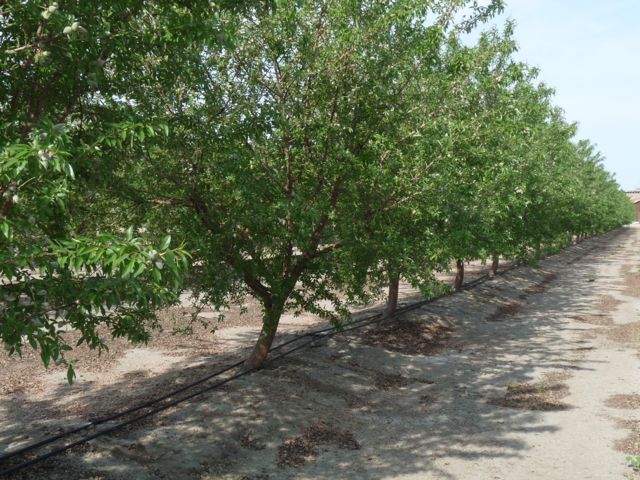
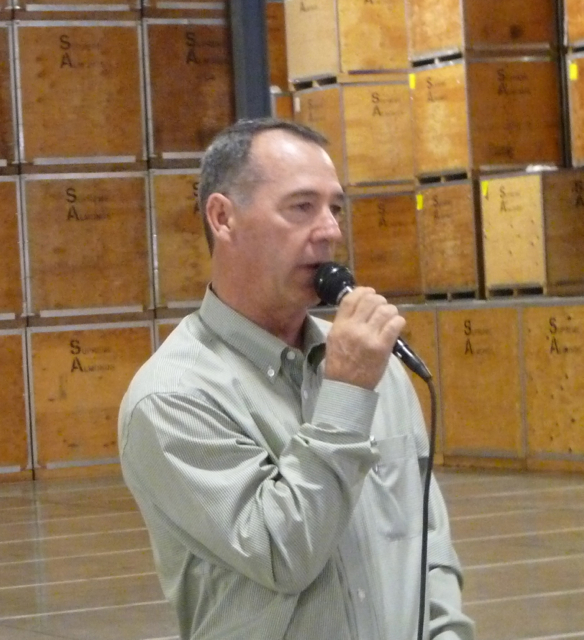
At a recent drought forum, California Ag Today spoke with Mike Mason, an almond grower and partner with Supreme Almonds near Wasco, as well as  chairman of the Almond Board of California. Noting breakthroughs in the almond industry, Mason said, “Facts bear out that we use 33 percent less water today than we did 20 years ago for every pound of almonds grown. There’s no reason  not to expect a similar result over the next 20 years given the ongoing research and funding we do through the Almond Board. We will continue to become more and more efficient, not just with water use, but with fertilizer and everything else we do in farming as well,” said Mason.

“Keep in mind that almonds, like all flowering plants, transpire 95 percent of the water they take up,” said Mason. “Water moves through the vascular system of the plant and exits the stomata of the leaves. When the stomata open, pure water exits and carbon dioxide enters the leaves. The carbon is used in photosynthesis to make carbohydrates that enable the almond almond tree to produce almonds. It’s all part of the universal water cycle that enables life to exist on the earth!”

Though current public opinion on water use seems to focus on almonds primarily, Mason remains confident that the facts will speak for themselves. It is simply a matter of getting the information out there. Mason elaborated, “We’ve got to go back to education because there are so many ways of comparison, and it is pretty hard to refute some of the things people are saying out there. But I think, over time, as we get the facts out there, public perception will be different.”

Because almonds are proving to be profitable at the moment, other countries are starting to take notice and planting more almond orchards of their own. Currently, California accounts for about 80 percent of the world’s supply of almonds. Mason believes, in spite of increased international competition, California will remain a world leader. “I wouldn’t call it a threat;” he said, “it is more like an opportunity than anything else. I think California will continue to be the world’s supplier, but there are other areas around the world where almonds can be grown, and that’s perfectly fine,” said Mason.

American consumption of almonds has increased roughly 220% since 2005. As a result, almonds have become the most-consumed nut in America, after  surpassing that of peanuts. This explosive increase in demand has been the driving force for almond production expansion.

Now, almonds cover about one million acres in California. On maintaining this level of success, Mason commented, “Markets go up, and markets go down. There are all kinds of different factors that cause these fluctuations, from oversupply to environmental issues. We think we have a bright future with a healthy product. Time will tell,” he said.

2016-05-31T19:28:11-07:00July 7th, 2015|

Average Almond Crop for Van Groningen

Van Groningen: Almond Crop Looks Average; Misleading Math on Watermelon Water Use

By Patrick Cavanaugh, Assistant Editor, California Ag Today

Van Groningen & Sons, Inc. farming has been operating in California since 1922. Field Manager Bryan Van Groningen updated California Ag Today, “The almond crop looks pretty average, ‘nothing that looks well over norm. It just depends on which field site you enter in; some of the younger blocks look a little better than the older blocks. So, right now the crop looks pretty old, but it is all across the board.”

Bryan Van Groningen

Bryan Van Groningen

Yosemite-Fresh-WatermelonBased in Manteca, Von Groningen & Sons has a diversified operation growing melons, sweet corn, pumpkins, squash, almonds and walnuts, and livestock feed. Noting recent negative press on almond water usage, Bryan said, “Almonds obviously have gotten a lot of bad press lately, as has ag in general. In looking at some of the water usage figures, I tend not to agree with them. I think a lot of the water usage figures are outdated and incorrect.” He explained, “For example, we grow watermelons, and one of the articles that I read reported that 160 gallons of water was needed to produce a single watermelon. On our farm, it is closer to 35-40 gallons.”

As the state continues to deal with water restrictions, Van Groningen says a lot of fingers are unfairly pointing at the agriculture industry. “I think there is a lot of misinformation being spread around and used to throw agriculture under the bus,” he stated, “making us look like we are the bad guys, when we are actually producing the nutritious food that consumers in our state and the nation eat and enjoy. The agricultural industry has made so many advances in water efficiency that we should actually be labelled as ‘water conservationists’, and not ‘water wasters’.”

Van Groningen says he sees firsthand, every day, exactly how much water is used per crop, because he actively manages the farm’s water. “I sat down and ran the numbers 3, 4, 5 times — just to make sure that I did the math correctly. So, some of this usage is being misrepresented and therefore does not shed a good light on what ag is actually doing.”

2016-05-31T19:28:12-07:00July 3rd, 2015|

Mario Santoyo: Hold Environmental Water Use Accountable!

Mario Santoyo: Hold Environmental Water Use Accountable!


By Laurie Greene, California Ag Today Editor


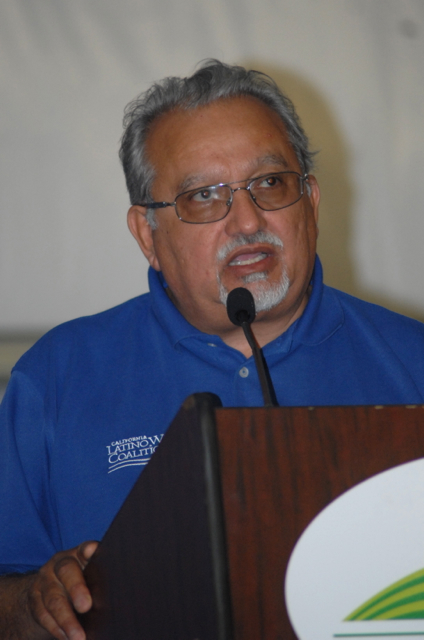
California Ag Today met with Mario Santoyo, executive director for the California Latino Water Coalition at the recent Clovis drought forum organized by Assemblymember Jim Patterson to talk about how serious the current drought situation has become.

We are definitely in one of the worst drought situations that has happened in recent times. But the fact is, the 1977 drought was actually worse than where we are now. But this year, we’re at a zero water allocation and in ’77 we were at 25% for both the Eastside and Westside. So what’s the difference? Well, it boils down to the differences that are now dedicating a whole bunch of water to environment use, but the environment is not being held accountable for its usage,” Santoyo said.

“Cities and agriculture have had to be very accountable for their water usage and efficiency. It’s not the same for the environment, and so I’m hoping people will understand this discrepancy when we push to reallocate some of the water back to the cities and farms. We must hold environmental water use accountable!”

Santoyo noted the critical importance of building new water storage projects. “We have been working on this for a long time, and we just can’t afford to continue losing millions and millions of acre-feet of water to the ocean during times like this, when we could use that water. We need everyone to understand they have a role in communicating to the state government that we must advance our storage capacity.

Santoyo noted, “Farmworker communities are doing a lot worse because, again, zero allocation on both the Eastside and Westside quickly translates into fallowed land, which means there are fewer jobs available. So farmworkers now find themselves in an extremely difficult position in which they either stick around and hope for the best or they leave. But once they leave, they aren’t coming back,” he said.

And, that makes life tough for the farmworkers, but it also makes it tough for the farmers because they need water and labor. You can’t do without both, and the lack of one causes problems with the other; if you don’t have water, you lose the labor, and then what do you do? So, it’s unfortunate that some changes in the way we are using water today have changed the entire landscape of agriculture here in the Central Valley.”

In terms of what we can do, Santoyo urged Californians never to give up. “There’s no reason why we all cannot write letters to our representatives and to the governor! Wake him up! Tell him, ‘Hey by the way, you’re supposed to represent us and step to the plate. Have better control over State Water Resources Control Board because they are making tons of mistakes.’ Governor Brown must start making the right decisions for the people.”

2016-05-31T19:28:12-07:00July 1st, 2015|

WADE: LET THE WATER FLOW!

Let The Water Flow:

Mike Wade Urges Water Board To Let Reclamation Pay Back Borrowed Water

By Laurie Greene, California Ag Today Editor

Mike Wade, executive director of the California Farm Water Coalition, discussed with California Ag Today, his article for the Coalition’s Blog, entitled, “State Water Resources Control Board Could Cost California’s Agricultural Economy $4.5 Billion.”

“A number of San Joaquin Valley farmers have been working the last couple of years to set aside emergency water supplies through conservation and water purchases on the open market,” began Wade. “That water is set aside in the San Luis Reservoir and currently being borrowed, if you will, by the Bureau of Reclamation to help meet their obligations and ultimately the temperature management plan for winter run Chinook salmon.”

Wade said the Bureau’s water obligations also include provisions for summer agriculture south of the Delta, as well as refuge management for numerous listed terrestrial species like the Giant Garter Snake.

Wade estimates the loaned water is worth hundreds of millions of dollars. Lending farmers include those who own land on the Westside of the San Joaquin Valley, Sacramento Valley rice farmers who fallowed land this year to make supplies available for transfers and Friant-area farmers seeking to augment a zero water allocation for the second year in a row.

“We believe the Bureau has an obligation to pay that water back this fall, and we’re urging the State Water Resources Control Board to let that payback happen.” In his article, Wade reported that Reclamation would pay back the water from supplies stored in Lake Shasta as soon as temperature goals for winter run Chinook salmon were met.

Regarding accountability, Wade said, “I believe the Bureau intends to pay it back, but we want the public to understand what’s happening. We want transparency so we can follow this obligation and make sure this fall, when water becomes available, the Bureau follows through to pay it back. People don’t forget.”

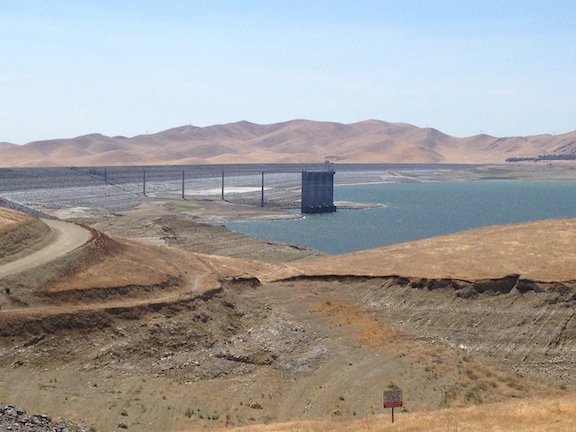
Built and operated jointly by the Bureau of Reclamation and the State of California, the San Luis Reservoir is at 44% capacity today, according to the California Department of Water Resources’ California Data Exchange Center, but the supply is already divided and allocated. Wade explained, “The water that is currently in San Luis Reservoir under the Bureau of Reclamation’s control is almost exclusively owned by growers who have conserved it or purchased it on the open market. The remainder belongs to the State Water Project and its users. So, there is little or no federally-owned water in San Luis at this time.”

Wade said, “There are a number of factors that contribute to the 4.5 – 4.9 billion dollar projected cost for San Joaquin Valley farmers. First is the actual value of the water that farmers have already set aside. Second is the monetary obligations farmers have contracted to pay Sacramento Valley rice growers for transferred water. The third component is the actual value of potential crop and orchard losses if that water isn’t paid back and farmers lose out on their ability to keep their farms going.”

Wade urged the State Water Resources Control Board, “to facilitate this complex and unprecedented collaboration” and allow Reclamation to release compensatory water as soon as possible.

Let the water flow!


Sources: Interview with Mike Wade, California Farm Water Coalition; “State Water Resources Control Board Could Cost California’s Agricultural Economy $4.5 Billion,” by Mike Wade, California Farm Water Coalition; Bureau of Reclamation; California Department of Water Resources

Featured Image: San Luis Reservoir-Empty, California Farm Water Coalition

2016-05-31T19:28:12-07:00June 26th, 2015|

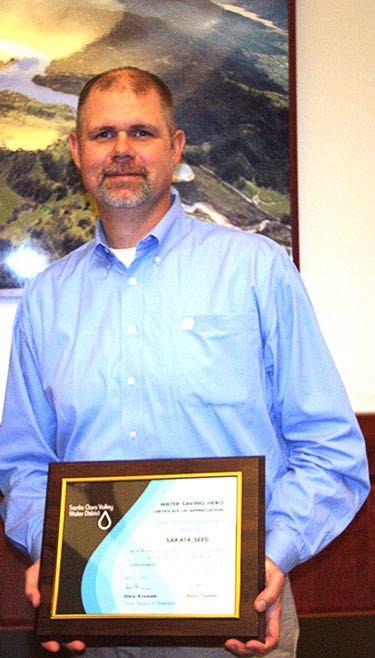
Sakata Seed America Awarded Title of ‘Water Saving Hero’

Sakata Seed America Awarded Title of ‘Water Saving Hero,’ Sets Example during Severe California Drought

Sakata Seed America is doing their part to ‘Go Green’ and conserve water during the severe California drought. The drought has taken a huge toll on the entire state; however, it has hit both the Agricultural and Horticultural industries particularly hard. According to a study by the UC Davis Center for Watershed Sciences, “the drought is expected to be worse for California’s agricultural economy this year because of reduced water availability…Farmers will have 2.7 million acre-feet less surface water than they would in a normal water year – about 33 percent loss of water supply. Individual farmers will face losses of zero to 100 percent.” In response, Sakata has made it a priority to focus on ways to reduce their water usage and boost long-term sustainability for the future.

In 2014, two main projects were completed to conserve water at the Morgan Hill office headquarters. First, 12,500 square feet of turf was removed and replaced with drought-tolerant plants and landscape coverage. In addition, the overhead sprinklers were removed and replaced with a low-volume drip system. The estimated water savings for the 2014 updates totals to 300,000 gallons of water annually. For the remaining turf, complete irrigation updates were implemented, and over 275 sprinkler nozzles were upgraded to a weather track system which reduces water when it’s not needed, resulting in an additional 50,000 gallons of water conserved annually.

This year, Sakata has already begun their next phase of water reduction. Thus far, 16,088 additional square footage of turf has been removed from the front of the company’s headquarters and replaced with a new, drought-resistance landscape and low-volume drip systems. And it doesn’t stop there, Sakata’s internal committee, ‘GreenUp,’ which is solely dedicated to creating a greener work environment has a lot more in store for the future – some immediate plans for facility upgrades include water-saving restroom updates such as touchless faucets. In addition, the committee is distributing free shower buckets to all interested employees.

Sakata’s water conservation efforts have not gone unnoticed. In September 2014, Sakata was deemed the title of a ‘Water Saving Hero’ and presented a plaque by the Santa Clara Valley Water District, who have been encouraging water conservation all over Santa Clara County with their ‘Brown is the New Green’ campaign, which distributes free ‘Brown is the New Green’ lawn signs, shower buckets, moisture meters, shower timers, shower heads and hose nozzles for Santa Clara county residents.

“It’s part of our responsibility to the community and the industry to conserve water and lower our carbon footprint. We are proud of our efforts thus far, but are determined to take it further and become a role model for other companies,”states Tye Anderson, Senior Logistics & Operations Manager for Sakata.

Sakata’s GreenUp committee’s future plans stretch far beyond lessening water usage and focus on sustainability as a whole. Long-term goals include such workplace additions as bike racks and charging stations for electric cars.

For more information on how you can help conserve water during the California drought, please visit: www.saveourwater.com. For more on Sakata’s contribution, read the full article.

#

Headquartered in Morgan Hill, CA, Sakata Seed America is a major research, seed production and marketing-distribution subsidiary of Sakata Seed Corporation, established in 1913.   Sakata Seed America serves as the headquarters for the North American operations.  

Featured Photo: Sakata’s Tye Anderson accepts Water Saving Hero Award

2016-05-31T19:28:13-07:00June 25th, 2015|

Valadao Addresses Western Water Reliability

Valadao, California Republicans, Introduce Legislation to Improve Western Water Reliability

Today, Congressmen David G. Valadao (CA-21) introduced a bill to modernize water policies in California and throughout the entire Western United States with the support of the entire California Republican delegation, the Chairman of the House Natural Resources Committee, and Chairman of the Western Caucus.


H.R. 2898, the Western Water and American Food Security Act of 2015 aims to make more water available to families, farmers, and communities in California and bordering Western states. The dedication of vast quantities of water to protect certain species of fish listed under the Endangered Species Act (ESA) is a significant obstacle hindering water delivery in Central and Southern California. H.R. 2898, will require federal agencies to use current and reliable data when making regulatory decisions, which in turn will provide more water for communities in need.

Additionally, Rep. Valadao’s legislation will provide federal regulators with direction and flexibility to capture water during periods of greater precipitation, which can be used to increase California’s water supplies dramatically. Furthermore, the bill will cut red tape holding back major water storage projects that have been authorized for over a decade, which will aid the entire Western United States during dry years.

Congressman David Valadao (CA-21), the author of the legislation, said, “California’s drought has devastated communities throughout the Central Valley and now the consequences are extending throughout the country. Inaction will result in the collapse of our domestic food supply.” He continued, “Congress cannot make it rain but we can enact policies that expand our water infrastructure, allow for more water conveyance, and utilize legitimate science to ensure a reliable water supply for farmers and families.”

Majority Leader Kevin McCarthy (CA-23) stated, “The tragedy of the current drought is no longer isolated to California’s Central Valley, and its response must include tangible solutions that provide us the opportunity to pursue the California Dream. Today is an important step to helping restore the water our communities desperately need by more fully utilizing the most sophisticated water system in the world to quench the robust economic opportunity California families, farmers, workers, and businesses all need.”

“My western colleagues have worked hard to collaborate on a common sense bill that helps people,” stated Rep. Rob Bishop (R-UT), Chairman of the House Committee on Natural Resources. “Communities are suffering and we are putting forward a creative solution to address those needs. I look forward to working on a bipartisan basis in the House and Senate to move this legislation forward.”

“Having personally visited California’s Central Valley on this matter, I can attest to the dire situation facing California with the drought,” said Western Caucus Chairman and Natural Resources Vice-Chairman Cynthia Lummis (WY-at large). “This situation demands congressional action to tackle the man-made barriers that are needlessly choking off water supplies crucial not just for California jobs but for the food on American tables. I am pleased to work with my Californian colleagues to ensure we also seize this opportunity to address water issues west wide through water project permit streamlining, enhanced water storage, and protecting state-endowed water rights that are increasingly under attack at the federal level.”

“The water bill we are introducing today will help California families and businesses that are suffering in our ongoing drought,” said Rep. Ken Calvert (CA-42). “No legislation will magically end our drought, but by passing this bill, we can take a step in the right direction and work in a collaborative way to enact meaningful solutions. Our bill takes important steps that are the direct result of bipartisan and bicameral conversations, and I look forward to the continued engagement with my House colleagues as well as action from the Senate in the near future. Despite what opponents might say, our legislation does not gut – let alone modify – the Endangered Species Act. Rather, our bill ensures our critical water infrastructure is operated using sound science in order to prevent wasting precious water in ways that do not benefit listed species but come at a high cost to Californians.”

“California’s devastating drought is hurting our ag economy and food supply nationwide,” said Congressman Jeff Denham (CA-10). “This bill provides both the short- and long-term solutions that the Central Valley needs, beginning with more storage. It includes two pieces of legislation I’ve introduced to study and eliminate the threat of predator fish and to increase storage in New Melones Reservoir. We can’t keep waiting on the Senate or the President to get engaged and provide Californians with the solutions they need to survive.”

“This bill was designed to address the underlying causes of the drought in a pragmatic and bipartisan manner,” said Congressman Steve Knight (CA-25). “There is no simple answer to this problem. But California needs rational solutions, not more water rations.”

“This balanced legislation improves water access for Californians around the state by using improved science to time water deliveries, preserving water rights and moving forward on new surface storage facilities,”  said Congressman Doug LaMalfa (CA-01). It protects the most fundamental water rights of all, area of origin rights, ensuring that Northern Californians who live where our state’s water originates have access to it. Californians have spoken clearly in support of investment in new surface storage projects, and this measure fulfills the promise to voters by advancing projects that would generate over one million acre-feet of water, enough for eight million Californians. We’ll continue to refine this proposal as it moves through the process, but I am proud to cosponsor a bill that addresses both short- and long-term needs of all Californians and supports continued economic growth.”

“Droughts are nature’s fault; water shortages are our fault,” said Congressman Tom McClintock (CA-04). “For a generation, we have failed to build the facilities needed to store water from wet years to have it in dry ones and radical environmental laws have squandered the water we did store. Our water shortage is caused by a shortage of sensible water policy. This bill begins fixing that.”

Congressman Devin Nunes (CA-22) explained, “Facing an annual water deficit of 2.5 million acre-feet south of the Delta, the San Joaquin Valley urgently needs whatever relief it can get. And once again, the House of Representatives is taking action to assist our long-suffering communities. As this entirely preventable water crisis continues to ravage Valley farms and devastate our economy, I urge the Senate to finally begin supporting the House’s consistent efforts to roll back the disastrous government regulations that prioritize fish over families.”

Original cosponsors of Congressman Valadao’s legislation include Reps. Ken Calvert (CA-42), Paul Cook (CA-08), Jim Costa (CA-16), Jeff Denham (CA-10), Duncan Hunter (CA-50), Darrell E. Issa (CA-49), Stephen Knight (CA-25), Dough LaMalfa (CA-01), Kevin McCarthy (CA-23), Tom McClintock (CA-04), Devin Nunes (CA-22), Dana Rohrabacher (CA-48), Edward R. Royce (CA-39), Mimi Walters (CA-45), Mark E. Amodei (NV-02), Rodney Davis (IL-13), Mario Diaz-Balart (FL-25), Cresent Hardy (NV-04), David P. Joyce (OH-14), Cynthia M. Lummis (WY-AL), Dan Newhouse (WA-04), Michael K. Simpson (ID-02), Chris Stewart (UT-02), Scott Tipton (CO-03), and Ryan K. Zinke (MT-AL).

2016-05-31T19:28:13-07:00June 25th, 2015|
Go to Top