Who Safeguards California Farm Employees’ Rights? – Part 9

Court Allows UFW to Force Representation and Dues on Gerawan Employees


By Laurie Greene, Founding Editor


The California Supreme Court announced their decision on Nov. 27, 2017 in favor of forced UFW representation on Gerawan employees, thus mandating these workers pay three percent of their wages to the UFW or lose their jobs.

As background, the UFW was elected to represent Gerawan employees in 1990, but never successfully represented them in contract negotiations. Subsequently, the UFW disappeared from this farm operation for nearly two decades, so 99% of current Gerawan employees never voted for union representation; many were born after 1990. In addition, Gerawan employees have reportedly been paid the highest wages in the industry.

Gerawan Employees

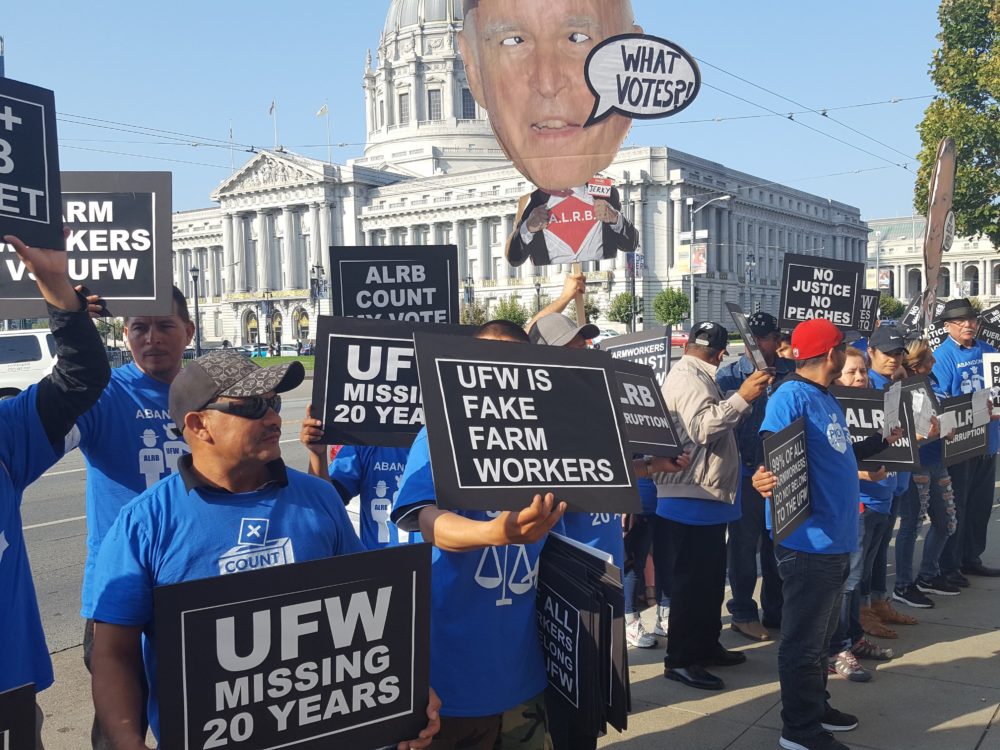
Gerawan Farm Workers Protest against UFW at California Supreme Court.


Below is the transcript (in English) of the message, which was recorded in Spanish, that all Gerawan employees heard when they called in on Nov. 27, 2017 to hear their work schedules.

Hi, this is Dan Gerawan.

Unfortunately, the California Supreme Court today decided to overturn the lower court that had said you should have the right to choose whether a contract is forced on you. Instead, the California Supreme Court agreed with UFW and ALRB that you should not have the right to choose, even though you have to pay UFW.

Fortunately, today’s decision does not strip your right to decide whether the UFW can represent you. The majority of you asked for the right to make that decision, and the ALRB held a decertification election over four years ago.

Nothing in today’s court decision prevents your ballots from being counted. As you may know, the California Fifth District Court of Appeal is still going to decide whether your votes from the November 2013 election will be counted.

You are entitled to the same dignity and respect that all other workers in our state and country have, which is the right to choose who represents you.

As for today’s decision, we intend to ask the United States Supreme Court to review it.

Thank you for listening.

According to the November 27, 2017 press release posted by David A. Schwarz, legal counsel for Gerawan Farming, “We believe that coerced contracts are constitutionally at odds with free choice. The employees are entitled to the dignity and respect that they earned by giving them what is their right. A secret ballot election allows them to decide for themselves who will speak for them at the bargaining table.”


Laurie Greene Wins Journalism Award

Greene Wins Fresno County Farm Bureau Award for Series on Farm Workers’ Rights,  by Patrick Cavanaugh, Editor 


2019-12-25T15:59:00-08:00December 7th, 2017|

Agricultural Guestworker Act Won’t Help California

Proposed Legislation Long Way from What State Needs

By Joanne Lui, Associate Editor

Virginia Congressman Bob Goodlatte’s Agricultural Guestworker Act is moving forward for the full Ag Committee to consider it, but according to Paul Wenger, President of the California Farm Bureau Federation, it’s a long way from what California needs.

“They did something with the H2C proposal. It’s a long, long, long ways from what we need here in California. We’ve been very clear on that … with Kevin McCarthy’s office, being the leader of the Republicans and really our key architect for all things that go through the Legislature, and so we’re in constant contact with Congressman McCarthy,” Wenger said.

The ag leaders in California are pretty astounded that Congress is doing anything about labor.

“We’re glad we finally got something to discuss, but there’s a long ways to go,” Wenger explained. “As it’s written, as it came through the subcommittee, there’s really nothing there that would work for our employees here in California and give us the kind of flexibility that we need, but we need a vehicle to start the discussion. … Talking to Congressman [David] Valadao’s office, Jeff Denham and others on the Republican side because it’s really got to be led by the Republicans.”

“We  now need a lot more that will allow for some portability of our workforce, in order to get legal documentation for those folks that don’t have good documentation that are already here in our state working without touchback, because we know folks aren’t going to go back and stand in line for 20 years waiting for some kind of a work authorization.”


2017-11-07T21:47:30-08:00November 7th, 2017|

Washington Post Writer Sees Ag Issues with RAISE Act

Disconnect Exists with Urban Politicians, Ruben Navarrette says

By Joanne Lui, Associate Editor

Ruben Navarrette grew up in the Central Valley and is a syndicated columnist for the Washington Post Writers Group. California Ag Today caught up with him recently at an event in Fresno called the The Latino Paradox: Immigration Forum. He spoke about the RAISE Act S.354, which severely limits immigration into the U.S. because it would be based on education and skills.

Ruben Navarrette

“There’s this disconnect in Washington and New York … mostly urban areas where politicians don’t think much about agriculture, agribusiness,” Navarrette said. “They have no clue about where this fruit is coming from when they walk down the street in New York and they see an orange. They don’t understand how dangerous something like the RAISE Act would be if you ultimately limit the amount of people who come here based on education and skills.”

The RAISE Act will limit immigration from Latin American countries. Meanwhile, U.S.-born citizens don’t go out to work in the fields.

“I think there’s a lot of people who wrongly believe that American workers will do those jobs if the wages are high enough, and the way they tell the story [is] to make the agribusiness and the farmers into the bad guy,” Navarrette said. “If you know enough farmers and you go out into enough fields and you interview enough farmers and enough workers, you know that’s completely false. Farmers could be in business for 30 years and never in 30 years have they ever had an American come to them and say, ‘Can I pick peaches?’ ”

With the Deferred Action for Childhood Arrivals act (DACA), if dreamers are sent back, there are questions about what may happen with their parents.

“If they go back, the parents may ultimately self-deport as well and that’s going to be disruptive,” Navarrette said. “Clearly it’s a mistake for us to believe that sort of agriculture and DACA, they’re all separate from each other. The issues are all intertwined. When a farm worker is working in a field, he cares about whether the local police have the authority to detain him, if he’s pulled over. He cares because he has kids who are in the DACA Program, so farming isn’t necessarily segregated. The farm workers are piped into all these different issues.”


2017-09-22T16:02:29-07:00September 22nd, 2017|

Farm Workers Strive For Success

Farm Workers and Dreamers Work Hard To Reach the American Dream

By Patrick Cavanaugh, Farm News Director

Joe Del Bosque is a diversified farmer in western Fresno and Merced counties. At one time, Del Bosque was a farm worker in the field and eventually was able to buy some acreage and expand over time. Now, Del Bosque has his own farm worker employees who are climbing the economic ladder like he did.

“When I see the farm workers on my farm, it’s like looking at my ancestors. It’s like looking at how hard they worked, working in the fields, picking crops, and so forth, and trying to do the best they can to raise their families and give their children a push-up the way I got it,” Del Bosque said.

“I know that my farm workers are trying to do the same thing. They’ve got children, they’re trying to push them up, and I see that happening because a lot of them have children in college right now. They’re getting educated, they’re going to go on to become professionals, and I’m very happy about that,” he said.

“There’s no doubt. They’re definitely climbing the economic ladder. I see on our farm that a lot of our farm workers have bought homes. Even some of the Dreamers, who are now at risk of being deported, have bought homes and they’re worried about what’s going to happen to them,” Del Bosque explained. “Some of them, and other folks in our communities that have invested in small businesses and so forth, have really become members of our society, of our economy, and their efforts are sometimes underappreciated.”

Del Bosque spoke of Dreamers that are working with him. “We have one, for instance – he does maintenance for us. He’s so skilled with repairing equipment and building things and so forth. He’s been with us for a while, and is a very valuable member of our team.”

2017-09-21T15:07:35-07:00September 21st, 2017|

Who Safeguards Farm Worker Rights? – Part 8

Pick Justice, Gerawan Farm Workers Protest Forced Unionization


By Laurie Greene, Founding Editor


Jesse Rojas, spokesperson for Pick Justice, a farm worker rights group (not a union) organized a rally of farm workers last week at the California Supreme Court building in San Francisco to bring attention to the court hearing on the UFW’s effort to force unionization on farm workers at Gerawan Farming, Inc.—despite having abandoned the workers for nearly 20 years. Over 150 Gerawan workers traveled from the Central Valley to protest the UFW/ALRB team that is pushing for forced unionization of these farm workers via the justice system through Mandatory Mediation and Conciliation (MMC).

Jesse Rojas, spokesperson for Pick Justice (PickJustice.com)

Gerawan workers, dressed in blue Pick Justice t-shirts and armed with company ID cards and pay stubs to demonstrate authenticity, chanted at the UFW protesters who wore red UFW t-shirts. Rojas said the UFW individuals were apparently not Gerawan farm workers and were paid to be there. “All attending [in our group] are employees of Gerawan Farming,” he stated.

“I wish all 3,000 Gerawan workers could have come today like they’ve done in the past,” Rojas said. “But they actually have to work because they are real workers and they don’t get paid to come here. They miss days of work. A lot of them are going to get written up. They are going to get into trouble. They have had to find babysitters to take care of their kids; they are real workers.”

Rojas explained the focus of the demonstration is the need for these employees to choose their own future. “At this point, what is really important for them—not just them, but for all farm workers in the state—is simply to have the freedom to choosefreedom to vote.”

“Why would they have to be forced into a contract without reading it, without negotiating it, without approving it?” Rojas asked. “It’s not the American way. That’s not a democracy. The most fundamental civil right that all employees have is the right to vote if they want a union or not or if they want a contract or not.”

“But they are not getting those rights. Why not them? It is their right to vote and have their votes counted,” Rojas said.

If the Court imposes mandatory mediation, Rojas said the outcome “would affect about every farm worker in the state, almost 800,000 of them. The rights of the workers would be taken away.”

“The way mandatory mediation and conciliation works is the ALRB, the state government, has the right to write and impose a contract on employees without their approval,” Rojas explained. “In the Gerawan case, they will not have the right to strike or protest like they are doing today.”

“On top of that, this so-called contract will actually lower their take-home pay,” said Rojas, because mandatory UFW union dues totaling three percent of their paychecks would be imposed on the workers. If any of them refuse to pay the union as a condition of employment, they will be fired.

The justices of the California Supreme Court have until December 5th to make a ruling.

To see a video of Jesse Rojas speaking to California Ag Today, click here.


PickJustice.com celebrates freedom of choice for farm workers. As posted on their website:

We are concerned citizens who support the rights of workers to choose whether or not they want to have a union represent them. We are standing up for workers who are victimized by a politicized government agency.

Freedom of choice is a human right. People who are not educated are deprived of their freedom by those who are educated.

PickJustice.com exists to educate the public about the corrupt relationship between a once-noble union and the dishonest attorneys at the California Agricultural Labor Relations Board (ALRB). We want to help social change to show that, once a union has violated the trust of those it purports to represent, that union no longer votes for the workers.

As César Chávez himself said, “Once social change begins, it cannot be reversed. You cannot un-educate the person who has learned to read. You cannot humiliate the person who feels pride. You cannot oppress the people who are not afraid anymore.”

A generation ago, many farm workers were afraid of their employers. That isn’t the case anymore.

Thanks to organization against social injustice and a greater consciousness of producers and consumers alike, the plight of thousands of farm workers in America is over.

In César’s words more than three decades ago: “The very fact of our existence forces an entire industry – unionized and non-unionized – to spend millions of dollars year after year on improved wages, on improved working conditions, on benefits for workers.”


Who Safeguards California Farm Employees’ Rights? – Part 9  Court Allows UFW to Force Representation and Dues on Gerawan Employees


2019-12-25T15:48:07-08:00September 14th, 2017|

Who Safeguards CA Farm Workers’ Rights? # 7 – CA Supreme Court

CA Supreme Court Hears Case of Gerawan Farming, Inc. vs. UFW/ ALRB


By Laurie Greene, Founding Editor


Gerawan Farm Workers Show Company IDs and Paystubs (Identification has been blurred out for privacy reasons.)

A significant labor hearing occurred at the California Supreme Court (Court) in San Francisco yesterday, the day after Labor Day, between the team of the United Farm Workers (UFW) and the California Agricultural Labor Relations Board (ALRB or Board) versus Fresno County-based Gerawan Farming, Inc. over self-determination. At stake is the right of farm workers to determine if they want to be represented by the union or not. Under scrutiny is the Mandatory Mediation and Conciliation (MMC) provision of the Agricultural Labor Relations Act that paves the road for the UFW to force unionization on all farm workers.


Anthony Raimondo, of Fresno-based Raimondo & Associates, lawyer for Gerawan farm worker spokesperson, Silvia Lopez

“Although Gerawan farm workers attempted to participate in this hearing, as well as other hearings, they were denied legal participation in the trial by the state of California and by the UFW,” according to Anthony Raimondo, of Fresno-based Raimondo & Associates and lawyer for Gerawan farm worker spokesperson, Silvia Lopez. Nevertheless, hundreds of Gerawan employees in blue t-shirts attended the proceedings and protested outside the courthouse, lending their voices, exercising their free speech and showing their legitimate Gerawan company ID cards and payroll stubs.


Dan Gerawan, who co-owns Gerawan Farming, Inc., with his brother Mike and father Ray, commented on the court hearing just after it ended. “It is frightening to see the deference that the Court gives to the ALRB. Everyone in our industry and all farm workers should be scared by the deference this Court gives to a Board that is clearly not interested in the employees’ best interests.” Describing his perceptions in the courtroom, Gerawan said, “It was Orwellian to hear the government attorneys argue that they are defending self-determination, when in fact, what they are doing is the exact opposite.”


“That said,” he continued, “I am encouraged by the questions I heard from the Court. They obviously are taking this very seriously, and I’m hopeful that they will side with our employees and us.”


Silvia Lopez, Gerawan farm worker spokesperson

Members of the UFW were also present at the Court in red t-shirts, though only one person claimed to be a Gerawan employee. Marc Grossman, spokesperson for the United Farm Workers of America and communications director of the Cesar Chavez Foundation, said that the Gerawan operation should be unionized because the UFW was elected in 1990 by Gerawan farm workers and certified in 1992 by the ALRB.


However, the UFW did not successfully reach a contract for the Gerawan farm workers, and therefore did not collect dues. Furthermore, the UFW abandoned the Gerawan farm workers for nearly 20 years.


Grossman said the Court discussed today the long-standing principle that a union is certified until it is decertified. Workers have a right to decertify the union but it has to be the workers—not the company. It is patently illegal for an employer to have anything to do with determining union representation by his or her employees.

Marc Grossman, spokesperson for the United Farm Workers of America


When asked to account for UFW abandonment of Gerawan farm workers, Grossman said, “Bogus issue! The UFW never abandoned the workers at Gerawan. It repeatedly attempted to negotiate with Gerawan. At every step, it was met with virulent resistance by the company. It became apparent that only a law that would allow neutral state mediators to be brought in to hammer out a union agreement when the grower refused to do so would be the only course, and we followed it.”


Grossman asked us to read the September 5 ‘News from UFW’ press release he provided, entitled, “Giant grower challenging law giving farm workers the union contracts they voted for already owes its workers $10 million under a state-imposed union contract.”  Here are excerpts:


What about Gerawan’s claim the union “abandoned” the workers for 20 years?

Even before the Mandatory Mediation statute was adopted in 2002, the ALRB and the courts consistently rejected employer claims that unions should not be deemed workers’ bargaining representatives if they allegedly “abandoned” them. It is long-established law that a union remains certified as bargaining representative until workers—and only workers—vote to decertify it. At the time of the law’s passage in 2002, Gerawan was one of the 243 companies where farm workers voted for the UFW but the companies never agreed to contracts. (See UFW-Gerawan chronology)

1995-2002: Gerawan workers and the UFW continued working to improve conditions while the ALRB stopped enforcing the farm labor law under Republican political appointees.

2002: The Mandatory Media law was enacted. The agricultural industry mounted a major constitutional challenge.

2006: The Third District Court of Appeals in Sacramento upheld the Mandatory Mediation law. The industry appealed to the state Supreme Court, which refused to take the case. The industry declined an appeal to the U.S. Supreme Court—and the law’s constitutionality was settled.

2012: The UFW sent a new negotiations request to Gerawan. At least 10 bargaining sessions failed to produce a union contract.

March 2013: The UFW requested mandatory mediation at Gerawan with the ALRB.


The above chronology vaguely refers to UFW involvement between 1995 and 2002 that remains unsubstantiated. UFW contact with Gerawan farm workers appears to have been reestablished in 2012.

Dan Gerawan, co-owner Gerawan Farming, Inc.

Dan Gerawan, co-owner Gerawan Farming, Inc.

The ALRB did supervise a sanctioned election for Gerawan farm workers to decertify the UFW on November 5, 2013; however, the ballots were collected, sealed and never counted.

When told that UFW representative Grossman said they never walked away, Gerawan asked, “If they didn’t abandon, then where were they for almost two decades? They did not phone us or send us a fax. They did not show up on our property. They did not inquire on behalf any of our employees. They did not file an unfair labor practice. They did nothing during that time. They abandoned our employees.”

Ron Barsamian, attorney for Gerawan Farming, Inc.


One of Gerawan’s attorneys, Ron Barsamian, managing shareholder of Fresno-based Barsamian & Moody, stated, “I’m very encouraged. I think the Justices’ questions indicated that they understood the issue we were raising. I think they certainly read the briefs. I think they understand the difficulty in how locked-in workers, such as the [Gerawan] ones behind us, can be under the way this law works: if you have an MMC contract, [the workers] never have an opportunity to decertify the union. Even the questions asked by the justices that we expected to be against us were great, and I certainly loved the answers that Mr. Schwartz gave.”

David Schwarz, attorney for Gerawan Farming, Inc.


Barsamian was referring to another Gerawan attorney, David Schwarz, from the law firm, Irell & Manella, who addressed the central issues of the case: “I think it was a full and fair hearing. I think the Court—all members—are deeply concerned about the unaccounted for two-decade [UFW] absence, an unaccountable power given to a mediator [ALRB], and uncheckable power given to the union [UFW] to compel one grower and one group of employees into this process. Ultimately, I think the justices were very much focused on and troubled by the inability of the [ALRB] agency to step in in a situation of gross abandonment where a contract is being imposed by that agency.”


The California Supreme Court typically releases it decisions and commentaries after 90 days.

Protesting are Gerawan farm workers (in blue) and UFW members (in red)

Protesting are Gerawan farm workers (in blue) and UFW members (in red)


Who Safeguards Farm Worker Rights? – Part 8

Pick Justice, Gerawan Farm Workers Protest Forced Unionization


2019-12-25T15:44:52-08:00September 6th, 2017|

Who Safeguards CA Farm Workers’ Rights? Part 5

Post-Labor Day, Forced Unionization Hearing at CA Supreme Court


By Laurie Greene, Founding Editor


Forced Unionization Hearing

On Tuesday, Sept. 5, one day after Labor Day, busloads of concerned farmers and farm workers will arrive at the Supreme Court of California in San Francisco to support Gerawan Farming and farm workers—and quite possibly 80,000 family farms in the state—against forced unionization in the first case on the Court’s agenda:  Gerawan Farming, Inc. v. Agricultural Labor Relations Board (United Farm Workers of America, Real Party in Interest) and Consolidated Case, S227243 (Kline, P. J., assigned justice pro tempore).


Gerawan Case History

Explaining the case history, David Schwarz, attorney for Gerawan Farming, Inc. from the Los Angeles-based law firm of Irell & Manella LLP, said, “This case began almost five years ago in mid-October of 2012. The United Farm Workers (UFW) sent a letter to Gerawan Farming demanding that the company resume bargaining over a collective bargaining agreement. The UFW had won an election at Gerawan in 1990 and was certified to represent the workers by the California Agricultural Labor Relations Board (ALRB) in 1992. After one preliminary negotiating session in early 1995, the union disappeared and wasn’t heard from by Gerawan for nearly 20 years.”


“The UFW resurfaced in late 2012 demanding negotiations,” Schwarz stated, “but after ten bargaining sessions, the union abandoned the bargaining table.” This scenario was similar to UFW’s behavior after having won several certification elections by California farm workers employed on separately-owned farms but was unable to obtain first contracts with many growers on behalf of these farm workers.


Farm Worker Rights under the Agricultural Labor Relations Act 

According to the ALRB website, all agricultural employees in California, whether or not they are represented by a labor organization (union), have certain rights under the Agricultural Labor Relations Act (ALRA or Act). The purpose of the Act is to ensure peace in the agricultural fields by guaranteeing justice for all agricultural workers and stability in labor relations. The ALRA became law in 1975.

The Act describes and protects the rights of agricultural employees to make their own decisions about whether or not they want a union to negotiate with their employer about their wages, hours, and other working conditions. Where the employees, through a secret ballot election, have selected a union to represent them, the Act requires that the employer bargain in good faith with the union concerning wages, hours, and other working conditions.

The Agricultural Labor Relations Board (ALRB) is the state agency established to enforce the Act.


Mandatory Mediation and Conciliation (MMC)

“At this juncture, UFW invoked a process known as “Mandatory Mediation and Conciliation (MMC), a euphemism for forced-contracting, passed by the legislature in 2002 at the behest of UFW,” Schwarz explained. “Through MMC, the State of California imposes a contract on the employer and its farm workers at the union’s request. In Gerawan’s case, the failure to reach a contract can be explained by the failure of the UFW to show up and attempt to negotiate; however, that failure to bargain—or for that matter, the union’s complete abandonment of the Gerawan farm workers—was deemed irrelevant in the eyes of the ALRB.”

Count our votes Farm workers' rights UFW Endorsement

“The ALRB argued that the union certification in 1992 means the UFW remains the perpetual representative of Gerawan workers now and forever,” said Schwarz, “and until such time as the workers vote the union out through a petitioned election process known as decertification.” The ALRB disregarded both UFW’s failure to represent Gerawan farm workers in any successful contract negotiation and the UFW’s failure to qualify to collect union dues from Gerawan farm workers. Most significantly, the ALRB disregarded the legally-sanctioned and ALRB-supervised election on November 5, 2013, in which Gerawan farm workers had the opportunity to vote to decertify the UFW or not—the ballots of which have never been counted and are believed to be stored in an unknown, unsecured location.


“Let’s be clear,” Schwarz explained, “at no point after this union was certified until this union invoked the MMC process, was there an allegation that Gerawan refused to show up or refused to negotiate the terms of the contract. So this is not a case about a grower refusing to show up at the bargaining table or a grower inserting that the abandonment forfeits the right of the union to bargain.”


“Rather, this is a case about whether or not the union’s abandonment means that it forfeits the right to compel the State of California to force a contracting process on the workers. And that’s the key difference: between duty to bargain, which is a continuous bargain, and the right, as the union claims, to impose a state-ordered contract.”


What is at Stake for Farm Workers?


Tal Cloud, president and co-founder of Fresno-based family-owned Paper Pulp & Film, Inc., a converter of printing and industrial papers, including raisin (drying) trays, is part of the team that organized the trip. Cloud said, “The UFW and the California ALRB are hoping the California Supreme Court will rule in their favor by forcing unionization on California farms and farm workers—the next flash point in the two-decade long battle between Gerawan Farming and the UFW.”


“People don’t understand that this is incrementalism,” Cloud said. “If the California Supreme Court rules against Gerawan, it literally puts every agricultural operation of any size in the state right in the “bulls-eye” for mandatory UFW unionization, and that is what is so concerning. And although people do not understand it, the laws are already all there; they just need to be formalized. So, yes, it is really scary.”


“The ALRB has power in these courts due to California legislators who have given the ALRB all these powers, but without checks or balances,” said Cloud. “So, you have an agency that basically plays god with people’s lives and there are no legitimate governmental organizations or courts looking at it, until now that [the forced unionization case] has come to the California Supreme Court.”


The upcoming California Supreme Court hearing follows the UFW’s appeal of a lower court ruling in favor of Gerawan on the same issue in 2015. “We are hoping that the Court goes by the law, and does not give [the ALRB and UFW] this kind of opportunity to really put all of our operations in California at risk for forced unionization and forced contracts,” Cloud said.


“The bus trip on Tuesday is to make a statement and not sit by silently. The hearing is at 9:00 A.M., and more than 300 people from the Valley are going. We are leaving at 3:30 AM, providing food for our passengers and protesting outside the Supreme Court. The UFW also will be rallying at the Supreme Court.


It remains uncertain if farm workers will be allowed inside the courtroom. Cloud said, “There has already been a lot of back and forth about not allowing any farm workers, or Silvia Lopez (the Gerawan farm worker spokesperson) into the courtroom. The attorneys are still fighting on that. But there will be a big protest, so to speak, outside.”


“There are public areas for us to be in, and we will be peaceful like all the other demonstrations that we have done,” Cloud said. “My hope is that everyone stays safe and we do not have extremists or rabble-rousers there who try to cause problems.”


Cloud said there is a glimmer of hope for the farming industry because the UFW lost to the lower courts. “But, you just don’t know. We are hoping these farmers, farm workers and protesters will bring attention to this issue,” he said.


Once the California Supreme Court hearing is completed, the court will have 90 days to make its ruling. “The reality is:  If agriculture does not get behind the effort against MMC now, and the California Supreme Court reverses the lower court’s decision, literally every farming organization in California could face unionization. And that is a scary thought,” said Cloud.


“Likewise, if the ruling goes against the UFW,” Cloud said, “I am sure the case will go to United States Supreme Court, which would certainly be a do-or-die point for agriculture.”


Who Safeguards CA Farm Workers’ Rights? Part 6 – Facts vs. PR


2019-12-25T15:36:31-08:00September 4th, 2017|

Expert Talks Protecting Our Food Supply And Industry

Maintaining Food Safety – Part 2

By Patrick Cavanaugh, Farm News Director

Continuing our series on food safety in the state of California, we spoke with Jon Kimble, Operations Business Development Manager at Safe Food Alliance, and he explained the need for worker awareness when it comes to protecting our food supply.

“Too often, we see these recalls on foods where people are getting ill. Many times, it gets tracked back to an employee. Somebody’s got a virus, somebody’s got a bacteria, they’re sick,” Kimble said. “They come in contact with the food while they’re ill, and that translates back to getting out in the food supply and making people sick.”

“That’s what we’re trying to minimize. In a practical sense, in cases where we’ve observed people getting sick from things, we track that back, see what the source is, and try and share that information with everybody so that they can minimize that from happening in the future,” Kimble explained.

There are economic implications to consider as well.

“It is really paramount to prevent not only economic damage to your own farm and your own business, but also an entire industry,” Kimble said. “We see [that] one bad apple affects the whole industry.”

“We’ve even seen situations, such as a few years ago ,where there were some contaminated peppers, but they suspected tomatoes initially. It impacted an entire year’s harvest of tomatoes,” Kimble said. “We want to minimize the damage to the industry, and how people protect their businesses legally, by doing the right thing.”

Buyers are also setting a higher standard of quality, in light of the new rule.

“The regulation does set a minimum requirement, but buyers, customers, purchasers are setting a higher standard,” Kimble said.

“We’re seeing that trickle down effect as a result of the Food Safety Modernization Act (FSMA), that even folks who aren’t necessarily required to do certain things in their operation are being asked by their customers to do above and beyond what the regulation requires, and even in advance of their compliance dates for the regulation.”

“We’ve seen it both on the processing side and on the growing side, that customers are starting to raise their expectations for growers,” he said.

This is Part 2 of a 3 Part Series.

2017-09-02T23:13:09-07:00August 23rd, 2017|

Expert Emphasizes Farm Equipment Safety

Nut Harvest Safety – Part 4

By Jessica Theisman, Associate Editor

On the job injuries are all too common in agriculture when working with tractors and other machinery. We spoke with Paul Williams, a senior loss prevention consultant with the State Compensation Insurance Fund, about the importance of farm equipment safety.

One big safety concern is unguarded PTO shafts and missing guards, which could also lead to a hefty fine. Checking these areas are part of the preseason inspections that should be done at harvest. Farmers should get out there and make sure everything is working properly.

Farm Equipment Safety

Paul Williams

“It is cheaper to repair equipment in the shop than it is trying to make the repairs in the field. Just proper maintenance and making sure things are properly guarded,” Williams said.

According to Williams, wearing seat belts while operating tractors is also extremely important. “Every year we get these fatalities operating tractors. Fifty fatalities a year maybe in tractors; they’re all so preventable,” he said.

“We are all used to driving cars in our California, wearing our seat belt. We get on farm equipment, all of the sudden we don’t know what that seat belt’s for anymore,” Williams said. “There are all kinds of excuses for not wearing a seat belt. At the end of the day, your safety is worth the extra three seconds it takes to put one on.”

Even if your tractor has rollover protection, it is very important to wear a seat belt as well. A lot of safety equipment is the cause of death when a worker does not wear their seat belt.

“They are ejected and tractors roll over and what kills the worker? It is that rollover protection that crushes them into the ground,” Williams explained.

Many workers rush because they think that it makes them more efficient. If you are being rushed, you are putting yourself at risk.

“The whole idea at the end of the day is to go home to your family, safe. Be able to return the next day to your work. You should always work to provide, to live, not live to work,” Williams said.

2017-09-02T23:21:23-07:00August 17th, 2017|
Go to Top