CCA Exam Signup Open

California Certified Crop Advisor Exam Signup Open

Certified Crop Advisers (CCAs) in California and Arizona have the opportunity to register for the August 5, 2016 CCA Exam until June 24, 2016.  The exam will be given in Sacramento, Tulare, Ventura and Yuma.  Registration for the exam is available at: https://www.certifiedcropadviser.org/exams/registration.CAPCA ED

More than 1,000 active CCAs in California and Arizona are playing an important role assisting growers with the efficient and environmentally sound use of fertilizer and crop management.  Many California CCAs recently completed the University of California/California Department of Food and Agriculture Nutrient Management Training Course which qualified them to complete grower nitrogen management plans that are or will be required by the various California Regional Water Quality Boards.

“Crop consultants are encouraged to become CCA s to show that they have the commitment, education, expertise, and experience to make a difference in a client’s business,” said California CCA Chairman, Fred Strauss, Crop Production Services.  “The CCA certification is largest, most recognized agriculturally-oriented program in North America.  The CCA Exam Preparation Course, scheduled in Sacramento on June 24,  will help candidates prepare for the test. Registration for the exam prep course is available at https://capcaed.com/june-24,-2016-ca-cca-exam-preparatory-workshop. 

For more information on the California CCA program, go to: www.cacca.org, or contact Steve Beckley at (916)539-4107 or steve.beckley48@gmail.com for more information. The California CCA Program is also on Facebook.

2016-06-15T18:03:18-07:00May 18th, 2016|

LGBTQ+ Agriculture Summit

Cultivating Change: Building A Network of LGBTQ+ Agriculturists

June 8th – 11th, 2016 Kicks off the 2nd Annual Cultivating Change Summit In Sacramento

The Cultivating Change Foundation is hosting their 2nd annual Cultivating Change Summit designed to explore and empower the intersection of the agriculture industry and the LGBTQ+ communityLesbian, Gay, Bi, Transgender and Questioning  (and allies)a group of people rarely represented in either of the communities of which they are a part, the agriculture community or the LGBTQ+ community, for the most unique professional development conference ever. 

CDFA LOGOParticipants can go to http://www.cultivatingchangefoundation.org and register to join this important conversation. The Summit is the first of its kind providing a safe space for LGBTQ+ agriculturalists and people who love and respect them to come together and connect through a shared experience. With over 200 participants from industry leaders to innovators uniting June 8th-11th, in Sacramentothe epicenter and capital of the number one agriculture producing state in the nation, with a common goal of amplifying and elevating this global conversation. This Summit will allow LGBTQ+ agriculturists of theUSDA past, present, and future to see that they are not alone and recognize the Ag industry needs all of us for a sustainable future.

“It is important that the community come together to share information and best practices, not only to ensure we all reach our full potential, but also to support one another as so many LGBTQ people across the country contribute daily to our rural and agriculture communities.” – Ashlee Davis, LGBT Rural Summit Series, U.S. Department of Agriculture.

Over the three days, the Cultivating Change Summit will have 40 speakers, workshop presenters, and keynotes delivering content focused on four different areas: agricultural education, production agriculture, government and policy in agriculture, and urban agriculture. Some of the Summit’s distinguished guests include the California State Secretary of Agriculture, Karen Ross, and the President of California Farm Bureau, Paul Wenger. Representatives from the United States Department of Agriculture, Sacramento government officials, and individuals from global agricultural companies will be present.

CFBF logoThe main summit events will take place at the Crest Theatre in Downtown Sacramento, 1013 K Street. The final day of the summit will include tours of Northern California’s Agriculture landscape and local agricultural operations.

“I’ve waited more than 20 years for someone to start the conversation. I believe in Cultivating Change! Let’s do this!” – Rob Larew, Staff Director, US House Committee on Agriculture.

About The Cultivating Change Foundation

Founded in 2015, the Cultivating Change Foundation, a 501(c)(3) nonprofit, focuses on valuing and elevating minorities in agrarian communities through innovation, education, and advocacy.

Tickets are available for the Cultivating Change Summit and can be purchased through the website for $225. Special group ticket packages, sponsorship opportunities, and a detailed schedule are also available online. Visit www.cultivatingchangefoundation.org for more information.

2016-05-31T19:24:03-07:00May 16th, 2016|

A Positive View of Agriculture

Use Buzzwords to Convey Positive View of Agriculture

By Charmayne Hefley, Associate Editor


While it may not always seem that consumers view agriculture favorably, David Spady, Americans for Prosperity of California state director, said agriculture is actually viewed positively, as demonstrated through the “So God Made a Farmer” Ram 2013 Super Bowl ad, an extended version of the “So God Made a Farmer” video based on the speech authored and narrated by legendary radio broadcaster Paul Harvey and produced by the truck manufacturer to commemorate Ram’s “Year of the Farmer.” Spady also included FarmersOnly, the online dating site, as portraying a positive view of agriculture, among other programs and outreach.

“How you present farming to the public is very important,” Spady said, “ to make sure you’re hitting those values that people do see in farming.”

Spady suggested one way farmers can maintain the value placed on agriculture is by using the buzzwords that anti-agricultural groups have used against agriculturein favor of agriculture. “Sustainability has become a very common buzzword,” Spady said, “but it’s very important to project [sustainability] with the idea of farming because farming is sustainable—sustainable for not just our food production but also for the environment,” he affirmed.

“[Farmers] are really growing large-scale gardens, not just planting rows of crops. But, ultimately, that’s what people are doing even in their backyards. So, giving people an image they can relate to that has a values-connection is a really important message for projecting who farmers are.”

_________________

The mission Americans for Prosperity (AFP) California, as reported on their website, is:

  • to educate citizens about limited government, lower taxation, and free market principles
  • to advocate for public policies that champion the principles of entrepreneurship as well as regulatory and fiscal restraint.
  • to mobilize citizens to advocate for policies that cut red tape and increase opportunity and get the economy working for hard workers–not special interests.

What we do:

  • AFP mobilizes citizens to effectively make their voices heard in public policy campaigns.
  • We build coalitions of like-minded organizations in California fighting for the common cause of lower taxation and free market principles.
  • AFP California educates citizens about where their elected officials stand on our issues.
  • AFP combines state-of-the-art national capabilities with local on-the-ground armies to create Grassroots operations that win.
  • Through its Grassroots Training Schools, AFP Foundation has recruited and educated thousands of citizens on how to promote greater economic prosperity.
2016-06-03T10:01:25-07:00May 13th, 2016|

Farmworkers Win One

Barry Bedwell: Court Decision Returns Constitutional Rights to Farmworkers

By Patrick Cavanaugh, Deputy Editor

Barry Bedwell, president of the Fresno-based California Fresh Fruit Association, discussed the implications of a unanimous decision on May 9, 2016, the California Fifth District Court of Appeal struck down as unconstitutional a 2002 law that stripped workers of their constitutional right to seek invalidation of unlawful Agricultural Labor Relations Board (ALRB) decisions in Superior Court.

Barry Bedwell, president of California Fresh Fruit Association

Barry Bedwell, president of California Fresh Fruit Association

According to a Gerawan press release:

This case arose after a Gerawan farmworker Lupe Garcia filed a lawsuit in Fresno Superior Court in which he claimed that the First Amendment was violated when the ALRB refused to permit him to silently observe the ALRB’s “on the record” proceedings concerning the terms of a contract to be imposed on him and all other Gerawan farm employees. Gerawan Farming supported Mr. Garcia in the Court of Appeal and in the Superior Court, and filed its own action seeking the same relief. The 39-page decision in Garcia and Gerawan Farming, Inc. v. ALRB, Case No. F069896, held that the California Constitution barred the California Legislature from stripping workers of the right to bring claims in Superior Court. In reversing the dismissal of Mr. Garcia’s lawsuit, the Court of Appeal directed the Superior Court to hear the employee’s case.

Bedwell said while this was good news for the farmworkers because they can’t be barred from secret meetings, “it’s even more technical than that. It says [ALRB] cannot deny [farmworkers] the right to sue to be there.” Previously, according to Bedwell, ALRB claimed farmworkers “could not sue in Superior Court on this issue of being denied access to the mandatory mediation hearing. This Court of Appeals has decided that was unconstitutional, that [farmworkers] can now move forward and sue under the theory that their First Amendment rights were denied.”

“I don’t think [the court decision] solves the entire issue,” Bedwell said, “but it clearly indicates the ALRB has really overstepped their boundaries, not only in the case of denying access to these farmworkers, but not allowing the ballots to be counted. What it really indicates is the ALRB is once again denying farmworker rights at a time they should be representing them. This is just more evidence that, unfortunately, the ALRB seems to be more directed towards protecting the union rather than the workers’ rights. This is a continuing pattern; it’s clear that the ALRB is not representing the farmworkers, they are representing the union, and that’s unfortunate.”

In terms of next steps, Bedwell thinks the ALRB may decide—as a policy—they won’t deny access. He commented, “It essentially may have accomplished what the farmworkers wanted in the whole question—of just being able to observe the mandatory mediation process. These were people who were going to be subject to the [union contract] terms, but the ALRB said, ‘Oh no, we don’t want you in. We only want the union representatives in.’ That’s pretty poor,” stated Bedwell.

“The system unfortunately is so biased and heavily weighted toward organized labor,” he continued. “I’m not sure what it’s going to take. I suspect that if we’re going to find justice for Gerawan employees, it’s not going to come through the agencies in Sacramento; it’s going to have to come through the courts.”

2016-05-31T19:24:04-07:00May 11th, 2016|

Common Sense ESA Enforcement

NCBA Calls for Common Sense ESA Enforcement and Critical Habitat Designations

By Brian German Associate Editor


The interpretation and impact of the Endangered Species Act  (ESA) continues to be a concern for growers and ranchers. Ethan Lane, executive director for the Public Lands Council of the National Cattlemen’s Beef Association, is working to inject more common sense into ESA enforcement.

“We’re spending a lot of time on the ESA. It’s an issue that impacts producers all over the West, and it’s starting to creep East as species like the northern long-eared bat and wolves” are added to the list. “So we’re engaging with Congress, talking about ways to improve the act and get it back to its original intention,” Lane said.

NCBA Public Lands Council logoLane addressed the difficulty in changing anything on the ESA, “Right now, because of outside litigation pressure, the ESA and its implementation is totally focused on listing. That’s because they’re completely swamped—the United States Fish and Wildlife Service (USFWS) is totally swamped—responding to those listing petitions and subsequent lawsuits.”
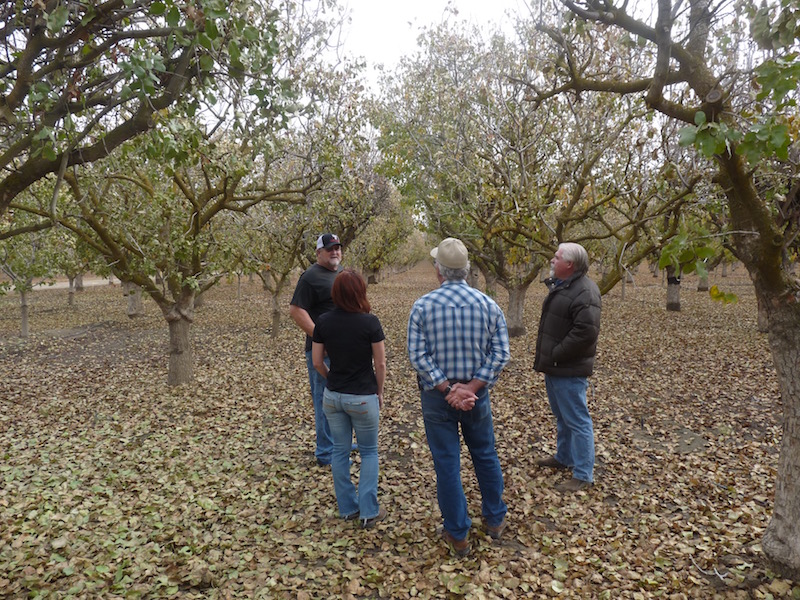
Land, who has 18+ years of experience in natural resource and land use issues, commented that to ensure the act is appropriately enforced, “We need to transition back to a place where they can focus on listing, recovery and then delisting a species once those species have recovered. That’s going to take Congress probably getting involved and making sure to refine how those resources are spent and where the attention is placed inside the USFWS.”

Lane emphasized the importance of the ESA and the necessity to ensure it achieves its purpose. “There’s no secret, I don’t think, to anybody who pays attention to this issue,” Lane said. “The ESA is popular with the American people. I think we need to be realistic that we’re not going to be doing away with the ESA anytime soon, so we had better make sure it works for everybody.”

“The first step in doing that,” Lane explained, “is making sure that it is a fully-functioning act; because right now, it is really broken. So we’re putting our attention on solvable issues that people can get behind where we can build consensus and actually try to make some changes.”

As a result of a new rule concerning critical habit guidelines, Lane anticipates potential problems for California’s cattle industry. “There are more species than I can count that could potentially impact the cattle industry in California and beyond,” he said. “So right now, where the rubber meets the road, is in the expansion of critical habitat guidelines on behalf of USFWS. They’ve just released a new expanded rule definition on what constitutes critical habitat. This new designation includes areas that have the biological potential to support that habitat needed for a species’ survival,” he said.


2016-05-31T19:24:04-07:00May 10th, 2016|

Talk, Merely Talk

Farmer Hears Plenty of Talk But Sees No Action on Water Management

Erik Hansen

Erik Hansen, Legacy Farmer in Kings County

By Patrick Cavanaugh, Deputy Editor

Erik Hansen, a big legacy farmer down in the Tulare Lake Basin in Kings County, is quite frustrated by how the state’s freshwater has been managed this year. “The most important thing,” he said, “is that people realize politicians in this state do not have your best interests in mind when it comes to how the water is run. We have infrastructure that is out of date and needs to be improved, but they are not even using the existing infrastructure at the full capacity it should be used, even though we are in a water emergency.”

“Now there is just nobody who can tell me that that’s OK,” stated Hansen. “Plenty of people can talk around it; they can say, ‘environmental this’ and ‘environmental that.’ But in the end, we need to take a very hard look at how these decisions are being made at the top levels—where people should be losing their jobs in a big way. ‘Starting from the governor having to explain—How do you have a water emergency; yet your appointments at the State Water Resources Control Board are not running the water as they should?

Hansen expects water mismanagement will continue and worsen until the California public holds their feet to the fire. “It is a power move,” Hansen declared.”They are able to hold off one of our most precious resources in the state, and currently two thirds of the state is suffering for it. Northern California has plenty of water, and that is where all the votes are. They forgot about the southern two thirds, and there are plenty of people here who are not happy about it.”

Hansen recounted, “There are higher bills in just about every municipality. Wells are running dry. Certain areas of the state are completely dry to the point where they require 250 gallon totes of water by truck delivery. This is unsustainable, and hopefully the politicians in Northern California can understand that word.”

2016-05-31T19:24:05-07:00May 2nd, 2016|

Tree Nut Theft Alert

Roger Isom Warns: Take Precautions to Thwart Tree Nut Theft

By Patrick Cavanaugh, Deputy Editor


Roger A. IsomWestern Agricultural Processors Association (WAPA) president and CEO, told CalAgToday, “Tree nut theft is still a serious issue this year, as it was last year. Folks behind the thefts have not been caught. We’ve had over 30 thefts in the last 6 months.”

There is good news. “We’ve had numerous attempts thwarted,” Isom commented, “because folks have started to implement some of the procedures that we talked about at our emergency Tree Nut Cargo Theft Summit back in December.” Following the successful Summit, nut theft legislation sponsored by the WAPA passed out of the Assembly Agriculture Committee unanimously. According to WAPA, AB 2805 (Olsen) would form a statewide California Agriculture Cargo Theft Crime Prevention Task Force with combined law enforcement services and support activities to fight agricultural cargo theft. Among the loads of tree nuts stolen was a load of almonds reportedly stolen during the Summit.”

Roger Isom, president and CEO, Western Processors Association

Roger Isom, president and CEO, Western Processors Association (source: LinkedIn)

Isom explained, “We brought experts in cargo theft from across the country to the training seminar held in mid-April in Modesto to make sure all members understood: What has happened? How are the thefts occurring? What have we learned from those thefts and the investigations? What can people do to prevent these thefts from happening at their locations?”

“What we’ve learned, for sure,” he explained, “is that if you do not implement the procedures, you will be hit. Following the December meeting, we’ve had companies hit by cargo theft; the [companies] that implemented the practices we talked about prevented thefts from occurring; those that did not have lost truckloads of tree nuts.”

Isom understands it is time consuming to follow the recommendations, and there is some cost associated with it. “You have to take the time to take pictures of the drivers,” he elaborated. “You have to fingerprint the drivers. You’ve got to make calls. You’ve got to make sure these truckloads of shipments have been placed at least 24 hours in advance. If there are driver changes, you cannot allow that. It takes some serious steps to prevent [theft].”

“We had one a few weeks ago,” Isom explained, “where they switched drivers and trucks—literally the day of [transport]. It ended up being OK, but the alarms went off. The next time it could be an actual fictitious pickup.”

Tracking a stolen truckload is difficult. Isom reported, “Typically they do get the license plate number. Prior to these thefts, they might have just asked the driver for the license plate number and taken his word for it. Maybe they would go to the extent of taking a picture of [the plate], but what if it is what they call a “cold plate”, a stolen plate?”

“In at least one of the thefts,” said Isom, “the license plates had been switched. The thieves literally stole somebody’s license plates off a pickup truck and put them on the truckload of nuts. Had someone in charge been educated on license plate numbers—just normal [information]—they may have easily discovered the plates were not valid; they were not applicable for a truck-tractor-trailer setup.

Isom remarked the thieves are clever. “Most occur on a Friday or just prior to a holiday,” he stated. “In some cases, the theft might not be discovered for 3 or 4 days. The damage depends on the value of the nuts at the time,” Isom said, “and are we talking about finished product? Has it been processed? Seasoned? But you’re talking a stolen value of at least $100k-$150k. That’s what makes it so attractive and why cargo theft is on the increase across the country.”

Furthermore, Isom stated, “We’ve been told by law enforcement that Los Angeles (LA) is now the highest cargo theft location in the world. It has increased dramatically in the last couple of years, and more so this past year. We did not see theft in tree nuts until recently. We had the occasional theft out-in-the-field or maybe at the huller—someone picks up a couple of trailers and tries to get rid of them—but not to this level, not this brazen, and not with finished product.

Cargo Theft Interdiction Program (CTIP) with the California Highway Patrol

Cargo Theft Interdiction Program (CTIP) with the California Highway Patrol

“Now it’s over 30 loads!” he said. “We’ve had almonds taken from 4 or 5 different locations; we’ve had walnuts; we’ve had pistachios from several different locations; and we’ve had cashews stolen. We didn’t even know there were cashews here in California, but they are imported and processed here in Fresno, and there have been multiple loads stolen.”

“Nobody is immune to it,” Isom commented. “Tree nuts are the preferred product right now compared to other cargo thefts—TVs, tires, or tablets. Tree nuts have no serial numbers; thieves can turn and burn them faster than you-know-what. The other attractive part about the tree nuts is you can also store them for while. You can hit the farmers’ markets just a little bit at a time. It’s easy.”

“This is not the common criminal,” Isom surmised. “This is something sophisticated. Look how they have hacked into the U.S. Department of Commerce (DOC) database to get this information. Look how shipping papers have been modified; they put their phone numbers on them, and it looks legitimate. We’ve had trucking companies’ identities stolen. They’re using their forms, their information, their drivers’ names, but it is somebody else doing this.”

“And trust me,” Isom added; “it’s not the guys just right along California State Highway 99 (‘the 99’), they’ll go to the smallest processor off the beaten path. They fool people with what looks like very legitimate paperwork. This isn’t something that somebody took a sharpie to; these look like legitimate shipping papers.”

Isom and WAPA are engaged with “all the law enforcement, not just the local county sheriffs, including the Cargo Theft Interdiction Program (CTIP) with the California Highway Patrol. We’ve got the U.S. Department of Justice, Federal Bureau of Investigation (FBI) involved now. There are a lot of people on it, but, because of the value, it’s so attractive that we’ve got to make everybody is aware of this.”

“This is a new type of theft facing our industry,” warned Isom, ” and you have to do your due diligence. It takes somebody taking some time, and it is going to slow down shipments. There’s no doubt about it; you have to be prepared and aware.”

Through the use of fictitious pickup, even if the drivers are caught, Isom explained it’s not a felony anymore due to changes in California laws. “If you hold the driver at gunpoint,” he said, “and you basically carjack the truck; that’s a felony. So they’re basically saying that legally, the processor or handler voluntarily gave up the load. So it is not a felony; it’s a misdemeanor. So guys aren’t doing any state prison time. They’re doing a couple of weeks in county jail. With all the overcrowding, Boom, they’re gone; let them go.”

“Quite frankly,” Isom relayed, “the majority of the trucks end up in LA, so that’s where law enforcement finds the trucks. And that’s where they say the theft ‘happened.’ You can’t get the LA district attorney to prosecute these cases because they are too busy with murderers, rapists, and other—what they consider more serious—crimes than your voluntarily giving up a load, in their opinion. Even though some of these loads are worth half a million dollars.”

“But now we have the FBI involved,” Isom affirmed. “Thieves are now stealing on interstate highways; these are now federal crimes. There is certainly more teeth in federal law. When we catch these guys, they’ll be in federal prison, doing some serious time.”

(Featured Photo Source: USDA-NRCS)

2016-05-31T19:24:05-07:00April 26th, 2016|

California Women for Agriculture Anew

California Women for Agriculture Rebrands After Forty Years

By Charmayne Hefley, Associate Editor


Founded in 1975 in Coachella Valley to promote and develop the interest of women in a strong agriculture industry in California, California Women for Agriculture (CWA) marks its 41st year with a rebranding. Jeanette Lombardo, president of CWA, said, “The theme for this year is Innovate, Activate and Motivate. We are really taking a look at everything we do, and trying to change it for the better,” she said.

Lombardo said there are currently 20 chapters with 2000-plus members across the state. Guided by five principle objectives, CWA aims to speak on behalf of agriculture in an intelligent, informative, direct and truthful manner; to keep members informed about pertinent legislative activities; to collaborate in support of agricultural issues and challenges; to improve the public image of farmers; and to develop a rapport with consumers, educators, and governmental & business leaders in communities throughout the State.

The wonderful thing about our organization is the age range,” Lombardo said, “from very young to very old. And the older ladies are wiser ladies, as I like to say; they provide mentoring capabilities to the younger folks who are coming in. And the younger folks are seeking leadership, personal growth, and network and industry knowledge,” Lombardo said.

Likewise, Lombardo said, young CWA members have been reverse-mentoring mentors on matters such as social media, “It is a wonderful thing and my goal is to have chapters in every county,” she noted.

2016-05-31T19:24:06-07:00April 22nd, 2016|

ALRB Discharges Farmworker Vote, Part 2 Exclusive Interview with Attorney Raimondo

Anthony Raimondo, “Let the People Vote!”


In an exclusive interview with Fresno attorney Anthony Raimondo, California Ag Today’s Patrick Cavanaugh discussed the significance to farmworkers of yesterday’s Agricultural Labor Relations Board (ALRB) decision to “set aside” Gerawan farmworker votes from the ALRB-sanctioned November 2013 election to decertify the UFW. Raimondo is the attorney for the UFW union decertification petitioner, Silvia Lopez, an employee of Gerawan Farming, a Fresno County diversified tree fruit operation.

California Ag Today: The central California agricultural industry is flabbergasted this week following the California Agricultural Labor Relations Board’s decision to set asideand not countthe ballots of 2,600 Gerawan farmworkers cast in 2013. What is your take on this decision?

Anthony Raimondo, Fresno County-based attorney

Anthony Raimondo, Fresno County-based attorney

Raimondo: It is unfair because from the outset, we have argued all along that this entire process has been unfair and has denied the workers their “day in court” and their due process. From the first day that Silvia Lopez walked into the ALRB office in Visalia, the greatest opposition to her filing for an election has been the ALRB itself.

We had a judge who couldn’t stay awake for the hearing. We have board members who are—shall we say at the least—biased. In the case of ALRB board member, Genevieve Shiroma, we have a person whose entire career is intertwined with the UFW’s primary paid lobbyist. There’s no way these folks can be objective in a case that has this kind of stakes in the UFW.

And this case is all about money. If they can get a contract with Gerawan, the UFW will essentially double its revenue and double its membership overnight.

California Ag Today: What is at stake for the UFW?

Raimondo: There is a clear reason why the State would end up spending $10 million on this case: They want to silence these workers and save the UFW. There is no union organizing in the field; the UFW has abandoned organizing. They’re not out there getting the workers to support and join the union.

They’re in the courtroom and in the back halls of Sacramento, making deals to take control of these workers’ future, whether the workers want it or not.

Ag LawCalifornia Ag Today: In denying the ballot votes to be counted, the ALRB said it was unfair that the employer—Gerawan in this case—gave the workers a pay raise without permission of the state government or the UFW.

Raimondo: But even with this illegitimate process, the only thing that the Board actually found was that the employer violated the law—not the workers.

So the Board is going to punish the employees by destroying their ballots, like some sort of third-world dictator. What control does the farmworker have over what the company does? What can the workers do to protect their right to vote if their right to vote can be thwarted by what a third party—the company—does?

The workers’ right to vote shouldn’t be in the hands of the company, or of the union, or of anybody else. The California Constitution says that when people cast votes in our state, those votes must be counted. That’s apparently true, unless you’re a farmworker.

California Ag Today: And the agricultural industry is asking, “How can the State of California and the state ALRB get away with this?”

Raimondo: It’s appalling what they’ve done here. It really is appalling. They’ve decided that the best way to control the behavior of an employer is to punish the workers who have no control over that employer.

You know there’s no reason that, if they believe that that election was tainted, they can’t run another election. I’ve spoken to Silvia, and Silvia’s not afraid of letting the people vote. I wonder if the UFW is as brave.

Let the people vote.

California Ag Today: Is the ALRB and the UFW requesting a new vote?

Raimondo: No, they want the farmworkers to stand off to the side and be quiet while the UFW makes the deal through political moves to take their money.

California Ag Today: What’s next?

Raimondo: We are planning, on Silvia’s behalf, to file briefs in the ongoing mandatory arbitration case that is sitting before the California Supreme Court. The UFW has a brief due and the Court has not yet set a hearing date.

We’re hoping that the Supreme Court will be kind enough to give us the opportunity to speak in that case, as the Court of Appeal did. So that case still provides us with a very real chance to vindicate the workers’ rights.

In the election case that was just decided, we are planning on filing a petition for reconsideration with the Board. We think that they need to think twice before they destroy people’s ballots.

California Ag Today: The ballots have not been destroyed at this point, right?

Raimondo: We don’t know. That’s a question only the ALRB can answer.

From my view, I would hope that they were not rushing to have a bonfire today.

I would think that because these votes are precious and irreplaceable, the Board would show the restraint to withhold taking any action on the ballots until the parties have had the opportunity to pursue the various legal options that we have to challenge this decision and make sure they are doing the right thing.

_______________

Resources:

ALRB Decision and Order Case No. 2013-RD-003-VIS, 39 ALRB No. 20, April 15, 2016)

Agricultural Labor Relations Act Employee Questions & Answers ELECTIONS

Petitioner Silvia Lopez’s Petition to Disqualify Board Member Shiroma, ALRB Case No. 2013-RD-003-VIS (39 ALRB No. 20)

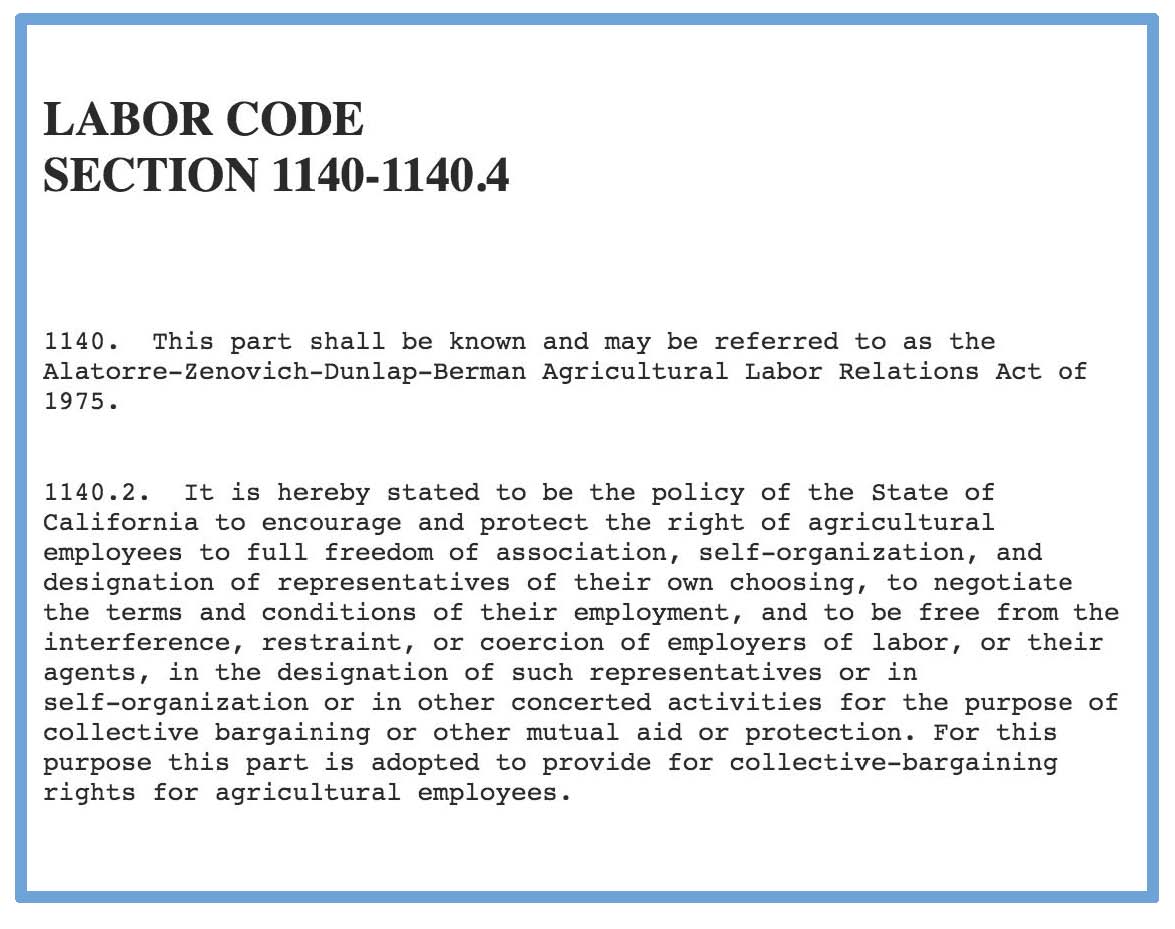
California LABOR CODE SECTION 1140-1140.4

Pick Justice

2016-05-31T19:24:06-07:00April 19th, 2016|

ALRB Discharges Farmworker Vote, Part 1

ALRB Abolishes Gerawan Farmworker Vote

By Laurie Greene, Editor

The Ninth Amendment to the Constitution of the United States pays tribute to “unenumerated” rights of citizens—rights not specifiedsuch as the right to travel, to vote, to keep personal matters private and to make important decisions about one’s health care or body, as upheld by the Supreme Court over the years. Likewise, the cherished American legal notion of “No taxation without representation,” generally attributed to James Otis embraces “actual representation” over “virtual representation.”

Yet, Court documents issued on Friday, April 15, 2016, by the Agricultural Labor Relations Board (ALRB) upheld the September 17, 2015 decision by Mark R. Soble, Administrative Law Judge, ALRB, to set aside farmworkers’ ballots in a 2013 election to decertify mandated representation by the United Farm Workers of America (UFW).

The following paraphrased issues were among ALRB findings:

Gerawan Farming committed unfair labor practices under California Labor Code section 1153 by providing unlawful assistance to the decertification effort against the UFW, directly soliciting grievances and granting employees a wage increase.

-Petitioner Silvia Lopez, a Gerawan farmworker, solicited and received an unlawful donation from an association of which Gerawan was a member.

The ALRB concluded these unlawful actions (a) make it impossible to know if the signatures collected represent the workers’ true sentiments and (b) created an environment, which would have made it impossible for true employee free choice when it came time to vote.

“As a result of the employer’s unlawful support and assistance,” Judge Soble, in September 2015, called for “setting aside the decertification election and dismissing the decertification petition. Given that the unlawful conduct tainted the entire decertification process, any election results would not sufficiently reflect the unrestrained free expression of the bargaining unit members.”

Thus, the UFW, voted in by Gerawan farmworkers in a runoff election in 1990, certified by the ALRB in 1992, never reached a contract to represent the farmworkers in wage negotiations with their employer, and did not collect dues from or provide services for the farmworkers, reportedly among the highest paid in the industry, effectively abandoned the Gerawan farmworkers. 

When the California State Legislature amended the Agricultural Labor Relations Act in 2002 and 2011 to allow and to accelerate the process for imposed mandatory mediation and conciliation for a union contract, UFW offered a new contract proposalafter having abandoned the Gerawan farmworkers from 1995 and 2012.

Despite a lower court’s rejection of the so-called mandatory mediation and conciliation provision, the ALRB appears to have been successful in forcing UFW representation and mandatory dues collection on current Gerawan employees, after 25 years of ineffective UFW involvement that encompassed about 18 years of no involvement whatsoever—and certainly without counting their votes.

Click here to read, “ALRB DISCHARGES FARMWORKER VOTE, PART 2 – EXCLUSIVE INTERVIEW WITH ATTORNEY RAIMONDO: LET THE PEOPLE VOTE!”

2016-05-31T19:24:06-07:00April 19th, 2016|
Go to Top