Seat Belts Important to Farm Worker Safety

Year-Round Nut Harvest Safety –  Part 2

By Patrick Cavanaugh, Farm News Director

Safety should be top priority on farms, especially during harvest. Most farm accidents and fatalities involve machinery and a busy atmosphere like harvest creates many opportunities for injury. However, farm worker safety is important year round. Paul Williams, a senior loss prevention consultant with the State Compensation Insurance Fund, talked to California Ag Today about the topic.

“Some things like wearing seat belts is critical. All the new farm equipment has seat belts, and workers should be encouraged to wear the seat belts because if they are unfortunate enough to get rear ended, that seat belt’s going to keep them in the equipment. You’re not going to get ejected out onto the road,” Williams said.

“A lot of it’s just simple common sense, but the whole idea of doing these before harvest is to remind people, that they are getting ready to enter a busy time of the year. And fatigue is always a factor when you’re working six days a week, 10-12 hours a day. It’s just natural that you get tired, and when you’re tired, you don’t always think clearly,” he said.

“Worker reaction times are slower so we just want to remind people, about safe work practices to follow. And they are good to follow year-round,” Williams noted.

It’s also important to consider safety when riding from one area of the farm to another.

“If there is not a seat and a seat belt, then there should not be a rider. And it does not matter if it is a tractor or bin trailer or a tractor pulling irrigation pipe,” Williams said.

“We’re all basically lazy; none of us like to walk any further than we have to. We don’t see any harm in hitching a ride, but we have a number of fatalities and serious injuries on California farms every year. We have way too many accidents occur where people are passengers on bin trailers and harvest, whether it’s in the vineyards or in the orchards.

“People jumping on a bin trailer where a tractor driver up front may be making a sharp turn to get out of a row. A lot of times there can be pinch points and that’s where people get pinched between that part of the trailer or that bin that they can’t always see. It’s a very dangerous place to be because all it takes is one bump, one hole in the ground or a rough spot to cause someone to be bounced off the tractor.

“The worst injury we see is not so much being bounced off, but just being caught in between row end or the poles at the end of a vineyard,” Williams said.

For more information on safety on the farm, go to: http://www.agsafe.org/
2017-09-03T00:23:27-07:00August 9th, 2017|

Sharing Secrets to a Successful Bowl of Cherries

Weather and Pruning Make Life a Bowl of Cherries

By Laurie Greene, Founding Editor

Clark Goehring, a third generation Kern County farmer, produces cherries and almonds. He summarized his cherry harvested as “good compared to the other years when we have had rain. Some people in our area still had rain during harvest, but we were able to harvest and bring our cherries to market in good condition.”cherry tree

“Of course, it rained a lot this winter and spring, but you do not want rain when cherries are maturing on the tree; they don’t like rain.”

Goehring explained that when it rains beyond the point when cherries start coloring, they split, making them unmarketable. “But while it may take some rained-on cherries off the market, the price of the marketable fruit goes up,” he said, benefiting those growers who had a quality crop, like him.

Goehring’s farm workers train the cherry trees to keep them low—approximately 8 feet tall. “We have tried to have them bush out instead of being more of a central leader. Actually, it’s called Spanish Bush style or, in modified form, KGB.”

Kym Green Bush designed the KGB training method in Australia to use multiple leaders and have them fruit on the leaders themselves. KGB simplifies pruning so less experienced farm workers can learn the skill more easily. The trees are replenished every five years.

Goehring said the method saves money on the farm, cuts labor and increases workers’ safety because it requires no ladders and the harvest is quicker. Harvesting without ladders also gives Goehring an advantage of attracting farm labor over other orchards that require ladders.

“In California, if farm workers have their choice of picking your cherries without using ladders, which is usually piecework, or someone else’s crop with ladders, they are going to want to come to you,” he explained.

2017-08-02T16:14:04-07:00August 2nd, 2017|

New Estimates on Broccoli and Lettuce Production Costs

Broccoli and Lettuce Production Cost Studies Released by UC ANR

News Release

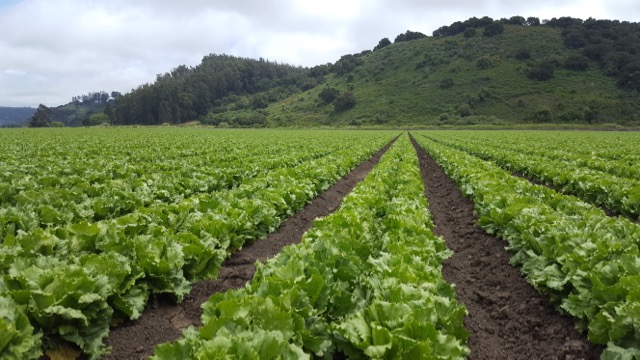
New studies with sample costs to produce and harvest iceberg lettuce and broccoli for fresh market in the Monterey, Santa Cruz and San Benito counties have been released by UC ANR Agricultural Issues Center and UC Cooperative Extension. Vegetable growers may find these useful for estimating their own production costs and potential returns on investment.

“These studies have an expanded section on labor, which includes information on California’s new minimum wage and overtime laws,” said Laura Tourte, UC Cooperative Extension farm management advisor in Santa Cruz, Monterey and San Benito counties, who co-authored the study.

The analysis is based on a hypothetical well-managed farming operation using practices common to the Central Coast Region. The costs, materials and practices shown in this study will not apply to all farms. Growers, UC ANR Cooperative Extension farm advisors and other agricultural associates provided input and reviewed the methods and findings of the study.

Both studies assume a farm operation of 1,500 non-contiguous acres of rented land. The hypothetical iceberg-lettuce farm has 250 acres planted to iceberg lettuce. The lettuce is hand-harvested into 42-pound cartons containing 24 film-wrapped heads. The hypothetical broccoli farm has 500 acres planted to broccoli. The broccoli is hand-harvested into 21-pound bunch cartons.  On each farm, the remaining acreage is assumed to be planted to other cool season vegetable crops. 

The authors describe the assumptions used to identify current costs for production material inputs, cash and non-cash overhead. Ranging analysis tables show net profits over a range of prices and yields. Other tables show the monthly cash costs, the costs and returns per acre, hourly equipment costs, and the whole farm annual equipment, investment and business overhead costs.

Free copies of “Sample Costs to Produce and Harvest Iceberg Lettuce in the Central Coast – 2017” and “Sample Costs to Produce and Harvest Broccoli in the Central Coast – 2017” and other sample cost of production studies for many commodities are available. To download the cost studies, visit the UC Davis Department of Agricultural and Resource Economics website at https://coststudies.ucdavis.edu.

The cost and returns studies program is funded by the UC Agricultural Issues Center and UC Cooperative Extension, both of which are part of the UC Division of Agriculture and Natural Resources, and the UC Davis Department of Agricultural and Resource Economics.

For additional information or an explanation of the calculations used in the studies, contact Jeremy Murdock of the Agricultural Issues Center University at (530) 752-4651, Richard Smith, UC Cooperative Extension advisor in Monterey County, at (831) 759-7357 or Tourte at (831) 763-8005.

2017-06-08T14:59:43-07:00June 8th, 2017|

Help Lobby To Veto SB1

SB1 Proposed Taxes & Fees Are Detriment to Farmers

By Jessica Theisman, Associate Editor

SB1 was recently passed by the legislature in California. This bill affects everyone in the state and increases several taxes and fees to raise the equivalent of roughly $52.4 billion over 10 years in new transportation revenues. It is not likely that the governor will veto the bill. We spoke with Anja Raudabaugh, CEO of the Western United Dairymen about how this bill will affect California’s agriculture.

This bill proposes a 20 percent increase in fuel taxes, which is something that farmers cannot afford, especially the dairy industry. “As you know, we cannot pass on our costs to our consumers, so adding another regulatory cost of production is incredibly hurtful and harmful,” Raudabaugh said.

Western United Dairymen continues to lobby on a nosb1.com campaign. They are asking the governor to veto it, although it is highly likely not to occur given that this is his bill. “This is his policy coalition, his desire to tax the constituents in California to their grave,” Raudabaugh said.

Starting November 1, SB1 will increase the excise tax on gasoline by 12 cents per gallon and the tax on diesel fuel by 20 cents per gallon. The bill also creates a new annual transportation improvement fee (TIF) beginning January 1, 2018. This is based on the market value of your vehicle. This fee will range from $25 to $175. SB1 also creates the road improvement fee of $100 per vehicle for zero emission vehicles starting in 2020 for model year 2020 and later.

Western United Dairymen are asking that if you have not filled out a nosb1.com petition that you do so, because they are using it to geo-track the information and essentially target the areas that are subject to vulnerability in the upcoming 2018 election. It is systemized so that when you enter your zip code, it goes directly to your legislator, either Assembly, Senate or both.

“We can actually see then which counties in California using some voter referencing material are more inclined to hate the gas tax,” Raudabaugh explained.

SB1 is not just targeting people who drive gas and diesel vehicles. Electric vehicles will also be targeted and will receive new fees.

“What’s more outrageous is that there are no guarantees that it will actually fix our roads. None whatsoever,” Raudabaugh said.

There is a ballot measure that was negotiated as a result of SB1 so that several key Silicon Valley Assembly members would vote for the bill. “To actually suggest that you would need a ballot measure to ensure that the funds do that, at least 20 percent of funds, seems really ironic,” she said.

2017-05-23T15:56:34-07:00May 23rd, 2017|

Legislative Pressure on Agriculture

Legislative Pressure Builds for Agriculture

By Jessica Theisman, Associate Editor

Dennis Albiani is a lobbyist with California Advocates based in Sacramento. California Ag Today met with him at the recent Almond Alliance meeting in Santa Barbara, where he discussed the legislative pressure on agriculture. California’s agricultural interests have had a challenging past couple of years on the subjects of overtime, minimum wage and some of the regulatory compliance areas.

“As we work with legislators, legislative process and the administration, we need to definitely find opportunities to advance the arguments on how the regulations are impacting agriculture,” Albiani said.

What also needs to be realized is that there might be some opportunities. We may be able to benefit from in the climate contained, constrained economy. We also must keep in mind the possible challenges.

Albiani looked at the almond industry as an example. “We have three crops per the drop for nuts. You have the nut, the bio-massed product, and the tree is a carbon sink,” he said. All of those are options that need to be further explored and also continue to pushed back on the regulatory constraints that they are inflicting.

2017-06-23T18:13:31-07:00May 22nd, 2017|

SB-1 Is Yet Another Tax Grab

SB-1 Gas Tax Will Severely Hurt Ag

By Melissa Moe, Associate Editor

Governor Jerry Brown recently signed SB-1 into law. This bill will affect everyone in the state and increases several taxes and fees to raise the equivalent of roughly $52.4 billion over 10 years in new transportation revenues. We spoke with Anja Raudabaugh, CEO of the Western United Dairymen, about how this bill will affect California agriculture.

Anja Raudabaugh, CEO of Western United Dairymen

“A twenty-percent increase on fuel taxes is something that we can hardly, especially in dairy industry, afford. As you know, we cannot pass on our costs to our consumers, so adding another regulatory cost of production is incredibly hurtful and harmful,” Raudabaugh said.

SB-1 increases the excise tax on gasoline by 12 cents per gallon and the tax on diesel fuel by 20 cents per gallon starting November 1, 2017. SB-1 also creates a new annual transportation improvement fee (or TIF) starting January 1, 2018. This is based on the market value of your vehicle. This fee will range from $25 to $175.

SB-1 isn’t just targeting people who drive gas and diesel vehicles. Electric vehicles will also be targeted and will receive new fees. SB-1 also creates the road improvement fee of $100 per vehicle for zero emission vehicles starting in 2020 for model year 2020 and later.

“Everyone should be outraged over this. What’s more outrageous is that there are no guarantees that it will actually fix our roads. None whatsoever,” Raudabaugh said.

“There is actually a ballot measure that was called a lock box that was negotiated as a result of SB-1 so that several key Silicon Valley Assembly members could vote for the bill that says the public must award this transportation fund to go toward road repairs,” Raudabaugh said.

“It was sold to the Legislature as actually fixing roads and creating repairs where badly needed. To actually suggest that you would need a ballot measure to ensure that the funds do that, at least 20 percent of funds, seems really ironic,” she said.

2017-05-10T22:29:43-07:00May 7th, 2017|

Uniqueness of California Wheat Industry

California Wheat Growers Farm Every Class of Wheat

By Brian German, Associate Broadcaster

Wheat is a primary crop for many producers, along with being a valuable rotational crop that helps manage disease and improve the condition of the soil. Wheat production is an important aspect of the economics of farming in California.  Nick Matteis is the Executive Director for the California Association of Wheat Growers.  Having finished planting last month, California wheat growers are pleased with the amount of rainfall already coming to California.

“Soil moisture is key for having a good start on the wheat-growing season. … It’s the best start you could ask for as far as growing season goes,” Matteis said.

The average wheat production in California is 1.1 million tons annually and is most often used within the state for both human and animal consumption. Nearly a quarter of that total is exported. Between 2010 and 2014, an average of 47 percent of the common wheat planted in California was used for silage, forage, green chop or hay.    California wheat also has some characteristics that sets it apart other states.

“We have both irrigated and non-irrigated acreage in this state which is sort of unique compared to most other wheat-growing regions in the country. Most of it’s rain-fed; what we call dryland farming,” Matteis said.

The irrigated wheat acreage in the state also provides “the highest yields in the country, like tons per acre versus bushels, which is how most of the other wheat producing states would measure it,” Matteis said. This quality also contributes to the production of high protein wheat.

California growers planted close to 470,000 acres of wheat in 2015, with a farm value of nearly $125 million for grain produced.  It appears that 2016 saw an increase in plantings. “Right now, I think the guesstimate is somewhere between 500,000 and 600,000 acres are planted in wheat,” Matteis said.

The two main types of wheat grown in California are hard red winter wheat and durum wheat, but growers also produce multiple other varieties.  “We grow every class of wheat, which we’re one of the only states that actually does that. You’re talking Hard Red Winter, Hard Red Spring, Hard White, Soft White. We have the Desert Durum which is really popular for the pasta makers in the world,” Matteis said.

The hard red varieties are classified as winter wheat because of the timing of when it enters the market.  Winter wheat is grown throughout the state, with the majority of production coming from areas located in the San Joaquin Valley, where Fresno, Kern, Kings and Tulare counties dominate production.

Desert Durum is a registered certification mark owned by the Arizona Grain Research and Promotion Council and the California Wheat Commission.  Durum is the hardest of all the wheat varieties, with a high protein content and white bran. Its most often used to make pasta, couscous and some types of Mediterranean breads.

A significant portion of the state’s common wheat is used for milling into general purpose or bread flour.  California also happens to have the largest milling capacity in the U.S., due to having the most mills in one state.

2017-01-22T19:11:41-08:00January 22nd, 2017|

Livestock Economics for Western Producers

Livestock Economics: What Attributes Bring Higher Prices?


By Laurie Greene, Editor


At the 100th Annual California Cattlemen’s Association (CCA) & California CattleWomen’s (CCW) Convention last week in Sparks, Nevada, Tina Saitone, cooperative extension specialist, UC Davis Department of Agricultural and Resource Economics, described her research on rangeland and livestock economics. “Primarily, my focus has been on cattle — beef cattle to date — but I’ve also started some projects recently with sheep producers and the predator interactions they have specifically with coyotes. I am examining whether or not [producers] can use nonlethal depredation methods to mitigate those losses.”

“Right now, I have been concentrating on marketing characteristics of cattle,” she said. “I study those practices employed by producers, such as when they wean their cattle; how many vaccinations they have; whether they market [their cattle] as natural, grass-fed, or organic; and the impact that [these choices] have on their prices.”

Tina Saitone

Tina Saitone, cooperative extension specialist, UC Davis Department of Agricultural and Resource Economics

Interestingly, Saitone and her colleagues have mainly been using satellite video auction data. “Western Video Market Auction actually held their auction this month here in Sparks, Nevada because they can do it at different locations all the time. So, we use that data to figure out cattle characteristics and then determine the marginal impact that each of those characteristics has on price,” said Saitone.

Characteristics such breed, frame score, flesh score, and weight, are definitely controls in Saitone’s research model because those are main drivers of price. “But what we want to do is figure out — holding all those things constant —if a producer raises their cattle natural, what kind of premium does that bring them? We’re really looking for that incremental difference.”

One might expect certain factors such as natural or organic, to deserve a higher price, but there always has to be a buyer. “Right now, when prices are low relative to 2014 and early 2015, ranchers do have some opportunities to get some higher prices in what we would call niche markets. Consumers are increasingly demanding a wider range of characteristics. They want grass-fed. They want organic. They want natural, no hormones. All of these are what we would call credence attributes. If you go to the grocery store and you taste a steak, you probably don’t know if it was raised natural.”

Accordingly, the industry has third-party certification to assure consumers that when they pay a higher price for that product they are actually getting those traits. “Farmers actually have the ability to fill some of those niche markets that consumers have created with their demand and possibly get higher prices than just selling into traditional commercial channels.”

The data that Saitone has been looking at from Western Video is focused on Western states, including California. Certainly, location places Western producers at a persistent disadvantage because the majority of the processing capacity is in the central part of the country, with Nebraska being the hub. Saitone said, “When you think about cattle being raised in California having to be transported all the way to Nebraska, some 1600 or 1700 miles, not only do you have the cost associated with that transportation, but you also have shrink; you have mortality.

California Cattlemen’s Association (CCA)

California CattleWomen

UC Davis Department of Agricultural and Resource Economics

2021-05-12T11:17:11-07:00December 6th, 2016|

Algae in Soils Increases Soil Health, Better Crops

Is Algae in Soils a New Frontier in Plant Health and Yield?


By Patrick Cavanaugh, Farm News Editor


Could applying microalgae to the soil boost yield and strengthen plants? We spoke to Len Smith, chief business office, Heliae Development LLC., based in Gilbert, Arizona, in the southeast Phoenix metropolitan area. “Heliae is a company that is dedicated to unlocking the potential of microalgae,” said Smith. “We’ve been in business now for over eight years. We hope to be able to deliver microalgae products in a lot of areas, including in plant agriculture.”

“While we work with hundreds of algae species, the algae we are currently marketing for plant agriculture is a green algae. It is actually subject to genetic classification so I couldn’t even tell you the exact species at the moment,” noted Smith. “We’re working on several others as well. We have often seen in our early stage testing that many different kinds of microalgae have different positive effects on plant agriculture, so we’re bringing many of them along,” he said.

Unlock the secrets in the soil diversity

Natural Resources Conservation Service (NRCS) Soil Health Campaign

Smith said these algae are among the most common components in healthy soil. “A lot of what we’re doing is actually restoring what is already present in the soil. A lot of the scientists we work with think this is a critical component of the whole plant ecosystem below the soil line.”

Similarly, many university researchers are taking a closer look at algae. “We have about 30 university and contract research studies in, and we are working with growers. We have been selling the product in what I would consider almost a beta launch mode for about two years. So, we probably have about that same number of grower trials—maybe even double that,” said Smith.

Having the algae in the soil not only increased yields, according to Smith, it increased crop quality and strengthened the soil. “Benefits include root mass; in fact, we saw a 20 percent root mass increase in cotton. We have also seen the plant’s ability to grow in stressed environments such as heat stress and drought stress, in some of the work UC Davis did for us. We saw a 25 to 30 percent increase in overall yield in the stressed soils in which the algae was present, as compared to the control,” Smith explained.

Could it be that algae may be the new frontier in plant health and yield? “Yes, we’re very excited about what we’re doing. I would say we are opening a field here that nobody else is really paying attention to. I think that you will be seeing more of these products come to market, hopefully  helping growers get better results in a restorative and natural way,” Smith said.


Heliae Development LLC.

Phycoterra

2021-05-12T11:05:43-07:00December 5th, 2016|

Improved Huanglongbing Detection in Citrus Trees

Projects Underway for Better Huanglongbing Detection in Infected Trees


By Patrick Cavanaugh, Farm News Director


The big problem with Huanglongbing Disease (HLB), also known as citrus greening, is that an infected tree, despite having no visual symptoms, could quietly be a massive reservoir of HLB. The main vector, the Asian Citrus Psyllid (ACP), could easily pick up HLB from that tree and spread the disease throughout the orchard.

Currently, the main push to contain the possible spread of HLB is by controlling ACP. Yellow sticky traps are positioned near every commercial orchard in California, as well as near non-commercial trees in neighborhoods. Finding a psyllid on a trap triggers mandatory spray programs to help eliminate all psyllids in the area.

Neil McRoberts, Huanglongbing Detection

Neil McRoberts, associate professor of plant pathology, UC Davis

“Yes, one of the most critical questions in managing in HLB is the trees can be infected for a long time before you can visually see the ACP there,” said Neil McRoberts, an associate professor of plant pathology, University of California, Davis.

“There is a group of scientists, funded by the Citrus Research Board of California (CRB), working on different early detection methods. Those are methods where you would be able to tell the tree was infected before you could see the tree is infected,” said McRoberts.

The CRB funded field trials in Texas over the last few years that have narrowed the field of competitors to two or three techniques. The CRB will continue to fund the two leading contenders in that race to determine the leading early detection technology.

In the first technique, researchers analyzed all the microbes that live on a non-infected leaf surface and studied how that profile of microbes changes when the tree gets infected. Detecting a change in microbe profile could indicate the tree is not as healthy as it should be.

“Researchers take the microbes that live on an infected tree, extract the DNA from those microbes and run the DNA through a sequencer. The sequencer identifies which types of microbes are there,” he said.

McRoberts said sampling for microbes is easy. Researchers use an industrial-sized swab on the leaf surface. “You literally clean the leaf surface with the swab until it’s squeaky clean, put that swab in a bottle and send it to a lab. When it gets to the lab, they extract the DNA out of it and the rest of the process happens from there.

ACP Nymph Tamarixia Huanglongbing

A female Tamarixia radiata laying egg on an ACP nymph. (Photo by J. Lotz). Courtesy of Citrus Research Board

In selecting which trees should undergo microbe swabbing, McRoberts noted that the ACPs tend to attack the groves from the outer edges, inwards. “At different times of the day, the light will be on different edges of the grove depending on where the sun is and how warm it is. You can target your sampling towards the places where you’re more likely to find it, but still, finding those initial little infections is tough.”

The second method is a technique called metabolic profiling. A newly infected tree starts to produce different proteins and other chemicals in response.

Still another research strategy is analyzing things that stay in the tissue. “There’s a change in the profile of metabolites in the tree. If you run those metabolites through a mass spectrometer, the mass spectrometer will spit out a profile. You can tell the difference between a healthy profile and an infected profile,” McRoberts said.

“This is how the dogs come into the picture. Everybody knows that citrus has an odor. When the trees are infected, the profile of the chemicals and the composition of that odor change. We can’t smell it, but a very sensitive electronic detector device can sometimes pick it up. Remarkably, dogs can pick it up. We think that’s what happening with the canine detectors; they’re picking up some change in the smell of the trees.”

McRoberts said that dogs are amazingly accurate in detecting trees with HLB disease. “The best that we can tell from the trials involving dogs, the false positive rate is less than 1 in 1,000. I’m very confident with the detector dogs,” McRoberts said.


Featured photo: Adult Asian citrus psyllid (Photo by J. Lewis). Courtesy of Citrus Research Board

Citrus Research Board of California (CRB)

UC Davis Department of Plant Pathology

2021-05-12T11:02:00-07:00December 2nd, 2016|
Go to Top