BREAKING NEWS: John Duarte Settles TODAY Prior to Court Proceedings

By Patrick Cavanaugh, Farm News Director


Northern California farmer John Duarte spent years fighting the federal government after being fined for routine plowing on his wheat field which included protected wetlands. He attracted a nationwide army of conservative supporters who saw it as government overreach and hoped the Trump administration would order federal officials to back off.

But just before his trial was set to start Tuesday in U.S. District Court in Sacramento, Duarte settled, admitting no liability, but agreeing to pay $330,000 in civil penalty fines and another $770,000 for “compensatory mitigation,” in vernal pool mitigation credits.  

In a press release TODAY by John Duarte and Pacific Legal Foundation (PLF), John Duarte said, “This has been a difficult decision for me, my family, and the entire company, and we have come to it reluctantly. But given the risks posed by further trial on the government’s request for up to $45 million in penalties, and the catastrophic impact that any significant fraction of that would have on our business, our hundreds of employees, our customers and suppliers, and all the members of my family, this was the best action I could take to protect those for whom I am responsible.”

“John would have preferred to see this case through to trial and appealed the court’s liability ruling, which holds that plowing a field requires federal permission — despite the clear text of the Clean Water Act and regulations to the contrary,” said Tony Francois, senior attorney, PLF.  “John and his counsel remain concerned that legal liability for farming without federal permission undermines the clear protections that the Clean Water Act affords to farming and poses a significant ongoing threat to farmers across the nation.”

The court will hold a hearing in approximately 45 days to approve the settlement.  In the meantime, the trial that was to begin today has been canceled.
2017-08-15T19:24:36-07:00August 15th, 2017|

Embattled Farmer John Duarte Defends Farming in Federal Court

Farmer Must Defend Plowing His Wheat Field

By Patrick Cavanaugh, Farm News Director

John Duarte, a California farmer who gained national attention after the United States Army Corps of Engineers (USACE or Army Corps) sued him for plowing his Tehama County wheat field, will defend himself in a federal courthouse in Sacramento on Tuesday, August 15.

“Agriculture is at a very dire crossroads right now,” said Duarte, imploring all farming stakeholders and food consumers across the country “to get loud with their Senators, Representatives and USACE. And if you know how to get ahold of President Trump, give him a call.”

In February 2013, with no warning or opportunity to discuss the matter, USACE sent Duarte a cease and desist letter to suspend farming operations, claiming that he had illegally filled wetlands on his wheat field simply by plowing it.

“I am being prosecuted for planting wheat in a wheat field during a global food crisis,” Duarte said. “They’re claiming I should have pulled a [Clean Water Act] permit that nobody has ever pulled and conducted practices that nobody has ever conducted to grow wheat.”

Duarte who is also the owner of Duarte Nursery, argues that the Army Corps violated his constitutional right to due process. He said the agency came down on him hard and never gave him an opportunity to defend himself against the accusations before levying the fine. Duarte now faces $2.8 million in government fines.

“The Army Corps of Engineers is prosecuting us,” Duarte said, “and the Army Corps does not even have subject matter jurisdiction to conduct this prosecution.”

In a June 14, 2017, news release, Tony Francois, senior attorney for Pacific Legal Foundation, explained, “Prosecutors and bureaucrats are seeking to establish, for the first time, that farmers with seasonal puddles need a federal wetlands permit in order to plow their own private land—even though plowing is exempt from Clean Water Act (CWA) coverage.”

Duarte believes if he were to lose the upcoming trial, it would change the way farmers in America farm. “This battle may never be resurrected in court. Taking this battle to the Supreme Court on several fronts is the only way to give farmers the long-term security they need, the right to farm and property rights protections, to deliver food security to America.”

The American Farm Bureau Federation, the California Farm Bureau Federation, the farm bureau in Duarte’s backyard and farm bureaus across the country are behind him.

“The Butte County Farm Bureau has 1065 members,” Duarte stated, “and they donated a check for $10,650 to the Duarte Defense Fund at California Farm Bureau Federation. That’s $10 a member! Thanks to the challenge from Biggs, CA, farmer, Clark Becker (President of the Butte County Farm Bureau) that defense fund has already collected over $100,000 in support of our lawsuit. We are hoping to collect hundreds of thousands more.”

Duarte said, “Although this lawsuit for planting wheat in a wheat field has gained a lot of attention, we need more help to fight it.”

While Duarte is grateful for the political support in favor of Duarte Nursery’s position in this wetlands prosecution, he wants to settle this case before trial. “We need complete rights to appeal, and if necessary, to take it to the Supreme Court of the United States. We must protect food security as well as farmers’ right to farm.”

“My greatest nightmare is if Duarte Nursery is forced into settling this case without the right to appeal. If we cannot get such a release, American farming could be oppressed by federal agencies into the future, and there won’t be another fool to follow us and stand up to them again.”

“Any farmer can see the kind of abuse—the misstatements, the falsehoods, the misquoting of laws that the Department of Justice is using in this case against us—and the $2.5 to $3 million we’re spending to fight this battle. There won’t be another family to come along and fight like this in the future.”

2017-09-02T23:46:02-07:00August 12th, 2017|

Farm Safety is Critically Important

Nut Harvest Safety – Part 3

By Jessica Theisman, Associate Editor

Farm safety is extremely important. The U.S. Department of Labor reported that the farming industry saw about 600 fatalities across the country last year. More than 200 laborers are injured in the U.S. on a daily basis. Many of these injuries result in permanent disability.

Paul Williams

Safety is not just important on the road; electrical safety is also a hot topic, noted Paul Williams, a senior loss prevention consultant for State Compensation Insurance Fund.

“We always talk about lock-out, tag-out, chocking and blocking tires, and before you make any repairs, making sure that equipment is shut off, and then doing repairs in the field,” he said.

Yet, many people are lost every year at harvest when they decide to make repairs in the field with just a quick adjustment.

“Sometimes people are in a hurry, they’re impatient, they’re tired, maybe fatigue sets in there; too easy to get caught in moving parts,” Williams said.

Although many ranchers have mechanics they go to, some choose to ‘fix’ the problem themselves.

“It’s the seasonal guys, the guys that aren’t trained, they’re trying to do good work but they try to do things they’re not trained to do. … This is why many ranchers stress that employees not be afraid to ask for help,” Williams said.

For more information on safety on the farm, go to: http://www.agsafe.org/

2017-09-02T23:48:01-07:00August 9th, 2017|

Seat Belts Important to Farm Worker Safety

Year-Round Nut Harvest Safety –  Part 2

By Patrick Cavanaugh, Farm News Director

Safety should be top priority on farms, especially during harvest. Most farm accidents and fatalities involve machinery and a busy atmosphere like harvest creates many opportunities for injury. However, farm worker safety is important year round. Paul Williams, a senior loss prevention consultant with the State Compensation Insurance Fund, talked to California Ag Today about the topic.

“Some things like wearing seat belts is critical. All the new farm equipment has seat belts, and workers should be encouraged to wear the seat belts because if they are unfortunate enough to get rear ended, that seat belt’s going to keep them in the equipment. You’re not going to get ejected out onto the road,” Williams said.

“A lot of it’s just simple common sense, but the whole idea of doing these before harvest is to remind people, that they are getting ready to enter a busy time of the year. And fatigue is always a factor when you’re working six days a week, 10-12 hours a day. It’s just natural that you get tired, and when you’re tired, you don’t always think clearly,” he said.

“Worker reaction times are slower so we just want to remind people, about safe work practices to follow. And they are good to follow year-round,” Williams noted.

It’s also important to consider safety when riding from one area of the farm to another.

“If there is not a seat and a seat belt, then there should not be a rider. And it does not matter if it is a tractor or bin trailer or a tractor pulling irrigation pipe,” Williams said.

“We’re all basically lazy; none of us like to walk any further than we have to. We don’t see any harm in hitching a ride, but we have a number of fatalities and serious injuries on California farms every year. We have way too many accidents occur where people are passengers on bin trailers and harvest, whether it’s in the vineyards or in the orchards.

“People jumping on a bin trailer where a tractor driver up front may be making a sharp turn to get out of a row. A lot of times there can be pinch points and that’s where people get pinched between that part of the trailer or that bin that they can’t always see. It’s a very dangerous place to be because all it takes is one bump, one hole in the ground or a rough spot to cause someone to be bounced off the tractor.

“The worst injury we see is not so much being bounced off, but just being caught in between row end or the poles at the end of a vineyard,” Williams said.

For more information on safety on the farm, go to: http://www.agsafe.org/

2017-09-03T00:23:27-07:00August 9th, 2017|

Worker Safety During Nut Harvest – Part 1

Nut Harvest Safety –  Part 1

By Patrick Cavanaugh Farm News Director

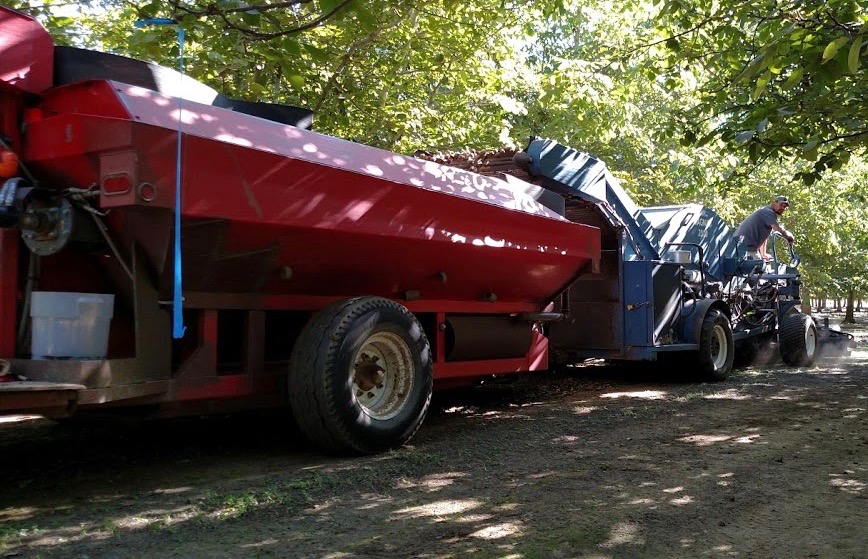
Safety is very important, especially when working with heavy machinery. As most farm accidents and fatalities involve machinery, farm safety begins with educating and preparing workers for emergency situations, and making them aware of hazards. California Ag Today interviewed Paul Williams, a senior loss prevention consultant with the State Compensation Insurance Fund, regarding nut harvest safety.

“The hazards are primarily with walnuts and almonds. They tend to stir up more dust in the harvest process,” Williams said. “There are respiratory issues that employees need to be protected from.”

“There’s also a need for hearing protection with any type of farm equipment. A lot of times, you’re sitting there all day at elevated levels of noise – there’s potential for hearing loss. Hearing loss is often overlooked because it’s slow acting, but it can have a huge effect on workers lives down the road,” Williams explained. “It’s important to be aware of it as a factor, and we talking about it as one season, probably not going to be any noticeable … you do that for 20 and 30 seasons, and you’re not able to understand your grandchildren when they talk to you. It’s one of those things that sneaks up on you.”

Williams said there are also a lot of safety issues with farm equipment and transportation. “You’re driving a slow-moving vehicle down a county road at 10 miles an hour, and you’ve got impatient drivers who want to pass you. Many drivers are not paying attention at all and they rear-end your equipment,” Williams said. That happened in Kingsburg a couple weeks ago.

This is always a danger whenever you’re transporting harvesting equipment or any kind of farm equipment on a county road. “It’s always nice if you have a pilot car; it’s always nice if you have a truck behind with their flashers on, trying to control traffic and periodically being a good neighbor and pulling over and letting traffic get by you when that’s possible,” Williams said.

For more information on safety on the farm, go to: http://www.agsafe.org/

2017-09-02T23:57:46-07:00August 7th, 2017|

Supporting Temperance Flat to Increase Groundwater Recharge

Building Above Ground Water Storage Enables Groundwater Recharge

By Laurie Greene, Founding Editor

Dramatically helping to recharge groundwater storage is one of the major benefits of the proposal to build Temperance Flat Dam behind Friant Dam, located to the north and east of Fresno. The new dam would triple the storage that is currently available with Friant Dam. Mario Santoyo, the executive director of the San Joaquin Water Authority, is helping the organization prepare the package to submit to the Water Commission by the August 14 deadline.

“We will be making timed releases to various water districts and amenities that will have groundwater recharging basins,” Santoyo said. “First, we need storage and then some time to move above ground water to underground storage. This is a physics necessity and directly counters those who argue we should not build above ground infrastructure if we need only underground storage. Well, if you don’t have above ground water storage, you ain’t putting any below. It is as simple as that.”

Water in Friant-Kern Canal

Water in Friant-Kern Canal

“There are two water conveyances from Friant and [the proposed] Temperance Flat Dams: the Friant-Kern Canal – the longest of the two primary canals – and the Madera Canal. Friant moves water south to Bakersfield, and Madera conveys it north to Chowchilla.”

“We will have one of the strongest applications to receive monies,” said Santoyo, assuring that the water authority will receive the package on time.

Now this is important,” Santoyo stressed. “A new video, ‘Build Temperance Flat,’ is now on YouTube. The video aims to educate Californians on the importance of building Temperance Flat Dam.” Santoyo urges those who are on social media to send the URL: https://www.youtube.com/watch?v=f30o_dQNmn8  “to as many people as you can!”

2017-08-04T16:16:06-07:00August 4th, 2017|

Sharing Secrets to a Successful Bowl of Cherries

Weather and Pruning Make Life a Bowl of Cherries

By Laurie Greene, Founding Editor

Clark Goehring, a third generation Kern County farmer, produces cherries and almonds. He summarized his cherry harvested as “good compared to the other years when we have had rain. Some people in our area still had rain during harvest, but we were able to harvest and bring our cherries to market in good condition.”cherry tree

“Of course, it rained a lot this winter and spring, but you do not want rain when cherries are maturing on the tree; they don’t like rain.”

Goehring explained that when it rains beyond the point when cherries start coloring, they split, making them unmarketable. “But while it may take some rained-on cherries off the market, the price of the marketable fruit goes up,” he said, benefiting those growers who had a quality crop, like him.

Goehring’s farm workers train the cherry trees to keep them low—approximately 8 feet tall. “We have tried to have them bush out instead of being more of a central leader. Actually, it’s called Spanish Bush style or, in modified form, KGB.”

Kym Green Bush designed the KGB training method in Australia to use multiple leaders and have them fruit on the leaders themselves. KGB simplifies pruning so less experienced farm workers can learn the skill more easily. The trees are replenished every five years.

Goehring said the method saves money on the farm, cuts labor and increases workers’ safety because it requires no ladders and the harvest is quicker. Harvesting without ladders also gives Goehring an advantage of attracting farm labor over other orchards that require ladders.

“In California, if farm workers have their choice of picking your cherries without using ladders, which is usually piecework, or someone else’s crop with ladders, they are going to want to come to you,” he explained.

2017-08-02T16:14:04-07:00August 2nd, 2017|

Temperance Flat Dam is Needed

Temperance Flat is a Sure Way to Improve California’s Water Infrastructure

By Patrick Cavanaugh, Farm News Director

Mario Santoyo is the Executive Director for the San Joaquin Valley Water Infrastructure Authority. He spoke to California Ag Today about Temperance Flat, a proposal supported by the Joint Powers of Authority composed of five counties: Merced, Madera, Fresno, Tulare and Kings County. In addition to those counties, there are representatives from the eastern side cities, (Orange Cove) and western side cities, (Avenal)

“We also have water agencies, such as the San Joaquin River Exchange Contractors,” Santoyo said. “The JPA is also in the process of dealing with membership requests by Friant Water Authority and the San Luis Delta Mendota Water Authority.”

Mario Santoyo

“You can see we’ve got a pretty elaborate team as far as the authority,” Santoyo said. “It was put together in order to pursue funding opportunities both by the state of California and the federal government to build revenue leading towards the construction of the Temperance Flat Dam and Reservoir project, which will be located just north of Friant Dam on Millerton Lake, and actually would be built in Millerton Lake … expanding that reservoir.”

The five counties got together on this because they understand fully the importance of creating a more reliable water supply for the area. Santoyo said, “It was proven to be a problem when we had the five-year drought and the Valley had to exercise its groundwater pumping, which plummeted the groundwater levels so much that … it actually resulted in what is now the Groundwater Sustainability Law.”

“So there’s no question this project is greatly needed, and the irony is that this year, coming out of a five-year drought, we’ve got high runoff, and the Bureau of Reclamation had to make flood releases in order to not exceed the capacity at Friant Dam/Millerton Lake,” Santoyo explained. “We fully expect that they will have made up to 2.5 million acre feet of releases down the river to the ocean. Then if you stop and think about what that means, it basically you could roughly say it’s about two years’ worth of water supply for the eastern side of the Valley.”

“There are those who would argue that we would never fill up the Temperance Flat Reservoir,” Santoyo said. “Well, not only have we done it twice this year, we also have a history—a long history—of this … [being] the common scenario.”

When there is high runoff water, it doesn’t come in little bits, it comes in huge amounts. “I think we looked at the record, and 50% of the time that we have high runoff, we usually have to make flood releases in excess of one million acre feet, so that’s why the size that was determined for Temperance Flat was just a little bit over a million acre feet,” Santoyo said.

“Now having that, it’s actually 1.2 million acre feet that it adds to the system. When you add it to … the balance of what’s left with the original, we’re close to 1.8 million acre feet,” Santoyo said.

“It will triple the capacity of Millerton, ensuring that for the future, that [there is] a chance to maximize the available water supply for the cities, for the farms, and most importantly, to recharge the groundwater and put us back into a level that we’re stable and that residents, farmers and others can use that groundwater and not be restricted by the new groundwater sustainability laws,” said Santoyo, adding, “If we don’t solve that problem, the world is going to change dramatically for our farmers, number one, and it will have an immediate effect also on our cities.”

Santoyo describes the recharge opportunities. “What we’ll be doing is with Temperance Flat, we will be making timed releases to various water districts and entities that will have groundwater recharging basins, and they will be syncing it, but you need time,” he said.

“You need storage, and you need time to be able to move water from above ground to below ground. That’s just a physical necessity, and that’s part of the argument against those that argue, ‘Don’t build above, you only need below.’ Well, if you don’t have water above, you aren’t putting it below. It’s just as simple as that,” Santoyo explained.

Temperance Flat would be ideal for the state of California. “The Friant-Kern Canal is the longest of the two primary canals. The other one is the Madera Canal. The Madera moves it north to Chowchilla. The Friant moves it south to Bakersfield, so yeah, those are the primary conveyance systems for farmers and cities,” he said.

Recently a video that educates the public on the value of Temperance Flat, released on YouTube called Build Temperance Flat. We ask all who are active on social media to grab a link of the video and post it on Facebook and Twitter as well as other social media platforms.

Here is the video link: https://www.youtube.com/watch?v=f30o_dQNmn8

2017-09-03T00:21:56-07:00July 31st, 2017|

FieldIn Technology Answers Spray Questions

New FieldIn Technology Helps with Spray Efficiency

By Patrick Cavanaugh, Farm News Director

Those operating spray rigs for farmers are always striving to do their best job, but a company by the name of FieldIn has technology that will make sure that job is being done correctly.

Neil Knaak

Neil Knaak is with FieldIn, a company that puts accuracy into the spray rig.

“With FieldIn, you know, they can just track this stuff. It’s how it’s actually being sprayed, and with that type of information, they’re able to save time and money on their applications,” Knaak said.

It’s all part of the agricultural technology revolution we’re seeing, and Knaak says it’s being well received. “So far, it’s been pretty positive. It’s all the more critical for them to be taking a look at just the speeds. You know, to know the speed, the location, out put. You know, coverage of how these things are doing, and so once they see the data, it just kind of clicks, and it makes all the sense in the world.

Knaak said there’s sensors on the tractor that are recording important information.

“Now we know what’s going on in the field, and with that information you can track, because historically, maybe you had a material that didn’t work or a pressure dropped, and there was not a good way of testing the validity of why those things went wrong,” he said.

“Well, now we can actually replay spray events, and you can watch it in almost real time. So how it’s helping guys is when we go out there and talk to them about speeds and gallons per acre. A grower now can pull up a smartphone and just basically, from a simple dashboard, he’s looking at quality reports,” Knaak said.

“FieldIn will even give him weather data, and they have the scouting feature within the system. I mean, they can pull in just lots of good data that helps them make real time decisions,” he explained.

2021-05-12T11:05:16-07:00July 27th, 2017|

Almond Growers Conserve Water – Part 2

The Value of the California Almond Industry – Part 2

By Patrick Cavanaugh, Farm News Director

The California almond industry is doing very well as a leading crop desired by consumers around the world, and growers are doing a tremendous job in growing the crop efficiently. This is Part 2 of a multipart series on the value of the California almond industry.

Buddy Ketchner runs a consulting firm called Brand K Strategies, and he works closely with the almond industry. He said that a cornerstone of industry is the fact that about 78 percent of the almond growers farm almonds under drip or micro sprinklers.

“That’s why we have the fact now that we’re using 33 percent less water than we were 20 years ago. I think that investment and that commitment to continual innovation is one of the reasons the industry’s done well. Now, all food takes resources, all food takes water, all food takes energy to grow,” Ketchner said. “I think what the almond industry has done well, and needs to continue doing, is to make sure that we’re doing it in the most effective, the most efficient, the most productive way. Not just for our growers but for the Earth and for the planet, which is what they do.”

The almond industry is committed in saving even more water over the coming years. There is a solid trend going on in the food industry that’s known as plant protein.

“I think one of the things we talk a lot about is the rise of the plants. The notion is that as populations increased, that as the middle classes increased globally, there’s a sense that we need to have protein that comes from plants as well as animals. So, people choose plant-based proteins for a number of different reasons,” Ketchner explained.

“For some of them, it’s because of the environmental story; they believe it’s more sustainable. For some people, it’s a health story; they just think it’s healthier or lighter, or it has some contribution to health that makes it a better choice for them than animal protein,” he said.

“For some people, it’s cost. There are a lot of reasons people pick plant-based protein. And how people are choosing to get their protein. I don’t remember what the latest statistic is. I think it’s like eight percent of the population is vegetarian, but 33 percent of the population regularly chooses vegetarian and plant-based protein options. It’s just how they want to balance their diet,” Ketchner said.

“I just want to make sure I’m clear: All food is good. I think animal protein is great, and plant-based protein is great. Consumers are looking for a balance in their diet, and so lots of reasons why that’s grown, but almonds are certainly part of that trend,” he said.

2017-07-26T17:36:10-07:00July 26th, 2017|
Go to Top