Associations, Organizations, Educational and Research Institutions
Reducing ACP Spread In California

Beth Grafton-Cardwell: Spread of Disease Must Be Prevented

By Patrick Cavanaugh, Editor

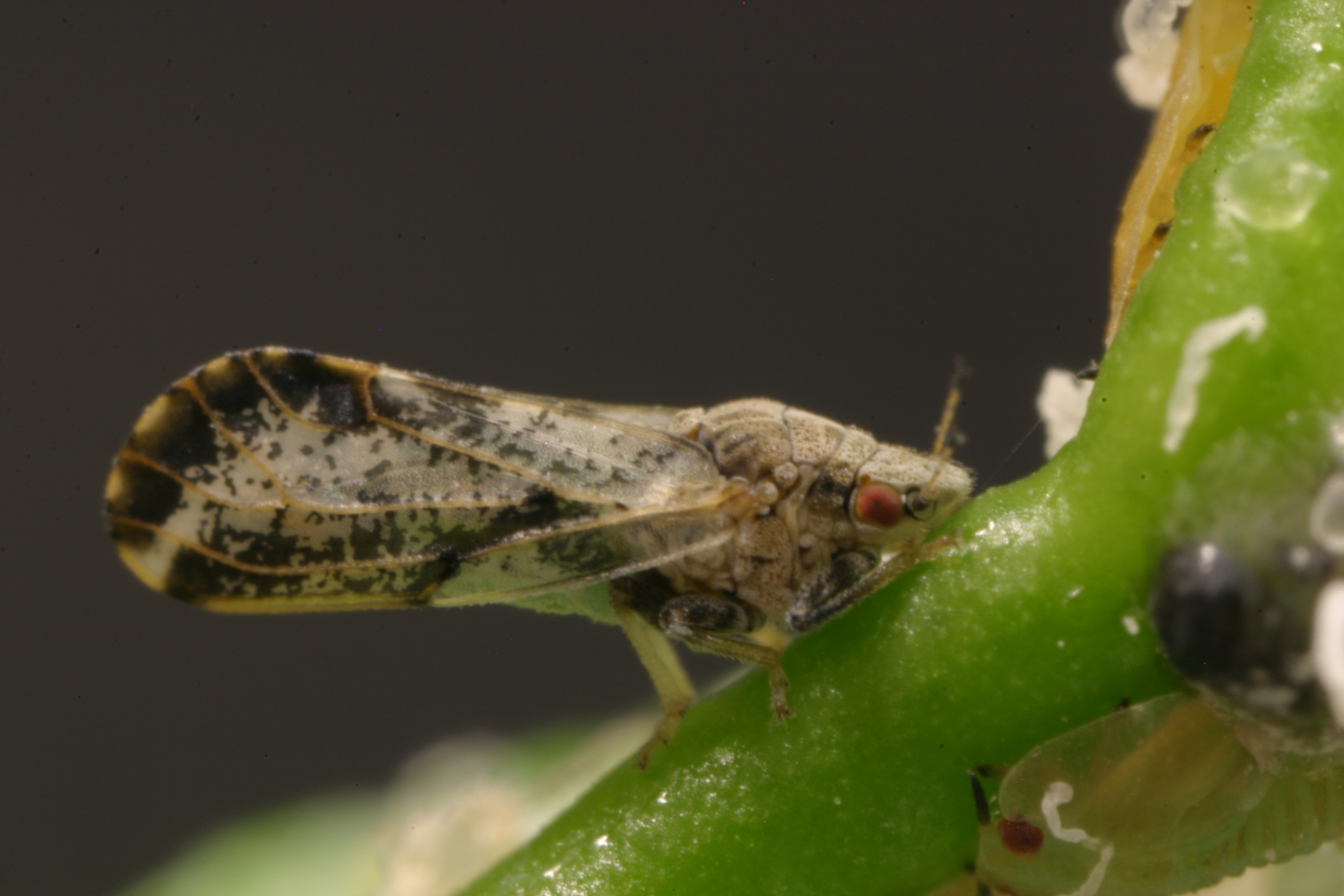
Collaborative changes are being made to combat the Asian Citrus Psyllid (ACP). Beth Grafton-Cardwell is the director of Lindcove Research and Extension Center near Exeter, as well as a research entomologist with UC Riverside. She recently spoke at the 2019 Citrus Showcase in Visalia as a key speaker on the state of Huanglongbing (HLB) in California, with an overview of how to prevent ACP,—which vectors HLB, a fatal disease to citrus—from moving around the state.

We were trying to communicate why we’ve made the changes we’ve made for the industry that has been a collaborative effort between CDFA, growers, and the university, Grafton-Cardwell said. “We need better ways to prevent psyllids from moving around the state because they might have HLB in their bodies, and we’ve got to prevent the spread of the disease.

beth_grafton-cardwell

Beth Grafton-Cardwell

The Florida citrus industry did not do a great job in containing the Psyllid, and now HLB is rampant in the state’s citrus industry, which has devastated the citrus economy there.

“Florida found that they did not do much to control psyllid movement, and they found that psyllids were moving in bulk citrus bins and retail nursery plants around the state, and within a concise amount of time, they spread the Psyllid and the disease everywhere,” Grafton-Cardwell said. “We’re trying to avoid that. We have 100% tarping of citrus truckloads. We have treatments that have to be done if growers want to move citrus between major zones in California, so that we can prevent that kind of movement.”

Conversations continue about quarantine areas in California to reduce spread.

“There’s been a lot of discussion regarding quarantines because it’s painful for some growers who have low Psyllid numbers to have to treat and to move their fruit to other zones.”

“There’s been a lot of questions. We did a lot of scientific analysis to look at impacts as well as numbers. It’s not just about psyllid numbers; it’s about their impact if growers were to move the disease into a high citrus growing region,” Grafton-Cardwell explained.

2021-05-12T11:01:48-07:00May 8th, 2019|

FFA Student Anna Kelly Experimenting with Garlic Eggs

Anna Kelly Feeds Her Chickens Garlic to Flavor Their Eggs with Garlic

By Patrick Cavanaugh, Editor

It’s a very interesting concept, garlic eggs. Flavoring freshly-laid eggs with garlic. How to do it is very simple, according to Anna Kelly with the West Sacramento FFA at River City High School, who is working with a Blue Ameraucana chicken. She had the idea of replicating what your grandparents may have done. They just fed their laying hens some garlic.

Blue Ameraucana Chicken

They wanted to try to change their chickens’ diets cause their chickens were not eating much

And low and behold, the eggs started tasting as if they were seasoned with garlic.

Kelly got the idea of feeding her chicken garlic as a research project.

“I took one garlic clove, and I fed it to my chicken, whose name is Monster, and she loved it,” said Kelly. “And every time when I gave her daily garlic, she would meet me up at her bedding, and it was so cute.”

She found that her chicken wanted the garlic, and sure enough, the eggs had a garlic taste. She asked her culinary arts teacher, Cheryle Sutton to see if she could cook one of her chicken’s garlic eggs. The teacher said okay.

“I cut it up, and I asked several of my teachers to try it,” Kelly said. “And it was amazing; the teachers said it tasted like an actual garlic egg. No salt and pepper, no other additional seasonings.”

“What I’m hoping is to grow my project more. I am incubating more chickens, and I’m going to put them on the same diet. I want to test different varieties of chickens to see which one’s eggs taste more like garlic eggs,” Kelly explained.

Eventually, she may grow the project into a wholesale operation supplying grocery stores with garlic-tasting eggs.

To hear a podcast with Anna Kelly on her garlic eggs experiment, click here.

2021-05-12T11:17:08-07:00May 3rd, 2019|

Tulare Center Trains UC Davis School of Veterinary Medicine Students

UC Vet Students Learn About Livestock Animals in Tulare

By Patrick Cavanaugh, Editor

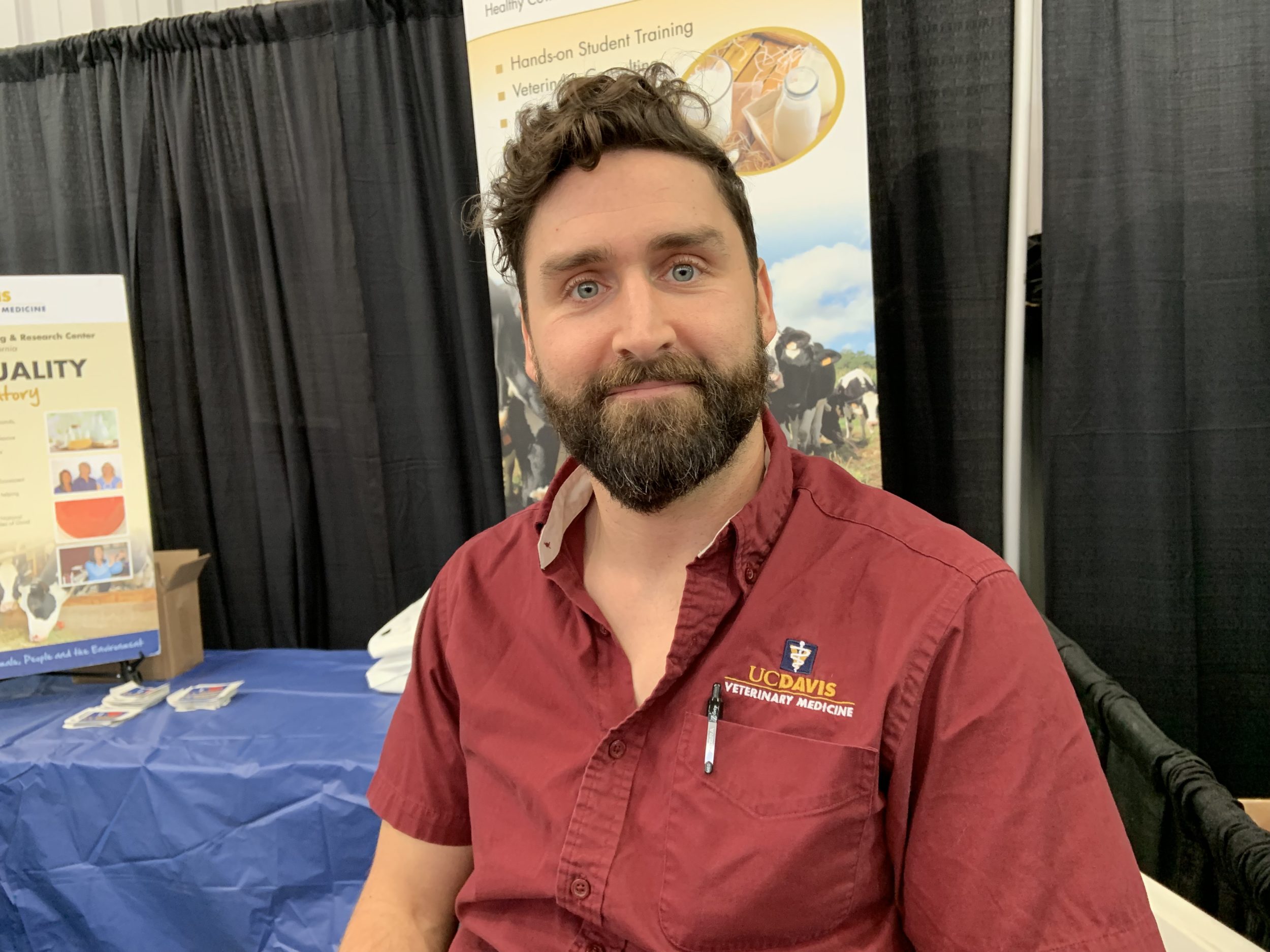
VMRTC is the Veterinarian Medicine Training and Research Center located in Tulare. The facility is an extension of the UC Davis School of Veterinary Medicine. The site offers education and training to veterinarians by offering senior veterinary students and residents on-the-farm clinical medical training and residencies in dairy production medicine.

Nathan Brown, a UC Davis veterinary student, is working on practicals in and out of a hospital setting.

“We do rotations in the hospital and outside of the hospital. We have a teaching center and, in addition, we have our California Animal Health and Safety Laboratory System (CAHFS), which is involved with diagnosing foreign animal diseases,” Brown said. “That is sort of the main mission.”

“In the mornings, we do herd checks, we go out to different dairies. We palpate cows for diagnosis of pregnancy, and we’re under the supervision of some of the veterinarians that work at our center,” Brown explained. “In the afternoons, we work on a variety of different projects. One of the projects that we’re working on currently is milking frequency. We are looking at different variables that go into whether or not it’s profitable to move from either two to three times a day or three times a day to two times a day.”

Brown said that the students at the Tulare center are doing their livestock track through UC Davis. “We’re all in our fourth year. It’s been a wonderful experience. Tulare is a great place, and it’s good to see a different part of California.”

Students studying at the center decide which direction they will take regarding animal type or other medical pursuits.

“After our second year, we make a decision about whether we do small animals or large animals,” Brown said. “Some people do equines, other focus on zoo animals—there is a variety of options in our profession and that our school offers.

Brown is pursuing livestock medicine, but he has a commitment to the Air Force to do public health epidemiology for them.

Army veterinarians do clinical medicine for animals on the base. They focus on German shepherd dogs and horses, and they also do some food safety.

“As as a veterinarian in the Air Force, it’s essentially veterinary public health, and my role will be epidemiology on a base, so that’s actually more human focus, and food safety,” Brown said.

“If you kind of think about the historical roots of veterinary medicine, much of the role of veterinarians has been ensuring that food is safe for humans to consume, meaning that the animals are healthy before they get ready for human consumption,” Brown explained. “We must ensure that there’s no points of contamination so that all the food that people eat in this country is healthy and nutritious, and we don’t have to worry about disease.”

Most bases have a veterinary clinic, primarily staffed with army veterinarians.

“My hope is to do some amount of clinical practice at these clinics to sort of keep my veterinary skills relevant. And I’ve had some good advice from some epidemiologists who works at the CDC,” Brown said. “He told me that at least for him, it’s made him a better epidemiologist by keeping his clinical skills relevant because thinking about that differential diagnosis is really a big part of trying to find the cause of a disease.”

2021-05-12T11:17:08-07:00May 2nd, 2019|

Weedy Rice—Not as Simple as it Sounds

Weedy Rice is A Pesky Rice Type in Production Rice Fields

By Mikenzi Meyers, Associate Editor

Contrary to its name, weedy rice is not in fact weeds in rice—but it is presenting several challenges to California rice growers. To help farmers combat the pesky variety, UC Davis Ph.D. student Liberty Galvin and the horticulture and agronomy graduate group have conducted extensive research.

According to Galvin, the genetic and physiological properties of weedy rice are the same as the cultivated varieties consumers typically eat. So what’s the issue? Galvin said that besides the fact that weedy rice is off in its coloring, it’s nearly impossible to harvest.

“The issue is that the seed shatters, or basically falls to the ground. So when you go through and try to harvest it, the grain does not get collected in the harvester,” Galvin explained.

Although right now it seems that commercially growing weedy rice is not an option, there are ways to prevent it. Galvin’s research found that drilling the seeds at least two inches into the soil will eliminate seed germination or emergence in the field. This is especially useful in California, where tillage is done only to prepare the field, not plant the rice itself.

Galvin said that while growers can produce their own rice seed, it has to be certified by the California Crop Improvement Association or a Rice Seed Quality Assurance Program.  In all cases, growers are required to plant only certified rice seed so there is no opportunity for traces of weedy rice to enter the soil.

“That is why tillage depth is so important, because that’s how you reduce your seed bank,” she said.

2021-05-12T11:05:04-07:00April 30th, 2019|

Alliance For Food and Farming Launches New Website!

New Safefruitsandveggies.com Website Will Improve Visitor Experience

News Release

The Alliance for Food and Farming (AFF) has launched an updated safefruitsandveggies.com website with new content and to improve visitors’ experiences on the increasingly popular site.

“The safefruitsandveggies.com website now receives tens of thousands of visitors each year,” said Teresa Thorne, AFF Executive Director.  “We want to continue to improve the site, retain our visitors, and attract new users.  The newly formatted site will help us to do that.”

New sections include “A Dozen Reasons to Eat Fruits and Veggies,” and “Five Facts About Produce,” which are based upon popular blog posts.  These sections provide quick and easily-retained information about the benefits of eating fruits and veggies as well as the safety of organic and conventional produce.

The Safety Standards section of the website, which provides comprehensive information about the stringent regulations governing the approval and use of organic and conventional pesticides, has also been updated.

“This has become among the most visited sections of safefruitsandveggies.com because all the pesticide regulation information from various government agencies can be found in one place,” Thorne said.  “Instead of going through multiple searches and websites to learn more about these regulations, people can just come to safefruitsandveggies.com.”

Still to come are web pages specifically designed for nutritionists and dietitians to help them answer produce safety questions from consumers, their customers, and clients.

“This new web page was actually requested by dietitians, and we are excited to have their input as we build the content,” Thorne said.

“Since research shows consumers find dietitians and nutritionists are among the most credible sources when it comes to pesticide residues and produce safety, it is important they have readily usable information,” Thorne added.

Among the most visited website section continues to be the residue calculator, which shows consumers they could literally eat hundreds to thousands of servings of a fruit or veggie in a day and still not have any health effects from residues.

“All of the website content is either based upon peer reviewed research or on analyses by experts in the areas of toxicology, risk analysis, nutrition and farming,” Thorne said.  “Consumers can also view 40 videos featuring farmers and scientists, as well as information about peer reviewed studies.”

The AFF works to provide credible, science-based information so consumers can make the right shopping choices for themselves and their families.

“The safefruitsandveggies.com website is the cornerstone of our efforts,” Thorne said. “By providing facts about produce safety and countering misinformation, we hope to remove fear as a barrier and encourage increased consumption of all forms of produce.”

2021-05-12T11:05:04-07:00April 24th, 2019|

Protecting Melons From Silver Leaf Whitefly

Avoid Planting Near Earlier Planted Crops

By Patrick Cavanaugh, Editor

Silver leaf whitefly can be a severe yield-robbing pest in melons, but there are ways to prevent the damage, according to Tom Turini, a UCANR Vegetable Crops Adviser in Fresno County.

“A tactic is going to depend upon planting. If you’re able to put the crop into an area where you’re not next to earlier planted melons or cotton or known sources of whitefly, your likelihood of experiencing damaging whitefly levels is going to be lower,” Turini said. “Growers can’t always do that, but that’s part of the approach when you can. You’ll limit your risk.”

Tom Turini, UCANR Farm Advisor, Fresno County

Turini said the pest could mainly be a problem when you’re putting in those late melon fields when whitefly populations are higher.

“Whiteflies are not good fliers, so when you put those fields in areas where you don’t have sources of whitefly nearby then you will have less pressure for sure,” Turini said.

“Then there are some insecticide programs that you can look at, particularly when you know you’re going to have pressure,” Turini explained. “If you’re coming into high temperatures, and you’ve got late-planted melons, you may want to start with soil-applied insecticides, through the drip. It could be Admire; also Sivanto is a newer material that that has registration and has shown efficacy in desert production areas, which have much higher pressures and more consistent pressures than we do in the San Joaquin Valley.”

2021-05-12T11:01:49-07:00April 23rd, 2019|

Tom Nassif: Ag Immigration Reform is Critical

All Fruits and Vegetables Harvested by Foreign Hands

By Cory Lunde, Western Growers Assoc. Director of Strategic Initiatives and Communications

Recently, Western Growers President and CEO Tom Nassif detailed the critical labor shortages facing American agriculture and laid out the case for agricultural immigration reform before the House Judiciary Subcommittee on Immigration and Citizenship.

In his testimony, Nassif stated that experienced workers are aging out of the agricultural workforce, with few Americans lining up to take their place, despite wages well above state and federal minimums. Farmers in all sectors of U.S. agriculture, especially in the labor-intensive fruit and vegetable industries, are experiencing chronic labor shortages, which have been exacerbated by recent interior immigration enforcement and tighter border security policies.

As a result of the uncertain agricultural labor market, Nassif explained, many American farmers are either shifting toward more mechanized crops or moving their operations to other countries.

“The simple fact is this,” Nassif said, “fruits and vegetables that are eaten in the United States will be harvested by foreign hands.”

He continued: “The simple question for you, as members of Congress, is do you want those foreign hands harvesting your fruits and vegetables to be on farms here in the United States or do you want to see production continue to shift to farms in foreign countries?”

After touching on the existing, flawed H-2A agricultural guest worker program, rife with burdensome regulatory red tape, Nassif outlined a two-pronged proposal for agricultural immigration reform that jointly provides a pathway to legalization for existing farmworkers and their immediate families and creates a more flexible, efficient and market-based agricultural worker visa program to ensure a sufficient future flow of labor.

Nassif concluded that while “immigration can be among the most divisive and difficult to resolve in Washington,” this issue is decidedly non-partisan, as agricultural immigration reform is really about securing the future of American agriculture and, by extension, long-term U.S. food security.

Western Growers appreciates the efforts of Chairwoman Zoe Lofgren and Ranking Member Ken Buck to elevate the dialogue around this vital issue, and we look forward to working across the aisle to advance bipartisan legislation that provides our country and farmers with a legal, stable and reliable source of agricultural labor.

2019-04-16T15:40:09-07:00April 16th, 2019|

CA FFA Leadership Conference April 24-28

91st FFA Annual Conference is in Anaheim

By Patrick Cavanaugh, Editor

The FFA is a leadership and career development organization found in many California high schools. It represents more than 91,000 members from 320 chapters across the state.

About 7,000 of those FFA students will converge on Anaheim from April 24 to 26 for the 91st Annual Conference.

“There’s going to be some public speaking contests, and the students will participate in workshops by the agricultural colleges and universities throughout the state,” said Matt Patton, Executive Director of California FFA. “They’re also going to conduct the business of the FFA association. It is a true student-run organization.”

All 320 chapters from California will send two delegates to do the organization’s business. There are a couple of items that they’re going to debate on and vote on what will be a change in the bylaws of the FFA. Additionally, they are going to elect their new state officers that will represent the state of California for the upcoming year.

Patton noted the diversity of the California FFA.

“Of the more than 91,000 members, 48 percent are female, and 51 percent are male. Hispanic and Latino members represent 41 percent, 43 percent are Caucasian, with three percent African American. We are very diverse in a large demographic of areas.”

For more information on the upcoming convention: https://www.calaged.org/stateconvention

2019-04-12T16:46:45-07:00April 12th, 2019|

College Scholarships Available from Westlands Water District

Westlands Water District Announces 2019 Scholarship Application with May 1oth Deadline

Westlands Water District is pleased to announce it is accepting applications for the District’s annual scholarship program. This is the thirteenth consecutive year the District will provide scholarships to recognize and reward exceptional academic achievement and leadership by graduating seniors.

Scholarships are awarded to students from the following west side high schools: Coalinga, Firebaugh, Lemoore, Mendota, Riverdale, and Tranquility.

“These scholarships represent a small gesture of thanks and support to the communities on the west side of the San Joaquin Valley that contribute to making our region productive and vibrant,” said Tom Birmingham, Westlands’ general manager. “We hope the recipients of these scholarships will continue to contribute to their communities and make them even better for future generations.”

Each scholarship recipient will receive $1,000 to be used for college expenses. Applicants are judged on their academic performance, school activities, and community leadership.

Past scholarship recipients have enrolled into California State University, Fresno; University of California, Berkeley; California Polytechnic State University; University of California, Los Angeles; West Hills Community College; and more.

Applications and all supporting documents are due by May 10 and may be submitted by mail to P.O. Box 6056, Fresno, CA 93703 or in person to 3130 N. Fresno Street, Fresno, between 8 a.m. to 5 p.m., Monday through Friday. For an application and list of instructions, please contact the public affairs office at (559) 241-6233 or visit https://wwd.ca.gov/wp-content/uploads/2019/02/scholarship-application.pdf.

2019-04-11T17:00:35-07:00April 11th, 2019|

Study: Remote Sensing of Weeds on Vineyards Has Merit

Aerial Sensing Of Weeds Saves Time and Labor

By Jessica Theisman, Associate Editor

There is a potential use of remote sensing with drones and vineyard weed management. Working on that research is Cody Drake, a senior at California State University, Fresno. He’s working with Luca Brillante, an assistant professor in the Department of Viticulture and Enology. Anil Shrestha is chair and professor, also in the Department of Viticulture and Enology at Fresno State. Drake’s research is at a vineyard in Napa County.

“The goal of my research is to make weed management practices in vineyards a little more efficient,” Drake said.

Currently, there is a lot of manpower, money, and time going into scouting for weeds and spraying.

“What we did with the drone is we wanted to map high-pressure weed zones to target spray in the field instead of spraying the entire field,” Drake explained.

This aerial scouting is hoping to become more efficient for time and labor.

“It’s all based on imagery. The drone gives us waypoints as to the areas where we need to spray. We have a company that’s called Drone Deploy, and they go through, and they stitch all the photos together,” Drake said.

Drake’s research has only been on vineyards so far, and his research has been proven to work.

“We did a 30-meter flight and a 10-meter flight, and that just shows the difference in how close you can get to identifying weeds species on the ground at a 30 meter height,” he said.

At 30 meters, it was very hard to tell which species was which. At 10 meters, the weeds were more identifiable.

“We would prefer to do another trial with a higher resolution camera. That way we can see the species, identify them a little easier and a little more efficiently,” Drake said.

By doing this, Drake and his team can pinpoint where the heavyweights are and just go spray that one area. For future research, they are going to try a camera with higher resolution to see if it can see through a denser vineyard.

2021-05-12T11:05:04-07:00April 1st, 2019|
Go to Top