About California Ag Today

This author has not yet filled in any details.
So far California Ag Today has created 2014 blog entries.

New Location for Center for Land-Based Learning Breaks Ground

$1.5 Million Lead Gift Launches Campaign for Center for Land-Based Learning’s New State Headquarters

News Release

The Center for Land-Based Learning announced a lead gift of $1.5 million from the Yocha Dehe Wintun Nation at a groundbreaking celebration today for the Center’s new site in Woodland.

The gift officially launches the Center for Land-Based Learning’s $4 million Growing Our Future Campaign to build a new statewide headquarters and expand its programs and services. In recognition of this generous gift, the Center for Land-Based Learning will name its new administrative building the Yocha Dehe Wintun Nation Farm House.

The Center For Land-Based Learning Groundbreaking today.

The groundbreaking, which coincided with the Center for Land-Based Learning’s 25th anniversary, took place on part of the original Patwin Tribal Land. The site, a historic 50-acre farm in Woodland known as The Maples, is owned by Clark Pacific, which is providing the Center with substantial support, including a no-cost, 25-year+ lease for major portions of the property and buildings.

“We are extremely grateful to the Yocha Dehe Wintun Nation for their remarkable and inspiring gift,” said Center for Land-Based Learning Executive Director Mary Kimball. “Their donation, in conjunction with the generous support of Clark Pacific, gives us the capacity to train, support, and resource stewards as we look forward to the next 25 years.”

A rendering of the new Center For Land-Based Building.

The Center will include:

-Yocha Dehe Farm House — A 5,400 square-foot building to house new administrative offices, community services, and classrooms.
-New and existing barn buildings — For storing training equipment and supplies and housing a produce washing, packing, and cooling station.
-Three farm fields totaling 30 acres — This is six times more acreage than the current site in Winters.
-Cache Creek riparian habitat and restoration area — Nearly nine acres of creek-side habitat and floodplains for restoration education.
-Space for training in resource conservation and “beautification” — Landscaping and designated areas for farm and conservation training and education in aesthetically-designed spaces.

“The Yocha Dehe people have a deep connection with the land of the Capay Valley, where our ancestors lived for hundreds of years, and we are committed to protect and preserve it,” said Yocha Dehe Wintun Nation Tribal Chairman Anthony Roberts. “One of the best ways we can do that is to work together as a community to educate about the importance of and ways for caring for the beautiful valley, soil, and environment around us. For 25 years, the Center for Land-Based Learning has led the way in developing agricultural leaders and natural resources stewards among us, and we are proud to partner with the organization to support what we are confident will be an incredible success over its next quarter century.”

Established in 1993 by walnut farmers Craig and Julie McNamara, the nonprofit Center for Land-Based Learning inspires, educates, and cultivates future generations of farmers agricultural leaders, and natural resource stewards.

“Agriculture is our heritage and our future,” said Craig McNamara. “By training a new generation of farmers and decision makers, the Center is helping ensure the long-term prosperity of California. Their passion and their mission deserve our support.”
2019-05-11T07:57:48-07:00May 10th, 2019|

Biological Products Finding More Demand

Biological Products Industry Alliance Growing Rapidly

By Patrick Cavanaugh, Editor

The Biological Products Industry Alliance (BPIA) was started 16 years ago for only five biopesticide member companies. Now there are 129 member companies and membership ranges from manufacturers of biopesticides and biostimulants to service providers, marketers, distributors, and anybody who touches this industry.

Keith Jones is executive director of the BPIA. He said during a recent meeting in Rochester, NY, that the alliance is growing.

“The running theme for the event was the growth of our association, the growth of the industry, and much of that is driven by consumer demand, regulatory pressures, and just a real move towards a sustainable future in agriculture and other markets where biological products are used,” Jones explained.

Biological products got their start in commercial agriculture, such as fruits and vegetables but have grown in demand by other markets like golf courses and ornamental operations. Among the earliest biologicals used in production agriculture are B.t. products.

“For a variety of reasons, some traditional chemistries are losing efficacy because of pests developing resistance,” Jones said. “Biologicals can be helpful with that. They don’t replace traditional chemistries, but they can actually extend the life of traditional chemistries.”

Biologicals are all part of integrated pest management and can be used during different parts of the production season, where conventional products are not labeled for use.

Biologicals can be used at the onset of a growing season and when getting close to harvest, because there are less or no pre-harvest intervals.

“What’s great about biologicals is that most of them have multiple modes of action, so it’s very hard for the pests to become resistant to that,” said Jones, adding that, “There are many benefits of biologicals, and their acceptance is growing rapidly.”

Jones said that biological products don’t replace traditional chemistries, but they can actually extend the life of traditional chemistries.

2021-05-12T11:01:48-07:00May 9th, 2019|

Reducing ACP Spread In California

Beth Grafton-Cardwell: Spread of Disease Must Be Prevented

By Patrick Cavanaugh, Editor

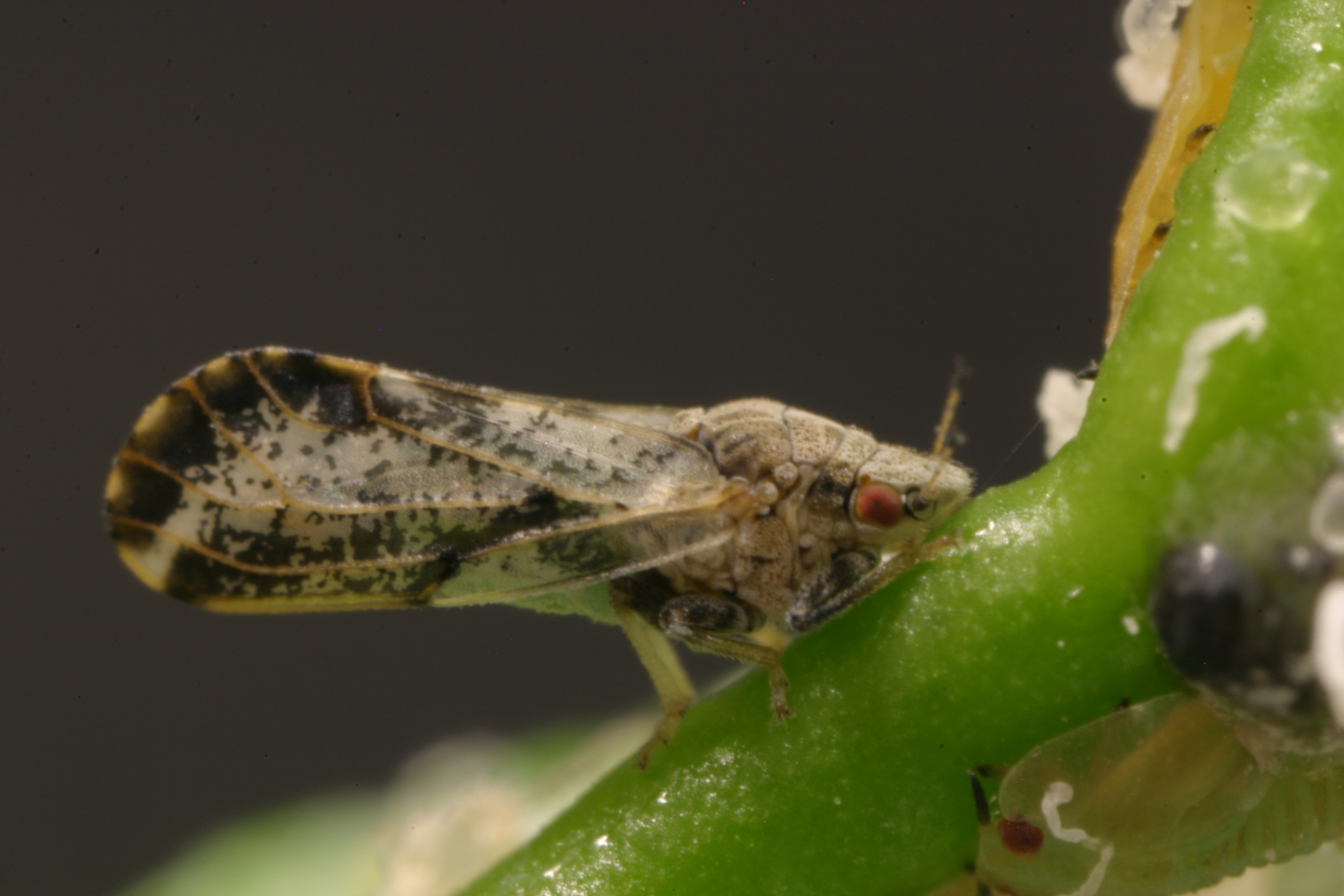
Collaborative changes are being made to combat the Asian Citrus Psyllid (ACP). Beth Grafton-Cardwell is the director of Lindcove Research and Extension Center near Exeter, as well as a research entomologist with UC Riverside. She recently spoke at the 2019 Citrus Showcase in Visalia as a key speaker on the state of Huanglongbing (HLB) in California, with an overview of how to prevent ACP,—which vectors HLB, a fatal disease to citrus—from moving around the state.

We were trying to communicate why we’ve made the changes we’ve made for the industry that has been a collaborative effort between CDFA, growers, and the university, Grafton-Cardwell said. “We need better ways to prevent psyllids from moving around the state because they might have HLB in their bodies, and we’ve got to prevent the spread of the disease.

beth_grafton-cardwell

Beth Grafton-Cardwell

The Florida citrus industry did not do a great job in containing the Psyllid, and now HLB is rampant in the state’s citrus industry, which has devastated the citrus economy there.

“Florida found that they did not do much to control psyllid movement, and they found that psyllids were moving in bulk citrus bins and retail nursery plants around the state, and within a concise amount of time, they spread the Psyllid and the disease everywhere,” Grafton-Cardwell said. “We’re trying to avoid that. We have 100% tarping of citrus truckloads. We have treatments that have to be done if growers want to move citrus between major zones in California, so that we can prevent that kind of movement.”

Conversations continue about quarantine areas in California to reduce spread.

“There’s been a lot of discussion regarding quarantines because it’s painful for some growers who have low Psyllid numbers to have to treat and to move their fruit to other zones.”

“There’s been a lot of questions. We did a lot of scientific analysis to look at impacts as well as numbers. It’s not just about psyllid numbers; it’s about their impact if growers were to move the disease into a high citrus growing region,” Grafton-Cardwell explained.

2021-05-12T11:01:48-07:00May 8th, 2019|

Dealing With Social Security Number Mismatch

Farm Field Employees Often Get Notices of Social Security Mismatch 

By Anthony P. Raimondo

Much has been made in the media of late regarding the Social Security Administration’s (SSA) push to address wages reported under names and Social Security Numbers that do not match the numbers in the SSA’s database.

These notices used to be quite common but were suspended by the Obama administration in 2012. In the last few years, these notices have begun to go out, and a recent increase in the notices has caught the attention of media and politicians. Employers must understand their legal obligations when they receive such a notice, and media commentators and politicians are poor sources.

Anthony Raimondo

Anthony Raimondo

What is new is that the notices no longer provide a list of employees with mismatches. Instead, employers must log on to a web site to get the names of the mismatched employees. Employers should follow the instructions carefully. Employers are not required to sign up for the Social Security Verification system in order to get the information, and should only enroll in that program if they wish to verify all employee Social Security Numbers.

The first thing to understand is that a mismatch notice is not an immigration problem. The SSA does not enforce immigration law, and is prohibited from sharing mismatch information with ICE. There are many reasons a mismatch may occur, and an immigration issue is only one of them. Never presume that an employee is undocumented, and never fire a worker simply because you receive a mismatch notice. Primarily, the notice is a payroll tax issue, as IRS regulations require employers to use reasonable diligence to obtain the correct wage reporting information from employees.

The initial step for an employer who receives a mismatch notice is to check whether there was a clerical or other error on the part of the employer that triggered the mismatch. If so, the error should be corrected, with the proper forms filed with the IRS. If there is no error, the employer should next check the employee’s I-9.

If the employee used the questionable Social Security card as a List C document to show employment authorization, then the employer must reverify the employee’s authorization to work in the United States in Section 3 of the I-9. The employee should be given 3 business days to present another List C document (such as a certified birth certificate) or a List A document (such as a US Passport or Permanent Resident Alien card).   If the employee did not present a Social Security card to demonstrate his or her authorization to work, then there is no immigration issue, only a payroll tax issue.

In order to resolve the payroll tax issue, the employer must notify the employee in writing that the notice was received. The employee should be directed to resolve the issue and report the correction to the employer. The letters ask for correction within 60 days, but this is not a firm legal deadline. Generally, employers set a deadline of somewhere between 60 and 120 days to give the employee time to solve the problem. The employee should also be given a blank W-4. Some do not give a deadline and simply send a W-4 annually, although this author does not recommend that approach.

In these politically volatile times, it is important for employers to cut through the noise and understand their actual legal obligations. This way, we can avoid needless employee anxiety, needless employer stress, and we can promote smooth running operations where all involved prosper.

The goal of this article is to provide employers with current labor and employment law information. The contents should not be interpreted or construed as legal advice or opinion. For individual responses to questions or concerns regarding any given situation, the reader should consult with Anthony Raimondo at Raimondo & Associates in Fresno, at (559)432-3000.

2019-05-07T17:35:07-07:00May 7th, 2019|

Food Safety Is Paramount In California Agriculture

Researchers Hone in on Bacteria Genome to Isolate Pathogens

By Laurie Greene, Founding Editor

Food safety is paramount in the specialty crop farm industry; but when a bacterium causes a food safety problem, there is important work to determine the exact fingerprint of that bacteria.

Matthew Stasiewicz, assistant professor of applied food microbiology in the area of food safety at the University of Illinois at Urbana-Champaign, Department of Food Science & Human Nutrition, said it’s important to determine the genome of these bacteria that are causing problems.

“The biggest thing that has happened in the field of food safety is that the U.S. government has committed to using whole genome sequencing as a primary public health surveillance tool. So, if you have a foodborne disease and go to a doctor, and they isolate that organism, it will go into a nationwide database—now international database—that can link that organism’s genome sequence to whatever else shows up in the database. So, at the same time, if pathogens are isolated from foods potentially as part of an outbreak, those sequences can be [entered into the database] and [experts can] gather information from food sources as well as clinical patients. And that’s just a major tool.”

Stasiewicz said the genome is important because we need to know the true source of that bacteria. “The pathogens that can make you sick can be distributed in the environment.

So just because you potentially got sick from eating food and maybe you got an E.coli O157:H7 infection in your hometown, even if someone else two towns away got the same infection with E.coli O157:H7, we don’t know if that’s related, even if you potentially ate the same food,” Stasiewicz said. “That could come from the soil in your town, your local grower, a local grower somewhere else, or from a common source, common grower, or common packer, and gotten you both sick. This genome sequence information allows us to make those links much more clearly.”

Stasiewicz said this is an important pioneering effort to reduce food safety illnesses. “Importantly, from the food standpoint,” Stasiewicz said, “we want that information so we can find that and eliminate it. No food processor wants to make anyone sick. No grower wants to make anyone sick. So, we need to identify those concerns.”

2021-05-12T11:05:04-07:00May 6th, 2019|

FFA Student Anna Kelly Experimenting with Garlic Eggs

Anna Kelly Feeds Her Chickens Garlic to Flavor Their Eggs with Garlic

By Patrick Cavanaugh, Editor

It’s a very interesting concept, garlic eggs. Flavoring freshly-laid eggs with garlic. How to do it is very simple, according to Anna Kelly with the West Sacramento FFA at River City High School, who is working with a Blue Ameraucana chicken. She had the idea of replicating what your grandparents may have done. They just fed their laying hens some garlic.

Blue Ameraucana Chicken

They wanted to try to change their chickens’ diets cause their chickens were not eating much

And low and behold, the eggs started tasting as if they were seasoned with garlic.

Kelly got the idea of feeding her chicken garlic as a research project.

“I took one garlic clove, and I fed it to my chicken, whose name is Monster, and she loved it,” said Kelly. “And every time when I gave her daily garlic, she would meet me up at her bedding, and it was so cute.”

She found that her chicken wanted the garlic, and sure enough, the eggs had a garlic taste. She asked her culinary arts teacher, Cheryle Sutton to see if she could cook one of her chicken’s garlic eggs. The teacher said okay.

“I cut it up, and I asked several of my teachers to try it,” Kelly said. “And it was amazing; the teachers said it tasted like an actual garlic egg. No salt and pepper, no other additional seasonings.”

“What I’m hoping is to grow my project more. I am incubating more chickens, and I’m going to put them on the same diet. I want to test different varieties of chickens to see which one’s eggs taste more like garlic eggs,” Kelly explained.

Eventually, she may grow the project into a wholesale operation supplying grocery stores with garlic-tasting eggs.

To hear a podcast with Anna Kelly on her garlic eggs experiment, click here.

2021-05-12T11:17:08-07:00May 3rd, 2019|

Tulare Center Trains UC Davis School of Veterinary Medicine Students

UC Vet Students Learn About Livestock Animals in Tulare

By Patrick Cavanaugh, Editor

VMRTC is the Veterinarian Medicine Training and Research Center located in Tulare. The facility is an extension of the UC Davis School of Veterinary Medicine. The site offers education and training to veterinarians by offering senior veterinary students and residents on-the-farm clinical medical training and residencies in dairy production medicine.

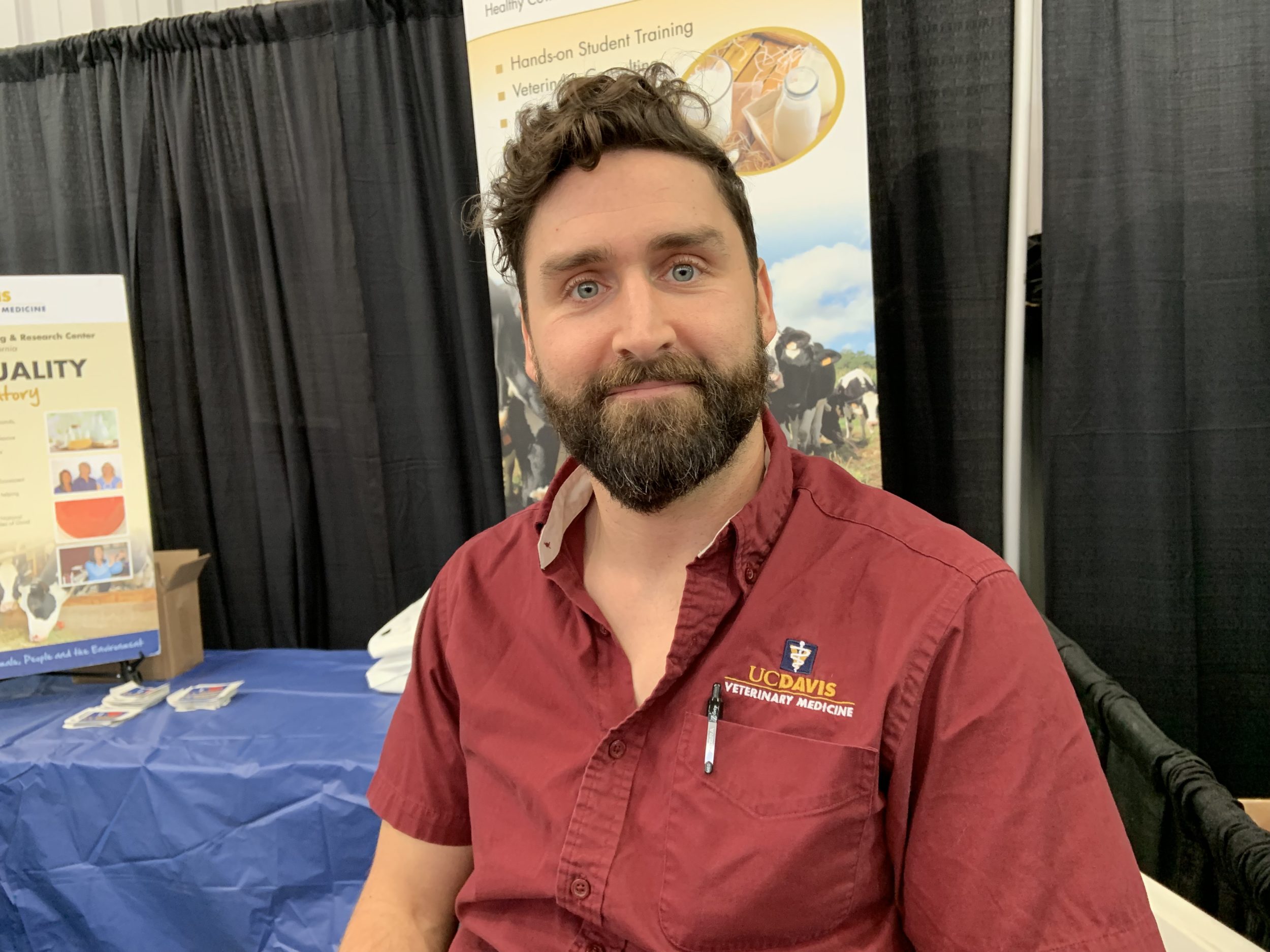
Nathan Brown, a UC Davis veterinary student, is working on practicals in and out of a hospital setting.

“We do rotations in the hospital and outside of the hospital. We have a teaching center and, in addition, we have our California Animal Health and Safety Laboratory System (CAHFS), which is involved with diagnosing foreign animal diseases,” Brown said. “That is sort of the main mission.”

“In the mornings, we do herd checks, we go out to different dairies. We palpate cows for diagnosis of pregnancy, and we’re under the supervision of some of the veterinarians that work at our center,” Brown explained. “In the afternoons, we work on a variety of different projects. One of the projects that we’re working on currently is milking frequency. We are looking at different variables that go into whether or not it’s profitable to move from either two to three times a day or three times a day to two times a day.”

Brown said that the students at the Tulare center are doing their livestock track through UC Davis. “We’re all in our fourth year. It’s been a wonderful experience. Tulare is a great place, and it’s good to see a different part of California.”

Students studying at the center decide which direction they will take regarding animal type or other medical pursuits.

“After our second year, we make a decision about whether we do small animals or large animals,” Brown said. “Some people do equines, other focus on zoo animals—there is a variety of options in our profession and that our school offers.

Brown is pursuing livestock medicine, but he has a commitment to the Air Force to do public health epidemiology for them.

Army veterinarians do clinical medicine for animals on the base. They focus on German shepherd dogs and horses, and they also do some food safety.

“As as a veterinarian in the Air Force, it’s essentially veterinary public health, and my role will be epidemiology on a base, so that’s actually more human focus, and food safety,” Brown said.

“If you kind of think about the historical roots of veterinary medicine, much of the role of veterinarians has been ensuring that food is safe for humans to consume, meaning that the animals are healthy before they get ready for human consumption,” Brown explained. “We must ensure that there’s no points of contamination so that all the food that people eat in this country is healthy and nutritious, and we don’t have to worry about disease.”

Most bases have a veterinary clinic, primarily staffed with army veterinarians.

“My hope is to do some amount of clinical practice at these clinics to sort of keep my veterinary skills relevant. And I’ve had some good advice from some epidemiologists who works at the CDC,” Brown said. “He told me that at least for him, it’s made him a better epidemiologist by keeping his clinical skills relevant because thinking about that differential diagnosis is really a big part of trying to find the cause of a disease.”

2021-05-12T11:17:08-07:00May 2nd, 2019|

Wasco High School Students Attend Bakersfield College

High School Students Gain Interest in Agriculture

By Patrick Cavanaugh, Editor

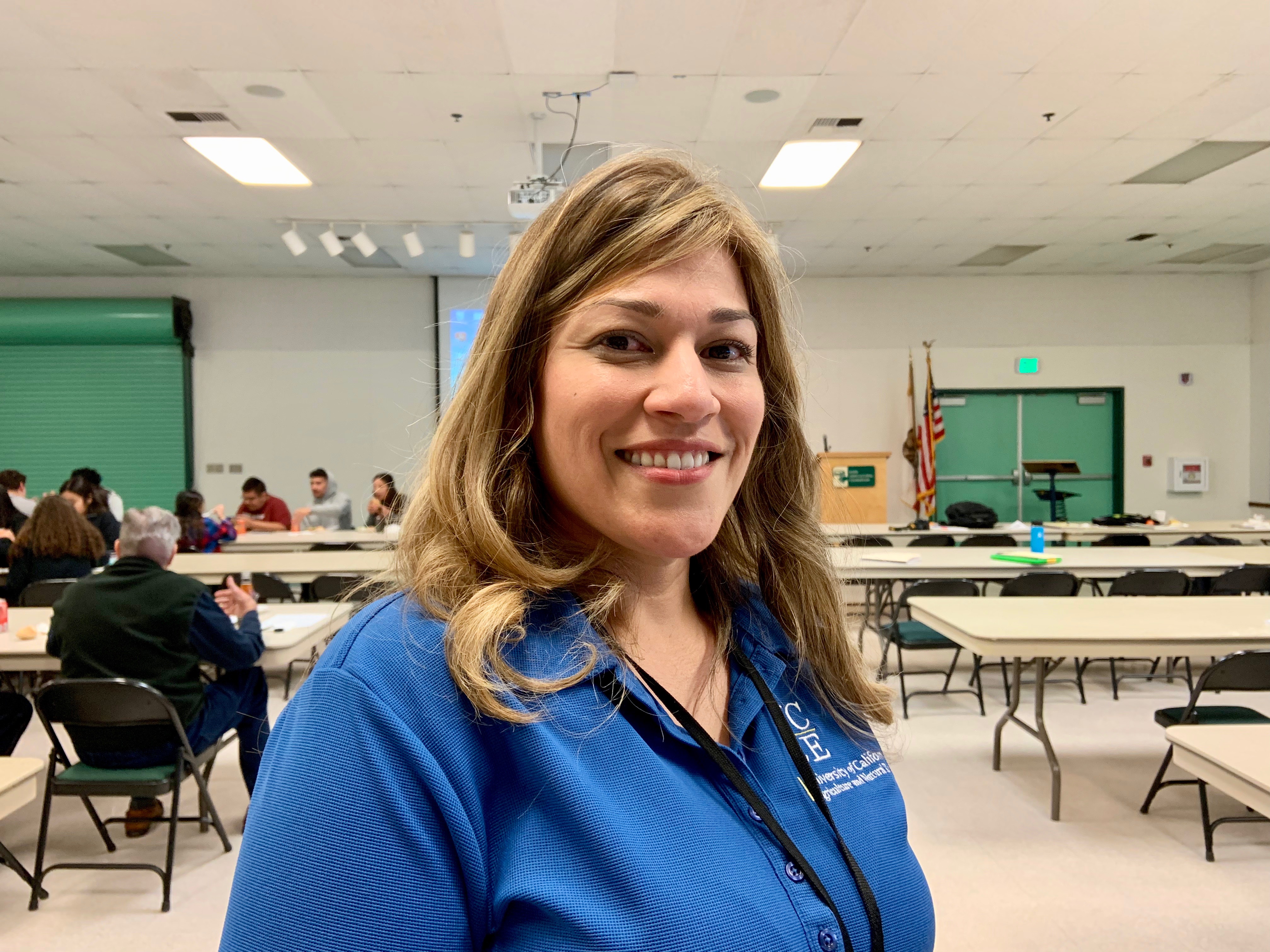
Sophia Marin is a lab assistant at UC Cooperative Extension Kern County, and she also is an adjunct professor at Bakersfield College in a dual enrollment program with Wasco High School. She is helping high school students attend Bakersfield college at the same time.

“The students are in the 11th grade, so by the time that they’re done with high school, they’ll have their high school diploma plus an Associate Degree from Bakersfield College,” Marin said. “They’re essentially doing two schools in one,  and at the college, they attend lectures and they have a lab.

California Ag Today met Marin and her students at a California Fresh Carrot Advisory Board meeting in Kern County.

“We have been discussing different pathogens that affect plant growth. The carrot meeting was a great opportunity to actually hear the researchers, instead of reading a textbook and me going over it,” Marin said. “They got to see it real life, and I thought it would be a more memorable and something that they could grasp.”

Wasco High School Students Who Also Attend Bakersfield College

Marin explained that since the students come from the rural area of Wasco, most have an interest in agriculture.

“And by the end of this next year, they will all receive an agricultural business degree from Bakersfield College,” she said.

“It will depend on them what the students do the degree. So whatever I can instill or spark in them to whatever career path they want to go to. It may be agronomy, pathology or research, it’s all on them,” Marin said. “It’s nice to open their eyes to see more.”

She noted that most of the kids have plans to go to a university. “I am very impressed with them. Some of the terminology that I mention, I might say I wonder if they know about this or that,” she said. “But they do know. When I’m speaking to them, they understand, and if they don’t, they will research an idea themselves. I am very impressed.”

“These students work very hard. They have weekend classes and summer classes. I am very proud of these students,” Marin said.

2019-05-01T17:21:26-07:00May 1st, 2019|

Weedy Rice—Not as Simple as it Sounds

Weedy Rice is A Pesky Rice Type in Production Rice Fields

By Mikenzi Meyers, Associate Editor

Contrary to its name, weedy rice is not in fact weeds in rice—but it is presenting several challenges to California rice growers. To help farmers combat the pesky variety, UC Davis Ph.D. student Liberty Galvin and the horticulture and agronomy graduate group have conducted extensive research.

According to Galvin, the genetic and physiological properties of weedy rice are the same as the cultivated varieties consumers typically eat. So what’s the issue? Galvin said that besides the fact that weedy rice is off in its coloring, it’s nearly impossible to harvest.

“The issue is that the seed shatters, or basically falls to the ground. So when you go through and try to harvest it, the grain does not get collected in the harvester,” Galvin explained.

Although right now it seems that commercially growing weedy rice is not an option, there are ways to prevent it. Galvin’s research found that drilling the seeds at least two inches into the soil will eliminate seed germination or emergence in the field. This is especially useful in California, where tillage is done only to prepare the field, not plant the rice itself.

Galvin said that while growers can produce their own rice seed, it has to be certified by the California Crop Improvement Association or a Rice Seed Quality Assurance Program.  In all cases, growers are required to plant only certified rice seed so there is no opportunity for traces of weedy rice to enter the soil.

“That is why tillage depth is so important, because that’s how you reduce your seed bank,” she said.

2021-05-12T11:05:04-07:00April 30th, 2019|

Building a Relationship Between Consumers and Ag Industry

There Are Ways to Gain Trust Among Consumers

By Mikenzi Meyers, Associate Editor

Bridging the gap between consumers and their food has been an ongoing battle that research shows can only be won by trust. Charlie Arnot with the Center for Food Integrity has looked further into what it really takes to gain trust among consumers.

Arnot said that studies conducted alongside Iowa State University showed that there are three main drivers in creating a relationship with consumers: influencers, competency, and confidence in shared values. Further research revealed that of the three main variables, confidence in shared values proved to be the most important—but this can be a difficult goal to accomplish.

“Agriculture has a historical mantra of ‘We’re Feeding the World,’ but most consumers just don’t care, and it’s not a justification for more industrialized food production,” Arnot said.

This resistance towards industrial farming is largely due to food being so readily available to the public.

Arnot suggests taking the approach of addressing known consumer concerns such as food safety, nutrition, and treatment of animals, to name a few.

“Addressing those concerns is going to be the most effective strategy we can have in building trust in who we are and what we do in agriculture today,” he said.

2019-04-29T17:01:37-07:00April 29th, 2019|
Go to Top