Wastewater Treatment Plant in Delta Causing Problems

Harmful Algal Blooms Impacting Watershed

News Release Edited By Patrick Cavanaugh

The San Francisco Bay Regional Water Quality Control Board updated its regulations on nutrient discharges into the San Francisco Bay watershed recently to protect the watershed from harmful effects of discharges from municipal wastewater treatment plants and other sources.

Although San Francisco Bay is not impaired by nutrients, it is a nutrient-enriched estuary with higher nitrogen and phosphorus concentrations than most estuaries in the world. Too much nitrogen and phosphorous can lead to harmful algal blooms, which can release toxins to the Bay. Harmful algal blooms can also result in low dissolved oxygen or insufficient oxygen in the water to support aquatic life.

In the Bay, nitrogen has the biggest influence on phytoplankton growth, and the Region’s municipal wastewater treatment plants account for 65 percent of the nitrogen discharged to the Bay. Regional population growth will increase these nitrogen discharges.

The regulatory update, in the form of a reissue of the Nutrients Watershed Permit first adopted in 2014, provides a consistent approach for regulating nutrient discharges from municipal wastewater treatment plants in the San Francisco Bay watershed.

The first Nutrients Watershed Permit required sewage treatment agencies to: (1) monitor their discharges, (2) support scientific studies to evaluate the Bay’s response to current and future nutrient loads, and (3) evaluate opportunities to remove nitrogen through treatment plant improvements.
This update will increase monitoring and scientific studies. Importantly, it requires treatment agencies to evaluate opportunities to remove nitrogen using “green” solutions, like routing wastewater through treatment wetlands and wastewater recycling.

These types of opportunities may provide water quality benefits beyond nutrient removal, for example, by providing protection against climate change through carbon sequestration and adaptation of the shoreline to address sea-level rise. Green solutions can also remove additional contaminants of emerging concern for water quality.
2019-05-17T17:12:41-07:00May 17th, 2019|

Cavanaugh Wins Fresno County Farm Bureau Journalism Award

Patrick Cavanaugh Wins Award for Audio Report on Temperance Flat Dam

By Laurie Greene, Founding Editor

The Fresno County Farm Bureau (FCFB) recognized Patrick Cavanaugh, Ag News Director and co-owner of California Ag Today Radio Network and CaliforniaAgToday.com, with a First Place Journalism Award in the Audio category on May 9. Cavanaugh’s radio report entitled “Temperance Flat Dam Denied Full Funding” broadcasted across our 26-station network, focused on the California Water Commission’s failure to fund the Temperance Flat Dam storage project.

Cavanaugh was among four award winners recognized by the FCFB at its second annual “Bounty of Fresno County” event at Wolf Lakes Park in Sanger. This year marked the FCFB’s 25th annual Journalism Awards.

Patrick Cavanaugh Wins FCFB Journalism Award


Over 25 entries were received from publications, websites, radio and television stations. The criteria for the awards were: thorough and objective coverage of issues, given time and space limitations; educational element for the agriculture industry or the consumer; and portraying the personal stories of those who make up the food and agriculture industry, making issues relevant to consumers and Valley residents.

Serving as judges were Westlands Water District Public Affairs Representative Diana Giraldo, farmer Liz Hudson of Hudson Farms, and journalist Don Wright of Water Wrights.

Award winners are:

Audio

Patrick Cavanaugh, California Ag Today Radio, “Temperance Flat Dam denied full funding,” March 9, 2018

Cavanaugh discusses the California Water Commission’s failure to fund the Temperance Flat Dam storage project.

Farm Trade Print

Vicky Boyd, Cotton Farming Magazine, “A bird’s eye-view of cotton,” September 1, 2018

Boyd explains the value of drones and how California farmers and ranchers are enlisting such technologies to help boost efficiency, optimize crop inputs and yields, and ultimately, remain profitable.

General Print

Robert Rodriguez, The Fresno Bee, “Will adding a sour kick get millennials to eat raisins?,” August 19, 2018

Rodriguez speaks with the President and Chief Executive Officer of Sun-Maid Growers of California, Harry Overly, about the company’s national campaign focused on rekindling consumers’ fondness for the brand.

Video

Alexan Balekian, KSEE24, “Is the gas tax putting California’s most valuable resource in jeopardy?,” February 19, 2019

Balekian explores the implications of Prop. 6, “the gas tax,” on California agriculture.

Check the CaliforniaAgToday.com Google News-recognized website for additional coverage on Temperance Flat Dam.

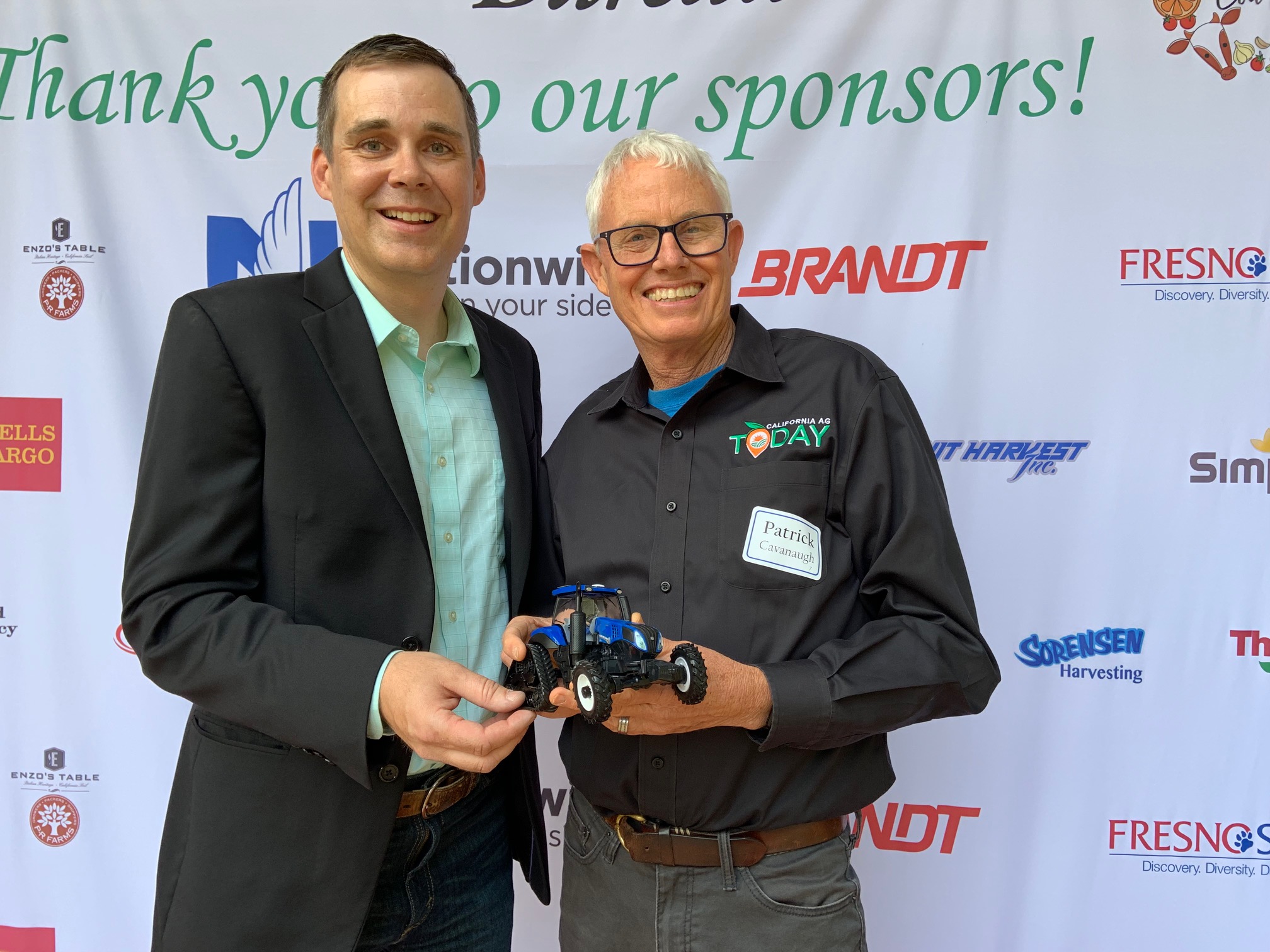
Featured Photo:  Ryan Jacobsen, CEO, Fresno County Farm Bureau, and Patrick Cavanaugh, California Ag Today Radio Network, holding tractor award.

###

Fresno County Farm Bureau is the county’s largest agricultural advocacy and educational organization, representing members on water, labor, air quality, land use, and major agricultural related issues. Fresno County produces more than 400 commercial crops annually, totaling $7.028 billion in gross production value in 2017. For Fresno County agricultural information, visit www.fcfb.org.


Recommended:  The Fresno County Farm Bureau (FCFB) held the 22nd Annual Journalism Awards at the organization’s Celebrating Friends of Agriculture social where it awarded Vernon and the mental health series the Audio Award. 

2019-05-13T16:39:59-07:00May 13th, 2019|

65% Percent Water Allocation for Westlands with 163 Percent Snow Pack

Statement on Bureau of Reclamation’s April Water Allocation Announcement

News Release from Westlands Water District

Today, the Bureau of Reclamation announced the water allocation for south-of-Delta Central Valley Project agricultural water service contractors is being increased to 65%. In light of current hydrologic and reservoir conditions, this minor increase is astonishing.

Thomas Birmingham, Westlands Water District’s general manager, stated: “This announcement begs the question, what has to happen before south-of-Delta farmers served by the Central Valley Project can get a full supply?”

With San Luis Reservoir full and flood flows coming, the 65 % allocation was more than disappointment.

Since October 1, the beginning of the current water year, California has been blessed with abundant precipitation; the 2018-19 water year is now classified as wet. As of April 8, the snow water content in the northern and central Sierra Nevada was 160% and 163% of the long-term average, respectively. Storage in every CVP reservoir used to supply south-of-Delta CVP agricultural water service contractors was more than 100% of average for that date. Indeed, these reservoirs were and remain in flood control operations.

Birmingham added, “I know that Reclamation staff understands the consequences of the decisions they make. Reclamation staff understands reduced allocations in a year like this needlessly increases overdraft in already overdrafted groundwater basins. Reclamation staff understands delayed allocation announcements make it nearly impossible for farmers to effectively plan their operations. If Reclamation’s leadership could, they would make a 100% allocation. But Reclamation’s hands are tied by restrictions imposed by biological opinions issued under the Endangered Species Act. These restrictions have crippled the CVP and have provided no demonstrative protection for listed fish species, all of which have continued to decline despite the draconian effect the biological opinions have had on water supply for people.”

Birmingham concluded, “Notwithstanding the restrictions imposed by the biological opinions, Westlands firmly believes that there is sufficient water to allocate to south-of-Delta agricultural water services contractors 100%. Today’s announcement by Reclamation is disappointing for every south-of Delta farmer served by the CVP, and we hope Reclamation will increase the allocation quickly to enable farmers to quit pumping groundwater.”

After 2019, no one will be able to argue that water supply reductions for south-of-Delta CVP agricultural water service contractors are a result of hydrologic conditions. This year demonstrates only too well the crippling consequences of ineffective and unchecked regulations. Because of restrictions imposed on operations of the CVP under the guise of protecting fish, the CVP cannot be operated to satisfy one of the primary purposes for which it was built, supplying water to farmers.

2019-04-18T16:42:08-07:00April 18th, 2019|

Dire Need for Temperance Flat

Temperance Flat Dam Could Minimize the Devastation of SGMA

By Jessica Theisman, Associate Editor

Mario Santoyo, Executive Director at San Joaquin Valley Water Infrastructure Authority, explained the dire need to build Temperance Flat Dam to California Ag Today recently, and the possible consequences if it is not built.

“With the new groundwater sustainability law coming into play, it is going to basically shut down a lot of farming,” he said.

If farmers cannot prove that they are replenishing the amount of groundwater as they are taking out, they are not going to be allowed to use the groundwater pumps.

“With the continuing extraction of our surface water by the environmental community and by governmental regulations, farming in the Central Valley is in for a world of hurts,” Santoyo said.

The Temperance Flat Dam would give the ability to manage the high run-off water that is otherwise lost into the ocean.

“We are losing millions and millions of acre-feet into the ocean that makes absolutely no sense to anyone,” Santoyo explained.

Temperance Flat would provide additional storage opportunities—up to an additional 1.2 million acre-feet—and will allow farmers to have carryover water from year to year. This will carry the farmers through the dry years, and it will give the allowance to stabilize the groundwater condition.

This dam needs funding from federal, state, and local water agencies.

“The JPA that we represent secured 171 million dollars, which is enough money to pay for the environmental paperwork and initiate the engineering,” Santoyo said.

The remainder of the funds has come in chunks from the federal government through the WIIN Act.

“The bulk of it will have to be the end users, the beneficiaries, i.e. the water agencies,” Santoyo said.

Right now, they are working on the process to evaluate the level of investment that they want to partake in.

“The way this project will work is multidimensional. But the key element will be storage management,” Santoyo said.

The investors would be buying chunks of storage cells in that reservoir to manage.

“In some cases, if you have a bad year in which you have water and others don’t, you’d be able to work something out with them,” Santoyo explained.

“Temperance Flat was a part of the focus when the WIN Act was being put together by Senator Feinstein and Congressman McCarthy,” Santoyo said.

The money allocated is enough to keep the project moving forward on an annual basis.

President Trump signed a memorandum a few months ago, however, Santoyo said, “Since I’ve been involved for a longer period of time, unfortunately, that memorandum that was signed in effect really didn’t do anything.”

Federal courts had already ruled previously that the biological opinions needed to be redone.

“All this memorandum did was just accelerate the study of it,” Santoyo explained.

A resolution on the Delta does not look like it will be here anytime soon.

“That’s why I think that if you have an opportunity to do something positive that doesn’t affect usage of the Delta water you should take it,” Santoyo said.

That’s what Temperance Flat does.

“Three billion dollars represents the full construction of the dam,” Santoyo said.This is the targeted budget for the dam. If the funds can be collected and in time, the dam will be fully operational by 2033.

2019-04-15T16:22:59-07:00April 15th, 2019|

Attorney Suggests That Meters Go on Pumps Now for SGMA

Meters Could Help From a Legal Standpoint

By Mikenzi Meyers, Associate Editor

There are different options available to make the implementation of the Sustainable Groundwater Management Act (SGMA) a bit easier on farmers. Lauren Layne of Baker, Manock & Jensen is helping her clients in the Central Valley carry out the SGMA Act in the most beneficial way possible.

“We want to see the Central Valley thrive. So we represent irrigation and water districts who are the local agencies that are forming these groundwater sustainability agencies, and I serve as a council to a number of those groundwater sustainability agencies as well,” explained Layne.

According to Layne, a lot of farmers are considering fallowing certain land to put in recharge projects that will allow them to regulate irrigation, while simultaneously being beneficial to the groundwater basin as a whole.

Layne also highly encourages growers to install meters or transducers to monitor how much water is being used, and what the groundwater table looks like.

“Data is very, very, important from a legal standpoint. It’s important to have the information as a backup for any argument we’re going to make,” she said.

If the cost of installing a meter is an issue, Layne is working on an incentive program that will grant funding to farmers and incentivize them to put meters on.

2019-04-04T16:37:04-07:00April 4th, 2019|

Congressman McCarthy: Water Projects Needed Instead of High Speed Rail

McCarthy Introduces Legislation to Repurpose High-Speed Rail Funding to Water Infrastructure Projects

News Release

Congressman Kevin McCarthy introduced legislation recently that would repurpose recovered federal funding from the California High-Speed Rail project to critical water infrastructure projects in California and the West. McCarthy released the following statement on this legislation, H.R. 1600, the Repurposing Assets to Increase Long-term Water Availability and Yield (RAILWAY) Act:                                                                                   

“The California High-Speed Rail project is a boondoggle that California and American taxpayers must move on from. Since its inception, the project’s costs have ballooned while oversight and accountability within the California High-Speed Rail Authority has been nonexistent. Last month, Governor Newsom in his State of the State rightfully recognized these shortcomings and announced an end to the project as it was put to the voters.”

Congressman Kevin McCarthy

“The RAILWAY Act would end the Federal government’s involvement in this failed endeavor by repurposing up to $3.5 billion in recovered Federal funding for the California High-Speed Speed Rail project to water storage infrastructure projects as outlined in the bipartisan WIIN Act. Under the WIIN Act, five storage projects in California are advancing, and when completed, could provide 5 million acre-feet of additional water storage in our state. This is a far better use of taxpayer money that can address more important needs in our state.

 “California has experienced over five years of drought, and people across the state have felt the consequences, with entire communities on the brink of disaster due to lack of water. The RAILWAY Act would address this crisis head-on by providing significant funding for what California really needs: infrastructure projects that help our state capture and store water during wet years for use in dry ones. The RAILWAY Act builds on the success of the WIIN Act by continuing to increase California’s drought resiliency and helping ensure our communities, families, and farmers have access to life-sustaining water.” 

 Every Republican Member of the California Congressional Delegation joined McCarthy as cosponsors of the RAILWAY Act. Below are their quotes:

 “California farmers and families need a reliable water supply, not an extravagant high-speed rail line. This bill will redirect crucial funds and resources where they’re most needed—particularly in water infrastructure projects—to help ease the burden on Central Valley communities struggling through the water crisis.” –Congressman Devin Nunes (CA-22)

“The RAILWAY Act repurposes funding from the most wasteful project in California’s history and invests it into some of our most critical water storage projects. That’s a win for taxpayers and a win for California’s future. We know California experiences periods of droughts followed by periods of significant rainfall. The RAILWAY Act provides a common sense solution to this problem by building storage projects to capture more water in wet years in order to sustain California families and our economy through the dry years. Building water storage is long overdue. It’s time to stop watching water be diverted into the ocean and start acting to capture and store that water.” –Congressman Ken Calvert (CA-42)

“Years of drought in California brought entire cities within months of exhausting their water supplies. In extremely wet years, we have watched our dams spilling millions of acre feet of water to the ocean because of lack of storage. The infrastructure funding provided in the RAILWAY Act will begin to turn this tide in support of water abundance.” –Congressman Tom McClintock (CA-04)

“California’s high-speed rail project has been a very expensive disaster, with costs ballooning so much that voters are no longer getting anywhere close to what they were sold. I agree that all federal funding given to California for this project should be promptly returned and invested in commonsense projects people need, be it water storage or transportation. I have a bill, the High-Speed Refund Act, with a similar goal of reinvesting these funds into useful transportation infrastructure, such as widening Highway 70, three lanes for I-5, improving Highway 99 or 395, or many other real world projects that are actually useful to people in Northern California. Almost any type of infrastructure will be more beneficial and, one way or another, taxpayers deserve a stop to additional waste for this misguided pipedream of high-speed rail.”Congressman Doug LaMalfa (CA-01)

“The last major reservoir in California was built forty years ago. Since then, our population has grown significantly, and we’re ill-prepared to endure droughts. It’s time we take action to increase our water supply and modernize our water infrastructure. This bill makes good use of funds that were already going to be spent in California. I hope that Congress will pass this legislation quickly.” –Congressman Paul Cook (CA-08)

“Efficient water storage and management is California’s greatest need. The high-speed rail project is California’s greatest waste of time. The RAILWAY Act corrects this problem by implementing a common-sense plan to address a significant concern in our state by investing significant and critical resources to ensure we have water availability for the future. I am proud to be part of this effort and will continue working with my colleagues to lead on this important ongoing issue.”  –Congressman Duncan Hunter (CA-50)

Background

  • The Federal Railway Administration (FRA) made two grant awards to the California High-Speed Rail Authority for the High-Speed Rail (HSR) project totaling approximately $3.5 billion.
  • On February 12, the Governor of California, in his State of the State address summarized the reality that the HSR project costs too much, will take too long to build, and that “there simply isn’t a path to get from Sacramento to San Diego.”
  • On February 19, the FRA notified the California High-Speed Rail Authority it is de-obligating $929 million in unspent FRA grant funding for the HSR project after determining that the Authority “has materially failed to comply with the terms of the funding agreement and has failed to make reasonable progress on the HSR Project.”  The FRA also indicated it is “exploring all available legal options” to recover approximately $2.5 billion in Federal funds already expended on the HSR project.
  • To view the FRA letter click here.

The RAILWAY Act would accomplish three important things:

  • Ends the California High Speed Rail (HSR) Project: The RAILWAY Act would reflect reality and end Federal participation in the HSR project—consistent with the FRA notification of February 19—in the Central Valley and repurpose funds to critical water infrastructure projects.
  • Increases Drought Resiliency in California and the West: The RAILWAY Act would provide significant funding to the Water Infrastructure Improvements for the Nation (WIIN) Act program that the U.S. Department of the Interior (DOI) uses to design and construct various large-scale water infrastructure projects in California and the West, including expanding existing and building new reservoirs, thereby increasing drought resiliency in western states.
  • Helps Keep Federal Funds in California: By providing significant funding to the WIIN Act program that the DOI is using to advance the Shasta Dam and Reservoir Enlargement Project, the Sites Reservoir Storage Project, the Upper San Joaquin River Basin Storage Project, the Los Vaqueros Reservoir Phase 2 Expansion Project, and the Friant-Kern Canal subsidence correction project, all which are located in California, the RAILWAY Act would help ensure repurposed Federal funds remain in California to create jobs and build needed infrastructure.

The RAILWAY Act would also repurpose a portion of HSR project funds to the U.S. Department of Agriculture to award grants to projects designed to help small, rural communities by:

  • Developing new sources of water when residential wells run dry; and
  • Reducing or eliminating elevated nitrate levels in drinking water.
2019-03-18T14:40:31-07:00March 18th, 2019|

Water Rights Holders Must Measure Stream Diversions

UC Cooperative Extension Offering Water Measurement and Reporting Courses April 4

News Release

California water rights holders are required by state law to measure and report the water they divert from surface streams. For people who wish to take the water measurements themselves, the University of California Cooperative Extension is offering training to receive certification April 4 in Redding and Woodland.

At the workshop, participants will:

  • Clarify reporting requirements for ranches.
  • Understand which meters are appropriate for different situations.
  • Learn how to determine measurement equipment accuracy.
  • Develop an understanding of measurement weirs.
  • Learn how to calculate and report volume from flow data.

UC Cooperative Extension is offering a limited number of trainings in 2019. The next training will be held at Shasta College Farm and Yolo County Fairgrounds:

  • Yolo County Fairgrounds in Woodland – Register at http://cecapitolcorridor.ucanr.edu or by emailing Morgan Doran at mpdoran@ucanr.edu or calling the UCCE office in Yolo County at (530) 666-8143. Training will begin at 2 p.m. and should conclude by 5 p.m.

Background on the water diversion law

Senate Bill 88 requires that all water right holders who have previously diverted or intend to divert more than 10 acre-feet per year (riparian and pre-1914 claims), or who are authorized to divert more than 10 acre-feet per year under a permit, license or registration, to measure and report the water they divert. 

Detailed information on the regulatory requirements for measurement and reporting are available on the State Water Resources Control Board Reporting and Measurement Regulation webpage: https://www.waterboards.ca.gov/waterrights. For diversion or storage greater than or equal to 100-acre feet annually, the law requires approval of installation and certification of measurement methods by an engineer, contractor, or other approved professional.

To make it easier for farmers and ranchers to comply with the law, the California Cattlemen’s Association worked with Assemblyman Frank Bigelow on a bill that would allow people to get certified to take the measurements themselves. Assembly Bill 589 became law on Jan. 1, 2018.

Until Jan. 1, 2023, this bill allows anyone who diverts water and has completed an instructional course on measurement devices and methods administered by UC Cooperative Extension, including passage of a proficiency test, to be considered qualified to install and maintain devices or implement methods of measurement. The bill requires UC Cooperative Extension and the water board to jointly develop the curriculum for the course and the proficiency test.

2019-03-09T23:17:00-08:00March 9th, 2019|

Groundwater and Need for Temperance Flat Dam

To Deal with SGMA, Temperance Flat Dam Must Be Built

By Jessica Theisman, Associate Editor

The Sustainable Groundwater Management Act, also known as SGMA, is seen as dire for the future of farming as we know it in the San Joaquin Valley. One thing that could help reduce the threat of SGMA is more storage for surface water deliveries—increased storage such as the proposed Temperance Flat Dam.

Mario Santoyo is the executive director of the San Joaquin Valley Water Infrastructure Authority. For decades, Mario Santoyo has been pushing for the construction of Temperance Flat Dam.

“With this new groundwater sustainability law coming into play, it is going to basically shut down a lot of farming,” he said.

If farmers cannot prove that they are putting in as much water as they are taking out of the ground, they will lose their access to the groundwater pumps.

“Farming in the Central Valley is in for a world of hurt. The only thing that can help us won’t solve everything but can help us,” Santoyo said.

It is a major step in the right direction to be able to manage high runoff water that we are otherwise losing to the ocean—meaning millions and millions of acre-feet lost into the ocean.

“Building Temperance Flat, which would provide us additional storage opportunities up to additional 1.2 million acre-feet, will allow us to have carry over water from year to year,” Santoyo said. “This would come in handy when we hit dry years here in California. It would allow us to move water from above ground to below ground, stabilizing our groundwater condition.”

2019-03-07T16:21:59-08:00March 7th, 2019|

Funding for Friant-Kern Canal Repairs May Come

Senator Melissa Hurtado Introduces Bipartisan Bill to Fix Friant-Kern Canal

News Release

State Senator Melissa Hurtado (D-Sanger), representing the 14th Senate District in California, along with principal co-authors Senator Andreas Borgeas (R-Fresno), Assemblymember Devon Mathis (R-Visalia), Assemblymember Dr. Joaquin Arambula (D-Fresno), and Assemblymember Rudy Salas (D-Bakersfield), announced last week the introduction of Senate Bill 559.  The bipartisan-supported legislation will secure California’s water supply by investing $400 million in general funds towards the Friant-Kern Canal, one of the Central Valley’s most critical water delivery facilities.

Currently, the Friant-Kern Canal’s conveyance capacity has degraded due to several factors, including severe land subsidence caused by regional groundwater overdraft. A portion of the canal, roughly 20 miles long, has subsided twelve feet below its original design elevation, including three feet of subsidence from 2014 to 2017. As a result, the canal has suffered the loss of 60 percent of its carrying capacity—constricting the delivery of water to some of California’s most vulnerable communities.

“From 2012 to 2016, California experienced one of the most severe drought conditions. As a result, many of our farmers, families and entire communities within the Central Valley continue to experience limited access to one of their most fundamental rights—clean water,” Hurtado said.

“The Valley’s socioeconomic health depends on the conveyance of clean and safe water. Not only does this canal support nearly 1.2 million acres of family farms in California, but it provides one in every five jobs directly related to agriculture,” Hurtado continued. “For this reason, I am proud to stand with my colleagues to introduce SB 559. This legislation prioritizes our most disadvantage communities by restoring water supply in the Central Valley.”

“The Friant-Kern Canal has lost 60 percent of its carrying capacity in some locations. This problem threatens about 350,000 acres of highly productive farmland below the damaged portion of the canal, and also limit opportunities to maximize groundwater recharge projects that will be very important to helping the Valley comply with the Sustainable Groundwater Management Act,” said Jason Phillips, CEO of the Friant Water Authority. “On behalf of the farmers, businesses, and communities who rely on the Friant-Kern Canal, we very much appreciate Senator Hurtado’s leadership on this legislation.”

“Today, we are fighting for the future of the Central Valley, and I am pleased to join my colleagues in this bipartisan effort and support funding for the Friant-Kern Canal,” Borgeas said. “Valley farmers and our communities depend on this infrastructure to ensure a reliable supply of water. By restoring the canal to its fully operational state, we ensure the delivery of clean and reliable water supply to our communities and farmers. This investment in our water infrastructure is long overdue and critical for our valley.”

“California faces a stark reality when it comes to water,” Arambula said.  “Scarce water supplies, aging infrastructure and a growing population are some of the stressors on our state’s water system.  That is why we need real-time solutions to our long-term water challenges. Restoring the Friant-Kern Water Canal will help us protect our existing water supply while we work on reaching sustainable solutions that will get water out to our communities.”

“SB 559 is crucial to keep the Friant-Kern Canal, the largest artery for water on the east side of the Valley, afloat. This measure is extremely important to keep this economic engine which powers our economy and provides tremendous benefit locally, statewide and even nationally. Failing to fix the Friant-Kern Canal is not an option, simply because having water is never an option. I am proud to coauthor this measure with Senator Hurtado and look forward to bringing this funding to the Valley,” Mathis said.

“Water is the lifeblood of the Valley and the backbone of California’s economy.  Senate Bill 559 is a step towards bringing the Friant-Kern Canal to its full capacity and addressing the State’s critical water needs.  This measure will invest in our future by building water infrastructure projects and helping our local water districts fulfill their sustainable groundwater management plans,” Salas said.

“On behalf of the City of Porterville, I am very appreciative of our leaders’ efforts and support by introducing SB 559,” said Porterville Mayor Martha Flores.

“The Friant-Kern Canal is the lifeblood to the southeastern San Joaquin Valley, and the canal being fully-efficient with the ability to carry surface water to its designed capacity is essential, especially in consideration of the Sustainable Groundwater Management Act,” Flores continued. “The Friant-Kern Canal plays a valuable strategic role in the sustainability of Porterville as the city seeks to enhance its surface water recharge program and reduce its groundwater footprint.”

2019-03-04T17:05:32-08:00March 4th, 2019|

Optimism Still Alive for Temperance Flat Dam

Hope on the Horizon, but Questions Still Unanswered for California Water Systems

By Mikenzi Meyers, Associate Editor

Funding awarded for the new Temperance Flat Dam may have fallen short, but hopes for construction are still very much alive. Jason Phillips, Director of Friant Water Authority and alumni of the San Joaquin Valley Water Infrastructure Authority, has insight as to why those involved with the project are still optimistic.

According to Phillips, the Temperance Flat project is being moved to a joint power authority (JPA), an action that was previously expected.

“Part of the process is to take the application that the water infrastructure authority submitted and move it to the implementing agency. So this is a really positive step moving forward for implementing the project,” Phillips explained.

He further added, “This is not the result of any kind of conflict. This is exactly what has been envisioned.”

Although progress is being made towards the Temperance Flat JPA, the question as to how existing water structures will be repaired still stands. After Californians failed to pass Prop 3, there has been much anticipation around issues like water supply and infrastructure restoration.

“We’re going to be working with this administration on whether another water bond might make sense or whether there are other mechanisms to help finance the infrastructure to keep farming viable in the valley,” Phillips said.

2019-02-26T15:41:20-08:00February 26th, 2019|
Go to Top