Groundwater Recharge at Terranova Ranch

Major Groundwater Recharge Program at Terranova Ranch Progresses

By Patrick Cavanaugh, Deputy Editor

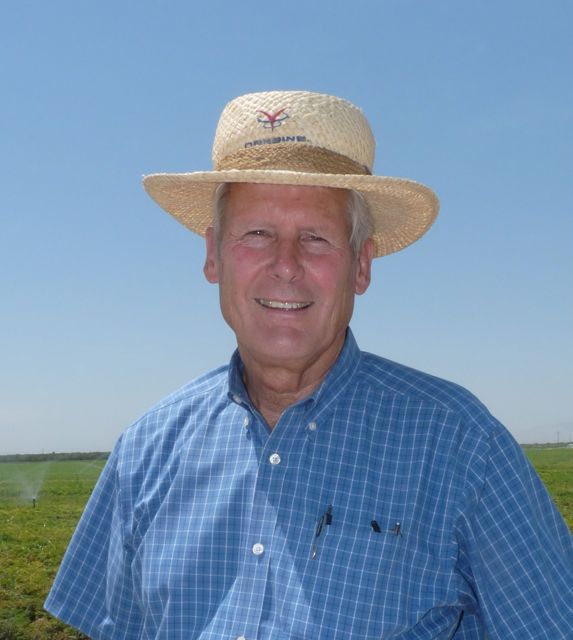
Don Cameron, manager of Fresno County-based Terranova Ranch has been working with the Kings River Conservation District (KRCD) on a groundwater recharge plan for nearly 20 years to convey floodwaters from the Kings River across Terranova Ranch and other properties in the area. “It has been a long, hard, committed struggle,” said Cameron, “but in 2011, we got Natural Resources Conservation Service (NRCS) involved.

“Once we submitted our grant application to the California Department of Water Resources (DWR), they reviewed it and awarded us a $5 million grant, which really got the project off the ground,” said Cameron.

“We are in the third year of work with the grant and we are currently doing the environmental studies with California Environmental Quality Act (CEQA). We are still very much involved in the engineering phase and we are putting a lot of agreements together with all the neighboring agencies that we have to work with,” Cameron said.

Logistically, Terranova Ranch is in an ideal location to capture potential floodwaters from the Kings River. Adjacent to the North Fork of the Kings River where floodwaters move though the James Bypass to the Mendota Pool, Terranova Ranch, provides the operation a unique opportunity in terms of groundwater recharge.

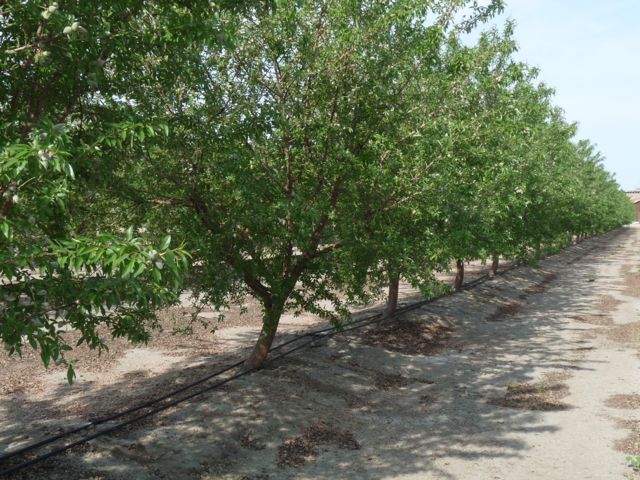
“We are taking farmland that is in production, and when the floods come, we will direct floodwaters across that land and neighboring land, to recharge the groundwater in our fields,” said Cameron. “We have proven that we can recharge in existing vineyards and tree-crop orchards, as well as in tomato, onion and carrot fields before we plant. We can use the floodwater across our farmland so that we do not need a dedicated basin dug out just for a recharge.”

“We know we can recharge anywhere on our land,” explained Cameron. “We can even turn off our pumps and use the water on the land to irrigate, through our drip systems. There are a lot of different ways to attack the problem. We think this is the best fit for our area, and we hope to be successful in rebuilding our groundwater supply,” said Cameron.

“The plan is to dedicate about 250 acres of ground for recharge,” said Cameron. Low levies will be built around the land when floodwaters are anticipated. We may have crops planted on the fields,” but Cameron hopes to be able to predict floods prior to planting a crop. Nevertheless, Cameron said, “We will flood crops if we need to.”

When the fields are flooded, the water may be as much as 2 to 3 feet deep, or as little as six inches deep. But the goal is to keep the water continuously on those fields to continue the recharge.

And since this is a large project involving state money, CEQA must be involved. Cameron emphasized, “We want to be sure that there is no environmental damage to any possible endangered species anywhere near our farm or near the project we are doing. There are state and federal laws that we have to abide by and so we need to jump through those hoops to get the project approved to completion,” said Cameron.

“We have been working with the project for a long time and we think its time has come,” said Cameron. “We are in the fourth year of a drought now and there is a lot of interest in putting water underground now, rather than building dams. We think dams are necessary as part of the overall water storage for irrigation, but we need both aboveground and below-ground storage.”

Cameron contends this groundwater recharge plan could improve groundwater quantity and quality fairly quickly, and be implemented faster than trying to build a large dam in the state. “We want to do our part here,” he said. “We would hate to see all the floodwater flow by during flood periods. It’s smarter to capture those stormwater flows on the land and into the ground water reservoir. We think it’s a real win for the whole state,” he said, adding there has been a lot of interest in duplicating this type of project throughout the state.

Cameron noted the project is perfect for the Sustainable Groundwater Management Act, which went into effect Jan. 1, 2015. “We are going to be ahead of the game on this, which is where we want to be,” he said.

Yet, not fast enough. Though a sizeable El Niño may pound California this fall and winter, bringing potential floodwaters to many rivers, the paperwork for the Terranova Ranch recharge program will not be completed in time. Cameron and the KRCD have been pushing to complete the project, but the agencies that need to sign off are numerous, including:

  • California Department of Transportation (Caltrans) – because floodwaters will be moving to additional landowners east of 145.
  • Pacific Gas and Electric Company (PG&E) – because water will need to flow under a natural gas pipeline.
  • U.S. Army Corps of Engineers – because a major cement structure with gate valves must be in place for the floodwater to be extracted from by-pass. “This will essentially mean that the levies will be breached,” said Cameron.

Again, the floodwaters will be flowing north and to the east, to several landowners in the region. Cameron and KRCD have been doing all the setup for everyone, not just themselves. “We hope, in long term, to expand the recharge project to 16,000 acres,” said Cameron.
2016-05-31T19:27:05-07:00October 26th, 2015|

Joe Marchini, Mr. Radicchio

Joe in truckJoe Marchini Brings Radicchio to California

By Patrick Cavanaugh, Deputy Editor

Joe Marchini, of J. Marchini Farms, was born in 1938 to Italian parents who farmed and packed tomatoes in Le Grand, Calif. Marchini has lived and worked in that locale for his whole life, exemplifying a high level of spirit and accomplishment.

His father, Florindo Marchini, brought his family over from Tuscany in 1920.” They settled in Le Grand because Florindo’s brother was already living there when Florindo first arrived. Before long, Florindo met a long time grower by the name of Carlo Giampaoli who invited Marchini to grow tomatoes and bell peppers with him. So Giampaoli took Florindo Marchini under his wing, and his brother as well, and established their farm, Giampaoli-Marchini Company. Together, they packaged tomatoes under the Live Oak brand because they actually packed the produce by hand in the shade of a live oak tree that still thrives there today!

Florindo’s son, Joe Marchini, was around seven when he began working at the packing shed stamping produce boxes. “I would sit on a box,” he said, “and as they came down the line, I used a little stamp pad to size tomatoes 6/6, 7/7, 7/8, 5/6, 4/4, 3/4. I only worked about 3-4 hours a day, and that was it. The older I got, the more I became involved in different things, from stamping, to packing, to wrapping tomatoes in cellophane paper and putting them in a box.”

The tomatoes were packed green and transported back east by train in ice cars. “They weren’t pink ones; no, they were dead green! They knew when to pick them, when the gel formed inside of the tomatoes,” Marchini said. “They could tell by the color and the shine of the tomatoes, and that’s what the pickers were supposed to pick. They were going to break soon. It took about a week, running day and night, to get to New York on steamer trains.”

“The early farming venture was comprised of 150 acres, which was a lot of acreage with horses,” said Marchini. “In the fall, we would travel to Gustine and cut tulles and bamboo for our tomato stakes.”

“My two brothers, Richard and Leonard Marchini, went to school with me. None of us could speak any English; we only spoke Italian,” Marchini said. So they all learned English in a small schoolhouse with two classrooms and one teacher.

“My dad grew tomatoes on that land for two years and then planted 40 acres of almond trees. The almonds were harvested green and then dried down by air.” Of course this was before mechanical shakers were used to harvest, so it was done with mallets and tarps. “It was very tough work,” noted Marchini, “and the price of almonds was less than 60 cents a pound.” Marchini credits Blue Diamond Growers, a cooperative he joined, with marketing the almonds so prices could increase.Radicchio


Mr. Radicchio

Not satisfied with growing only tomatoes and almonds, Joe Marchini was always looking for something new to grow. In 1962 on a trip to Italy, Joe noticed fields of radicchio, a leafy Italian chicory and relative of endive, in the Venice area and found the crop was selling well in Italian grocery stores. He said, “I liked the crop and thought it would grow well in California, so I smuggled in little packages of seeds.”

Unfortunately, the seeds he brought back did not grow well. “Radicchio production wasn’t perfected and the source I had in Italy did not tell me what season the seeds were for.” Marchini’s radicchio would grow and form green leaves but not make a head. So Marchini went back to Italy, 40 miles southeast of Venice, to talk to growers, but no one would talk. “I certainly could not tell the guys that I was going back to the U.S. to grow the crop,” he said.

Marchini finally found a couple of growers to ship a 100-pound sack of seeds to San Francisco for him. “I picked up the bag, planted the seed and the same thing happened—it didn’t grow.” He called the Italian growers and asked how many different radicchio varieties they were growing. They told him eight varieties. “I asked them why they sent me only one variety, why they did not tell me when to plant the seed, and if they wanted me to buy more seed, they had better tell me what varieties to grow,” he said.

“Since I spoke Italian, the growers started to open up. Eventually, I brought them to the U.S., and we partnered up to grow radicchio. I even sent them to Mexico because they thought they could produce an earlier crop than in California,” Marchini said. After reaching mediocre success for about four years in Mexico, they moved back to California to work with Marchini, now without a partnership.

The company now productively farms in Mexico with the right seed. “We farm in Mexico for the winter crop in February, March and April. But before we started growing in Mexico, in the late 1970s, we started in Salinas and then in the San Joaquin Valley. The Italian growers knew what to plant and we got all the varieties in the right mode that would do well. The Italians wanted to be partners again and I declined it because I had kids coming up, but I told them that I would buy all the seeds from them, and they were making good money. So they ended up disclosing the secret in the whole deal of growing radicchio. So without them, and me speaking Italian, we would have never gotten started. We are still friends today and I’m still buying seed from them,” Marchini said.

Over the years, Marchini has worked with his son Jeff to plant the right seed at the right time. They learned which varieties could handle different climates, such as going into the heat, and coming out of the heat, and they emerged with 6 or 7 dependable varieties.

“So we plant six varieties in the fall, one week after the other. We can have radicchio in the San Joaquin Valley from November until March, and we harvest seven days a week.

His processors want radicchio 12 months out of the year, so Marchini’s company manages harvesting to fill the sales pipeline 12 months a year. “And we never run out of it,” he said.

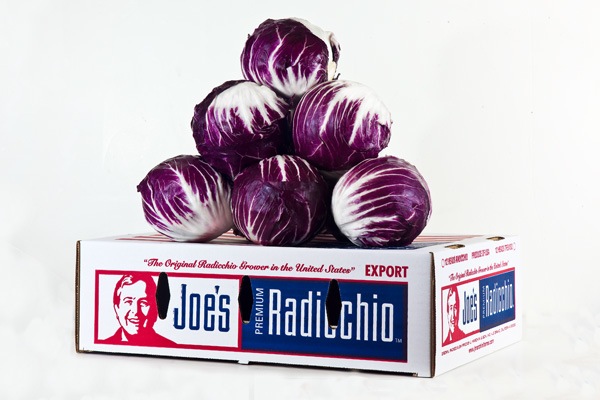
Joe's Premium LogoToday, Marchini uses about 12 different labels, including his own image on the ‘Joe’s Premium Radicchio’ box, for the domestic market and select export markets. “We let global importers pick their own labels. J. Marchini ships all over the world now, including Italy, and has a large percentage of the market in Japan, Korea and Taiwan. “They love the color of radicchio in a blend,” he said.

J. Marchini deals with nearly every processor in California including Taylor Farms, Apio, Fresh Express, Dole, Earth Bound, and Ready Pac, year-round, with production from Kern to Merced counties and Mexico.

Managing all this production with Joe and his son Jeff (the third generation), are grandchildren Marc and Nic and Francesca (fourth generation), with the fifth generation coming along with Gabriella, Maximus and little Giuseppe, named after his great-grandfather Joe (Giuseppe). Marc and Francesca work in the sales and post-harvest side of the business. Nic works in the farming operation side of the business. Jeff oversees the company as a whole.

Overseeing production, and especially the harvest of the radicchio throughout the growing regions, including Mexico, is Alejandro Calderon, Joe Marchini’s right hand since day one. Jenny MacAfee, a key person in the sales department, has been on board for the last 20 years.

Today Marchini farms three main radicchio varieties: Castelfranco (white head with red polka dot specks), Treviso (elongated red with white ribs), and Palo Rosa (red head type with white veins). “We do a three-pack deal in the wintertime with all three varieties together, but we also grow many other varieties,” said Marchini.

J. Marchini Farms’ production operation, based in Watsonville, a great climate for radicchio in the summer months, includes 2,000 acres spread between the Central Valley, the Coastal areas and Mexico.

The Central Valley fall and winter nighttime temperatures are cool, and radicchio production, five lines down the row on 80-inch beds, is about 20,000 pounds per acre, with most of it on drip or sprinkler.

The operation also grows almonds, walnuts, fresh figs and other crops, “but radicchio has been a good ride,” said Marchini. “We have had ups and downs with the crop, but overall it has provided a good cash flow,” he said.


For the last three years, Joe Marchini has been dealing with Squamous Cell Carcinoma (the second most common form of skin cancer) and has undergone multiple surgeries and treatments. His love for his family and his incredible passion for farming keep him going.

_______________

J. Marchini Farms

2016-05-31T19:27:06-07:00October 16th, 2015|

#CitrusMatters Spreads Info

#CitrusMatters Helps Spread Word on Serious Citrus Greening Disease

By Kyle Buchoff, Assistant Editor

Steve Olson, senior product manager for Bayer CropScience has a big passion for citrus, an important U.S. crop currently at risk to Huanglongbing (HLB), also known as citrus greening, a bacterial citrus plant disease. The vector of the deadly disease is a tiny insect known as the Asian citrus psyllid. Bayer CropScience launched the #CitrusMatters initiative this year to fully convey the significance of HLB to the California public.#CitrusMatters

Olson said the initiative focused on California’s urban settings because more than 60 percent of homeowners in California grow citrus trees in their yards. “We felt we could have some influence on broadening public awareness of this very significant disease.”

“So we introduced the #CitrusMatters initiative with California Citrus Mutual to help spread through social media the importance of citrus and how people enjoy citrus,” said Olson. “We were trying to make that emotional connection, and I think to a degree we have had some success. We held a #CitrusMatters Day in San Diego on May 8 and in Los Angeles on July 2, and tried to engage mass media. I think it is a very important undertaking to really bring awareness to homeowners who have citrus in their backyards.”

For more information go to: citrusmatters.bayercropscience.us.

2016-05-31T19:27:07-07:00October 13th, 2015|

JPA Could Save Temperance Flat Dam

Joint Power of Authority Could Save Temperance Flat Dam

By Patrick Cavanaugh, Deputy Editor

A Joint Power of Authority (JPA) is being formed to help preserve money authorized for construction of the Temperance Flat Dam with the passage of California Proposition 1, the Water Bond in 2014. Joel Nelsen, president of California Citrus Mutual, has been engaged in getting the project off the ground.

“It is unfortunate what has happened to the Friant Water Authority leadership and the lack of suitable talent there to run with it. The situation has adversely impacted getting a Temperance Flat water storage program in front of the California Water Commission, whose nine governor-appointed members are responsible for advising the director of California Department of Water Resources, approving rules and regulations, and monitoring and reporting on the construction and operation of the State Water Project. The Water Commission, which elicits preferred priorities from the agricultural industry, will award bond money in early 2017.

The Water Bond approved by voters last fall designates $2.7 billion for water storage. While this amount will help subsidize the construction of the dam, Nelsen noted there needs to be better organization in its planning, “because when we negotiated money for storage planning, we were set on two locations, Temperance Flat, behind Friant dam and east of Fresno, and Sites Reservoir, north of Sacramento. Of course, all along, we have known that farmers were investing a lot of money into it as well, but you have to have a plan,” Nelsen said.

Nelsen explained the JPA consists of city and county leaders as well as farm industry leaders from Merced to Bakersfield, including those from Fresno, Madera, Kings, Kern and Tulare Counties, and will require everyone’s cooperation to get the job done. “The inability to sustain some leadership at the Friant system right now has stalled our ability to make something happen in that regard.

“If we can use the talent within our counties right now to generate some of the proposals until we have the ability to get additional water experts online, I would give those who are working on the JPA all the credit in the world,” Nelsen said.

2016-05-31T19:27:08-07:00October 6th, 2015|

Bayer CropScience Horticulture Symposium Builds Relationships

Bayer CropScience Horticulture Symposium Builds Global Relationships for Collaborative Problem-Solving

By Patrick Cavanaugh, Deputy Editor


Nearly 200 professionals in the horticultural industry from across the food chain and the value chain, and from Europe and North, Central and South America, gathered this week at the Bayer CropScience Horticulture Symposium in Puerto Vallarta, Mexico. Attendees were treated to an inspirational mix of lectures, panel discussions, as well as an interactive poster session, all incorporating forward-thinking sustainable practices into contemporary agriculture. Among the crops discussed were tomatoes, citrus, grapes, potatoes, bananas.

Rob Schrick, strategic management lead, Bayer CropScience Horticulture, based in Research Triangle Park, North Carolina, said the event was the company’s second in a series of horticulture symposiums focused on international collaboration and problem-solving. “This is about bringing the best and brightest from across our industry,” said Schrick, “from influencers and universities to industry members like ourselves and the media. It’s about getting these creative minds together and discussing solutions. The solutions may not come from the symposium itself, but the connections that are made—you don’t know what will yield from those relationships.”

Jim Chambers, director of marketing, Bayer CropScience Food Production, said the Horticulture Symposium was all about sharing information on best management practices. “Bayer is a leader in the crop protection business within the horticultural space around the world, and this is a real opportunity to bring all of us within horticulture across the food chain and the value chain to talk, from the grower, to the processor, and to the consumer. It is a wonderful opportunity to work together to solve some very difficult challenges.”

“And, vivid to all attendees, was that members of the fruit and vegetable industry throughout the Americas have similar challenges to overcome,” noted Chambers. “It was very interesting; the issues that we talk and hear about in the specialty crop states such as California, Florida and Texas, are very much the same issues that people, for example in Mexico, Brazil, Argentina, or Central America, are facing. These issues do not go across just states or counties; they reach across the globe in solving these problems,” Chambers said.

Among the speakers were growers, commodity specialists from the industry and academia, and experts on sustainability practices, professionals on Maximum Residue Levels (MRLs), Bayer CropScience specialists and major agricultural association leaders such as Tom Nassif, ceo, Western Growers Association (WGA) and Dana Merrill, president, Mesa Vineyard Management Inc.

Bayer is a global enterprise with core competencies in the Life Science fields of health care and agriculture. Bayer CropScience, the subgroup of Bayer AG responsible for the agricultural business, is one of the world’s leading innovative crop science companies in the areas of seeds, crop protection and non-agricultural pest control. The company offers an outstanding range of products including high value seeds, innovative crop protection solutions based on chemical and biological modes of action as well as an extensive service backup for modern, sustainable agriculture. 

(Photo features Rob Schrick, Bayer CropScience – Horticulture strategic management lead)

2016-05-31T19:27:08-07:00October 2nd, 2015|

Plants Do Not USE Water…They Borrow it!

Plants Transpire Most of the Water They Use!

Editor’s note: California Ag Today interviewed Allan Fulton, an Irrigation and Water Resources Advisor, UC Cooperative Extension Tehama County, in Redbluff CA, to comment on the debate about the agricultural industry’s use of water and to focus on a critical but disregarded process—that all plants transpire, even plants cultivated for the crops we eat.

Allan Fulton, Irrigation and Water Resources Advisor

Allan Fulton, Irrigation and Water Resources Advisor

CalAgToday: We hear in the media that our crops are using too much water. And while all plants need water to grow food, we also know that a high percentage of water taken up by all plants actually transpires back into the atmosphere, to form clouds and precipitation, right?

Fulton: Yes, when plants transpire, the water just returns to the local hydrologic cycle, leaving the harvested crop that we distribute elsewhere in the US or in the world actually very low in water content.

CalAgToday: When we think about transpiration, are the plants actually “borrowing” the water?

Fulton: Yes. We get a lot of questions about why we irrigate our crops so much, and it comes from the general public not being as close to farming everyday. The truth is, plant transpiration is a necessary biological process. The water cools the tree so it stays healthy and exits the leaves through special cells called stomata. While the stomates are open to allow water to transpire, carbon dioxide enters and is used in photosynthesis, making sugars and carbohydrates for the plant to create the fruits and nuts that we eat. So, an inadequately watered plant cannot take in enough carbon dioxide during transpiration, resulting in defective fruits and nuts that are smaller, shriveled, cracked—all the things the typical consumer does not want to buy.

Plants cannot gain carbon dioxide without simultaneously losing water vapor.[1]

CalAgToday: Can we say 95 or 99% of the water that is taken up by the plant gets transpired and definitely not wasted?

Fulton: Definitely. We converted to pressurized irrigation systems, micro sprinklers and mini sprinklers, so we have a lot more control over how much water we apply at any one time. We do not put water out in acre-feet or depths of 4-6 inches at a time anymore. So, much like when rainfall occurs, we can measure it in tenths, or 1 or 2 inches at most. As a result, the water doesn’t penetrate the soil very deeply, maybe only 1 or 2 feet each irrigation.

We are very efficient with the water, but because we deliver it in small doses, we have to irrigate very frequently. That is why we see irrigation systems running a lot, but they are systems that efficiently stretch our water supply and do not waste it.

CalAgToday: But again, the vast majority of the water that the tree is taking up is being transpired, right?

Fulton: Yes, most of the time, at least 90% of the water that we apply taken up through the tree and transpired so that photosynthesis can happen.UCCE Tehama County

CalAgToday: And transpiration increases on a hot day?

Fulton: Yes, we do get a little bit of loss from surface evaporation from wet soil, but we try to control that with smaller wetting patterns—drip-confined wetting patterns. When you think about it, the heat of the day is in the afternoon when many irrigation systems don’t run because of higher energy costs. There are incentives not to pump in the middle of the afternoon, but those who do try to confine the wetted area to limit evaporation. And the hot hours of the day make up about 4 hours of a 24-hour cycle, so we irrigate mostly during the nighttime and early morning hours to lesson evaporative loss.

CalAgToday: Growers are doing everything they can to conserve water. If the trees and vines are all transpiring most of their irrigated water, why is using water to grow food a problm?

Fulton: I think the emphasis throughout the United States has always been to provide a secure food supply. That security has many benefits, economically and politically; and in the end, we are trying to provide the general public with good quality, safe food at the best price possible.

______________________________________________

[1]  Debbie Swarthout and C.Michael Hogan. 2010. Stomata. Encyclopedia of Earth. National Council for Science and the Environment, Washington DC.

CIMIS


The California Irrigation Management Information System (CIMIS) is a program unit in the Water Use and Efficiency Branch, Division of Statewide Integrated Water Management, California Department of Water Resources (DWR) that manages a network of over 145 automated weather stations in California. CIMIS was developed in 1982 by DWR and the University of California, Davis (UC Davis). It was designed to assist irrigators in managing their water resources more efficiently. Efficient use of water resources benefits Californians by saving water, energy, and money.

The CIMIS user base has expanded over the years. Currently, there are over 40,000 registered CIMIS data users, including landscapers, local water agencies, fire fighters, air control board, pest control managers, university researchers, school teachers, students, construction engineers, consultants, hydrologists, government agencies, utilities, lawyers, weather agencies, and many more.

2021-07-23T14:31:38-07:00September 23rd, 2015|

Exclusive Interview with ALRB Chairman Bill Gould

ALRB Chairman Bill Gould Defends ALRB’s Actions

By Patrick Cavanaugh, Deputy Editor

California Ag Today exclusively interviewed William B. Gould IV, member and chairman of the California Agricultural Labor Relations Board (ALRB), and previously chairman of the National Labor Relations Board. ALRB Chairman Bill Gould described his extensive experience in labor law, “I have been practicing in labor law both on the union and employer side. I’ve arbitrated labor disputes for 50 years as an impartial arbitrator, and I’ve been in academics, teaching law, and of course in government service as well.”

Chairman Gould defined the Board’s role, “The ALRB is a quasi-judicial neutral agency that was established to interpret and administer the Agricultural Labor Relations Act of 1975. It deals with the cases in front of it the best it can and tries to promote rulemaking to implement the objectives of the statute.

When pressed to address a widely held belief that the ALRB is biased in favor of the United Farm Workers (UFW), particularly against Gerawan Family Farms, a Fresno County tree fruit operation which for several years has witnessed a majority of its farmworkers attempt to fight mandatory-mediation-imposed UFW representation and fees, Chairman Gould replied, “The ALRB is a government agency that is concerned with enforcing and administering labor laws. I think when you get in the business of interpreting law and finding facts, sometimes people don’t always agree, and that has happened in a number of cases. A lot of people don’t understand that the statute is written fundamentally to protect the rights of workers to engage in freedom of association and in concert under conditions they consider unfair. The Act also protects employees from retaliation for these freedoms. We are an impartial agency that attempts to take into account the interests of all parties; but fundamentally, we have to find all the facts before us and make decisions and determinations.”

ALRBWhen asked if, in general, farmers were taking care of their workers, Gould answered, “I’m not in a position to say whether farmers are taking care of their farmworkers. That’s really a broader mission than the one that the legislation has given to us. We are concerned with whether, in particular cases, violations of the statute have occurred, and in remedying those violations.”

“And while farmers would agree that farmworkers should have the right to speak up when something is wrong without any retaliation,” Gould elaborated, “bosses are not forced to correct any wrong or to change things. And the boss is not obliged under our statute to do anything about wages, health or safety concerns. We are concerned with giving workers the ability to speak up and engage in concerted activity with protection against employer retaliation.”

On September 17, ALRB administrative judge Mark Soble ruled to prohibit Gerawan employees from learning the outcome of ballots cast in 2013 to decertify the UFW union, angering the agricultural industry and the Gerawan farmworkers, in particular. Gould said, “I can’t make any comments about that matter at all.”

Recently the ALRB hosted three hearings in the state to learn how to better educate farmworkers about their labor rights and to establish legal access to communicate directly with them during work hours at their work sites. Prompted to explain this ALRB request to access private farm property, during production hours, Gould replied, “The problem is the difficulty in reaching those with lack of legal status and who live in the shadow of the law and are afraid to protest. As the most recent witness testified, this population is sometimes cut off by language barriers and might not know the content of the law.”

“Putting aside language and documented status,” Gould continued, “many workers don’t know some very basic aspects of the National Labor Relations Act because of the inability of the Board under the Act to communicate with those workers. So what we are looking at is our ability to communicate the content of the law and the procedures we employ more effectively than in the past.”

When asked about other forms of outreach, such as hanging educational posters in different languages that workers understand, Gould said, “These indigenous languages are something that only academics read. I don’t think that many of the farmers are academics.”

Chairman Gould explained the ALRB could reach workers who speak these ancient languages by “having lawyers on private property describe the content of our statutes and our procedures and perhaps show videos that would explain the rules in their own language.”

ALRB Bio

Appointed in March 2014 as a member and chairman of the Agricultural Labor Relations Board, William B. Gould IV has been Charles A. Beardsley professor of law, emeritus at Stanford Law School since 2002, where he has held multiple positions since 1972, including professor of law. He was chairman of the National Labor Relations Board from 1994 to 1998. Mr. Gould was a visiting professor of law at Harvard Law School from 1971 to 1972, professor of law at Wayne State University Law School from 1968 to 1972, and a lawyer at Battle Fowler Stokes and Kheel from 1965 to 1968. He was an attorney-advisor for the National Labor Relations Board from 1963 to 1965 and assistant general counsel for the United Automobile Workers from 1961 to 1962. Mr. Gould is a member of the National Academy of Arbitrators. He earned a Bachelor of Laws degree from Cornell Law School.

Mr. Gould’s term expires January 1, 2017 (Pursuant to Labor Code § 1141(b).)

2016-05-31T19:27:10-07:00September 21st, 2015|

Fighting ACP in California

Fighting ACP In California to Stay Well Ahead of HLB

By Patrick Cavanaugh, Deputy Editor

With more than 275,000 acres of citrus trees in California, keeping the Asian Citrus Psyllid (ACP) out of groves is a serious concern. Bob Blakely, vice president of California Citrus Mutual, based in Exeter, talked to California Ag Today about how growers are fighting ACP in California.

“We’ve been very proactive, ever since the first psyllid was found here back in 2008. We already had an action plan in place when that psyllid was found. We have engaged with and educated the public and the media, and we have very good cooperation with the state’s citizens,” Blakely said.

Tamarixia radiata (female)

Tamarixia radiata (female); Mark Lewis, UC Riverside Center for Invasive Species Research

Blakely noted the industry is using a variety of methods, “We are usually able to go in and treat urban areas in Southern California, where ACP is now endemic, with crop protection materials. If we determine we cannot control it with pesticides, we implement a new biological program by releasing the parasitoid Tamarixia (a tiny non-native wasp) in residential areas. The new wasp is becoming well-established, and we are hoping the species will help manage ACP populations.”

“We hope to prevent ACP from creating the type of damage seen in Florida, where the citrus industry has been reduced by 50%,” said Blakely. “We are way ahead of the game here in California. We have managed to slow ACP spread in commercial areas in order stay ahead of the spread of the HLB disease the bug carries. We hope a reasonable cure can be found so we can prevent the kind of devastation we are witnessing in some other states.”

2016-05-31T19:27:10-07:00September 18th, 2015|

ACP Devastates Florida Citrus

ACP Devastates Florida Citrus Industry; California Continues Vigilance

By Patrick Cavanaugh, Deputy Editor


California Citrus growers must not underestimate the potential damage from Asian Citrus Psyllid (ACP), according to Bob Blakely, vice president, California Citrus Mutual, based in Exeter.

Given multiple ACP detections in California this year, Blakely used Florida’s ACP catastrophe as an example of how devastating the pests can be. “We are challenged here in California with ACP,” Blakely began, “which vectors the fatal disease known Honglongbing, (HLB), also known as citrus greening. But, it is nothing like what they are dealing with in Florida, since HLB [the disease itself] was discovered there less than ten years ago. “Florida’s citrus acreage, which measured just under 1 million acres prior to the calamities they’ve been facing,” said Blakely, “has been reduced by almost 50%.”

Bob Blakely, VP, California Citrus Mutual

Bob Blakely, VP, California Citrus Mutual

While occurrences of Citrus Canker Disease as well as urbanization also contributed to the reduction in acreage, Blakely stated, “the big killer, citrus greening, is mostly responsible for the reduction of citrus acreage to the lowest level in decades.”

Because Florida has become so infested with ACP and HLB, reestablishing the industry there will take some time. “They are replanting and trying to replant healthy trees,” Blakely explained, “but they know those trees are short-lived compared to trees in California. We have hundred year-old groves. Florida farmers are just hoping to raise those trees and get a few years of production out of them before HLB re-infects them and they must be replaced again,” said Blakely.

2016-05-31T19:27:10-07:00September 16th, 2015|

Citrus Growers Determined to Succeed

Frustrated Citrus Growers Are Determined to Succeed

By Patrick Cavanaugh, Deputy Editor

While farmers have been dealing with some tough times, Bob Blakely, vice president of California Citrus Mutual is optimistic about future generations of citrus growers, “Perceptions and attitudes are really all over the board; we’ve got growers who are really frustrated and ready to throw it in. But most growers are staying in, thinking they can still makeSaveOurCitrus it in the citrus industry.”

“California growers are known for their tenacity in the face of challenges,” Blakely commented.  “It’s exciting to see young farmers come on, even though they continue to fight the regulatory battles and higher farming costs. But these young guys have the same determination the prior generation had when they started. So, I am optimistic about the future of the citrus industry in California.”

One of the major threats to citrus is the Asian Citrus Psyllid (ACP) and its potential to spread the disease Huanglongbing (HLB), as it has in Florida and Texas. “We are very concerned about the recent HLB finds. Here again, they have been discovered in residential areas, which is no iPhone Save Our Citrus Appsurprise to us. That is typically where diseases first show up. At the present time, the ACP are contained. We are starting to delimit that area, and residents are very cooperative in allowing those trees to be removed.”

Download the Save Our Citrus App

There is now an iPhone app to help California residents identify signs of the Asian citrus psyllid and HLB, and easily report findings to agriculture officials. Download the free app in the iTunes store.

2016-05-31T19:28:04-07:00September 11th, 2015|
Go to Top