Citrus Psyllid Control Strategy Changes
Reducing Sprays in Areas, and Border Nets
By Jessica Theisman, Associate Editor
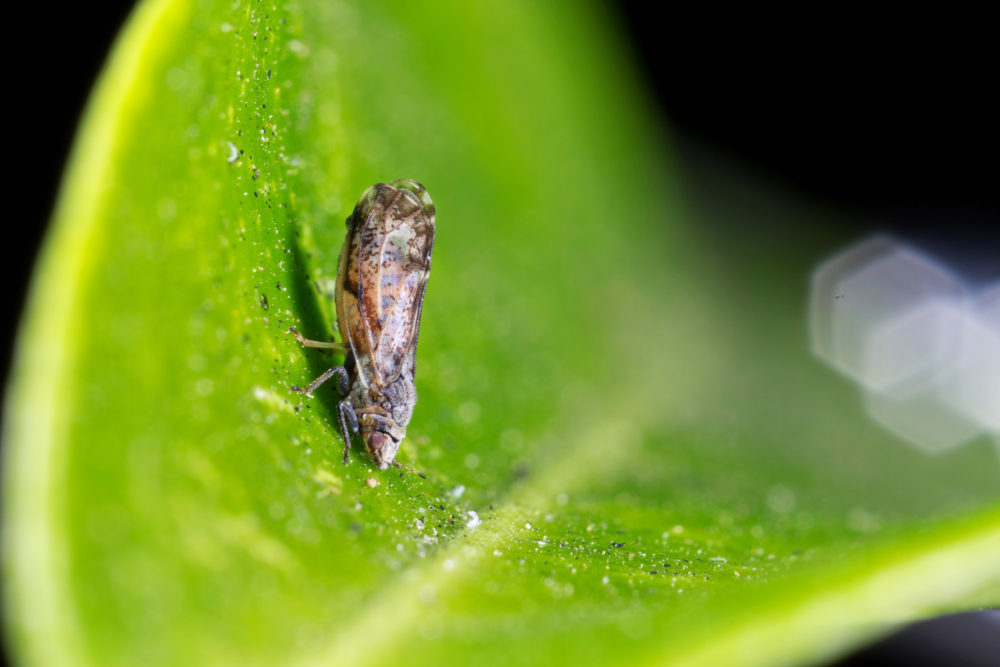
Huanglongbing, vectored by the Asian Citrus Psyllid, (ACP) is the dreaded disease that has nearly wiped out the Florida citrus industry and is a potential problem for citrus growers in California. California Ag Today recently met with Beth Grafton-Cardwell, a UC Cooperative Extension Specialist. She specializes in integrated pest management; she discussed new strategies for the control of HLB.
“We have been surveying grower orchards in southern California and following how pesticide sprays are working, and I’m going to make some new recommendations on how to handle the populations down there,” said Grafton-Cardwell, who is also the director of the Lindcove Research and Extension Center. “Some regions of Southern California are easier to control psyllids than others. The pesticide treatment is less intensive due to the desert climate. San Diego is one of the areas that is less intensive due to the drier trees making them more hardened off, with less new flushes, where ACP is attracted.”
“There are other areas of southern California where the trees flush continually, providing great places for the psyllids to lay eggs, and that is where treatments are going to have to intensify,” she explained.
Areas such as Ventura, Riverside, and San Bernardino have to increase their treatments in the fall for better control.
And researchers are currently studying new prevention and control methods.
“Texas A & M has been looking at erecting net-like borders around the orchards because the psyllid tends to go to the edges,” Grafton-Cardwell said.
They want to treat the netting with yellow strips of sticky paper that would attract and/or apply insecticides to kill the psyllid.
“Our research is showing that often the infestation starts on the borders. Growers may have to intensify the number of treatments, but they don’t have to treat the entire orchard,” Grafton-Cardwell said. “Growers might be able to fight the psyllid with only treating the trees on the outer edges.”
Stolen Property Easily Detected With SmartWater
From SmartWater to Smart Farms
By Mikenzi Meyers, Associate Editor
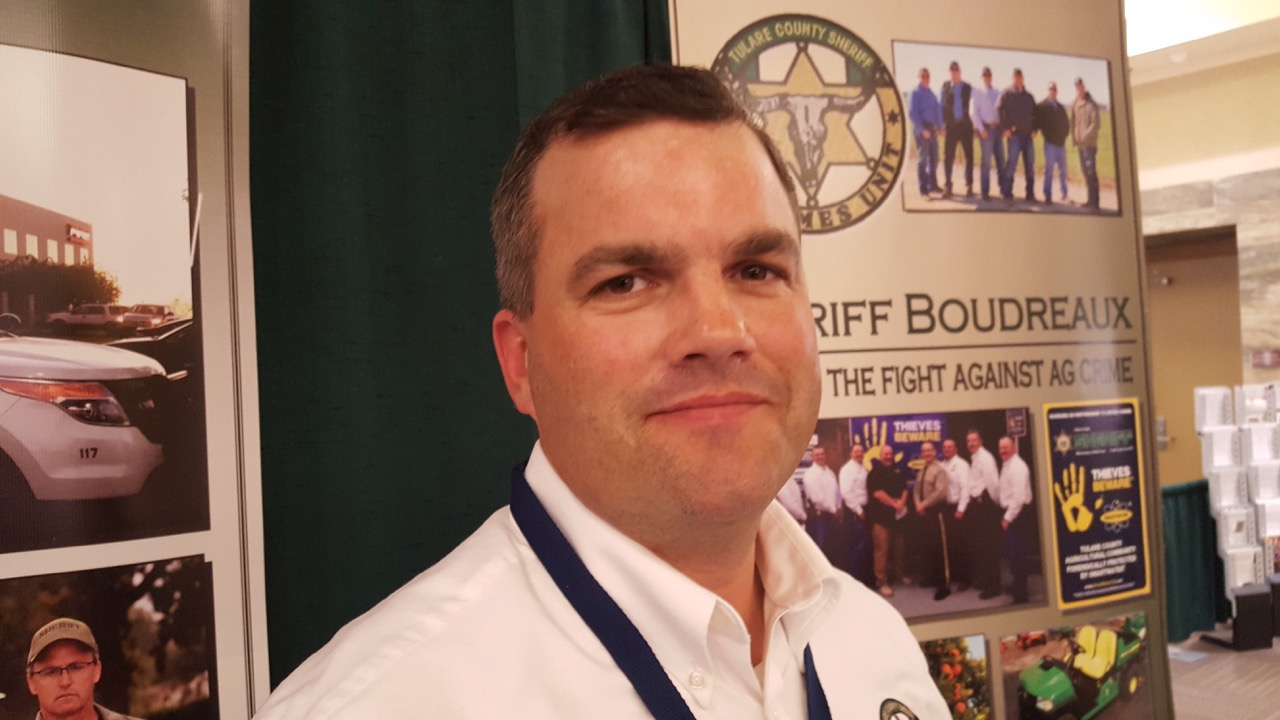
There’s a new tool that could lead to a significant decrease in crime rates, starting in the Tulare County. The tool is called SmartWater, and Detective John Nicholson of the Tulare County Ag Crimes Unit said that the Tulare County Sheriff’s Department has begun using it to track stolen property.
Nicholson said that SmartWater comes from a company based out of England that has been around for about 20 years and decided to open up a branch in Fort Lauderdale, FL. Word came about the tool’s dramatic effect on crime rates, with double-digit reductions in the neighborhoods where it was used.
“The sheriff was excited about it and thought it could be something that would protect the local farmers and ranchers of Tulare County,” Nicholson said.
Nicholson said growers could get their own vial so that they can mark equipment with a mark that is made visible by a particular light only the sheriff’s department has access to, so the criminals do not know it is there.
Nicholson explained it as working similar to identifying people by DNA, as a sample is taken back to the lab so it can come back registered to the property owner.
“It’s a mineral-based tool that can not only stand up to the elements, but even if bleach is poured onto it, the SmartWater will remain there as evidence against criminals in court,” Nicholson said.
“If someone is caught with a tool, jewelry, firearm or anything—and even if the serial number is ground off—if the item was marked with SmartWater, it comes back registered to a victim who has had the item stolen. Then we can identify that item in court,” he said.
This should ultimately lead to an arrest or conviction due to possession of stolen property.
The SmartWater program is available for free at the Tulare County Sheriff’s department.
iTrade Helps Growers
iTrade makes Growing and Shipping more Efficient
By Jessica Theisman, Associate Editor
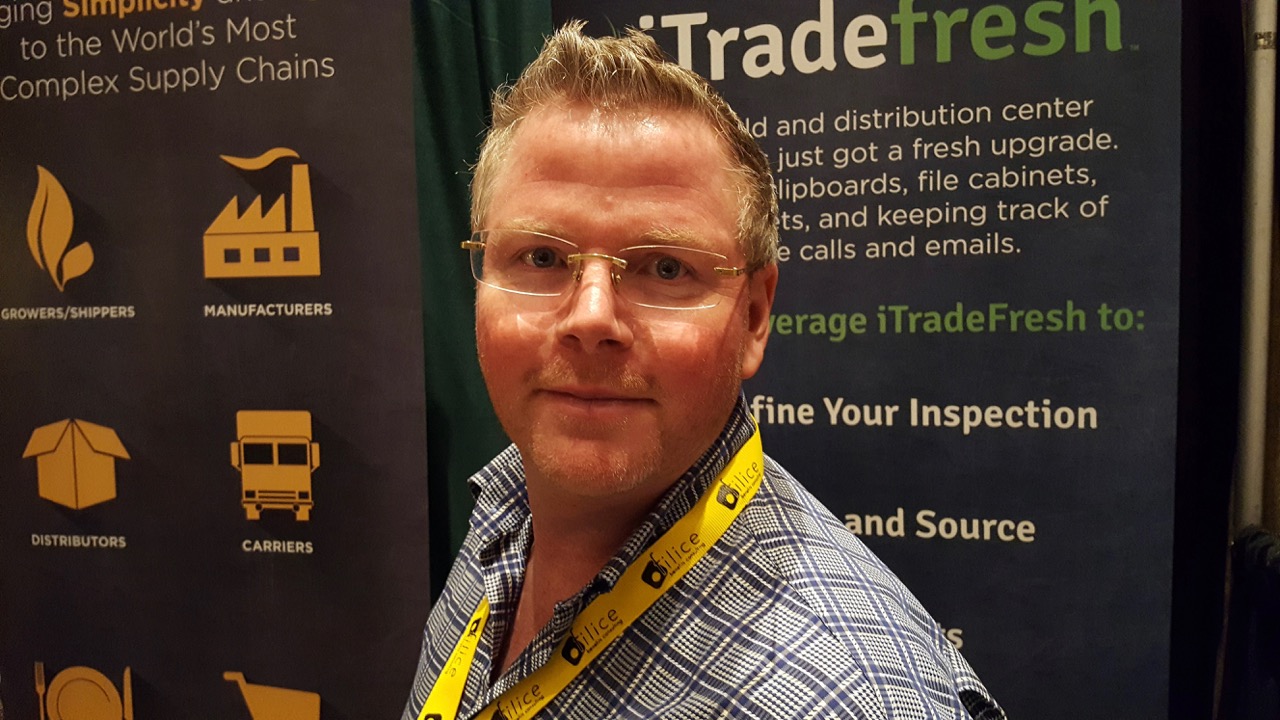
In a recent interview with California Ag Today, Dan Reighn, director of grower/shipper sales for iTrade, discussed how being a part of the system is helping the grower, shipper, supplier, and customers with iTrade’s efficiency by streamlining the process.
Cloud-based solution is key to the success of its speed. This will allow the information to flow quicker through all the channels by effectively being more beneficial to the grower, supplier, shipper, and inevitably the customer.
“The grower, shipper, and the supplier earn a lot of benefits when they are on our network every day transacting with 40 or 50 of their customers using an easy-to-use system, and we are able to handle that transaction for them rather than a purchase order being emailed or faxed or phone call,” Reighn explained.
iTrade is an efficient way to transact with buyers. It is a cloud-based software solution. There are carriers on the network to assist as well as field mobile systems that a grower can use at the source of picking. From that point, inventory can be done from the field to storage to assist the distribution.
“There are users in South America, Mexico, U.S. and Canada that are using our software on rugged mobile devices in the field,” Reighn said. “These customers are able to print off a PTI label, apply it to a case in the field as well as an electronic harvest tag. This also allows the supplier to know exactly what pallets, how much is in the field, when it is going to be received to the cooler, and when they can get that load off to Walmart or Safeway or Kroger.”
Farmers Add Emotional Connection to Food
Bayer Reports Consumers Still Trust Farmers
By Laurie Greene, Founding Editor
Adrian Percy, Global Head of Research and Development for Bayer Crop Science, told California Ag Today recently that he believes the public still trusts farmers.
“There’s a high degree of trust,” he said, “and I think that comes from the fact that there is an emotional connection with food and the fact that growers are known to be trying to work sustainably. Growers look from generation to generation in terms of passing the farm down, oftentimes, and I think that is still understood by the public, even if people have a few reservations about some of the technologies we use in agriculture.”
According to a recent Bayer global study about consumers, Percy reported, “We are seeing, not just in the U.S., but also in the Europe, South America and Asia, a lot of questions coming up around agriculture. As an agricultural input company, we think it’s our role to help understand this [phenomenon], first of all. We think it is very important for us to help activate—be it farmers or other folks in the industry—to come out and talk about agriculture, enter into dialogue with consumers and explain what we do.”
Commenting on some of the study’s most interesting revelations, Percy said, “It was interesting just asking the general question, ‘Do you believe that innovation in agriculture is actually important?’ And people came back, ‘Yes, we do believe that we need to innovate. We do see that there is a need to feed a growing population and that we need to help farmers farm more sustainably with better tools.’”
On the other hand, Percy explained that consumers drew the line, “when we quizzed them about the individual tools. People don’t necessarily like the idea of chemicals on the farm or GM technology in certain cases in certain parts of the world. So those are the types of discussions that we need to really go into.”
GMO Technology Can Help Prevent Starvation
First World Activists Dictate to Third World
By Patrick Cavanaugh, Editor
Needed GMO technology to help citizens in Third World countries is being thwarted by activist groups in First World countries who are anti-GMO, said Alison Van Eenennaam, a UCANR Cooperative Extension Specialist focused on Animal Genomics at UC Davis.
“If the African people choose to use this to develop better bananas, they should have the right to use that and not be dictated to by activist groups in the First World promoting fear around this technology,” she said.
GMO technology could greatly benefit those in the developing world, especially those who struggle with starvation on a daily basis.
“Most people have never seen starvation. People take food for granted, and when you see people that have problems in their agricultural production systems that are actually affecting the food security, you have to address those problems, whether they be drought or disease problems,” Van Eenennaam explained.
“And I’m all for using whatever technology that works best to address a problem. Maybe it’s conventional breeding or maybe its GMO, or gene editing. I don’t really care. I just want to use the best tool that is available. But it doesn’t make sense to take some tools off the table for no reason, and I think that’s what’s happening around the debate of genetic engineering,” she said.
And the use of GMO crops in a third world country has dramatically decreased the use of pesticides, which should be celebrated by activists.
“About 90 percent of the farmers growing GMO crops are on small acreage producers in the developing world, that are growing insect-protected Bt cotton. And the dramatic decrease of insecticide use resulting from that—well environmentalist should be singing this from the rooftops,” Van Eenennaam said.
“It’s incomprehensible to me that if your real intent is to decrease pesticide use in agriculture, to not appreciate what those Bt crops have done for global insecticide use is to be willfully ignorant of what the data shows,” Van Eenennaam said. “It’s just a win-win for everyone.”
BioConsortia To Bring New Tools to Ag
BioConsortia Continues Growth and Success, Securing $10 million in Series D Funding
By Patrick Cavanaugh, Editor
Getting even closer to helping California agriculture, BioConsortia, Inc., an innovator of microbial solutions for natural plant trait enhancement and yield improvement, has closed a further round of equity financing to support its continued growth, research achievements, and development of superior products.

Three new PhD scientists working on plants in lab: (from left) Jorge Santiago, Jenna Lang and Steve Wu
The $10 million round was led by Otter Capital and contributed to by Khosla Ventures, both of which are long-term backers of the biotechnology company and experienced ag tech investors.
The completion of Series D will further support the increased momentum BioConsortia saw in 2017, with three strategic new hires, the addition of a sixth U.S. patent, and the planting of fall and winter field trials. Funds raised will be used for the commercial development of a number of novel microbial consortia products — focused toward corn, wheat, soy, tomatoes, and leafy vegetables.
BioConsortia will also continue to build upon its proprietary discovery process Advanced Microbial Selection (AMS) including supporting the expansion of the AMS platform itself, incorporating deeper and more specialized analytics. Collectively, these steps will drive the company towards the establishment of an original and proven platform for the development of more efficacious and consistent microbial products for a wide range of agricultural crops.
“We are excited by the progress that we have made in product development, for both biostimulants and biopesticides, and the recognition from our investors.” says Marcus Meadows-Smith, CEO. “This new funding allows us to increase our annual spend on R&D, adding more tools from genomics, microbiome and machine learning to our already powerful discovery platform.”
A portion of BioConsortia’s planned development has been and, will continue to be, driven by the key hires made last year: Drs. Jenna Lang and Steven Wu providing scientific leadership in Microbiome Ecology and Computational Biology, respectively. Microbiome analysis and computational modeling underpin BioConsortia’s AMS process. When combined with the extensive physiological data collected throughout the discovery program, microbiome insights enable identification of the functional microbes benefiting high-performing plants, either as individuals or as consortia.
“Collectively, Jenna and Steven have a tremendous wealth of experience and expertise,” says Dr. Sue Turner, Sr. VP of Research. “Throughout the AMS process, we are capturing huge amounts of data; knowing how best to efficiently manipulate and analyze it is crucial for advancing leads and finding new, superior microbial solutions.”
In addition to adding big-data expertise to its research group, BioConsortia has been developing a strong fermentation team as it reaches the final steps in developing leads for commercial launch. Dr. Jorge Santiago-Ortiz joined the company as lead Fermentation Scientist early last year and has worked closely with Dr. Hong Zhu, Sr. VP Lead Development and Manufacturing, to lead scale-up and formulation experimentation in the newly built formulation facilities at the company’s Davis headquarters.
The drive to commercialization is now under way as several microbial treatments transitioned from second and third year field trials across a range of crops and geographies last year. A select number were entered into repeat field trials by major industry players, and these are moving forward to further testing and development. The early-stage biopesticide program also saw many remarkable successes in greenhouse and field trials, and so will be expanded onto many more crops in 2018.
“The expertise that we have added really reflects the comprehensive nature of our discovery and development platform,” Zhu said. “It has set us up for success as we ramp up our 2018 R&D program and move ever closer to product launch.”
Helping Anti-GMO Consumers Know the Truth
Van Eennennaam: It’s Tough to Change Emotion
By Patrick Cavanaugh, Editor
California Ag Today recently spoke with Alison Van Eenennaam, a UCANR Cooperative Extension Specialist focused on Animal Genomics at UC Davis. She discussed the argument against GMOs and the difficulty that some science communicators have with reaching anti-GMO consumers whose arguments are more emotion-based than fact-based.
“When every major scientific society in the world says something, then I don’t believe it’s a giant conspiracy theory,” Van Eenennaam said. “I believe that’s what the data show, and I get a little bit frustrated when people cherry pick an outlining study and just selectively ignore the consensus opinion of every single scientist in the world. That doesn’t make sense.”
“It becomes more like a denialist instead of a skeptic at that stage. Then discussion around the safety of GMOs is just out of kilt with the actual scientific data. It’s frustrating trying to correct that with science because it’s very hard to counter an emotional argument. So we need to peel back the story in a narrative form,” she said.
Van Eenennaam highlighted a movie called Food Evolution, narrated by American astrophysicist Neil deGrasse Tyson, which presents a factual representation of GMOs.
“I think that’s what’s been encouraging to me, just with general audience populations watching it, is they’ll come up afterwards and say, ‘You know what? This film made me think.’ ” Van Eenennaam said. “As a science communicator, I cannot ask for more than that. That’s exactly what I want people to do. I want them to dig down into the data and recognizing where they are getting the information and what it’s saying. I think that is a positive outcome.”
And certainly the movie has changed the mind of some people.
“And that is great, but we are wanting people to reevaluate on why they are changing their minds and are they willing to change their minds based on the evidence? That is one of the focal points of the movie,” Van Eenennaam explained.
The Food Evolution movie can be seen free if you subscribe to Hulu. It can also be seen in different areas on the web. Simply search for it online.
California Coffee Brews Success
Mark Gaskell on California Coffee Crop
By Laurie Greene, Founding Editor
California Ag Today recently spoke about the emerging California coffee crop with Mark Gaskell, who covers San Luis Obispo and Santa Barbara Counties as farm advisor for the University of California Small Farm Program as well as the UC Division of Agriculture and Natural Resources (UCANR) Cooperative Extension.
“Currently, there are about 30 farms with maybe 30,000 coffee plants between San Luis Obispo and San Diego Counties,” Gaskell said. “I would expect that to double this year. California’s coffee crop is doing well.”
“There is also now a private company, Frinj Coffee,” explained Gaskell, “that evolved out of a long relationship I had with Jay Ruskey, CEO and co-founder of Goleta-based Good Land Organics. Ruskey participated in some of our early research and development work with California coffee. Our collaboration has justified investment by the number of coffee growers in the Frinj Coffee operations.”
There are 25 growers, according to the Frinj Coffee website.
Coffee cultivation is new to California, because, as Gaskell explained, “traditionally, coffee is grown in subtropical areas, specifically at high elevations where the relatively cooler temperatures are. Cooler temperatures prolong the ripening time, which improves the quality of the coffee beans.”
“So, in the world’s newest coffee growing region, Coastal Southern California,” Gaskell said, “we replaced the high elevation with the influence of the Pacific Ocean. The ocean delivers a huge mass of relatively cool temperatures—always between 50 and 60 degrees Fahrenheit. These mild coastal conditions enable a very long ripening season for the coffee cherries and coffee beans.”
Gaskell projects the California coffee crop will be very successful.
“We expect the coffee volume will double this year and probably continue to double for the next few years. Just based on existing interest in coffee, I expect demand to keep pace with the ability of California growers to supply it, and more and more growers will be planting it this year.”
Anna Gomes on Consumer Outreach
Tips on How to Speak to Consumers
By Patrick Cavanaugh, Editor
Anna Gomes is a senior at UC Davis studying Agricultural and Environmental Education, with a focus on plant and soil science. She spoke recently to California Ag Today about consumer outreach to the next generation regarding agriculture at the recent Bayer Crop Science Agvocate Forum. She also explained the plan to open up an Ugly Food Market in Sacramento.
Gomes said her background in agricultural education prepared her for consumer outreach.
“I had a really unique journey through my undergrad career. So as an Ag Education major, not only have I been focusing on communication, but a lot of it’s been focused on, “How do we take this hard science and actually convert it into something that’s understandable from a consumer’s point of view and their perspective?’ ” she said.
Gomes said agvocacy is something that she is working on.
“I’m really interested in the science and research behind moving agriculture forward, and I think there’s huge potential there, but how do we educate consumers about this research and about what’s going on to really make it impactful and make it actually practical in the ag industry?
“I think you can really start from their perspectives. What makes them interested in agriculture, and how are they connecting to it? Is it merely that they consumed food every single day?” Gomes said. “OK, start with that. What do you eat? Where does it come from? What do you know about it? It’s good to start with them and get to know them, instead of starting with you and getting to know them.”
The Ugly Food Market is something that Gome started at UC Davis, which aims to reduce food waste and eliminate food insecurity,
“It’s a startup through the UC Davis Graduate School of Management. We’ve been participating in entrepreneurial competition. We’ve pitched for seed funds, so wish us luck,” noted Gomes. “We want to start a physical marketplace in Sacramento, focused around food waste and food insecurity. We’re using shrinks from grocery stores, cull fruit from the farm, wholesalers and distributors, all in between the food chain.”