Agriculture Emerging: a progress report at CDFA

The following was written by California Agriculture Secretary Karen Ross…

Positive. Productive. Creative, collaborative, cooperative … CDFA staff, from scientists and veterinarians to inspectors and technicians, embody these characteristics as they undertake a variety of projects and programs on behalf of the agriculture industry and the people of the Golden State. A new report, Agriculture Emerging: Balanced Budgets, Big Decisions, Bright Future, is our opportunity to share our recent successes and provide updates on many ongoing efforts.

Agriculture has its share of challenges, starting with the drought. Looking ahead, though, global demand for California’s commodities is on the rise, and food and nutrition are front-and-center in the media and on the minds of consumers. Whether their crops, livestock and other products are headed for the produce aisle, the commodity exchange, international export or the local farmers’ market, California’s farmers are well-positioned to take advantage of these conditions.

Among the most significant changes at CDFA is the department’s addition this year to the governor’s Strategic Growth Council, which also includes agencies and departments within Business, Consumer Services and Housing, Transportation, Natural Resources, Health and Human Services, and Environmental Protection, along with the Governor’s Office of Planning and Research.

This core group provides local assistance grants and coordinates activities that support sustainable communities by emphasizing strong economies, social equity and environmental stewardship. When diverse agencies embrace these fundamental values and goals, the results are powerful. The inclusion of agriculture in this process is an important step as we embrace the challenges and opportunities of the 21st Century.

With Governor Brown’s leadership, the State of California is again on the rise. The budget is balanced. Businesses are getting back on track. Slowly but steadily, confidence is being restored. Throughout this recovery, agriculture has been a steady fixture in the state’s economy.

This report is by no means a full account of the department’s activities, but it does take stock of many of our efforts and achievements over the past few years. Like the farmers we support, CDFA has earned a reputation for innovation and effectiveness. I am proud of the people here who make that possible.
2016-05-31T19:32:12-07:00December 5th, 2014|

Farm to Food Bank Month

The following was written by Governor Brown…

California is America’s most robust and bountiful agricultural producer. With over 81,000 farms and approximately 400 crops, agriculture in the Golden State is responsible for feeding much of the nation and world.

As California’s economy recovers amidst one of the worst droughts on record, farmers and ranchers across the state are also doing their part to prevent the spread of hunger and expand access to affordable, nutritious food in their communities.

We owe those within the agricultural sector our gratitude during these challenging times. I urge all Californians to recognize the contributions of California’s agricultural community, as well as the food banks and partner organizations they work with to provide nourishment to the most vulnerable among us.

Farm to Food Bank Month


Celebrate Farm to Food Bank Month and team up with the California Association of Food Banks, the California Department of Food and Agriculture, & California Grown to help out! For more information http://www.cafoodbanks.org/ 


2016-05-31T19:32:12-07:00December 3rd, 2014|

CAPCA ANNOUNCES GARY SCHULZ NEXT CEO/PRESIDENT

The California Association of Pest Control Advisers (CAPCA) Chair, Jeremy Briscoe, has announced the hiring of Mr. Gary Schulz as the next Chief Executive Officer. Mr. Schulz succeeds retiring CEO Terry W. Stark, effective February 1, 2015.

Gary Schulz, next CAPCA CEO

Gary Schulz, next CAPCA CEO

Gary Schulz departs his current position as President/General Manager of the Raisin Federal and State Marketing Orders responsible for program research, marketing and compliance with the orders. Prior to his six years with raisins, Mr. Schulz managed the International Agri-Center, Inc. and the World AG Expo in Tulare from 1990-2005. The World AG Expo doubled in size under his leadership from 700 exhibitors to over 1,500 with over 2 million square feet of exhibits.

Established in 1975, CAPCA represents 75% of the 4,000 California EPA licensed pest control advisers (PCAs) that provide pest management consultation for the production of food, fiber, and ornamental industries of this state. CAPCA’s purpose is to serve as the leader in the evolution of the pest management industry through the communications of reliable information. CAPCA is dedicated to professional development and enhancement of our members’ education and stewardship which includes legislative, regulatory, continuing education and public outreach activities.

raisin characterCAPCA membership covers a broad spectrum of the industry including agricultural consulting firms, U.C. Cooperative Extension Service, city, county and state municipalities, public agencies, privately employed, forensic pest management firms, biological control suppliers, distributors, dealers of farm supplies, seed companies, laboratories, farming companies and manufacturers of pest management products.

The California Association of Pest Control Advisers (CAPCA) was established in 1975 to support and promote agricultural pest control advisers (PCAs).

2016-05-31T19:32:12-07:00December 2nd, 2014|

State employees donate 13 tons in Turkey Drop, Set record at Sacramento Food Bank

By: Monique Bienvenue; California Ag Today Social Media Manager/Reporter 

A partnership between California state employees and the Sacramento Food Bank has helped produce a record number of turkey donations via the 2014  Turkey Drop. The food bank accepted more than 9,300 turkeys for needy families in the Turkey Drop, with 1,760 of them–more than 26,000 pounds (13 tons!)–provided by state employees.Sacramento Food Bank

The Turkey Drop is one element in the ongoing State Employees Food Drive. Other ways to contribute include a rice donation program and a continuing effort to collect canned food and other items. State offices throughout the region have staged colorful bins to make donations easy.

The Sacramento Food Bank is Sacramento County’s largest direct food bank provider feeding approximately 40,000 food-insecure individuals a month, including 15,000 children and 8,000 senior citizens. In 2013, the food bank distributed over 6.5 million pounds of food, including 2 million pounds of fresh California-grown fruits and vegetables.

December is Farm to Food Bank Month . Help increase farm to food bank donations to 200 million pounds annually by making a product donation or future donation pledge today – contact Steve Linkhart, California Association of Food Bank at (510) 350-9916.

2016-05-31T19:32:12-07:00December 2nd, 2014|

Westlands Water District Approves Emergency Water for Westside City of Huron

Edited by Laurie Greene, CalAgToday Reporter and Editor

During its monthly meeting yesterday, Westlands Water District Board of Directors unanimously approved making water available to the City of Huron, as the City struggles with a desperate situation of diminishing water resources in the face of the drought.

Westlands Water District Map

As the State of California experiences unprecedented water supply conditions, not only is the agricultural industry suffering, many rural communities are struggling to meet basic water needs. The City of Huron, in Fresno County, has experienced the same perilous situation, for its approximately 6,900 residents and additional temporary farm workers. With unemployment hovering just above 35%, Huron recently approached Westlands about acquiring water to enable it to meet the City’s water needs.

Westlands Water District Board President Don Peracchi stated, “We are very pleased to be able to assist one of our local, rural communities during this difficult situation. Every day we hear of another family or community succumbing to a dry well. Unfortunately, situations like these are becoming all too commonplace.”

The City of Huron welcomed the recent news ensuring they would receive water from the District. Mayor Sylvia Chavez said, “Our community continues to suffer with the effects of the drought. We take for granted that water will remain plentiful, but the drought has depleted our reserves. We are thankful that Westlands was willing to work with us during this difficult situation.”

Earlier this year, the United States Bureau of Reclamation (USBR) initially denied the City of Huron’s request for assistance; at which point, the City turned to Westlands as an additional source. The issue was brought before Westlands’ board members who agreed to help the City look for viable solutions.

The drought has caused irreparable harm not only to agriculture but also to families, businesses and communities with effects that are far-reaching beyond this year. This decision will provide limited relief to a much greater problem.

Westlands Water District, the largest agricultural water district in the United States, is made up of more than 1,000 square miles of prime farmland in western Fresno and Kings Counties. Westlands currently has a contract with USBR for its annual supply of water to properly irrigate the district, yet USBR determines the allocation percentage it will supply. For example, USBR’s allocation percentage to Westlands for 2013 was 20% and for 2014 was 0%.


Sources: Gayle Holman, Westlands Water District; Jack Castro, City of Huron, CA

2016-05-31T19:32:13-07:00November 27th, 2014|

A Grateful Word from Karen Ross

The following was written by California Agriculture Secretary Karen Ross…

What’s on the table for the Thanksgiving feast is often a matter of household tradition. In my family, that means turkey with all the fixings! Maybe your traditional Thanksgiving is much the same, but it’s good to know that here in California our bountiful crops and agricultural products make the options pretty inspiring. Whatever is on your family’s table – including flowers – Californians are blessed to live in this beautiful, productive and diverse place, and consumers all over the world are thankful for what our farmers provide.

Protecting the long-term viability of our agricultural systems and the people who make up California’s farm communities is part of our job here at CDFA, and we are so proud to be a part of that effort. It takes a lot of hands to bring a crop to harvest, starting with the ranchers, farmers and farmworkers themselves. It has been heartening in recent years to see so many consumers paying more attention to where their food comes from and who grows it. Our farmers deserve our thanks for the care and attention they devote to our food supply. Let me also express my thanks for all of the other agencies, stakeholders, scientists, educators and representatives who, along with CDFA, play supporting roles in the achievements of our farmers and ranchers.

I feel fortunate to have been given such vital work to do, and such wonderful employees and colleagues to work with. Ranchers, farmers and farmworkers don’t shy away from hard work, and they have entrusted us at CDFA to be a partner in their efforts. Gratitude for what we have in-hand and what we have accomplished together is an essential part of the Thanksgiving spirit, but it is also important to be thankful for the anticipation of worthwhile work that remains.

I wish you and your loved ones a very happy Thanksgiving and a joyous holiday season!

2016-05-31T19:32:13-07:00November 26th, 2014|

California Turkey Industry Enjoys Excellent Year

California Turkey Producers and Processors Offer Wide Variety to Consumers and Benefit From Steady High Prices

For the last two weeks, grocery store meat departments have been catering to consumers looking for the perfect turkey.

According to Bill Mattos, President of the Modesto-based California Poultry Federation, it has been a great year for California turkey producers:

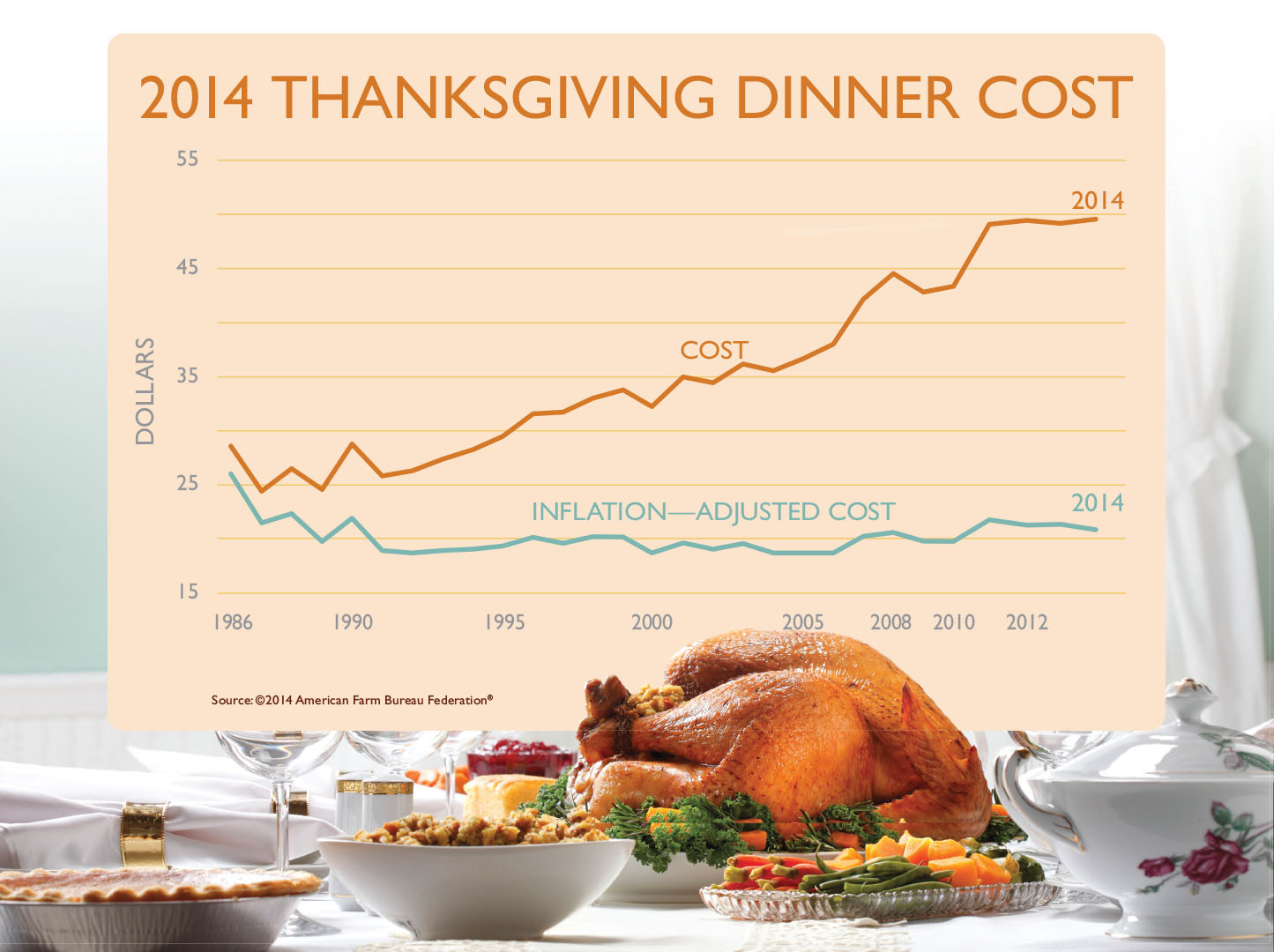
“This is probably one of the best years for turkey in many, many years for the farmer and the processor. The consumer still gets a bargain every Thanksgiving even though prices this year are higher [as] there are less turkeys in the nation. California fresh turkey was sold out from our processors two weeks before Thanksgiving. So, we were urging everyone who wanted California fresh turkey to get their order in early, and they may still be able to do that. The California farmer is offering everything from fresh and natural to organic to free range; you can find just about everything in your supermarket. It will be a very good year for turkey, and it will be a good year for chickens coming up as well. We look forward to 2015 because we think it will be even better than 2014.”

Mattos said that the turkey industry was careful to avoid oversupply, “The turkey industry didn’t grow crazy, and prices stayed at a pretty good level. They didn’t all start growing like farmers do sometimes as they all get into the business when prices are good. Turkey farmers held back and kept their supply even; however,  with very high beef, pork and other meat prices at this time of year, people look at turkey and even chicken as a bargain.”

As we all sit around the table with friends and family this Thanksgiving, we can be thankful for the California turkey producers and processors, as well as the farmers and farm workers who provide so much for the seasonal meals.

2016-05-31T19:32:13-07:00November 24th, 2014|

Silicon Valley Needs Farmers Too – Farm to Food Bank Month Spotlight

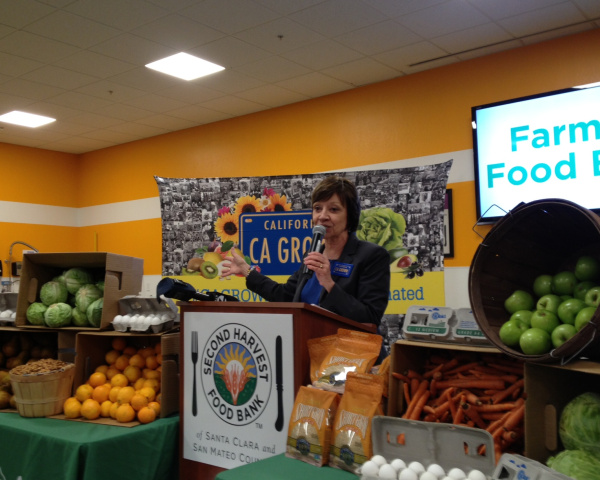
Second Harvest Food Bank of Santa Clara and San Mateo Counties is centered in one of America’s wealthiest regions. But as the cost of living soars, nutritious food has become a luxury for the nearly 250,000 people who depend on us for food every month. A recent article in USA Today highlights this disparity.Second Harvest

More than two-thirds of our clients purchase unhealthy food. They know the food is unhealthy, but it’s what they can afford. We’re on a mission to not only end local hunger, but to provide everyone with access to the nutritious food they need to thrive.  Local farmers are some of our strongest allies.

Thanks to generous growers throughout our region, Second Harvest was able to distribute nearly 30 million pounds of fresh produce last fiscal year, more than any other food bank in the nation. Much of this food was donated from family farms, demonstrating the deep connection that farmers have to local community.

Together, farmers and the food bank community can ensure that anyone who needs a meal—especially a healthy meal—can get one.


Kathy Jackson was named a “Woman of Influence” by the Silicon Valley Business Journal in 2010 and currently serves on the boards of the California Association of Food Banks and Feeding America, the nation’s largest domestic hunger-relief charity. In 2014 she was honored as Network Leader of the Year across the 202 food banks within Feeding America.

2016-05-31T19:32:13-07:00November 24th, 2014|

West Sacramento Urban Farm

By: Monique Bienvenue; Cal Ag Today Social Media Manager/Reporter

West Sacramento has its first urban farm in the Broderick neighborhood of West Sacramento: 5th & C St. Farm. What was once a vacant city lot is now a 2/3 acre farm growing over 50 varieties of vegetables, melons, flowers and herbs. Most of what is grown is almost never sold in stores. These crops are planted specifically for their flavor, picked when the produce is ripe and delivered the day of harvest.

Diversity, companion planting, crop rotation, lunar cycle planting, compost, and working with nature are the central values held by 5th & C St. Farms. All goods are grown naturally using 100% organic compost. The farm never uses any chemical fertilizers, insecticides or sprays. Sustainability, selling locally and providing people with nutrient dense, delicious food is what drives this farm.

Visitors and guests interested in seeing small scale agriculture thriving in the midst of a busy city are welcome to visit the farm. 5th & C St Farms is living proof that small scale farmers can make a difference in the local food system.

2016-05-31T19:32:14-07:00November 20th, 2014|

Farmers, Agriculture Technology Providers Reach Agreement on Big Data Privacy and Security Principles Expected to Accelerate Technology Adoption

By: Monique Bienvenue; Cal Ag Today Social Media Manager/Reporter

A coalition of major farm organizations and agriculture technology providers (ATPs) announced an agreement on data privacy and security principles that will encourage the use and development of a full range of innovative, technology-driven tools and services to boost the productivity, efficiency and profitability of American agriculture.

The coalition supporting the principles includes: American Farm Bureau Federation, American Soybean Association, Beck’s Hybrids, Dow AgroSciences LLC, DuPont Pioneer, John Deere, National Association of Wheat Growers, National Corn Growers Association, National Farmers Union, Raven Industries, The Climate Corporation – a division of Monsanto, and USA Rice Federation.

“The principles released today provide a measure of needed certainty to farmers regarding the protection of their data,” said American Farm Bureau President Bob Stallman. “Farmers using these technology-driven tools will help feed a growing world while also providing quantifiable environmental benefits. These principles are meant to be inclusive and we hope other farm organizations and ATPs join this collaborative effort in protecting farm-level data as well as educating farmers about this revolutionary technology.”

The principles promise to greatly accelerate the move to the next generation of agricultural data technology, which includes in-cab displays, mobile devices and wireless-enabled precision agriculture that has already begun to boost farm productivity across the United States.

Central to the effort surrounding the principles will be grower education initiatives that will include an easy-to-use transparency evaluation tool for farmers. The tool would allow farmers to compare and contrast specific issues within ATP contracts and to see how the contracts align with these agreed-upon principles, and how ATPs manage and use farmers’ data.

“The privacy and security principles that underpin these emerging technologies, whether related to how data is gathered, protected and shared, must be transparent and secure. On this matter, we all agree,” said Stallman. “Farmers are excited about this new technology front, which is why Farm Bureau asked these groups to come together and begin this collaborative dialogue.”

The principles cover a wide range of issues that must be addressed before most farmers will feel assured to share their private business information with data providers. Highlights include:

  • Ownership: The group believes that farmers own information generated on their farming operations. However, farming is complex and dynamic and it is the responsibility of the farmer to agree upon data use and sharing with the other stakeholders with an economic interest such as the tenant, landowner, cooperative, owner of the precision agriculture system hardware, and/or ATP etc. The farmer contracting with the ATP is responsible for ensuring that only the data they own or have permission to use is included in the account with the ATP.
  • Collection, Access and Control: An ATP’s collection, access and use of farm data should be granted only with the affirmative and explicit consent of the farmer.
  • Notice: Farmers must be notified that their data is being collected and about how the farm data will be disclosed and used.
  • Third-party access and use: Farmers and ranchers also need to know who, if anyone, will have access to their data beyond the primary ATP and how they will use it.
  • Transparency and Consistency: ATPs shall notify farmers about the purposes for which they collect and use farm data. They should provide information about how farmers can contact the ATP with any inquiries or complaints, the types of third parties to which they disclose the data, and the choices the ATP offers for limiting its use and disclosure.
  • Choice: ATPs should explain the effects and abilities of a farmer’s decision to opt in, opt out or disable the availability of services and features offered by the ATP.
  • Portability: Within the context of the agreement and retention policy, farmers should be able to retrieve their data for storage or use in other systems, with the exception of the data that has been made anonymous or aggregated and is no longer specifically identifiable.
  • Data Availability: ATPs agree they should provide for the removal, secure destruction and return of original farm data from the ATP, and any third party with whom the ATP has shared the data, upon request by the account holder or after a pre-agreed period of time.
  • Market Speculation: ATPs will not use farm data to illegally speculate in commodity markets.
  • Liability & Security Safeguards: The ATP should clearly define terms of liability. Farm data should be protected with reasonable security safeguards against risks such as loss or unauthorized access, destruction, use, modification or disclosure.

Privacy and Security Principles for Farm Data can be found here: http://bit.ly/1zjQ4Sk.

2016-05-31T19:32:14-07:00November 17th, 2014|
Go to Top