We are being lied to!

Assembly Member Patterson Accuses NRDC and Governor’s Office of Bias

By Laurie Greene, Editor


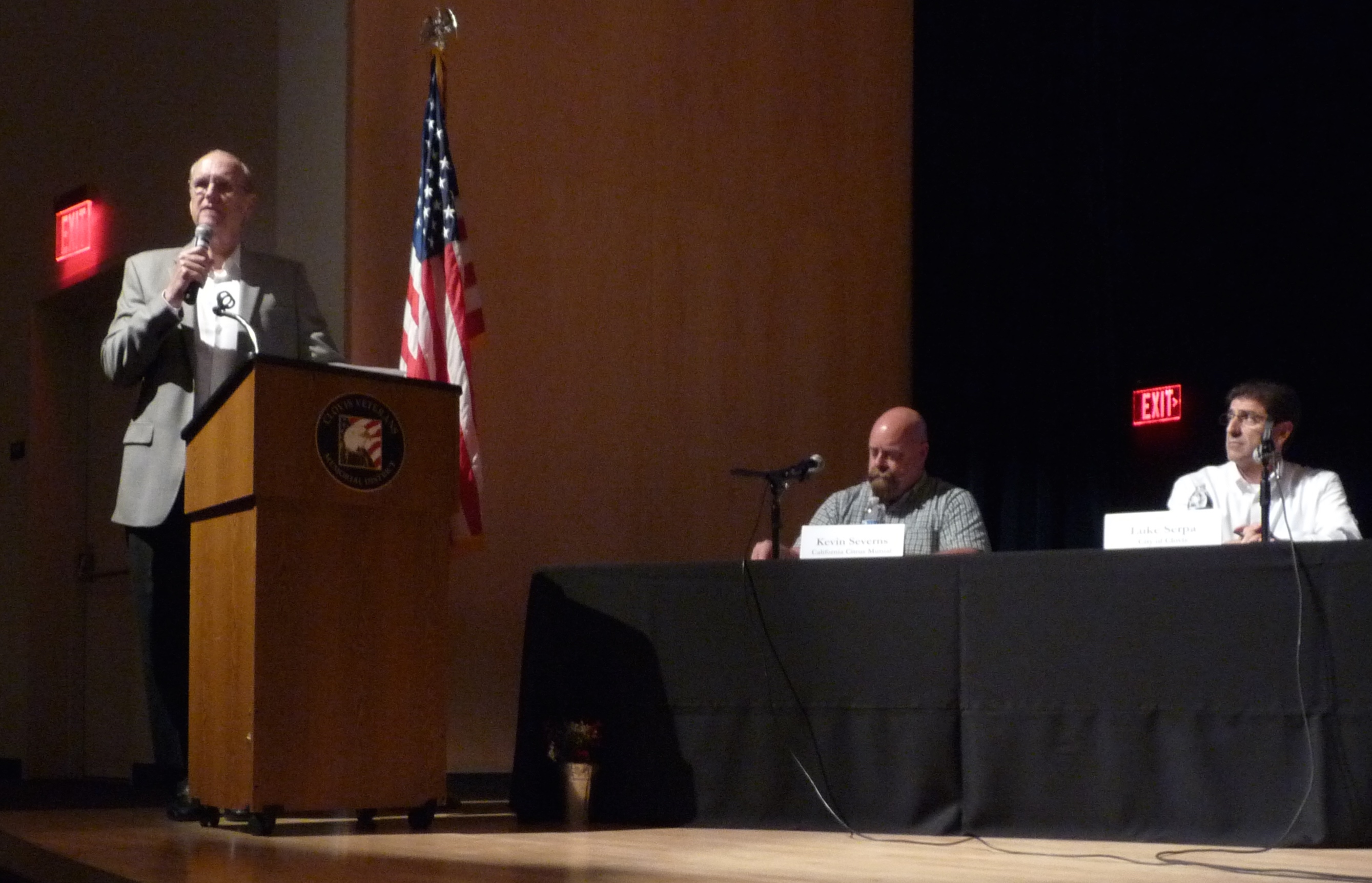
We are being lied to,” declared Jim Patterson, who represents the 23rd Assembly District in the California State Assembly since 2012, at his recent drought forum in Clovis.

“I have come to the conclusion there is a power structure led by the Natural Resources Defense Council (NRDC), the governor’s office and in the bureaucracies,” Patterson explained. “They are not telling us the truth. They do not abide by their own agreements, and they have a bias against the very water technology and the water systems that have made California a ‘Golden State’. They are biased against dams, reservoirs and conveyance, and every time I turn around, I find another example.”

Jim Patterson, California Assembly Member

Jim Patterson, California State Assembly Member

“We need to have regulatory relief from the State of California in order to build Temperance Flat (a proposed dam project on the San Joaquin River) and its conveyance systems and to build the improvements at Shasta Dam and Reservoir and at Sites Reservoir,” said Patterson.

“And yet,” he continued, “I know for a fact that we are not going to get that regulatory relief. Nevertheless, the governor and this legislature have given that very same regulatory relief to the Kings’ Basketball Stadium in Sacramento (Golden 1 Center) and to two big NFL football stadiums in the state.”

To build water saving and conveyance systems, Patterson expects to face a gauntlet of litigation from the NRDC. “Though we have tried over and over again, unsuccessfully, to get the California Environmental Quality Act (CEQA) reformed,” he stated, “the Democrats will do it for basketball and football, but they won’t do it for water. That demonstrates to me they are absolutely disingenuous.”Map_of_proposed_Temperance_Flat_Dam_and_reservoir

“Secondly, we were promised money in this budget for the Central California InterConnect,” Patterson said. “Putting an interconnect between the federal Central Valley Project (CVP), best illustrated by the Kings River and San Joaquin River Watersheds in the Central Valley, and the state’s California State Water Project (SWP), exemplified by the San Luis Reservoir system, is critically important. We need to connect those projects so we have water conveyance alternatives to improve water reliability and to save us from the kinds of hard decisions that we’ve had to reach now—to starve a portion of the Valley. Because we can’t get water between the two systems, the situation is real and dire.”

“The governor promised those of us who negotiated the bond the budget would include appropriations for the InterConnect,” Patterson reported. There is no such thing. It doesn’t exist, and it didn’t show up in this budget. The governor didn’t come through on his promises.”

“I have tried repeatedly to talk with the water bureaucracies—appointees of the governor—and ask how I could help them understand the importance of giving us back the water,” Patterson commented. “For example, the water behind Shasta Dam right now has been paid for and banked by our farmers. I’ve asked repeatedly, ‘Why can’t we get the InterConnect funded? You promised us that you would do that.’ I’ve asked, ‘What is it going to take for you to understand the importance of storage in the San Joaquin River Watershed?’ It’s like talking to a wall; I get no answer.”

“So, I have had to come to the conclusion that we’re being misled, and it’s on purpose,” he said. “I just don’t believe this governor anymore. That’s a sad conclusion to have to come to, but I think we are seeing a ‘behind-the-scenes hand of power’ called the NRDC, that runs the governor’s office and the state legislature.

When asked what concerned citizens can do, Patterson answered, “Today we heard a lot of passion. I think we need to turn that passion into significant efforts, politically and organizationally. We have to make a real nuisance of ourselves to the governor and to the legislature until they pay attention to us. I have learned in public life, as mayor and now in the legislature, that those people who stand up and are persistent and persuasive get heard. We have got to continue to step up in ever-increasing numbers and be heard.”

Sign of drought Westlands Water District Turnout“We also have win some elections,” he emphasized. “We are under a one party-dictatorial rule right now. And I would be saying this even if Republicans were the party in rule. Our founders believed there should be separated powers in government and people in office from all walks of life. These kinds of checks and balances get us to good policy for most people, most of the time.”

“You can’t do that in a dictatorship,” Patterson explained, “and that’s really what we have—one party that has all the levels of power and is using them all against us in Central California. And we’re seeing the result of it.”

Patterson tells other members of the legislature on the committees he serves, “You are literally putting a bait fish that striped bass are eating, ahead of the lives and the wellbeing of people and their property, and you’re blaming us for it. The reality is you’re making a drought that is bad into a drought that is a nightmare.”

“If this were to be compared, for example, to a forest fire,” Patterson conjectured, “and the firefighters were told by the governor, ‘Stop trying to save lives and stop trying to save property; go make sure you save that tree over there because there’s a spotted owl in it,’ people would very quickly tell the governor where to go and what to do.”

2016-05-31T19:28:09-07:00July 21st, 2015|

Location! Location! Location!

UC ANR Research and Extension Centers Strategically Located

By Charmayne Hefly, Assistant Editor, California Ag Today

Bill Frost is the director of the University of California, Division of Agriculture and Natural Resources’ Research and Extension Center System that has nine different research and extension centers located throughout the state.

UC ANR Research and Extension Center System

UC ANR Research and Extension Center System

Describing the strategy in their geographic placement, Frost said, “We have located them in different growing zones, climates and environments. We have chosen everything from the desert region in El Centro, to cropland here in Kearney, to livestock grazing in both our Hopland and Sierra Foothill Research and Extension Centers, all the way up to Intermountain in Tulelake, where we research potatoes, garlic and crops that can be grown in that fairly short growing season.”

The goal, according to Frost, is to solve local issues from a local or regional perspective. “Each one of our centers has different environments, crops and pest issues to address,” he explained. “These diverse locations are critically important to us because we can do localized, applied research and get useful information out to people, whether they are homeowners in their gardens or growers managing a thousand acres of a crop.”

Frost noted the UCANR Research and Extension Center System has been actively seeking new personnel to better meet the needs of growers. “Just in the last four years,” he said, “we’ve hired almost one hundred new cooperative extension advisors and specialists around the state—many of whom are housed here at the Kearney Research and Extension Center. They are also housed on UC campuses and in our county Cooperative Extension offices.”

Frost commented, “We continue to be relevant. We continue to do cutting-edge applied research. Our programs provide information to everyone; from our youth development program in 4-H and our nutrition education, to master gardener programs that help homeowners with pest problems and water management.”

“And of course, we serve the agricultural community. We have a lot of good research going on and we’re generating lot of good information in commodity production, pest management and water management,” Frost said.

The nine UC ANR Research and Extension Stations are:

Featured Photo: UC ANR

2016-05-31T19:28:10-07:00July 20th, 2015|

False Data Abounds

California Drought Information Game:

False Data Out-Markets Ag

By Laurie Greene, Editor and Producer


At “The Truth About the Drought” forum, organized by Assemblymember Jim Patterson recently in Clovis, CA, moderator John Broeske, executive director of Families Protecting The Valley, said he thinks Ag is doing really badly on the information game.

“I think that we are getting out-marketed in messaging in the state of California,” said Broeske. “I think a lot of the people in the Central Valley know things that the people in Southern California and in the Bay Area, don’t know.”

Broeske continued, “I don’t blame those people for not knowing because they’re being told over and over again about the ‘80% number’ for Ag water use; and the ‘2%’ Ag contributes to the economy’. These are not real numbers, but people hear them repeatedly, so it’s not hard to understand they believe it.”

“I think the environmentalists want people to believe the 80% figure,” Broeske stated, “because it’s a lot easier to demand water from us if it appears we are using it all. But we’re not, and it’s hard for us to get the message out that these numbers aren’t true.”

Broeske did not know the best way to get the message out, but said he tries to correct people when they get it wrong. He suggested correcting online articles in the comment section to empower more people with the right numbers as ammunition for when they get into conversations. “You’ve got to fight back; if you let people use these false numbers over and over again, nothing is ever going to change.”

As false data out-markets ag in messaging, Broeske said water usage accountability is unequivalent. “Farmers are getting blasted for raising almonds and using too many gallons per almond,” said Broeske. “But, there’s no article about how many gallons it takes to raise a smelt. How many acre-feet for salmon? How many is too many? I think those questions have to be asked.”

“California is spending four million dollars of water per salmon!” Broeske declared. “Should there be some accountability there? How much water are we going to spend on one salmon? At least we get almonds at the end of the farming process. That’s what accountability means; we’ve got to create some rules about how much water is too much to save one fish.”

“I think the only way the public can demand accountability from the government and the scientists is to win elections,” he conjectured. “We are not winning the marketing war on these water usage numbers, so voters keep electing the same people who tell them the wrong numbers, and there’s nothing we can do if they keep getting elected. It’s a tough battle.”

“We are outnumbered,” Broeske said, “and I don’t know how we can overcome their marketing. They’re not even buying marketing, like billboards or advertising—just newspaper articles and news stories they are quoted in—so their marketing costs them nothing.”

“For us to win the market,” Broeske concluded, “we have to buy billboards and ads, and have enough money to do so.”

2016-09-13T14:11:41-07:00July 16th, 2015|

Permission to farm?

Must We Ask Permission to Farm What Consumers Want?

By Patrick Cavanaugh, Associate Editor, California Ag Today

Richard Waycott, president and CEO of the Almond Board of California, discussed the availability of land to grow the crops that consumers want to eat with California Ag Today.

“It’s interesting,” said Waycott, “because we have our current population, plus the anticipated growth in population–not just in the US–but globally. And to the extent we all foresee a future in which people are eating a sufficient number of calories and enjoying a decent standard of living, we must be supportive and understand that land and natural resources will have to be employed judiciously to do that,” said Waycott.

“All crops can’t be grown everywhere,” Waycott noted. “First, the percentage of total land that is arable is pretty small, so you can’t grow anything anywhere. And many times, water availability affects which crops you can grow.”

“With so many people taking issue with irrigating almonds, should we have to ask permission to farm?” asked Waycott.

“There has to be a better understanding that permission to farm is critical so we can meet the dietary and lifestyle needs of generations to come,” he said.

2016-05-31T19:28:10-07:00July 16th, 2015|

HLB Found in LA

Huanglongbing Detected on LA County Pre-Symptomatic Kumquat Tree


By Patrick Cavanaugh, Farm Director; Laurie Greene, Editor, California Ag Today


#CitrusMatters

#CitrusMatters (provided by Bayer CropScience, in partnership with California Citrus Mutual)

“It’s disappointing, but fortunately it was found in a residential area,” commented Joel Nelsen, president of California Citrus Mutual (CCM), on the second discovery of Huanglongbing  [wong-long-bing] (HLB), or citrus greening, in California. CCM refers to HLB as “a death sentence for California citrus” as once the plant is infected with this bacterial disease, there is no known cure.

Joel Nelsen

Joel Nelsen, president, California Citrus Mutual

“HLB was detected in plant material taken from a kumquat tree in a residential neighborhood in the San Gabriel area of Los Angeles County,” Nelson stated. “The 20-year-old tree was in the front yard of a residence and had not yet shown any symptoms.”

The San Gabriel neighborhood is located about 15 miles from Hacienda Heights, where the first HLB case in the state was detected in 2012 in a residential citrus tree. The  An aggressive trapping program for the Asian citrus psyllid (ACP), a pest known to spread the HLB bacteria as it feeds on citrus trees and other plants, has been ongoing ever since this first finding, including in the San Gabriel area.

“It’s fortunate that the homeowner is quite cooperative,” said Nelsen, “and other neighborhood homeowners are allowing officials to run PCR tests (polymerase chain reaction) on samples of their trees to determine if the disease is present.” PCR analysis is a sensitive research technique for detecting and identifying small numbers of bacteria in plants via DNA amplification.

Nelsen declared, “This find is exactly what the Citrus Pest and Disease Prevention Program is designed to do. PCR testing of a random sampling of leaves and stems in the area, as our program prescribes, enabled us to hit a positive” before symptoms appeared.

“We do not know how long the tree had been diseased,” said Nelsen, “but we do know that we have been trapping ACPs there for a long time and had not found any HLB before. You do not want to

Citrus Pest & Disease Prevention Program

find anything,” Nelsen said, “but when you do, you want to find it before it becomes an epidemic.”

In a statement on Friday, California Department of Food and Agriculture (CDFA) Secretary Karen Ross said, “Citrus is a cherished part of our landscape and our shared history, as well as a major agricultural crop.” CDFA has been planning and preparing for HLB detections since before the first ACP was detected in the state in 2008. Quarantines are now in place in 17 California counties.

Los Angeles County Agricultural Commissioner Kurt Floren will mobilize his team over this week to check on citrus trees in plant nurseries that fall within the 800-meter radius around the infected tree area. A spray protocol is already in place for all citrus trees within the 800-meter radius.

“More traps are going out so we can try to delineate the scope of the problem. Hopefully it will be nothing more than this one tree, like the solitary diseased tree we found in Hacienda Heights,” Nelsen said.

Resources

To support the citrus industry in its fight against HLB, go to California Citrus Mutual Action Center.


For questions about the ACP or HLB, visit or call CDFA’s toll-free pest hotline at 1-800-491-1899.


View the Distribution Map  of ACP, HLB and parasites in California published by the UNIVERSITY OF CALIFORNIA Division of Agriculture and Natural Resources.

USDA's free "Save Our Citrus" iTunes app

USDA’s free “Save Our Citrus” iTunes app


Visit the Citrus Pest & Disease Prevention Program.


Verify plant symptoms at USDA’s SaveOurCitrus website.


For information and ACP solutions, go to #citrusmatters, provided by Bayer CropScience, in partnership with California Citrus Mutual


2016-05-31T19:28:11-07:00July 13th, 2015|

CROPS ACTUALLY BORROW WATER VIA TRANSPIRATION

Almonds and All Other Crops Borrow Water Via Transpiration

By Patrick Cavanaugh, Associate Editor

Editor’s note: We interviewed Allan Fulton, UC Cooperative Extension Irrigation and Water Resources Farm Advisor, Tehama County, on an important, yet overlooked, process of a plant’s water use in agriculture. We zeroed in on a major process all plants have called transpiration in which crops borrow water.

Allan Fulton

Allan Fulton, UC Cooperative Extension Irrigation and Water Resources Advisor,
Tehama County

California Ag Today (CAT): We hear in the media that our crops are using too much water. And while all plants need water to grow food, we also know that a big percentage of the water taken up by all plants actually transpires out of the plant, back into the atmosphere, to form clouds and precipitation, right?

Fulton: Yes, the water just returns to the hydrologic cycle.  Most of the crops we are distributing, whether within the US or globally, are actually very low in water content.

CAT: When we think about transpiration, the plants are actually borrowing the water. Isn’t that true?

Fulton: We get a lot of questions from the general public about why we irrigate our crops so much.

The truth is, plant transpiration is a necessary biological process. The water cools the tree so it stays healthy. The water exits the leaves through special cells called stomata. While they are open, stomata allow water to transpire and carbon dioxide to enter the plant for photosynthesis, making sugars and carbohydrates, which, in turn, are used to make the fruits and the nuts that we eat.

So if we don’t have an adequately watered plant that is allowed to transpire, the plant won’t get enough carbon dioxide. The plant will grow defective fruits, and nuts—smaller, shriveled, cracked, all the things that the typical consumer does not want to buy.

CAT: Now, when we are talking about transpiration, can we say  most of the water taken up by the plant ends up being transpired back to the environment for reuse? So the water transpired by the plant is definitely not being wasted?

Fulton: Definitely. Since we converted to pressurized systems, micro-sprinklers and mini-sprinklers, we have a lot more control over how much water we apply at any one time. We no longer measure water output in depths of acre-feet, or even 4-6 inches at a time anymore. Much like rainfall, we measure it in tenths of an inch, or 1 or 2 inches at most.

As a result, we use less water, so it doesn’t penetrate the soil very deeply, maybe only 1 or 2 feet each irrigation. We are very efficient with the water; but, we have to irrigate very frequently because we apply it in small doses, and we run our irrigation systems a lot. So,   we are definitely using systems that stretch the water supply, not waste it.

CAT: But again, the vast majority of the water that the tree takes up is transpired, right?

Fulton: Yes. Most of the time, at least 90% of the water we apply is taken up through the tree and transpired for photosynthesis to occur.

CAT: Does transpiration increase on a hot day?

Fulton: Yes, plus the plant looses a bit from surface evaporation  from the wet soil, but we try to control that with smaller wetting patterns and drip-confined wetting patterns.

When you think about it, the heat of the day occurs in the afternoon, and many systems don’t run because of energy costs.  There are incentives not to pump in the middle of the afternoon; but for those who do, try to confine the wetted area to limit evaporation. The hot hours of a day comprise about 4 hours of a 24-hour cycle, so a lot of irrigation occurs at night-time or in the early morning hours to lesson evaporative loss.

CAT: Growers are doing everything they can to conserve water. If the trees and vines are all transpiring most of the applied water, what is the problem with using water to grow food?

Fulton: I think the concept throughout the United States has always been to secure our food supply. That security has many benefits—economically and politically. In the end, we are trying to provide the general public with great quality, safe food, at the best price possible.

CAT: And nutritious food. We are growing the food people need more of.

2016-05-31T19:28:11-07:00July 10th, 2015|

Almond Growers Conserve Water

Almond Growers Conserve Water…Period!

By Laurie Greene, Editor, California Ag Today

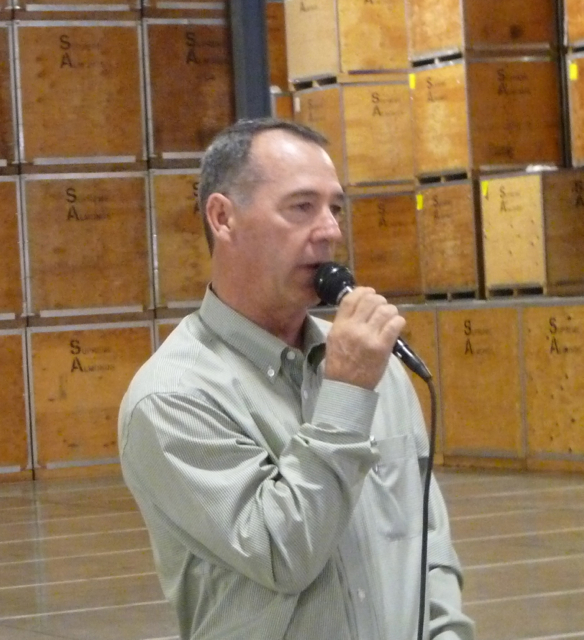
At a recent drought forum, California Ag Today spoke with Mike Mason, an almond grower and partner with Supreme Almonds near Wasco, as well as  chairman of the Almond Board of California. Noting breakthroughs in the almond industry, Mason said, “Facts bear out that we use 33 percent less water today than we did 20 years ago for every pound of almonds grown. There’s no reason  not to expect a similar result over the next 20 years given the ongoing research and funding we do through the Almond Board. We will continue to become more and more efficient, not just with water use, but with fertilizer and everything else we do in farming as well,” said Mason.

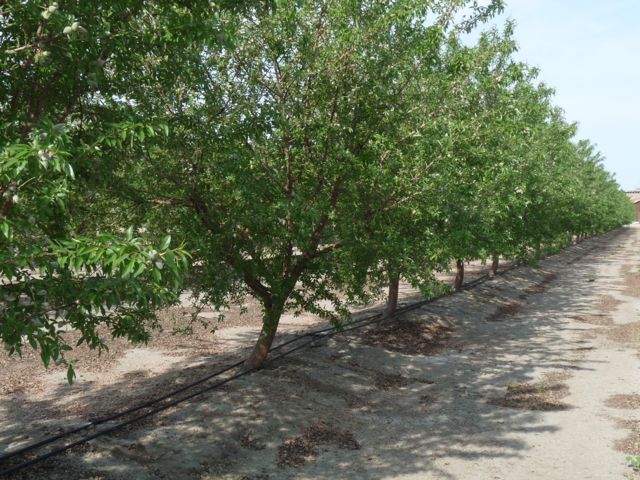
“Keep in mind that almonds, like all flowering plants, transpire 95 percent of the water they take up,” said Mason. “Water moves through the vascular system of the plant and exits the stomata of the leaves. When the stomata open, pure water exits and carbon dioxide enters the leaves. The carbon is used in photosynthesis to make carbohydrates that enable the almond almond tree to produce almonds. It’s all part of the universal water cycle that enables life to exist on the earth!”

Though current public opinion on water use seems to focus on almonds primarily, Mason remains confident that the facts will speak for themselves. It is simply a matter of getting the information out there. Mason elaborated, “We’ve got to go back to education because there are so many ways of comparison, and it is pretty hard to refute some of the things people are saying out there. But I think, over time, as we get the facts out there, public perception will be different.”

Because almonds are proving to be profitable at the moment, other countries are starting to take notice and planting more almond orchards of their own. Currently, California accounts for about 80 percent of the world’s supply of almonds. Mason believes, in spite of increased international competition, California will remain a world leader. “I wouldn’t call it a threat;” he said, “it is more like an opportunity than anything else. I think California will continue to be the world’s supplier, but there are other areas around the world where almonds can be grown, and that’s perfectly fine,” said Mason.

American consumption of almonds has increased roughly 220% since 2005. As a result, almonds have become the most-consumed nut in America, after  surpassing that of peanuts. This explosive increase in demand has been the driving force for almond production expansion.

Now, almonds cover about one million acres in California. On maintaining this level of success, Mason commented, “Markets go up, and markets go down. There are all kinds of different factors that cause these fluctuations, from oversupply to environmental issues. We think we have a bright future with a healthy product. Time will tell,” he said.

2016-05-31T19:28:11-07:00July 7th, 2015|

New Partners Offer MRL Database

Agrian and Bryant Christie Inc. Partner Up for MRL Database


By Patrick Cavanaugh, Assistant Editor, California Ag Today

They’re called “Maximum Residue Levels”(MRLs) and nearly all crop protection products have them; however, keeping track of MRLs for export is difficult. To this end, two companies have joined together to provide an MRL Database, globalmrl.com, to help the Ag industry comply with MRL regulations. Bryant Christie Inc. of Seattle, helps open, maintain and expand international markets by eliminating trade barriers for Ag exports. Agrian, Inc., a Fresno-based service-oriented company, provides subscription-based online information on most crop protection and nutrient products.

Nishan Majarian

Nishan Majarian, chief executive officer and cofounder of Agrian Inc.

Nishan Majarian, ceo and cofounder of Agrian, reported, “Several years ago we had a large ag retail customer who became concerned about MRLs and global export. We developed recomendation writing tools that ensure the safe application of crop protection materials, and MRL’s are an extension of that. We did not have an MRL database, so we called around and found out that Bryant Christie had the premier global MRL database.”

So Majarian reached out to James Christie, president and managing director of Bryant Christie, “And we began the process of partnering for a hybrid system that uses both his data and our data to ensure the safe application of a material, and give insight into the export requirements of that crop.”

James Christie

James Christie, president of Bryant Christie, Inc.

James Christie added, “At Bryant Christie, we work on preventing trade violations, such as chemical and food additive violations, and on ameliorating consequences when they occur. So for us, this collaboration makes so much sense. If we can avoid violations, we can help the ag industry considerably.”

And those consequences can cost ag exporters significant amounts of money, “The consequences range from a single cargo load lost to a violation,” said Christie, “to bad public relations, to having an entire commodity prohibited from entering a foreign country.”

They developed an MRL database, a one-stop resource, Christie explained, “in 1992, with our first client for the hop industry. It is just the best way to keep and manage the information. As database technology advances, it’s made even more sense to have it in that format.”

Majarian said the successful partnership with Bryant Christie is a matter of being at the right place, at the right time. “We think domestic and global compliance are growing in irreversible trends,” Majarian elaborated, “and as more field-level users move to digital record-keeping, these tools and the database will only grow in importance over time. We are excited to be on the cutting edge of online technical solutions. Sometimes I call it the ‘bleeding edge’ because it is a little painful to be innovators.”

Resource Links:

Bryant Christie, Inc.

Agrian, Inc.

Global MRL Database

2016-05-31T19:28:12-07:00July 7th, 2015|

Happy Fourth to All

Our Third President on This Fourth of July

On this Fourth of July, it’s fitting to focus on Thomas Jefferson, the nation’s Agrarian President and signer of the Declaration of Independence 239 years ago.

Yes, our third President was Thomas Jefferson an agronomist, an educated man of the land. So, unique in his time, he believed in proper land stewardship for posterity.

Jefferson understood that humanity affected the environment, so he practiced crop rotation with an extensive seven-year plan, using wheat, turnips, corn, potatoes, peas, rye and clover, buckwheat, and livestock grazing.

He tested to determine the exact number of cattle required to fertilize a given area of land and compared grain yields on manure vs. unfertilized fields.

“Agriculture … is our wisest pursuit, because it will

in the end contribute most to real wealth, good

morals & happiness.”


Jefferson developed scientific plowing of “least resistance,” which lifted and turned the sod to a depth of about six inches, enabling farmers to contour-ridge erodible fields, plow out shallow ditches, and ridge poorly drained flat lands.

He terraced his vegetable garden, orchard, and vineyard sites, and planted native ground cover to stop erosion.

He conserved timber by not cutting trees for any purpose as long as cut wood was available.

As U.S. envoy to France, he sent seeds of various grasses, fruits and vegetables, acorns, olive plants to agricultural societies, farmers, and botanists back home.

He brought Italian rice to South Carolina, pecan trees to the eastern United States and was first to introduce Brussels sprouts, eggplant, cauliflower, and broccoli.

He encouraged agricultural societies, agricultural education and university-level research.

Jefferson kept extensive farm journals for nearly six decades on the 170 varieties of fruits and 330 different kinds of vegetables he cultivated, and on his experiments with viticulture and beer brewing.

Another July 4th notation

Presidents John Adams (who lived to 90 years old) and Thomas Jefferson (who lived to 82) both died on the same day July 4 1826, 50 years to the day of the signing of the signing of the Declaration of Independence.


Quote from © 2015 Thomas Jefferson Foundation

2016-05-31T19:28:12-07:00July 4th, 2015|

Average Almond Crop for Van Groningen

Van Groningen: Almond Crop Looks Average; Misleading Math on Watermelon Water Use

By Patrick Cavanaugh, Assistant Editor, California Ag Today

Van Groningen & Sons, Inc. farming has been operating in California since 1922. Field Manager Bryan Van Groningen updated California Ag Today, “The almond crop looks pretty average, ‘nothing that looks well over norm. It just depends on which field site you enter in; some of the younger blocks look a little better than the older blocks. So, right now the crop looks pretty old, but it is all across the board.”

Bryan Van Groningen

Bryan Van Groningen

Yosemite-Fresh-WatermelonBased in Manteca, Von Groningen & Sons has a diversified operation growing melons, sweet corn, pumpkins, squash, almonds and walnuts, and livestock feed. Noting recent negative press on almond water usage, Bryan said, “Almonds obviously have gotten a lot of bad press lately, as has ag in general. In looking at some of the water usage figures, I tend not to agree with them. I think a lot of the water usage figures are outdated and incorrect.” He explained, “For example, we grow watermelons, and one of the articles that I read reported that 160 gallons of water was needed to produce a single watermelon. On our farm, it is closer to 35-40 gallons.”

As the state continues to deal with water restrictions, Van Groningen says a lot of fingers are unfairly pointing at the agriculture industry. “I think there is a lot of misinformation being spread around and used to throw agriculture under the bus,” he stated, “making us look like we are the bad guys, when we are actually producing the nutritious food that consumers in our state and the nation eat and enjoy. The agricultural industry has made so many advances in water efficiency that we should actually be labelled as ‘water conservationists’, and not ‘water wasters’.”

Van Groningen says he sees firsthand, every day, exactly how much water is used per crop, because he actively manages the farm’s water. “I sat down and ran the numbers 3, 4, 5 times — just to make sure that I did the math correctly. So, some of this usage is being misrepresented and therefore does not shed a good light on what ag is actually doing.”

2016-05-31T19:28:12-07:00July 3rd, 2015|
Go to Top