First the Feds, Now The State Plans More Water Diversions From Farms

More Planned Water Diversions From Farms to Fish-Not Just by Federal, but Also State Officials

By Patrick Cavanaugh, Farm News Director


California’s State Water Resources Control Board (SWRCB), regulators and environmental organizations want more water diversions to flow into the San Francisco Bay Delta Watershed to help save the declining Delta Smelt and Salmon. They have targeted three tributaries of the lower San Joaquin River; one of which is the Tuolumne River. Phase 1 of the Bay-Delta Plan is a real threat to all Modesto Irrigation District (MID) and Turlock Irrigation District (TID) customers including ag, urban water, and electric.

Coalitions for a Sustainable Delta, water diversionsMichael Boccadoro a spokesperson for the Coalition for a Sustainable Delta, commented on the SWRCB: “They need to be pushed back. They need to be told no.” Boccadoro explained the water in question represents about 400,000 acre-feet taken from communities, businesses and farms. Ironically 400,000 acre-feet is roughly equivalent to the capacity of Hetch-Hetchy Reservoir (360,400 acre-feet) that funnels water, unabated, to San Francisco.

“This is only Phase One of the Boards’ decision,” said Boccadoro. “This is going to eventually encompass the Sacramento River; this is just the beginning. This isn’t by any stretch of the imagination the only potential impact agriculture would feel,” he said.

Boccadoro, like other people in the industry, cannot fathom why the SWRCB needs to take this water when it doesn’t seem to be doing anything beneficial for the endangered fish species. “This issue of continuing to take water that is providing no benefit—or no clear benefit—for fish, while we do nothing [to mitigate] the other stressors that are having a huge impact on the fish, has to stop,” Boccadoro said.

Boccadoro noted, “It looks like Governor Brown has it in for farmers. We have problems with groundwater and increasing water scarcity in the state, and the result of this [plan] would be increased groundwater pumping—until they tell us we can’t pump groundwater. At that point, they are basically telling us, ‘You can’t farm any more.'”

“It’s a huge problem, said Boccadoro. “For whatever reason, it appears that the Brown administration has declared war on California agriculture. Enough is enough. We need to push back hard against the Water Board’s decisions,” noted Boccadoro.

“This is as good a place to fight as any as I can think of,” Boccadoro explained. “We need to start the fight and continue the fight, which is the only way it’s ever going to be turned back. The regulators and environmental groups must address the other stressors [to the endangered species]. Taking water from agriculture has not corrected the problem.

In the meantime Boccadoro hopes the farmers are taking notice. “I sure hope they’re willing to come up here [to Sacramento] and demand that the state not take their water,” he said.

2021-05-12T11:05:46-07:00September 28th, 2016|

Food Tank’s Farm Tank Summit in Sacramento Reveals Knowledge Gap

Food Tank’s 1st Annual Farm Tank Summit in Sacramento Reveals Gap in Agricultural Knowledge

Good Starting Point for Constructive Conversation

By Patrick Cavanaugh, Farm News Director


Several hundred food activists attended the First Annual Farm Tank Summit in Sacramento last week, hosted by Food Tank, in partnership with the Visit SacramentoCalifornia Farm-to-Fork Program, and University of California, DavisDanielle Nierenberg, co-founder and president of Food Tank noted having the event in Sacramento enabled West Coast agricultural experts to contribute to the discussion.

“We were really excited to feature California agriculture, because it’s such a huge part of the American economy,” said Nierenberg. “Californians are feeding the world, and we need to really highlight what these amazing producers are doing. When the Farm to Fork program of the Visitors Bureau reached out to us, we were thrilled to partner with such an amazing group of people, as well as UC Davis folks and the Center for Land-Based Learning,” she said.

Food Tank, an abbreviation of Food Think Tank, is a 501(c)3 non profit organization focused on building a global community for safe, healthy, nourished eaters that values education, inspiration and change.

According to their website:

Food Tank is for the 7 billion people who have to eat every day. We will offer solutions and environmentally sustainable ways of alleviating hunger, obesity, and poverty by creating a network of connections and information for all of us to consume and share. Food Tank is for farmers and producers, policy makers and government leaders, researchers and scientists, academics and journalists, and the funding and donor communities to collaborate on providing sustainable solutions for our most pressing environmental and social problems.

The organization begins with the premise, “Our food system is broken. Some people don’t have enough food, while others are eating too much. There’s only one way to fix this problem—and it starts with you and me.”

Food Tank, Farm Tank SummitWith the goal of feeding the hungry world of nine billion people in a few years, “Food Tank highlights hope and success in agriculture. We feature innovative ideas that are already working on the ground, in cities, in kitchens, in fields and in laboratories. These innovations need more attention, more research, and ultimately more funding to be replicated and scaled-up. And that is where we need you. We all need to work together to find solutions that nourish ourselves and protect the planet.”

Nierenberg clarified, “I don’t necessarily think we need to scale up food production; I think we need to scale out different innovations that are working. We’re wasting about 1.3 billion tons of food annually. That’s enough to feed everyone who’s hungry today, so we don’t necessarily need to ramp up production. We need to have better distribution, and processing practices that can help get food to people who need it the most,” she said.

“We need the political will behind those things,” she continued, “to build the infrastructure necessary for farmers to have better processing facilities, to have better storage facilities, to have better roads—if we’re talking about the developing world. I don’t necessarily think that we need to invest in producing more calories; we need better calories. We need more nutrient-dense food, and we need less starchy staple crops,” she noted.


Editor’s Note: Activists overtook the stage during the event, and the conversation was notably challenging for panelists. In an effort to Cultivate Common Ground to link consumers with the farmers who grow their nutritious food—and vice versa—California Ag Today has chosen to share some interesting statements from presenters and attendees to illustrate, perhaps, where the discussion could begin:

Regarding farms and processing facilities, big is bad, and small is good.

Regarding food quality, organic produce is healthy and safe, while conventional produce is unsafe and full of pesticides.

One of many moderators from the Bay Area, Twilight Greenaway, managing editor of Civil Eats mistakenly introduced Oscar Villegas, Yolo County Supervisor, District 1, as being from Sacramento County. When Villegas corrected her, Greenaway said, “I’m showing my Central Valley and Bay Area eliteness.”

Eric Holt-Giménez, executive director of Food First, noted that farmworkers are invisible in California agriculture. “There is racism in the fields. We need more worker unions and we need farmworkers to be paid much more than they are now and the farmworkers should be getting pensions from the farmer.”

Michael Dimock, president, Roots of Change, said to the audience, “You guys are doing a great job. Keep doing it. Keep working with your NGOs. They know policy. In turn, they can work with the legislators.”

“You need to be in the capital, pursuading the legislatures to support their bills. They want to be reelected, and if they don’t do what we ask them to do, they are scared.”

“In the meantime, we have to be nice to farmers because farmers are scared. We are putting a lot of pressure on them; They are in a vice. Our movement has supported bills AB 1066 – the overtime bill, minimum wage increases, organic farming legislation,  and workers’ rights.”

Kerryn Gerety, founder and CEO, Lazoka, referred to John Purcell, vegetables global R&D Lead, Hawaii business lead, vice president and distinguished fellow, Monsanto Company, and said, “There is an elephant in the room, the Monsanto rep. Monsanto has all the technology patents. We all want transparency and we need you to be more transparent.”

Continuing, “Why doesn’t Monsanto open-source some of your patents and release the intellectual property so others can take advantage of your teçhnology?”

Purcell answered, “We are an Ag company. Why would our company invest a million dollars on technology and let everyone have it? It is our investment and we need to have the opportunity for a return on that investment.

During a panel discussion of food companies including Blue Apron, Almond Board of California, and Bayer CropScience, that covered organics, Jennifer Maloney, food chain sustainability manager, Bayer CropScience, said, “We do support  the organic industry, because we have biological products that work in organic as well as conventional [farming].”

Maloney also talked about agricultural Integrated Pest Management (IPM) technology such as smart sprayers that spray only targeted areas.

Matt Wadiak, founder & COO, Blue Apron, responded, “It’s not about smart sprayers; it’s about biological systems in the field and trying to lean on them instead of spraying.”

Maloney replied, “Yes, that is exactly what IPM is.”

Keith Knopf, COO, Raley’s Family of Fine Stores, commented on the organic question, “the way we see organic versus inorganic—that is not the discussion for us. What’s more important to us is, is it the candy bar or the apple?”


This two-day event featured more than 35 speakers from the food and agriculture field, interactive panels moderated by top food journalists, networking, and delicious food, followed by a day of hands-on activities and opportunities for attendees. This was the second in a series of three 2016 Summits, following the Washington, D.C. Food Tank Summit that completely sold out and drew in more than 30,100 livestream viewers. The third Summit will be held in Chicago on November 16, 2016.

2021-05-12T11:05:46-07:00September 27th, 2016|

CULTIVATING COMMON GROUND: Water Use Efficiency Grants

Water Use Efficiency Grants: Beneficial or Double Jeopardy for California Farming? Or both?


By Patrick Cavanaugh, Farm News Director


Through a competitive joint pilot grant program, the Agricultural Water Use Efficiency and State Water Efficiency and Enhancement Program, the California Department of Water Resources (DWR) and the California Department of Food and Agriculture (CDFA) jointly intend to demonstrate the potential multiple benefits of conveyance enhancements combined with on-farm agricultural water use efficiency improvements and greenhouse gas reductions.

The grant funding provided in this joint program is intended to address multiple goals including:

  • Water use efficiency, conservation and reduction
  • Greenhouse Gas Emissions Reduction
  • Groundwater Protection, and
  • Sustainability of agricultural operations and food production
Agricultural Water Use Efficiency & State Water Efficiency and Enhancement Program – DWR/CDFA Joint RFP Public Workshops

Agricultural Water Use Efficiency & State Water Efficiency and Enhancement Program – DWR/CDFA Joint RFP Public Workshops

Are these competitive grants promoted by DWR and CDFA providing financial support for further compliance or insulting to farmers who have already met and exceeded these stockpiling regulations? Or both?

I would like to address each goal, one by one.

Water Use Efficiency

I challenge DWR and CDFA to find one California farmer who is using water inefficiently or without regard to conservation. Grant or no grant, many farmers in the state have lost most of their contracted surface water deliveries due to the Endangered Species Act, which serves to save endangered species, an important goal we all share, but does so at any cost.

In addition, DWR is now threatening to take 40 percent of the surface water from the Tuolumne River and other tributaries of the San Joaquin River from February 1 to June 30, every year, to increase flows to the Delta to help save the declining smelt and salmon. This will severely curtail water deliveries to the Modesto Irrigation District (MID) and Turlock Irrigation District (TID)—population centers as well as critical farm areas.

MID TID Joint LogoThis proposal, which disregards legal landowner water rights and human need, would force MID and TID to dedicate 40 percent of surface water flows during the defined time period every year, with no regulatory sunset, for beneficial fish and wildlife uses and salinity control. The proposal disregards other scientifically acknowledged stressors such as predatory nonnative non-native striped bass and largemouth bass, partially treated sewage from Delta cities, and, according to the Bay Delta Fish & Wildlife Office of the U.S. Fish & Wildlife Service Pacific Southwest Region, invasive organisms, exotic species of zooplankton and a voracious plankton-eating clam in the Delta from foreign ships that historically dumped their ballast in San Francisco waters.

While many farmers have fallowed their farmland, other farmers across the state have resorted to reliance on groundwater to keep their permanent crops (trees and vines) alive. The new DWR proposal to divert 40 percent of MID and TID surface water will force hundreds of growers in this region—the only groundwater basin in the Valley that is not yet critically overdrafted—to use more groundwater. 

In a joint statement, MID and TID said, “Our community has never faced a threat of this proportion. MID and TID have continued to fight for the water resource that was entrusted to us 129 years ago.”

The deadline for submitting public comments is September 30, 2016.

Greenhouse Gas Reduction

Have regulators forgotten Assembly Bill (AB) 32, the Global Warming Solutions Act of 2006, that requires the state to reduce its greenhouse gas emissions by 25 percent (back to 1990 levels) by 2050? Ag is already accommodating this regulation.

U.S. Greenhouse Gas Emissions (Source: EPA) https://www.epa.gov/ghgemissions/sources-greenhouse-gas-emissions

U.S. Greenhouse Gas Emissions (Source: EPA)

Now Governor Brown has signed SB-1383, “Short-lived climate pollutants: methane emissions: dairy and livestock: organic waste: landfills” into law that mandates a 25 percent reduction in methane emissions from cow burps, flatulence and manure from all dairy cows and other cattle to achieve the 1990 statewide greenhouse gas emissions level by 2020.

Now CDFA and DWR are asking for grant requests to reduce greenhouse emissions even further. Really?

The deadline for submitting public comments is September 30, 2016.

Groundwater Protection

Ironically, farmers want to reduce their groundwater needs because groundwater has always functioned in the state as a water savings bank for emergency use during droughts and not as a primary source of irrigation. But massive non-drought related federal and state surface water cutbacks have forced farmers to use more groundwater.

Golden State farmers are doing everything possible not to further elevate nitrates in their groundwater. Some nitrate findings left by farmers from generations ago are difficult to clean up.

But the DWR and CFA grant wants California agriculture to do more!

The deadline for submitting public comments is September 30, 2016.

Sustainability of Agricultural Operations and Food Production

Virtually, no one is more sustainable than a multi-generational farmer. Each year, family farmers improve their land in order to produce robust crops, maintain their livelihoods, enrich the soil for the long term, and fortify the health and safety of their agricultural legacy for future generations.

California farmers will continue to do all they can to improve irrigation methods and track their crop protection product use.

And so, I ask again, is this beneficial or double jeopardy for California farming? Or both?

The deadline for submitting public comments is September 30, 2016.

2021-05-12T11:17:12-07:00September 26th, 2016|

Almond Assessment Increase Comment Period Reopened

Comment Period Reopened for Almond Assessment Increase Through October 12.


Julie Adams, vice president global, technical, and regulatory affairs with the Almond Board of California, commented in an exclusive interview with California Ag Today on the proposed additional one cent almond assessment increase from 3 cents to 4 cents a pound by the Board of Directors to use in marketing the anticipated crop increases over the next three years, starting this season.

The proposed rule change was first published in the Federal Register on July 18, 2016. The comment period was reopened on Sept. 12 with an announcement in the Federal Register. The comment period is open for 30 days, ending Oct. 12, 2016, at midnight, Pacific Standard Time (PST).

California Ag Today (CAT): Where do almond growers go to make comments about the increased almond assessment?

Adams: Growers can go to www. regulations.gov and search for almonds.

Click here for the direct link to the Assessment entitled, Almonds Grown in California: Increased Assessment Rate.

CAT: The first comment period in August was only two weeks. How long will this one last?almond assessment increase

Adams: The new comment period is now open and will be stay open until Oct. 12. We have also sent out notifications to handlers and we’ve included it in our communication to growers. 

CAT: Why did the comment period reopen?

Adams: Basically this discussion has been going on for quite some time, actually, and started with planning and strategic meetings within the production and environmental research committees. Some of this discussion also started back a year ago when we were talking about all of the challenges facing the industry related to environmental issues, water requirements, and sustainability issues. And then, of course, with the anticipated increase in crop size, what was that going to mean in terms of keeping demand growing ahead of supply?

Discussions at strategic planning meetings underway and within our global market development committees, started feeding up to the Board recommendations that we really needed to get ready both for the challenges facing growers as well as building that [market] demand. It was at that time that the Board started talking about an increase in the assessment for a specific period of time.

We recognized that crops were increasing, and to get us through this period, we really needed to accelerate our activities. The increased assessment was approved by the Board several months ago and was published in the Federal Register. It was, at that point, a two-week comment period. While there had been a lot of communication out to the industry, the comment notification had not been sent out in a timely fashion as it needed to be since it was such a short comment period.

Based on that, as you’ll see from the reopened comment period, USDA determined that they would go ahead and reopen the period for 30 additional days. That’s the process we’re in right now.

Almond Board of California CAT: One argument against the assessment is that the almond industry is heading into big record crop, and the 150,000 to 200,000 non-bearing acreage will soon be bearing—and that alone is sure to increase the Almond Board’s marketing budget.

Adams: It does. What we have found throughout our programs is that the more we can start building consumer awareness and demand for the product, it’s going to be ready as those crop sizes increase. We really want to be ahead of that supply situation so that we’re not trying to chase the opportunities in the market. We want to make sure there’s a strong foundation. As crops are more available, customers are ready to take in that product, really ready to put more on the shelf for consumers, and hopefully [meet] increased demand from consumers.

I think the other part of this assessment increase is about what’s happening on the production side. Research takes time and growers are facing more challenges now in terms of water availability, water quality, production issues, and environmental concerns. There’s more pressure on growers now than ever before. Part of this assessment increase for this three-year period is really to accelerate a lot of the research and work that’s underway on irrigation practices and harvesting practices, and to ramp up our food safety education. We’ve got the Food Safety Modernization Act (FSMA) coming on board now—a  requirement starting to put additional burdens on the industry.

With all of that happening, the concern is that we really need to get in front of all of this. The idea is to do that with some additional funding, so while we’re keeping up our ongoing programs, accelerating some of this research over the next three years will put us in a position, when we do come into those larger crops, where we will already have a lot of those programs in place and we will have accelerated the research so we can continue to meet a very demanding market.

California AlmondsCAT: We can see the need to increase our momentum in research and marketing. Of course, the vast majority of the Almond Board’s budget is for marketing right? Will the vast majority of this extra assessment go toward global marketing?

Adams: The global marketing demand portion of the budget is over 70%. That includes more than just market development. It includes a lot of consumer research, attitudes and awareness research It also includes a lot of the investment we’ve made lately on reputation management—how consumers really perceive almonds and how we need to best communicate back to consumers about what our industry is doing.

CAT: Obviously there is not going to be a vote on the added assessment. There is going to be a comment period, and if the USDA approves the assessment, it will go forward.

Adams: It was a unanimous recommendation coming forward from the Board of Directors and from a number of committees that included industry members that made recommendations to the Board of Directors. Obviously the Board is responding to the strategies and recommendations coming through the committee process. That’s what the Board unanimously endorsed and put forward in a recommendation to the Agricultural Marketing Service (AMS), and USDA. Now based on the comments that start to come forward through this period, then USDA will assess all of that and publish a final rule, a final determination, after the comment period closes.

CAT: If the added assessment is for this season, the USDA will have to turn it around very quickly?

Adams: They would. Obviously the USDA is monitoring this comment period and will respond to the comments and the issues expressed by individuals who are commenting on the rule. They will reflect their thinking as they come forward.

CAT: If there is a big mixture of No and Yes comments, is it possible that the comment period will stay open past the 30 days to get a consensus?

Adams: I think the USDA will look at the issues and the context of the comments. If the comments are more about clarifications and they feel what has been proposed will deal with those concerns or areas of focus, then they will look at that and make a determination. I really couldn’t say whether they would go forward with an additional comment period.

CAT: And the additional assessment will automatically sunset in crop year 2018/2019?

 Adams: Exactly, and it would go back to the current 3 cent assessment. Really nothing has to be done for that to happen and that’s why the industry put in that sunset period. The Board does not have to vote on it; there does not have to be any further consultation. It will automatically go back to the 3 cent assessment.


2016-09-22T12:30:01-07:00September 22nd, 2016|

Fresno State Launches New Agricultural Leadership Program

Fresno State’s Avery Culbertson Launches Solid Agricultural Leadership Program


By Lauren Dutra, Associate Editor


Dr. Avery Culbertson, who is passionate about agricultural leadership joined California State University, Fresno (Fresno State) in August, in a newly created position to develop an Ag leadership curriculum for the Jordan College of Agricultural Sciences and Technology.

Dr. Culbertson’s interest in Ag leadership was initially sparked by “being a product of National FFA Organization* (FFA). You have a lot of role models and influences around you. You start getting an idea of what Ag leadership is,” said Culbertson.

“After I got my degree in agricultural education and was looking for a job, I met with a colleague who said, ‘There are adult leadership programs around the country, and I want you to start one at New Mexico State University.’”

Having been trained by the California Agricultural Leadership Program, Culbertson was confident that she could successfully launch a program. “They really opened their arms to me,” she commented, “and provided resources. As that progressed, I started defining what leadership was.”

Culbertson asserted, “An agricultural leadership program is not only [about] understanding our industry, but understanding our customer. That became very important to me in and outside of the job. The only way that agriculture can lead in society is by understanding our stakeholders.”

Culbertson thinks it is critical not only to know how to lead—having the skill set to be a great speaker or to be knowledgeable in different fields,” she explained, “we also need to know who we are leading. As I’ve been discussing with my classes right now, leadership is a matter of taking a group of people and accomplishing a collective goal,” she said.


*National FFA Organization (FFA), formerly known as Future Farmers of America, helps students by developing their potential for premier leadership, personal growth and career success through agricultural education.

2016-09-21T10:50:45-07:00September 21st, 2016|

Senate Tells Gov. Agencies to Back Off WOTUS Rule

U.S. Senate Tells EPA/Army Corps to Back Off Farmers re: WOTUS Clean Water Act


Edited by California Ag Today Staff


A report issued TODAY by a U.S. Senate committee documents how federal agencies overreach their authority to regulate farmland, according to the California Farm Bureau Federation (CFBF), which said the report underlines the need for congressional action to reform the agencies’ practices, particularly regarding the WOTUS Rule.

The report from the Senate Environment and Public Works Committee describes numerous incidents in which the U.S. Army Corps of Engineers and the U.S. Environmental Protection Agency have tried to expand their authority to regulate what crops farmers grow and how they grow them, based on the agencies’ interpretation of the Clean Water Act.

“A disturbing number of the cases described in the Senate report came from California,” CFBF President Paul Wenger said. “Farmers and ranchers here have seen firsthand that the abuses outlined in this report aren’t theoretical—they’re real.”

One case in California is particularly troublesome. The U.S. Army Corps of Engineers (Corps) ordered John Duarte, a farmer and nurseryman to cease farming his land after he plowed 4-7 inches deep to plant a wheat crop in his field. Duarte, in turn, filed a lawsuit to vindicate his right to farm his land. The U.S. Department of Justice fired back with a countersuit.John Duarte WOTUS

Duarte has spent over $1 million in legal fees to date, yet the government is seeking $6-8 million in fines and “wetland credits.” Duarte now faces a costly appeal and legal battle, the outcome of which will set precedence on important issues affecting farmers and ranchers nationwide.

Landowners’ concerns stem from a rule the agencies finalized last year, known as the “Waters of the United States” or WOTUS rule, which would bring more waterways under the jurisdiction of the Clean Water Act. Although a federal court has temporarily halted enforcement of the WOTUS rule, landowners and their representatives say the Corps continues to enforce the act so narrowly that, as a practical matter, its actions mirror the intent of the new rule.

“We’re grateful the Senate committee has highlighted the impact on farmers and ranchers caused by overzealous interpretation of the Clean Water Act,” Wenger said. “Farmers and ranchers want to do the right thing and protect the environment as they farm. But they shouldn’t be tied up in knots by regulators for simply plowing their ground or considering a new crop on their land, and they shouldn’t have their land declared off limits if they must leave it idle due to drought or other conditions beyond their control.”

Wenger called on California Senators Barbara Boxer and Dianne Feinstein to join efforts to clarify Clean Water Act enforcement and reform agency practices. “Congress has the ability to restore balance to Clean Water Act enforcement,” said Wenger. “We urge our California members to help farmers grow food and protect the environment, free from fear of overreaching regulation.”

Details of Senate Statement

epa-logo-wotusU.S. Senator Jim Inhofe (R-Okla.), chairman of the Senate Environment and Public Works (EPW) Committee, released an EPW Majority Committee report titled “From Preventing Pollution of Navigable and Interstate Waters to Regulating Farm Fields, Puddles and Dry Land: A Senate Report on the Expansion of Jurisdiction Claimed by the Army Corps of Engineers and the U.S. Environmental Protection Agency under the Clean Water Act.”

The report releases findings from the majority staff’s investigation into how the Environmental Protection Agency (EPA) and the Army Corps of Engineers are interpreting and implementing their authority under the Clean Water Act.

“This new majority committee report demonstrates in detail that the EPA and the Army Corps of Engineers, under the Obama administration, are running rogue,” Inhofe said. “Case studies in this report show that the Obama administration is already asserting federal control over land and water based on the concepts they are trying to codify in the WOTUS rule, even though the courts have put that rule on hold. Congress shouldn’t wait on the Supreme Court to make the inevitable decision that this agency overreach is illegal.

“This report should be evidence enough that it’s time for Democrats and Republicans to work together rein in EPA and the Corps. Over the course of the past year, 69 Senators – a veto proof majority – have gone on the record about their grave concerns regarding the WOTUS rule. It’s time to come together to protect farmers, ranchers, water utilities, local governments, and contractors by giving them the clarity and certainty they deserve and stopping EPA and the Corps from eroding traditional exemptions.”

The report summarizes case studies that demonstrate the following:

EPA and the Corps have and will continue to advance very broad claims of jurisdiction based on discretionary authority to define their own jurisdiction.

The WOTUS rule would codify the agencies’ broadest theories of jurisdiction, which Justice Kennedy recently called “ominous.”

Landowners will not be able to rely on current statutory exemptions or the new regulatory exemptions because the agencies have narrowed the exemptions in practice and simply regulate under another name.

For example, the report highlights instances where if activity takes place on land that is wet: Plowing to shallow depths is not exempt when the Corps calls the soil between furrows “mini mountain ranges,” “uplands,” and “dry land;”

Disking is regulated even though it is a type of plowing:

Changing from one agricultural commodity constitutes a new use that eliminates the exemption; and puddles, tire ruts, sheet flow, and standing water all can be renamed “disturbed wetlands” and regulated.

On Tuesday, Inhofe delivered a copy of the report with a letter to 11 Senate Democrats who, in a letter on Nov. 3, 2015 to Gina McCarthy, administrator of the Environmental Protection Agency, and Jo-Ellen Darcy, assistant Secretary of the Army (Civil Works) on WOTUS, stated that: “Farmers, ranchers, water utilities, local governments, and contractors deserve clarity and certainty. Should the EPA not provide this clarity or enforce this rule in a way that erodes traditional exemptions, we reserve the right to support efforts in the future to revise the rule.”

In Inhofe’s letter to the 11 Senators, he said the new committee report should meet the test set forth in their Nov. 3 letter, and he called on the members to live up to their commitment and work with the committee on tailored legislation to end agency overreach.

2021-05-12T11:05:47-07:00September 20th, 2016|

National Farm Safety Week in the Golden State

California Agriculture Takes National Farm Safety Week Seriously


 By Patrick Cavanaugh Farm News Director


California is focused on National Farm Safety Week across all commodities and in all areas of the state. Amy Wolfe, president and CEO of AgSafe, based in Modesto, said National Farm Safety Week takes place in September because it is such a critical juncture for folks. “We’re gearing up at the beginning of harvest, or the middle of harvest for some, and it’s the end of harvest for others,” said Wolfe.


“It’s really a great opportunity to make sure you’re either taking a look at what’s going on in your operation and making those necessary mid-harvest adjustments, or evaluating what went well or what could be improved upon.”

lockout tagout agsafe safety


Sadly, Wolfe shared, Farm Safety Week follows a tragedy that occurred during the week of September 12 “when lack of agricultural safety cost somebody their life in the Huron area of Fresno County. We’ve had a fatality in our nut industry, which just continues to be—number one—a tragedy for those of us who work in agriculture. It is also a very significant reminder of the importance of addressing such issues as lockout-tagout, which ensures that equipment is properly shut down before any maintenance,” said Wolfe.


“There needs to be strict communication between everyone around the machine. Everyone should know why it may be shut down and why they should never restart the machine until everyone is cleared,” noted Wolfe. In addition, all equipment must be maintained so that it runs properly in the field. “We also need to make sure that good systems of communication are in place when someone is injured.


AgSafe is recognizing Farm Safety week in many creative ways this week. “This is the week to reflect on how well we are doing everything that we possibly can to protect our farmworkers,” Wolfe said. “If you book for Farm First Aid Training with us by Friday, you’ll receive a 10% discount. We are going to enter folks into a drawing at the end of the week for free attendance to the 2017 AgSafe Conference if you participate in some of the fun Q&As on Facebook and @AgSafeOnline on Twitter,” Wolfe said.


“We will also offer specials every day this week on our tailgate training kits, our pesticide decontamination kits, and on our compliance binders,” said Wolfe. “Its our way of getting folks even more engaged, and giving discounts for our services in honor of a very important week for the industry.”


For more information on these tailgate training kits and other events, go to Agsafe.org.


AgSafe is a statewide non-profit organization dedicated to providing employers and employees in the agricultural industry with education and resources to prevent injuries, illnesses and fatalities.

2021-05-12T11:05:47-07:00September 20th, 2016|

Eighteen New California Farm Academy Graduates!

Eighteen New Farmers Graduate from California Farm Academy


By Patrick Cavanaugh, Farm News Director


The California Farm Academy, a part-time, seven-month, beginning farmer training program run by the Land-Based Learning, graduated 18 new farmers on Sunday, September 18, 2016.


With more than 250 hours of classroom and field training behind them, these enterprising graduates were honored by notables such as Karen Ross, secretary, California Department of Food and Agriculture (CDFA); Craig McNamara, president and owner of Sierra Orchards, as well as president of the California State Board of Food and Agriculture; Sri Sethuratnam, director, California Farm Academy (CFA); and Mary Kimball, executive director, Center for Land-Based Learning, based in Winters California.

new farmers graduate from California Farm Academy beginning farmer training program run by the Land-Based Learning.

Eighteen new farmers graduated from California Farm Academy’s beginning farmer training program run by the Center for Land-Based Learning.


“The impetus of our program,” said Christine McMorrow, director of development for Land-Based Learning, “is the need for more farmers as the current ones age out. According to the USDA, over 700,000 new farmers will be needed in the next 20 years to replace those who retire.


CFA teachers, farmers, academic faculty and staff, and agricultural, natural resource and business professionals, teach CFA students basic production agricultural practices; crop planning; soil science; pest management; organic agriculture; irrigation and water management; marketing; ecology and conservation; obtaining loans, insurance and permits; farm financials; human resource management; risk management; farm safety; regulatory compliance and problem-solving.


McMorrow stated, “These folks have been with us since February, following a rigorous application process. A lot of these folks either have land they have dreamed of farming but did not know how to put it into production. Some of them come from farming families, but they wanted to get involved in the family business on their own. They may have been in a different career and now want to do something new or different. Perhaps they haven’t studied agriculture or they have not seen much agriculture other than what their family does, so this is an opportunity for them to learn and to explore a new business idea.


“We only take people who are serious about production agriculture. This is not a program for somebody who thinks, ‘I’ve got an acre in my backyard and I really want to grow something.’ While that’s a cool thing to do, the academy is not for those people.”


“Our graduating farmers, who range in age from their late 20s to early 50s, each wrote a business plan and presented it to folks within the agriculture industry,” said McMorrow. “They also planted some of their own crops on a farm in Winters.


McMorrow elaborated, “These new farmers have been able to create their own networks, having made contact with more than 40 different folks within the agricultural industry throughout the time they spent with us. These networks include local farmers around Yolo County, Solano County, Sacramento County, and other regions, and will help our graduates realize their dreams.”


California Farm Academy (CFA) We grow farmers

“This is the fifth class that has graduated,” explained McMorrow, “and mind you, these folks are doing lots of different things. Some of them already have their own land, some are going to work for someone who has land, some will work other farmers, and some will go into a food-related business.”


“Still others will stay and lease small plots of land from us,” McMorrow commented, “to start their own farming business. Beginning farmers face huge barriers to getting started, the biggest of which is access to land, capital and infrastructure. So, to get their farming businesses started, California Farm Academy alumni are eligible to lease land at sites in West Sacramento, Davis and Winters at a very low cost.”


The Center for Land-Based Learning exists to cultivate opportunity.

For the land.

For youth.

For the environment.

For business.

For the economy.

For the future of agriculture.
2021-05-12T11:00:49-07:00September 19th, 2016|

Keeping the California Dairy Industry Afloat

The Necessity of Keeping the California Dairy Industry Competitive


By Brian German, Associate Broadcaster


Anthony Raimondo, an attorney with 15 years of experience working with farmers and farm labor contractors, is concerned the California government is placing the state’s agricultural industry at an economic disadvantage compared to other states. Raimondo used the California dairy industry as a prime example in which arbitrary in-state legislation is giving other states an advantage.
dairy cows


“The state government tells the dairy farmer how much they get to charge for milk,” explained Raimondo. “They have now raised minimum wage and overtime, with AB-1066 becoming law, but they do not tie any of that [added cost] to the milk price. Farmers will lose money,” he said.


“The California dairy industry is still fighting to be a part of the USDA’s Federal Milk Marketing Order (FMMO),” Raimondo continued. “But until that happens, the added costs are causing many California dairymen to weigh their options.”


Increasing government regulation is making it difficult for California dairies to compete with other states, Wisconsin in particular. Raimondo elaborated, “For many years, Wisconsin’s milk production was on the decline and California’s milk production was on the rise; that trend has now reversed. Wisconsin is now on the rise again and California is on the decline because our dairies can’t make it with the level of regulation and the level of cost,” he said.


“Some dairies have reduced hours to keep costs low,” said Raimondo. “Other dairies are closing either because they are going out of business or because they are moving to places like Idaho and Texas where the milk price is better and the cost profile is more favorable.”


The move to a FMMO would help even the playing field for California dairies. Raimondo warned there is a lot at stake if nothing is done to lower milk production costs in the number one Ag state. “We are going to lose a segment of agriculture that is 100% family farms. Family farming is one of those things that is precious to our state, and it can’t be brought back once it’s gone,” Raimondo said.

2021-05-12T11:17:12-07:00September 16th, 2016|

Unique Wines Earn Packaging Design Awards

California Wines Win Packaging Design Awards for Innovation

By Laurie Greene, Editor 


Some interesting smaller California wineries won special awards during the third annual Wines & Vines Packaging Conference last month in Yountville, California, but not for the quality of their wine. It was all about what contained the wine—the packaging.


Jim Gordon, editor of Wines & Vines magazine that sponsored the awards, said, “One of the most interesting developments these days is the proliferation of different wine packaging types and designs. We decided to get a handle on that by starting the Wines & Vines Packaging Design Awards a couple of years ago.”


Out of 135 vintner and supplier entries from North American wineries, five wine packaging designs convinced a panel of five experts that they have what it takes to sway consumers to stop in the wine aisle to give the product a closer look. Packages were judged on their creativity, visual appeal, design functionality, appropriateness for the price segment and the package’s ability to stand out in a crowded marketplace.


Each package entered contained wine, was filled between Aug. 1, 2014, and July 31, 2016, and is currently available or was available to the general public between those dates. Submissions included wine boxes, wine bottles, wine bags or cans.

Wines & Vines 2016 Packaging Design Awards Winners (Source: Wines & Vines)

Wines & Vines 2016 Packaging Design Awards Winners (Source: Wines & Vines)

The winners of the 2016 Wines & Vines Packaging Design Awards are:

Supplier Contest

Most Outstanding Package–Supplier 

Stranger & Stranger’s design of Run Riot Pinot Noir

Run Riot, a Treasury Wine Estates brand created by Stranger & Stranger, an international design firm, is a “critter” brand with a purpose and a story about a wild boar that rampages through the vineyard. The wine label includes a fascinating die-cut and graphic.

Most Innovative Package–Supplier 

Quest Industries’ “masked spray” on a bottle of Reed Wine Cellars’ 2011 Lodi Cabernet Sauvignon

The bottle exterior is spray-coated in a unique process on the upper half in dark red.


Winery Contest

People’s Choice Most Innovative Package

One87 Wine & Cocktails’ single-serving plastic wine “glass” and “stem”

Designed by OGW/France, this single-serve container is a PET plastic, BPA-free vessel, 100% recyclable with a smooth glass-like rim and a guaranteed shelf life of 12 or more months.


Most Innovative Package–Winery

Rubin Wines’ Q&A brand packaging

A traditional bottle as well as a box wine was recognized for its large graphics. Each bottle of this new brand, known as “Q & A,” included sets of questions and answers that differed from bottle to bottle.


People’s Choice Most Outstanding Package

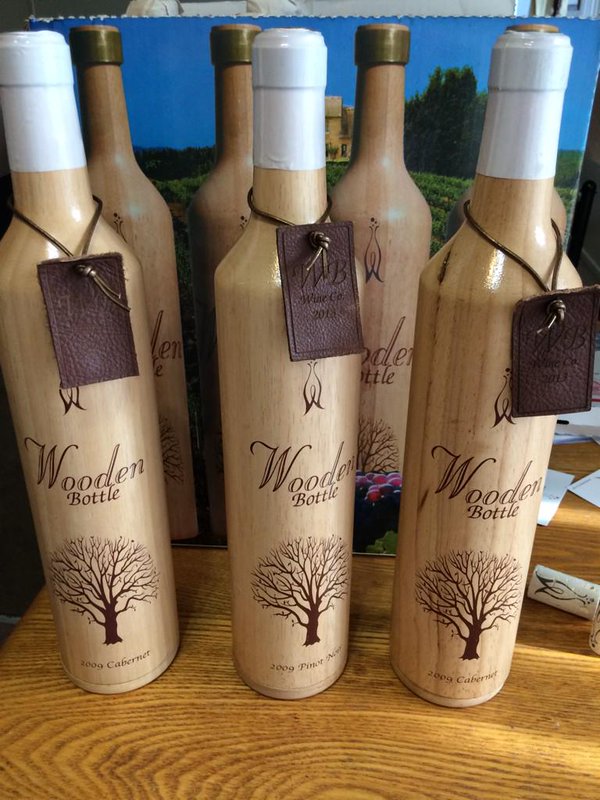
Wooden Bottle Wine Co.’s 2009 Pinot Noir

This wine was actually in a lathe wooden bottle designed and patented by owner Marcos Oliver crafted entirely of wood from the Thai rubber trees, lined with an FDA-approved, non-toxic product that protects the wine from wood and oxygen infusion.


Featured Photo: Wooden Bottle Wine Co.’s 2009 Pinot Noir, courtesy of Wines & Vines magazine.


Resources:

2016 Wines & Vines Packaging Design Awards

5 wine packaging designs win awards in Napa

Wine Packaging Design Awards Expand

Wooden and Plastic Wine Packages Win

2016-09-15T05:57:26-07:00September 15th, 2016|
Go to Top