Sparked Cultural Interest in Gardening and Locally Grown Produce

Locally Grown Food Inspires Consumers to Learn More, Garden at Home 

By Laurie Greene, Editor

Cultural changes in eating habits are sparking an added interest in locally grown produce. Scott Steinmaus, professor in the Biological Sciences Department at California Polytechnic State University, San Luis Obispo (Cal Poly SLO), outlined the surge in local produce purchasing and how it is igniting consumer interest in growing their own gardens.

“The food craze is a real big movement right now,” Steinmaus stated, “especially with urban folks. Some of the biggest scenes are the foodie craze—that farm-to-table idea of buying locally, organically-produced food.”

Scott Steinmaus, professor of Biological Sciences Department at Cal Poly San Luis Obispo.

Scott Steinmaus, professor of Biological Sciences Department at Cal Poly San Luis Obispo.

Continuing, “And the cooking shows are out of control-popular, right? Where does the food come from? It comes from here; this is what it’s all about,” he said, with pride.

The growing trends are also reinvigorating students to become more involved, according to Steinmaus. “Students are asking where their food comes from,” he commented, “and who the farmers are that produce such healthy fruits and vegetables. That is an exciting part of our discipline as well—this foodie craze, and I think our students want to become a part of that,” he reflected.

The push for local produce is also inspring more people to grow their own home gardens. “When they garden, they get it,” Steinmaus explained. “And as soon as people get their hands dirty and as soon as they produce their first tomato; there’s nothing more empowering than producing your own food,” he said, “even if it’s a little bit.”

With this renewed interest in home gardening, Steinmaus observed, many are discovering their preconceived notions of farming were not quite accurate. “We’re working with the American Horticultural Society, putting together the videos that show people farming isn’t what you might think it is; it is actually completely different.” Steinmaus said.

“Farming involves a lot more than a green thumb,” he elaborated. “It requires the understanding of growing cycles and identifying various deficiencies. It utilizes very high technology. It is producing food; there is nothing more empowering than putting food on your kitchen table that you grew in your garden, or was grown by a farmer you know just down the street, and you know his [or her] name,” said Steinmaus.

2016-07-06T17:44:22-07:00July 6th, 2016|

Timorex Gold, Broad-spectrum Biofungicide

Biofungicide Timorex Gold to Help Western Vegetable Growers Fight Disease Pressure

By Patrick Cavanaugh, Farm News Director

The U.S. EPA has approved Timorex Gold, a new broad-spectrum reduced-risk biopesticide that is already a leading biofungicide in Latin America to control black sigatoka, a leaf-spot fungal disease on bananas, for various domestic crops such as tomatoes, strawberries, as well as other berries, cucurbits, grapes, tree nuts, and lettuce.

Stockton photo Strawberries & Blueberries beautiful!Timorex Gold is well positioned for American crops because it is known to be effective on powdery mildew and Botrytis on strawberries and tomatoes, plus bacterial blight on tomatoes.

Sarah Reiter, country manager of STK Stockton, an innovative Israeli company that opened its U.S. headquarters in Davis, CA. “We are very excited about the products performance we are seeing in areas where it is registered,” said Reiter. “We are happy with the label the EPA granted us. We still await registration in California and anticipate it next year or possibly late this season.”

Reiter noted the highly effective active ingredient in Timorex Gold, the plant extract Meluleuca alternifolia, or tea tree oil, gives growers a powerful new tool to control both bacteria and fungi diseases. “We know growers do not have a lot of choices for bacterial control,” said Reiter, “so any new active ingredient is a good thing. This product has the added bonus of being a fungicide too.”

“Timorex Gold has been established as a primary control product for sigatoka because it performs so well,” Reiter commented. “Growers use it because of its profile, and it’s easy to use. And while the product is a biopesticide, once the growers get it in their hands, they tend to forget it’s a biopesticide because it performs as if it is a synthetic material.”

timorexgold STK Stockton Group“As an industry we have been looking for this for quite a long time,” Reiter reflected. “While biologics have been around for a century, historically, growers would have to give up some levels of control in order to implement them into a conventional program. We do not see that loss when using Timorex Gold against sigatoka disease.”

“Our expectation in the U.S. is that growers will see that same high level of performance when they use the product here,” Reiter said. “And since Timorex Gold is a biological, there is no concern for Maximum Residue Level (MRL) data because there is no residue on the crop. The product will have very short re-entry intervals (REIs) and preharvest intervals (PHIs), as well as flexible application intervals, a strength that growers like because it gives them a lot of flexibility to implement the product into their program when they need to instead of having to manage REIs and PHIs.”

In addition, Timorex Gold has a very low designation of FRAC 7¹, which means the product has a unique mode of action that can be used in alternate succession with other fungicide modes of action to prevent the development of resistance.

Concurrently, STK Stockton continues to invest heavily in its new technology pipeline with the intention of bringing more innovative biopesticides into different markets. As part of these efforts, the company has recently announced the appointment of Shay Shaanan as the new vice president R&D, leading the company’s activities. The former global development manager of the fungicides division at ADAMA (formerly Makhteshim Agan), Shaanan has over 15 years of experience in research and commercialization of crop protection products.

“Having Shay join our team marks another significant milestone in our growth strategy. It reflects our commitment to advance our technologies and provide the agriculture industry with new solutions for sustainable agriculture.” explained Guy Elitzur, CEO of STK Stockton. “Shay will lead our R&D and will be of enormous value in moving our company forward. Additionally, we will be looking for in-licensing partners, including bio companies in the U.S. to broaden our product offerings.” said Elitzur.

The products of Stockton will be sold under the Syngenta brand for Botrytis and Powdery Mildew in ornamentals globally. The biofungicide technology complements the comprehensive fungicide portfolio of Syngenta and will help to provide its customers with innovative sustainable tools for disease resistance management.

“We are very excited about this agreement,” Elitzur commented, “as Syngenta is the perfect partner for our new products in ornamentals.”

________________________________

¹FRAC is a Specialist Technical Group of CropLife International (CLI) that provides fungicide resistance management guidelines to prolong the effectiveness of “at risk” fungicides and to limit crop losses should resistance occur.

The main aims of FRAC are to:

  1. Identify existing and potential resistance problems.
  2. Identify existing and potential resistance problems.
  3. Collate information and distribute it to those involved with
    fungicide research, distribution, registration and use.
  4. Provide guidelines and advice on the use of fungicides to reduce the risk of resistance developing, and to manage it should it occur
  5. Recommend procedures for use in fungicide resistance studies.
  6. Stimulate open liaison and collaboration with universities, government agencies, advisors, extension workers, distributors and farmers.
2021-05-12T11:05:54-07:00June 28th, 2016|

Postharvest Short Course Focused on Taste and Quality

UC Davis Postharvest Course Covers Food Loss, Produce Handling

By Lauren Dutra, Associate Editor

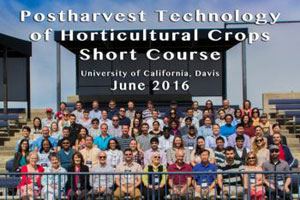
The 38th annual Postharvest Technology of Horticultural Crops Short Course concluded TODAY, June 24 at UC Davis. Presented by Beth Mitcham, director of the Postharvest Technology Center, the course focused on postharvest produce quality and safety.

Beth Mitcham, Director of the Postharvest Technology Center at UC Davis.

Beth Mitcham, Director of the Postharvest Technology Center at UC Davis.

“This class provided a really broad overview of all the topics that are relevant for postharvest handling of produce, including fruits, vegetables, nuts, and also ornamentals,” said Mitcham. “We cover the crops that are grown in California, but because our audience includes a lot of people from around the world who want to learn the basics about postharvest handling, we also cover a few crops that aren’t grown in California for commercial purposes. Furthermore,”she noted, “we also address some of the latest technologies that are available for maintaining excellent quality,”

Maintaining a good cold chain throughout the entire shipping line is critical, according to Mitcham. “We talk a lot about temperature,” she elaborated. “In fact, we tell students the three most important things about postharvest biology and technology are: temperature, temperature and temperature. We discussed many other technologies during the week, but they are secondary to good temperature management,” she noted.

Mitcham also mentioned food waste and how to control it. “So much effort goes into growing the crop, which includes harvesting at the prime of ripeness and getting it in the pre-cooler, on the trucks and to the market. But, people buy it, put it in their refrigerator and then don’t eat it. It goes bad and they waste it. It does happen,” said Mitcham. “Our goal is to try to make the product as hearty as possible while retaining really good flavor so it can last in your refrigerator as long as possible but also so people want to eat it, so hopefully it doesn’t sit in there and degrade.”
UCD Postharvest Technology Center

In reducing postharvest losses, Mitcham commented on the dissonance between addressing postharvest flavor and consumer satisfaction, “In some ways they are two opposite ends of the spectrum; some of the things we do to reduce losses are counter to delivering good flavor to consumers,” she said. “We really need to do both, and that was a big part of our message this week.”

Also at the event, the California Leafy Green Marketing Agreement (LGMA) discussed food safety principles, and Trevor Suslow, a UC Davis Plant Pathologist with the Postharvest Technology Center, discussed good agricultural practices (GAP) for food safety.

2021-05-12T11:05:54-07:00June 24th, 2016|

Supreme Court Ruling on Immigration

Manuel Cunha Jr. Fires Off Letter RE:  Supreme Court Ruling on Immigration 

The following is a letter that Manuel Cunha, president of the Nisei Farmers League sent out about the Supreme Court ruling on immigration TODAY:

“As the president of the Nisei Farmers League, board member of the National Immigration Forum in Washington, D.C., chair of the Insure America Project, and as a farmer myself, I am deeply disappointed in the Supreme Court ruling that was announced TODAY. Their ruling provided no guidance nor direction to this Congress and ignored the safety of those affected by the ruling.

The 4-4 deadlock leaves in place an appeals court ruling blocking President Obama’s immigration plan. His plan would have allowed parents of citizens or of lawful permanent residents to apply for a program that would spare them from deportation and provide them with work permits.

Dignity, integrity and justice is what this country believes in and has made this country great. This country was built and strengthened by immigrants. Many of us today realize it was our parents and ancestors from other countries that brought us here. However, there are those that have forgotten, many of which are currently members of Congress.

This decision does not move us closer to immigration reform, but allows Congress to repeatedly refuse to support bipartisan legislation to update immigration laws. Congress continues to not deal with Immigration, but rather deal with their own party politics.

Millions of families will remain in limbo, and our system remains broken. The attention now turns to Senate and House Republicans to provide leadership on this issue. What is their solution to our broken immigration system? This escalates many of the problems that currently exist. Drug and human trafficking will continue, U.S. Immigration and Customs Enforcement (ICE) raids will not go away. Millions of immigrants living in the shadows is not the answer. Deportation of the people that clothe and feed us is shameful and not the answer.DACA Dreamers logo_2016

We must remember that the “Deferred Action for Childhood Arrivals,” DACA (Dreamers), is untouched. We need to focus on providing alternatives to the children who were brought here and have grown up here as Americans and identify themselves as Americans. The DACA program is still in play and we need to encourage those that are eligible to apply.”

2016-06-24T19:48:29-07:00June 23rd, 2016|

AgTech—The New Frontier for Farming

AgTech: Bringing Agriculture and Technology Together for Success

by Emily McKay Johnson, Associate Editor

Aaron Magenheim, an innovative leader in the AgTech movement, helps startups and investment companies understand production farming in California to bridge the disconnect between farmers and evolving technology. Enabling farmers to be on the cutting edge of technology has been key to the success of his company, Ag Tech Insight (ATI).

Aaron Magenheim, AgTech Insight founder

Aaron Magenheim, AgTech Insight founder

Magenheim grew up in a family agricultural irrigation business on the Central Coast, Signature Irrigation, and has supported growers his whole life. Four years ago he started Signature AgTech, a stand-alone agriculture technology company, which sells, installs and supports various technologies for growers on the Central Coast and in the Salinas Valley.

The turning point occurred when, according to Magenheim, “I started spending a lot more time in Silicon Valley, and about two years ago I saw a huge disconnect among bright people with great ideas, a lot of money coming into the market and the knowledge that many farmers have absolutely no clue there are solutions 50-100 miles away.”

“That’s when I started AgTech Insight,” Magenheim continued. “I had no clue what we were going to do with it. We have evolved through a number of different situations and built a great team. We started doing meet-ups about a year and a half ago, and we have done nine or ten of them now.”

“We’re at the point now where we are getting collaboration from the city of Salinas and other Monterey Bay economic entities coming together to work with us to build meet-ups and more activity in the area.”

Helping Growers Understand

“As we’ve talked with growers and helped them understand what technology can do to them,” Magenheim explained, “we have also raised money for some companies through grower funding to develop technology and installed in the field. Through that process, we have found growers are really interested in working with and helping early-stage companies. But the value proposition has changed; growers used to have a good value proposition to help an early stage company because they would get use for two or three years of a new technology in their operation before someone else did and profit from that.”

“We’re starting the AgTech Grower’s Alliance (ATGA) —a next generation, ag industry-backed ecosystem to advance the development of AgTech businesses,” Magenheim detailed. “From prototype to market expansion, ATGA, a catalyst for the adoption of technology in agriculture, is basically putting a fund together to allow growers to invest in early stage companies before they’ve put a million dollars into their product, and develop their idea from concept to a scalable point that attracts Silicon Valley [investment],” Magenheim said.

ATGA is growing, even outside of California. “We’re stamping out a satellite in the Turlock area,” Magenheim stated, “and I’m heading to Chicago tomorrow to meet with groups of growers to establish another satellite in that area. This can happen in a lot of different regions—bringing the technology together. It’s really a community effort bringing the growers together,” he said.

Field-level actions

Magenheim wants to track equipment and improve collection of in-field data. “I want to be able to go to a field and see when it was disced, when it was listed, when it was watered, when it was planted, when we should harvest, and what that projected harvest is going to be,” he elaborated. “We have a lot of companies working on software and big data and Internet of Things (IOT) and that’s great; but if you can’t get that information from the field, and you don’t have a place to pull the data from, then it doesn’t exist. We really concentrate on a lot of field-level actions.”

“People are coming from schools such as California State University, Monterey Bay (CSUMB) and Hartnell College in Salinas, and from all over the country at this point,” Magenheim said, “whether they are educators or students trying to understand where their opportunities are. Growers come to our events to learn and understand where technology is going and how their operations can benefit. Then you have a lot of technology people. We get people from Silicon Valley and from Western Growers Center for Innovation & Technology coming down to hear what the growers are talking about and looking for.”

_______________

Over the past 45 years, Ag Tech Insight (ATI) team members have been integrating the best ideas and advancements available to the agriculture industry, including designing, building, and implementing new tractor equipment; revolutionizing row crop irrigation by incorporating drip tape in Salinas Valley; and starting drip tape recycling programs and hydrostatic harvesting. AgTech has brought dozens of new software solutions to the market, from multiple GPS asset tracking systems to world-leading data collection and remote management. Recently AgTech diversified and significantly improved current monitoring and control systems for some of the largest names in the agricultural industry.

2021-05-12T11:05:55-07:00June 22nd, 2016|

Downey Mildew Continues to Challenge Leafy Greens

Downey Mildew Continues to Threaten Lettuce and Spinach

By Patrick Cavanaugh, Farm Director

One of the many facets that makes California Agriculture so successful is the hard-working group of farm advisors who assist growers with a multitude of plant and pest issues. Steve Koike, plant pathology farm advisor for UC Division of Agriculture and Natural Resources, Cooperative Extension in Monterey County, noted, “It has been a fairly typical year, and I wouldn’t say any particular new disease has been noteworthy, which is good for the growers.”

Steve Koike, farm advisor of UC ANR Cooperative Extension, Monterey County.

Steve Koike, farm advisor of UC ANR Cooperative Extension, Monterey County.

Koike, whose research focuses primarily on understanding disease systems, identifying new diseases and examining new methods of disease control, said growers “don’t like to see new diseases come out of our work. The main concern, downey mildew, continues to be challenging for both lettuce and spinach growers.”

“We started in the early spring with heavy mildew on both lettuce and spinach crops,” explained Koike, “and it’s remained pretty heavy on lettuce throughout the spring and early summer here. Spinach downey mildew goes up and down, which is not unusual.” he said. “We had some heavy mildew weeks for spinach growers, then we didn’t hear anything, then we heard that it had died down, and then ten days ago there was another surge. It’s one of those things that is hard to predict because it is variable.”

Since starting his farm advising position in 1989, Koike has been involved in educational programs and applied research in vegetable, fruit and ornamental crop diseases. Because downey mildew can overwinter in perennial crops, its continued occurrence is not too surprising.

“Earlier this year, Jim Correll, my cooperator at University of Arkansas, other leaders in the industry and I finally did confirm race 16, a new biotype of downey mildew. A few years ago, it was only race 12; it is moving target,” he noted.

“Although we have confirmed Race 16 on spinach, we are a little concerned because there are reports of disease on some race 16-resistant varieties.” Koike said.

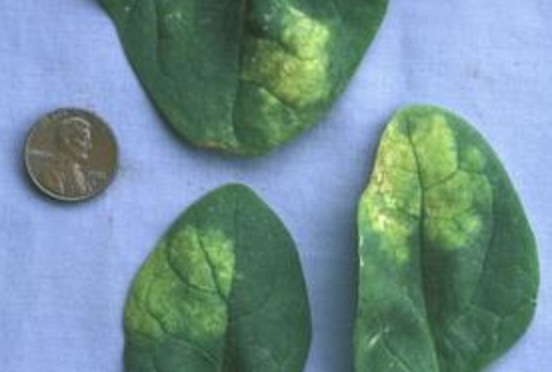
Featured image: Downey Mildew (Source: UCANR Cooperative Extension, Tehama County)

2021-05-12T11:05:55-07:00June 22nd, 2016|

Food Waste Solutions Include the American Farmer (Part 2)

Biotechnology is Part of the Food Waste Solution

by Patrick Cavanaugh, Farm Director

Last week, California Ag Today published an article about the food waste in America discussion held at the 2016 Maximum Residue Level (MRL) Workshop in San Francisco. Jay Vroom, CEO of CropLife America, felt the farmer’s voice was largely absent from the topic of food waste. In the second part of this series, Vroom advocates for the use of bioscience to help eliminate food waste.

According to Vroom, the most vital occurrence of food waste is in production. Consumer food waste is very high, but Vroom believes bioscience is key to keeping the statistics low in all areas of production. “The opportunities for crop protection and biotechnology span a visual that would certainly overcome food waste yield potential with biotechnology,” he said.

In addition, Vroom stated that other genetic enhancements, crop protection tools, seed bed preparation, soil health, moisture management, modern plant nutrient, fertility programs and equipment advances all underscore why farmers need to be included in the food waste discussion. “Most especially,” Vroom said agriculture community can contribute, “the miracles of precision agriculture that are out there in the hands of farmers in almost every corner of the United States today and in almost every farming system.”

At the MRL Workshop, Vroom told the audience, “The farmer’s role and the farmer’s voice in all this is largely absent. We’re looking to help lead—with many of you and others who are willing to participate in a broad coalition—in getting the farmer’s voice in there.”

Jay Vroom, CEO, CropLife America

Jay Vroom, CEO of CropLife America

The farmer’s voice, equipment and biotechnology are imperative because, “modern genetic seed advancements and breeding also generate plant material that is healthier and results in longer storability,” said Vroom. If food were to have longer storability, it wouldn’t be as much of a consumer issue.”

Vroom’s affiliates, who have surveyed the food waste landscape and uncovered results that encourage farmers to speak up, concluded, “The farmer’s voice in the food waste conversation is an opportunity that we see as wide open.”

“I think a place for us to start would be to get the facts together,” Vroom stated, “such as, ‘How much more food would be wasted if the technologies the farmers used to produce those crops today weren’t available and you would have a lot less storability, shelf life, etcetera?’”

“We know that insects, disease, weed control, regulators, fumigants, direct and indirect food waste data is out there,” Vroom said. “We need to gather that up, work together, and assemble it by crop to tell that story about the crops that are directly consumed by consumers.”

Vroom discussed food waste mostly with regard to produce; however, animals and dairy are equally important in the conversation. “Certainly  it gets a little more complicated with protein; but once again, better animal nutrition results in less food waste from meat, milk and eggs. Those are animal agriculture partnerships that we don’t often reach out to, yet another opportunity for us to be able to tell that indirect story as well,” he said.

Vroom contended there are many ways for farmers in every aspect of agriculture to “join forces, connect to the food waste and food safety debate, and to eliminate these critical issues, which certainly time to time is also front of mind for consumers and voters. And we’ve got a great story to tell,” he concluded.

2016-08-03T21:12:23-07:00June 21st, 2016|

Hope Yet For California Dairy Industry

Proposed Federal Marketing Order Would Benefit California Dairy Farmers

By Brian German, Associate Editor

Chandler Goule, senior vice president of programs for the National Farmers Union

Chandler Goule, senior vice president of programs for the National Farmers Union

California gets hit the hardest when milk prices drop and it is the last state to recover from depressed dairy prices. The California dairy industry eagerly awaits a decision from the USDA regarding the move to a Federal Milk Marketing Order (FMMO). Chandler Goule, senior vice president of programs for the National Farmers Union, believes the state will gain from moving to FMMO.

“I think it will definitely be a win for the dairy industry,” said Goule, “and for our dairymen out there.” Goule anticipates increased participation in the margin revenue program that was incorporated into the FMMO.

Should the USDA hand down a positive determination, the move to a federal order would require a 2/3 majority vote from California dairy producers. “With California being so far from the corn and grain belt, even though you all produce a lot of food in California, it’s not necessarily feed additives for livestock,” Goule remarked.

Unfortunately, the FMMO has a much better chance of being voted in during a time when milk prices are low, according to Goule, as high milk prices may lessen voter turnout and sense of urgency.

“I’m definitely not advocating for low milk prices whatsoever,” Goule said. “We want high milk prices out there. The sooner we can get this vote done, the better off California will be, and the better off your milk prices will be. Then we can start working on this as a nation rather than 48 states—and California by itself.”

2021-05-12T11:17:13-07:00June 20th, 2016|

The Fight Against the Asian Citrus Psyllid

California Citrus Mutual on the Fight Against the Asian Citrus Psyllid and HLB

By Laurie Greene, Editor

On Saturday, June 4, 2016, Patrick Cavanaugh, California Ag Today’s farm news director, hosted iHeart Media’s Ag Life Weekend show on “Power Talk 96.7 FM Fresno and 1400 AM Visalia stations, sitting in for broadcaster Rich Rodriguez. Cavanaugh’s invited guests included Alyssa Houtby, director of public affairs, and Chris Stambach, director of industry relations for the Exeter-based California Citrus Mutual, to discuss the status of the state’s citrus industry amidst the ACP and HLB Infestation.Ag Life Weekend

The Asian Citrus Psyllid (ACP), certainly the number one pest for California citrus, can spread a bacterium known as Huanglongbing (HLB) that is fatal to citrus trees. As of 2016, 22 trees in the state have been infected with the fatal disease and had to be destroyed. The entire citrus industry of California has been and continues to be concerned that the ACP could take down the citrus industry, as it has in Florida.

Alyssa Houtby explained that the fight against ACP in California “is going well, we hope. The Florida citrus industry has been completely decimated by HLB; an estimated 90 percent of their acreage is infested with this disease.”

Asian Citrus Psyllid Evidence on New Growth (Source: California Ag Today

Asian Citrus Psyllid Evidence on New Growth (Source: California Ag Today)

“Here in California,” Houtby continued, “we saw it crop up in residential citrus before we saw it in commercial citrus. All of the HLB finds, to date, have been in the Los Angeles Basin.” Houtby said they are working diligently to keep the psyllid population down to decrease the exposure of trees to HLB.

The California citrus industry spends approximately $15 million annually on an ACP assessment program, which includes extensive public outreach. Part of the research entails trapping the pest, conducting survey work in the regions in question, applying treatments in residential areas, and managing a delimitation survey around the area of Los Angeles where the disease has populated.

“That means that we’re scouting very consistently,” explained Houtby, “looking for other trees with the disease and pulling those trees out as soon as we find them. We are doing everything we can here in California to keep the pest and disease from spreading—now that we have it,” she noted.

Alyssa Houtby, director of public affairs, California Citrus Mutual

Alyssa Houtby, director of public affairs, California Citrus Mutual

“The California industry has always been one to use a proactive approach,” Houtby elaborated. “We saw what happened in Florida, and we realized really early on that we couldn’t stand by and wait for this disease to find us. We had to actively go look for it and find it—before it found commercial citrus—and we’ve done that.” Regarding the 22 trees in the state that have been destroyed thus far, Houtby said, “It could be a lot worse if we weren’t as proactive as we are.”

When locating a positive ACP find in a residential area, Houtby noted, generally speaking, homeowners have mostly been compliant. “There are pockets in this state where folks don’t like government coming in, knocking on their door and asking to spray their trees with pesticides. We understand that. It’s an opt-in/opt-out scenario here. We’re not forcing homeowners in most cases to treat their trees.”

Chris Stambach

Chris Stambach, director of industry relations for California Citrus Mutual

“But that’s a different situation if HLB is present,” she emphasized. “Then we do. We get a warrant, and we go in and treat the surrounding trees. If we’re treating in response to an ACP find, homeowners can opt out, but overwhelmingly, they don’t. They support our program. They understand that citrus is a part of the California heritage, they like their citrus trees, and they want to keep them in their yards. They understand that the alternative to not treating is that tree will eventually die if it becomes infected. We’ve worked really hard to communicate to the general public about the seriousness of this issue. We’re pleased with the results.” Houtby said.

Chris Stambach discussed the importance of homeowners having a general understanding of the ACP, so if they find something unusual in their citrus tree, they know to call the local ag commissioner.

Stambach detailed ACP and HLB specifications to increase homeowners’ understanding about their beloved citrus trees. “HLB is symptomatic, but it takes a long time for those symptoms to show up in the tree,” said Stambach. “You really have to know what you’re looking for because some fertilizer deficiency issues in the tree will mimic what HLB looks like.”

“Though the ACP is a really tiny little bug, there are some key signs the public can look for,” explained Stambach. “You want to look for that psyllid and the little tubules it excretes on the new flush of growth—pretty much right there at the end of the terminals where all that new growth comes in the springtime and in the fall. That’s key to California, because there are only certain times of the year when that ACP is actively feeding on the citrus tree.”

California has a real benefit over the Sunshine State, where they have to spray 12 times a year to keep the psyllids at bay. “It hasn’t been effective for [Florida],” noted Stambach. “We had a couple of growers out this last winter to our Citrus Showcase. They planted new trees, 4 years old, and although they spray 12 times a year, their orchards are 100% infected with HLB. That’s the devastation that this insidious disease can bring. It’s really difficult to get your hands around it because it takes so long to be able to detect it.”

Another benefit for California citrus, according to Houtby, is, “We have a lot of areas in the state where we don’t have to spray at all because we can use beneficial insects. That’s just the great part about farming in California.”

Asian Citrus Psyllic Yellow Trap 2 (Source: Citrus Pest & Disease Prevention Program)

Asian Citrus Psyllic Yellow Trap (Source: Citrus Pest & Disease Prevention Program)

Houtby and her team often look to Florida for ideas and recommendations on what has worked for them, what hasn’t and what citrus growers here can do to prevent the disease from taking hold of their citrus. She clarified that 90 percent of the Florida citrus market is used for juice production; whereas, California is a “fresh-oriented industry, meaning that over 90 percent of our product goes into the fresh market.”

Although California citrus looks for recommendations from Florida, “here in California, there are a lot of things that we can’t afford to do because of the [fresh] market that we’re serving,” said Houtby.”  That is what we’re fighting so hard to maintain because we cannot sustain as long as Florida has; we don’t have the luxury of sending a bad-looking piece of fruit into the marketplace like Florida can, because they just juice it. Knowing that, we’re working really hard to never get to the point that Florida has reached.”

As if the dire situation in Florida couldn’t be any worse, they battled with “another deadly bacterial-based citrus disease, citrus canker, brought in from the far reaches of the world,” Stambach said. “That’s a concern we always have with importing citrus. When we import Argentine lemons, for example, we risk our domestic plant health by exposing orchards to a lot of plant diseases they have that we don’t. We want to keep those out of our country,” noted Stambach.

Abandoned citrus trees also pose problems for the industry; they can be sanctuaries for ACP. “If those trees are dead, that’s not a problem. They may look bad, but if they are not living, that’s not a problem. It’s when those trees aren’t cared for, aren’t sprayed in a normal routine, and there is a flush of new growth, the trees provide a sanctuary for the psyllids,” he said.

Abandoned Citrus

Abandoned Citrus

“And ACP are very good at finding citrus. They’ll target the perimeters of new growth on the very first citrus they find. Boom, they’re right on it,” he noted.

“Those abandoned groves create a real problem, particularly when they’re in close proximity to other commercial acreage or even homeowners,” he said. Neglected neighborhood citrus trees can become ACP sanctuaries. “ACPs will feed on them and move on to another tree, and feed there,” Stambach explained. “All that time, if an ACP is infected with the HLB bacteria, it will spread that disease, with a latency period of 2 to 5 years.”

Stambach and his team are working on a critical program in Southern California to remove abandoned citrus trees. “Sometimes it’s just getting a hold of the landowner and making them aware of the situation,” he said. “Our county ag commissioners are really key in contacting those people. We’ve had growers go in and spray their neighbor’s orchard to help them out. There are a lot of different ways to attack that problem.”

Compared to counties in the San Joaquin Valley, Riverside and Ventura Counties typically have a big-ag urban interface, which means there is a lot of acreage intermixed with home sites—small homes with citrus trees. Stambach said, “It’s not really commercial production, but it’s a significant amount of acreage with a number of trees that don’t get treated.”

“We’ve gotten some support from some of our partners in the chemical industry. Bayer CropScience has stepped up and worked with us to put together a program. We’re really happy. We’re working hard to take [ACP and HLB] out.” Stambach said.

“Fresno has even found ACPs in residential areas,” commented Houtby on the Central Valley situation. “ACPs are endemic in Southern California, but we’re still at a point in the Central Valley at which we can control these populations and knock them down really quickly when they arrive here.”CA Citrus Mutual

Houtby points to the Central Valley’s vulnerability when citrus plant material is moved over the grapevine or from the Central Coast. “We ask that homeowners, and the citrus industry as well, not move plant material out of Southern California into the Central Valley,” she stated. “The psyllid lives on that plant material and not on the fruit. If you’re going to buy a citrus tree, buy it at a local plant nursery or a local Home Depot or Lowe’s. Don’t buy it in Southern California and drive it to the Central San Joaquin Valley,” she urged.

“Our biggest task for homeowners is that they cooperate when the California Department of Food and Agriculture knocks on the door and wants to look at their trees,” Stambach said. “That is the best way you can help us win this battle against the ACP.”

Homeowners can learn how to protect their citrus trees at:

CaliforniaCitrusThreat.org

U.S. Department of Agriculture

California Department of Food and Agriculture

University of California Cooperative Extension

Contributors to this report include Patrick Cavanaugh and Emily McKay Johnson.

2021-05-12T11:05:56-07:00June 6th, 2016|

California Depends on National Dairy Month

National Dairy Month Encourages Americans to Eat More Cheese

By Patrick Cavanaugh, Farm News Director

Across the country, National Dairy Month will be celebrated during the month of June to promote the consumption of dairy products. Though California is the number one dairy state, California dairy farmers have been experiencing a decline in dairy production amidst high labor costs, competition from other states and declining profit.

Founded in 1937 as National Milk Month with the goal of increasing milk consumption to stabilize the dairy surplusthe holiday was renamed National Dairy Month to encompass all dairy products.

Anja Raudabaugh, CEO of Western United Dairymen

Anja Raudabaugh, CEO of Western United Dairymen

Anja Raudabaugh, CEO of Western United Dairymen in Modesto, Calif., is hopeful that celebrating National Milk Month will educate more consumers about the health benefits of diary products, increase dairy consumption opportunities, open more markets and enable the lagging dairy industry in California to better compete with other states.

States such as South Dakota and Wisconsin have ramped up their milk production significantly, which has stressed California producers to even the gap. According to Raudabaugh, the term oversupply doesn’t necessarily apply to the dairy conditions in this state. She remarked, “We’re actually in a 17-month decline at the moment, which is the longest decline [in milk production] we have ever been in.”

The dairy industry has managed to be very competitive with wages, another stressor, but the high labor costs are hurting production companies. “As things get more and more competitive globally,” said Raudaubaugh, “we are going to continue to struggle to figure out how those margins play out.”

“The margin is going to continue to shrink, especially as wages get more and more competitive,” Raudaubaugh observed. “Being a worker on a dairy farm is certainly very wage-competitive throughout the agricultural industry. We cannot keep workers at anything less than about $16 or $15 an hour as it is, so it’s a good time to be a worker in the dairy industry. It’s a good craft and skill to have if you become a milker.”Real California Cheese Logo

Given Western United Dairymen’s mission to promote and administer programs and policies aimed at maintaining the longevity of the dairy industry on the West Coast, and as the milk industry struggles and continues to face tough times, Raudabaugh has a solution: “Eat more cheese.”

Enter: National Cheese Day every June 4! According to the California Milk Advisory Board website and California Department of Food and Agriculture (CDFA) 2014 data, California is the #2 cheese producing state—right behind Wisconsin—and the #1 producer of Monterey Jack cheese. An amazing 43% of California’s cow’s milk is used to make California cheese, which is produced by more than 50 California cheesemakers.

Even beyond cheese, Raudabaugh said, “There is a tremendous amount of diversity in the way people have exposure to dairy products they don’t even know about. There are yogurts and sour creams, ice creams, and whey products.”  She believes market sectors should understand more about the dairy products consumers are exposed to every day to increase not only more milk consumption, but higher-value dairy as well.

“The diversification of the product line is really what has kept us in business,” reflects Raudabaugh, “It’s what keeps us looking to the horizon and looking to the future optimistically, even in the face of some pretty bad milk prices right now.”

Remember California dairy producers, particularly, this monthNational Dairy Month, and try a new dairy product. And discover a new cheese tomorrow, June 4, National Cheese Day!

2021-05-12T11:17:13-07:00June 3rd, 2016|
Go to Top