Fresno County Ag Value Down in 2015 Crop Report

Fresno County Ag Commissioner Les Wright on the 6.55 Percent Drop in Ag Value

The Fresno County agriculture value for the 2015 fiscal year was calculated at $6.6 billion. It was down 6.55 percent from 2014, when Fresno County had a record year of $7.0 billion in agriculture value. The report included nearly 400 commodities; 62 of which had a value in excess of $1 million.

The report represents the resiliency and hard work of farmers and farm workers, as well as those allied in the industry.

In the video above, Les Wright, the Fresno County Ag Commissioner, spoke about the implications of the drop.

2016-08-11T06:50:05-07:00August 10th, 2016|

Fresno County Agricultural Value Declines in 2015

Fresno County Agricultural Value Declines in 2015

Drought, Lower Commodity Prices and Production Issues Drive Report Down

The Fresno County Department of Agriculture’s 2015 Crop and Livestock Report was presented to the Fresno County Board of Supervisors TODAY.  Overall, agricultural production in Fresno County totaled $6.61 billion, showing a 6.55 percent decrease from 2014’s $7.04 billion.

“The strength of Fresno County’s agricultural industry is based upon the diversity of crops produced.  This year’s report covers nearly 400 commodities, of which, 62 exceed $1 million in value,” said Fresno County Agricultural Commissioner/Sealer of Weights and Measures Les Wright“The lack of a reliable water supply continues to fallow productive land,” Wright continued.

Les Wright Fresno County Ag Commissioner

Les Wright, Fresno County Ag Commissioner

The annual crop report provides a chance to examine changes and trends in crop acreage and yields.  Amounts in the report reflect the gross income values only (income before expenses) and does not reflect net return to producers.

According to the released figures, an increase was seen in vegetable crops (4.95% = $59,025,000). Decreases occurred in field crops (41.99% = $134,995,000), seed crops (30.80% = $10,437,000), fruit and nut crops (6.6% = $229,551,000), nursery products (25.65% = $16,088,000), livestock and poultry (9.44% = $118,769,000), livestock and poultry products (31.38% = $199,769,000), apiary (2.39% = $1,735,000) and industrial crops (54.38% = $3,992,000). 

“Every day, millions throughout the world are eating food that originated in Fresno County,” said FCFB CEO Ryan Jacobsen. “The magnitude of this industry does not occur by happenstance. Generation upon generation of agricultural infrastructure has been built to feed an unbelievably productive, wholesome and affordable food supply.

Ryan Jacobsen

Ryan Jacobsen, CEO Fresno County Farm Bureau

“I continue to remind all—eaters; elected officials; local residents who benefit from a healthy, vibrant farm economy; and those whose jobs depend upon agriculture—that we must not take what we have for granted,” continued Jacobsen.  “By not addressing our challenges head-on, whether it be water supply reductions, labor issues, governmental red-tape, etc., we are allowing our economy, our food and our people to wilt away. The direction of the Valley’s agricultural industry explicitly determines the direction of the Valley as a whole.”

One popular component of the report is review of the county’s “Top 10 Crops,” which offers a quick glimpse of the diversity of products grown here. In 2015, these crops accounted for three-fourths of the report’s value.  Added to this year’s list were mandarins (9) and oranges (10).  Mandarin demand continues to push acreage upwards.  Dropping out of the Top 10 was pistachios and cotton.  Pistachio production was significantly reduced last year due to the “blanking” issue that left many shells without nuts, and cotton acreage continues to be depressed due to reduced water supplies and fallowed land.

For a copy of the full crop report, contact FCFB at 559-237-0263 or info@fcfb.org. 
Fresno County Crops 2015
Fresno County Farm Bureau is the county’s largest agricultural advocacy and educational organization, representing members on water, labor, air quality, land use, and major agricultural related issues. Fresno County produces more than 400 commercial crops annually, totaling $6.61 billion in gross production value in 2015.  For Fresno County agricultural information, visit www.fcfb.org.
2021-05-12T11:05:49-07:00August 9th, 2016|

Vigilant Seed Bank Reduction for Weed Control

Vigilant Seed Bank Reduction: Whatever it takes, don’t let weeds set seed.

By Patrick Cavanaugh, Farm News Director


For the past 15 years, Robert Norris, professor emeritus and vegetable crops weed specialist, UC Davis Department of Plant Sciences, has continued to attend Weed Day each year at UC Davis and to contribute weed photography for CalPhotos, a UC Berkeley Digital Library Project photo database of world-wide plants, animals, landscapes, and other natural history subjects developed to provide a testbed of digital images for computer science researchers to study digital image retrieval techniques. Norris was involved with initiating the Plant Protection and Pest Management Graduate Program at UC Davis.


“I’ve been a botanist since I was 14 years old,” Norris said, “and I still have a lot of passion regarding weed control.” Norris has a strong and steady philosophy on weed control and it all comes down to seeds. “The last 25 years of my work, I looked at population dynamics of weeds, like seed longevity in the soil and what we call the size of the seed bank also known as the seed production by weeds. That’s really where I spent most of my time.

Field Bindweed

Field Bindweed


“I found that most people have a very poor idea of how many seeds are produced by a weed. This led me to question some of our current management philosophies; namely, the one that comes out of entomology—the use of thresholds (or how many weeds need to be present before treating them),” noted Norris. “I felt that for weed science, thresholds were not the way to go, and my position has been vindicated by the problems we’ve run into using thresholds.”


Norris offered the example, “Barnyard grasses are probably one of our most serious summer grass weeds. A small plant can produce 100,000 seeds; while a big plant, well over a million. I can remember going put in a tomato field years ago and looking at one barnyard grass plant. Because I had been working with it, I can say that plant probably put out 50,000 seeds. If you spread those seeds around an acre, that’s enough to give you serious yield loss the next year,” Norris explained. “Again, that’s one plant, spread out over an acre. Obviously its seeds wouldn’t spread over an acre [on their own], but with our tillage equipment we would move it around quite a bit.”


“My bottom line for about 30 years now is: Don’t let the weeds set seed. Whatever it takes, don’t let them set seed,” Norris said. If you follow that philosophy, Norris said after a while you drive the seed bank down.


“Many people don’t realize this, but some of our really big growers got on to it a long time ago. One farming operation I worked with for years, J. G. Boswell Co., with most of its land in Kings County. “I knew the manager in the late ’50s, into the ’70s. He now is retired now, but he came to this conclusion himself back in the late ’50s,” Norris said. “I haven’t been on Boswell’s property now for 20 years, because I retired. However, if you go down there, you will not see a weed problem, at least not like most growers.”


“The difficulty really is, in order to carry out this philosophy, you need to use hand labor for weed management and it is becoming less and less easy to find,” explained Norris. “Most weed management is done on a one-year one-crop basis; whereas, the type of management we’re talking about where we’re really thinking seed bank dynamics, has to be done over multiple years. Another big problem that I still see is if you miss one year, you can undo 5 to 10 years of what you’ve just been doing, because of this high seed output,” he said.


NEVER LET ‘EM SET SEED, by Robert Norris, Weed Science Society of America.


2021-05-12T11:05:50-07:00August 8th, 2016|

CAWG Gears Up to Fight New Overtime Bill

Following Defeat of Overtime Bill AB 2757, CAWG Gears up to Fight New Overtime Bill AB 1066

By Laurie Greene, Editor


California Assembly Bill 2757, which called to end the 10-hour workday for farm laborers (by enforcing overtime) and to illuminate extra work time opportunities, was voted down in June 2016, but a new version of the bill, AB 1066, is back on the drawing table.


Brad Goehringtreasurer of the California Association of Winegrape Growers (CAWG) Board of Directors and current chair of the CAWG State Government Affairs Committee, spoke about the process of fighting back on this bill. “We already beat it and we had a major victory in the California State Assembly earlier in the year. The author of the bill didn’t like that result, and it is all union-backed and backed by taxpayer groups like California Rural Legal Association, Inc. (CRLA),” Goehring said.


cawg

“But the pressure is back,” said Goehring, also a fourthgeneration winegrape grower and owner of Goehring Vineyards, in Clements, near Lodi. “They did a dirty gut and amend bill¹, which is a slide of hand and basically reintroduces the bill again under a different bill number. This time it’s going to start in the Senate and we’re expecting a tough battle; but we’ve got a very organized coalition of Ag associations and we’re going to put the same energy into fighting this that we did before,” explained Goehring.


“It was a bloody fight in the Assembly,” noted Goehring. “But still, we’re optimistic as there are plenty of no votes from the party that wanted this to go through that we think it will be hard for the governor to sign even if [the bill] makes that far.


Goehring maintained, “The key is to educate legislators that the bill would hurt farmworkers because it would force farmers to minimize work hours to prevent overtime payroll. In fact, farmworkers are pushing for this second bill to fail.”


“Where the lack of understanding lies is the clear line between the urban legislators and the rural legislators,” Goehring commented. “The urban legislators, ironically, are the ones who already hav $15 minimum wage laws in their towns—San Diego, San Jose, Los Angeles, and San Francisco. These legislators are trying to cram it down our throats and our lives here in the rural areas. We’re not having any real hard times getting to agreement with either party, if they are in the rural areas. It’s the urban ones that are doing all the damage.”


“We’ve had these legislators out to our farms. We’ve walked away and let them talk openly with our employees, and our employees have told them they don’t want it,” Goehring said. “Our employees have told them that they want to make an honest living. They want to teach their kids how to do the same thing. Our employees have taken it one step further; we overheard them telling the legislators they are not even in favor of any of the entitlement programs because that’s not the way to make an honest living that they want for their kids.”


“With all that said,” Goehring concluded, “the urban legislators are turning their backs on and ignoring our employees. This is all about unions and CRLA. They don’t care about the employees—is basically what they’re saying,” noted Goehring.


¹GUT AND AMEND is when amendments to a bill remove the current contents in their entirety and replace them with different provisions. (Source:  California State Legislature Glossary of Legislative Terms).

2021-05-12T11:05:50-07:00August 5th, 2016|

Mechanical Weeding Would Help Veg Industry

Mechanical Weeding Saves Labor

By Patrick Cavanaugh, Farm News Director

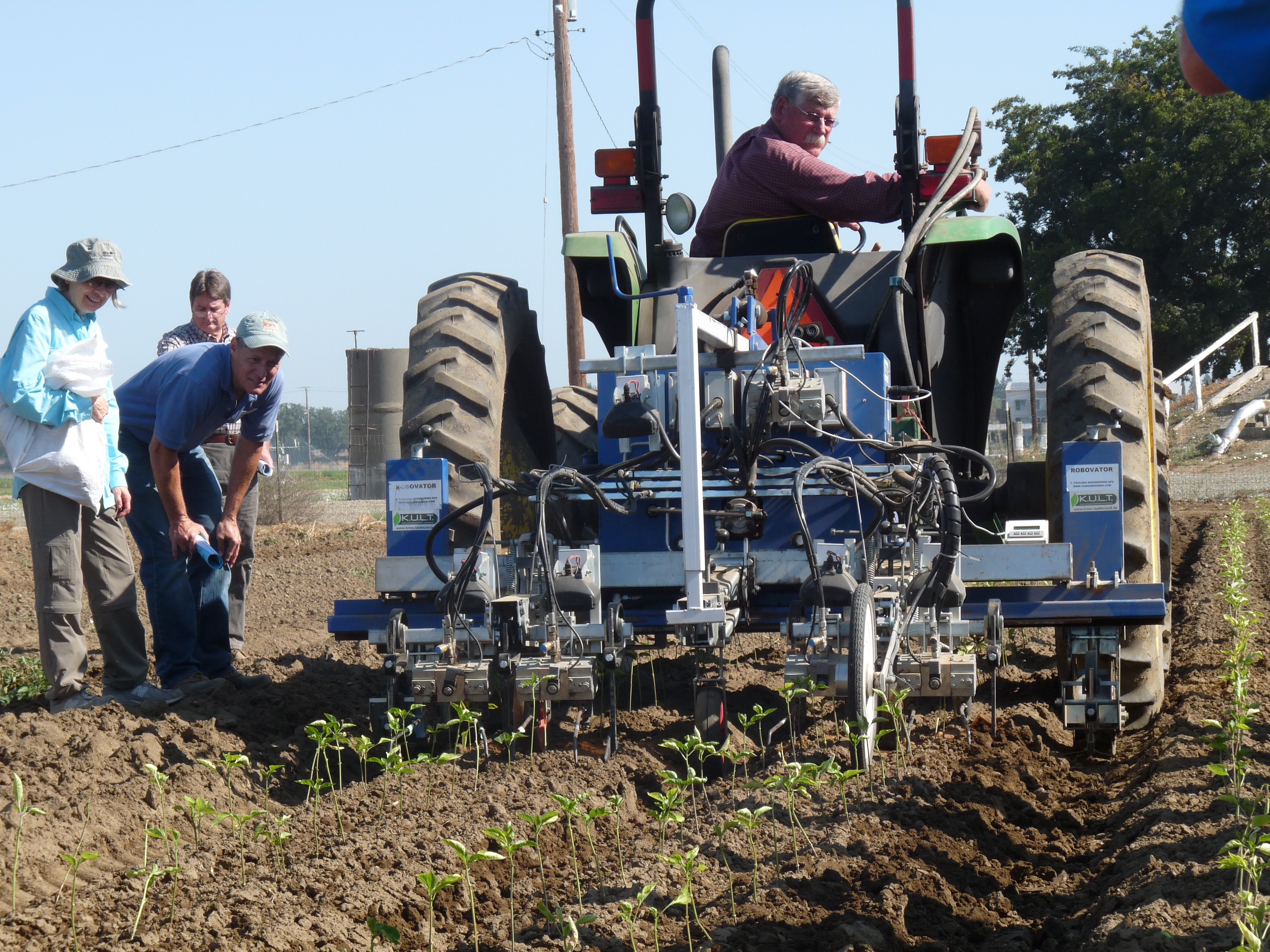
A machine that mechanically removes weeds from the rows of lettuce and other crops and thereby saves costly labor bills, is now commercially available. “The Robovator, made by F. Poulsen Engineering ApS in Denmark, works amazingly well,” said Steve Fennimore, weed specialist, UC Agricultural and Natural Resources Cooperative Extension, SalinasFennimore said companies in Scandinavia have had more incentive to develop labor-saving machines after having faced many major labor shortages, as well as significant restrictions on pesticide use throughout the European Union, including the use of herbicides.

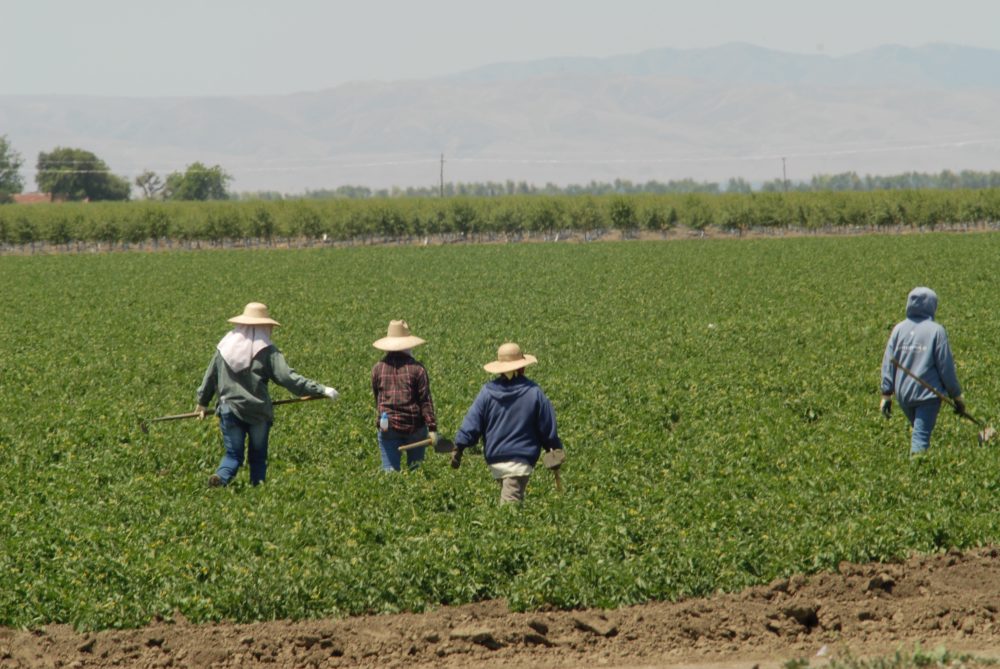
Meanwhile, significant domestic demand for organic tomatoes and tomato sauce makes hand-weeding especially necessary. California fields of tomatoes and lettuce, among other crops, often have lines of workers using hoes to briskly cut away the weeds or thin the crop. “Including thinning, there are three passes of labor in organic lettuce,” said Fennimore.

Steve Fennimore UC Davis Dept. Veg Crops and Weed Science, Salinas 1-1-1

Steve Fennimore researches alternative methods of weed control.

“The Robovator is an intelligent machine with cameras and a computer processor onboard to direct reciprocating knives to open and close,” Fennimore began. “It can follow the pattern in the plant line and the knife mechanism moves sideways (in and out) as it goes down the row. The knives delve generally ¾ inch into the ground, open as they pass a tomato or lettuce plant and close in between to dig up the weed.”

“It worked really well in the lettuce plants,” Fennimore commented, “where you have that 18-inch spacing, double planted on a bed. Everything was going so well in the double-row bed, we told the tractor driver to kick it up a notch and see what we could do—of course, with the grower right there,” Fennimore said. “So he stepped on it and got up to five mph. It was so fast that we could not see the knives move,” he said.

“I don’t think it is totally perfected, but it is commercially good,” said Fennimore. “Of course everything can be improved, but unlike an herbicide— which is a molecule that you cannot alterthis is a machine that can be modified. You can make the knives longer or bend a shoe a little to get better performance, which is nice,” he added.

“If you get the weeds when they are small, such as nightshade, pigweed, or purslane, the machine just pops them right out of the ground, flipping them upside down so their roots are up. In Europe, especially on organic lettuce where they cannot use herbicides, producers typically send in a crew with hoes as often as once per week, and it’s an expensive labor force. Instead, growers are letting the crop grow, coming through with the machine every 7 to 10 days to kill emerging weed flushes and doing a great job,” said Fennimore.

lettuce“So far, we have used the machine on tomatoes, broccoli, lettuce and celery here,” he listed, “and we are starting to look at peppers. And I know that the Europeans have used it in cabbage, onions, and radishes. The machine has done a good job without injuring the plants. With transplanted tomatoes, the plants are much bigger than the cotyledon stage of a weed [before it reaches one inch in height]. So the knives stay open around tomato plants but then close over the weeds, which basically uproots them.”

“You always have to be aware of the safety zone,” Fennimore cautioned. “If the crop is getting bigger and has roots near the surface, the knives need to stay back and you will not get all the weeds. The problem weeds in a halo right around the plant stem are the most difficult and most expensive to get. If you force the knifes in and try to get really close, you will probably not be able to go five mph. You will have to go slower to allow the machine to kick out the weeds near the stem.”

Fennimore mentioned two Poulsen ApS machines are presently in use in California and another mechanical weeding machine made by Steketee IC (intelligent cultivator) from The Netherlands is being tested in the Salinas Valley,” Fennimore noted. Teams are attempting to determine how the machine could be improved for use here, and the machines are becoming available for growers to test.

The biggest crowd that has observed the Poulsen Robovator was at the UC Davis Weed Day in 2015. “We have also been going to individual farms, showing it to farmers and explaining what it does,” said Fennimore. “We brought the machine to a Ventura lettuce farm about a month ago, and a few weeks ago we had it in tomatoes,” he noted.Celery

With tomatoes, we are looking at less than 10,000 plants per acre,” Fennimore said, “so we can go about 5 mph in the tomatoes because the knives do not have to open and close as fast. However, with lettuce, we are looking at maybe 60,000 plants per acre, so you would have to go more slowly, around 1-2 mph in lettuce.”

Even on conventional vegetable farms, hand-hoeing is often done due to the lack of adequate herbicides. “We do not have a good spectrum of coverage,” said Fennimore, “and there are unsolved weed problems that are going to be hard to untangle.”

The development cost of the original machine prototype, the most expensive phase, was $11 to 15 million, as compared to the $250 to 300 million necessary to get an herbicide to label. And since 2010, only four new active herbicide ingredients have been developed worldwide. For lettuce applications, the last new herbicide was introduced about 40 years ago.

Yet another machine in development that Fennimore recently read about is essentially a weed-punch machine with electronics by Deepfield Robotics, a Bosch start-up company in Germany. “These guys drive through the fields, the machine finds the weeds and instantly punches them dead-center into the ground,” he elaborated.

Fennimore considered using such machinery on fields of garlic, onions or spinach that are densely planted, where back and forth knives would not work well. He theorized that machinery that can distinguished the weeds from the crop might work simply by punching the weed down into the soil where it’s not going to thrive. But perfecting this prototype is going very slowly, as it must accommodate a variation of cameras, weeds and crops. Yet, Fennimore expressed optimism, “I see a lot of potential with this type of technology because it can be modified.”

2021-05-12T11:02:59-07:00August 4th, 2016|

Breaking News: The 5 Percenters May Not Receive All of Their Water Allocation

5 Percenters and Endangered Fish May Both Lose 

By Patrick Cavanaugh, Farm News Director


Will the 5 Percenters—the Federal water users in California who were restricted by a 95% water allocation reduction this year—actually receive the promised 5% allocation? This scenario follows a more-than-average winter rainfall and snowfall throughout the state.

Ryan Jacobsenexecutive director and CEO of the Fresno County Farm Bureau, said, “arguably it’s turned out to be much worse. Right now, for the initial 5% allocation to even be questionable right now is just absolutely insane. It all boils down to the amount of water being held up in Lake Shasta for fish purposes, which has put a major stranglehold on what’s happening down here at this point,” noted Jacobsen.

Central Valley Project (CVP) Water

Central Valley Project (CVP) Water

At Shasta Reservoir, a keystone reservoir of the Central Valley Project, the U.S. Bureau of Reclamation essentially discharged flood releases earlier this year just to make room for the water that was expected to come in.  Shasta now stands at a above average full for this time of year, because the Feds are holding all the water for release for salmon later.

This is part of the plan to have cold water available to release for the salmon. And Shasta actually has 30 percent more cold water than what they thought, and water leaders are pushing hard to get the Feds to release it for agriculture.

San Luis Reservoir dead pool

San Luis Reservoir at Dead Pool Status

And San Luis Reservoir is  at a dead-pool status, which insures no more water can be sent south from that reservoirDead pool means no more water can be drawn from San Luis Reservoir, which does not bode well.

Jacobsen said, “This means our federal contractors’ 5% is in question. And that’s the irony: we were looking at such a strong year—or at least an average year [of precipitation]—and ending up now where our meager water supply is in jeopardy. This is incomprehensible and inexcusable from the federal side.”

Shasta has both federal and state water, and the federal side is essentially nothing at this point, explained Jacobsen. “Farmers rely upon San Luis Reservoir water for July and August irrigation, “and the water is essentially gone at this point,” he said. “It just shows you the major mismanagement we’re seeing from the federal side and the inability to capture water even when it is available, and not at the demise of any of these species.”

Jacobsen reiterated, “Back when the precipitation was falling [last winter], water was available at some extraordinarily high levels; yet, we never saw the increase in pumping that we would have expected under the normal conditions. “Of course, we’ve seen less pumping this year for the farmers and the cities south of the Delta,” noted Jacobsen. “During the times of the rainfall this year, it was essentially excuse, after excuse, after excuse. Some newer excuses pertained to why the pumps were not operating or operating at a very reduced capacity,” explained Jacobsen.

“The situation has been frustrating for a couple of years, but the anger continues to build because right now, this is not a ‘Mother Nature’ issue. It is completely a man-made regulatory drought that is, again, just incompetency at its best.”

“When we talk about the water stored behind Shasta [Dam] right now, really it is for the fish,” noted Jacobsen. “The most-watched fishery, at this point, is the salmon fishery. We’re in year four of this drought, but when it comes to the critical side of fish, the salmon essentially operates in three-year cycles. The last two years have been arguably two of the worst years on record for them, and this potential third year is a kind of make-it-or-break-it for salmon fisheries in the Delta region.”

Unfortunately, per Jacobsen, many decisions have been based on guesstimates. “There are a lot of folks who think we need to reserve all of this cold water for a fishery that may or may not be responding to what has been done in the past for this [contracted irrigation] water that has been given up for those purposes,” Jacobsen explained. “Right now, I think we’re doing a lot of experiments at the cost of jobs and employment, and most importantly, the farms here in the San Joaquin Valley. The frustration is that science is really not playing a big part in it. A lot of decisions are just simply, ‘We think we should be doing this versus what the science actually says we should be doing.’”

Jacobsen’s leading frustration is that all that water taken from farmers and given to fish has not helped the fish at all. In fact, the smelt and salmon numbers continue to decline. “I talk about growing frustration and anger from so many folks in the last couple of years… specifically because it hasn’t made a difference,” said Jacobsen. “An exorbitant amount of water has been given up for these fisheries, [endangered fish populations] continue to decline and crash, and as we’ve been saying for years, it is beyond time to look at just the water exporters,” he added.

Jacobsen maintains other stressors should be seriously investigated. “Many other issues taken place in the Delta should be pulled into play here, but again the regulators and the environmentalists continue to look only at the exporters as the sole issue for fish decline. There are so many other factors out there that need to be looked at,” he said.


Highly recommenced reading: “We are the 5 percenters, stretching our water supplies to get by,” by Joe Del BosqueContributing writer, The Orange County Register, July 14, 2016.

2021-05-12T11:05:50-07:00August 3rd, 2016|

WGA Conflicted on SCOTUS DACA Decision

Western Growers Association has Mixed Feelings on Recent Supreme Court DACA Decision

By Patrick Cavanaugh, Farm News Director

The 4-4 ruling on immigration reform last month by the Supreme Court of the United State’s (SCOTUS) affirmed the lower court’s injunction against President Obama’s executive order, which would have granted deportation deferrals and temporary legal work status to about five million undocumented immigrants. Tom Nassif, president and CEO of Western Growers Association (WGA), has been vocal about the need to establish some type of immigration reform.

Nassif compared the recent SCOTUS ruling to what happened when a 2013 U.S. Senate-endorsed bill that supported a pathway to citizenship was never passed in the U.S. House of Representatives. “The House did not want a pathway to citizenship,” said Nassif. “They were not even sure if they wanted a pathway to legalization. Most Republicans did not even want a border security bill in the House coming to the floor for a vote because they didn’t want any immigration reform—whatsoever.”

Western Growers logoNassif said, “The House was part of that Send-them-home! crowd that considered anything you did—even if it was putting them on probation—as amnesty. It is interesting that with the House doing nothing about immigration, what we have today is amnesty, because we’re not doing anything about it.”

Nassif expressed mixed feelings about the SCOTUS decision. “In a way, it disappointed us; in a way, it didn’t. It didn’t disappoint us because there was no requirement that people working in agriculture who might qualify for this Deferred Action For Childhood Arrivals (DACA) or Deferred Action for Parents of Americans (DAPA) would actually remain working in agriculture.”

To get a pathway under the Senate bill, farmworkers would have to stay in agriculture for a certain number of years, but they could eventually work in other industries. So if you have a choice of working in any industry, why would you go to work on the farm? But, in this instance, you would adversely affect other American jobs,” said Nassif.

Nassif said the motivation of the Obama administration is understandable due to the inability of Congress to compromise on immigration reform, yet Nassif maintains the Immigration Reform should not be done with Executive Orders as the President has done. Instead, Nassif stressed that Congress should take up Immigration Reform and pass it.

2016-08-04T15:40:15-07:00August 1st, 2016|

Celebrate National Ice Cream Month!

Celebrate National Ice Cream Month with California Ice Cream and Flavors!

By Lauren Dutra, NAFB Summer Intern and Assistant Editor

Jennifer Giambroni, director of communications, California Milk Advisory Board

Jennifer Giambroni, director of communications, California Milk Advisory Board

First established in 1984 by Ronald Reagan, the 40th President of the United States, National Ice Cream Month was scheduled for the month of July, with the third Sunday of the month designated as National Ice Cream Day.

Jennifer Giambroni, director of communications, California Milk Advisory Board, explained why Californians, in particular, have so much to celebrate during National Ice Cream Month. “As the number one ice cream state,” she said, “we produce 126 million gallons of ice cream a year.”

Thats a lot of scoops!

California also leads the nation in milk production, and 99 percent of dairies in the state are family-owned. Including milk production on farms and milk processing, the California dairy industry, supports about 190,000 jobs in the California economy and contributed about $21 billion in economic value added in 2014, according to “Contributions of the California Dairy Industry to the California Economy,” by the University of California Agricultural Issues Center (May 14, 2015). 

Blueberry Ice Cream Float

Blueberry Ice Cream Float (Source: California Milk Advisory Board, Kristina Vanni Blogger, 2012)

Ice cream, being both timeless and innovative, has evolved in flavors and varieties over the years, according to Giambroni, while still holding true to the traditional treat you grew up with as a kid. “Ice cream is an important category that represents a lot of the milk produced on California’s more than 1,400 family dairy farms and carry the Real California Milk seal,” she noted.

“We’re seeing adult-friendly milkshakes with the addition of spirits, ice cream sandwiches made with more than cookies, and sundaes with everything from balsamic vinegar reductions to red bean paste,” Giambroni elaborated. Other new ice cream trends include hyper-indulgent flavor combinations, including nuts and fruits grown in California, and “better for you” versions with probiotics, varying levels of fat and sugar, added calcium, lactose-free, and different kinds of oils. “We’re loving the olive oil and walnut oil ice creams for their subtle flavors,” Giambroni noted.


Approximately 12 pounds of Real California Milk are used to make just one gallon of California ice cream.


Watermelon Chill Ice Cream (California Milk Advisory Board)

Watermelon Chill Ice Cream (California Milk Advisory Board)

The California Milk Advisory Board works with bloggers on how to incorporate ice cream into events for children of all ages:

TomKat Studio – DIY Ice cream Sandwich Bar

Hostess with the Mostess – Healthy Milkshake Bar

Hostess with the Mostess – How to Set Up a Cocktail Milkshake Bar

Hostess with the Mostess – Kids Sundae Party


Check it out:

Ice Cream Sandwich (California Milk Advisory Board)

Ice Cream Sandwich (California Milk Advisory Board)

Rick’s Ice CreamBlue Moon-A fruit loops tasting ice cream with super-secret natural ingredients

McConnell’s Boysenberry Rosé Milk JamCentral Coast, grass-fed milk & cream and cane sugar, slowly-simmered to a thick, rich and decadent milk jam – then churned into house-made, boysenberry & rosé wine preserves. 

Breyer’s Strawberry Ice Cream-packed with sun-ripened California strawberries picked at the peak of happiness!

Gilroy Garlic Festival Garlic Ice Cream-July 29-31, 2016

The Orange Works‘ Orange Ice Cream and Chili Mango Ice Cream

Where Is the Best Ice Cream in California? (PBS, 2014)

2016-07-23T17:33:15-07:00July 22nd, 2016|

Poultry Industry Doing Well, for Now

Poultry Industry Shines, Like a Canary in a Coal Mine

By Patrick Cavanaugh, Farm News Director


Bill Mattos, president of the California Poultry Federation, based in Modesto, reported the state’s poultry industry is doing well despite new regulations and wage increases. “First of all,” he explained, “it looks like chicken has taken over as the [category of] highest meat consumption now in the United States. It’s getting more and more popular, so that’s good,” Mattos noted.

“Also, the best thing is the industry seems to be weathering the Highly Pathogenic Avian Flu (HPAI) A (H5N1) storm,” he continued. “In California, we’re doing our due diligence with biosecurity. We don’t have any Avian Influenza. We’ll knock on wood for that.”

California Poultry Federation logo“The industry is also enjoying lower feed costs. That’s 60% of our cost, so that’s good news,” he added.

And, poultry industry employees have job security. “It doesn’t look like there will be fewer employees in the industry over the next few years, and we’d like to have more,” he said.

Notwithstanding the good news, challenges loom on the near horizon. “The Air Quality and Water Quality Control Boards are regulating a lot of different industries,” Mattos observed. “They’re starting to look at the poultry industry now that they have completed the dairy rules. We’re very concerned about those issues, so we are trying to work with the boards to explain to them what we do and how our business runs,” noted Mattos.

The updated minimum wage requirement may hurt the California poultry industry, another big concern of Mattos. “We supply half the chicken consumed in California. The other half comes from out of state. Without the same minimum wage requirements, we’re going to be at a disadvantage. We’re looking into the different possibilities—what we can do—to offset that.”

“You will be seeing some new things coming out from the poultry industry as we look at the ramifications of the new minimum wage,” explained Mattos. “We can’t compete with that. They are going to be taking a lot more percentage away from us, which may cost us some jobs if we don’t work this out.”

“With the minimum wage hike, California lawmakers are trying to appease workers. But it really affects businesses. Ours happen to be mostly in the Central Valley, which is the hardest-pressed area for unemployment. It isn’t a good place to have to follow wage requirements like you’re seeing in San Francisco and Los Angeles. It frankly makes no sense in the Central Valley,” said Mattos.

2021-05-12T11:17:13-07:00July 21st, 2016|

Pushing for Immigration Reform

The Unrelenting Push for Immigration Reform

By Laurie Greene, Editor


Tom Nassif, president and CEO of Western Growers Association is frustrated with the lack of immigration reform. “In 2013, we finally got a bill passed in the United States Senate. The reason we got it passed in the Senate is because we supported the pathway to citizenship; the other things we could work out,” Nassif said.

Tom Nassif

Tom Nassif, president and CEO of Western Growers Association

“However, in the United States House of Representatives,” Nassif continued, “they didn’t want a pathway to citizenship. They weren’t even sure if they wanted a pathway to legalization,” he noted.

“Most people didn’t even want a border security bill coming to the floor for a vote in the House because they didn’t want any immigration reform—whatsoever,” said Nassif. “They were part of that ‘send them home crowd.’ Anything you did, even if it was putting them on probation or fining themwhatever we didwas still considered amnesty. That is not amnesty. What we have today is amnesty because we’re not doing anything about it,” he argued.

Nassif had a mixed opinion on the recent Supreme Court of the United States’ 4-4 ruling against President Obama regarding his expansion of the Deferred Action for Childhood Arrivals (DACA) and Deferred Action for Parents of Americans and Lawful Permanent Residents (DAPA). “In a way, it disappointed us; in a way, it didn’t,” Nassif commented.

Western Growers logo“The reason it didn’t disappoint us is because there was no requirement that the people working in agriculture who might qualify for DACA or DAPA would remain in agriculture. Under the Senate bill, to get a pathway, you had to stay in agriculture for a certain number of years. In this case, they could have gone to work in any industry. If you have the choice of working in industry, why would you work on the farm? The choice adds adversity and affects other American jobs,” said Nassif.

Immigration reform should not be done by executive order, according to Nassif, as President Obama was trying to do. “It should be done by the legislature. They have the responsibility and the duty to pass immigration reform,” he said.

2016-07-24T15:22:12-07:00July 20th, 2016|
Go to Top