Devastating Virus Challenges Lettuce Growers

Lettuce Growers Hope Weeding, Research Can Counter Devastating Plant Virus

Population explosion of insect vector contributed to $100 million in losses in 2020

By Mike Hsu. UCANR Senior Public Information Representative

While most Californians are wholeheartedly embracing the wet start to winter, one group is welcoming the rain more warily (and wearily) – lettuce growers in the Salinas Valley.

“It’s a blessing, yes, we need the water,” said Tony Alameda, managing partner of Topflavor Farms, which grows a variety of produce in Monterey and San Benito counties. “But, oh gosh: with that water, here come the weeds, here comes the habitat, here comes all the other problems that go along with it.”

Weeds are overwintering havens for a tiny insect called the Western flower thrips, which in turn carries the impatiens necrotic spot virus (INSV) – a plant virus that caused $100 million in lost gross revenue for Salinas Valley growers in 2020.

The agricultural community called it “the biggest problem we’ve seen in a long, long time,” said Mary Zischke, facilitator of a task force convened by the Grower-Shipper Association to address INSV and a related affliction, Pythium wilt.

Widespread crop failure in 2020

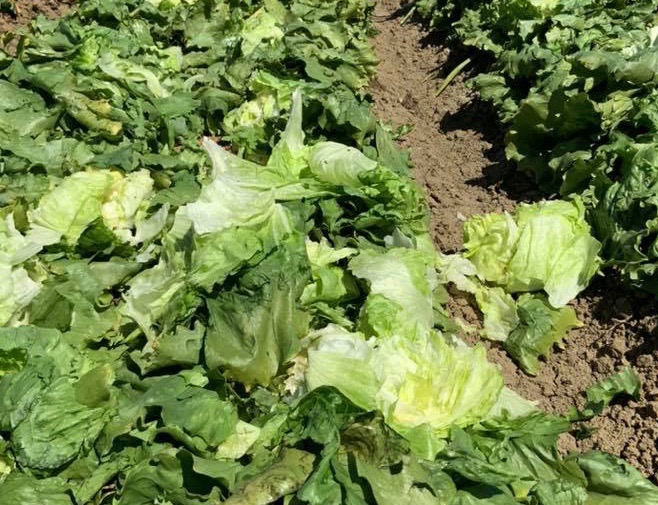
Since INSV was first observed in the state in 2006, the virus – which poses no threat to people – triggered significant crop losses in 2019, leading up to a catastrophic 2020. As Alameda’s lettuces began to show the telltale “bronzing” of the leaves, efforts to bag up or remove the infected plants had no effect on the virus’ implacable spread.

“Nothing seemed to work,” he recalled, “and you just watch those fields collapse, week after week, until you’re just like, ‘Ugh, there’s nothing here to even harvest.’”

After “100% crop failure” that year in his prime fields at the heart of the Salinas Valley, Alameda tried to dodge the virus in 2021 – shifting lettuce plantings to San Benito County and instead using his most valuable land for unaffected crops such as cilantro, leeks and radishes. By decamping to San Benito, Alameda was able to harvest 70% of his usual lettuce yield.

Generally, growers enjoyed a reprieve from virus pressures in 2021. Even in this “good” year, however, about one-third of all lettuce plantings in the Salinas Valley had at least a low level of infection, according to Zischke.

“Since we were attributing a lot of our so-called good fortune – on having less damage this year – to the cooler weather, we know we can’t count on that to get us out of this problem,” Zischke said. “All the models point to the fact that we’re in a warming climate, so we were fortunate this year.”

More research needed on thrips

Heat waves were a major driver of the INSV disaster of 2020. Although researchers have established a link between warmer temperatures and population increases of thrips, science still has a lot to learn about those disease vectors.

“Thrips are something we’re trying to understand as much as we can, but it’s pretty tough because they’re a little mysterious in the way they get around and where they overwinter,” said Richard Smith, a University of California Cooperative vegetable crops and weed science farm advisor for the Central Coast region.

Smith – along with U.S. Department of Agriculture research entomologist Daniel Hasegawa and California State University-Monterey Bay plant pathologist JP Dundore-Arias – provided an INSV update during an Assembly agriculture committee hearing in December.

Recent studies have identified several weeds as key “reservoirs” of thrips, including malva, marestail, and hairy fleabane. The ubiquitous mustards, fortunately, appear to be poor hosts for thrips, although their pollen serve as potential food sources.

Controlling those weeds – which are beginning to spring up as the days lengthen – is a top priority during the winter months, according to Smith. Aggressive weed management in the preceding winter was an important factor in limiting the virus’ spread in 2021.

And because weeds recognize no boundaries, experts are also urging managers of non-agricultural lands to keep their properties as clean as possible, including industrial sites, equipment yards and the edges of roadways – namely U.S. Route 101, which runs through the center of the valley. Some growers have been volunteering to weed their neighbors’ vineyards.

“We’re encouraging everybody – as best they can – to knock down known weed hosts; that’s really critical,” Zischke said.

Search for long-term solutions

Within the grower community, there is “nervous optimism” for the coming year, said Alameda, as he continues to hope for an innovation that would aid in the fight against INSV – whether a more targeted pesticide application or a beneficial insect that could deter the thrips.

However, both Alameda and Zischke pointed to the breeding of more resistant lettuce varieties as the ultimate solution to INSV – albeit one that is years away.

“We have a lot of different types of lettuce that we grow, so to move resistance into all the different types of lettuce we grow throughout the season … that’s going to take time,” Zischke explained.

Research funding from the state and USDA – as well as projects supported by the California Leafy Greens Research Program – can help expedite that process. But, for Alameda, the INSV crisis underscores the need for more resources and farm advisors such as Smith, who has spent more than three decades cultivating relationships and building trust within Salinas Valley communities.

Alameda would like to see a renewed focus on bringing “bright, young, passionate people who live and breathe this stuff” to the region, so growers are better equipped to handle the inevitable next calamity.

“Hopefully this is a wakeup call to all,” he said. “This is a valued industry – you have to take care of it; it cannot be taken for granted. The ‘salad bowl of the world’ cannot rest on its laurels.”
2022-01-17T09:16:29-08:00January 17th, 2022|

CA Minimum Wage Jan 1 is $15

New Minimum Wage Starting Jan. 1 2022


By Teresa McQueen, Western Growers Corporate Counsel

Effective Jan. 1, 2022, the minimum wage in California will increase to $15 per hour for large employers with 26 or more employees; it will increase to $14 for small employers with fewer than 25 employees.

The amount for small employers will increase again on Jan. 1, 2023 to $15 per hour.

State law requires that California workers be paid the minimum wage; in addition, some cities and counties have a local minimum wage that his higher than the state rate. Employers should keep this rule in mind: When faced with conflicting employment law standards, an employer must follow the standard that is most beneficial to the employee. Review the UC Berkeley Labor Center’s detailed list of local minimum wage ordinances for additional guidance.

Agricultural employers in California should also be mindful of the continued phase-in of agricultural overtime provisions. In 2016, California initiated a plan to phase-in agricultural overtime to the same basis used in most other California industries. The multi-year phase-in schedule continues in 2022 for large employers (26 or more employees).

As of Jan. 1, 2022, a large employer must pay overtime of 1.5 times the employees’ regular rate of pay for any hours worked over 8 hours per day or 40 hours per week. This is the last phase-in for large employers. Click here for important information on calculating the regular rate of pay.

Employers are required to post information on wages, hours and working conditions at a worksite area accessible to employees. In addition, employers must ensure that the wage rate is displayed on the employee’s pay stub and that employees are paid at least the minimum wage even when employees are paid at the piece rate.

Updated wage and hour notice posters (Spanish and English) can be found on the Department of Labor Standards and Enforcement website.

2021-12-31T10:15:48-08:00December 31st, 2021|

A Better Dairy Digester

Dairy Digesters Have Struggled

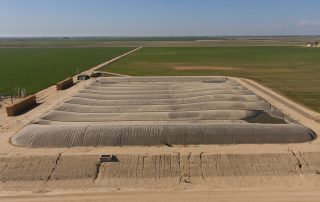
A digester that can turn manure from dairy cattle into renewable fuel is not a new concept, but over the years very few have lasted. Daryl Maas of Maas Energy Works is a part of a collaboration in Tulare County California that have developed a model to make it work.

“Up until 10 years ago, even five years ago, a lot of digesters had struggled in California and elsewhere. They didn’t have a strong revenue model. They were often under capitalized or not maintained well. Just the technology was overly complex, but a covered lagoon in Tulare county California is about the simplest digester you can imagine,” said Maas.

These covered lagoons are located on site and over a dozen dairies and the biogas is connected to Calgren Renewable Fuels via pipeline.

“As a practical matter in California what we do is we build a large tarp, a gas tight tarp over a pond of manure,” said Maas. “So if you can imagine several acres of liquid manure sitting there, which is something we imagine all the time here, we love these topics. If you were to put a gas tight seal over the top of it, the bacteria in that manure, they think there’s still in a cow. They continue breaking down the little bits of calories and releasing methane gas, which we can capture. And then we’ve got a collection of biomethane, which is mostly methane gas, which is the same energy as natural gas.”

2021-12-28T12:16:35-08:00December 28th, 2021|

Suppliers, Retailers Warn California Grape Growers of Herbicide Shortages

Supply-chain Crisis Forces Some to Pivot to Mechanical, Biocontrol Measures

By Mike Hsu, UCANR Senior Public Information Representative

Driving through her vineyards on a chilly morning in December, Hortencia Alvarado is taking comfort – for now – that the weeds she sees are all yellow. But there remains a nagging worry that, like the pesky plants, is merely lying dormant for the season.

When March rolls around, and the first signs of new green growth appear on the vines, Alvarado and other vineyard managers will again have to confront the ongoing shockwaves of the global supply-chain crisis.

Growers of grapes – the third-highest valued agricultural commodity in California at $4.48 billion in 2020 – likely won’t be able to access the herbicides that they usually apply.

“I definitely need to start thinking and considering it because I don’t want to be in that situation where I don’t have [the herbicide] when I need it,” said Alvarado, a vineyard manager in the San Joaquin Valley.

Imperfect alternatives

She first noticed the effects of the shortages this past August, during the application following the harvest of early varietals. Alvarado’s agricultural pest control adviser had recommended a different product, instead of their usual standby, Rely – because none of the handful of suppliers in California could find it. Then Alvarado’s foreman started reporting that the substitute wasn’t controlling the weeds.

“We were using some other stuff that wasn’t as good, so basically we were wasting money on stuff that wasn’t doing what we wanted it to do,” Alvarado explained.

They quickly pivoted to their mechanical weeder to chop up the weeds, but that’s been an imperfect solution. They only have one machine and it would take three or four machines to adequately weed the nearly 3,000 acres that Alvarado manages.

The need for more machines or labor is just one result of the herbicide shortage, said George Zhuang, University of California Cooperative Extension viticulture farm advisor in Fresno County. Zhuang has received “a lot” of calls from growers about the chemical supply issues, which are also affecting fertilizers. He’s been urging them to move away from traditional herbicides to mechanical means or biocontrol such as sheep or fowl – even though they might be more expensive.

Zhuang estimates that while a weed program comprises 5% to 10% of total production costs in a normal year with the usual herbicides, the use of nonchemical alternatives could hike that percentage up to 10% to 20%. In addition to their impact on the bottom line, effective herbicides are especially crucial to grape growers because vines – unlike tree crops – cannot naturally shade out weeds with expansive canopies.

“Right now, people can still scramble around and find some limited chemicals to make sure the crop is successful for the harvest, but if the situation goes for another year, I think there’s going to be a panic in farming communities,” Zhuang said.

Herbicide challenges expected to linger

Unfortunately, the availability of certain products is likely going to be “challenged” into at least the middle of 2022, according to Andy Biancardi, a Salinas-based sales manager at Wilbur-Ellis, an international marketer and distributor of agricultural products and chemicals. Biancardi said that the suppliers he talks to are advising people to make preparations.

The supply of glyphosate, the key component in products such as RoundUp (used by many Midwestern farmers), appears to be most affected, Biancardi said. As a result, that shortage has put the squeeze on alternatives such as glufosinate, used in products like Rely – the herbicide favored by many California grape growers.
“The cost of glufosinate has definitely gone up because there just isn’t enough, so everyone is obviously marking it up,” said Biancardi, who estimates that prices for both glyphosate and glufosinate are up 25% to 30% for growers.

“And that’s if you can get it,” he added.

Alvarado said that while large commercial operations are able to pay the premium prices or shift to other weed control measures, some smaller growers have essentially given up the fight – simply letting the weeds take over.
“They’re just letting it go wild until the dormant season,” she said. “They’re hoping that – by when they do start to spray [around March] – they’ll hopefully have that Rely.”

Silver lining to supply crisis?

Large-scale growers and retailers are buying up those scarcer products when they can, in anticipation of future shortages during critical times. Biancardi said that while his company traditionally runs inventories down at the end of the season, they are instead stocking up on herbicides that customers will demand.
“Careful planning and forecasting is going to be more important than ever, that’s really the key,” he said. “At this point we can’t guarantee ‘business as usual,’ based on what we’re hearing.”

Shaking off old habits might actually bring some benefits to business, according to Alvarado, as a forced shift away from chemicals could prove to be a selling point for customers, from a sustainability and marketing standpoint.

“Out of this shortage, there might be some good, some wins,” she said, “but at the same time, we’re going to need some answers – I think it’s going to be a bumpy road.”

Calling the confluence of drought, record heat and a shortage of chemicals a “perfect storm,” Zhuang said that consumers could start feeling those jolts as well.

“Eventually, somebody is going to eat the costs – either the farming community or the consumer is going to eat the cost, I hate to say it,” he said.

2021-12-20T15:42:14-08:00December 20th, 2021|

Of Course, Consuming Nuts is Good For Health

 Nuts are Good For Your Health, But it Took a While  For the Medical Industry to Say So!

By Patrick Cavanaugh with the Ag Information Network

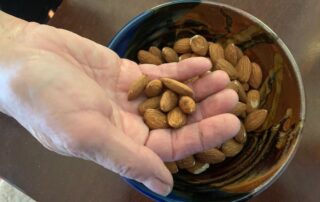
Do you remember when consuming nuts was not good for you? The medical industry had it all wrong. Richard Waycott is President and CEO of the Almond Board of California, he said the journey to get the truth  took a while.

“It was a journey that took about 20 years and we started down it, not really knowing, like most research, you don’t know what you necessarily are going to get,” said Waycott. “Fortunately, the focus both for Almonds and walnuts was on cholesterol and heart health, and we were able to have redundant trials, clinical trials, published in the papers that revealed that, yes, indeed increasing almond consumption does help with cholesterol.”

And that it reduced the bad cholesterol and increased the good cholesterol. “So, that was our first stake in the ground, and we’ve just built on that,” noted Waycott.

And that’s all part of a major priority with the Almond Board and that’s investing in good health research. “We invest every year, COVID, sort of got in the way a little bit because the clinical trials, but upwards are $3 million a year on clinical trials, they’re not cheap, and they usually take multiple years to accomplish and then you got to get published,” Waycott noted. “That’s definitely a foundation of the Almond Board’s work.”

And in further evidence, according to the largest study of its kind, people who ate a daily handful of nuts were 20% less likely to die from any cause over a 30-year period than those who didn’t consume nuts.

2021-12-17T07:44:47-08:00December 17th, 2021|

Strawberries Are A Big Fresh Market Crop

 Strawberries Are A big Crop in California


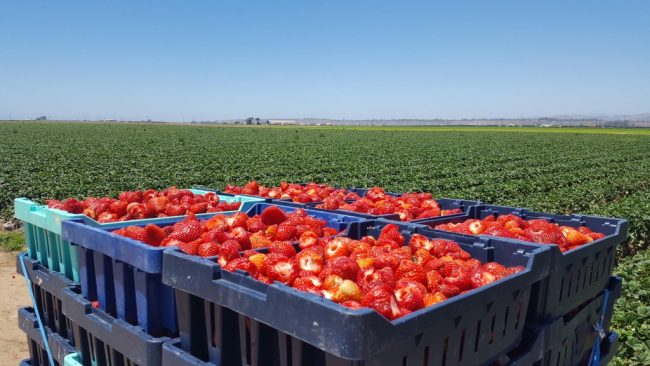
From the end of September through the end of October, strawberries are planted and harvesting occurs from mid- December through mid-July in Ventura County,  which produces more than 27 percent of the state’s strawberries. The peak harvesting season in California runs from April through June, when up to 10 million pint baskets of strawberries are shipped daily.

The largest producing state, California harvests 83% of the strawberries grown in the U.S. on approximately 24,500 acres. And with about 5,000 commercial acres, Florida is the second largest producing state. Ideal temperature for strawberry plants should not exceed higher than 78 degrees or lower than 55 degrees.

Every strawberry plant is hand-picked approximately every three days. This is the time in which it takes for strawberries to complete their cycle of turning from green to white to red. There is no storage of fresh strawberries. After picking, they are rushed to coolers where huge fans extract the field heat. Then they are delivered to supermarkets across the country via refrigerated trucks.

Strawberries are the largest available fresh fruit source for vitamin C. Frozen strawberries are America’s largest available frozen fruit source of vitamin C. Versatile and nutritious strawberries are easy to include in school meals and snacks. Low in calories and sugar, strawberries are packed with vitamin C and antioxidants, helping to boost immunity and brain health.

2021-12-16T07:42:03-08:00December 16th, 2021|

CDFA Celebrates 30 Years with USDA Pesticide Data Program

CDFA Food Safety Scientists Celebrate 30 Years of Continuous Growth Partnering With USDA Pesticide Data Program


The California Department of Food and Agriculture (CDFA) joins the U.S. Department of Agriculture (USDA) in celebrating the 30th anniversary of the Agricultural Marketing Service Pesticide Data Program (PDP). CDFA’s Center for Analytical Chemistry (CAC) Food Safety group has partnered with PDP since its inception in 1991.

PDP is a federal partnership with nine states that monitors pesticide residues in the U.S. food supply. PDP data helps demonstrate the high quality of the U.S. food supply — analyses show that pesticide residues are lower than the limits established by the U.S. Environmental Protection Agency in nearly all food samples (typically >99%).

The partnership between the agencies started with a screening list of 28 pesticide compounds. It has since expanded the scope to detect and quantify more than 515 compounds.

Partnering in this project has helped the CAC Food Safety program model its quality system framework into one that generates the highest-quality data for enforcement and regulatory purposes. Innovation was fostered through CAC scientists applying novel analytical methods and custom-made software to automate data processing and review.

“These endeavors opened doors to continuous technical improvement and enabled us to significantly increase our capability to generate high-quality, defensible data in a fast-turnaround work environment,” said CAC Environmental Program Manager Tiffany Tu. “The benefit gained from collaborating with other agencies in the pesticide analysis field in impactful scientific projects helped further our goal of being in the forefront of the pesticide analysis arena, which also ensures CAC Food Safety program’s relevance in our mission of promoting and protecting California agriculture.”

2021-12-15T10:46:09-08:00December 15th, 2021|

Brandon Crosson Earns Top Honors in Young Farmers and Ranchers Discussion Meet

Modesto Junior College student wins in Farm Bureau’s Collegiate Discussion Meet

Braden Crosson, an intern in the Modesto Junior College School of Agriculture’s crop unit, has won the 2021-22 California Young Farmers and Ranchers Collegiate Discussion Meet.

Crosson, of Galt, emerged as the winner of the competition finals, held in Bakersfield on Nov. 13. The event featured a policy discussion on the long-term viability of livestock processing following the COVID-19 pandemic.

In his winning presentation, he addressed how California Farm Bureau efforts can lead to easing government regulations to enable long-term economic viability for local animal processing facilities, while also protecting workers and ensuring that healthy products are delivered to consumers.

As the winner of the contest, he receives $1,250 and will now represent California in the national competition held in February 2022 during the American Farm Bureau Federation’s Young Farmers and Ranchers Conference in Louisville, Kentucky.

The competition, part of the Farm Bureau’s Young Farmers and Ranchers Program, simulates a committee meeting, in which each committee member is expected to actively participate in a policy discussion. The idea is for participants to improve their discussion skills while learning about important agricultural issues. Ultimately, they learn to work in groups to pool knowledge, reach consensus and solve problems.

2021-12-13T08:59:53-08:00December 13th, 2021|

Water Supply At Risk From Wildfires

How Can California Protect its Water Supply From Wildfire? 

By Pam Kan-Rice UCANR Assistant Director, News and Information Outreach

Stakeholders from across disciplines and institutions offer recommendations to ensure safe, reliable water supply amid a growing wildfire threat 

It’s intuitive that wildfires can affect ecosystems, harm wildlife and contaminate streams and rivers. But wildfires can also have complex, severe and direct effects on our water supply and infrastructure—effects that have only become clear in recent years. Scientists and policymakers must integrate insights and experience from many disciplines and sectors to understand and address the consequences.

In September, 23 scholars and practitioners with a diversity of water and fire expertise came together to answer a critical question: How can California proactively protect its water supply from fires? Their findings, combined with the insights of the author team, form the basis of a new scoping report, released by the University of California Division of Agriculture and Natural Resources’ California Institute for Water Resources and the UCLA Luskin Center for Innovation.

“Different people have different pieces of the puzzle, but it’s really hard to put them together. That is why we assembled this cross-sector group,” said Faith Kearns, academic coordinator at the California Institute for Water Resources.

Illustrated by the 2017 Tubbs Fire in Wine Country, it has been recognized that community water systems face effects that last long after the fire is quenched. For example, Boulder Creek residents in Santa Cruz County still did not have reliable water access more than a year after firefighters extinguished the 2020 CZU Lightning Complex Fire.

“This is truly an emergent issue,” said co-author Peter Roquemore, project manager at the Luskin Center for Innovation. “We have only seen wildfires directly affect community water systems in the past few years.”

To help California policymakers, researchers, affected communities, and water system operators understand the complex relationship between wildfire damage and water supply, the report authors and participants in this workshop present a set of recommendations:

  • Make communications more accessible, consistent and trustworthy. Residents must receive timely, unified messaging, translated into appropriate languages and in accessible venues, telling them if their water is unsafe and how to access clean water.
  • Invest in local capacity and expertise. The challenges faced vary widely for different communities, and it is important to provide each community with the resources it needs to address the risk it faces. As part of this, efforts should support Indigenous leadership, knowledge and practices to help manage healthy ecosystems.
  • Provide guidance to update regulations. Guidance such as building codes and infrastructure regulations will help individuals and communities make informed decisions and address risk appropriately.
  • Conduct research and build a broader base of knowledge. There is still much to learn, and it is important to illustrate the exact challenges water systems face and how best to address them.
  • Make funding accessible and targeted. Increased earmarked funding for emergency water supplies, housing assistance, and support for water systems, local organizations, and others will help advance solutions. 
  • Further coordinate efforts to address water and fire issues. Focusing on these interconnected issues together, rather than tackling them separately, can lead to substantial benefits.

To read the specific recommendations identified, read Wildfire and Water Supply in California. Funding for this research was provided by the U.S. Geological Survey through the California Institute for Water Resources.

2021-12-09T17:54:59-08:00December 8th, 2021|

Important COVID Prevention at Almond Industry Conference

Almond Industry Conf. Offers Before-You-Go-Tips

Big Event will he at the SAFE Credit Union Convention Center

It’s almost here! The Almond Conference is just around the corner and we are looking forward to gathering in-person with our friends and colleagues in the almond industry. When the Board of Directors made the decision to move forward with an in-person conference at our meeting in June, we knew it would be a challenge given State of California restrictions on large indoor gatherings. We knew there was a risk in moving forward with planning when we could get the rug pulled out from under us at any time, but we felt the benefits of meeting in person outweighed the risks and voted unanimously to move forward.

Now here we less than one week out and we are full speed ahead! More than 3,000 industry members have pre-registered to join us in downtown Sacramento on Dec. 7-9. A record number of exhibitors will be arriving this weekend to set up for the largest trade show The Almond Conference has ever assembled. And staff have put together a tremendous lineup of educational sessions, keynote speakers and world-class entertainment!

In order to meet in person we must meet the State requirements for “mega events” (more than 1,000 people indoors). This includes requiring attendees to provide proof of vaccination or a negative COVID test taken within 72 hours of arriving in Sacramento. This is a State of California requirement, not an Almond Conference policy (these are the same restrictions that are in place to attend a Kings game at the Golden One Center). We understand this is an inconvenience and have tried to make it as easy as possible to provide this information so we can hold the event in person. See below for more information.

Also, at this time, the County of Sacramento requires masks be worn indoors in public spaces, including the Convention Center. Sacramento County’s Public Health Department will end their indoor mask requirement if the count reaches 5 or fewer cases per 100,000. We’re watching the numbers closely and currently Sacramento is on a downward trend at around 10 cases per 100,000. We are hoping the downward trend continues as we know many of you would prefer not to wear masks in the facility. We will update you if the County lifts the requirement. If not, you will need a mask to enter the Convention Center.

We appreciate everyone’s understanding and assistance as we navigate the various State and Local requirements to hold The Almond Conference in person. We hope you’ll agree that the opportunity to meet in person is worth it! Thank you for your patience and we’re looking forward to seeing you next week in Sacramento.

2021-12-01T16:48:11-08:00December 1st, 2021|
Go to Top