Environment

Wineries Need Business after Napa & Sonoma Fires

Following Disastrous Fires, Napa/Sonoma Valleys Need Visitors Back

By Patrick Cavanaugh, Farm News Director

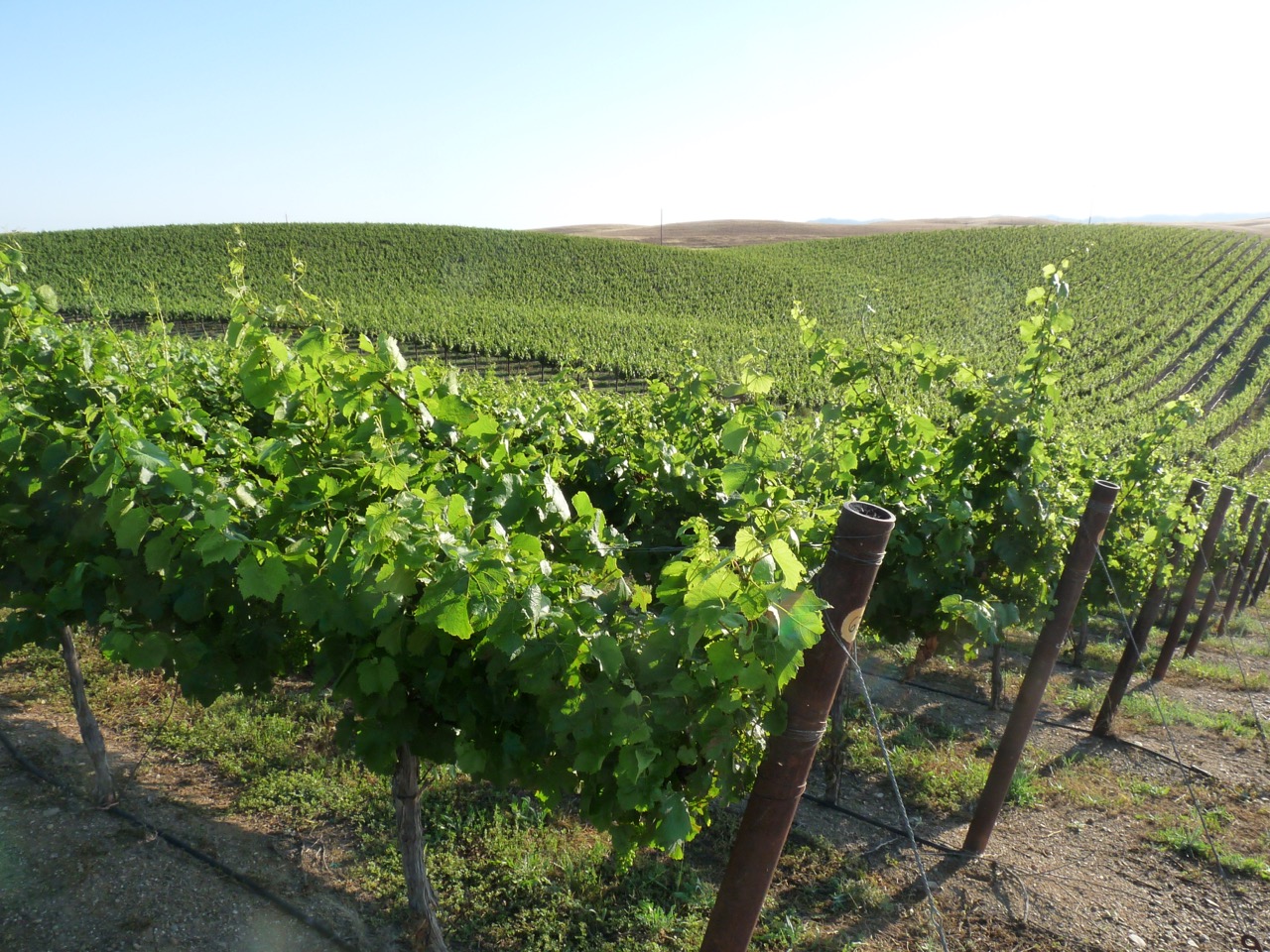
The recent Napa & Sonoma fires have left wine country reeling.

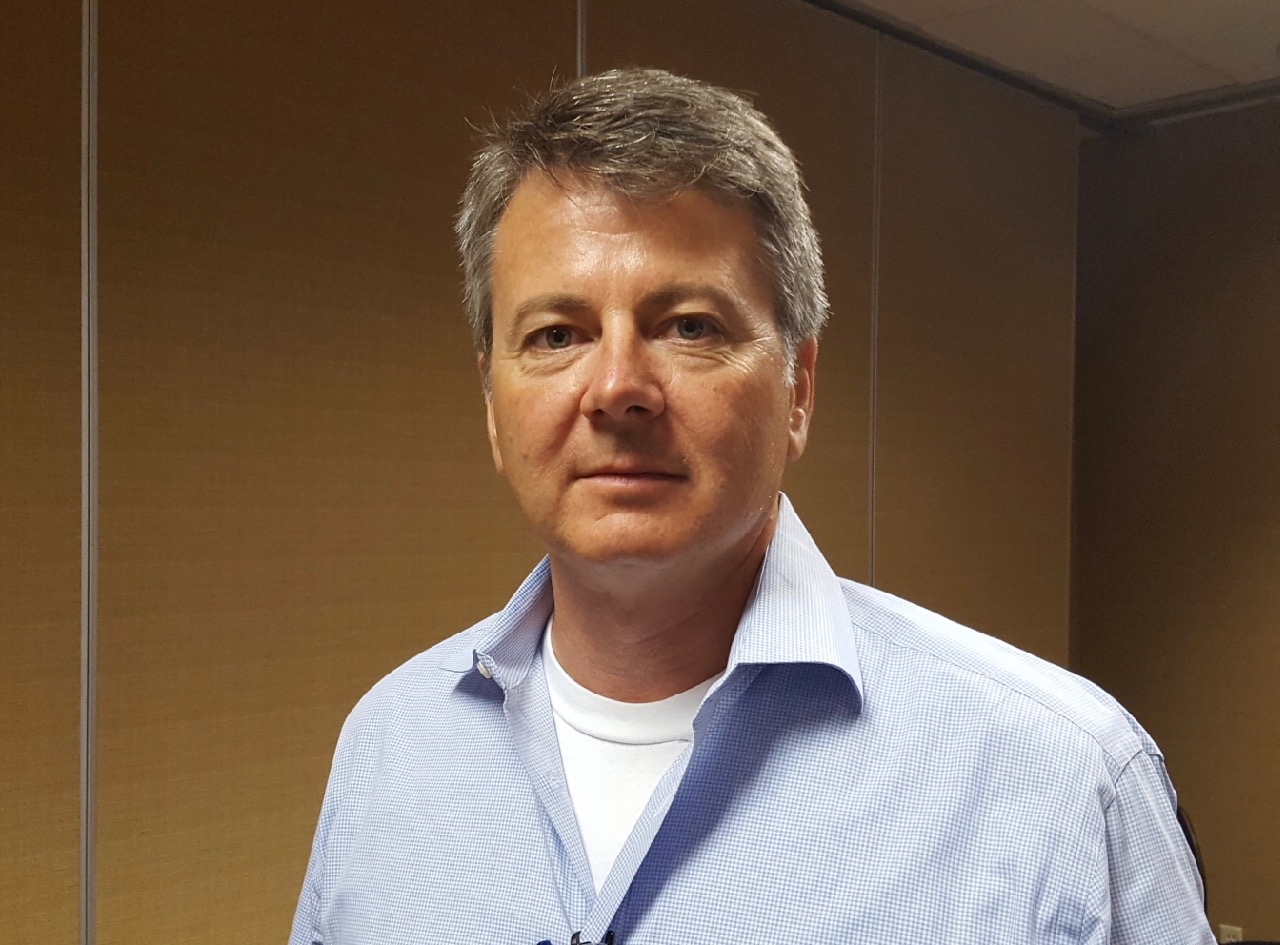
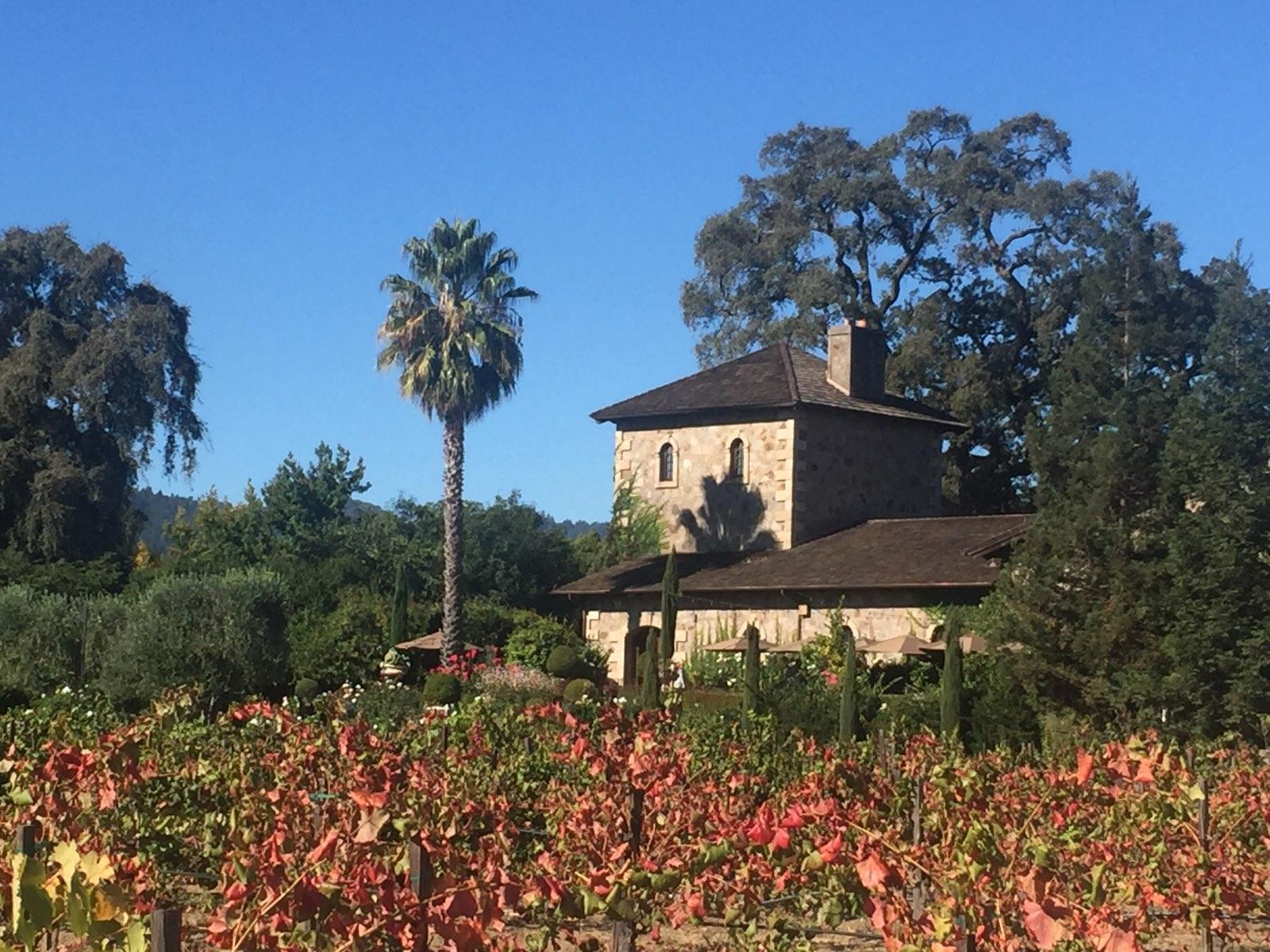
“Our message is, please come back to the wine country,” said John Winkelhaus, vice president of operations and general manager of V. Sattui Winery, the number one visited winery in Napa Valley.

The region just had some devastating fires.

“It was absolutely dramatic. We certainly just have heartfelt feelings for the folks that have lost their homes and their businesses. And of course, you can’t measure the sorrow we feel for those who lost their lives,” Winkelhaus said.

Sonoma and Napa counties were hit pretty hard. Sonoma County was perhaps worse than Napa because of the devastation that was in that residential area.

It rained last Thursday, the fire was put out and the smoke was washed out of the sky, but now there’s another problem.

“It cleared the air. I mean, we have beautiful blue skies here. But visitor traffic is way down,” Winkelhaus said. “We always have a lot of complaints about the traffic here in the Valley, especially on weekends. But there’s no traffic here.”

“So, what’s happened is that the people, our guests, our visitors who we depend on, allow our staff to come to work every day. They’re not coming,” he said.

“Everybody has a mortgage or rent to pay, or food to buy, or bills to pay as well. … In Napa Valley, 70% of the wage earners are earning their money through the hospitality business, whether it’d be the restaurants, or the hotels, or the wineries,” Winkelhaus said.

“There are 500 wineries in the area, and only seven were damaged or destroyed by the fire. So 447 are open for business and need business,” he explained.

 

2017-11-08T19:59:54-08:00October 25th, 2017|

Blue Tech Valley Innovation Cluster – Part 1

Blue Tech Valley Funded by California Energy Commission

By Patrick Cavanaugh, Farm News Director

The Blue Tech Valley Central Valley regional innovation cluster represents an expansion and interconnection of multiple incubators in entrepreneurship programs, with services located at each of the seven designated Blue Tech Valley cluster hubs, collectively serving 39 counties and covering two-thirds of California’s geographic area. Funding for the new cluster is provided by a $5 million grant from the California Energy Commission.

The designated hubs for the Blue Tech Valley innovation cluster features Fresno State as the central portion. Other hubs include: CSU Bakersfield, Chico State, Humboldt State University, Cal State University, Monterrey Bay, Sacramento State, and a Sierra small business development center.

California Ag Today recently spoke with Erik Stokes of the California Energy Commission Research and Development Division. Blue Tech Valley was part of a major $60 million initiative the Energy Commission launched about a year ago to really try to create a state-wide ecosystem to support clean energy entrepreneurship across the state.

“As part of this initiative, we created four regional innovation clusters to manage a network of incubator-type services that can encourage clean tech entrepreneurs in the region and really try to help make what can be a very tough road towards commercialization a little bit easier,” Stokes said.

“Blue Tech Valley and their partners were selected to be the Central Valley cluster. A big reason for that was their strength and expertise in the food and agricultural sector,” he explained.

One of the focus areas of the incubator is to find areas in farming to save costs and minimize greenhouse gases.

“We really want to focus on those technologies that can help both reduce water use, as well as energy use,” Stokes said.

2021-05-12T11:05:15-07:00August 30th, 2017|

Embattled Farmer John Duarte Defends Farming in Federal Court

Farmer Must Defend Plowing His Wheat Field

By Patrick Cavanaugh, Farm News Director

John Duarte, a California farmer who gained national attention after the United States Army Corps of Engineers (USACE or Army Corps) sued him for plowing his Tehama County wheat field, will defend himself in a federal courthouse in Sacramento on Tuesday, August 15.

“Agriculture is at a very dire crossroads right now,” said Duarte, imploring all farming stakeholders and food consumers across the country “to get loud with their Senators, Representatives and USACE. And if you know how to get ahold of President Trump, give him a call.”

In February 2013, with no warning or opportunity to discuss the matter, USACE sent Duarte a cease and desist letter to suspend farming operations, claiming that he had illegally filled wetlands on his wheat field simply by plowing it.

“I am being prosecuted for planting wheat in a wheat field during a global food crisis,” Duarte said. “They’re claiming I should have pulled a [Clean Water Act] permit that nobody has ever pulled and conducted practices that nobody has ever conducted to grow wheat.”

Duarte who is also the owner of Duarte Nursery, argues that the Army Corps violated his constitutional right to due process. He said the agency came down on him hard and never gave him an opportunity to defend himself against the accusations before levying the fine. Duarte now faces $2.8 million in government fines.

“The Army Corps of Engineers is prosecuting us,” Duarte said, “and the Army Corps does not even have subject matter jurisdiction to conduct this prosecution.”

In a June 14, 2017, news release, Tony Francois, senior attorney for Pacific Legal Foundation, explained, “Prosecutors and bureaucrats are seeking to establish, for the first time, that farmers with seasonal puddles need a federal wetlands permit in order to plow their own private land—even though plowing is exempt from Clean Water Act (CWA) coverage.”

Duarte believes if he were to lose the upcoming trial, it would change the way farmers in America farm. “This battle may never be resurrected in court. Taking this battle to the Supreme Court on several fronts is the only way to give farmers the long-term security they need, the right to farm and property rights protections, to deliver food security to America.”

The American Farm Bureau Federation, the California Farm Bureau Federation, the farm bureau in Duarte’s backyard and farm bureaus across the country are behind him.

“The Butte County Farm Bureau has 1065 members,” Duarte stated, “and they donated a check for $10,650 to the Duarte Defense Fund at California Farm Bureau Federation. That’s $10 a member! Thanks to the challenge from Biggs, CA, farmer, Clark Becker (President of the Butte County Farm Bureau) that defense fund has already collected over $100,000 in support of our lawsuit. We are hoping to collect hundreds of thousands more.”

Duarte said, “Although this lawsuit for planting wheat in a wheat field has gained a lot of attention, we need more help to fight it.”

While Duarte is grateful for the political support in favor of Duarte Nursery’s position in this wetlands prosecution, he wants to settle this case before trial. “We need complete rights to appeal, and if necessary, to take it to the Supreme Court of the United States. We must protect food security as well as farmers’ right to farm.”

“My greatest nightmare is if Duarte Nursery is forced into settling this case without the right to appeal. If we cannot get such a release, American farming could be oppressed by federal agencies into the future, and there won’t be another fool to follow us and stand up to them again.”

“Any farmer can see the kind of abuse—the misstatements, the falsehoods, the misquoting of laws that the Department of Justice is using in this case against us—and the $2.5 to $3 million we’re spending to fight this battle. There won’t be another family to come along and fight like this in the future.”

2017-09-02T23:46:02-07:00August 12th, 2017|

Sharing Secrets to a Successful Bowl of Cherries

Weather and Pruning Make Life a Bowl of Cherries

By Laurie Greene, Founding Editor

Clark Goehring, a third generation Kern County farmer, produces cherries and almonds. He summarized his cherry harvested as “good compared to the other years when we have had rain. Some people in our area still had rain during harvest, but we were able to harvest and bring our cherries to market in good condition.”cherry tree

“Of course, it rained a lot this winter and spring, but you do not want rain when cherries are maturing on the tree; they don’t like rain.”

Goehring explained that when it rains beyond the point when cherries start coloring, they split, making them unmarketable. “But while it may take some rained-on cherries off the market, the price of the marketable fruit goes up,” he said, benefiting those growers who had a quality crop, like him.

Goehring’s farm workers train the cherry trees to keep them low—approximately 8 feet tall. “We have tried to have them bush out instead of being more of a central leader. Actually, it’s called Spanish Bush style or, in modified form, KGB.”

Kym Green Bush designed the KGB training method in Australia to use multiple leaders and have them fruit on the leaders themselves. KGB simplifies pruning so less experienced farm workers can learn the skill more easily. The trees are replenished every five years.

Goehring said the method saves money on the farm, cuts labor and increases workers’ safety because it requires no ladders and the harvest is quicker. Harvesting without ladders also gives Goehring an advantage of attracting farm labor over other orchards that require ladders.

“In California, if farm workers have their choice of picking your cherries without using ladders, which is usually piecework, or someone else’s crop with ladders, they are going to want to come to you,” he explained.

2017-08-02T16:14:04-07:00August 2nd, 2017|

New Nematicide Available

New Velum One Nematicide Registered For Use in California

By Patrick Cavanaugh, Farm News Director

Horticulture crops in California and Arizona can now be protected by Velum One nematicide, a wide-spectrum nematicide that increases root health and suppresses key diseases.

“We’re excited to see Velum One go to work for growers in the key horticultural areas of California and Arizona,” Bayer Product Manager Joel Lipsitch said. “It’s another example of the innovation that our growers have come to expect from Bayer.”

Velum One suppresses nematodes below ground but also works by moving upward from the roots into the leaves of the plant to suppress key diseases and promote early season crop establishment. This activity has been shown to protect roots and establish the crop by limiting damage from a wide range of nematodes and key diseases, such as powdery mildew.

Trials have shown that Velum One aids in increasing yields as it protects plants from nematodes and disease.

“In tomatoes, for example, we’re seeing significant yield increases both from Velum One versus untreated and more importantly when Velum is added to grower-standard programs” Lipsitch said. “The combination of nematode and disease control really gives growers confidence that they are maximizing their yields and return on investment.”

Velum One is applied early in the growing season via drip chemigation. While it’s not meant to replace a fumigant, Velum One is most effective when used as part of a complete nematode management program.


2021-05-12T11:01:59-07:00May 7th, 2017|

Huanglongbing is causing concern in California

Increase of Huanglongbing in California Causes Concern

 By Brian German, Associate Broadcaster

Southern California has seen a concerning increase in the amount of trees that are infected with Huanglongbing, or citrus greening disease. California Ag Today discussed the news with Beth Grafton-Cardwell, an IPM Specialist and Research Entomologist for the UC Riverside Entomology Department stationed in the San Joaquin Valley.  She agreed that there is an increased concern surrounding HLB.

“It kind of exploded this fall, and it’s kind of continuing. And, that’s not unexpected. The Department of Food and Ag removes only the trees that are polymerase chain reaction – positive. And sometimes, it takes one to two years for a tree for you to be able to detect the bacteria using that method,” Grafton-Cardwell said.

Beth Grafton-Cardwell

There is no cure currently available for HLB, so once a tree is infected, it will eventually die.  Researchers continue working to find a possible cure for HLB, or at the very least, a more effective means of diagnosing infected trees. “Most of the techniques that are going to help us cure or prevent the disease from being transmitted are five to ten years away. Yet, I think we’re going to see a rapid expansion of the disease in Southern California in this coming year,” Grafton-Cardwell said.

Early detection is one of the most important things.  Grafton-Cardwell noted that many farmers are “helping to get the research accomplished and, for example, helping to get early detection techniques tested, and things like that so that we can try and stay on top of the disease.”

In California, production trees are not required to be screened, but many nurseries are now shifting towards putting all of their trees under screening in an effort to be more proactive in guarding against the spread of HLB.

Biological controls like Tamarixia are used as a means to reduce the number Asian citrus psyllids, which cause HLB, but that type of control method is not designed to completely eradicate insects.

“They’re starting to release the Tamarixia Wasps in Bakersfield. So we’re getting them up into the San Joaquin Valley so they can help out in those urban areas,” Grafton-Cardwell said.

Dogs are also used as a means to detect infected trees, but there is still a need for more effective techniques.  “A large team of dogs can do maybe 1,000 acres a day, and we’ve got 300,000 acres of commercial citrus. So I think we need a multitude of techniques,” Grafton-Cardwell said.

2021-05-12T11:01:59-07:00April 27th, 2017|

Atmospheric Rivers Hit California

Many Atmospheric Rivers Hit State

By Patrick Cavanaugh, Farm News Director

California needs an average of three atmospheric rivers annually to reach its average yearly rainfall. So far this year, the state has seen an incredible 46 atmospheric rivers. This intense rainfall has pushed much of California out of longstanding drought conditions.

California Ag Today spoke with Steve Johnson, a private meteorologist for farmers in California. We discussed atmospheric rivers (AR) and the abundance of rain California has seen in late winter and early spring.

“We had four very big AR flows, and that made a big difference. I think we’re up to 46, and that’s what has made the big difference this year,” Johnson said. With the additional 41 smaller AR, we have seen a very wet California; it is an astounding amount of atmospheric rivers.

Johnson explained that because the storms have been so difficult to predict, it has made things difficult for farmers planning their season. “This year, there was no signal at all. These storms crept up on us this winter. It was very, very dicey for forecasting,” he said. “The year was difficult because some of these storms – in fact the big ones – even though they showed up in the 14, 16-day period, they didn’t look gigantic until about day seven or eight. Then they start gaining and gaining and gaining, and by day four or day five they looked monstrous. Well, that’s not very much time to prepare.”

Johnson noted that these unpredictable storms were caused by an anomaly in the Pacific Ocean that is a remnant of last year’s El Nino. “The predominant reason that we kept getting these atmospheric rivers has been the fact that the sea surface temperatures across the Pacific Ocean have been in a very unusual anomaly,” he said. “They’ve been cold in the Gulf of Alaska, and we have a leftover bit of warmth from last year’s record-setting El Nino that has spread north to just west of the California coast – very warm waters that go all the way over to Japan.”

“If you take a look at the differentiation between the cold water in the Gulf of Alaska versus the warm water, the anomalies between Japan and California, that has created a zonal flow since October.

“Those atmospheric rivers have been grabbing a lot of moisture coming up from that warm water off the California to the Hawaii coast, and then coming into California. It’s just been one right after another,” Johnson said.


2021-05-12T11:05:16-07:00April 25th, 2017|

California Rice Growers are Model of Environmental Stewardship

Understanding Water Usage For California Rice Growers

By Brian German, Associate Broadcaster

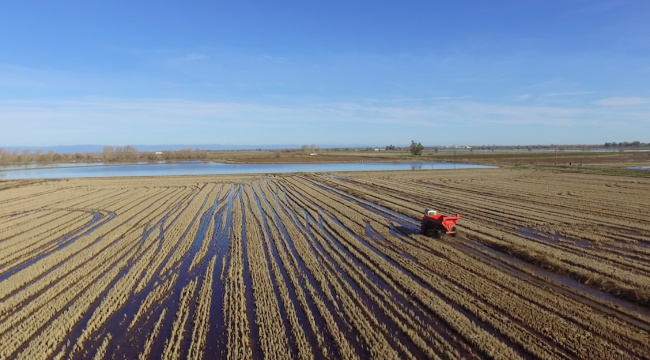
The amount of rain California received in March has put a hold on rice planting.  In a normal year, California rice growers would be finishing up their fertilizer regimen, getting ready for their April planting.  Luis Espino, a UC Cooperative Extension Farm advisor in Colusa County, explained that the wet weather has caused many farmers to push back their planting schedule.  “We had a lot of rainfall, so the ground is pretty soaked. There are some areas that are still flooded; they still have water in the field. It’ll be a while before tractors can get in there, but I’m guessing that as things dry out, things should start moving soon,” Espino said.

Photos Courtesy of Matthew Sligar of Rice Farming TV

After five years of drought conditions, California finally had a considerable amount of rainfall over the winter months.  Available water supplies are at a much better level than they were in recent years, but there is another aspect that could hurt rice planting this season.  “There’s been a good winter, so they’re going to have enough water to plant acreage as they would on a normal year. What’s not helping is the price of rice. It’s a little too low, and so that might hinder some of the plantings,” Espino said.

The California rice industry is a model of environmental stewardship, working closely with regulatory agencies and conservation groups to ensure that rice production improves wildlife habitats while promoting sound management of water resources.  The rice industry has faced quite a bit of scrutiny over the past few years because of misconceptions regarding flooded rice fields.  It is important to understand that the water used to flood rice fields has more than one use and eventually goes back into the water cycle.  “There is a constant flow of water coming into the field and then leaving so that water is going back to the canal, going back eventually to the river and so it does get recycled,” Espino said.

Rice production in the state has changed remarkably over the past 50 years, with improved varieties, increased yields and improved marketability.  With water on the minds of many Californians, Espino explained some of the reasons why rice fields are flooded for planting.  “It can produce biomass and grain when the field is flooded. Maybe more important than that is the fact that water functions as a herbicide. By having water on the field, you have a way to suppress weeds from growing,” Espino said.

Aside from a small percentage of water being lost to evaporation, most of the standing water in rice fields stays in the overall water cycle.  “The water used in rice fields – before it gets back to the river – is used four times, so in four different fields,” Espino said.

2017-04-13T16:39:24-07:00April 13th, 2017|

Water District Talks Low Water Allocation

Water District’s Water Allocation Disappoints

 By Brian German, Associate Broadcaster

The Bureau of Reclamation announced an initial 2017 water allocation for the Central Valley Project, and it’s considerably lower than what was expected.  Despite a wet winter and a significant snowpack, the Bureau has only allocated 65 percent of their contract supply to South-of-Delta contractors.

Johnny Amaral is the Deputy General Manager for the Westlands Water District – the largest agricultural water district in the United States.  Amaral thinks the deck is stacked against area growers as a result of water policy. “There are laws on the books that were deliberately put into place that created this bottleneck in the CVP and have hamstrung the CVP. This is the outcome that you get when you purposely curtail project operations or pumping: You get shortages,” Amaral said.

San Luis Reservoir is full this season, yet the allocation is only 65 percent.

The 65 percent allocation is especially disheartening since the announcement was not released until well into the planting season, forcing farmers to make decisions about land use and labor without any assurance of water supplies.  Amaral thinks there’s a need for a serious policy discussion as to whether the government truly values what growers produce.  “Those laws are going to have to be changed if we’re ever going to restore water supply to a situation where the westside ag contractors get 100 percent,” Amaral said.

Westlands Water District is made up of more than 1,000 square miles of premier farmland in western Fresno and Kings counties and provides water to 700 family-owned farms, averaging about 875 acres in size.  Amaral believes that it is time for legislators to reevaluate their priorities.  “It really comes down to a very simple but more fundamental policy question about, ‘Do we value being able to grow our own food in a safe way? Does that matter to people?’ ” Amaral said.

During election season last fall, then-candidate Donald Trump vowed to fix the water problems in California.  Farmers are going to need to be patient in their desire to see some action on those promises. “The agencies that have direct influence over western water issues and western resources issues, it’s really the Department of Interior. The Secretary of Interior was just confirmed a couple of weeks ago. … There are a whole host of positions and people that need to be nominated and put into place for the Trump Administration to really have a day to day impact over how the decision’s made on water supply and project operations,” Amaral said.

2017-04-06T11:42:51-07:00April 6th, 2017|

GMOs Are Part of Nature’s Technology

Lowell Catlett On Ag, Part Two

GMOs Are an Ancient Technology

By Jessica Theisman, Associate Editor

Lowell Catlett says GMOs have been around for thousands of years.

There is not a morsel of food that 7.2 billion people put it their mouth today that is not GMO. “That is called agriculture,” said Dr. Lowell Catlett, Ph.D. He is a futurist with a positive and upbeat predictions about agriculture.

Catlett gave California Ag Today the inside story on hybrids and GMOs. One question arose about whether hybrids are indeed considered genetically modified organisms. “Of course they are,” he said. “If you want to say it’s transngenetic, somebody moved a gene out of a fish into corn, that’s trans genetic. If you say GMO, that’s all of agriculture.”

What many people do not understand is that their non-GMO products, do come from GMO sources. “I get a kick out of people saying, ‘Well, this is non-GMO milk for ice cream.’ That Holstein has been genetically modified for 400 years. She is a genetically modified organism. There is no question about it,” Catlett said.

“We have the ability to move things around with genetics. The whole green revolution that gave people more food than at any time in history was all about accelerating genetically. Genetic modification in the old traditional ways is [what] we now call hybridization or crossing, ” Catlett said.

Corn is a GMO crop as well. “It was domesticated about 8,000 years ago by Neolithic women by crossing two grasses. Also, diabetic insulin is the result of GMO technology,” Catlett explained. “If you love yogurt, most yogurt in the United States is manufactured through a genetic modification called CRISPR, which is mother nature’s way of modifying genes.”

This process is caused by the bacteria in the yogurt. “It is the technology that bacteria use to protect themselves from invading other bacteria or pathogens. Right now, the 27 countries that are the EU, or soon to be the 26 EU countries that have banned GMOs, are now having to come back and say, ‘Wait a minute, CRISPR technology is Mother Nature’s technology.’ Mother Nature was a good genetic engineer long before we did it in laboratory” Catlett said.

“It is going to be an interesting time for GMOs in the next few years as the technologies merge to help us have better understandings and better control over things,” Catlett said.

2021-05-12T11:17:10-07:00March 23rd, 2017|
Go to Top