Environment

Temperance Flat Denied Funding

All Hope Dries Up

By Patrick Cavanaugh, Editor

Again, it came down to fish, specifically Chinook salmon, that forced the proposed Temperance Flat Dam out of the race for Proposition 1 funding for building new water storage projects.

Mario Santoyo and Temperance Flat Denied Funding

Mario Santoyo fought hard for Temperance Flat Dam funding.

For more than 20 years, the Temperance Flat Dam proposal was passionately advocated with unwavering support by Central Valley cities and the San Joaquin Valley Infrastructure Authority (SJVIA) who were behind the application. Temperance Flat came crumbling down Wednesday at the California Water Commission (CWC) meeting in Sacramento on the second day of discussion.

On Tuesday, CWC staff members assigned to crunch the Public Benefit Ratios for the project were solidly encased in concrete, refusing to grant the project any consideration for its ecosystem restoration benefits. The Dam would provide critical cold water to flow down the San Joaquin River, thus helping the salmon spawn.

CA Water Commission kills Temperance Flat funding

CA Water Commission denied funding for Temperance Flat Dam.

And while the official public benefit calculation came up short today, proponents already saw that the project was already on life support Tuesday, with a dire prognosis.

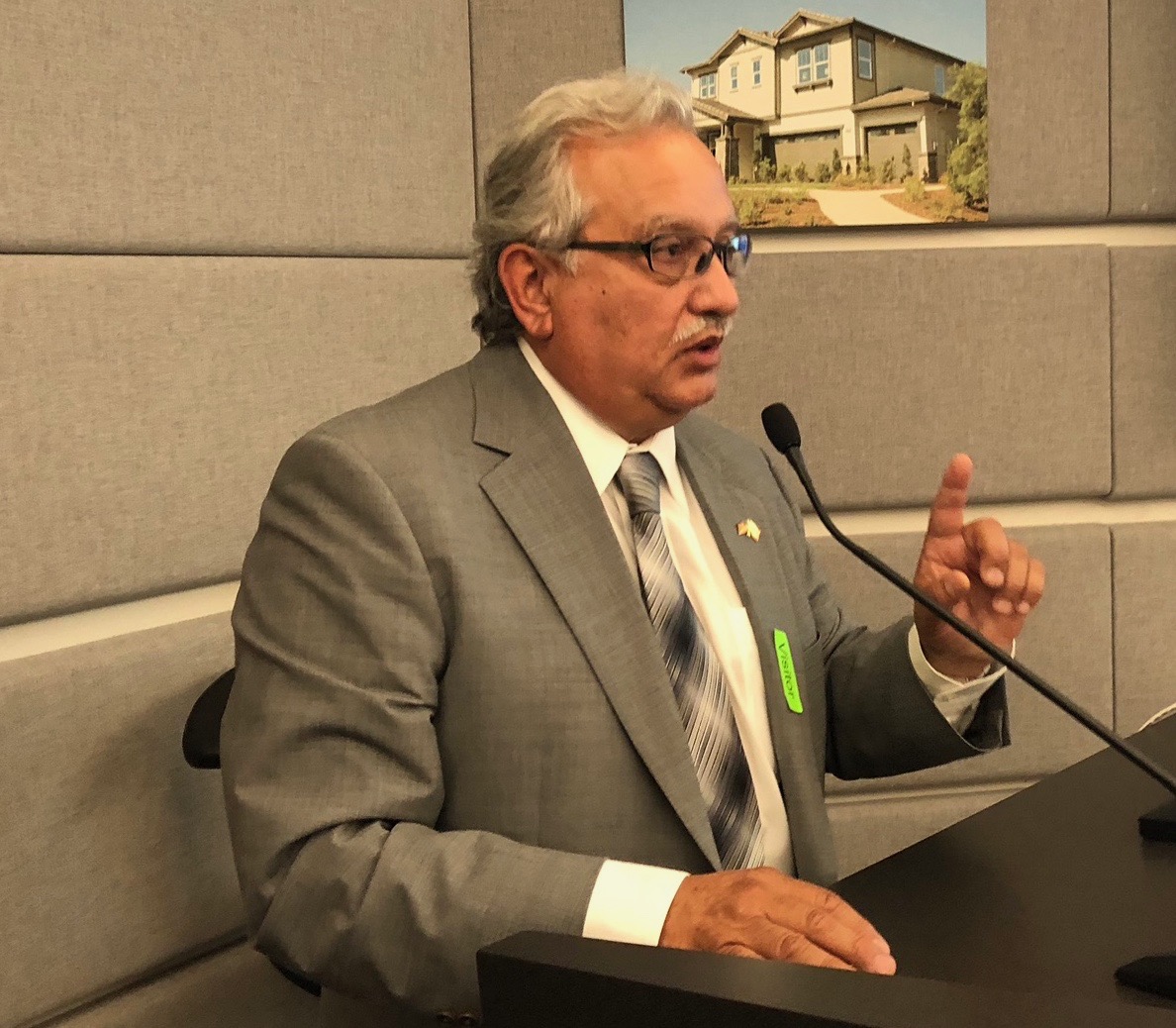
“Stunned is an understatement,” said Mario Santoyo, executive director of the SJVIA, who has worked for more than 18 years on the project. “Temperance Flat is the most critical water project ever proposed for the Central Valley, which is ground zero for significant water shortages that will not go away.”

It all boiled down to the Ecosystem Diagnosis and Treatment (EDT) model that was approved by Bureau of Reclamation and the California Department of Water Resources. Despite both approvals, that model did not jive with the Commission staff’s model, which undervalued the project’s public benefit ratio, killing the opportunity for Temperance Flat Dam to receive funding of more $1 billion for construction.

“We are working in an area of great uncertainty in professional judgment,” Bill Swanson, vice president, Water Resources Planning & Management for Stantec, a global planning and engineering firm, who presented data for the SJVIA. “We do not have fish in the river. We do not have empirical data. The only issue available to us is a comparison of how the system would respond to changes in flow, temperature and habitat,” Swanson said.

“That’s the reason we used the EDT model, the same model that the Bureau of Reclamation has used in their models of flow,” Swanson explained. “The SJVIA’s challenge was how to take the results of that model and analyze them to a level of detail that distinguishes the precision that we might want to have around the results,” said Swanson.

Bill Swanson

Stantec’s Bill Swanson advocated for Temperance Flat Dam funding.

“I’m very disappointed with the way they scored a great project that needed to be built,” noted Santoyo. “And I am not happy about one commissioner from Orange Cove who stabbed us in the back and scolded us on why we did not meet the Public Benefit Ratio. We did meet and exceed that ratio, but the CWC disagreed with our ecosystem restoration model that had been used by both the state and the feds.”

Several Water Commissioners publicly wrangled with their staff on how they could make the project work. They sought areas to increase the project’s cost-benefit evaluation to get it funded.

Commissioner Joe Del Bosque read the ballot text of Prop 1, approved by California voters by 67 percent in 2014. He reminded those present that voters expected a water storage project to be built, adding, “We need to find more certainty in order to get Temperance Flat built.”

Commissioner Daniel Curtain distinguished two parts to the discussion—physical and monetary. “Take a look and see if there is a physical benefit for ecosystem restoration. Finding a potential benefit and attaching a potential monetary benefit could be helpful,” he said.

The project was also short on points for recreation opportunities on what would be a new lake behind the 600-foot high dam east of Fresno, behind Friant Dam. Commissioner Joseph Byrne said he hoped for more thought given to the recreation cost benefit. “Intuitively, zero benefit does not make sense. We need a higher level of confidence in the estimated recreation cost-benefit,” he said.

CWC staff stipulated that while the newly created lake behind Temperance Flat Dam would accommodate boating activity, the lack of camping, hiking, and other activities within the existing San Joaquin River Gorge neutralized any recreation benefits.

If built, the Temperance Flat Reservoir would contain 1.26 million acre-feet of new water storage above Millerton Lake, northeast of Fresno. Temperance would have helped provide a more reliable supply of fresh drinking water for disadvantaged Valley communities. It would have enabled below-surface groundwater recharge, addressed extreme land subsidence and provided critical help to farmers facing severe groundwater restrictions due to the Sustainable Groundwater Management Act (SGMA).

Santoyo said the SJVWIA spent more than $2 million on the California Water Commission application, utilizing what he said were the most qualified engineers to develop the technical data required by Commission staff. The U.S. Bureau of Reclamation, which administers California’s Central Valley Project for the U.S. Department of the Interior, has invested more than $38 million in studying the project. Santoyo said those studies supported the finding that the selected Temperance Flat site is the most preferred location for such a crucial project.

2018-05-03T15:42:58-07:00May 3rd, 2018|

Happy, Healthy Bees are Better Pollinators

Keeping Bees Happy

By Jessica Theisman, Associate Editor

Becky Langer is the project manager for the North American Bayer Bee Care Program. She spoke with California Ag Today recently about the problems that the bee population is facing.

“Bees are continuing to face multiple challenges. People are getting a better grasp of awareness that pests and diseases continue to be a huge problem in beehives,” Langer said.

A big contender in the problem is forage and habitat. Beekeepers are working hard to monitor and control the issue.

“We know that the beekeepers and growers have to continue to communicate with one another and use all those products according to label,” Langer explained.

It is also important for producers to increase the variety or forages around their land to keep bee populations healthy.

If farmers could have something blooming year-round, it would help keep the pollinators healthy.

“They also like diversity in different plant species, different colors, different sizes, flowers,” Langer said. “If the bees are happy and healthy, they will be better pollinators for the crops. You can help keep bees healthy by following the label directions carefully on your sprays and fertilizers.”

For more information on the Bayer Bee Health program


2018-04-06T15:11:43-07:00April 6th, 2018|

California Coffee Brews Success

Mark Gaskell on California Coffee Crop

By Laurie Greene, Founding Editor

California Ag Today recently spoke about the emerging California coffee crop  with Mark Gaskell, who covers San Luis Obispo and Santa Barbara Counties as farm advisor for the University of California Small Farm Program as well as the UC Division of Agriculture and Natural Resources (UCANR) Cooperative Extension.

“Currently, there are about 30 farms with maybe 30,000 coffee plants between San Luis Obispo and San Diego Counties,” Gaskell said. “I would expect that to double this year. California’s coffee crop is doing well.”

“There is also now a private company, Frinj Coffee,” explained Gaskell, “that evolved out of a long relationship I had with Jay Ruskey, CEO and co-founder of Goleta-based Good Land Organics. Ruskey participated in some of our early research and development work with California coffee. Our collaboration has justified investment by the number of coffee growers in the Frinj Coffee operations.”

There are 25 growers, according to the Frinj Coffee website.

Coffee cultivation is new to California, because, as Gaskell explained, “traditionally, coffee is grown in subtropical areas, specifically at high elevations where the relatively cooler temperatures are. Cooler temperatures prolong the ripening time, which improves the quality of the coffee beans.”

“So, in the world’s newest coffee growing region, Coastal Southern California,” Gaskell said, “we replaced the high elevation with the influence of the Pacific Ocean. The ocean delivers a huge mass of relatively cool temperatures—always between 50 and 60 degrees Fahrenheit. These mild coastal conditions enable a very long ripening season for the coffee cherries and coffee beans.”

Gaskell projects the California coffee crop will be very successful.

“We expect the coffee volume will double this year and probably continue to double for the next few years. Just based on existing interest in coffee, I expect demand to keep pace with the ability of California growers to supply it, and more and more growers will be planting it this year.”

2021-05-12T11:05:12-07:00April 4th, 2018|

Registration of Hives for Notification

Beekeepers Should Register the Position of their Hives

By Laurie Greene, Founding Editor

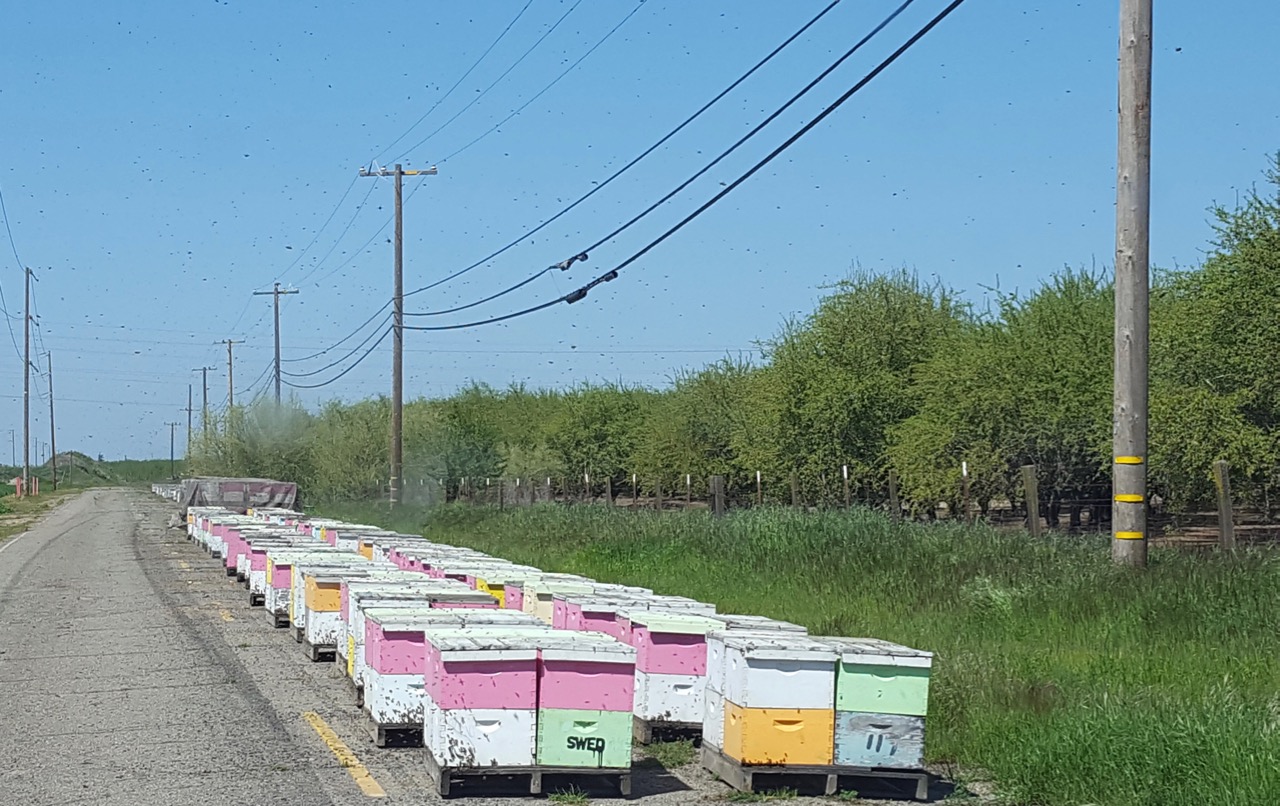
Tim Pelican, Agricultural Commissioner for San Joaquin County, recently explained to California Ag Today the critical importance for beekeepers to register the location of their delivered hives to farm operators, so the beekeepers can be notified when farmers are preparing to spray.

Pelican suggests farmers not spray during the day when bees are active, even if the product label does not suggest this restraint. He also reported that state agricultural commissioners are working on “our concern about the lack of notification by beekeepers to farmers about the exact location of their delivered beehives when we have instances of reported bee kills.”

“Beekeepers are supposed to register with the county,” Pelican explained, “when they move beehives into the counties. It is like a $5 fee, but for some reason people just do not do it. Beekeepers tend to be secretive sometimes, but we do keep all of that information strictly to ourselves. That’s not something we issue to the public.”

Pelican also mentioned that Ag commissioners will attempt to encourage farmers to notify schools about nearby spraying.

“We are actually notifying growers who are impacted. When they come in and do their pickup, their permits, we will have computers available to them to help them get their notification done. Their PCAs or dealers, if they are listed on their permit, can do the notification for them as well.”

“That notification then goes directly to the affected school,” he continued. “Then that school also can take a look and see which growers are applying what products. That information, however, is available only to the people who can get into the computer program—school officials, the grower, or the Ag commissioner. This is not information that is out there for the general public. The program has the ability to transfer the chemicals listed on the permit over to the notification. That way we are avoiding duplication of effort.”

2021-05-12T11:01:55-07:00March 29th, 2018|

Billy Synk Manages Seeds for Bees Program

Cover Crops and Bee Health

By Jessica Theisman, Associate Editor

California Ag Today recently spoke with Billy Synk, director of pollination programs with project Apis m (the genus/species of European honey bee). We asked him about bees and the importance of cover crops in relation to bee health, and orchard soil health.

Early this year was difficult year with the lack of rain.

“Those almond growers that were on drip did not really have great cover crop stands,” he said.

The project Apis m mustard mix  is a combination of canola, musters, and daikon radish that will bloom before the almonds and give the bees a boost of nutrition energy before the almond bloom starts.

“All these colonies from everywhere in America that are at their hungriest or at the weakest are placed in almond orchards, and they’ve got their most important job to do: that’s pollinate almonds,” Synk explained.

These cover crops are important to get bees stimulated before almond bloom.

“If you can get them stimulated before the almonds bloom, they are going to have a lot more vigor and vitality and really attack those blooms when it is time,” Synk said.

The bees go after the almond blossoms in what is called a positive feedback loop.

“They are looking for signs of spring, day length, and temperature, but they’re also looking for the very first fresh pollen to come in that year,” Synk said.

Bees will lay more eggs inside their hive when the new pollen comes.

“That brood has a pheromone that cues the bees to  leave the hive to harvest more pollen to support more bees, and the whole cycle continues,” Synk explained.

2021-05-12T11:05:13-07:00March 5th, 2018|

Kern County Ag Commissioner Notes Mild Winter

Weather and Pest Control this Season In Kern County

By Jessica Theisman, Associate Editor

California Ag Today recently spoke with Glenn Fankhauser, Agricultural Commissioner for Kern County. He let us know his thoughts about the weather in his county this season.

He said it has been a mild winter and it may affect future crop production. “We are not sure how it is going to affect fruit set. It could be negative for some of our stone fruits and cherries, but on the bright side, the mild weather allows farmers to plant certain field and vegetable crops earlier than normal,” Frankhauser said. “The little rain and shortage of water will challenge growers again this year.”

Fankhauser says that Kern County is doing what they can to stop Huanglongbing (HLB) disease, which is spread by the Asian Citrus Psyllid (ACP).  HLB is the number one disease in citrus because once a tree is infected with a bacterium, it is deadly to the tree.

“We have our traps set, we are monitoring the levels, and we have a treatment coordinator that helps the growers to maximize their effect on the Asian Citrus Psyllid,” Frankhauser said.  “By making sure the treatments are precisely coordinated, they are able to knock down more of the populations. There have not been any positive HLB trees in Kern County.”

Of course, any trees that become positive to the disease are immediately destroyed.

“We also have a group of citrus growers who are visiting homeowners and gaining voluntary removal of citrus trees at home,” he said. “They pay a nominal amount of money to allow a citrus tree to be removed. Once removed, they replace the citrus tree with a non-citrus shade tree.”

2021-05-12T11:01:56-07:00February 28th, 2018|

Thomas Fire Assistance Needs Improvement

Thomas Fire Assistance is Slow

By Patrick Cavanaugh, Farm News Director

The Thomas Fire in Ventura County was the largest wildfire in California history. We recently spoke with Henry Gonzalez, the Agricultural Commissioner for Ventura County, whose own home was affected by the fire, about the ongoing fallout from the disaster.

“I could see from my kitchen window the flame just onto the hill there, and fortunately, we’re protected by some of the orchards. Also, the wind was blowing in a favorable direction, so we were part of a voluntary evacuation area, so we were very fortunate,” Gonzalez said.

Henry Gonzalez

“We were ready to flee,” he explained. “We packed up our most prized possessions and were ready to leave at a moment’s notice. I stayed up until 2:00 in the morning that night of the fire, monitoring to see what was going to happen and then in the morning we saw that there was indeed still fire very close to my home.”

Gonzalez said that disaster assistance for agricultural losses is in need of reform.

“It’s a bit frustrating because some of the disaster assistance that’s out there through FSA, the Farm Service Agency wouldn’t pay until 2019,” he said.

“Any farmers or ranchers that had losses from the fire needed to have the money up front to pay for things, and that’s really not acceptable,” he continued.

“We need to have a disaster assistance program that meets the magnitude of the disaster,” Gonzalez said. “With the drought, that disaster happened slowly so people could make adjustments accordingly. But with something like this fire, it was so quick and of such magnitude that the assistance needs to also be as quick and matched the magnitude of the disaster.”

“And that’s where we really need to rethink what the FSA is doing and how they are doing it. It’s just a bureaucracy that goes so slow that by the time we get the assistance here, there’s going to be a number of agriculturalist that have gone out of business,”Gonzalez said.

2018-02-06T16:45:34-08:00February 6th, 2018|

Agriculture Created Buffer During Thomas Fire

Southern California Thomas Fire Hurt Agriculture

By Brianne Boyett, Associate Editor

The Thomas Fire that burned through Ventura County last December led to some major agricultural losses. California Ag Today spoke with Henry Gonzales, the Agricultural Commissioner of Ventura County, about the situation.

“There were 6,603 acres of avocados and then another 1,800 acres of lemons, about another 540 acres of oranges, and another dozen crops were affected,” Gonzales said.

“One of the things that we’ve seen is that these orchards actually provided a buffer between the fire and urban areas. They really saved us quite a bit. Some of the avocado orchards experienced significant losses; the very efficient irrigation systems that we have are sadly made out of plastic, and so they melted and we’re actually looking at two different disasters,” Gonzales explained.

“We’re still suffering from the impacts and effects of the drought … so everything was very dry, and then we had the Santa Ana winds, and it really created the perfect firestorm,” Gonzales said.

The rain this last year did help, but then it created more problems.

“It did help. No doubt. We didn’t get as much rain as many other areas. In Southern California, we were very happy to get the amount of rain that we did get,” Gonzales said. “But then it created mudslides that we’re now dealing with.”

2018-01-31T21:02:41-08:00January 31st, 2018|

Growers Face Fire Damage on Avocado Trees

Avocado Growers Should Not Cut Down Trees With Only Fire-Damaged Canopies

By Patrick Cavanaugh, Farm News Director

Avocado growers should not make quick decisions on what to do with fire damage on avocado trees. There are right decisions and wrong decisions.

Wildfires in Ventura County have burned over two hundred and thirty thousand acres, and avocado growers are among those affected by the fires;  many orchards have been burned. We spoke with Ben Faber, a UC cooperative extension farm advisor in Ventura County. He told us about this devastation, and how it’s affected avocado orchards.

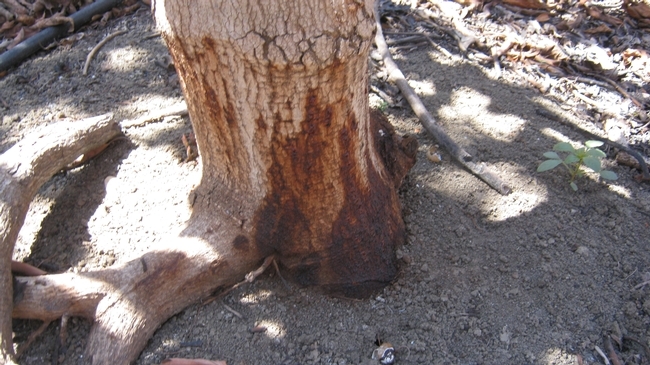
“I’ve been out looking at burned orchards, and it’s really too early to look. It looks worse than you see, so you see the burn canopies and it looks devastating, but they’ll come back,” Faber said. “It’s when you look at the orchard and see the green canopy and and you say, Oh gosh, I’m saved. But if you get down on your knees and you see these pustule, or boils round the base of the tree, that means the tree is gone.”

“This is tree sap underneath that’s boiled out,” Faber explained. “The cambium is damaged, and you may think, ‘Oh, everything is looking fine,’ and then you get a nice dry wind and the tree collapses all of a sudden because the can’t carry enough water to meet transpirational demand. Oftentimes, that means it was a crown fire and burned around the base of the trunk.”

“Some of the trees that looked the most damaged actually might be much better off than those showing little signs of damage. That’s why it’s important for growers to wait to assess the damage in their orchards,” he said.

In trees showing canopy burn, you’ll have to prune the tree. It’ll come back fine, according to Faber.

“What we are afraid of is that growers will respond in the wrong way. They’ll probably start cutting down trees that have lost their canopies and leave the ones that have a green canopy, and it might be the other way around,” he said. “We’re telling people, don’t do anything. Water if they need to and let nature take its course.”

Editor’s note: Photos by Ben Faber


2017-12-14T14:37:53-08:00December 14th, 2017|

Cover Crops Help Bees and Soil

Flowering Cover Crops Stimulates Bees

By Patrick Cavanaugh, Farm News Director

California Ag Today recently interviewed Billy Synk, director of pollination programs for Project Apis m and manager of the Seeds for Bees Project. The Project Apis m mission is to fund and direct research to enhance the health and vitality of honeybee colonies while improving crop production. He spoke on the benefits of cover crops for honeybee health.

“It’s an amazing project and an exciting project to work on and manage because it’s doing two good things at once. It’s a win-win situation. It’s helping out the soil and helping out bees,” Synk said.

When Synk speaks to growers, he mentions those two good reasons.

“Do it to help the bees that are in your orchard become stronger, and do a better job pollinating, but then also help your soil with organic matter and improved water infiltration.”

There are about two million beehives, coming to California from every corner of the United States, and the bees are very hungry.

“Not only are they very hungry, they’re the hungriest they have been all year, and their most important job is to pollinate almonds. Well, if you can have a cover crop blooming before those almonds bloom, you can stimulate them a lot better and create a positive feedback loop,” Synk said.

Synk explained that as more pollen comes into the hive, they rear more bees.

“That brood has a pheromone that tell the adult bees to leave the hive and go collect pollen. That stimulation is just going to make that hive excited and strong and ready to go the day that those almonds bloom,” he said.

Contact Project Apis m for more information and to possibly get cover crop seeds to plant this season.

https://www.projectapism.org/


2021-05-12T11:05:14-07:00December 12th, 2017|
Go to Top