
Environment

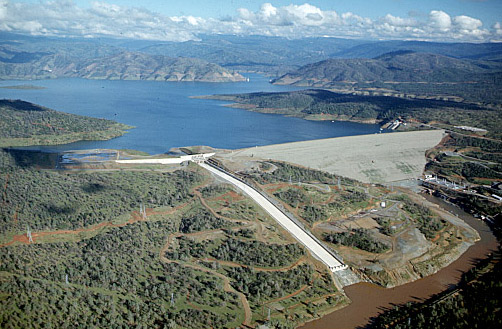
Saving Fish May Have Caused Oroville Disaster
Were Fish Cause of Oroville Dam Disaster?
By Jessica Theisman: Associate Editor
Reportedly, an effort to save millions of salmonoid fish below the Oroville dam may have caused a delay in releasing water from Oroville Dam on February 12. It set up the evacuation of at least 188,000 people in the area after authorities warned of an emergency spillway in the structure was in danger of failing and unleashing uncontrolled floods of water on towns below.
It was a near disaster and would have taken agricultural irrigation water with it, which has a lot of people asking questions. One person is Edward Needham. He provides agricultural services for growers throughout the state.
“I was trying to figure out what the missing piece was, why they could all of a sudden release 100,000 CFS and go from 65,000 to 100,000,” he said. Needham had spoken with a friend who worked at the refuge that day, who had told him he had been down at the fish hatchery, cleaning it out and saving all of the salmon.
“You’re telling me that they delayed the releases on the dam to save the four million salmon that were downstream?” Needham asked.
That may be correct! Many local news stations had reported that approximately 40 employees from the refuge were saving the salmon and loading them into trucks to be hauled away.
“That was two days before the dam nearly failed because of all the water it was holding back” Needham remarked.
Temperance Flat Could Control Floods
Association Calls for Flood Control through Temperance Flat
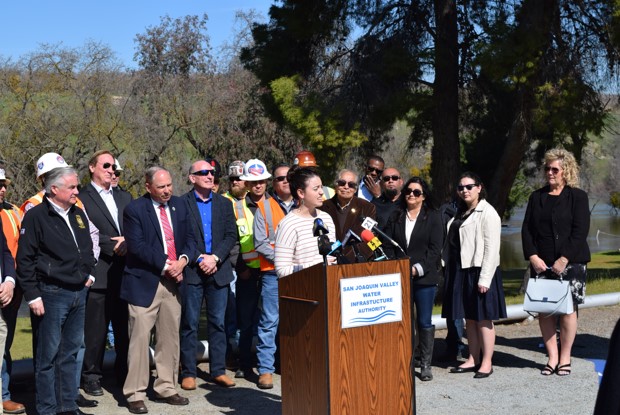
With the rising San Joaquin River in the background, board members of the San Joaquin Valley Water Infrastructure Authority (SJVWIA), assemblymen, city officials and stakeholders of the Temperance Flat project gathered recently to discuss the importance of flood control.
 The Western Ag Processors Assocation (WAPA) Director of Regulatory Affairs Jodi Raley spoke at a recent news conference highlighting the impacts of flood damage as it relates to agriculture. Noting the acres of valuable agricultural land along the river, Raley expressed that while it is important for the future dam to capture water, this season, we are seeing how the project would play a critical role in flood control.
Many acres of orchards and fields have experienced saturation or an inundation of water during this heavy rain season. These conditions on an extreme not only lead to situations concerning crop health, but could also result in loss of jobs for ag workers in affected areas.
In addition, it was highlighted that the amount of water released from Friant, currently 9,000 cubic feet/sec (cfs), has very little to no demand. It is being said that with the rain received and the significant snow pack in the Sierras, Millerton Lake will receive enough water to be drained and refilled seven times over.
The SJVWIA and the Technical Advisory Committee, along with the large breadth of stakeholders, are calling upon Governor Brown to recognize the need for this project’s construction. Raley said that the association will continue to push and fight for the construction of Temperance Flat to bring more water not only to the Central Valley, but to the entire state.
Paraquat Resistance in Weeds?
Weeds Now Showing Paraquat Resistance
By Patrick Cavanaugh, Farm News Director
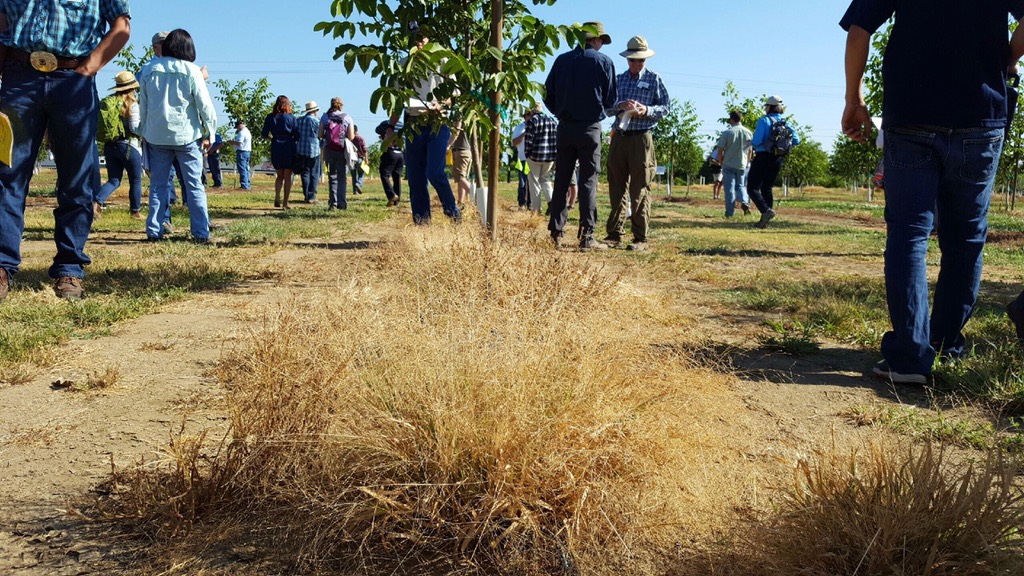
There’s been weed resistance to glyphosate herbicide, but now some weeds show resistance to paraquat herbicide.
“When we see paraquat resistance at often a very high level of resistance, it doesn’t cause any visual injury, which is different than a lot of cases,” said Brad Hanson, a UC Cooperative Extension Weed Specialist at UC Davis.
“We’re dealing with a lot of glyphosate resistant weeds right now, and when you spay glyphosate on the resistant weeds, they are slightly injured and then they recover,” said Hanson. “With paraquat resistance, it’s very stark. You often don’t see any symptoms at all. I describe it almost as immunity. It’s such a high level of resistance.”
“We have glyphosate resistance to annual ryegrass and hairy fleabane, and we have some populations of those same weeds that are resistant to paraquat,” Hanson said. “We see a very temporary reduction in the photosynthetic ability, but within a few hours it bounces back to normal.”
The plant is taking that active herbicide molecule, and it is being sequestered. It’s taking that molecule and putting it somewhere in the cell where it cannot get to the photosynthetic apparatus that’s its target site. It’s a very unique and interesting kind of resistance challenge.
“I think we’re talking about multiple resistance to paraquat and glyphosate. The grower likely switched to use paraquat in order to kill the glyphosate resistant weeds, and then the weeds selected paraquat resistance on top of that.”

Early Registration Open for MRL Workshop in San Francisco
Annual MRL Harmonization Workshop May 31 to June 1
The California Specialty Crops Council will hold its twelfth annual 2017 MRL Harmonization Workshop May 31-June 1 in San Francisco. The interactive seminar based on maximum residue limits (MRLs) will address critically important issues for stakeholders with interests in exporting agricultural products.
Registrants, growers, packers, shippers, PCAs, regulators, trade experts, and other stakeholders in international trade are strongly encouraged to attend. Presentation topics include: international trade trends, global registrations, pesticide residue monitoring, MRL strategies for growers, updates for international residue standards, global MRL challenges, and research reports regarding the impacts of residues.
Ed Ruckert, Partner at McDermott Will & Emery LLP, will kick off the Workshop discussing “Pesticide Regulatory Trends in the New Administration.” Julia Doherty from the US Trade Representative will discuss “Recent Work in the WTO SPS Committee on Pesticide MRLs.” The agenda also includes international speakers from the EU, Korea, Australia and Taiwan.
A copy of this year’s speaker lineup can be found at the link below. The Workshop will be held at the Hyatt-Fisherman’s Wharf in San Francisco. On-line pre-registration is required by May 22. For all meeting, hotel information and an updated agenda go to http://specialtycrops.org. The registration fee is $425 by March 31 and $475 after that date.
The California Specialty Crops Council (CSCC), a 501(c) 5 non-profit organization, is a trusted source of field-based information spanning horticultural crop production, pest management, food safety and stewardship activities in fruit, root, vegetable, vine and berry crops (fresh, dried, and processed). Its diverse partnership of ag organizations also includes the CA State Beekeepers Association. Combined, CSCC growers generate almost $4.1 billion annually on approximately 522,000 acres of California farmland.

EPA Reviews Agricultural Pyrethroids
Pyrethroid Products Reviewed
By Brian German, Associate Broadcaster
Pyrethroids are synthetic chemical insecticides that are included in more than 3,500 registered products, with many of those being used in agriculture. Every 15 years, the Environmental Protection Agency is required by congress to review all registered pesticides. They received their first-ever review evaluating how they impact fish and aquatic plants.
John Cummings is the Registration and Regulatory Affairs Manager for FMC, a diversified chemical company that has been serving the agricultural community for over a century. “We are very concerned with the content of that risk assessment – that they have identified that there is high-risk concerns to certain aquatic organisms, not necessarily fish or anything like that, but small aquatic organisms,” Cummings said.
The underlying purpose of these kinds of reviews is to ensure public safety, especially when reviewing products used in ag production. “They’ve done a very high level, simple, cursory risk assessment that has identified these concerns,” Cummings said.
During the past decade, the use of pyrethroids has increased, as the use of organophosphate pesticides continues to decline. That is due to their higher toxicity to birds and mammals when compared to pyrethroids. Cummings expressed his concern regarding the data that the EPA bases their decision on. “There’s been other actions by EPA recently around the use of the best available data and the best science around risk assessment. … The EPA should be using the best science to make the right regulatory decisions while protecting the environment,” Cummings said.
Through their industry consortium, the Pyrethroid Working Group, FMC is in the process of putting data together that they hope the EPA will take into consideration. Cummings explained that their research will “make it more real world while still conservative and protecting the environment. It’s more real world and typical of how these products are used.”
Pyrethroids are a broad-spectrum insecticide that have shown tremendous success in controlling a variety of different insects considered to be economically important to the ag industry. “Pyrethroids are a very important element of both integrated pest management as well as resistance management. Growers today are facing very complex insect control problems, and it’s necessary to have many tools in the tool box,” Cummings said.
“I think EPA needs to understand how important it is to consider the benefit of these to production agriculture as well as society, in feeding the world,” Cummings concluded.
The public comment period for the EPA’s risk assessment has been extended to March 31st.
Ag Stakeholders are urged to comment at http://www.defendbifenthrin.com
Recharging Aquifer: Job One Today
Water Districts Recharging Aquifer
By Patrick Cavanaugh, Farm News Director

David Nixon, Deputy General Manager of the Arvin Edison Water Storage District
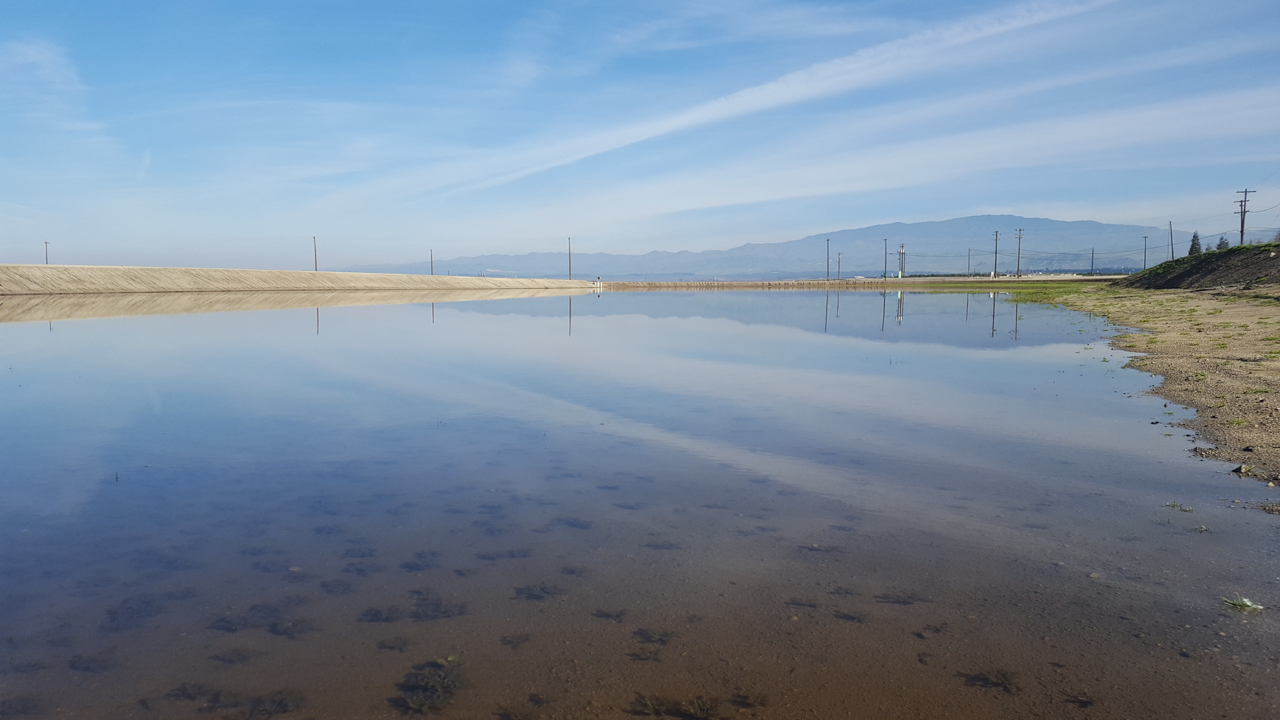
With the reservoir and all water district canals brimming, there is a great effort to move water into underground aquifer recharge ponds, said David Nixon, general manager of the Arvin-Edison Water Storage District in Kern County.
“Absolutely, we tried to get every acre foot of water in this district we possibly can,” he said. “With that water at this time of year, before it’s needed by agriculture, it’s all about water storage and rebuilding that underground aquifer.
“We have about 1500 acres of recharge ponds that we can use to refill the underground aquifer,” Nixon said.
It has been a great, wet year, with Middleton Lake filling in Fresno County, and water moving Southward in the Friant-Kern Canal all the way to Kern County, right where Arvin-Edison Water Storage District is located.
“It’s beautiful out there. Ponds are full, and hopefully, if everything works out with our water supply, they’ll be full all year long,” Nixon said.
“We take a wet year supply and turn it into dry year water. When we do not have ample water supply for the 53,000 acres that are under a long-term surface water contract with us, then we will run our wells,” Nixon said.
This year will not be one of those years.
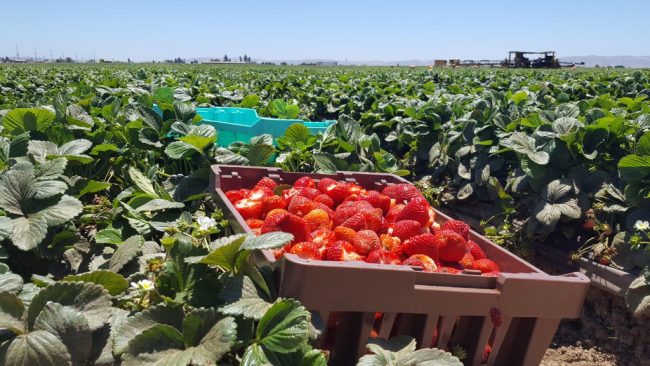
Post Methyl Bromide Era Creates Questions
Without Methyl Bromide, Then What?
By Brian German, Associate Broadcaster
Methyl bromide was first identified as an ozone-depleting compound in 1991 and was scheduled to be phased out by 2005. California strawberry growers found it irreplaceable and fought for exemptions that allowed the fumigant to be used through 2016. Mark Bolda is a UC Cooperative Extension Farm Advisor who specializes in strawberries and caneberries and also serves as the County Director for Santa Cruz County. He discussed the work being done to find an effective alternative to methyl bromide.

Mark Bolda is working to help berry growers with the loss of Methyl Bromide
“It’s not just one thing does it all; it’s going to be one thing and then you add other things on top of that. … We don’t have the silver bullet anymore; it’s gone. We need to figure it out using the systems approach,” Bolda said.
The inability to use methyl bromide is causing some concerns for strawberry growers, who are looking at what new type of management approach to take. “Everybody’s familiar with the concept of integrated pest management for insects, and really, we need to approach this post methyl bromide era using integrated pest management,” Bolda said.
Growers are worried about how vulnerable their crops are going to be to various soil diseases without methyl bromide, as researchers have yet to find an alternative that is equally effective. One of the ways to combat disease is to focus on the details of planting.
“In strawberries, you have different chill times. You know, if you add cold conditioning, you give the plant more vigor. The colors of the plastic that you’re using to manage the temperatures of the soil, the amount of fertilizer that your using, all of these things now, we need to start to integrate into the way we are growing the strawberries,” Bolda said.
Methyl bromide controls a variety of pests in agriculture. It was also commonly used to treat commodities like grapes, asparagus and other imported goods to prevent introducing pests to the U.S. Bolda expressed disappointment in the lack of preparation in finding an adequate replacement for methyl bromide. “Here we are, zero hour, and we don’t have this worked out. I think, to some extent, there’s been a lack of leadership in the industry,” Bolda said.
The quest for replacing the fumigant might have gotten a late start, but industry experts have been working double-time to find solutions. “We have got all of the researchers in this industry together, working as a unit, and there’s a lot of smart people working on this problem right now. …. What do we need to research? What do we know? What do we not know? Let’s go,” Bolda said.
Nearly 90 percent of methyl bromide use in California was for pre-plant soil fumigation in strawberries, nursery crops, grapes, and tree fruits and nuts. Growers are preparing for a 5 to 10 percent drop in yield as a result of methyl bromide’s absence and are looking for ways to make up that deficit.
“Maybe using more precise fertility practices, adding cold conditioning to the plant, taking it away, using different varieties. All of this is going to start to go into this system,” Bolda said
The phasing out of methyl bromide is most impacting to the strawberry industry, which is California’s third most valuable crop behind almonds and grapes, with annual farmgate sales of $2.5 billion dollars. The biggest disease threats to strawberry fields are macrophomina phaseolina and fusarium, which can both have devastating results in crops. “It’s plant collapse. You’ll see it kick in once the plant loads up in fruit and gets a little warm. It’s just too much stress for the plant,” Bolda explained.
Methyl bromide will be missed by growers, but its absence is allowing them to demonstrate their creativity in finding new solutions to a problem. “We’re starting to see some methods that are pretty interesting,” Bolda said. One such method is steam, which involves pushing steam into the soil to kill certain pathogens.
Breeding in resistance to disease can also be beneficial; however, it can have some negative consequences as well. “When you have strong tolerance, you’re taking a hit on something else. There’s no such thing as a free lunch. You might have a plant that’s super resistant but then the yields are low, it doesn’t fruit until late. There’s always the trade off,” Bolda said.
Getting a good chill before planting can also be effective in making the plant more vigorous and better able to withstand disease pressure. “It’s a little complicated because the longer you chill, the later you’re planting times get, and if you’re planting in the middle of December, [there’s] not a light of sunlight in the middle of December, so you know, there’s a trade off there too,” Bolda said.
Crop rotation can also assist with some soil diseases, but more research is needed to determine just how effective it is.
Methyl iodide was showing some success as a possible replacement for methyl bromide, but its use became a problematic issue. “It became a political problem. I don’t think the industry stood it’s ground on it, and the industry, basically they struck their flags and left the field. Of course, the entire problem was defined by the opposition,” Bolda said.
Growers might have some difficulty working out a new pest management program without the use of methyl bromide, but Bolda explained that understanding the problem at hand is an excellent step in the right direction. “Don’t just turn scientists loose and just say, ‘study and do experiments.’ No. Define the problem. I think what we’ve done with the fumigants over this last two years. Getting everybody together and working as a unit, we have defined the problem and now that mental energy and that mental potential is moving. You need to define it in order to bring the people in to solve it,” Bolda said.
It’s going to take some time to work out a program that best replaces methyl bromide, but Bolda is optimistic about the future. “Sometimes the solutions aren’t so obvious, but they’re starting to show up and you know, the thing is that some of these will be radically different,” Bolda said.

Pyrethroids Under Review
EPA Reviewing Pyrethroids
Ag Industry Urged to Comment
By Patrick Cavanaugh, Farm News Director
The pyrethroid insecticide class is in review for ecological risk assessment by the Environmental Protection Agency. John Cummings, Registration and Regulatory Affairs Manager at chemical company FMC believes that the assessment could have a large impact on producers.
Agricultural leaders have urged all to comment on the need to keep this chemistry available. Please share your thoughts by clicking here.
“At FMC, we’re very concerned with the content of that risk assessment that they’ve identified that there’s high risk concerns to certain aquatic organisms, not necessarily fish or anything like that, but small aquatic organisms,” Cummings said. “Our concern, as a company who manufactures these pyrethroids, which are used in California, is that the EPA has not used the best science that’s available. They’ve done a very high level simple cursory risk assessment that has identified these concerns.”
More than 3,500 registered insecticides contain a pyrethroid. Many pyrethroids are household products and are not limited to agricultural usage.
“Our hope, as a pyrethroid company, is that EPA will consider better data which FMC and our industry consortium, the Pyrethroid Working Group, are developing to incorporate into this risk assessment. We need the EPA to look at the real world of how these products are used. With that, that risk assessment should look much better and remove any of these risk concerns that EPA currently has,” he said.
There have been other actions conducted by the EPA around the use of the best available data and the best science in risk assessment. These kind of precedents will impact production agriculture in the U.S. as well as California.
“EPA should be using the best science to make the right regulatory decisions while protecting the environment,” Cummings said. “It is very important, and I think it’s important, too, that EPA understand the implications of taking a conservative approach and making regulatory decisions that may impact production. I think EPA needs to understand how important it is to consider the benefit of production agriculture in feeding the world.”
It is important to keep many pest control products available to prevent the overuse of one product. Pesticide resistance is a growing problem, and it is essential that producers are able to keep all of their options open.
“Pyrethroids are a very important element of integrated pest management, as well as resistance management. Growers today are facing very complex insect control problems,” Cummings said.
“It’s necessary to have many tools in the toolbox to control insects. We have multiple classes of chemistry, but based on regulatory decisions, the EPA could potentially remove some of these important tools, which puts more pressure on other tools that remain in the toolbox, and insects may become resistant to many of these tools,” Cummings explained.
“Pyrethroids are a critical broad spectrum insecticide that are very affordable and control a lot of different insects that are economically important,” Cummings said.
Bob Klein, the manager of the Pistachio Research Board, agrees that pyrethroids are essential to pest management.
“The use of pyrethroids goes hand-in-hand with the use of soft chemicals like the growth regulators, or some of the neonicotinoids, or some of the other new chemistries we have,” Klein said.
“It guards against resistance development in those other chemicals as well. The inclusion of pyrethroids by the University of California, and many other Integrated Pest Management manuals, shows that pyrethroids are an important part of any IPM program. IPM programs are the way that people control pests in their orchards,” Klein said.
The risk assessment is currently open for comment and will remain open until March 31st.
Comment: Here

Recharging Aquifers Using Floodwaters
Floodwaters Could Recharge Aquifer
By Brian German, Associate Broadcaster
Last October, the Almond Board of California announced new partnerships with Sustainable Conservation, Land IQ and UC Davis researchers to look at ways floodwaters could recharge Central Valley groundwater aquifers. Daniel Mountjoy is the Director of Resource Stewardship for Sustainable Conservation, an organization helping to solve some of the challenges facing our land, air and, most importantly, water.
Mountjoy explained the idea behind the partnership: “The concept is, ‘Can we capture the available peak flows when they’re available from surface supply and recharge the groundwater so that it’s available during dry years when surface flows are under stress from environmental needs and other demands for it?’ ”
The thought is to use surface irrigation water during times of availability in order to flood almond orchards to recharge the aquifers. This would not only help growers during times of drought, but also benefit those with limited access to surface irrigation. Mountjoy has found some success in their research. The initial focus will be on sandy soils, where the infiltration is really fast.
The concept behind the effort has already shown a level of success on a smaller scale. “In 2011, Don Cameron at Terranova Farms in Western Fresno County captured 3,000 acre feet of water on 1,000 acres of sandy farm land. He infiltrated on pistachios, grapes and alfalfa fields in some fallow land during winter, as well as well into June and July on some of those crops,” Mountjoy said.
Partnerships like these are needed as California begins to fall under the full implementation of the Sustainable Groundwater Management Act. “What we’re doing with the Almond Board right now is looking for sites in the Sacramento Valley, because there’s more likelihood that we’re going to have water supply there to test the concept. Both UC Davis and Sustainable Conservation are out working with growers,” Mountjoy said.
UC Davis will be working on the crop health aspect, while Sustainable Conservation will be looking into how much water can be put on different crops and what types of management compatibility there is with the crop. Once a significant amount of data is collected, the next step in the process will be looking towards how to further incentivize the method for growers. “Any time you recharge an aquifer, it becomes everyone’s aquifer. There’s still not a system in place to credit landowners for the benefit they are providing to their neighbors and to other irrigation pumpers,” Mountjoy said.
There are over one million acres of almonds stretching roughly 500 miles from Red Bluff to the south end of the San Joaquin Valley. Nearly two-thirds of that land is considered moderately good or better in its ability to percolate water into the underlying aquifers. “We have to prove the viability that you can actually do this on farm land across extensive acres, because that’s really the cheapest solution, rather than buying land, dedicating it to recharge basins and managing it that way without production of crops,” Mountjoy said.
