HLB Found in LA

Huanglongbing Detected on LA County Pre-Symptomatic Kumquat Tree


By Patrick Cavanaugh, Farm Director; Laurie Greene, Editor, California Ag Today


#CitrusMatters

#CitrusMatters (provided by Bayer CropScience, in partnership with California Citrus Mutual)

“It’s disappointing, but fortunately it was found in a residential area,” commented Joel Nelsen, president of California Citrus Mutual (CCM), on the second discovery of Huanglongbing  [wong-long-bing] (HLB), or citrus greening, in California. CCM refers to HLB as “a death sentence for California citrus” as once the plant is infected with this bacterial disease, there is no known cure.

Joel Nelsen

Joel Nelsen, president, California Citrus Mutual

“HLB was detected in plant material taken from a kumquat tree in a residential neighborhood in the San Gabriel area of Los Angeles County,” Nelson stated. “The 20-year-old tree was in the front yard of a residence and had not yet shown any symptoms.”

The San Gabriel neighborhood is located about 15 miles from Hacienda Heights, where the first HLB case in the state was detected in 2012 in a residential citrus tree. The  An aggressive trapping program for the Asian citrus psyllid (ACP), a pest known to spread the HLB bacteria as it feeds on citrus trees and other plants, has been ongoing ever since this first finding, including in the San Gabriel area.

“It’s fortunate that the homeowner is quite cooperative,” said Nelsen, “and other neighborhood homeowners are allowing officials to run PCR tests (polymerase chain reaction) on samples of their trees to determine if the disease is present.” PCR analysis is a sensitive research technique for detecting and identifying small numbers of bacteria in plants via DNA amplification.

Nelsen declared, “This find is exactly what the Citrus Pest and Disease Prevention Program is designed to do. PCR testing of a random sampling of leaves and stems in the area, as our program prescribes, enabled us to hit a positive” before symptoms appeared.

“We do not know how long the tree had been diseased,” said Nelsen, “but we do know that we have been trapping ACPs there for a long time and had not found any HLB before. You do not want to

Citrus Pest & Disease Prevention Program

find anything,” Nelsen said, “but when you do, you want to find it before it becomes an epidemic.”

In a statement on Friday, California Department of Food and Agriculture (CDFA) Secretary Karen Ross said, “Citrus is a cherished part of our landscape and our shared history, as well as a major agricultural crop.” CDFA has been planning and preparing for HLB detections since before the first ACP was detected in the state in 2008. Quarantines are now in place in 17 California counties.

Los Angeles County Agricultural Commissioner Kurt Floren will mobilize his team over this week to check on citrus trees in plant nurseries that fall within the 800-meter radius around the infected tree area. A spray protocol is already in place for all citrus trees within the 800-meter radius.

“More traps are going out so we can try to delineate the scope of the problem. Hopefully it will be nothing more than this one tree, like the solitary diseased tree we found in Hacienda Heights,” Nelsen said.

Resources

To support the citrus industry in its fight against HLB, go to California Citrus Mutual Action Center.


For questions about the ACP or HLB, visit or call CDFA’s toll-free pest hotline at 1-800-491-1899.


View the Distribution Map  of ACP, HLB and parasites in California published by the UNIVERSITY OF CALIFORNIA Division of Agriculture and Natural Resources.

USDA's free "Save Our Citrus" iTunes app

USDA’s free “Save Our Citrus” iTunes app


Visit the Citrus Pest & Disease Prevention Program.


Verify plant symptoms at USDA’s SaveOurCitrus website.


For information and ACP solutions, go to #citrusmatters, provided by Bayer CropScience, in partnership with California Citrus Mutual

 

2016-05-31T19:28:11-07:00July 13th, 2015|

UC ANR Horticulture Advisor Retires After 28 Years

John Kabashima wrapped up his horticultural career on July 1, after 28 years with University of California Agriculture and Natural Resources. Nursery professionals lauded the UC Cooperative Extension advisor’s service to the nursery and landscape industry and to homeowners in Orange and Los Angeles counties.

“He’s one of the few people who could translate science into business with a sense of candor and fact-based conversation,” said Robert Crudup, president of Calabasas-based Valley Crest Tree Company, of Kabashima.” John has long-term vision, which he used throughout his career to move the nursery industry forward.”

John Kabashima

John Kabashima, UC ANR

“He is smart about political science as well as plant science,” Crudup said. On a regular basis, Kabashima would warn growers about emerging issues that were likely to affect the nursery industry, such as regulations to control the spread of polyphagous shot hole borer, red imported fire ant and palm borer.

“He’s been very, very valuable,” said retired nurseryman Gary Hayakawa, noting that Kabashima not only contributed research on pest control and water issues for the nursery and landscape industries, but also persuaded people from UC campuses, the California Department Food and Agriculture and industry to work together. “Before he was involved in issues, the work was all separate. Industry didn’t have input,” Hayakawa said. “What John has done is to work with all three to form a coalition.”

Crudup, whose company has nursery operations in Los Angeles, Ventura, Alameda and San Joaquin counties, agreed.

“John’s biggest contribution was his work with the glassy-winged sharpshooter subcommittee,” said Crudup, who served on the subcommittee. “He brought a voice of reason that helped counterbalance emotional sides of the discussion.”

“His ability to act as the primary liaison between the nursery industry, CDFA, the UC, the county agricultural departments and the wine and grape industries was the primary reason this part of the GWSS (glassy-winged sharpshooter)  program was so successful and, more importantly has resulted in the continued viability of the California nursery industry in light of significant regulatory pressures,” said Bob Wynn, who was statewide coordinator of the CDFA Pierce’s Disease Control  Program and who  continues to oversee the program as senior advisor to Secretary Karen Ross.

“The CDFA, with advisement and counseling from John, developed what is known as the Approved Nursery Treatment Program, which allows nurseries in the infested areas of the state to ship by merely treating the plants with an approved treatment,” Wynn said.  “John was the primary author in the development of the nursery ‘Approved Treatment Best Management Practices’ document published in 2008. The use of this document has allowed the nursery industry to save millions of dollars in regulatory compliance costs over time.”

A native of Los Angeles, Kabashima says he started working in his family’s nursery business as soon as he was tall enough to water 1-gallon nursery plants.  “After killing thousands of plants, I was finally allowed to manage the family business from 1970 to 1976,” he quipped.

In 1976, his family sold the nursery and Kabashima enrolled at California Polytechnic University, Pomona. After he  earned a B.S. in agricultural biology from Cal Poly Pomona in 1979, he was hired by UC Riverside horticulture entomologist Pat Morishita as a lab technician. While working at UC Riverside, Kabashima earned a  master’s degree in pest management. He would later complete a Ph.D. in entomology at UC Riverside.

Kabashima earned his MBA at Pepperdine University in 1986 while managing the Ornamental Horticulture Division at Target Specialty Products. In 1987, the UC Division of Agriculture and Natural Resources recruited him to become a UC Cooperative Extension environmental horticulture advisor in Orange and Los Angeles counties.

Over the years, he has studied the management of insects, diseases and weeds in horticulture production systems, biological control of exotic pests, and water-related problems in landscapes, golf courses, nurseries, municipalities and watersheds.

In 1998 Kabashima took over the fledgling UC Master Gardener Program in Orange County, which as of now has trained more than 300 UC Master Gardener volunteers to extend research-based information on gardening and horticulture to the public.

The UCCE environmental horticulture advisor has also served as director of UC Cooperative Extension in Orange County and interim director of the UC ANR South Coast Research and Extension Center.

In 1994, when Orange County filed for bankruptcy and the Board of Supervisors voted to discontinue funding and housing for the local UC Cooperative Extension, Kabashima worked with Gary Hayakawa to keep UCCE in the county.

“When Orange County cut Cooperative Extension’s budget, we found out that without extension you don’t have 4-H or Master Gardeners,” Hayakawa said. To preserve the UC Cooperative Extension programs, Hayakawa, who was an Orange County Fair Board member, helped Kabashima  secure office space in trailers on the fairgrounds. In 2014, the UCCE office moved from the fairgrounds to UC ANR South Coast Research and Extension Center in Irvine.

Kabashima belongs to many professional organizations including the Entomological Society of America, California Association of Nurseries and Garden Centers, Nursery Growers Association, Western Chapter of the International Society of Arboriculture, United Agribusiness League, and San Diego Flower and Plant Association. The scientist has served on numerous government and industry advisory committees.

Throughout his career, Kabashima’s achievements in education and research have been recognized by various organizations. To name a few, he received the 1987 Education and Research Award from the Orange County Chapter of the California Association of Nurseries and Garden Centers (CANGC), 1993 CANERS Research Award from CANGC, 2002 Nursery Extension Agent Award from the American Nursery and Landscape Association, 2008 Western Extension Directors Award of Excellence, 2010 Entomological Society of America’s National IPM Team Award and the 2011 California Agriculture Pest Control Advisors Association Outstanding Contribution to Agriculture Award. In 2014, he and his friend Hayakawa were inducted into the Green Industry Hall of Fame.

Being a UCCE advisor has suited Kabashima. “I love learning new things, sharing that information with others, and using my skills to solve problems facing California, such as the ever-increasing arrivals of exotic and invasive pests,” he said. The avid photographer has been able to unite his avocation with his vocation. His photographs of insects have been used to illustrate textbooks, websites and news articles.

“Success in one’s field is often a combination of natural ability, informal and formal training and education, being mentored, and networking with collaborators and colleagues, all sprinkled with a little bit of luck and support from one’s family and friends,” Kabashima said.

In retirement, Kabashima plans to seek new culinary experiences with his wife Janet and daughter Misa, at  home and in their travels together. He has been granted emeritus status by UC ANR and he will continue his efforts to help UC Irvine save trees on its campus that are infested with polyphagous shot hole borer.

UC Agriculture and Natural Resources researchers and educators draw on local expertise to conduct agricultural, environmental, economic, youth development and nutrition research that helps California thrive. Learn more at ucanr.edu.

2016-05-31T19:28:11-07:00July 12th, 2015|

BREAKING NEWS ON HUANGLONGBING CITRUS DISEASE

HUANGLONGBING CITRUS DISEASE DETECTED IN SAN GABRIEL AREA OF LOS ANGELES COUNTY
CDFA
Release #15-031

Sacramento, July 10, 2015 – The California Department of Food and Agriculture (CDFA) and the United States Department of Agriculture (USDA) have confirmed detection of huanglongbing (HLB) citrus disease, or citrus greening. The disease was detected in plant material taken from a kumquat tree in a residential neighborhood in the San Gabriel area of Los Angeles County.

This is the second time HLB has been detected in California. The first detection occurred in 2012 in a residential citrus tree in Hacienda Heights, about 15 miles from San Gabriel.

HLB is a bacterial disease that attacks the vascular system of plants. It does not pose a threat to humans or animals. The Asian citrus psyllid (ACP) can spread the bacteria as the pest feeds on citrus trees and other plants. Once a tree is infected, there is no cure; it typically declines and dies within a few years.Residential Citrus Trees

“Citrus is a cherished part of our landscape and our shared history, as well as a major agricultural crop,” said CDFA Secretary Karen Ross. “CDFA is moving quickly to protect the state’s citrus. We have been planning and preparing for HLB detections with our growers and our colleagues at the federal and local levels since before the ACP was first detected here in 2008.”

A CDFA crew has removed and disposed of the infected tree and is preparing to conduct treatment of citrus trees for ACP infestation within 800 meters of the find site. By taking these steps, a critical reservoir of disease and its vectors will be removed, which is essential.

An intensive survey  of local citrus trees and psyllids is underway to determine if HLB exists anywhere else in the area. Planning has begun for a quarantine of the area to limit the spread of the disease by restricting the movement of citrus trees, citrus plant parts, green waste, and all citrus fruit except what is commercially cleaned and packed. As part of the

SAVE OUR CITRUS app is a free USDA iPhone to report and identify the four leading citrus diseases: citrus greening, citrus canker, citrus black spot and sweet orange scab. Report your symptoms, upload a photo and  citrus experts will respond.

SAVE OUR CITRUS app is a free USDA iPhone to report and identify the four leading citrus diseases: citrus greening, citrus canker, citrus black spot and sweet orange scab. Report your symptoms, upload a photo and citrus experts will respond.

quarantine, citrus and closely related plants at nurseries in the area will be placed on hold.

Residents of quarantine areas are urged not to remove or share citrus fruit, trees, clippings/grafts or related plant material. Citrus fruit may be harvested and consumed on-site.

CDFA, in partnership with the USDA, local agricultural commissioners and the citrus industry, continues to pursue a strategy of controlling the spread of ACPs while researchers work to find a cure for the disease.

HLB is known to be present in Mexico and in parts of the southern U.S. Florida first detected the pest in 1998, and the disease in 2005, and the two have now been detected in all 30 citrus-producing counties in that state. The University of Florida estimates that the disease causes an average loss of 7,513 jobs per year, and has cost growers $2.994 billion in lost revenue since HLB was first detected in that state in 2006.

HLB has also been detected in Georgia, Louisiana, South Carolina and Texas, as well as Puerto Rico and the U.S. Virgin Islands. A total of 15 states or territories are under full or partial quarantine due to the detected presence of the Asian citrus psyllid: Alabama, American Samoa, Arizona, California, Florida, Georgia, Guam, Hawaii, Louisiana, Mississippi, Northern Mariana Islands, Puerto Rico, South Carolina, Texas, and the U.S. Virgin Islands.

The ACP was first detected in California in 2008, and quarantines are now in place in 17 California counties. If Californians have questions about the ACP or HLB, they may call CDFA’s toll-free pest hotline at 1-800-491-1899 or visit:  http://www.cdfa.ca.gov/phpps/acp/.

2016-05-31T19:28:11-07:00July 10th, 2015|

CROPS ACTUALLY BORROW WATER VIA TRANSPIRATION

Almonds and All Other Crops Borrow Water Via Transpiration

By Patrick Cavanaugh, Associate Editor

Editor’s note: We interviewed Allan Fulton, UC Cooperative Extension Irrigation and Water Resources Farm Advisor, Tehama County, on an important, yet overlooked, process of a plant’s water use in agriculture. We zeroed in on a major process all plants have called transpiration in which crops borrow water.

Allan Fulton

Allan Fulton, UC Cooperative Extension Irrigation and Water Resources Advisor,
Tehama County

California Ag Today (CAT): We hear in the media that our crops are using too much water. And while all plants need water to grow food, we also know that a big percentage of the water taken up by all plants actually transpires out of the plant, back into the atmosphere, to form clouds and precipitation, right?

Fulton: Yes, the water just returns to the hydrologic cycle.  Most of the crops we are distributing, whether within the US or globally, are actually very low in water content.

CAT: When we think about transpiration, the plants are actually borrowing the water. Isn’t that true?

Fulton: We get a lot of questions from the general public about why we irrigate our crops so much.

The truth is, plant transpiration is a necessary biological process. The water cools the tree so it stays healthy. The water exits the leaves through special cells called stomata. While they are open, stomata allow water to transpire and carbon dioxide to enter the plant for photosynthesis, making sugars and carbohydrates, which, in turn, are used to make the fruits and the nuts that we eat.

So if we don’t have an adequately watered plant that is allowed to transpire, the plant won’t get enough carbon dioxide. The plant will grow defective fruits, and nuts—smaller, shriveled, cracked, all the things that the typical consumer does not want to buy.

CAT: Now, when we are talking about transpiration, can we say  most of the water taken up by the plant ends up being transpired back to the environment for reuse? So the water transpired by the plant is definitely not being wasted?

Fulton: Definitely. Since we converted to pressurized systems, micro-sprinklers and mini-sprinklers, we have a lot more control over how much water we apply at any one time. We no longer measure water output in depths of acre-feet, or even 4-6 inches at a time anymore. Much like rainfall, we measure it in tenths of an inch, or 1 or 2 inches at most.

As a result, we use less water, so it doesn’t penetrate the soil very deeply, maybe only 1 or 2 feet each irrigation. We are very efficient with the water; but, we have to irrigate very frequently because we apply it in small doses, and we run our irrigation systems a lot. So,   we are definitely using systems that stretch the water supply, not waste it.

CAT: But again, the vast majority of the water that the tree takes up is transpired, right?

Fulton: Yes. Most of the time, at least 90% of the water we apply is taken up through the tree and transpired for photosynthesis to occur.

CAT: Does transpiration increase on a hot day?

Fulton: Yes, plus the plant looses a bit from surface evaporation  from the wet soil, but we try to control that with smaller wetting patterns and drip-confined wetting patterns.

When you think about it, the heat of the day occurs in the afternoon, and many systems don’t run because of energy costs.  There are incentives not to pump in the middle of the afternoon; but for those who do, try to confine the wetted area to limit evaporation. The hot hours of a day comprise about 4 hours of a 24-hour cycle, so a lot of irrigation occurs at night-time or in the early morning hours to lesson evaporative loss.

CAT: Growers are doing everything they can to conserve water. If the trees and vines are all transpiring most of the applied water, what is the problem with using water to grow food?

Fulton: I think the concept throughout the United States has always been to secure our food supply. That security has many benefits—economically and politically. In the end, we are trying to provide the general public with great quality, safe food, at the best price possible.

CAT: And nutritious food. We are growing the food people need more of.

2016-05-31T19:28:11-07:00July 10th, 2015|

UC Cooperative Extension Farm Advisor in Ventura County

UC Cooperative Extension Farm Advisor in Ventura County

By Laurie Greene, Editor California Ag Today

Ben Faber, UC Cooperative Extension Farm Advisor in Ventura County, works with growers who farm a variety of different crops including blueberries, raspberries, blackberries and strawberries as well as lemons and avocados.

Faber is developing new approaches for better avocado pruning to increase yield. “We have not done a lot of pruning on avocados in the past,” Faber said, “because this plant species responds to pruning in a very rapid fashion with a lot of shoots and water sprouts, so people have been scared to prune avocados. Over time, we have learned how to prune avocados somewhat differently than other tree crops.”

Faber said the two pruning choices are a heading cut and a thinning cut. “A heading cut,” he explained, “is often what you see peach growers doing, indiscriminately cutting into a branch. Well, they are actually doing is selecting the branches that will be the fruiting branches for the next year. Whereas, if you do that in avocados, you just get a lot of wild regrowth.”

So Faber believes the strategy in avocados has to be a thinning cut, “where you prune back to a sub-tending branch or a crotch so the remaining branch continues growth. This method controls growth lower down in the branch. It has taken a long time to discover this, though it seems simple now.”

He added, “Thinning cuts are all about keeping the tree from ‘crowning out,’ which reduces yield. As neighboring trees start shading each other, the flowering and fruiting spreads to the very top of the tree.  This is where you see significant yield reduction because instead of having fruit form all over the tree’s canopy, fruit and flower production forms only on the very top of the canopy.” Faber said.

“Keeping the avocado fruit lower in the tree is better for harvesters to grab,” Faber commented. “So, growing fruit high in the tree presents not only yield loss, but a worker safety issue as well.”

2016-05-31T19:28:11-07:00July 9th, 2015|

Almond Growers Conserve Water

Almond Growers Conserve Water…Period!

By Laurie Greene, Editor, California Ag Today

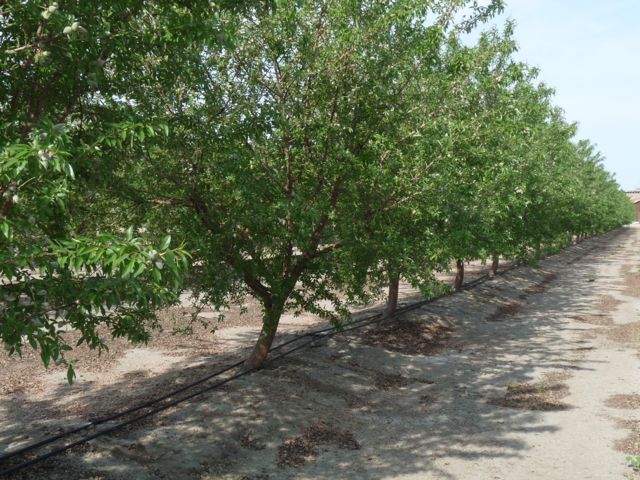
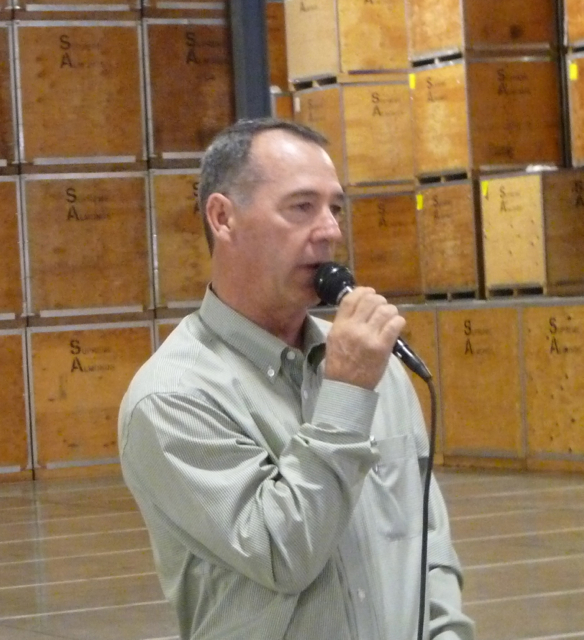
At a recent drought forum, California Ag Today spoke with Mike Mason, an almond grower and partner with Supreme Almonds near Wasco, as well as  chairman of the Almond Board of California. Noting breakthroughs in the almond industry, Mason said, “Facts bear out that we use 33 percent less water today than we did 20 years ago for every pound of almonds grown. There’s no reason  not to expect a similar result over the next 20 years given the ongoing research and funding we do through the Almond Board. We will continue to become more and more efficient, not just with water use, but with fertilizer and everything else we do in farming as well,” said Mason.

“Keep in mind that almonds, like all flowering plants, transpire 95 percent of the water they take up,” said Mason. “Water moves through the vascular system of the plant and exits the stomata of the leaves. When the stomata open, pure water exits and carbon dioxide enters the leaves. The carbon is used in photosynthesis to make carbohydrates that enable the almond almond tree to produce almonds. It’s all part of the universal water cycle that enables life to exist on the earth!”

Though current public opinion on water use seems to focus on almonds primarily, Mason remains confident that the facts will speak for themselves. It is simply a matter of getting the information out there. Mason elaborated, “We’ve got to go back to education because there are so many ways of comparison, and it is pretty hard to refute some of the things people are saying out there. But I think, over time, as we get the facts out there, public perception will be different.”

Because almonds are proving to be profitable at the moment, other countries are starting to take notice and planting more almond orchards of their own. Currently, California accounts for about 80 percent of the world’s supply of almonds. Mason believes, in spite of increased international competition, California will remain a world leader. “I wouldn’t call it a threat;” he said, “it is more like an opportunity than anything else. I think California will continue to be the world’s supplier, but there are other areas around the world where almonds can be grown, and that’s perfectly fine,” said Mason.

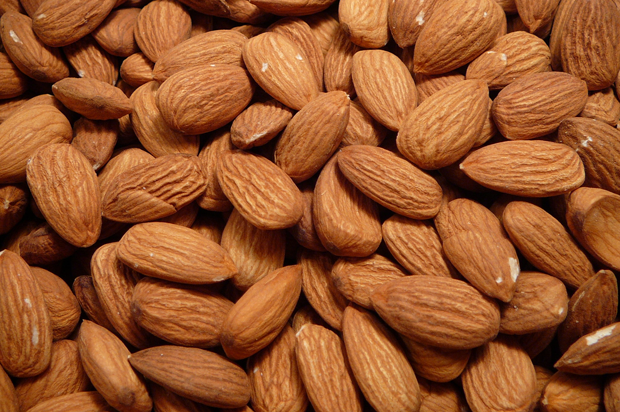
American consumption of almonds has increased roughly 220% since 2005. As a result, almonds have become the most-consumed nut in America, after  surpassing that of peanuts. This explosive increase in demand has been the driving force for almond production expansion.

Now, almonds cover about one million acres in California. On maintaining this level of success, Mason commented, “Markets go up, and markets go down. There are all kinds of different factors that cause these fluctuations, from oversupply to environmental issues. We think we have a bright future with a healthy product. Time will tell,” he said.

2016-05-31T19:28:11-07:00July 7th, 2015|

New Partners Offer MRL Database

Agrian and Bryant Christie Inc. Partner Up for MRL Database


By Patrick Cavanaugh, Assistant Editor, California Ag Today

They’re called “Maximum Residue Levels”(MRLs) and nearly all crop protection products have them; however, keeping track of MRLs for export is difficult. To this end, two companies have joined together to provide an MRL Database, globalmrl.com, to help the Ag industry comply with MRL regulations. Bryant Christie Inc. of Seattle, helps open, maintain and expand international markets by eliminating trade barriers for Ag exports. Agrian, Inc., a Fresno-based service-oriented company, provides subscription-based online information on most crop protection and nutrient products.

Nishan Majarian

Nishan Majarian, chief executive officer and cofounder of Agrian Inc.

Nishan Majarian, ceo and cofounder of Agrian, reported, “Several years ago we had a large ag retail customer who became concerned about MRLs and global export. We developed recomendation writing tools that ensure the safe application of crop protection materials, and MRL’s are an extension of that. We did not have an MRL database, so we called around and found out that Bryant Christie had the premier global MRL database.”

So Majarian reached out to James Christie, president and managing director of Bryant Christie, “And we began the process of partnering for a hybrid system that uses both his data and our data to ensure the safe application of a material, and give insight into the export requirements of that crop.”

James Christie

James Christie, president of Bryant Christie, Inc.

James Christie added, “At Bryant Christie, we work on preventing trade violations, such as chemical and food additive violations, and on ameliorating consequences when they occur. So for us, this collaboration makes so much sense. If we can avoid violations, we can help the ag industry considerably.”

And those consequences can cost ag exporters significant amounts of money, “The consequences range from a single cargo load lost to a violation,” said Christie, “to bad public relations, to having an entire commodity prohibited from entering a foreign country.”

They developed an MRL database, a one-stop resource, Christie explained, “in 1992, with our first client for the hop industry. It is just the best way to keep and manage the information. As database technology advances, it’s made even more sense to have it in that format.”

Majarian said the successful partnership with Bryant Christie is a matter of being at the right place, at the right time. “We think domestic and global compliance are growing in irreversible trends,” Majarian elaborated, “and as more field-level users move to digital record-keeping, these tools and the database will only grow in importance over time. We are excited to be on the cutting edge of online technical solutions. Sometimes I call it the ‘bleeding edge’ because it is a little painful to be innovators.”

Resource Links:

Bryant Christie, Inc.

Agrian, Inc.

Global MRL Database

2016-05-31T19:28:12-07:00July 7th, 2015|

Average Almond Crop for Van Groningen

Van Groningen: Almond Crop Looks Average; Misleading Math on Watermelon Water Use

By Patrick Cavanaugh, Assistant Editor, California Ag Today

Van Groningen & Sons, Inc. farming has been operating in California since 1922. Field Manager Bryan Van Groningen updated California Ag Today, “The almond crop looks pretty average, ‘nothing that looks well over norm. It just depends on which field site you enter in; some of the younger blocks look a little better than the older blocks. So, right now the crop looks pretty old, but it is all across the board.”

Bryan Van Groningen

Bryan Van Groningen

Yosemite-Fresh-WatermelonBased in Manteca, Von Groningen & Sons has a diversified operation growing melons, sweet corn, pumpkins, squash, almonds and walnuts, and livestock feed. Noting recent negative press on almond water usage, Bryan said, “Almonds obviously have gotten a lot of bad press lately, as has ag in general. In looking at some of the water usage figures, I tend not to agree with them. I think a lot of the water usage figures are outdated and incorrect.” He explained, “For example, we grow watermelons, and one of the articles that I read reported that 160 gallons of water was needed to produce a single watermelon. On our farm, it is closer to 35-40 gallons.”

As the state continues to deal with water restrictions, Van Groningen says a lot of fingers are unfairly pointing at the agriculture industry. “I think there is a lot of misinformation being spread around and used to throw agriculture under the bus,” he stated, “making us look like we are the bad guys, when we are actually producing the nutritious food that consumers in our state and the nation eat and enjoy. The agricultural industry has made so many advances in water efficiency that we should actually be labelled as ‘water conservationists’, and not ‘water wasters’.”

Van Groningen says he sees firsthand, every day, exactly how much water is used per crop, because he actively manages the farm’s water. “I sat down and ran the numbers 3, 4, 5 times — just to make sure that I did the math correctly. So, some of this usage is being misrepresented and therefore does not shed a good light on what ag is actually doing.”

2016-05-31T19:28:12-07:00July 3rd, 2015|

LA Declares Citrus Matters TODAY

LA Citizens And Commercial Citrus Growers Highlight Deadly Citrus Disease And Why Citrus Matters

LOS ANGELES (July 2, 2015) – California’s citrus industry is threatened by the Asian citrus psyllid (ACP), a tiny pest that can transmit the world’s deadliest citrus disease, Huanglongbing (HLB). Currently, all of Los Angeles County is under quarantine[1] for the psyllid, which continues to spread across the state. Along with Bayer CropScience and California Citrus Mutual, City Councilmember Gil Cedillo announced TODAY, July 2 that, “Citrus Matters” to Los Angeles. During the event, commercial citrus growers from the region were recognized for their contributions to the state of California and acknowledged the devastating disease that could destroy the state’s citrus industry. The announcement also serves to highlight the role Los Angeles residents must play in protecting California’s $2.4 billion commercial citrus industry through the #CitrusMatters initiative.Citrus Matters to Los Angeles

Citrus Matters Logo

To date, the psyllid has reached 15 counties throughout Southern California[2]; however, HLB has been recorded in only one tree in California[3] – a lemon/pummelo tree found on residential property in the Hacienda Heights neighborhood of Los Angeles in 2012. For every Californian who cares about citrus, that tree, which has since been removed and destroyed, serves as a warning that all citrus trees are at risk of being affected, from the trees that decorate their neighborhood to the commercial groves nearby.

The #CitrusMatters initiative from Bayer CropScience and California Citrus Mutual encourages all residents of California and Los Angeles – where there are more citrus trees on residential property than in commercial groves – to take action to help prevent the spread of the ACP. It is essential that homeowners with citrus trees on their property understand how to protect their trees and know what to do if they suspect trees are infected. If left untreated, the insects can move quickly from one tree to the next, eventually spreading to the commercial groves that cover much of Southern and Central California.There are a number of ways the Los Angeles community can get involved with the campaign to help prevent the spread of ACP and protect California citrus, including:

  1. Spreading the word and increasing awareness about the disease, the ACP and why they love citrus, using the hashtag #CitrusMatters. Through each use of the hashtag (now through September 30), Bayer CropScience will contribute $1, up to $25,000, to advance existing and future research to find a solution to HLB in California.
  2. Visiting CaliforniaCitrusThreat.org to access HLB and ACP resources specific to Los Angeles County.
  3. Monitoring their trees, contacting the California Department of Food and Agriculture (CDFA) Exotic Pest Hotline at 1-800-491-1899 if they think they’ve spotted an infestation and having their trees checked.
  4. Becoming familiar with solutions[4] available that can protect against ACP in their trees

CA Citrus Mutual

The citrus industry has a storied history in Los Angeles. Southern California’s first orange grove[5] was planted at San Gabriel Mission in 1804, and the state’s very first commercial citrus operation[6] was established in what is now downtown Los Angeles.

“Almost all of us native Los Angelenos have some kind of memory of grabbing a lemon off of the trees in our yards growing up or stepping outside during the spring and taking in the fresh scent of orange blossoms,” said Cedillo when he presented the announcement. “The city of Los Angeles recognizes the contribution citrus adds to California’s economy and our residents’ lives.”

“The Los Angeles area has played a vital role in the industry’s history,” said Joel Nelsen, president of California Citrus Mutual. “We’re excited to see residents celebrate citrus and rally around our mission to protect it from the spread of HLB.”bayer-cropscience-logo

The #CitrusMatters initiative is part of the ongoing effort by Bayer CropScience to provide citrus growers across the nation with solutions to help combat ACP and HLB. To learn more about the #CitrusMatters initiative and how homeowners, commercial citrus growers and citrus lovers alike can help save citrus, visit CitrusMatters.us.

For more information on Bayer CropScience’s citrus portfolio, please visit: https://www.bayercropscience.us/crops/citrus!

###

[1]http://www.aphis.usda.gov/plant_health/plant_pest_info/citrus_greening/downloads/pdf_files/nationalquarantinemap.pdf

[2] http://www.californiacitrusthreat.org/pdf/ACP-Quar%20Expansion_2-17-2015_CA-AZ.pdf

[3] http://californiacitrusthreat.org/news/huanglongbing-citrus-greening-disease-found-in-california.php[4] http://www.bayeradvanced.com/find-a-product/insects-pests/fruit-citrus-vegetable-insect-control

[5] http://ucanr.edu/blogs/blogcore/postdetail.cfm?postnum=924

[6] http://californiacountry.org/features/article.aspx?arID=695

###

Bayer CropScience Twitter Page: http://twitter.com/bayer4cropsus
Bayer CropScience Blog: 
https://www.bayercropscience.us/news 

Bayer CropScience is committed to bringing new technology and solutions for agriculture and non-agricultural uses. For questions concerning the availability and use of products, contact a local Bayer CropScience representative, or visit Bayer CropScience online at www.bayercropscience.us.

Visit the Bayer Connect – Social Hub for all Bayer CropScience social media, recent news, blog posts, videos and more.

###

About Bayer CropScience

Bayer is a global enterprise with core competencies in the fields of health care, agriculture and high-tech materials. Bayer CropScience, the subgroup of Bayer AG responsible for the agricultural business, has annual sales of EUR 9,494 million (2014) and is one of the world’s leading innovative crop science companies in the areas of seeds, crop protection and non-agricultural pest control. The company offers an outstanding range of products including high value seeds, innovative crop protection solutions based on chemical and biological modes of action as well as an extensive service backup for modern, sustainable agriculture. In the area of non-agricultural applications, Bayer CropScience has a broad portfolio of products and services to control pests from home and garden to forestry applications. The company has a global workforce of 23,100 and is represented in more than 120 countries. This and further news is available at: www.press.bayercropscience.com.

About California Citrus Mutual

California Citrus Mutual (CCM) is a citrus producer’s trade association whose 2,200 grower members comprise 60 percent of California’s 275,000 acre, $2.4 billion citrus industry. The Exeter, California-based organization was founded in 1977 by those who felt the need to unite their fellow growers into a cohesive, powerful force. Throughout the years, CCM has brought to fruition many of the goals of the founding fathers and has developed into a dominant force from within as well as outside the industry.  Having attained the privilege to be called the “voice of the citrus grower,” CCM remains the vessel which successfully navigates the often rocky waters of the business interest of its membership. For more information on CCM, visit www.cacitrusmutual.com.
2016-05-31T19:28:12-07:00July 2nd, 2015|

MRLs and Crop Protection Materials are Improving but Complicated

MRLs and Crop Protection Materials are Improving but Complicated!

By Laurie Greene, Editor and Patrick Cavanaugh, Associate Editor

Rachel Kubiak, Environmental & Regulatory Affairs director with the Western Plant Health Association, based in Sacramento, commented that crop protection materials are improving. They target specific pests and they are set to maximum residue levels (MRL’s) when sold domestically or internationally. Yet, they are quite complicated.

“The materials are getting better,” Kubiak said, “but I would say that there is a large component that I don’t believe the activist community understands,” noted Kubiak.

Richard Cornett, director of communications for WPHA, blogged, “What most people are unaware of is that there is a highly integrated and multi-layered process of safety procedures to assure that pesticides are accessed for their safe use around humans and in the environment.”

U.S. EPA (a) scientifically reviews all pesticides for safety before registration, (b) involves EPA scientists at the Office of Pesticide Programs, the Department of Fish and Wildlife, as well as other departments, (c) guarantees that any pesticide used in the U.S. has been accessed and is safe and (d) applies tolerances only to produce grown in or imported into the United States.

In California, the Department of Pesticide Regulation (DPR) enforces EPA tolerances by sampling produce for pesticide residues from throughout the channels of trade, both domestic and imported, including wholesale and retail outlets, distribution centers, and farmers markets.

“There are complications in making those products available to our growers,” Kubiak said, “because so much of what we produce in California is exported to other countries, and this MRL issue complicates things.”

Foreign countries follow an international standard called CODEX Alimentarus which contains a list of pesticide MRLs. EPA tolerances and International Codex MRLs are not harmonized; residue on an imported commodity can trigger a no-tolerance-established assessment and removal by California DPR while being a legal residue in other countries.

“I think this is a large area in which we could do better. Educating those who don’t live in our world on the difficulties in bringing new products to market isn’t as simplistic as they like to make it seem,” said Kubiak.

2016-05-31T19:28:12-07:00July 2nd, 2015|
Go to Top