Prunes May Be Answer to Osteoporosis

Prunes May Help Fight Osteoporosis

By Melissa Moe, Associate Editor

California is the world’s largest producer of dried plums, producing about 40% of the world’s supply and 99% of the U.S. supply. Dried plums, also known as prunes, are considered to be a super food thanks to their valuable nutritional content. Recently, California Ag Today spoke to Donn Zea, the executive director of the California Dried Plum Board, about the prune industry and the nutritional benefits of prunes.

“The growers are doing well. Of course, we’ve lost acreage over the last decade. We’re at about 47,000 acres or so. We have a big crop this year; it looks like 105,000 tons. Last year was a short one because of the weather. We seem to be in a good place, Zea said. “I think acreage, certainly in California but even globally, is in balance with demand, and it’s our job now to make sure that we continue to keep California prunes at a high value profile. We like to think that we grow them better and that they taste better than any other prune in the world.”

Recent studies show that prunes are able to assist in aiding and even reversing osteoporosis, the process in which bones become fragile and brittle due to old age.

“We’re finding out a lot about the prune’s role in slowing or even reversing age-related osteoporosis and improving bone health in women so far, but we’re now doing research in men,” Zea said. “There’s a lot of exciting things going on there, especially for those that can’t eat dairy. It’s not the calcium. What we’re learning is that it’s a combination of polyphenols that are working together in prunes. The evidence seems to be clear, in the animal studies we’ve done and in the clinical trials that we’ve done, that these combinations of nutrients and micronutrients are working together to produce a defense against osteoporosis and bone loss and maybe even strengthening bone.”

2021-05-12T11:05:16-07:00June 29th, 2017|

Huanglongbing Discoveries in California

Recap of Huanglongbing Cases in California

News Release

Huanglongbing has now been confirmed in numerous communities in Los Angeles and Orange counties. These detections are disheartening, but the Citrus Pest & Disease Prevention Program, California Department of Food and Agriculture and county agricultural commissioners are taking aggressive steps to remove all diseased trees and educate homeowners about this critical threat to California citrus.

Here is a recap of the Huanglongbing activity in California to date:

Hacienda Heights:

HLB+ Trees = 2

HLB+ ACP = 1 (on the initial HLB detection site)

San Gabriel:

HLB+ Trees = 56

HLB+ ACP = 4 (on HLB+ tree sites)

Cerritos:

HLB+ Trees = 2

HLB+ ACP = 2 (1 on HLB+ tree site, 1 on a separate site)

Rosemead:

HLB+ Trees = 0

HLB+ ACP = 1

La Puente:

HLB+ Trees = 0

HLB+ ACP = 1

La Habra:

HLB+ Trees = 1

HLB+ ACP = 0

Anaheim:

HLB+ Trees = 11

HLB+ ACP = 8 (6 on HLB+ tree sites, 2 on separate sites)

Fullerton:

HLB+ Trees = HLB+ ACP = 1 (1 on HLB+ tree site)

In response to each and every HLB positive tree detection, CDFA conducts mandatory 800-meter response, which includes surveys and sampling of all host trees, treatments and removal of the confirmed HLB infected tree.

Nursery stock in quarantine areas is placed under USDA-approved screen facilities, where it is held and tested for two years, or it is destroyed. Outreach is done to homeowners and elected officials to educate them on the severity of the issue encourage them to help stop the spread of this devastating disease.

2021-05-12T11:00:45-07:00June 26th, 2017|

Heat Wave Puts Renewed Focus on Worker Safety

Worker Safety and Heat Illness Prevention is Important

By Melissa Moe, Associate Editor

There has been a definite heatwave in the Central Valley, and that means an extra effort should be in place to protect farm workers from heat illness. Darren Stevens is an associate safety engineer with Cal/OSHA Consultation. He explained to California Ag Today the areas where growers need to comply to ensure that all workers make it home safely.

“The big things to remember is that the employers need to have written policies and procedures that address the specific requirements provided for water, shade, written procedures, emergency procedures and training. Those are the real keys,” Stevens said.

With temperatures in the triple digits, heat illness can be a very real threat. It is important to know the signs and have a plan in place to prevent overexposure to heat. There are regulations in place to protect worker wellness, with guidelines that producers must follow to guarantee their safety.

“The minimum temperature for shade is 80 degrees, but shade also needs to be available below 80 degrees if it’s requested by the employees. Water has to be available at all times. Really, we want to make sure that the shade and the water is available at all times, primarily just because of the heatwave. Or if they’re coming from another area, they’re not used to this type of weather. We need to have those precautions in place,” Stevens said.

For more information about heat safety, visit https://www.dir.ca.gov/dosh/heatillnessinfo.html.

2017-06-26T15:45:17-07:00June 26th, 2017|

Imperial Farmers Spared from Alfalfa Aphid

Fungi Stops the Spread of Alfalfa Aphid

By Melissa Moe, Associate Editor

Blue alfalfa aphids can pose a huge threat to farmers. The toxins that they inject into the alfalfa causes slow growth and low yields. Alfalfa farmers in Imperial County saw high numbers of alfalfa aphids. However, the recent rain may have spared farmers from further damage that the aphids might have caused. We spoke with Eric Natwick, a UC cooperative extension entomology advisor in Imperial County, about the blue aphids that farmers saw in the area.

“As far as the weather goes, the wet weather seemed to really take care of the blue alfalfa aphids. Sometimes with the aphids down here, we get what we call an epizootic fungus that infects those aphids, and quickly moves through the population and wipes them out. This entomopathogenic fungus seems to be very specific to the blue alfalfa aphid,” Natwick said.

The sudden disappearance of these aphids is good news for producers. Epizootic fungi are usually very specific to insects and can wipe out entire populations very quickly. These fungi do not pose a threat to other animals or plants.

“The blue alfalfa aphid left the pea aphids in the field. We did have some aphids, and of course we had some weevils, but the blue alfalfa aphid disappeared. This is also true over in Arizona. I’ve been working with Iman Mustafa. He’s located over there at Mac in Arizona. He’s getting the same results. I guess the good news is, well, we got the Sivanto [insecticide] for use in Arizona and California,” Natwick said.

Photo by Jack Kelly Clark for UC Statewide IPM Project

2017-06-23T17:46:17-07:00June 12th, 2017|

Rising Labor Costs Will Make CA Non-Competitive

Increased Labor Costs Take Toll

By Jessica Theisman, Associate Editor

The new labor laws are going to become a big problem for California’s agriculture in the near future. California Ag Today recently met with Alex Ott, who is the Executive Director of the California Apple Commission and the California Blueberry Commission. He also manages the California Olive Committee. Ott spoke with us about the growing concern that farmers in these industries have about rising labor costs in California.

Alex Ott

“Well, there is the overtime provision, which cuts our field work back from 10 hours to eight hours. That’s difficult,” Ott said. In order for employers to not pay overtime, their employees will have to work two separate shifts to get a day’s work finished instead of getting a day’s duties done in one shift. This ultimately cuts hours for workers, far from their benefit.

The minimum wage increase will have a huge negative impact on California growers and all of those that they employ. With an increase in minimum wage, employers will have to pay more for the same work.

“The problem there is obviously increased cost, but now, not only are we competing against the world, but competing against other states that produce the exact same type of crop,” Ott said.

“Employers will have to pay employees higher wages and deal with retailers not giving higher prices. Employers have to compete with states that have lower wages and have their overtime provisions as well.”

2017-06-07T13:07:06-07:00June 7th, 2017|

CAPCA To Visit Legislators

CAPCA Leadership Increasing Advocacy for Pest Control Advisors

By Patrick Cavanaugh, Farm News Director

The California Association of Pest Control Advisers (CAPCA) want to have more of a voice in Sacramento as they set new goals and priorities for our government relations and advocacy outreach.

“We are really excited to host a Legislative ‘Leg’ (pronounced ‘ledge’) Day in Sacramento for the first time in a very long time, on the 7th and 8th of June,” said Ruthann Anderson, president and CEO of CAPCA. “Our government relations committee members and our board of directors will meet with regulators and legislators and interactively discuss who CAPCA is and some of the issues we are concerned about.”

“In my first year here at CAPCA, I found the level of advocacy that we were doing and the level of advocacy that our members perceived we were doing didn’t quite add up. I wanted to turn up the volume and make sure that we were consistent with where our membership felt we should be.”

“I also wanted give ourselves a fresh voice to reach a whole new group of legislators and regulators,” Anderson continued, “many of whom had little experience with CAPCA and did not realize who we are and the group we represent. Many also did not know the value and professionalism our PCA license brings to the big picture of agriculture here in the state.”

Of recent interest, Anderson mentioned that, “Talking about IPM with different groups has been very valuable for me. Also fascinating, CropLife America created a great kind of layout on label to field—the process a proposed chemistry undergoes to become labeled and available for application in the field.”

“The timeline and all the different tests and processes that a manufacturer has to go through is at least a 10-year process on the federal side,” Anderson explained. “Then there are another two years of review once it comes to California for the manufacturer to get something in the field. Just showing the professionalism and the science behind what is being applied in the field—that this isn’t something just off the shelf that hasn’t been rigorously considered—is so vital to the conversation.”

Particularly given the loss of use of organophosphates, a broad-spectrum class of chemistry, and the EPA’s pyrethroid review, Anderson insists we need multiple tools in the toolbox. “There may be some really great products in the pipeline, but sometimes it takes 12 years from the initial start of an application until it actually becomes relevant or usable in the field. So, there may be some great opportunities or great options in that pipeline going through EPA, but they are not here yet.”

“So keeping as many tools in the PCA toolbox to address pest pressures and disease is really key for us. Our government relations committee is actually working on a response to current EPA chemistry reviews, and we are working with a handful of other associations to provide some boots on the ground comments from our PCAs. We want to talk about not only the different uses, but also key consequences for us if it did go away.”

2017-06-05T14:42:00-07:00June 5th, 2017|

Students Awarded Scholarships

California’s Table Grape Growers Award Scholarships

 All recipients will be attending California universities or colleges.


Six field worker scholarships were awarded in 2017: three $3,500 two-year scholarships to community colleges, and three $20,000 four-year field worker scholarships. Also, three $20,000 four-year agricultural scholarships were awarded in 2017.

Here are the 2017 scholarship recipients:

$3,500 Two-year Field Worker Scholarships


Mr. Jose Aldaco is a graduate of McFarland High School. Jose plans to attend Butte College and pursue a career as a certified welder. Jose is an active FFA member and won several awards for woodworking. Jose’s mother, Maria Navarro worked for Sun Pacific in 2016.

(Jose is pictured with Nathan Longcrier of Sun Pacific Shippers).


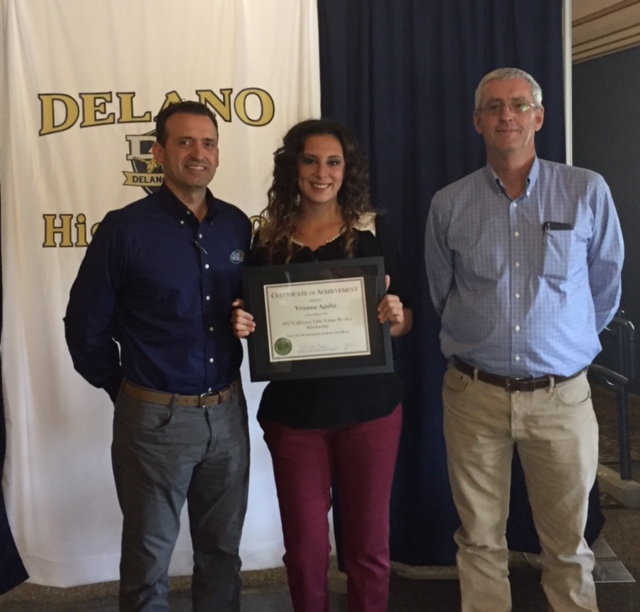
Ms. Vivianna Aguilar is a graduate of Delano High School. Vivianna will attend Porterville College with a career goal of becoming a nurse. Vivianna was the most valuable player for the Delano High girls varsity basketball team and volunteers at local hospitals and senior retirement homes. Vivianna’s mother, Esperanza Aguilar, worked for Sun World International in 2016.

(Vivianna is pictured with Merrill Dibble (left) and David Fenn of Sun World International, LLC).


Mr. Juan Frausto is a graduate of Dinuba High School. Juan will attend Reedley College and plans to pursue a career in fruit sales or farm/ranch management. Juan is very active in special school programs related to agriculture including farm management, tree and vine management and is also involved in his local church. Juan’s mother, Julieta Marquez worked for several table grape growers in 2016.

(Juan is pictured with Gary Gipson with Gipson Farms).


$20,000 Four-year Field Worker Scholarships

Mr. Daniel Flores is a graduate of Robert F. Kennedy High School in Delano with a weighted GPA of 4.29. Daniel plans to attend the University of Southern California and major in microbiology with a career goal of becoming an oncologist. Daniel chose this career after his mother died suddenly from cancer. Daniel received the Superintendent’s Gold Award all four years in high school, was the captain of the school’s varsity baseball, football and basketball team and is also a youth leader at Guadalupe Catholic Church. Daniel’s father, Jesus Flores, recently retired from Pandol Brothers Farms.

Ms. Guadalupe Sandoval is graduating from Desert Mirage High School as the class valedictorian with a 4.40 weighted GPA. Guadalupe plans to attend UCLA where she will major in biology with a career goal of becoming a pediatric surgeon. Guadalupe is a member of the junior varsity volleyball team and tutors and translates at elementary and junior high schools. Guadalupe’s mother, Modesta Aguilar, currently works for Lucich Farms.

Ms. Rosa Linda Lopez plans to attend University of California Berkeley where she will major in mathematics with a career goal of becoming a financial analyst. Rosa is the student body president at McFarland High School and is graduating with a weighted GPA of 4.28. Rosa volunteered for Special Olympics and the McFarland Police Department. Rosa’s mother, Francisca, worked for several table grape growers during the 2016 season.

$20,000 Four-year Agricultural Scholarships

Mr. Omar Deion Perkins is a graduate of Cesar Chavez High School in Delano. Deion will graduate with a weighted GPA of 3.91. Deion plans to attend University of California Santa Barbara and will major in political science/communications with a career goal of working in food safety and marketing. Deion is a member of mock trial, and a four year member of the football team.


Ms. Sandra Gaylord is a graduate of Golden West High School with a weighted GPA of 3.92. Sandra plans to attend Fresno State where she will major in plant science and botany, and has a career goal of being a pest control advisor and certified crop advisor. Sandra is involved in FFA and volunteers at Food Link programs in Tulare County.


Ms. Jewlia Winter is a graduate of Selma High School with a weighted GPA of 3.88. She plans to attend Fresno State and major in agriculture education, with a career goal of becoming an agriculture teacher. Jewlia is a member of FFA and also serves as a tutor.

2017-06-20T17:20:48-07:00June 1st, 2017|

Who Safeguards California Farm Workers’ Rights? Part 3 – Bargaining in Bad Faith

What Does “Bad Faith” Mean?

By Laurie Greene, Founding Editor

Our ongoing coverage of developments among United Farm Workers (UFW), Agricultural Labor Relations Board (ALRB), Gerawan Farming, Inc. and California farm workers chronicles the continuing, increasingly complex quagmire that masquerades as protecting California farm workers’ rights.

As previously published, ALRB Administrative Law Judge William L. Schmidt issued a decision on April 14 in favor of the UFW, finding Gerawan violated labor law by negotiating a collective-bargaining agreement with UFW “in bad faith—commonly called “surface bargaining”—in the eight-month period from January 2013 through August 2013.

“Candidly,” said Anthony Raimondo, president and owner of Raimondo & Associates and attorney for Silvia Lopez, the Gerawan Farming employee and petitioner to decertify the UFW from representing Gerawan farm workers, “it is not surprising to me at all that this type of decision went against the company, because this ALRB has been in the pocket of the [UFW] … this whole time.”

“This is very much what happened to the workers in the [decertification] election case,” Raimondo said, “when the ALRB refused to count the ballots. They slammed the workers for exercising their right to free speech—to protest. They attacked the workers for engaging in actions of civil disobedience, and they denied the workers the right to vote, essentially, by refusing to count the ballots.”

On March 20, the UFW filed a claim alleging that Gerawan violated the ALRA by “proposing and insisting on” the exclusion of the farm labor contractor (FLC) employees from the terms of any collective bargaining agreement the parties might conclude.

“What the union was claiming here,” Raimondo explained, “is that Gerawan had made a contract proposal, as I understand it, that said that the employees that it receives from farm labor contractors would be excluded from the terms of the collective bargaining agreement. According to both the UFW and the Agricultural Labor Relations Board, making such a proposal alone represents “bad faith bargaining.”

Raimondo Bad Faith“Bad faith bargaining is when you bargain without the intention to make an agreement,” Raimondo said. “In this case, for example, I don’t see how that could be possible in the Gerawan case because I’ve seen UFW contracts from the past that did exactly that—they agreed to exclude labor contract farm employees.”

“It is very common,” Raimondo explained. “I negotiate collective bargaining agreements all the time. It’s very common when you’re negotiating a collective bargaining agreement to look at other contracts in the same industry, with the same union, to get an idea of what they’ve agreed to in the past. I do not know how recently they’ve done it, but in past years, I have certainly seen contracts that the union has agreed to, where labor contractor employees were excluded.”

Among the mandates issued by ALRB Administrative Law Judge William L. Schmidt in his April 14 decision on Case 2013-CE-010-VIS is a requirement that Gerawan Farming cease and desist from persisting in its refusal to bargain with the UFW about the wages, hours and other terms and conditions of employment for those members of the above bargaining unit who are employed by farm labor contractors.

“I personally am very skeptical of this decision,” Raimondo commented. “It seems to me to be a stretch of the whole idea of bad faith bargaining, which is bargaining without the intention to reach an agreement, especially since what we’re talking about here is a proposal. But the fact that an administrative law judge of the ALRB made a decision in favor of the UFW does not shock me at all.”

“It’s difficult for me to see how proposing something that a union had agreed to in another contract, with another employer, would trigger an accusation of ‘bad faith bargaining.’ I would be surprised if this stands up an appeal, but to me, it’s most indicative of what we’ve seen from the ALRB over the last few years, and it’s likely to continue. The ALRB is no longer an objective, independent state agency that enforces the law. This is an arm of the United Farm Workers Union, whose mission is to save this obsolete union from the consequences of its own failures.”

“Biased as the original election decision was against the farm workers, the one thing that really stood out to me, even for this biased judge,” Raimondo said, “is even the ALRB admitted that the movement in favor of decertification of the UFW was not started by Dan Gerawan. It was a movement that started organically among the workers; they organized themselves to take the action that they wanted to take.”

“The fact is,” Raimondo continued, “these workers had their minds made up. They were disgusted by the UFW’s absence, they were disgusted by the union trying to force a contract on them, without even talking to them about it first. When they found out that this contract was going be shoved down their throats, they organized themselves and they fought back. The ALRB wants to discredit the entire movement that exists amongst the Gerawan workers.”

ALRB Notice to Gerawan Employees

ALRB Notice to Gerawan Employees

“When you have a law that is designed to grant farm workers their voice, and their right to self-determination, as we have with this agricultural labor relations act, it seems to me to be an abomination, when you can acknowledge that workers organize themselves to be heard, and then you deny them that voice because of something that their employer did. What control do the workers have over their employer? The workers are now responsible for things that the employer does, that cost them their right to vote?”

“There is no basis in the law for this idea that the entire process is somehow tainted in a way that invalidates the election,” Raimondo said. “If you read the Agricultural Labor Relations Act and the case law, the law is very clear that when an election is held, the only time that we reverse the outcome of an election, or ignore the outcome of the ballots, is when there has been misconduct by a party that actually affected the outcome of the election.

“You can go back to cases from the ’70s and ’80s,” Raimondo continued, “where the UFW had protestors out there at the polls, and employers complained that that affected or influenced the workers, or intimidated them in some way. Unless the employer could show that there was some actual effect on how the workers voted—that affected the outcome of the election—the election would be upheld.”

“No one in this case has ever produced the slightest shred of evidence that anything that Gerawan did or said ever affected how these workers voted, or how they felt about the union. This idea of a so-called ‘tainted election,’ is something that was invented in the last few years by ALRB judges. It doesn’t appear in the law. This whole process has been biased.”

“In fact, more than anything else, the thing that shaped how the farm workers felt about the union was the 17 years when the union wasn’t there. The union has never had to defend their absence from Gerawan employees because the ALRB never forces them to answer for it. The ALRB considers that to be irrelevant.”

“Yet, they slander Gerawan. They discredit the workers’ efforts to organize themselves. They want to discredit the entire movement that exists amongst the Gerawan workers. They deny the workers the right to vote, but they completely ignore the fact that the union failed in its most fundamental purpose, which is to represent workers.”

Featured Photo: Attorney Anthony Raimondo


Who Safeguards CA Farm Workers’ Rights? Part 4 – Motion to Disqualify ALRB Member Hall

2018-05-07T01:03:23-07:00May 26th, 2017|

Help Lobby To Veto SB1

SB1 Proposed Taxes & Fees Are Detriment to Farmers

By Jessica Theisman, Associate Editor

SB1 was recently passed by the legislature in California. This bill affects everyone in the state and increases several taxes and fees to raise the equivalent of roughly $52.4 billion over 10 years in new transportation revenues. It is not likely that the governor will veto the bill. We spoke with Anja Raudabaugh, CEO of the Western United Dairymen about how this bill will affect California’s agriculture.

This bill proposes a 20 percent increase in fuel taxes, which is something that farmers cannot afford, especially the dairy industry. “As you know, we cannot pass on our costs to our consumers, so adding another regulatory cost of production is incredibly hurtful and harmful,” Raudabaugh said.

Western United Dairymen continues to lobby on a nosb1.com campaign. They are asking the governor to veto it, although it is highly likely not to occur given that this is his bill. “This is his policy coalition, his desire to tax the constituents in California to their grave,” Raudabaugh said.

Starting November 1, SB1 will increase the excise tax on gasoline by 12 cents per gallon and the tax on diesel fuel by 20 cents per gallon. The bill also creates a new annual transportation improvement fee (TIF) beginning January 1, 2018. This is based on the market value of your vehicle. This fee will range from $25 to $175. SB1 also creates the road improvement fee of $100 per vehicle for zero emission vehicles starting in 2020 for model year 2020 and later.

Western United Dairymen are asking that if you have not filled out a nosb1.com petition that you do so, because they are using it to geo-track the information and essentially target the areas that are subject to vulnerability in the upcoming 2018 election. It is systemized so that when you enter your zip code, it goes directly to your legislator, either Assembly, Senate or both.

“We can actually see then which counties in California using some voter referencing material are more inclined to hate the gas tax,” Raudabaugh explained.

SB1 is not just targeting people who drive gas and diesel vehicles. Electric vehicles will also be targeted and will receive new fees.

“What’s more outrageous is that there are no guarantees that it will actually fix our roads. None whatsoever,” Raudabaugh said.

There is a ballot measure that was negotiated as a result of SB1 so that several key Silicon Valley Assembly members would vote for the bill. “To actually suggest that you would need a ballot measure to ensure that the funds do that, at least 20 percent of funds, seems really ironic,” she said.

2017-05-23T15:56:34-07:00May 23rd, 2017|

Developing On-Site Rescue Plans for Worker Safety

Western Agricultural Processors Association Seeks to Improve Worker Safety

By Melissa Moe, Associate Editor

Agricultural work can be very dangerous when working in confined spaces. If a worker was to receive an injury, such as a heart attack or even just a sprained ankle while down in a pit, they would be unable to climb a ladder to safety. It is important for workers to be aware of these dangers and have a plan to rescue others in times of emergency.

Roger Isom is the president and CEO of the Western Agricultural Processors Association, representing California’s almond hullers and cotton ginners. We spoke with Isom about the dangers of working in confined spaces, and what producers can do to keep workers safe.

“Confined spaces are basically just an area you’re not normally working in, where if something happened, it would be very difficult to get you out of that hole, or out of that silo, or out of that baghouse. It’s a permanent required confined space, difficult to get in and out of, like a pit,” said Isom.

In an ongoing effort to increase safety awareness, the Western Agricultural Processors Association is conducting specialized confined spaces training workshops.

“The training that’s going on involves recognizing when and where you have confined spaces, what kind of safety plan you need to have in place, and what kind of rescue plan you need to have in place, so in the event someone does get hurt or has an illness, you can rescue them,” he said.

Most confined spaced accidents are completely preventable and involve workers who do not have a well thought out, organized plan. It is important to have these plans in place so that everyone returns home to their families at the end of the day.

“Nine times out of ten, a confined space accident is where somebody goes in to rescue the person that’s down. Maybe you’ve got a gas leak. You see the guy laying down in the pit as you walk by and think, “Oh my gosh, I gotta go down there and get him.” Then you’re overcome. Then the next guy comes along and he’s overcome by the gas,” Isom said.

“This is why companies need a rescue plan,” he explained.

2017-05-22T15:14:29-07:00May 22nd, 2017|
Go to Top