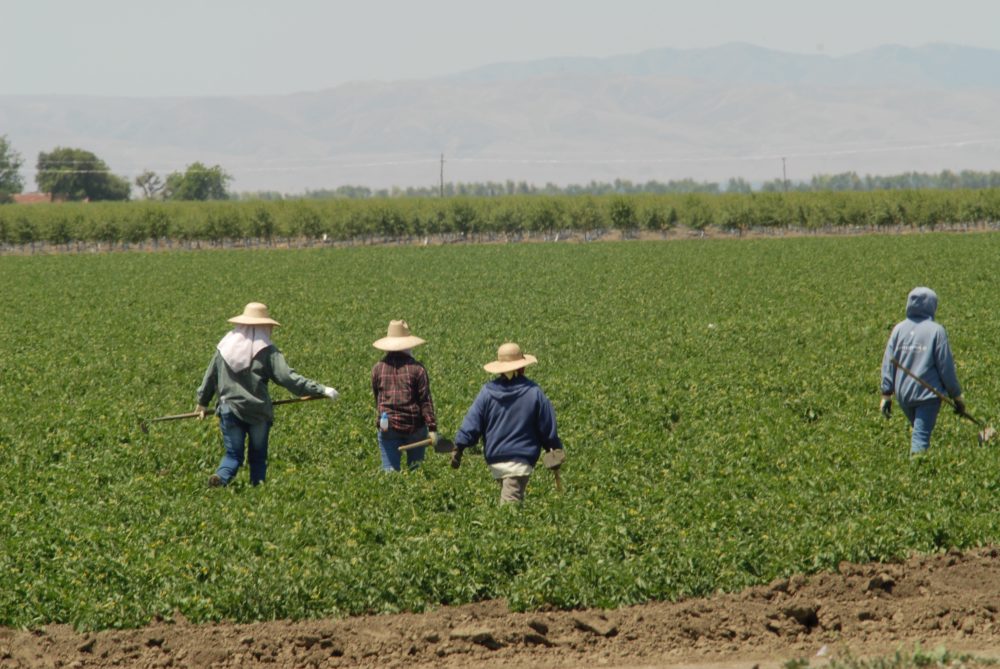
California Represented at Fresh Summit In New Orleans

PMA Fresh Summit Happening Now, Oct. 19-21

By Patrick Cavanaugh, Farm News Director

The Produce Marketing Association’s Fresh Summit brings together produce and floral industry leaders, retail buyers, food safety experts and importers and exporters from around the globe. A thousand exhibitors representing over 60 countries are at the Fresh Summit in New Orleans this week.

Alex Ott

“It’s a great opportunity to continue to meet with consumers and buyers and get the message out about the availability of California produce,” said Alex Ott, executive director of the California Apple Commission, California Blueberry Commission and the California Olive Committee told us about the Summit.

The Buy California Program will be a big part of the Fresh Summit this year, and Ott noted that it has been very positive for California apples and blueberries and olives.

“Getting the message out that California isn’t just Hollywood, but a big agricultural state as well, and we are there representing apples, blueberries and olives.

Regarding the 2017 blueberry crop, Ott noted that harvest went well and prices were good, however the price for processed blueberries were down this year.

“We were running about 10 days behind this year, but overall it was a very comparable year to last year as well. Not all the final numbers are in yet, but the fresh market was very, very good. Processed was not good,” Ott said.

“There was a lot of fruit out there and the processed prices were down significantly. And that had a huge impact on how many blueberries actually went to processing,” he said.

“The other unfortunate incident at the beginning of the year, is a lot of our friends in Georgia and some of the other southeast States, experienced a freeze, which impacted the crop, but on the other hand, was … good movement for California fresh blueberries,” Ott said.
 

2017-10-20T15:43:22-07:00October 20th, 2017|

California Dates Being Harvested

Medjool Date Season is Going Well

By Joanne Lui, Associate Editor

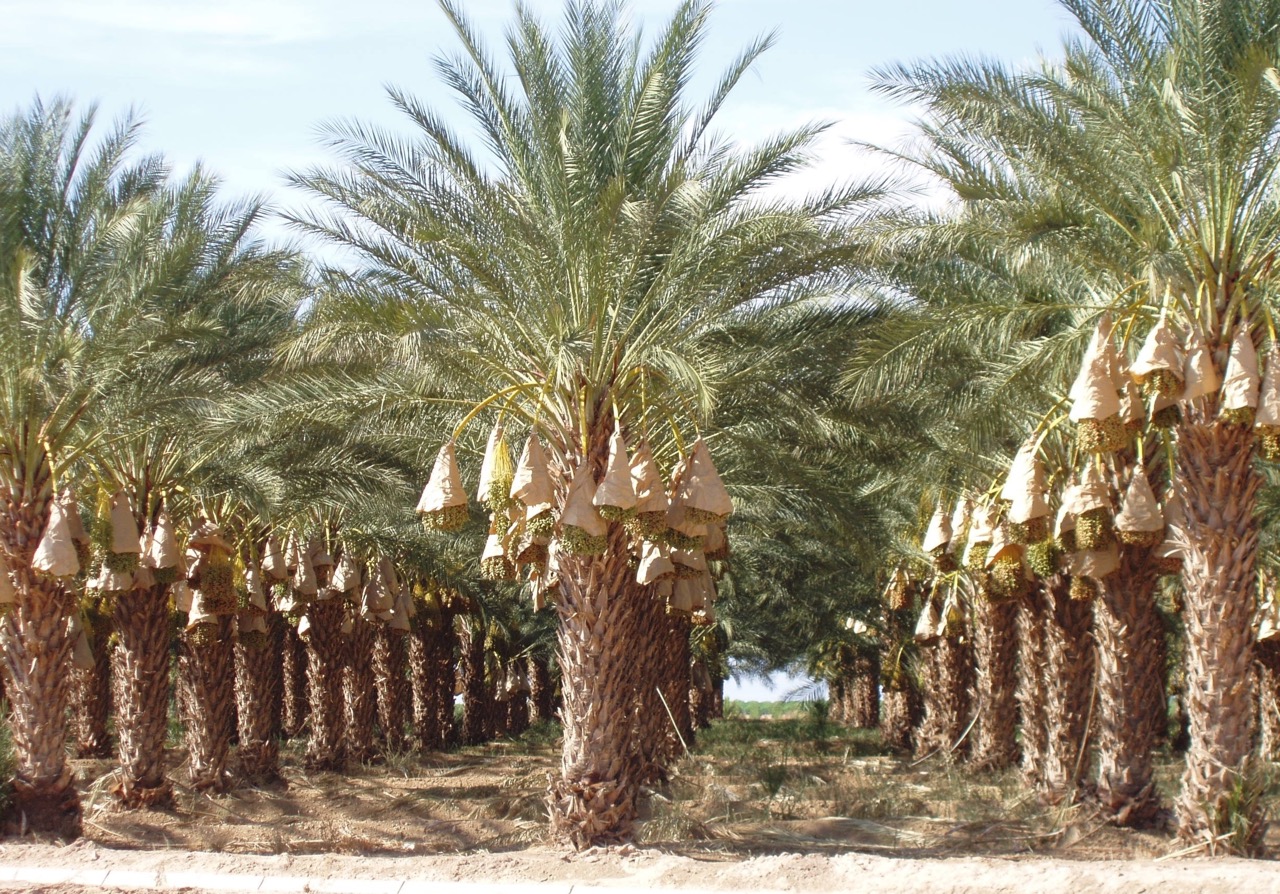
California Ag Today recently spoke with Ron Hill, farm manager of Royal Medjool Date Garden in Winterhaven, CA. The farm is located in Bard Valley, an unincorporated community in Imperial County. This area has a large amount of sunshine year round and stable, descending air and high pressure – perfect conditions for growing dates.

Dates grow in warm climates like California, Arizona, Florida and the Middle East. Medjool dates are one of the most popular – known for their large size, soft texture and rich flavor. We asked Hill if the harvest is beginning to wind down.

“The Medjool date season harvest is going well. We’re on the tail end. We’re going through and doing our last check,” Hill said. “Fruit quality is looking fair for this time of year, weather is cooperating and I think we’re going to have a pretty fair year this year.”

Date production is down due to weather.

“It’s down, just some due to the weather cycles, and then we have some damage from the rain,” Hill explained. “I have two different waves. When it’s a heavy rain on the dates, then they develop a black mold on the dates. And if the rain hits and then the humidity stays real high, then it starts, the fruit, to ferment on the tree. And so then that becomes a throw-away product also.”

The dates are still being harvested by man lifts and by hand.

“We do have man lifts. I would put four people up in each basket, and they go up and hand pick the dates, because the dates don’t ripen all at once, so we just go up and pick the ripe ones,” Hill said. “We have to be careful so we don’t knock off the unripened fruit, because at the present time there’s no means of ripening them if they haven’t started the process.”

There are also multiple picks that occur, between three and four times a year.

“The big difference is I’ve got some trees that are 60-foot tall, and so it takes some lifts, some big lifts, to get the people there, and just going up and down, it takes a lot of time,” Hill explained.

2017-10-18T16:03:11-07:00October 18th, 2017|

Raisin Growers Having a Tough Year

Kalem Barserian: Raisin Production is Down

By Patrick Cavanaugh, Farm News Director

The California raisin industry’s having a tough year on production, as well as a few rainstorms that impacted the crop.

Kalem Barserian

Kalem Barserian is CEO of the Raisin Bargaining Association in Fresno, an organization that goes to bat for growers when it comes to pricing. He noted a phenomenon that happens when it rains a lot, just ahead of Thompson seedless bud break as the vines came out of dormancy.

“For some reason, with all the rain – and I could go back 60, 70 years and show where ever there was a heavy rain year, the plants seemed to take a rest – and this was no different than what happened in 1998, when we had 20 inches of rain and we had only 7.5 grain tons, while the average green tonnage is 9.5 tons,” Barserian explained.

“The grape set was among the lowest in history, with only 27 bunches per vine. … The historical average is 39 bunches.”

“And then during the late summer, on Sept. 11 and Sept. 21, two rainstorms came through and tested the rain grower’s patience,” Barserian said. “The moisture did not cause the problem to the drying grapes. However the rain caused sand to bounce up on the trays with the grapes. The sand got into the wrinkles of the grapes and as they dried down further, it became embedded sand.”

“This is where the loss for the grower comes, because the damaged, embedded sand grapes must be reconstituted, reconditioned and cleaned up again. Ultimately, the quality is okay, but it is an additional cost to the grower,” Barserian explained.

According to Barserian, California used to account for 50 percent of the world production of raisins. Today, we are only 20 percent of the production, behind Turkey.

Many growers have traded in the raisin vineyard for other profitable crops such as almond or mandarins.

2017-10-03T16:27:35-07:00October 3rd, 2017|

Almond Achievement Award Nominations Being Accepted

Deadline for Almond Achievement Award Nominations is Oct. 19

News Release

Since 2011, the Almond Achievement Award has honored an industry or allied-industry member who has added value to the California Almond industry through long-term service, contributions or innovations.

Nominations for the Almond Achievement Award are being accepted now. Winners must:

  • Be an individual with long-standing and direct involvement with the California Almond industry.
  • Demonstrate lasting impact on and commitment to the California Almond industry.
  • Have a record of proven service to the visibility and growth of the industry.
  • Contribute to California Almonds becoming a Crop of Choice and supporting California Almonds becoming the Nut of Choice.

Almond Board of California’s (ABC’s) Industry Services Sub-Committee will evaluate the candidates and make a recommendation to the Board of Directors. The 2017 recipient will be selected by ABC’s Board of Directors and recognized during the gala dinner at The Almond Conference by ABC President and CEO Richard Waycott.

The names of the award winners are placed on the wall of the Nonpareil Conference Room at the Almond Board of California office.

Nominating an almond industry professional for the 2017 Almond Achievement Award is easy. Simply email Jenny Nicolau (jnicolau@almondboard.com) and state your nominee’s name and company, as well as your reasons for the nomination. Applications must be received on or before October 19 for consideration.

2017-10-02T16:40:01-07:00October 2nd, 2017|

Farmers Frustrated Over SGMA

CA Department of Water Resources Rolls Out SGMA Regulations at Meeting

By Patrick Cavanaugh, Farm News Director

The California Department of Water Resources held a recent workshop in Clovis, CA, to lay out the key components and regulations for the Sustainable Groundwater Management Act, known as SGMA. It’s thought that SGMA could forever change the face of agriculture in the central San Joaquin Valley, as it will limit the amount of groundwater that can be pumped.

turlock irrigation canal

If surface water was available for growers, the SGMA law would not have been created.

This entire approach of the Department of Water Resources is not sitting well with most farmers. Keith Freitas, who farms lemons on the east side of Fresno County, was at that recent workshop. “How can you call a program fair, but the stakeholders you bring to the table, before they enter the room to negotiate the deal, you cut their legs off?” Freitas asked.

“That’s basically what we have. We have a foot race here, but our legs have been cut off before the race even starts,” he said

And here’s the problem – there’s six deadly sins: lowering ground water levels, reducing ground water storage, increasing sea water intrusion, causing unreasonable water quality degradation, causing land subsidence and depleting surface water supplies that would have a significant and unreasonable adverse impact on beneficial uses of the surface water.

“The reason there’s six deadly sins is ’cause they’re all about the sins of the farmer. Not one of those sins is environmental,” Freitas said. “You think about it. We already have a subsidence and they know it, they don’t blame the environmentalists for subsidence, they blame farming.”

Farmers feel that if environmental water restrictions were not in place, there would be no overdraft of ground water or subsidence.

“How do you think we’re going to sustain overdraft pumping,” asked Freitas, “if they don’t have surface water to recharge the ground basin?”

“My perspective is that like Westlands Water District, who decided to turn down the twin tunnels – that decision was made I think in parallel to the overall consensus of farmers saying that if it’s going to be this way, if these are the rules that you’re going to set and these are the game rules, then we have no choice but to fight back,” Freitas said.

2017-09-29T16:22:43-07:00September 29th, 2017|

Humboldt State Looks for Entrepreneurs to Save Energy & Water

BlueTechValley’s Northern-Most Hub Seeks Innovation

By Patrick Cavanaugh, Farm News Director

Humboldt State University is among the northern-most hubs of the BlueTechValley Innovation Cluster. It’s part of the interconnection of multiple incubators, or entrepreneurship programs spanning the state serving 39 counties. The solid goal of the BlueTechValley initiative was established at Fresno State, and it’s all about managing water and energy resources in agriculture and other industries.

Lonny Grafman

Lonny Grafman teaches in the Environmental Resources and Engineering Department at Humboldt State, and he’s also the Humboldt State managing director of the BlueTechValley hub there.

“It’s a new program, so that’s pretty exciting,” Grafman said. “BlueTechValley has had a lot of success in Fresno, and what we are is their far northern Californian north coast arm. So, we’re seeking to have the type of success that they’ve had in Fresno,” Grafman said. “Specifically, we’re looking for entrepreneurs, inventors, businesses that are working on agriculture, energy and water efficiency projects.”

The university is looking for entrepreneurs and startups that can address saving water and energy.

“Any start up that has the chance of saving California electric rate payers’ money, we want to talk to them and see if we have resources that could help them to bring their product to market. That is that sweet spot that we’re trying to fill, “Grafman said.

BlueTechValley’s all about entrepreneurs, startups, computer hackers.

“It can be an energy project, it can be an agriculture project, it can be a water project, and it can be something at the nexus of all those things. We love those types of projects,” Grafman said. “As long as we can bring it back to how it saves California rate payers’ money, then we’re excited to explore all types of innovative ideas.


2021-05-12T11:05:15-07:00September 27th, 2017|

Bayer Launching CoLaborator Space in Sacramento

Biotech Startup Lab to Serve as Incubator

By Joanne Lui, Associate Editor

Bayer Crop Sciences Biologics Group in West Sacramento is Bayer’s global headquarters for microbial base crop protection products. The company recently announced that a new biotech startup lab space known as the Crop Science CoLaborator is available in 3,000 square feet within the West Sacramento facility. Jon Margolis, head of research technologies for Bayer Biologics, recently spoke to California Ag Today about the project

Jon Margolis

“This is a part of the original building as we built it out,” Margolis said. “We set aside about 3,000 square feet in the back to be dedicated to this incubator space, and now we’ve just finished the construction.”

The lab space is scheduled to become available in December.

“It’s part of kind of a larger strategy for Bayer,” Margolis said. “So we have actually now three of these so-called CoLaborator spaces. So there’s one in Mission Bay associated with UCSS in San Francisco. There’s another one in Berlin, and then this is the latest. But this is the first one for Bayer that’s dedicated to agriculture and food research.”

We asked Margolis what the meaning is behind the CoLaborator.

“It’s really based around the idea that for start-up companies, there’s a clear benefit of being associated and nearby to Bayer, not so much for the facilities as much as the opportunities to be able to talk to and interact with us,” Margolis explained. “From our side, it’s a great thing because it gives us kind of a reason or an opportunity to be talking to start-ups in this space who might be interested in renting this.”

Bayer is already starting to solicit for tenants for the space.

“It’ll be a combination of office and then fully modern, what we call, wet lab or biochemistry and cell biology kind of labs, which would be able to host up to three different companies,” Margolis said. “So typically, these early stage start-up companies are comprised one to three people, and what they’re really trying to do is get the initial proof of concept to really show that their idea, their technology works, to then be able to go out to investors and get the next round of funding. So this is kind of in that sweet spot because there’s not a lot of that space in the local area.”

2021-05-12T11:05:15-07:00September 26th, 2017|

Washington Post Writer Sees Ag Issues with RAISE Act

Disconnect Exists with Urban Politicians, Ruben Navarrette says

By Joanne Lui, Associate Editor

Ruben Navarrette grew up in the Central Valley and is a syndicated columnist for the Washington Post Writers Group. California Ag Today caught up with him recently at an event in Fresno called the The Latino Paradox: Immigration Forum. He spoke about the RAISE Act S.354, which severely limits immigration into the U.S. because it would be based on education and skills.

Ruben Navarrette

“There’s this disconnect in Washington and New York … mostly urban areas where politicians don’t think much about agriculture, agribusiness,” Navarrette said. “They have no clue about where this fruit is coming from when they walk down the street in New York and they see an orange. They don’t understand how dangerous something like the RAISE Act would be if you ultimately limit the amount of people who come here based on education and skills.”

The RAISE Act will limit immigration from Latin American countries. Meanwhile, U.S.-born citizens don’t go out to work in the fields.

“I think there’s a lot of people who wrongly believe that American workers will do those jobs if the wages are high enough, and the way they tell the story [is] to make the agribusiness and the farmers into the bad guy,” Navarrette said. “If you know enough farmers and you go out into enough fields and you interview enough farmers and enough workers, you know that’s completely false. Farmers could be in business for 30 years and never in 30 years have they ever had an American come to them and say, ‘Can I pick peaches?’ ”

With the Deferred Action for Childhood Arrivals act (DACA), if dreamers are sent back, there are questions about what may happen with their parents.

“If they go back, the parents may ultimately self-deport as well and that’s going to be disruptive,” Navarrette said. “Clearly it’s a mistake for us to believe that sort of agriculture and DACA, they’re all separate from each other. The issues are all intertwined. When a farm worker is working in a field, he cares about whether the local police have the authority to detain him, if he’s pulled over. He cares because he has kids who are in the DACA Program, so farming isn’t necessarily segregated. The farm workers are piped into all these different issues.”


2017-09-22T16:02:29-07:00September 22nd, 2017|

Mills Seek Out California Cotton Crop

California Cotton Crop Has High Quality

By Patrick Cavanaugh, Farm News Director

California Ag Today recently spoke with Dan Munk, Irrigation Soils and Cotton Farm Advisor of the UC Cooperative Extension in Fresno County, about the state’s cotton crop. California farmers have an advantage in that they get a higher price per pound due to the high quality produced.

Dan Munk, UC Cooperative Extension, Fresno County

“The San Joaquin Valley, and really California, does enjoy the production of higher quality cotton,” Munk said. “When mills are looking for the highest quality, extra long staple cotton, oftentimes they’re going to be going straight to California because of the consistency of the crop, the good color, the good strength, the good fiber qualities that typically make up a good and optimum fiber for translating into fabric.”

Munk said that an extended gin period could be implemented due to the increased crop in the Valley. “I’m not aware of any closed gins that are going to be opening up after closure. Although that might be the case for one or two, I imagine we’ll see extended gin period this year to take care of the additional crop.”

And while there is a trend to go with innovative harvesters that produce round bales of cotton, that will only be true for bigger operations, Munk sad.

“It’s going to be popular for the larger growers, and so we are going to see increases in equipment for those round bales, but for the most part, many of the smaller growers will not be converting any time soon to move to those round bale producing pickers,” he said.

Munk explained that the rainstorm coming through the Central San Joaquin Valley in early September had a minimal effect on the cotton.

“Certainly, parts of Fresno, Tulare and Kings County … there’s parts of the Valley that got quite wet, I’m sure. But most of the cotton had not opened, and because of those delayed crops, we’re probably not going to be impacted in a significant way at all by the rains that we saw,” he said.

2017-09-20T19:34:14-07:00September 20th, 2017|

LGMA Partners with Stop Foodborne Illness Group

Leafy Green Marketing Agreement Aids Decline in Citations

By Jessica Theisman, Associate Editor

Scott Horsfall, CEO of LGMA

After a severe E. coli outbreak in 2006, California farmers created the California Leafy Green Products Handler Marketing Agreement (LGMA) in 2007 to help prevent foodborne illness. Scott Horsfall, LGMA CEO, addressed the critical role LGMA currently plays in California agriculture, “If you are going to be in the leafy greens business, in particular, you are going to have to invest in what it takes to put a food safety program in place.”

“LGMA has partnered with a group called Stop Foodborne Illness, a national nonprofit, public health organization dedicated both to the prevention of illness and death from foodborne pathogens and to its victims. These two groups collaborated to create a video that is used in all training workshops. The video not only tells them why food safety is important, it shows them.”

Citations for foodborne pathogens in recent years have declined. Most of the citations are noted as minor infractions or minor deviations.

“They are not threatening public health; sometimes they indicate an oversight in having some documentation on hand, or something along those lines,” Horsfall said.

“Yet, there are still a handful of major deviations that are more significant and are treated differently,” Horsfall said. “Auditors are required to go back out, but if [the situation] is flagrant, they will go back out within a week to make sure that all corrective actions that were submitted are actually put in place.”


Links:

California Leafy Green Products Handler Marketing Agreement (LGMA)

Stop Foodborne Illness


2021-05-12T11:01:58-07:00September 19th, 2017|
Go to Top