Sakata Seed Helps American Heart Association Raises $44,000

Sakata Seed America Supports the AHA through its Sakata Gives Corporate Giving Program

New Release Edited by Patrick Cavanaugh

During the month of October, as part of its Sakata Gives Corporate Giving Program, Sakata Seed America, a world leader in breeding and producing vegetable and flower seed, participated in two walks, including a special Sakata-coordinated campus walk, to raise awareness and much-needed funds for the American Heart Association.

On the morning of October 20th, Sakata Seed America staff, friends and family joined the annual American Heart Association Central Coast Heart & Stroke Walk. The 5K walk commenced at the Depot Lot and continued along the scenic coastal pathway located in Monterey. More than 275 Central Coast residents and visitors gathered for the annual Heart Walk to raise life-saving funds and awareness for heart disease and stroke.

The event which included 19 teams, including Team Sakata, raised more than $44,000. Team Sakata raised $3,772 for the walk, earning the titles of Top Team, Top Company, and Top Walker (Jamie Kitz). Funds raised from the Heart Walk will benefit research, advocacy, outreach, and education.

In addition, on the morning of October 3rd the Sakata staff stepped out at their own regional offices for a companywide Heart Walk staged at seven of their campuses throughout the United States, including major locations in Yuma, AZ; Morgan Hill, CA; Salinas, CA; Woodland, CA; Ft. Myers, FL; Mt. Vernon, WA; and Burlington, WA.

A first for Sakata and the American Heart Association, Sakata’s coordinated campus walk was the “heartchild” of Jamie Kitz, Program Manager for Sakata Gives, the company’s Corporate Giving Program. Kitz said, “Partnering with strong community-minded organizations as the American Heart Association speaks to the essence of the Sakata Gives. We love engaging in our communities through activities that contribute to the betterment of both life and culture.”

To encourage and thank walkers, 400 colorful tulips were generously donated by Sun Valley Floral Farm. Participants were thrilled to walk away with gorgeous blooms that made for even happier hearts! Sakata was pleased to build awareness and camaraderie at their own facilities and blaze a new trail in fundraising for the American Heart Association.

From humble beginnings, the AHA has grown into the nation’s oldest and largest voluntary organization dedicated to fighting heart disease and stroke. A shared focus on cardiovascular health unites their more than 33 million volunteers and supporters as well as their more than 3,400 employees. According to the American Heart Association, heart disease is the No. 1 killer, and stroke ranks as the country’s No. 5 killer. For nearly 100 years, the AHA has been fighting heart disease and stroke, striving to save and improve lives.

Kelly LaPorta, Regional Director for the American Heart Association states, “It is evident that the mission of the American Heart Association is a mission that is near and dear to the hearts of the Sakata Family. Heart Walk is our premiere event for raising funds to save lives from heart disease and stroke and Sakata has fielded a team for the past six years. Happily, Sakata wanted to do more. They wanted to be sure they could participate at the highest level and raise the most funds and awareness—hence we decided to co-host our first coordinated campus walk for Sakata and it was a huge success!”

Overall, roughly 110 Sakata employees participated in the two walks and raised over $4,900 for the cause.

For more information on the Heart & Stroke Walk visit www.centralcoastheartwalk.org

2018-10-29T16:50:56-07:00October 29th, 2018|

Wonderful Day for California Farmers Due To President Trump Executive Order

From the White House

President Trump is Working to Promote Reliable Water in California and Other Western States.


REDUCING REGULATORY BURDENS: President Donald J. Trump’s Administration is reducing regulatory burdens that harm reliable water access in the West.

  • President Trump is signing a memorandum to reduce regulatory burdens and promote more efficient environmental reviews of water infrastructure projects in the West.
    • Decades of uncoordinated regulatory actions have diminished the ability of Federal infrastructure to deliver needed water and have increased costs in the West.
    • Court actions dictating water operations have further complicated the regulatory environment.
  • The President is directing the Secretary of the Interior and the Secretary of Commerce to:
    • Streamline regulatory processes and remove unnecessary burdens.
    • Develop a timeline for completing compliance requirements for major water projects.
    • Responsibly expedite ongoing environmental reviews.
    • Convene water experts and resource managers to develop an action plan for improving seasonal forecasts of water availability.
    • Expand the use of technologies to improve the delivery of water and power.
    • Consider the views of local operators during hydroelectric relicensing proceedings.

IMPROVING WATER RELIABILITY: President Trump is working to increase water reliability for families, farmers, and cities across the West.

  • President Trump is committed to ensuring Western communities have the water supplies they need to maintain our economic prosperity.
    • Federal water projects in the West irrigate millions of acres of farmland, provide water and power to millions, and support more than $48 billion in economic activity.
  • The President’s memorandum will benefit major water infrastructure projects in order to more effectively meet the demands of water users in California, Idaho, Oregon, and Washington.
    • The Administration will expedite biological opinions for the Central Valley Project and the California State Water Project in California, Klamath Irrigation Project in Oregon, and the Federal Columbia River System in the Pacific Northwest.
  • Expedited regulatory processes will provide certainty for California farmers who need more water to restore farmlands crippled by drought and regulation.

PROTECTING ENDANGERED SPECIES: The President’s memorandum will ensure a timely review process without compromising environmental protections under the Endangered Species Act.

  • The memorandum establishes timelines for environmental reviews of infrastructure projects, allowing the best information to guide conservation of endangered or threatened species.
    • The timelines allow for robust environmental review processes.
    • Agencies will make determinations regarding endangered and threatened species based on the best available scientific and commercial data.


2018-10-19T15:24:17-07:00October 19th, 2018|

Citrus Research Board Seeks to Hire New President

Nationwide Search Is On

Edited by Patrick Cavanaugh

The Citrus Research Board (CRB) has launched a nationwide search to hire a new president for the organization. A search committee is being formed.

“This year marks the Citrus Research Board’s 50th anniversary,” said CRB Chairman Dan Dreyer. “As we celebrate this milestone, we also are rededicating ourselves to do our utmost to ensure the success of the California citrus growers.” Dreyer said the CRB also is continuing to ramp up its fight against Huanglongbing, the deadliest citrus disease to date, which has devastated crops in other worldwide growing regions and potentially presents a critical threat to California citrus.

Citrus Research Board“Our search committee will be looking for a strong, research-focused senior executive – a consensus builder who can lead the organization and the California citrus industry through this challenging time and significantly contribute to the sustainability of California growers,” Dreyer said.

The CRB administers the California Citrus Research Program, the grower-funded and grower-directed program established in 1968 enabling the State’s citrus producers to sponsor and support needed research. More information about the Citrus Research Board may be found at www.citrusresearch.org.

###
Citrus Research Board
217 N. Encina Street, Visalia, CA 93291
Phone: 559.738.0246 | Fax: 559.738.0607
events@citrusresearch.org | www.citrusresearch.org
Copyright © 2018 Citrus Research Board | All rights reserved.
2018-10-02T19:46:05-07:00October 2nd, 2018|

Karen Klonsky Dies, Thursday, Sept. 27

Klonsky Credited for CA Agricultural Cost and Return Studies


By Patrick Cavanaugh, Editor and Laurie Greene, Founding Editor

Editor’s Note: We extend our deepest condolences to Karen’s family. Below is our interview with Karen upon her retirement in 2015.


This is an exclusive interview with Karen Klonsky, UC Davis Cooperative Extension specialist emeritus, in the UC Davis Department of Agricultural and Resource Economics. Her expertise has been farm management and production, sustainable agriculture and organic agriculture.

CalAgToday: Congratulations on your recent retirement!UCANR 100 years logo

Klonsky: Thanks, Patrick. I retired on July 1, 2015, after 34 years. I started at UC Davis in ’81, straight from graduate school.

CalAgToday: What has been your primary research interest?

Klonsky: My primary research areas are c and organic agriculture. I have approached these subjects from several dimensions, including the economic feasibility of alternative farming practices, the size and growth of organic production in California, and factors influencing the adoption of alternative farming systems.

Karen Klonsky UC Cooperative Extension specialist

Karen Klonsky UC Cooperative Extension specialist

CalAgToday:  Wow, what a great career! I understand your interest in alternative farming systems began with your dissertation work comparing alfalfa systems with integrated pest management.

Klonsky: I studied agricultural economics in graduate school and started working with a professor in my department who had a joint appointment in agricultural economics and entomology. And I just became very interested in that research area.

I worked with entomologists and researchers on a computer model of plants and alfalfa weevils, and their interaction, plus a management component. I studied the plant and bug components, then did the management part and imposed it on top and asked, ‘If you did this, how many bugs would die?’ The plant model showed how much the alfalfa would grow, and at what point you could cut the alfalfa and achieve the desired yield. I never actually did any fieldwork.”

CalAgToday:  Since 1983, you not only directed ongoing Cost and Return Studies, but the development of an entire archived library of Cost and Return Studies for the UC Davis Department of Agricultural and Resource Economics. You recently completed studies on pistachios and walnuts, right?

Klonsky: Yes, both “Sample Costs to Establish and Produce English Walnuts In the Sacramento Valley, Micro sprinkler irrigated” and “Sample Costs to Establish and Produce Pistachios In the San Joaquin Valley-South, Low-Volume Irrigation.”

Our library contains studies about field, tree and vine crops and animal commodities. But since I retired, Dan Sumner, director, University of California Agricultural Issues Center and Frank H. Buck, Jr. Distinguished Professor for the Department of Agricultural and Resource Economics has taken that over and I continue to be peripherally involved.

CalAgToday:  These cost studies have been recognized worldwide.ARE Cost and Return Studies

Klonsky: Yes, and it has been very gratifying work. We decided to put them online routinely, and we have had a million downloads per year. Around 2005, Pete Livingston, my staff research associate, got the idea of scanning in the older studies. All of the newer studies were in electronic file format, so posting was easy. However, most of the older studies were paper copies, so we got a grant to scan and add them to our new online archive.

CalAgToday:  What was the most interesting thing about doing those cost studies?

Klonsky: I loved doing those studies. I really learned a lot because all cost studies are done directly with farmers we met through county farm advisors. I really got to know what farmers were thinking about and what their options were.

CalAgToday:  So those were real costs, not university costs?

Klonsky: Those were not university costs. The farmers tell us what equipment they will use, and then we calculate the cost of using their equipment—the fuel used to operate the equipment and the repair costs—with an agriculture-engineering program.

CalAgToday:  Do you have a math background?

Klonsky: Yes, I got my bachelor’s at the University of Michigan in mathematics. It was very helpful.

CalAgToday:  And you also earned your Ph.D. at the University of Michigan?

Klonsky: Yes.

CalAgToday:  So did you grow up in Michigan?

Klonsky: No, I grew up in New York.

CalAgToday:  And you had an interest in going to Michigan State University?

Klonsky:  I had an interest in agriculture because I had an uncle who farmed corn and vegetables in upstate New York. We would go up there and I thought it was the most wonderful thing in the world.

CalAgToday:  What were some of the highlights of your career?

Klonsky: For many, many years, I was involved in the long-term on-campus sustainable agriculture research on land that is now on Russell Ranch, but it started as Sustainable Ag Farming Systems. We looked at four different farming systems, organic, low input, high-input, and we did a lot of analyses with cover crops and rotations. It was great to work on that project.

CalAgToday: And you worked with USDA on the trends of organic farms?

Klonsky: Then I worked quite a bit with Department of Food and Agriculture on using the registration data for their organic farmers to compile statistics about how many farmers they had, what they grew, and the number of acres they planted with each crop. They had this database, which started in 1992 I believe, but they weren’t using it. Now the most recent registration analysis is available for 2012.

CalAgToday:  Just to try to get more data on the organic movement and organic growth?

Klonsky: Yes, because there was no data at all about it. Now NASS (National Agriculture Statistics Service) conducts a nationwide Organic Census, in addition to the regular Census of Agriculture.

CalAgToday:  I understand you served as an editor of the Journal of American Society of Farm Managers and Rural Appraisers (ASFMRA). What did that entail?ASFMRA

Klonsky: Yes. I did that for many years. ASFMRA is a national organization. The Journal of the ASFMRA comes out annually. As editor, I corresponded with the authors, assigned reviewers, and ultimately, accepted or rejected submissions, like any journal.

CalAgToday:  Did you travel a lot with your work and presentations?

Klonsky: You know, not so much, I went to Spain one time and France once for work. But I did travel around domestically to symposiums and conferences to speak on the economics of growing a lot of different crops, including many presentations at the EcoFarm Conference.

CalAgToday:  You worked and collaborated with some really interesting people.

Klonsky: Most of my important collaborations were conducting trials with people in other disciplines. For instance, at Russell Ranch, I was the only economist involved in the collaboration with plant pathologists and pomologists who ran trials to discover fumigation alternatives in the preplanting of trees.

Then I worked with people at UC Santa Cruz on alternatives for strawberry fumigation. Most of my work has been interdisciplinary.

CalAgToday:  California farming is a tremendously diverse industry. We produce 60% of the fruits and vegetables, and nearly 100 percent of the nut crops that people across the country consume. Any comments on that and on how, valiant and resilient farmers are to get through year after year, particularly lately with the drought and the lack of water deliveries?

Klonsky: When I first started, there was a land price bubble, and there were a lot of bankruptcies because people had these land payments they just couldn’t pay.

It was kind of like the mortgage crisis that housing saw in 2008, agriculture saw in the early 80s.

CalAgToday:  So as you have been editor for the Journal of the American Society of Farm Managers and Rural Appraisers, you see land values going up and that keeps agriculture strong—the high land values, right?

Klonsky: Well, but it keeps it expensive. So now there is more and more leasing of land. As farmers retire from permanent crops, they have an orchard, but they don’t really want to sell it, so they lease it.

CalAgToday:  There you go. Keep it somehow in the family.

Klonsky: Yes, they try to keep ownership in the family. Or what we see also are these development leases where a young farmer can’t afford to buy the land, so they lease the land, but they pay for the trees to be planted.

CalAgToday:  So you are still coming to your office at UC Davis?

Klonsky: I am officially retired, but we have what we call a ‘partial recall’ where you can do things if you have funding. I have a project along with Rachel Goodhue, Professor, UC Davis Department of Agricultural and Resource Economics, with the California Department of Food and Agriculture, funded through the California Department of Pesticide Regulation. The Department of Pesticide Regulations is required by law to do an economic analysis of all proposed new regulations. So that is what I am working on.

CalAgToday:  Give me a couple of examples. VOC regulations?

Klonsky: Yeah, we do VOC.

CalAgToday:  Are you looking at sustainable groundwater legislation?

Klonsky: No, just pesticide regulation. It is funded by the Mill tax on pesticides.

CalAgToday:  Did you work with a lot of graduate students at UC Davis?UC Davis Graduate Studies

Klonsky: Oh yeah, I worked with a lot of graduate students coming through. One of them was on different ways of pesticide management on eucalyptus trees. I said I went to Spain. On that trip, I spoke about growing eucalyptus for firewood.

CalAgToday:  That was an economic study, wasn’t it?

Klonsky: Yes it was. They grow it not for firewood, but for paper. But that never really caught on here.

CalAgToday:  Are you bullish on agriculture? Do you think Ag is going to continue thriving in California?

Klonsky: Oh, sure. Oh, sure. But I think that the water situation is definitely real, and I think agriculture already has definitely made tremendous strides in irrigation systems, especially the subsurface irrigation in vegetables, in particular processing tomatoes, which I worked on.

CalAgToday:  That was a huge improvement in growing tomatoes. And people didn’t think it was going to work, but it turned out to be fantastic.

Klonsky: Yeah, a really win-win on that one. And orchards are getting more efficient. If you look at the water per pound of crop produced, you see major improvements with water efficiency.

CalAgToday:  Absolutely. Of course, most plants transpire most of the water they take up through the roots, up through the leaves and the stomata cells. By the way, do you have any interesting stories regarding your career?

Klonsky: It’s not the highlight, but the weirdest thing of my career is I got an email from somebody in Ministry of Agriculture and Fisheries from the United Arab Emirates. They wanted me to give a live presentation about Cooperative Extension in California and how it’s organized.

So I had to go to this office building in downtown Sacramento at 10:00 at night because of the time difference. I went into a conference room that had a special kind of projector so I could see them and they could see me. And on the monitor I see all these men walked in—they were all men—and half of them were in Western dress and half of them were wearing a Sheik-like headdress, with a band that sits on top and holds it on.

That was crazy, just being downtown after everybody is gone and the whole building was dark and quiet, except the one room that I was in.

CalAgToday:  How long was the presentation?

Klonsky: Gosh, maybe an hour.

CalAgToday:  You needed to do some research for that presentation?

Klonsky: Yeah, I had to do some research, I had to think about Cooperative Extension in a different way—the big picture. 

CalAgToday:  Keep up the good work, and I hope you are enjoying retirement.

Klonsky: Yeah, I come in two days a week, so it is nice to see everybody. I still get a lot of emails, which I need to answer.

2018-10-02T20:13:53-07:00September 29th, 2018|

ALRB Officially Certifies Gerawan Workers’ “No Union” Vote

“No Union” is Official Result

News Release Edited by Laurie Greene

TODAY, the Agricultural Labor Relations Board (ALRB) officially certified that a majority of the valid ballots from the November 5, 2013, election that were counted five years later in Fresno on September 18 were cast as “No Union.” In addition, the ALRB concluded that “the United Farm Workers of America thereby lost its prior status as the exclusive representative of the employees for the purpose of collective bargaining.”

Silvia Lopez, a Gerawan employee at the time, filed the petition on October 25, 2013, to decertify the UFW as the bargaining representative of the agricultural employees of Gerawan Farming, Inc., which led to the sanctioned decertification election a few weeks later. Today, Lopez commented, “I cannot believe what just happened today. The ALRB certified our votes and results. I am speechless and beyond excited and happy because justice was finally done.”

Count our votes Farm workers' rights UFW Endorsement "No Union"

Count the Votes

Said attorney Anthony Raimondo, “This is a great day for farm workers all across the state of California who can finally celebrate the fact that they wll be the ones who decide their future, not a government agency or a politically connected union. The workers will rest easy tonight knowing that their wages belong to them and will not be taken from them by the United Farm Workers union.”

“We are grateful that the ALRB has recognized the undeniable truth of the workers’ will as expressed in the vote,” Raimondo continued, “and relieved that the agency has decided to abandon its alliance with the UFW and work for the rights of California farmworkers rather than the financial health of a failing union.”

Jesse Rojas, spokesperson for Pick Justice, stated, “Pick Justice was started because of the courage, strength and determination of thousands of farmworkers who simply wanted the right to choose and to be treated equally like every other worker in the state and country. We are thankful that the ALRB finally did the right thing after 5 years of suppressing workers’ rights. Today is a historic and huge victory for the Gerawan farmworkers. Pick Justice is just getting started and will continue to advocate for what is right.”

Link: To review the ALRB Certification of the November 2013 Election to Decertify UFW issued TODAY, September 27, 2109, click on 44 ALRB No. 10.

2018-10-09T22:42:51-07:00September 27th, 2018|

Gerawan Votes Were Counted in a Professional Way

Votes Were Announced, Union or No Union

By Laurie Greene, Founding Editor

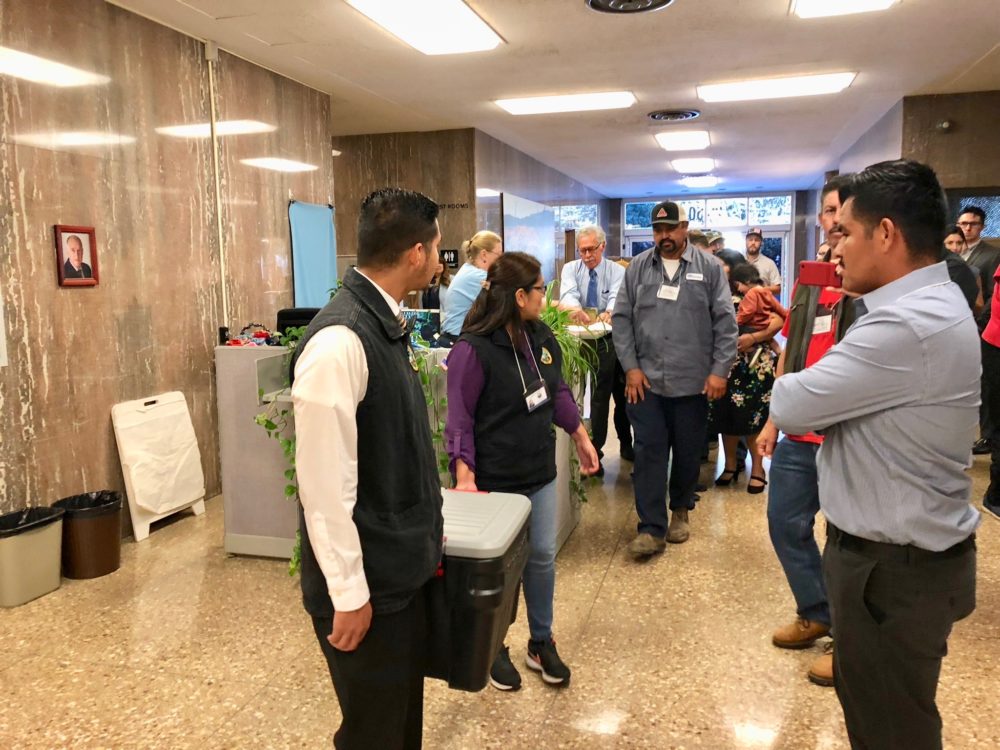
Following Election Protocols, below is a rundown of what happened at 2550 Mariposa Street, Fresno, California. The Gerawan ballots arrived by with ALRB officials carrying them in a black container with red handles. They arrived at the building at approximately 10:15 AM. Watch video here: https://youtu.be/dttdNbUQbG4

Number counted

ON STAGE

1 Veronica Cervantes ALRB Board Agent is running the election
1 UFW voter observer On stage, seated for observation and simultaneous tallying
1 Gerawan farm employee, Angel Lopez. On stage, seated for observation and simultaneous tallying
2 ALRB voter observers On stage, standing for observation
1 Gerawan farm employee On stage, standing for observation
2 ALRB employees On stage, standing for observation in Black Vests with ALRB patches
8 TOTAL ON STAGE

AUDIENCE

100 Silvia Lopez, Jessie Rojas (Pick Justice), Gerawan employees, people in red UFW t-shirts,; media.
2 Lawyers: Tony Raimondo, Ron Barsamian
1 Eduardo Blanco, ALRB
2 Assmb. Jim Patterson, Shannon Dee Grove (Kern County)

Observation Notes

Black cooler with red handles contains ballots.

Cervantes showed 21 large yellow Legal-sized? Envelope packets, each containing blue ballots and yellow #10 envelopes of challenged ballots

  1. Challenged ballots
    1. Cervantes removed ballots in yellow envelopes designating them as “challenged ballots.”
    2. Silvia said even if there are 300 Challenged ballots, “We’ll be OK.”
  2. Challenged ballots were identified during the Nov. 2013 election under the following circumstances:
  3. Farm employees were told to bring a paystub.
  4. Upon arrival, voters picked at random, were asked to show a California ID as well.
  5. If they lacked a second ID, CA ID, their votes were sealed in yellow envelopes designated as challenged ballots.
  6. Many voters told Silvia their vote was challenged. They were upset, angry and intimidated.
  7. TOTAL Contested ballots 634
  8. These contested ballots will be counted today only if necessary after the blue ballots are counted.
  • #10 Yellow envelopes identify and contain one challenged ballot each.
  • Placed in separate gray tote box to isolate them from the blue [non-challenged] ballots
  • See Silvia Lopez’s comments
  1. Blue Ballots
    1. Blue Ballot Rules. If voter:
      • used a check mark instead of an X OK
      • marked in the outer box instead of inner box OK
      • Marked “No” for unwanted option OK
      • Ballot with marking indicated the ID of the voter UNACCEPTABLE
    2. Counted in bunches of 50 2
    3. Read “No Union” in Spanish
    4. Cervantes made announcements in English, then Spanish
    5. 2:36


Union

No Union

Invalid

Challenged ballots

Ballots

197

1098

18

Total

635


7

No markings Unsufficient to affect outcome of ballot count


6

Markings on both boxes

2

Signature reveals ID (separated out)

1

Marked in the middle

1

Contains statement, sticker

1

?

1930 Ballots

Expected from 11/ 2013/

677

1948 Total voters

2645 # Names on list

2018-09-19T16:45:33-07:00September 19th, 2018|

Gerawan Statement on the Results of the November 5, 2013 Decertification Election

The following statement was issued on September 18, 2018, by Gerawan Farming Inc. regarding TODAY’S Decertification Election Ballot Count

Fresno, CA — Our employees have been waiting since November 2013 for their votes to be counted. After a historic struggle, they achieved that right today, in spite of the efforts by the UFW and the millions of taxpayer dollars spent by the Agricultural Labor Relations Board to deny them that right.

The final vote count was 1,098 “No Union,” and 197 for the UFW.  The employees overwhelmingly rejected the UFW as their bargaining representative – by a 5 to 1 margin – in spite of the ALRB’s last-minute, election day refusal to count approximately 640 ballots challenged by the UFW.

A secret ballot election is intended to embody and reflect the workers’ fundamental right to choose their representation. That right is at the heart of what the Agricultural Labor Relations Act is designed to protect and promote. Today’s vote tally leaves no doubt what our employees want.  It is a ringing endorsement of their right to choose, and a repudiation of concerted, unlawful, and anti-democratic efforts to deny them that right.

We call on the UFW and the ALRB to respect the choices of farmworkers, to certify the results of the election, and to decertify the UFW.  We call on the Legislature and the Governor to take immediate steps to ensure that the ALRB’s violation of the basic human rights of farmworkers never occurs again in California.

CONTACT: David Schwarz

(310) 277-1010

DSchwarz@irell.com

Featured Photo:  Silvia Lopez, Gerawan Farm Employee, listens to the Sept. 18, 2018 Ballot Count of Nov. 2013 Decertification Election.

2018-09-18T17:24:54-07:00September 18th, 2018|

2017 Tulare County Crop Report Tops $7 Billion

Tulare Crop Report Shows 10 Percent Growth in Single Year

By Patrick Cavanaugh, Editor

Big numbers announced today from Tulare County Ag Commissioner Marilyn Wright on the 2017 crop year.

“Our value is 10.5 percent up from last year, at 7,039,929,000. So, that’s 669 million more than the previous year,” Wright said.

Marilyn Kinoshita, Tulare County Ag Commissioner

Marilyn Wright, Tulare County Ag Commissioner

And, of course, more water in the system probably helped, as it did in Fresno County, which announced $7.028 billion in its 2017 Crop Report, released earlier this month.

The dairy industry, which is prominent in Tulare County, came in number one again, representing 25 percent of the total value.

“Milk prices were stronger in early 2017, but they went down later in the year. And they continue to go down, but still it was a big part of the Tulare County ag receipts in 2017,” Wright said.

Following dairy were grape products—including juice grapes, raisins, and table grapes. Table grapes had a stellar year.

Navel and Valencia oranges were next. Cattle and calves ranked fourth, down from category number three in 2016, because cattle prices were off last year.

Tangerines, also known as mandarins, were number five, followed by almonds, cling peaches, and freestone peaches.

Lemons, were ninth on the crop list.

We only have just over 10,000 acres of lemons in the County, Wright said.

Wright said the value of this year’s crop report, $7.39 billion, is the third highest value Tulare County has ever reported.

2018-09-18T16:39:21-07:00September 18th, 2018|

CA Supreme Court Rejects ALRB’s Effort to Avoid Counting Gerawan Farm Votes

California Fresh Fruit Association Applauds CA Supreme Court Order To Count Votes

George Radanovich, President of the California Fresh Fruit Association, applauded the recent decision by the California Supreme Court, upholding the earlier decision by the 5th District Court of Appeals ordering the California Agricultural Labor Relations Board (ALRB) to count the employee ballots cast in their 2013 decertification election.

George Radanovich

Radanovich stated, “Today we welcomed this long overdue decision. We are pleased and encouraged by the recent decision by the California Supreme Court, which affirms that the most important opinion in this entire matter, the prerogative of the employees will be heard.”

Gerawan employees voted in a decertification election in November of 2013 to decide whether or not to decertify from the United Farm Workers Union. Despite the fact the ALRB ordered and oversaw the decertification election, they impounded the ballots, denying recognition and acceptance of their decision.

Radanovich continued, “Today’s court action would not have occurred without the determined effort of Gerawan Farming, Inc., the Gerawan family, and in particular, company President Dan Gerawan for defending his company and his employee’s right to choose. This fight has been long and arduous, but

2018-09-13T16:44:54-07:00September 13th, 2018|

2017 Fresno County Crop Report Totals $7 Billion

Fresno County’s Ag Value Increases Significantly in 2017 Crop and Livestock Report


The Fresno County Department of Agriculture’s 2017 Crop and Livestock Report (Crop Report) was presented to the Fresno County Board of Supervisors Tuesday. Overall, the 2017 agricultural production value in Fresno County totaled $7.028 billion, showing a 13.58 percent increase from 2016’s $6.18 billion.

“Once again, Fresno County farmers and ranchers have produced an agricultural bounty for the world,” stated Fresno County Agricultural Commissioner Les Wright. “While much of this food and fiber goes towards feeding and supplying our nation, the Fresno County Department of Agriculture also issued 18,604 phytosanitary certificates for 133 commodities destined for 97 countries around the globe in 2017.”

“This Crop Report is comprised of nearly 400 commodities, of which 73 crops exceed $1 million in value,” Commissioner Wright continued. “Crop values may vary year-to-year based on production, markets and weather conditions, but our farmers and ranchers, their employees and all those who support their efforts work tirelessly year-around to bring in the harvest.”

With the great diversity of crops in Fresno County and the many variables in agriculture, it’s a given that some crops will be up in value while others are down. Increases were seen in a majority of the Crop Report segments, including field crops, seed crops, fruit and nut crops, livestock and poultry, livestock and poultry products, apiary products and pollination services, and industrial crops. Decreases were seen in vegetables and nursery. Surface water supplies were significantly better in 2017, although many Westside federal water contractors received much of that good news too late to benefit them with additional annual plantings.

Fresno County’s Top 10 Crops in 2017 (Source: 2017 Fresno County Agricultural Crop and Livestock Report)

Too often, the Crop Report gets summarized down to just a single overall number, but it yields a significant amount of information, such as the ability to examine changes and trends in crop acreage and yields. Amounts in the report reflect the gross income values only (income before expenses) and not the net return to producers.

“The San Joaquin Valley is the food capital of the World, and Fresno County is the region’s heart,” said Fresno County Farm Bureau (FCFB) CEO Ryan Jacobsen. “Daily, millions of food servings unceremoniously originate within our backyard, the result of generations of families and agricultural infrastructure that has been built to furnish an unbelievably productive, wholesome and affordable food supply.”

“The annual Crop Reports are more than numbers,” Jacobsen continued. “They provide the industry, the public and policymakers, regardless of the overall number, the opportunity to salute local agriculture and give thanks for the food and fiber, jobs and economic benefits, agriculture provides Fresno County.”

One popular component of the report is the review of the county’s “Top 10 Crops” that offers a quick glimpse of the diversity of products grown here. In 2017, these crops accounted for three-fourths of the report’s value. Almonds continue to lead the way as Fresno County’s only billion-dollar crop in 2017, representing 17.4 percent of the total gross value of the Crop Report. Added to this year’s list was mandarins at number six. Dropping out of the “Top 10 Crops” was garlic.

This year’s Crop Report was a salute to the Fresno-Kings Cattlemen’s Association. The organization is one of 38 affiliates of the California Cattlemen’s Association, a non-profit trade association that represents ranchers and beef producers in legislative and regulatory affairs.

2021-05-12T11:17:09-07:00August 21st, 2018|
Go to Top