Associations, Organizations, Educational and Research Institutions
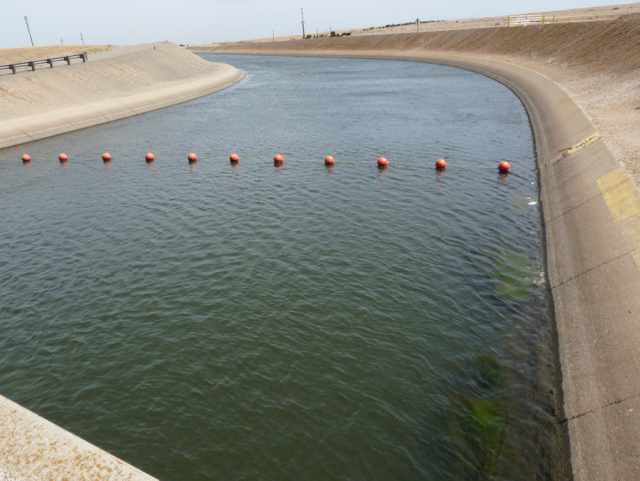
President’s Order Restores Western Water Supplies

Farm Bureau, CA Farm Water Coalition, Family Farm Alliance and Western Growers Support Order

News Release Edited By Patrick Cavanaugh

Last week, President Trump provided welcome relief to Western farmers, cities, rural communities and wildlife refuges that have struggled under water supply rules that are long overdue for an update. Prioritizing national interest and the value of California food production, the president’s order requires the re-consultation of the biological opinions to be completed and fully implemented by August 2019.

The deadline will bring to a close the review of rules governing the long-term operation of the federal Central Valley Project and California State Water Project. The review has been underway since August 2016, a process the order requires to be concluded by Aug. 31, 2019.

The president’s action fulfills his campaign commitment to help solve the state’s water supply shortages and will greatly benefit Central Valley communities and the environment. Since 1992, water supply restrictions have caused severe economic consequences for farms and the people who depend on them for work. Many of the state’s most disadvantaged communities have suffered due to scarce water supplies.temperance flat dam

Wildlife refuges that are a critical component of the Pacific Flyway have had insufficient water to meet the needs of millions of ducks, geese, shorebirds, songbirds and endangered animals in large parts of the Central Valley and the Klamath Basin. An ongoing review of the rules governing these critical water supplies only delays the ability of these important areas to recover.

This action will also help address water shortages that have occurred across the West as the result of federal regulations overseen by multiple agencies. It offers hope to farmers and ranchers served by federal water projects in the Pacific Northwest, including the Columbia Basin and the Klamath Basin. The president’s order places the responsibility of operating the federal water projects with the Department of the Interior, to be supported by the National Marine Fisheries Service and the U.S. Fish and Wildlife Service. The action prohibits any impacts to threatened or endangered species protected under the federal Endangered Species Act.

This issue has been scrutinized by the Executive Branch as far back as 2011. At that time, President Obama observed that the Interior Department is in charge of salmon while they’re in freshwater, but the Commerce Department handles them when they’re in saltwater. Those overlapping jurisdictions have only slowed efforts to help the fish.

A committee convened by the National Research Council also studied this matter a few years ago. The NRC found that the lack of a systematic, well-framed overall analysis between the two services is “a serious scientific deficiency, and it likely is related to the ESA’s practical limitations as to the scope of actions that can or must be considered in a single biological opinion.”

Improved coordination between federal agencies will promote more efficient, effective and coordinated management of all ESA responsibilities for anadromous and freshwater fish in Western watersheds, from the highest reaches of our headwaters to the Pacific Ocean.

“This action is an important and common-sense move that will benefit Western farmers and ranchers whose livelihoods depend on federal water projects,” said Dan Keppen, executive director of the Family Farm Alliance. “It’s a practical and assertive change to Western water management and species recovery that our membership strongly supports.”

California’s GOP congressional delegation from the Central Valley played an important role in identifying the problems in the state’s water system and worked closely with the Trump administration to produce a solution that is consistent with federal law and will improve the water delivery system.

“There’s no question that the Central Valley has lagged behind the economic recovery experienced in other parts of the state. We’re optimistic that these changes will not only help improve water supplies for farms, farm-related businesses, and disadvantaged rural communities, they will provide the incentive to put science-based solutions to work to help recover iconic native fish species that have suffered under the existing regulatory approach,” said Mike Wade, executive director of the California Farm Water Coalition.

“This is a common-sense improvement to a process that has been abused in the past by regulatory agencies seeking to impose a scientifically-unsound regime on water users that ultimately, by design, de-irrigates some of the highest quality farmland in the world. This move by the Administration simply ensures that the process of revising the rules governing Delta water operations will be less vulnerable to regulatory abuse,” said Tom Nassif, president of the Western Growers Association.

“Implementation of the Endangered Species Act can be better for both species and people, and the president’s action moves us in that direction,” California Farm Bureau Federation President Jamie Johansson said. “It’s time to grow beyond the culture of conflict that has governed California water for too long. We need streamlined solutions that benefit species and that benefit both the farmers who provide California-grown food and farm products and everyone who depends on those products.”
2021-05-12T11:05:09-07:00October 26th, 2018|

California Sweet Potatoes are One of A Kind

California Sweet Potatoes Grow in Well-Drained Soil

By Jessica Theisman, Associate Editor

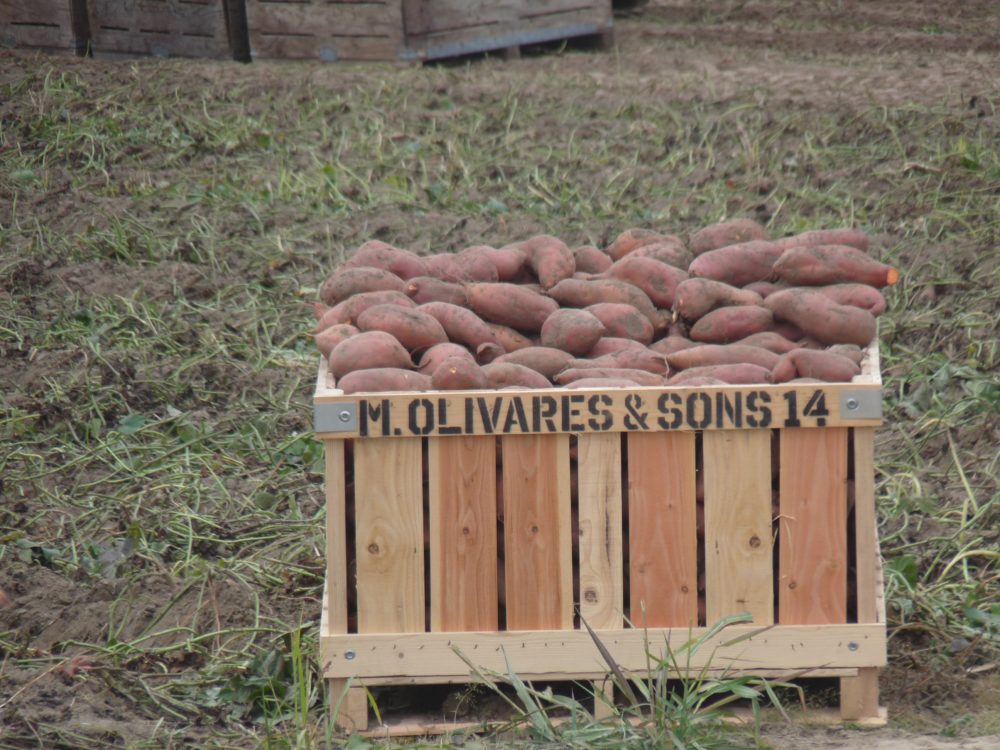
California sweet potatoes are in full harvest, and our potatoes are one of a kind, said Scott Stoddard a UCANR Cooperative Extension farm advisor for vegetable crops in Merced County. The difference is the sheen.

Scott Stoddard

“Sometimes they come up clean out of the ground because we’ve grown them in a very loose sand, so the sand just falls off of them, and it almost leaves some shine,” he said.

You can get what is called the California Sheen.

In a lot of other areas of the country, there is a little bit of mud and a little bit of silt. The crop they’re digging up is growing in the ground and kind of looks like it needs to be washed.

“A lot of times with California sweet potatoes, they don’t even look like they need to be washed when they come up out of the ground. It looks like they can just go straight from the field to fork,” Stoddard said.

Well-drained soil is important. Well-drained soil is what they grow best in.

“Not like a cactus where they can survive on no water, but we can get by in about two and a half acre feet. That’ll give you a good 100 percent potential yield,” Stoddard explained.

2018-10-24T16:15:13-07:00October 24th, 2018|

Almond Export Diversification Helps During Tariff War

Overseas Markets are Vast for Almond Industry

By Patrick Cavanaugh, Editor

Diversification is a strength, Richard Waycott, president of the Almond Board of California, told California Ag Today recently. The Almond Board of California is a nonprofit organization that administers a grower enacted federal marketing order under the supervision of the U.S. Department of Agriculture. When it comes to any losses due to a tariff war in China, the almonds can be redirected to other countries.

“It’s fortunate to be as diversified as we are. Always a strength of this industry is the diversification of our overseas markets,” Waycott said. “I think whatever volume we ultimately do lose—if we do lose volume to China—can be redirected and absorbed by other markets.”

The USDA has opened up a direct payment program to the almond industry if growers were to lose any money in a tariff war.

As those programs were announced, by far the largest piece of the pie, $6 billion, initially was directed to the soybean and corn growers and livestock, while the specialty crops were completely left out of it.

“We got together with the Almond Alliance of California and some of our industry members made a very concerted effort while there was still time to do so before the rules around these programs and those that got to participate were set in stone and were able to convince the powers that be … to open up to the direct payment program to almonds, and the sweet cherry industry did the same,” Waycott explained

Waycott also commented on the epic frost that hit almonds this past spring. And he is not sure of the impact on the crop.

“We realized that we don’t understand the impact of frost on almonds all that well because we saw one side of the street there was quite a bit of damage, while on the other side there was no damage. So I think there’s mother nature at work here that, you know, we don’t necessarily completely understand,” Waycott said.

2018-10-23T14:57:40-07:00October 23rd, 2018|

Livestock Owners Asked to Weigh in on Fire Impact

Livestock Owners Should Participate in Fire Survey

By Pam Kan-Rice, UC Agriculture & Natural Resources

Preparing a farm for wildfire is more complicated when it involves protecting live animals. To assess the impact of wildfire on livestock production, University of California researchers are asking livestock producers to participate in a survey. 

People raising cattle, sheep, goats, poultry, swine, horses, llamas, alpacas, aquaculture species or other production-oriented animals in California who have experienced at least one wildfire on their property within the last 10 years are asked to participate in the FIRE survey.

“We will aim to quantify the impact of wildfires in different livestock production systems,” said Beatriz Martinez Lopez, director of the Center for Animal Disease Modeling and Surveillance in the UC Davis School of Veterinary Medicine. “The idea is also to create a risk map showing areas more likely to experience wildfires with high economic impact in California.

“This economic and risk assessment, to the best of our knowledge, has not been done, and we hope to identify potential actions that ranchers can take to reduce or mitigate their losses if their property is hit by wildfire.”

Martínez López, who is also an associate professor in the Department of Medicine & Epidemiology at UC Davis, is teaming up with UC Cooperative Extension livestock and natural resources advisors and wildfire specialists around the state to conduct the study.

“Right now, we have no good estimate of the real cost of wildfire to livestock producers in California,” said Rebecca Ozeran, UC Cooperative Extension livestock and natural resources advisor for Fresno and Madera counties. “Existing UCCE forage loss worksheets cannot account for the many other ways that wildfire affects livestock farms and ranches. As such, we need producers’ input to help us calculate the range of immediate and long-term costs of wildfire.”

Stephanie Larson, UC Cooperative Extension livestock and range management advisor for Sonoma and Marin counties, agreed, saying, “The more producers who participate, the more accurate and useful our results will be.”

“We hope the survey results will be used by producers across the state to prepare for wildfire,” said Matthew Shapero, UC Cooperative Extension livestock and natural resources advisor for Ventura and Santa Barbara counties, “And by federal and private agencies to better allocate funds for postfire programs available to livestock producers.”

The survey is online at http://bit.ly/FIREsurvey. It takes 15 to 30 minutes, depending on the number of properties the participant has that have been affected by wildfire.

“Survey answers are completely confidential and the results will be released only as summaries in which no individual’s answers can be identified,” said Martínez López. “This survey will provide critical information to create the foundation for future fire economic assessments and management decisions.”

2021-05-12T11:17:09-07:00October 18th, 2018|

California Walnuts Face Threatening Tariffs

Big Challenges For the Walnut Industry

By Mikenzi Meyers, Associate Editor

It takes one glance at current news headlines to know that agriculture trade is a hot-button issue within the industry. Amongst countless exported crops being hindered by tariffs, the California walnut industry is no different. With California English walnuts making up two-thirds of the world’s trade, the California Walnut Commission is on high alert to ensure that growers are protected from tariffs that could damage their markets.

Pamela Graviet, the commission’s senior marketing director, spoke deeper on this issue.

Pam Graviet

“If you look at the three major markets—China, Turkey, and India—where we have tariff issues,” Graviet said, “that represents twenty percent of our total shipments … it’s over $300 million we’re going to lose.”

Thus far, the walnut industry has avoided paying the full tariff direct to China through the “gray market,” or the sales of walnuts through other countries that feed into China.

“But when you’re tariff constrained or in a trade war” Graviet explained, “they are also cracking down on those other routes, and the gray market has also suffered.”

The California Walnut Commission will continue their work to protect nearly 100 handlers and 4,800+ growers that make up the California walnut industry.

2018-10-11T14:42:10-07:00October 11th, 2018|

Facts Not Fear on Growing Produce

Understanding Salinas Valley Farming Practices

By Jessica Theisman, Associate Editor

Among the mix of registered dietitians conveying the accurate message, California Ag Today concluded our conversation about Facts Not Fear with Teresa Thorn, executive director of the Alliance for Food and Farming, located in Watsonville.

The Alliance hosted the second Facts Not Fear produce safety media tour, in conjunction with Markon Cooperative, for registered dieticians, health and nutrition writers, and bloggers last month in the Salinas Valley. Impacting the customer with the proper information is key.

Teresa Thorn

“We have a mix of writers and bloggers who again have that bullhorn to consumers,” Thorn said.

Social media was also used in conveying the message.

“They’re posting, and we’ve read it and retweeted a lot of their stuff so you can go to our social channels and see some of it,” she explained.

Speaking to growers was very important, and asking industry professionals to attend was vital to cultivating relationships.

“They loved being out in the field. We were always the last ones to get on the bus because they had so many questions,” Thorn said.

The group also does a roundtable discussion where they bring in scientists, shafts, regulators, farmers, and farming companies into the room at Markon’s Produce Expo.

“Building that network was really important,” Thorn said.

2018-10-10T16:43:27-07:00October 10th, 2018|

Sound Science Funding for Farmers

Funding for Sound Science is Critical

By Jessica Theisman, Associate Editor

Increased funding to make farming easier is a priority, an expert told California Ag Today recently. LaKisha Odom is the science program director for the Foundation for Food and Agricultural Research based in Washington, DC. Funding sound science is a goal for the foundation.

“We are interested in increasing the amount of funding that is available to make farming and decision making easier,” Odom said.

This is all based on sound science. Their foundation base depends on the readily available funding.

“We match public-private dollars and increase that amount of funding available to fund sound science,” she explained.

The funding is for foundations and agencies that will assist farmers.

“The universities, industry partners, foundations and the research that’s funded by those entities can then inform those decision makers to assist those farmers who are making those decisions,” she said.

“We were provided $200 million dollars in the 2014 Farm Bill,” Odom added.

There are seven challenge areas that the foundation focuses on: water scarcity; urban agriculture; food waste; food loss; making my plate your plate, which focuses on nutrition; protein challenge, which focuses on animal sustainability; and innovation pathways.

Fresno State is one of the founding partners.

“I’m working with the irrigation innovation consortium, which is a consortium of university partners as well as industry partners, and Fresno State is one of our partners in that,” Odom said.

They are working with Dr. Davis at Fresno State for ways in which they can make innovations in irrigation and make water issues a little less challenging for farmers.

2021-05-12T11:05:09-07:00October 8th, 2018|

WG Center for Innovation and Tech Celebrates Three Years

WG Center Brings Technology to Ag

By Patrick Cavanaugh, Editor

The Western Growers Association’s WG Center for Innovation and Technology in Salinas is turning three years old. Dennis Donahue, mayor of Salinas from 2006 to 2012 and currently the consulting director at the center, spoke to California Ag Today recently about the anniversary.

This center houses more than 50 ag-tech startup companies and is a hub for new developments in ag-tech with services ranging from infield robotics to renewable energy.

“The reality is you have to be making progress on all these things all the time,” Donahue said.fsma food safety flags in the field mean stop harvest here

The agriculture industry as a whole is facing many problems, including water supply, labor supply, water quality, and crop protection. And that’s why it’s so crucial for these startups to keep coming up with these new innovative solutions.

“Labor is a challenge because it’s getting tougher,” Donahue said. “The cost issues are—the supply issues are—intensifying, so that puts a lot of pressure on the automation piece and proof of concept, particularly in the field.”

“How do you get something crop off the ground, out of an orchard or clipped from a vineyard? That’s going to occupy a lot of time, cost efficiency, and technology. Those things are at best with some focus at three- to five-year play, and our problems may come a little sooner,” Donahue explained.

“California agriculture and the folks we deal with in the Western Growers network are bound and determined to address these problems. We often get a real dose of realism. ‘Look, here are the issues. Here are some of the things that haven’t been working well, and we need to work better, and we need to work faster.’ But, there’s no quittin’ the dog. You know, I think the industry is fully engaged, understands the challenges, and we’ve got a pretty good group of people determined to meet them on both the ag and technology side.”

2021-05-12T11:05:09-07:00October 4th, 2018|

2018 Cotton Crop Proceeding Well

Late Season Pests Can Be a Challenge

By Patrick Cavanaugh, Editor

The 2018 cotton harvest will be starting in the southern part of the Central Valley later this month, and some growers will be facing pressure from pests.

California Ag Today recently spoke about the topic with Dan Munk, a UC Cooperative Extension Farm Advisor in Fresno County specializing in irrigation crop nutrient management and cotton production systems.

“The crop looks very good and loaded with cotton bolls. We don’t have a lot of boll losses, and that’s a real positive thing, so very excited about the potential for fairly high yields in the 2018 season. The biggest concern right now is pest management, press pressures as we approach the latter part of the season,” Munk explained.

The main issue this time of year is the honeydew that pest leave on the cotton. Honeydew is the exudate extracted by the insect as it feeds on the leaves.

“Because we have the bolls on the plant that have opened, we now have exposed lint and need to protect that lint from stickiness that’s created from whitefly and the aphid honeydew, which is basically the added sugars that those insects that feed on the leaves of the plant, and they excrete them and deposit them on the lint,” Munk said.

Munk explained that the big concern right now is dealing with pest pressures in terms of whitefly and aphid—both sucking insects. “The problem right now [is] where we’re seeing pest pressures—particularly from whitefly as we get later in the season—will build in many fields.

There are several approaches to controlling whitefly and aphids. One is to deal with the eggs that they produced. And then there’s a certain class of materials to deal with the eggs.

“There’s another class of materials that deal with the juveniles—that early form of the insect—and then there are ways to control the adults,” Munk said.

“A number of insecticides have been applied to deal with those various levels of insect populations based on the individual field situation,” he explained.

2021-05-12T11:01:53-07:00October 3rd, 2018|

Citrus Research Board Seeks to Hire New President

Nationwide Search Is On

Edited by Patrick Cavanaugh

The Citrus Research Board (CRB) has launched a nationwide search to hire a new president for the organization. A search committee is being formed.

“This year marks the Citrus Research Board’s 50th anniversary,” said CRB Chairman Dan Dreyer. “As we celebrate this milestone, we also are rededicating ourselves to do our utmost to ensure the success of the California citrus growers.” Dreyer said the CRB also is continuing to ramp up its fight against Huanglongbing, the deadliest citrus disease to date, which has devastated crops in other worldwide growing regions and potentially presents a critical threat to California citrus.

Citrus Research Board“Our search committee will be looking for a strong, research-focused senior executive – a consensus builder who can lead the organization and the California citrus industry through this challenging time and significantly contribute to the sustainability of California growers,” Dreyer said.

The CRB administers the California Citrus Research Program, the grower-funded and grower-directed program established in 1968 enabling the State’s citrus producers to sponsor and support needed research. More information about the Citrus Research Board may be found at www.citrusresearch.org.

###
Citrus Research Board
217 N. Encina Street, Visalia, CA 93291
Phone: 559.738.0246 | Fax: 559.738.0607
events@citrusresearch.org | www.citrusresearch.org
Copyright © 2018 Citrus Research Board | All rights reserved.
2018-10-02T19:46:05-07:00October 2nd, 2018|
Go to Top