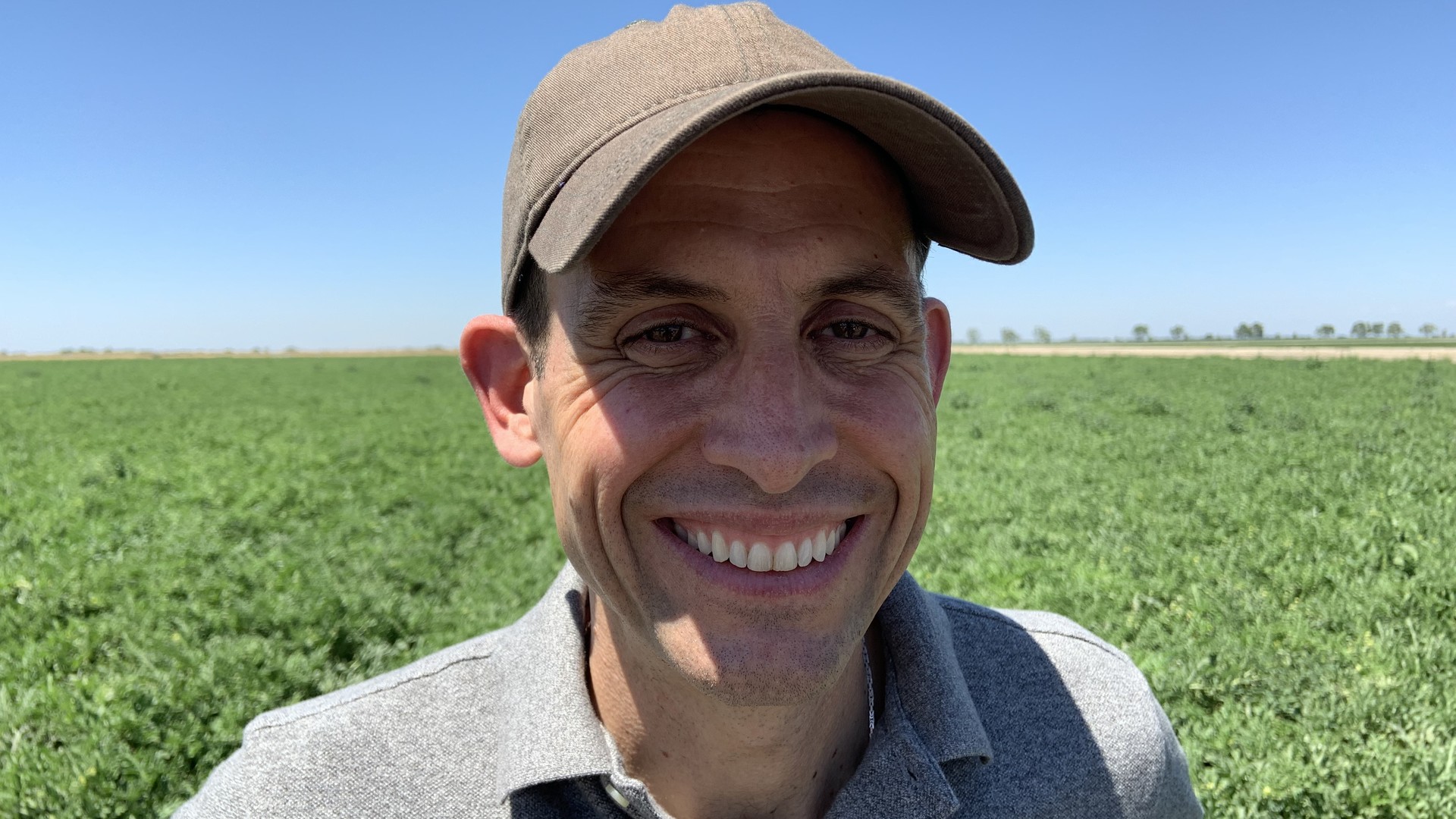
The Truth: Plants do not USE water….The plants Borrow water

Plants Transpire Most of the Water They Use!

Editor’s note: California Ag Today interviewed Allan Fulton, an Irrigation and Water Resources Advisor, UC Cooperative Extension Tehama County, in Redbluff CA, to comment on the debate about the agricultural industry’s use of water and to focus on a critical but disregarded process—that all plants transpire, even plants cultivated for the crops we eat.

CalAgToday: We hear in the media that our crops are using too much water. And while all plants need water to grow food, we also know that a high percentage of water taken up by all plants actually transpires back into the atmosphere, to form clouds and precipitation, right?

Fulton: Yes, when plants transpire, the water just returns to the local hydrologic cycle, leaving the harvested crop that we distribute elsewhere in the US or in the world actually very low in water content.

CalAgToday: When we think about transpiration, are the plants actually “borrowing” the water?

Fulton: Yes. We get a lot of questions about why we irrigate our crops so much, and it comes from the general public not being as close to farming every day. The truth is, plant transpiration is a necessary biological process. The water cools the tree so it stays healthy and exits the leaves through special cells called stomata. While the stomates are open to allow water to transpire, carbon dioxide enters and is used in photosynthesis, making sugars and carbohydrates for the plant to create the fruits and nuts that we eat. So, an inadequately watered plant cannot take in enough carbon dioxide during transpiration, resulting in defective fruits and nuts that are smaller, shriveled, cracked—all the things the typical consumer does not want to buy.

Plants cannot gain carbon dioxide without simultaneously losing water vapor.[1]

CalAgToday: Can we say 95 or 99% of the water that is taken up by the plant gets transpired and definitely not wasted?

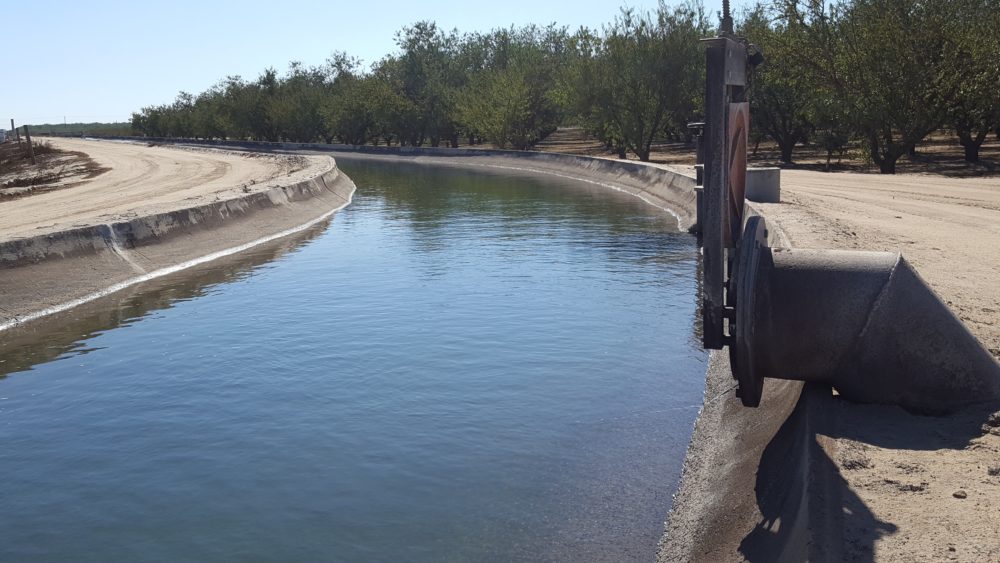
Fulton: Definitely. We converted to pressurized irrigation systems, micro-sprinklers, and mini sprinklers, so we have a lot more control over how much water we apply at any one time. We do not put water out in acre-feet or depths of 4-6 inches at a time anymore. So, much like when rainfall occurs, we can measure it in tenths, or 1 or 2 inches at most. As a result, the water doesn’t penetrate the soil very deeply, maybe only 1 or 2 feet each irrigation.

We are very efficient with the water, but because we deliver it in small doses, we have to irrigate very frequently. That is why we see irrigation systems running a lot, but they are systems that efficiently stretch our water supply and do not waste it.

CalAgToday: But again, the vast majority of the water that the tree is taking up is being transpired, right?

Fulton: Yes, most of the time, at least 90% of the water that we apply is taken up through the tree and transpired so that photosynthesis can happen.UCCE Tehama County

CalAgToday: And transpiration increases on a hot day?

Fulton: Yes, we do get a little bit of loss from surface evaporation from wet soil, but we try to control that with smaller wetting patterns—drip-confined wetting patterns. When you think about it, the heat of the day is in the afternoon when many irrigation systems don’t run because of higher energy costs. There are incentives not to pump in the middle of the afternoon, but those who do try to confine the wetted area to limit evaporation. And the hot hours of the day make up about 4 hours of a 24-hour cycle, so we irrigate mostly during the night time and early morning hours to lesson evaporative loss.

CalAgToday: Growers are doing everything they can to conserve water. If the trees and vines are all transpiring most of their irrigated water, why is using water to grow food a problem?

Fulton: I think the emphasis throughout the United States has always been to provide a secure food supply. That security has many benefits, economically and politically; and in the end, we are trying to provide the general public with good quality, safe food at the best price possible.

______________________________________________

[1]  Debbie Swarthout and C.Michael Hogan. 2010. Stomata. Encyclopedia of Earth. National Council for Science and the Environment, Washington DC.

CIMIS


The California Irrigation Management Information System (CIMIS) is a program unit in the Water Use and Efficiency Branch, Division of Statewide Integrated Water Management, California Department of Water Resources (DWR) that manages a network of over 145 automated weather stations in California. CIMIS was developed in 1982 by DWR and the University of California, Davis (UC Davis). It was designed to assist irrigators in managing their water resources more efficiently. Efficient use of water resources benefits Californians by saving water, energy, and money.

The CIMIS user base has expanded over the years. Currently, there are over 40,000 registered CIMIS data users, including landscapers, local water agencies, firefighters, air control board, pest control managers, university researchers, school teachers, students, construction engineers, consultants, hydrologists, government agencies, utilities, lawyers, weather agencies, and many more.

2021-08-04T18:34:08-07:00August 4th, 2021|

Big Grant for Dairy’s Net Zero Initiative

Dairy’s Net Zero Initiative Gets Boost with $10 million Research Grant

The Foundation for Food & Agriculture Research has awarded a $10 million grant to support U.S. dairy’s Net Zero Initiative as a critical on-farm pathway to advance the industrywide 2050 Environmental Stewardship Goals set through the Innovation Center for U.S. Dairy.

In California, UC Davis and UC Agriculture and Natural Resources scientists will collaborate on the nationwide project addressing carbon sequestration, soil health and nitrogen management.

“The Foundation for Food and Agricultural Research grant in partnership with Soil Health Institute and Dairy Research Institute are funding research that will positively impact the future of animal and plant agriculture in a world with increasingly limited natural resources,” said Deanne Meyer, UC Cooperative Extension specialist based at UC Davis, who studies livestock waste management.

Working with California dairy forage and almond producers, UC Cooperative Extension scientists and technicians will evaluate and demonstrate the impacts of using manure products as fertilizer in combination with more traditional soil conservation practices.

“With this research, there’s a potential to expand the use of dairy manure products beyond forage crops to crops such as almonds,” said Nick Clark, UC Cooperative Extension farm advisor for Fresno and Tulare counties. “We expect results to demonstrate that groundwater quality and quantity can be protected and preserved, and crop yields can be maintained without increasing net greenhouse gas emissions from crop production.”

Clark added, “We look forward to working with our local producers and connecting with our national partners and collaborators to examine and demonstrate the best practical solutions that science has to offer for farming in tomorrow’s world.”

California dairy operators who would like to participate in the experiment may contact Clark for more information at neclark@ucanr.edu.

Data from the “Dairy Soil & Water Regeneration: Building soil health to reduce greenhouse gases, improve water quality and enable new economic benefits” project will be broadly shared among the dairy community. The six-year project will provide measurement-based assessments of dairy’s greenhouse gas footprint for feed production. It will also set the stage for new market opportunities related to carbon, water quality and soil health.

“Addressing the U.S. dairy industry’s emissions is a critical solution to climate change,” said FFAR Executive Director Sally Rockey. “I know dairy farmers are working hard to decrease their environmental footprint and I’m thrilled to support their efforts by advancing research needed to adopt climate-smart practices on dairy farms across the country.”

Through foundational science, on-farm pilots and development of new product markets, the Net Zero Initiative aims to knock down barriers and create incentives for farmers that will lead to economic viability and positive environmental impact.

“After six years, we will have data that accurately reflect our farms’ greenhouse gas footprint for dairy crop rotations with consideration for soil health management practices and new manure-based products,” said Jim Wallace, Dairy Management Inc. senior vice president of environmental research. “We expect to develop critical insights that link soil health outcomes, such as carbon sequestration, with practice and technology adoption. This will provide important background information to support the development of new carbon and water quality markets.”

The project will be executed across four dairy regions responsible for about 80% of U.S. milk production: Northeast, Lakes, Mountain and Pacific. In addition to UC Agriculture and Natural Resources and UC Davis, collaborators include the Soil Health Institute and leading dairy research institutions, including Cornell University, Texas A&M AgriLife Research, University of Wisconsin-Madison, University of Wisconsin-Platteville, University of Vermont, and U.S. Department of Agriculture’s Agricultural Research Service (USDA ARS) Northwest Irrigation and Soils Research in Idaho.

Dozens of dairies representing climates and soils of these major production regions will participate in a baseline survey of soil health and carbon storage. Additionally, eight farms, including five operating dairies, two university research dairies and one USDA ARS research farm, will participate in the project. These pilots will be used to engage farmers in soil health management practices and monitor changes in greenhouse gas emissions, soil carbon storage, soil health and water quality.

The FFAR grant will be matched by financial contributions from Net Zero Initiative partners such as Nestlé, the dairy industry, including Newtrient, and in-kind support for a total of $23.2 million. The funds will be managed by the Dairy Research Institute, a 501(c)(3) non-profit entity founded and staffed by Dairy Management Inc., whose scientists will serve as the project leads to address research gaps in feed production and manure-based fertilizers.

About the partners

FFAR builds public-private partnerships to support bold science that fills critical research gaps. Working with partners across the private and public sectors, FFAR identifies urgent challenges facing the food and agriculture industry and funds research to develop solutions.

NZI is an industrywide effort led by six national dairy organizations: Dairy Management Inc., Innovation Center for U.S. Dairy, International Dairy Foods Association, Newtrient, National Milk Producers Federation and the U.S. Dairy Export Council. This collaboration represents a critical pathway on U.S. dairy’s sustainability journey.

For more information about dairy sustainability, visit www.usdairy.com/sustainability.

UC Agriculture and Natural Resources brings the power of UC to all 58 California counties. Through research and Cooperative Extension in agriculture, natural resources, nutrition, economic and youth development, our mission is to improve the lives of all Californians. Learn more at ucanr.edu and support our work at donate.ucanr.edu.


2021-07-22T16:09:39-07:00July 22nd, 2021|

This Growing Season Could Be Similar to 2015

Low Water Allocations Remind Growers of 2015


By Tim Hammerich with the Ag Information Network

The year 2015 is not a year most farmers remember fondly. The severe drought-affected California agriculture in profound ways and alarmingly 2021 is looking very similar.

Mike Wade is the executive director of the California Farm Water Coalition, which is a non-profit educational organization to help inform the public about agricultural water use.

“We’ve got quite a situation in California this year, similar to what we saw in 2015. And if we use that as kind of an example of what we might expect this year, we had over 540,000 acres of fallowed farmland back in 2015,” said Wade.

“And we’re expecting probably as much, or maybe more this year. Most of the state in agriculture has had significant water supply cuts. Probably one in four acres is facing a 5% water allocation this year. And huge other swaths have had 25% cuts – or they’re getting about 75%. But it’s affecting every corner of California agriculture and in a way that we’re starting to see impacts on our food supply this summer and into the fall through acreage reductions,” noted Wade.


2021-06-13T20:47:16-07:00June 13th, 2021|

Water Infrastructure Bill Passes Senate

Senate Passes Critical Infrastructure Bill


Recently, Federico Barajas, Executive Director of the San Luis & Delta-Mendota Water Authority, issued the following statement after the California Senate passed SB 559 – The State Water Resiliency Act – authored by Senator Melissa Hurtado (D-Sanger) by a 34-1 vote:
“This year’s very real drought conditions reinforce the need for an all of government approach to drought response, both in the short and long-term. Today’s overwhelming vote, led by Senator Hurtado and the Valley delegation, puts the California Senate firmly in support of a strong state role in repairing California’s water conveyance infrastructure and increasing California’s drought resilience.
“The San Joaquin, San Benito, and Santa Clara Valleys need long-term water supply solutions if they are to remain global leaders in food production, high tech, and environmental stewardship. SB 559 offers a holistic, statewide approach to restore the conveyance capacity of California’s most critical water delivery infrastructure.
“We applaud Senator Hurtado for her leadership and support for increasing water infrastructure investments that better prepare us for future droughts by enabling the movement of water when Mother Nature provides it and look forward to working with the broad coalition of supporters urging passage of this bill in the Assembly.”
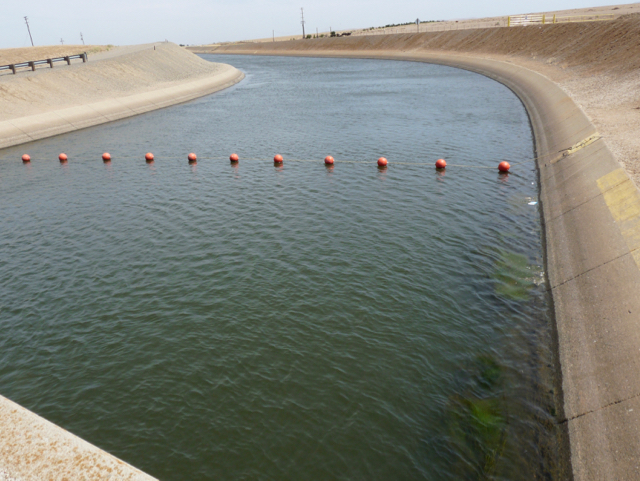
The State Water Resiliency Act of 2021 will allocate $785 million to repairing vital water delivery systems that provide drinking water to communities throughout California, water to sustain the state’s leading agricultural and technology economies, and wetlands of international importance. The funds would go to fixing the Delta-Mendota Canal, the Friant-Kern Canal, and major portions of the California Aqueduct, all of which have degraded and are losing water as a result of subsidence.
Key facilities of the Central Valley Project that convey water to member agencies of the San Luis & Delta-Mendota Water Authority have lost conveyance capacity over time due to subsidence. This lost capacity, combined with higher operational and power costs, results in millions of dollars of increased ratepayer expenses to convey less water through the system and reduces long-term climate resilience. The San Luis & Delta-Mendota Water Authority is a lead sponsor of a broad coalition supporting Senate Bill 559 (Hurtado) and S. 1179 (Feinstein) / H.R. 2552 (Costa), companion state and federal legislation designed to address this issue.
2021-06-06T20:51:31-07:00June 6th, 2021|

This Growing Season Could Be Similar to 2015

Low Water Allocations Remind Growers of 2015


By Tim Hammerich with the Ag Information Network

The year 2015 is not a year most farmers remember fondly. The severe drought-affected California agriculture in profound ways and alarmingly 2021 is looking very similar.

Mike Wade is the executive director of the California Farm Water Coalition, which is a non-profit educational organization to help inform the public about agricultural water use.

“We’ve got quite a situation in California this year, similar to what we saw in 2015. And if we use that as kind of an example of what we might expect this year, we had over 540,000 acres of fallowed farmland back in 2015,” said Wade.

“And we’re expecting probably as much, or maybe more this year. Most of the state in agriculture has had significant water supply cuts. Probably one in four acres is facing a 5% water allocation this year. And huge other swaths have had 25% cuts – or they’re getting about 75%. But it’s affecting every corner of California agriculture and in a way that we’re starting to see impacts on our food supply this summer and into the fall through acreage reductions,” noted Wade.


2021-05-11T18:17:01-07:00May 11th, 2021|

New Legislation Could restore Canal Capacity

Potential Funding to Accelerate Water Projects

By Tim Hammerich with the Ag Information Network

With more California farmers facing significant water cutbacks, public officials have responded with legislation to address the state’s recurring water shortages. A plan in the state Legislature would allocate $2 billion to accelerate a variety of water projects and programs. At the federal level, new legislation would restore canal capacity. Farm and water groups have also pressed to add water projects to a federal infrastructure package.

Two concurrent efforts aim to help farmers and ranchers ensure their properties in fire-prone areas. Legislation sponsored by the California Farm Bureau would authorize the state’s insurer of last resort, the California FAIR Plan, to underwrite coverage for commercial farms and ranches that can’t find it on the open market. At the same time, Nationwide has begun offering supplemental insurance for farmers who qualify for FAIR Plan coverage.

Dairy farmers will watch carefully as restaurants and other food-service facilities reopen. More than half of some dairy foods are typically consumed away from home. Dairy product sales to foodservice have increased and retail sales remain strong, but economists say future buying habits will be unpredictable as pandemic restrictions ease. With milk production expected to increase, analysts say food-service demand will be particularly important.


(Source: California Farm Bureau Federation)

2021-05-06T19:02:04-07:00May 6th, 2021|

Manure Management Get’s a Boost


A Consortia of Microbes Assist in Manure Management in Livestock


Boost is a product utilizing the digestion abilities of special bacteria and natural enzymes cultured for their ability to digest organic matter quickly, efficiently and without odor. These strains will work both in the presence of oxygen as well as in its absence. The natural enzymes quickly break down proteins, starch, carbohydrates, animal, and vegetable fats & oils as well as paper.

The composition of Boost includes a unique micro-nutrient enriched carrier to provide accelerated germination, growth, and superior enzyme production while reducing odor, BOD, COD, suspended solids, turbidity, and ammonia concentrations. Stable bacteria spores enhance shelf life and guarantee microbial concentration.  Spore-form allows it to resist chlorine, disinfectants, and high-water temperatures.

Considering the attributes of Boost in the digestion of organic materials, this consortium of bacteria proves to be a multi-functional/use means of preconditioning livestock manures in advance of field application.  Boost accelerates the transition of raw organics into plant-available nutrients reducing the stress on depleted indigent soil microbial bacteria. This process of preconditioning raw organics is not limited to poultry litter, livestock beddings, forage, and feed wastage.


The organic digestive ability of Boost bacteria has decreased the time required to compost whole livestock carcasses in mass to include the bones, viscera, hide, feathers, and bulking materials.  In the interest of on-farm biosecurity measures, the ability to dispose of animal/poultry carcasses at thermophilic temperatures at accelerated rates of decomposition decreases the exposure to trafficked disease while allowing for a field-ready, rich nutrient by-product.

In terms of poultry health and housing, Boost will reduce the measurable levels of ammonia ppm generated from litter after one application for an entire grow-out season significantly reducing flock mortality.  In the reduction of ammonia, the reduction of chick death loss due to blindness, respiratory infections, and footpad issues are noted.


In terms of swine health, applied to deep or shallow pull-plug pits, the ability of Boost to degrade organic materials reduces the levels of ammonia, hydrogen sulfide, and methane from the pits.  As with poultry, the reduction of pit gasses decreases the damage to ISOwean pig lungs, increases the rate of gain, and lessens effects of heat stress in confined livestock.

2021-05-13T16:03:01-07:00March 19th, 2021|

Congressman Harder Is Fighting For Valley

Harder, Already Appointed to Appropriations Committee, Successfully Secured Waiver to Serve on Ag

WASHINGTON – Representative Josh Harder (CA-10) will continue to serve on the House Committee on Agriculture for this term in Congress after successfully obtaining a waiver from the House Steering and Policy Committee. Members of the House who are appointed to the Appropriations Committee typically serve solely on that committee. If a member wishes to serve on an additional committee, they must seek out and obtain a special waiver allowing them to serve on an additional committee.

“This is the best-case scenario for the Valley. I get to fight for the funding we deserve on the Appropriations Committee – and I can continue my work on behalf of our farmers by serving on the Agriculture Committee once again,” said Rep. Harder. “It’s particularly important for me to serve on Ag this term as I’ll focus on our specialty crop producers when we look at drafting the next Farm Bill.”

Last month, Rep. Harder announced that he had been appointed to the House Appropriations Committee. The Committee is responsible for drafting all funding legislation in the House and will give Rep. Harder an opportunity to secure more funding for the Central Valley.

2021-01-18T18:21:53-08:00January 18th, 2021|

Agreeing on Water Needs

Sixth Generation Farmer and EDF Director Discuss Water Challenges

By Cannon Michael and Ann Hayden

Despite a seemingly endless era of upheaval – a surging pandemic, contentious election cycle and racial strife – we still have the responsibility to address pressing issues that cannot wait for calmer times. The future of California’s water is one of those issues.

While collaboration and relationship building have been made even more challenging due to distancing required by COVID-19, we believe that water is an issue where we can rise above party lines and entrenched perspectives.

Cannon Michael, Sixth Generation Grower

Water is the backbone of California’s agricultural economy, supports our iconic rivers, and of course, is essential to our survival.  Simply put, water is a lifeline that binds us together, and without it, we jeopardize our future and that of coming generations.

Could now be the time to collectively start down a better path for managing this precious resource and roll up our sleeves to make it happen? We think so.

For decades, fighting over water has stalled progress and sown deep mistrust across different water users.

We have forgotten that we are all stewards of California – a special place like no other, a rich connected tapestry of environmental beauty, diverse communities and productive agriculture.

We need to come together as Californians – not just farmers, environmentalists, rural community organizers and urbanites. We need to come together as Californians working for our children and future generations who are depending on us to leave them with a better California than we have today.

We need to come together to solve some admittedly difficult water challenges that affect the future of rural communities, cities, wildlife, farming in the Central Valley and consequently our country’s food supply. Drought and water scarcity are high on the list of these challenges. During our last major drought, the Sustainable Groundwater Management Act was enacted as one major piece of the solution to ensure we have enough water for future generations.

Looking forward, 2021 will be an important year for moving ahead on implementation of this sweeping change to water law. The state will be rolling out its first assessments of sustainability plans developed by regions with the most critically overdrafted groundwater supplies.

Balancing groundwater supply and demand, as required by the law, will no doubt be challenging: Some models say San Joaquin Valley landowners may need to take equivalent acreage to Yosemite National Park out of production to balance groundwater supply and demand.

To reach durable, fair solutions to such large challenges, we need to drop the baggage we’ve amassed over time. We need to come together as Californians to start collaboratively tackling problems – not just talking and arguing them. We need to come together and break the cycle of mistrust and take the time to truly understand how each side views the challenges and potential solutions.

It’s unlikely we will agree on everything – if we did California wouldn’t be the dynamic, diverse state it is today. But there is significant common ground we can build from. For instance, we all agree every single person in California should have clean and affordable drinking water when they turn on their kitchen faucet.

We also agree that replenishing groundwater is one of many solutions we will need to comply with the Sustainable Groundwater Management Act. But it’s not the only solution; it’s inevitable that we still will need to scale back some agriculture.

The question we need to address is, how can we make sure that agriculture can still thrive while some farmland becomes productive in new ways, whether it’s with less water-intensive ranching, low-impact solar projects, wildlife habitat or recreational areas for our families to enjoy on picnics and hikes?

Taking action to address these challenges may mean parts of our state and the very communities we live in will look different from how they look today. But if we can come together as Californians to get it right, California will evolve and endure as the special place it is today for generations to come.

We have decades of experience coming at water challenges from our silos. Let’s break down those silos, come together as Californians and see what happens. Isn’t it worth a shot?

Cannon Michael is a sixth-generation farmer and president and CEO of Bowles Farming Co., headquartered in Los Banos, cannon@bfarm.com

Ann Hayden is senior director of western water and resilient landscapes at Environmental Defense Fund, ahayden@edf.org

This document first appeared in WaterWrights.net


2021-05-12T10:52:43-07:00January 11th, 2021|

Agreeing on Water Needs

Sixth Generation Farmer and EDF Director Discuss Water Challenges

By Cannon Michael and Ann Hayden

Despite a seemingly endless era of upheaval – a surging pandemic, contentious election cycle and racial strife – we still have the responsibility to address pressing issues that cannot wait for calmer times. The future of California’s water is one of those issues.

While collaboration and relationship building have been made even more challenging due to distancing required by COVID-19, we believe that water is an issue where we can rise above party lines and entrenched perspectives.

Cannon Michael, Sixth Generation Grower

Water is the backbone of California’s agricultural economy, supports our iconic rivers, and of course, is essential to our survival.  Simply put, water is a lifeline that binds us together, and without it, we jeopardize our future and that of coming generations.

Could now be the time to collectively start down a better path for managing this precious resource and roll up our sleeves to make it happen? We think so.

For decades, fighting over water has stalled progress and sown deep mistrust across different water users.

We have forgotten that we are all stewards of California – a special place like no other, a rich connected tapestry of environmental beauty, diverse communities and productive agriculture.

We need to come together as Californians – not just farmers, environmentalists, rural community organizers and urbanites. We need to come together as Californians working for our children and future generations who are depending on us to leave them with a better California than we have today.

We need to come together to solve some admittedly difficult water challenges that affect the future of rural communities, cities, wildlife, farming in the Central Valley and consequently our country’s food supply. Drought and water scarcity are high on the list of these challenges. During our last major drought, the Sustainable Groundwater Management Act was enacted as one major piece of the solution to ensure we have enough water for future generations.

Looking forward, 2021 will be an important year for moving ahead on implementation of this sweeping change to water law. The state will be rolling out its first assessments of sustainability plans developed by regions with the most critically overdrafted groundwater supplies.

Balancing groundwater supply and demand, as required by the law, will no doubt be challenging: Some models say San Joaquin Valley landowners may need to take equivalent acreage to Yosemite National Park out of production to balance groundwater supply and demand.

To reach durable, fair solutions to such large challenges, we need to drop the baggage we’ve amassed over time. We need to come together as Californians to start collaboratively tackling problems – not just talking and arguing them. We need to come together and break the cycle of mistrust and take the time to truly understand how each side views the challenges and potential solutions.

It’s unlikely we will agree on everything – if we did California wouldn’t be the dynamic, diverse state it is today. But there is significant common ground we can build from. For instance, we all agree every single person in California should have clean and affordable drinking water when they turn on their kitchen faucet.

We also agree that replenishing groundwater is one of many solutions we will need to comply with the Sustainable Groundwater Management Act. But it’s not the only solution; it’s inevitable that we still will need to scale back some agriculture.

The question we need to address is, how can we make sure that agriculture can still thrive while some farmland becomes productive in new ways, whether it’s with less water-intensive ranching, low-impact solar projects, wildlife habitat or recreational areas for our families to enjoy on picnics and hikes?

Taking action to address these challenges may mean parts of our state and the very communities we live in will look different from how they look today. But if we can come together as Californians to get it right, California will evolve and endure as the special place it is today for generations to come.

We have decades of experience coming at water challenges from our silos. Let’s break down those silos, come together as Californians and see what happens. Isn’t it worth a shot?

Cannon Michael is a sixth-generation farmer and president and CEO of Bowles Farming Co., headquartered in Los Banos, cannon@bfarm.com

Ann Hayden is senior director of western water and resilient landscapes at Environmental Defense Fund, ahayden@edf.org

This document first appeared in WaterWrights.net


2020-12-14T11:32:24-08:00December 14th, 2020|
Go to Top