Landfill Dzine Partners with My Job Depends on Ag
Landfill Dzine Partners with My Job Depends on Ag
By Charmayne Hefley, Associate Editor

Heather and Todd Carpenter of Landfill Dzine and A&J Industrial sell recycled lay-flat tubing made into into belts, purses,bracelets, flip-flops.
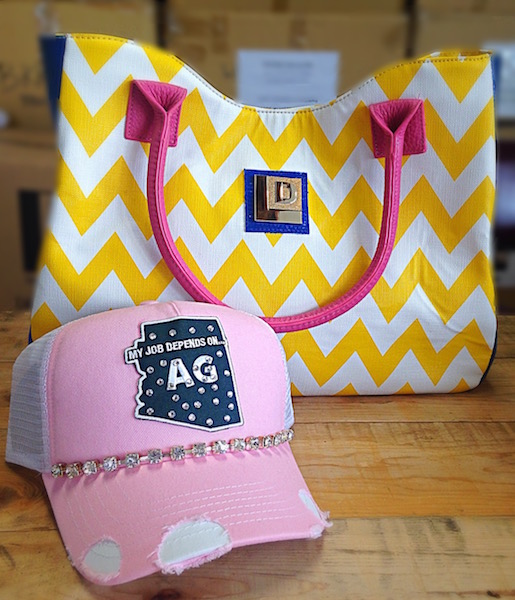
Landfill Dzine has partnered with My Job Depends on Ag (MJDOA) to sell specialized MJDOA merchandise, including the already-popular bling MJDOA baseball caps. Heather Carpenter, co-owner with her husband, Josh, of A&J Industrial and Landfill Dzine, said the partnership just makes sense because Landfill Dzine is a company based on upcycling old irrigation hoses, which depends on the agricultural industry for its existence.
“MJDOA is everything we already do,” Carpenter said, “so it’s just like a match made in heaven for us.”
Carpenter said that Landfill Dzine upcycles old irrigation hoses called Layflat that is made with rubber, nylon and other materials all woven or melted together, which makes the hoses un-recyclable.
We upcycle it into everyday, wearable products: flip flops, handbags, belts. We divert it from going to the trash, and we use it in all of our products. We cut [the irrigation hose], wash it, clean it and make it into something else.”
Carpenter said Landfill Dzine is able to help the agricultural community by taking waste straight from the field and giving it a new purpose. “It helps farmers save money because they don’t have to throw old irrigation hoses in the trash.”
Carpenter said she strongly believes the mission of MJDOA applies to Landfill Dzine; hence, the partnership between the two companies. “We help distribute MJDOA’s products as well,” said Carpenter, “ and increase awareness on what we’re trying to do in California and with water and waste.”



 California Ag Today: Wasn’t it 40 years ago when the dams were denied or no longer supported by the population?
 nce against them continued to be ignored, Duarte said, “We went to the Pacific Legal Foundation, where they filed a due process suit against the Army Corps of Engineers on behalf of a farmer’s right to farm their ground. The Army Corps of Engineers now claims that our 4-7 inch tillage through ground that has been tilled 18-24 inches in the past destroyed wetlands.”






 “Farmers and ranchers are innovative and always trying to do the best they can to protect their land and water; but we all can do better. I think our producers respond to change in very good ways. Look, we have gone through technological advances; we are more technically precise in using fertilizers and water,” Carleton said.