Agriculture Science Recognition Awards, Part 1- Megen Morales

Agriculture Science Recognition Awards, Part 1 – Megen Morales

By Patrick Cavanaugh, Deputy Editor

Assemblyman Jim Patterson joined Dr. Sandra Witte, dean of the Jordan College of Agricultural Sciences and Technology at California State University, Fresno (Fresno State) and Lawrence Salinas, Fresno State’s executive director of Government Relations, at the 23rd Assembly District’s 2016 Agriculture Science Recognition Awards on March 17 at Fresno State.

California Ag Today will highlight each of four Fresno State students in the Fresno State Honoree series, Meghan Loper, Megen Morales, Elizabeth Mosqueda and Nick Wolfenden, who were selected from among several students nominated for their dedication to the future of agriculture in the Central Valley.

“These brilliant students represent the best of the best,” said Assemblyman Patterson. “Their devotion to making a difference in our agriculture science community is to be commended and I can’t wait to see what the future holds for them.”

______________________________________

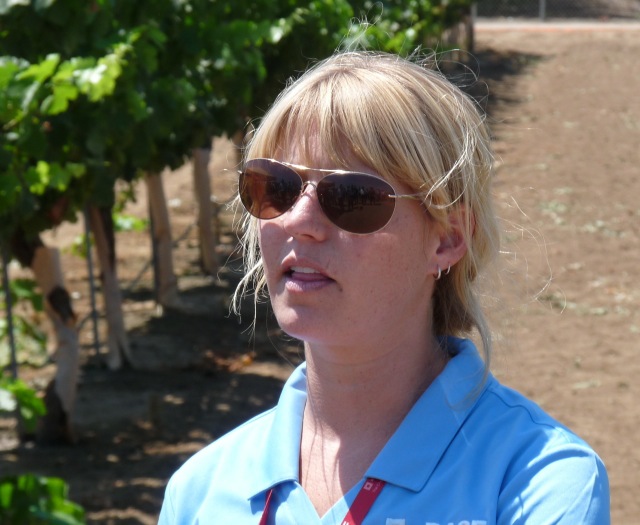
Megen Morales, a senior at Fresno State majoring in enology and chemistry, was honored recently for leading the way in the study of mold in winegrapes. “She’s also helping others in agriculture measure and quantify the amount of mold,” noted Patterson.

After a grapevine-judging contest in high school, Morales knew she wanted to work in the viticulture industry. So for the past three years, she has worked with her enology professors to create a new standard for wineries to follow for the amount of mold that is acceptable in harvested wine grapes. “The current maximum of moldy grapes acceptable in wineries is two percent,” noted Patterson, “but there is no process that accurately determines the level of mold content.” Morales explained, “Right now, you simply look at the grapes and usually determine that it looks like 1.5 to two percent mold.”

“So Megen harvested White Zinfandel Grapes from 15 farms throughout the Central Valley, and brought them back to the lab to study the levels of several types of mold,” noted Patterson. “Morales compiled the data, and her results are now used by large-scale wineries to determine how much mold is in their harvested grapes.”

A member of Central Valley Women for Agriculture (CWA) and a volunteer at the Fresno State Winery, Morales has also helped promote agriculture at Valley Children’s Hospital. As current manager of the laboratory, she trains other students on how to use it.

In fact, Morales has dedicated much of her time to teaching young people about the important role agriculture plays in everyday life. She says her experiences at Fresno State will help her excel in her future as an empowered, humble person, with the skills and mindset to accomplish great things. She hopes to work as an enologist at a major winery and eventually plans to become a senior wine maker. Morales’ ultimate goal is to serve as a role model, a mentor to women in agriculture, and to advocate for agricultural education to preserve the agricultural world of tomorrow.

“My passion started with crop production and it evolved towards viticulture,” noted Morales. “I really enjoyed chemistry in high school. Combining the two fields [agriculture and chemistry] was a challenge, but then I found enology. It has been really exciting learning how to make wine.”

“The winegrape scan spectrum we are developing will enable wineries to scan one sample of grapes coming in and better quantify the amount of mold,” Morales elaborated. “Since wine is filtered before it goes into a bottle, mold has not been a big problem. However, [mold] does affect the sensory impact of wine, so once you get above five percent mold you start to smell a funky, sweet, almost vinegary smell. It doesn’t affect the palate, but it does affect the nose,” she stated.

 ______________________________________

2021-05-12T11:05:57-07:00March 24th, 2016|

Sandra Witte, New Ag Dean at Fresno State

Dr. Sandra Witte Named Dean of Jordan College at Fresno State

(March 16, 2016) – Dr. Sandra Witte, who has been serving as interim dean of the Jordan College of Agricultural Sciences and Technology at Fresno State, has been appointed permanent dean, effectively immediately.

Dr. Lynnette Zelezny, provost and vice president for Academic Affairs, said Witte’s exceptional work as interim dean made her the best person for the position.

“We conducted a yearlong national search for a dean but did not find the right candidate for this important position,” said Zelezny. “In the meantime, it became clear to me, the faculty, staff and our strong partners in the agriculture community that Dr. Witte was the right candidate. I’m pleased she agreed to stay at Fresno State as permanent dean.”

Zelezny added: “This is a critical time for the Jordan College as we prepare for the opening of the Jordan Agricultural Research Center this spring and continue our laser-focus on crucial issues related to water and sustainability. I am confident Dr. Witte will lead the college to increasing national prominence.”real JCAST Logo

Witte has taken an unconventional route to the dean’s position, starting her career as a registered dietitian and serving as a professor and chair of the Department of Food Science and Nutrition, one of seven departments in the Jordan College.

“In the Jordan College, we often talk about offering programs from farm to fork and all the business in between,” said Witte. “While most people think of agriculture from the farm end, my connection is clearly on the fork end. I have always had an appreciation for traditional agriculture, and in my time at Fresno State, that has bloomed into a passion. After all, where is the food without the farmer?” she said.

Witte joins a growing number of women in agricultural leadership positions that traditionally have been held by males in universities, industry and commodity groups in the U.S.

The Jordan College maintains an enrollment of approximately 2,400 undergraduate and 100 graduate students from diverse backgrounds from throughout California, the U.S. and the world. Undergraduate, graduate and continuing education programs are offered in the major areas of agricultural business; animal sciences and agricultural education; child, family and consumer sciences; food science and nutrition; industrial technology; plant science; and viticulture and enology.

Faculty and students conduct applied research and public service in selected areas of agriculture, food sciences, industrial technology and family sciences. Students engage in learning science, technology and management in the classroom and by experience on the 1,000-acre on-campus University Agricultural Laboratory.

Witte has served as interim dean since October 2014. Previously, she jointly held the positions of associate dean of the Jordan College and dean of the Division of Graduate Studies. She joined the Fresno State faculty in 1992 and took her first administrative assignment in 2007.

She completed her bachelor’s degree in foods and nutrition at California State Polytechnic University, Pomona; master’s degree in home economics, nutrition and dietetics option at Fresno State; and her Ph.D. in food systems management at Oregon State University, Corvallis.

____________________________

Photo: Sandra Witte, dean of Agricultural Sciences and Technology at Fresno State (source: Fresno State

2016-05-31T19:24:10-07:00March 16th, 2016|

National Days Celebrations at Fresno State Farm Market

Fresno State Farm Market Hosts National Day Events

By Charmayne Hefley, Associate Editor


Fresno State’s Rue and Gwen Gibson Farm Market hosted its Annual Pistachio Day on February 26 in honor of World Pistachio Day. Miles Robinson, a student market lead, said, “We’ve been working with American Pistachio Growers (APG) to market this campaign and give away pistachio samples, all courtesy of APG. We are also raffling a gift basket with several of our products and APG items as well.”12821589_10153999748978330_676533612082576193_n

Robinson said the Fresno State farm market plans to host monthly events to feature the store and student products, including that very fowl day, Poultry Day, on March 18, and National Raisin Day on April 29. “For Poultry Day,” Robinson said, “we’ll be sampling Foster Farms chicken in a couple of different recipes. We look forward to having people actually taste our chicken. We will also have a chicken dance contest. For National Raisin Day we’re partnering with the California Raisin Board to bring information, samples and have a fun time.”

Robinson said the student-run farm market, which specializes in student-made products, is in the process of creating new recipes for its coated nuts and raisins. “Over the past year, we’ve been slowly rolling out new recipes for our milk chocolate raisins, milk chocolate almonds, milk chocolate cabernet raisins and dark chocolate raisins,” Robinson said. “All of our products will have brand-new recipes, 100 percent Fresno State-done.”

2016-08-10T11:56:30-07:00March 11th, 2016|

Falcons Work in Agriculture, Too

Farmers’ Other Best FriendFalconsWork in Agriculture, Too

By Charmayne Hefley, Associate Editor

Charmayne Hefley, California Ag Today broadcaster and associate editor, and farmers’ other best friend – the falcon.

Agriculturalists have found ways to employ some animals to assist them in the fields. Karl Kerster, owner of Sacramento-based Kerster’s Falconry, employs farmers’ other best friend, falcons, to keep agricultural products safe before and during harvest. More specifically, Kerster’s five falcons perform bird abatement—removal of nuisance birdsto protect cherries, berries and grapes. Pest birds are defined as sparrows, swallows, finches, starlings, pigeons, blackbirds and more.

“We work to protect the farmer’s crop,” Kerster said, “and we really enjoy doing it—which is a plus when you’re having to do it for a hundred days straight to keep a crop safe. We start when the fruit starts to ripen enough that the birds are going to attack, until the crop has been substantially harvested. I work five birds, and I have several more in reserve, but the five that I work keep me very busy.”

Kerster, a master falconer, has been serving as a falconer since 1996, and his birds have a high success rate at keeping pest birds away from crops.“We are 99 percent successful in protecting a crop in most situations,” Kerster said. “We also take care of any other bird problems that may or may not be on the berries, cherries and grapes that we normally do. Any customer who wants us to dispose of a problem, we’re ready to help.”

______________________________________

Becoming a falconer is not an “overnight” achievement and is not for the meek. The first of the “up-front questions you need to be able to answer to yourself,” according to the California Hawking Club is, “Will you, can you, commit part of your waking hours to a creature who at the very best of times will merely tolerate your presence, is as affectionate as a stone, and at the worst of times will cause you heartache and puncture wounds? Can you commit to an average of a half-hour a day, every day, and two to four hours on a hunting day, regardless of school, family, or job – forever?

The eight steps required to become a falconer in the state of California are provided by the California Hawking Club.

Becoming a Master falconer, according to the North American Falconers Association, “takes at least seven years; finishing your apprenticeship alone will take at least two.”

______________________________________

Falconry is a heavily-regulated practice, governed by federal and state laws and regulations.  For more information, go to:

California Natural Resources Agency Department of Fish and Wildlife

California Hawking ClubCalifornia-Hawking-Club-logo

Kerster’s Falconry 

Electronic Code Of Federal Regulations

______________________________________

2021-05-12T11:03:03-07:00February 29th, 2016|

Vertical Integration and Grape Flavors

Vertical Integration and Grape Flavors

By Charmayne Hefley, Associate Editor

Vertical integration, the combination in one company of two or more stages of production normally operated by separate companies, has helped lead to success in many facets of the agriculture industry. Harold McClarty, who founded HMC Farms with Mike Jensen, said without vertical integration, his farm would not be able to survive or have nearly the same level of success.  “We would not be in stone fruit if we were not vertically integrated,” McClarty explained. “There are three profit centers: the growing of it, the packing of it and the selling of it. We have all three of those profit centers. Without them we would not be able to survive the tough years.”

Cotton Candy grape clamshell

Cotton Candy grape clamshell (Photo source: Grapery)

McClarty also said the grape industry has made significant strides in flavor profiles in the marketplace. One popular flavor is Cotton Candy, which is grown and sold by Grapery, a company founded by Jack Pandol in 1996. Grapery also grows and sells Gum Drop grapes, Moon Drop grapes, Flavor Pops grapes and more.

The increase in unique flavors, according to McClarty, has helped grapes become a popular snack. “There’s been a revolution in the varieties of grapes grown just over the last five to seven years,” McClarty said. “These new varieties have revolutionized grapes and enabled us to produce more on less. 

To evaluate a grape, McClarty suggests you “look at a berry’s color, crispness and sweetness; these are the things that make a grape taste delicious. It really is a revolution, and we haven’t seen it in the California marketplace as much as we have in the rest of the United States. The retail chains in California just haven’t embraced it as well as some of the really good supermarkets on the East Coast and in the Southeast,” noted McClarty.

2016-05-31T19:24:13-07:00February 9th, 2016|

State of the Winegrape Industry

State of the Winegrape Industry

By Charmayne Hefley, Associate Editor

Growers attending the Grape, Nut and Tree Fruit Expo in Fresno last November had the opportunity to learn about the state of the winegrape industry from Nat DiBuduo, president of Allied Grape Growers. While DiBuduo acknowledged growers were facing challenges, he encouraged them to continue to work with the industry.

DiBuduo said the immediate challenges facing the winegrape industry—largely in the production and price of winegrapes—depend on the variety, “but I’m asking all winegrape growers to look at their crops, production levels and quality levels.” DiBuduo is asking growers to work with the wineries to get higher production numbers and contracts with higher prices for long-term sustainability.”

“I think 2016 will be a challenge, but I look forward to 2017,” he elaborated; “however, it’s not going to get better without the removal of some vineyards. We’ve got to get the price to where growers are sustainable and viable going forward,” said DiBuduo. “We supply a big base of grapes to in the industry. We want to keep that base despite dwindling sales.”

DiBuduo explained that growers could work on overcoming their challenges by remaining active in the discussion. “Go to meetings like this,” he explained. “Go to viticulture meetings. Work with specialists to get better production and better quality.”

DiBuduo also stressed the importance of designing labels and wines that appeal to millennials. Labels that stand out as creative and unique appeal to the millennial generation, which also does not hold the same brand loyalty as prior generations, he said.

Having labels and brands that are attractive to the millennials is important, DiBuduo said, because this generation cannot “be standardized into one-cookie-cutter-fits-all, so you’ve got to be energized. I think the winegrape industry has really done that. We’ve come out with a number of different blends of wines and different labels that catch the eyes of the millennials and get them excited.”

2016-06-03T09:48:42-07:00January 19th, 2016|

New Dietary Guidelines for Healthy Eating

HHS and USDA Release New Dietary Guidelines to Encourage Healthy Eating Patterns to Prevent Chronic Diseases


Secretary of Health and Human Services Sylvia M. Burwell and Secretary of Agriculture Tom Vilsack TODAY released updated nutritional guidelines that encourage Americans to adopt a series of science-based recommendations to improve how they eat to reduce obesity and prevent chronic diseases like Type 2 diabetes, hypertension, and heart disease. The 2015-2020 Dietary Guidelines for Americans is the nation’s trusted resource for evidence-based nutrition recommendations and serves to provide the general public, as well as policy makers and health professionals with the information they need to help the public make informed choices about their diets at home, school, work and in their communities.

The newly released 8th edition of the Dietary Guidelines reflects advancements in scientific understanding about healthy eating choices and health outcomes over a lifetime. This edition recognizes the importance of focusing not on individual nutrients or foods in isolation, but on the variety of what people eat and drink—healthy eating patterns as a whole—to bring about lasting improvements in individual and population health.

“The Dietary Guidelines for Americans is one of many important tools that help to support a healthier next generation of Americans,” said Secretary Vilsack. “The latest edition of the Dietary Guidelines provides individuals with the flexibility to make healthy food choices that are right for them and their families and take advantage of the diversity of products available, thanks to America’s farmers and ranchers.”

The specific recommendations fit into five overarching guidelines in the new edition:

1. Follow a healthy eating pattern across the lifespan. Eating patterns are the combination of foods and drinks that a person eats over time.

2. Focus on variety, nutrient-dense foods, and amount

3. Limit calories from added sugars and saturated fats, and reduce sodium intake

4. Shift to healthier food and beverage choices

5. Support healthy eating patterns for all

Healthy eating patterns include a variety of nutritious foods like vegetables, fruits, grains, low-fat and fat-free dairy, lean meats and other protein foods and oils, while limiting saturated fats, trans fats, added sugars and sodium. A healthy eating pattern is adaptable to a person’s taste preferences, traditions, culture and budget.

Importantly, the guidelines suggest Americans should consume:

1. A variety of vegetables, including dark green, red and orange, legumes (beans and peas), starchy and other vegetables

2. Fruits, especially whole fruits

3. Grains, at least half of which are whole grains

4. Fat-free or low-fat dairy, including milk, yogurt, cheese, and/or fortified soy beverages

5. A variety of protein foods, including seafood, lean meats and poultry, eggs, legumes (beans and peas), soy products, and nuts and seeds

6. Oils, including those from plants: canola, corn, olive, peanut, safflower, soybean, and sunflower. Oils also are naturally present in nuts, seeds, seafood, olives, and avocados.

Further, Americans should be encouraged to consume:

1. Less than 10 percent of calories per day from added sugars. ChooseMyPlate.gov provides more information about added sugars, which are sugars and syrups that are added to foods or beverages when they are processed or prepared. This does not include naturally occurring sugars such as those consumed as part of milk and fruits.

2. Less than 10 percent of calories per day from saturated fats. The Nutrition Facts label can be used to check for saturated fats. Foods that are high in saturated fat include butter, whole milk, meats that are not labeled as lean, and tropical oils such as coconut and palm oil.

3. Less than 2,300 milligrams (mg) per day of sodium for people over the age of 14 years and less for those younger. The Nutrition Facts label is a helpful tool to check for sodium, especially in processed foods like pizza, pasta dishes, sauces, and soups.

Based on a review of current scientific evidence on nutrition, the 2015 edition includes updated guidance on topics such as added sugars, sodium, and cholesterol and new information on caffeine. For example, the 2015-2020 Dietary Guidelines is the first edition to:

1. Recommend a quantitative limit to consume less than 10 percent of calories from added sugars.

2. Reaffirm guidance about the core building blocks of a healthy lifestyle that have remained consistent over the past several editions

3. Suggest there is still work to be done to encourage more Americans to follow the recommendations outlined in the Dietary Guidelines.

The 2015-2020 Dietary Guidelines continues the nation’s dependence on California agriculture, which includes more than 400 commodities. According to the California Department of Food and Agriculture (CDFA) in 2014, the state produced nearly half of US-grown fruits, nuts and vegetables. Across the nation, US consumers regularly purchase several crops produced solely in California.

California’s top-ten valued commodities (USDA/NASS Crop Year Report 2014):

* Milk — $9.4 billion

* Almonds — $5.9 billion

* Grapes — $5.2 billion

* Cattle, Calves — $3.7 billion

* Strawberries — $2.5 billion

* Lettuce — $2 billion

* Walnuts — $1.8 billion

* Tomatoes — $1.6 billion

* Pistachios — $1.6 billion

* Hay — $1.3 billion

The 2015-2020 Dietary Guidelines for Americans is available at dietaryguidelines.gov.USDA has also released updates for consumers on ChooseMyPlate.gov, and new resources will soon be available on Health.gov from HHS that will help health professionals support their clients and patients in making healthy choices.

The Dietary Guidelines is required under the 1990 National Nutrition Monitoring and Related Research Act, which states that every 5 years, the U.S. Departments of Health and Human Services (HHS) and of Agriculture (USDA) must jointly publish a report containing nutritional and dietary information and guidelines for the general public. The statute requires that the Dietary Guidelines be based on the preponderance of current scientific and medical knowledge.

2021-05-12T11:17:15-07:00January 7th, 2016|

Positive Outlook for Table Grapes

Barry Bedwell: Positive Outlook for Table Grapes

By Charmayne Hefley, Associate Editor

At the November 17 Grape, Nut & Tree Fruit Expo in Fresno, Barry Bedwell, president of the California Fresh Fruit Association, reported a positive outlook for table grapes this year. “Production continues to expand,” said Bedwell, “and consumer acceptance of table grapes continues to expand, particularly for exported California table grapes. That’s a real positive. We’re also seeing the development of newer varieties—more proprietary brands that are very consumer friendly.”

Barry Bedwell, president, California Fresh Fruit Association

Barry Bedwell, president, California Fresh Fruit Association

Bedwell said topping this year’s California Fresh Fruit Association annual Board of Directors Top 10 Issues survey are water concerns, followed by food safety and labor. “These are relatively consistent,” Bedwell said, “but we have seen some changes. Since last year, water, of course, has gone to the top of the list. Our members expressed concerns beyond the drought that encompass what future water system will allow proper conjunctive use of water—both surface water and groundwater.”

“We’ve also seen increased concern over food safety. And even though grapes are permanent crops with, I think, a low risk profile, we always have to be very concerned about food safety.

Then we have to look at the labor situation—not only the cost of labor—but also the availability. So, even though it has been stalled, the need for immigration reform is critically important. We will probably be in a defensive position in the next couple of years, compounded by increasing labor costs due to some well-intended, but I think misguided, efforts to increase wages around the state unnecessarily.”

_____________________

In 2015, the California Fresh Fruit Association survey identified the following issues as top priorities: 

  1. Water Supply/Drought Related Issues (#3 in 2014)
  2. Food Safety (#9 in 2014)
  3. Immigration reform (#1 in 2014)
  4. Health Care Mandates/Affordable Care Act (#4 in 2014)
  5. Labor Laws and Regulations (#2 in 2014)
  6. Labor Costs/Minimum Wage Increase Impacts (#5 in 2014)
  7. Groundwater Management Requirements (N/L in 2014)
  8. Water Quality Regulations (Nitrogen, Salts, etc.) (#7 in 2014)
  9. Invasive Pest Issues (#6 in 2014)
  10. Workers Compensation Issues (#8 in 2014)

(Source: California Fresh Fruit Association)

____________________

Links

Grape, Nut & Tree Fruit Expo

California Fresh Fruit Association

2016-05-31T19:27:02-07:00December 9th, 2015|

Raisin Bargaining Association Negotiations for 2015

Glen Goto: Raisin Bargaining Association Negotiations for 2015

By Charmayne Hefley, Associate Editor


In the midst of the 2015 (RBA) Raisin Bargaining Association negotiations on behalf of its members, the RBA  has reached a price agreement with one processor among 13 thus far, according to CEO Glen Goto. “It is a negotiation, so we don’t know where it will end up,” Goto said. “We also don’t know when it will end up, but we’re trying to do it as quickly as possible.”

Goto said California accounts for 30 to 35 percent of the world raisin supply. This year, Turkey, California’s largest competitor, which typically produces about the same amount, is experiencing a decreased supply due to a devastating April frost. “We are a world commodity,” Goto said. “The United States and Turkey, together, produce most of the dried grapes in the world, so we do look at Turkey as a competitor. Nevertheless, in certain markets, we may want to work together with Turkey. We are very structured with regard to our export destinations, and Europe is one of our big markets. Turkey is also very big in Europe, so our export success there varies by year and by supply situation.”

Goto is optimistic about the raisin industry despite its challenges and the loss of acreage as growers convert their vineyards to almonds, other nuts, citrus and other tree fruit crops. He explained, “Growers are doing their due diligence to determine the best economic scenario for their operations. And given other good, profitable commodities in the marketplace, more power to growers if they have the ability to convert their acreage to them.”

2016-05-31T19:27:02-07:00December 8th, 2015|

More Rain, More Fungi, More Use for Multiuse Fungicides

With More Rain, More Fungi, More Use for Multiuse Fungicides

By Patrick Cavanaugh, Deputy Editor

With spring rains, many vegetables, tree fruits, grapes and nuts succumb to fungi pressure. However, during the past few years, only trivial amounts of spring rain have moistened California’s soil and lulled farmers to abandon their vigilant watch for fungi proliferation. But now, the strong likelihood of El niño-driven wet weather this spring could catch growers off-guard.

“We have an El niño coming that has already been tagged, ‘Too big to fail,’ which will bring a lot of rain. So it’s really important for folks to think about switching gears this year on their pest management mindset. With more rain, comes more fungi disease. We always see really high pressure disease years with rain,” said Kate Walker a technical services representative with BASF Corporation on the Central Coast, who advises use of a multiuse fungicide product already on hand.

Anthracnose in Strawberries, UC Statewide IPM Project

Anthracnose in Strawberries (Source: UC Statewide IPM Project

Strawberries, in particular, are vulverable to fungi. “We have heard from our strawberry growers,” said Walker, “that these fungal diseases are always present in California, but they vary significantly in their severity year-to-year depending on the weather,” noted Walker.

“One major disease that accompanies higher moisture, Anthracnose, often called leaf, shoot, or twig blight,” Walker explained, “results from infection caused by the fungus Colletotrichum. I’ve heard some growers have not experienced Anthracnose issues in 10 years,” said Walker. “As it emerges and becomes more problematic in strawberries, farmers really need to know which types of fungicides to use to manage this and other diseases.”

“It is very important for farmers and PCAs to walk through and scout their fields for disease,” Walker said, “and when they identify one, to become very aggressive with their fungicide management program. So, as representatives for BASF, we are lucky to have multiuse fungicide products available to control these diseases, such as Merivon Fungicide.”

Walker noted Merivon has two modes of action, “so it is very broad-spectrum. Typically we position Merivon in California for use on powdery mildew and Botrytis, but what we seldom talk to growers about is its utility for Anthracnose. We see a lot more  Anthracnose in Florida and on the East Coast due to the increased rains; whereas, it usually doesn’t come through every year in California. So it is good to for farmers and PCSs to know that the product with which they are familiar for use in Botrytis, is also very effective with other issues, like Anthracnose.”

Walker offered, “Another very common disease that flourishes with increased rain, Rhizopus, occurs post-harvest, after the berries are picked up from the field. Again, Merivon has utility for Rhizopus as well, so growers don’t have to change or reinvent their program to manage these diseases.”

Walker said, “Rhizopus is an airborne bread mold. It is very common in the air and in the soil, so anytime a fruit or a nut is exposed to the spores blowing in the wind, it is vulnerable to infection with this disease.”

2016-05-31T19:27:02-07:00December 4th, 2015|
Go to Top