Historic Temperance Flat MOU Signing

Assemblymember Bigelow on Historic July 1 MOU Signing

By Patrick Cavanaugh, Farm News Director

East of Fresno at Friant Dam last Friday, July 1, the San Joaquin Valley Water Infrastructure Authority (SJVWIA) and the United States Department of the Interior, Bureau of Reclamation signed an historic Memorandum of Understanding to coordinate and complete feasibility studies of the proposed Temperance Flat Dam. 

Historic July 1, 2016 MOU Signing for Temperance Flat Dam

Historic July 1, 2016 MOU Signing for Temperance Flat Dam

State Assemblymember Frank Bigelow, 5th Assembly District (serving a large portion of Madera County, along with all the foothill and mountain communities north of Madera to the Sacramento area) noted the critical importance of getting Temperance Flat Dam built to store freshwater for the citizens and farmers of California.

Bigelow, a Madera rancher and farmer of pistachios, figs, and persimmons, said, “This is a huge event to enable us to have additional [water] storage. I just am so thankful to the people who put the water bond forward. Without the money that the people have made possible by voting to support the water bond, none of this would be possible; that’s a clear message.”

Friant Dam and Millerton Lake State Recreation Area

Friant Dam and Millerton Lake State Recreation Area (Source: U.S. Bureau of Reclamation)

“Without water,” Bigelow explained, “none of our communities would continue to survive in the way they have for years and years. Much of the water we see is being used in different ways; it is not all going to agriculture, and it is not all going to residential. It is going to the environment. So we’ve got to divide that up by the law now, and in equal proportional value.”

“Right now,” he detailed, “Millerton Lake captures 526,000 acre-feet of [fresh] water, but we have millions of lost acre-feet that flow past every year into the Delta, then ultimately to the ocean.” Upon completion, the Temperance Flat Dam would hold more than twice the amount of water that Friant Dam holds—”especially important for capturing freshwater during heavy rain and snow years,” noted Bigelow.
 

2016-07-07T10:05:08-07:00July 7th, 2016|

Sparked Cultural Interest in Gardening and Locally Grown Produce

Locally Grown Food Inspires Consumers to Learn More, Garden at Home 

By Laurie Greene, Editor

Cultural changes in eating habits are sparking an added interest in locally grown produce. Scott Steinmaus, professor in the Biological Sciences Department at California Polytechnic State University, San Luis Obispo (Cal Poly SLO), outlined the surge in local produce purchasing and how it is igniting consumer interest in growing their own gardens.
“The food craze is a real big movement right now,” Steinmaus stated, “especially with urban folks. Some of the biggest scenes are the foodie craze—that farm-to-table idea of buying locally, organically-produced food.”

Scott Steinmaus, professor of Biological Sciences Department at Cal Poly San Luis Obispo.

Scott Steinmaus, professor of Biological Sciences Department at Cal Poly San Luis Obispo.

Continuing, “And the cooking shows are out of control-popular, right? Where does the food come from? It comes from here; this is what it’s all about,” he said, with pride.

The growing trends are also reinvigorating students to become more involved, according to Steinmaus. “Students are asking where their food comes from,” he commented, “and who the farmers are that produce such healthy fruits and vegetables. That is an exciting part of our discipline as well—this foodie craze, and I think our students want to become a part of that,” he reflected.

The push for local produce is also inspring more people to grow their own home gardens. “When they garden, they get it,” Steinmaus explained. “And as soon as people get their hands dirty and as soon as they produce their first tomato; there’s nothing more empowering than producing your own food,” he said, “even if it’s a little bit.”

With this renewed interest in home gardening, Steinmaus observed, many are discovering their preconceived notions of farming were not quite accurate. “We’re working with the American Horticultural Society, putting together the videos that show people farming isn’t what you might think it is; it is actually completely different.” Steinmaus said.

“Farming involves a lot more than a green thumb,” he elaborated. “It requires the understanding of growing cycles and identifying various deficiencies. It utilizes very high technology. It is producing food; there is nothing more empowering than putting food on your kitchen table that you grew in your garden, or was grown by a farmer you know just down the street, and you know his [or her] name,” said Steinmaus.

2016-07-06T17:44:22-07:00July 6th, 2016|

Nut Harvest Safety Highlights

Nut Harvest Safety Seminar Highlights Risk Areas of Harvest Season

By Patrick Cavanaugh, Farm News Director

Nut harvest safety was the topic of a recent seminar, sponsored by AgSafe and the Western Agricultural Processors Association (WAPA), at the Fresno Farm Bureau office.

Nut_Harvest_Safety_2

Use of safety lighting for almond nut harvest

When almond harvest commences in a few months from now, safety in the field is very important as crews move out to eight hundred thousand acres of bearing orchards. California Ag Today produced a video on this meeting.

Click here to watch video.

Carlos Mendez, almond harvest manager for Madera-based AgriLand Farming, which produces almonds, pistachios, walnuts, grapes, and citrus, said, “Safety is number one for us. If you look at any of our vehicles, we have a lot of lights to help break through the dust. It looks like a Christmas tree, which includes my truck. We also use safety vests and strobe lights on everything,” he noted.

Nut_Harvest_Safety bank-out wagon

Bank-out wagon during almond nut harvest.

Mendez said safety is part of the AgriLand Farming culture. “We don’t have a safety officer or coordinator because we are all in charge of safety. All of us wear that ‘safety hat,’” Mendez said.

And when Mendez talks about all the necessary increased lighting, he is also trying to prevent harvest workers from being run over by harvest vehicles or getting their hands caught in chain drives or augers.

nut harvest safety

Bank-out wagon during almond nut harvest

“We’re moving, at any given time, sixty pieces of equipment. Everyone must be aware of harvesters backing up to bank-out wagons in the orchard to transfer the crop, as well as bank-out wagons unloading their the crop at elevators into transport trucks,” Mendez said.

“All workers need to be so constantly careful, even to preventing falling off equipment,” said Mendez.

__________________________

AgSafe is a statewide non-profit organization dedicated to providing employers and employees in the agricultural industry with education and resources to prevent injuries, illnesses and fatalities.  Our vision is to be a one-stop resource providing safety solutions for the agricultural industry.

Western Agricultural Processors Association (WAPA) was formed in 2009 to answer the industry’s call for representation and expertise in critical compliance areas, such as air pollution, food safety and safety services, a new agricultural organization has been formed. This organization shares staff and office with the California Cotton Ginners and Growers Associations. WAPA represents the tree nut industry including almond hullers and processors, pistachio, pecan and walnut processors, on regulatory and legislative issues. In addition, the Association performs critical consultative services for its members on issues such as air pollution permits, lockout/tagout and safety plans, Spill Prevention Control and Countermeasure (SPCC) plans and many other services.


2016-06-16T15:23:40-07:00June 16th, 2016|

Ricchiuti on World Nut & Dried Fruit Conference

Ricchiuti is Positive on Almond Industry 

By Patrick Cavanaugh, Farm News Director

Pat Ricchiuti, a third-generation diversified fresh fruit, olive and nut crop grower-packer-shipper and owner of P-R Farms in Clovis, attended the International Nut and Dried Fruit Council  (INC) World Congress on Nuts & Dried Fruit in San Diego early this month. Having met with industry handlers and traders from countries across the globe to discuss international almond prices, Ricchiuti’s observations were very positive for American nut growers.

Pat Ricchiuti, owner of P-R Farms

Pat Ricchiuti, owner of P-R Farms

“The greatest part of the conference was meeting a lot of good people—current customers and new people who handle and trade almonds globally,” said Ricchiuti.“We talked about the economic defaults in the Middle East, India and China and how they have affected current supply and demand.”

Ricchiuti said, “Everyone was questioning the 2 billion pound-subjective estimate for the almond crop,” USDA’s National Agricultural Statistics Service (NASS) early forecast about the coming Fall 2016 California almond crop developed after it is set [unripe nuts have emerged, ready to mature].

Many thought the subjective estimate was low—that more of a crop is out there. Some handlers and traders,fear that if we don’t have a good progress shipment report for this next month, it would be a disadvantage,” he said.

But, having a more positive outlook, Ricchiuti held that the crop is at least that amount and could be more. “It’s a reality but it shouldn’t scare everyone in the marketplace that tP-R Farms Logo Ricchiutihe price should go down any more. We need to be positive and I think the price can even move up a little more with the shipment reports being positive,” he said.

“We keep positive on shipment reports because everyone’s been buying hand-to-mouth. The warehouses are empty; there’s no one stockpiling almonds, even at the low prices. There’s hesitation in buying, but they’re buying on need and it’s picking up,” noted Ricchiuti.

Ricchiuti stated, “We just need to get these people away from thinking it’s doom and gloom and the sky is falling. It is not; it’s something that is very positive. First of all, there will be plenty of almonds to sell,” he elaborated.

We had a good shipment month last month and this month looks like it’s going to be good. People are still hungry for almonds; they still want almonds, but pricing is disrupting the market.”

“Even if it’s more than two billion,” Ricchiuti commented, “we think there’s a world market and demand from the consumer for almonds will continue.” He expects they will have less carryover [unsold crop], which will help with diminishing supply. “We feel it’s stabilized now. It has come up somewhat, about 50 cents a pound in the last few weeks.” he said, “so that’s been very positive.”

Ricchiuti explained, “We are looking forward to the objective estimate [in late June to early July] to really hone in where we are, what the May shipment reports will be, and move on from there. We just need to keep a very positive marketing attitude, keep selling almonds and keep selling the consumer on how nutritious and how good they are for you.”

Ricchiuti said conference topics included the immense nutritional value of almonds, how good they are for you and the diversified uses—”more so than any of the other nuts. We need to teach this younger generation to include almonds into their lifestyle. ‘Hey, have a handful of almonds every day.'”

2016-06-15T17:51:01-07:00June 15th, 2016|

Tree Nut Theft Alert

Roger Isom Warns: Take Precautions to Thwart Tree Nut Theft

By Patrick Cavanaugh, Deputy Editor


Roger A. IsomWestern Agricultural Processors Association (WAPA) president and CEO, told CalAgToday, “Tree nut theft is still a serious issue this year, as it was last year. Folks behind the thefts have not been caught. We’ve had over 30 thefts in the last 6 months.”

There is good news. “We’ve had numerous attempts thwarted,” Isom commented, “because folks have started to implement some of the procedures that we talked about at our emergency Tree Nut Cargo Theft Summit back in December.” Following the successful Summit, nut theft legislation sponsored by the WAPA passed out of the Assembly Agriculture Committee unanimously. According to WAPA, AB 2805 (Olsen) would form a statewide California Agriculture Cargo Theft Crime Prevention Task Force with combined law enforcement services and support activities to fight agricultural cargo theft. Among the loads of tree nuts stolen was a load of almonds reportedly stolen during the Summit.”

Roger Isom, president and CEO, Western Processors Association

Roger Isom, president and CEO, Western Processors Association (source: LinkedIn)

Isom explained, “We brought experts in cargo theft from across the country to the training seminar held in mid-April in Modesto to make sure all members understood: What has happened? How are the thefts occurring? What have we learned from those thefts and the investigations? What can people do to prevent these thefts from happening at their locations?”

“What we’ve learned, for sure,” he explained, “is that if you do not implement the procedures, you will be hit. Following the December meeting, we’ve had companies hit by cargo theft; the [companies] that implemented the practices we talked about prevented thefts from occurring; those that did not have lost truckloads of tree nuts.”

Isom understands it is time consuming to follow the recommendations, and there is some cost associated with it. “You have to take the time to take pictures of the drivers,” he elaborated. “You have to fingerprint the drivers. You’ve got to make calls. You’ve got to make sure these truckloads of shipments have been placed at least 24 hours in advance. If there are driver changes, you cannot allow that. It takes some serious steps to prevent [theft].”

“We had one a few weeks ago,” Isom explained, “where they switched drivers and trucks—literally the day of [transport]. It ended up being OK, but the alarms went off. The next time it could be an actual fictitious pickup.”

Tracking a stolen truckload is difficult. Isom reported, “Typically they do get the license plate number. Prior to these thefts, they might have just asked the driver for the license plate number and taken his word for it. Maybe they would go to the extent of taking a picture of [the plate], but what if it is what they call a “cold plate”, a stolen plate?”

“In at least one of the thefts,” said Isom, “the license plates had been switched. The thieves literally stole somebody’s license plates off a pickup truck and put them on the truckload of nuts. Had someone in charge been educated on license plate numbers—just normal [information]—they may have easily discovered the plates were not valid; they were not applicable for a truck-tractor-trailer setup.

Isom remarked the thieves are clever. “Most occur on a Friday or just prior to a holiday,” he stated. “In some cases, the theft might not be discovered for 3 or 4 days. The damage depends on the value of the nuts at the time,” Isom said, “and are we talking about finished product? Has it been processed? Seasoned? But you’re talking a stolen value of at least $100k-$150k. That’s what makes it so attractive and why cargo theft is on the increase across the country.”

Furthermore, Isom stated, “We’ve been told by law enforcement that Los Angeles (LA) is now the highest cargo theft location in the world. It has increased dramatically in the last couple of years, and more so this past year. We did not see theft in tree nuts until recently. We had the occasional theft out-in-the-field or maybe at the huller—someone picks up a couple of trailers and tries to get rid of them—but not to this level, not this brazen, and not with finished product.

Cargo Theft Interdiction Program (CTIP) with the California Highway Patrol

Cargo Theft Interdiction Program (CTIP) with the California Highway Patrol

“Now it’s over 30 loads!” he said. “We’ve had almonds taken from 4 or 5 different locations; we’ve had walnuts; we’ve had pistachios from several different locations; and we’ve had cashews stolen. We didn’t even know there were cashews here in California, but they are imported and processed here in Fresno, and there have been multiple loads stolen.”

“Nobody is immune to it,” Isom commented. “Tree nuts are the preferred product right now compared to other cargo thefts—TVs, tires, or tablets. Tree nuts have no serial numbers; thieves can turn and burn them faster than you-know-what. The other attractive part about the tree nuts is you can also store them for while. You can hit the farmers’ markets just a little bit at a time. It’s easy.”

“This is not the common criminal,” Isom surmised. “This is something sophisticated. Look how they have hacked into the U.S. Department of Commerce (DOC) database to get this information. Look how shipping papers have been modified; they put their phone numbers on them, and it looks legitimate. We’ve had trucking companies’ identities stolen. They’re using their forms, their information, their drivers’ names, but it is somebody else doing this.”

“And trust me,” Isom added; “it’s not the guys just right along California State Highway 99 (‘the 99’), they’ll go to the smallest processor off the beaten path. They fool people with what looks like very legitimate paperwork. This isn’t something that somebody took a sharpie to; these look like legitimate shipping papers.”

Isom and WAPA are engaged with “all the law enforcement, not just the local county sheriffs, including the Cargo Theft Interdiction Program (CTIP) with the California Highway Patrol. We’ve got the U.S. Department of Justice, Federal Bureau of Investigation (FBI) involved now. There are a lot of people on it, but, because of the value, it’s so attractive that we’ve got to make everybody is aware of this.”

“This is a new type of theft facing our industry,” warned Isom, ” and you have to do your due diligence. It takes somebody taking some time, and it is going to slow down shipments. There’s no doubt about it; you have to be prepared and aware.”

Through the use of fictitious pickup, even if the drivers are caught, Isom explained it’s not a felony anymore due to changes in California laws. “If you hold the driver at gunpoint,” he said, “and you basically carjack the truck; that’s a felony. So they’re basically saying that legally, the processor or handler voluntarily gave up the load. So it is not a felony; it’s a misdemeanor. So guys aren’t doing any state prison time. They’re doing a couple of weeks in county jail. With all the overcrowding, Boom, they’re gone; let them go.”

“Quite frankly,” Isom relayed, “the majority of the trucks end up in LA, so that’s where law enforcement finds the trucks. And that’s where they say the theft ‘happened.’ You can’t get the LA district attorney to prosecute these cases because they are too busy with murderers, rapists, and other—what they consider more serious—crimes than your voluntarily giving up a load, in their opinion. Even though some of these loads are worth half a million dollars.”

“But now we have the FBI involved,” Isom affirmed. “Thieves are now stealing on interstate highways; these are now federal crimes. There is certainly more teeth in federal law. When we catch these guys, they’ll be in federal prison, doing some serious time.”

(Featured Photo Source: USDA-NRCS)

2016-05-31T19:24:05-07:00April 26th, 2016|

Bee Health Fugitives

Bee Health: Varroa Mite Is Public Enemy No. 1

By Laurie Greene, Editor

The varroa mite is “Public Enemy No. 1” for bees, according to Becky Langer, the North American Bee Care manager for Bayer CropScience. “It’s the giant tick that’s attaching to [bees],” said Langer, “transmitting viruses and bacteria. This mite has to be constantly managed and we’ve seen very high levels. When our bee experts were out visiting with people last fall, people were reporting very high levels of mites. So we anticipate high [bee] losses coming out of this winter because of the cyclic effect of the mite.” Langer explained. “It really re-emphasizes the necessity of controlling that mite—all the time—and staying on top of it.

Bayer Bee Health's Feed a Bee Program

Bayer Bee Health’s Feed a Bee Program

Commenting on other “Most Wanted Criminals” against bee health, Langer discussed recent research findings that well-fed bees are better able to defend themselves against the notorious nosema, a fungi-related parasite. “They actually found higher counts of nosema in those bees, but the well-fed bees could manage the nosema populationas opposed to not-well-fed bees.”

“That of course ties into Bayer Bee Care Program‘s Feed a Bee Program and its forage and nutrition initiative,” commented Langer. Launched last year to address the lack of food and habitat for bees Feed a Bee worked with more than 250,000 people and 75 partners to plant 65 million flowers and thousands of acres of forage across the country. “We’ve got to be feeding these bees better,” Langer reinforced.

According to their website, this year, Feed a Bee kicks off the spring with the launch of a new song and video for children of all ages. Other ways people can become involved with the program to help these hardworking insects are: request a free packet of wildflower seeds, for a limited time while supplies last; commit to growing pollinator-attractant plants of your own; and locate Feed a Bee plantings in your own communities on the interactive partner map. You can also tweet a emoji and #FeedABee to have Bayer plant on your “bee-half.” 

Langer commented on crop protection products—”the usual suspects”—by stressing the importance for growers to follow labels.  “If that’s the case and they are used properly and in the proper settings, there is no long-term effect on colony health,” she said. “Really, where we see colony health problems correlates well with the varroa mite and with forage and habitat issues.”

Among the Feed a Bee Program collaborators in California are: Wilbur-Ellis, San Francisco, CABee Happy Apiaries, Vacaville, CA; Carmel Valley Ranch & Golf Course; PROJECT APIS M.; and Vitamin Bee.

__________________________________________

Resources:

Fleming, James C.; Daniel R. Schmehl; James D. Ellis,Characterizing the Impact of Commercial Pollen Substitute Diets on the Level of Nosema spp. in Honey Bees (Apis mellifera L.),” PLOS ONE [an international, peer-reviewed, open-access, online publication], July 30, 2015.

2021-05-12T11:05:56-07:00April 25th, 2016|

Pollinator Bee Nutrition

Collaborators on Pollinator Bee Nutrition: Bayer’s Bee Care Program and Project Apis m. 

By Patrick Cavanaugh, Deputy Editor


The North American Bayer Bee Care Program which, according to director Becky Langer, has invested more than $12 million to maintain pollinator health, has been working closely with Project Apis m. (PAm), which funds research to enhance the health and vitality of honeybee colonies while improving crop production.

Project Apis m. pollinator bee nutrition“We have enjoyed working with Apis m,” said Langer, “because foraging nutrition is one of the top factors affecting bee health today. Our ‘Feed a Bee’ program, launched in March 2015, has the goal to partner with 50 different organizations as ‘Feed a Bee’ partners, and PAm, dedicated to pollinator health, and is one of the “Feed a Bee” partners.”

Bayer Feed a Beed Program logoLanger explained that PAm really focuses on crops growers can plant around their orchards to provide for the bees when they arrive in California before the almond bloom, as well as after the almond pollination just before the bees move on to their next job. “Because PAm distributes free wildflower seeds and other to growers,” Langer said, “we see it as a great partnership that really helps pollinator health thrive and move forward.”

2021-05-12T11:05:57-07:00March 18th, 2016|

National Days Celebrations at Fresno State Farm Market

Fresno State Farm Market Hosts National Day Events

By Charmayne Hefley, Associate Editor


Fresno State’s Rue and Gwen Gibson Farm Market hosted its Annual Pistachio Day on February 26 in honor of World Pistachio Day. Miles Robinson, a student market lead, said, “We’ve been working with American Pistachio Growers (APG) to market this campaign and give away pistachio samples, all courtesy of APG. We are also raffling a gift basket with several of our products and APG items as well.”12821589_10153999748978330_676533612082576193_n

Robinson said the Fresno State farm market plans to host monthly events to feature the store and student products, including that very fowl day, Poultry Day, on March 18, and National Raisin Day on April 29. “For Poultry Day,” Robinson said, “we’ll be sampling Foster Farms chicken in a couple of different recipes. We look forward to having people actually taste our chicken. We will also have a chicken dance contest. For National Raisin Day we’re partnering with the California Raisin Board to bring information, samples and have a fun time.”

Robinson said the student-run farm market, which specializes in student-made products, is in the process of creating new recipes for its coated nuts and raisins. “Over the past year, we’ve been slowly rolling out new recipes for our milk chocolate raisins, milk chocolate almonds, milk chocolate cabernet raisins and dark chocolate raisins,” Robinson said. “All of our products will have brand-new recipes, 100 percent Fresno State-done.”

2016-08-10T11:56:30-07:00March 11th, 2016|

Semios Approved for Navel Orangeworm Control

Semios Aerosol Pheromone Approved for Navel Orangeworm Control


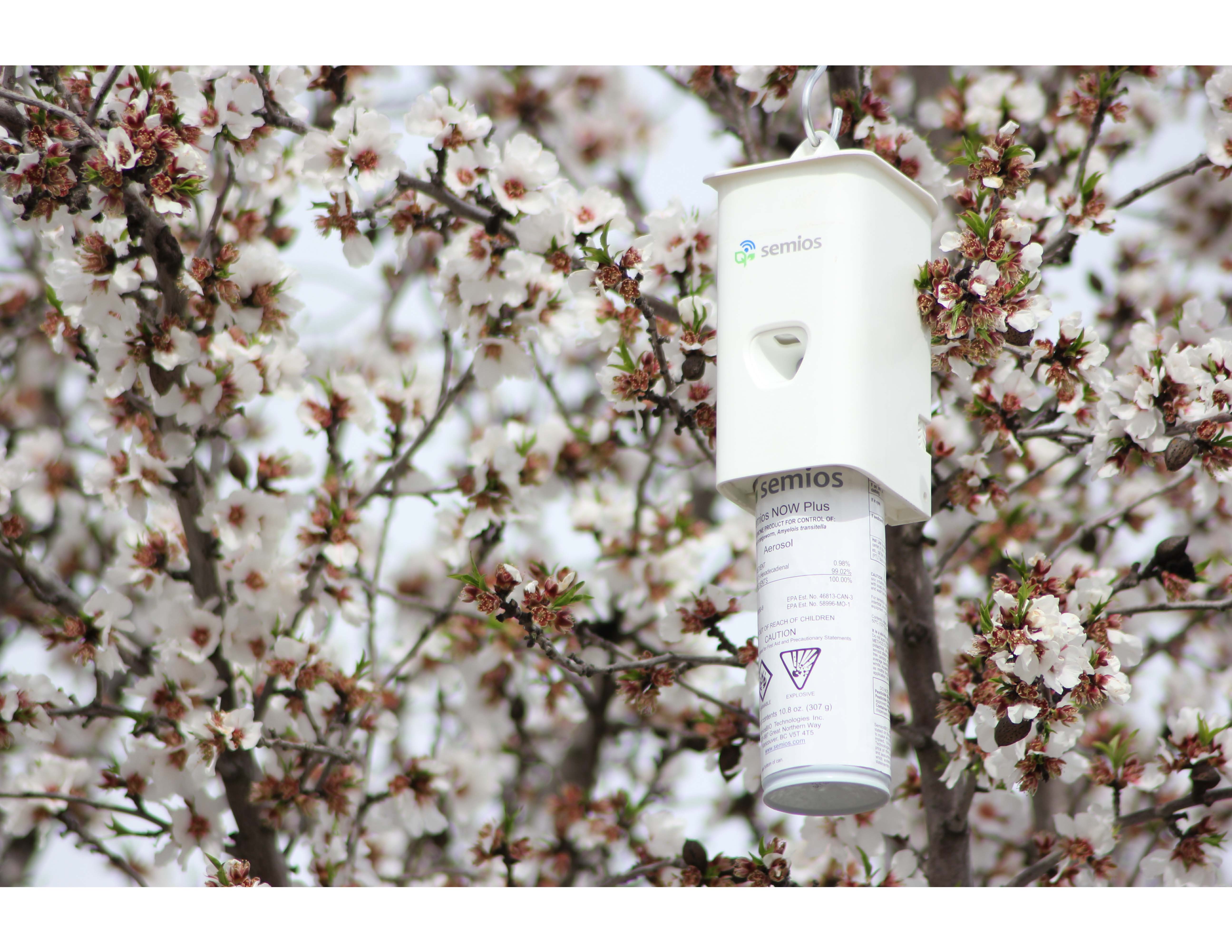
Announced TODAY, Semios, a leading provider of real-time agricultural information and precision pest management tools, has received US Environmental Protection Agency (EPA) approval and California Department of Pest Regulation (DPR) approval for aerosol pheromone biopesticide products that disrupt the mating of the Navel Orangeworm (NOW).  
Michael Gilbert, founder and CEO of Semios said, “The Navel Orangeworm pest causes significant loss of crop and revenue in the California almond and pistachio industries, and it’s getting worse every year.  The Semios NOW pheromone aerosol formulas give farmers the ability to reduce and control pest populations and, as a result, significantly reduce crop damage.  The Semios pheromone aerosol dispenser is part of a custom-designed controller and sensor network that gives farmers decision-making tools and remote access to the field conditions in real-time- all day, every day.”

Remote Control Makes it Highly Effective

The Semios platform includes in-field camera traps that monitor the number of pests and flight strength, which when combined with wind, temperature and other environmental conditions measured and reported by Semios, optimize pheromone deployment.  The combination of traps, pheromone dispensers and other sensors on the same network means farmers can deploy the right amount of pheromones where and when needed through a single interface.

A Destructive Pest for Many Crops

NOW is the most destructive pest of introduced nut crops. Semios NOW Plus and Semios NOW Standard (for organic growers) are available for control of NOW in orchards growing walnuts, pistachios, almonds, dates, figs, citrus, pome and stone fruits.


Sustainable Solution

Pheromones are a naturally occurring part of the communication systems used by insects.  Semios uses pheromones to disrupt the mating cycle of insects, thus diminishing pest populations and reducing crop damage.  Pheromones do not kill or damage the target insects and, as pheromones are species-specific and only target the specific pest, pollinators and other beneficial insect species are not affected.

_______________________________

About Semios

Semios is a leading precision farming platform that provides real-time information and pest management tools for the tree fruit, nut and grape growers.   Semios combines hardware with powerful secure online software that monitors field and weather conditions and allows remote pest monitoring and deployment of mating disruption pheromones. It’s easy to use, reduces labor and allows farmers to make decisions that preserve and increase crop value.
2021-05-12T11:03:03-07:00March 2nd, 2016|

Pistachios Trump Diabetes

Pistachios Trump Diabetes

By Brian German, Associate Editor

Just eating the right foods can benefit people diagnosed with pre-diabetes or with type 2 diabetes.  Recent research* suggests including pistachios as part of a balanced diet is a sound strategy to help lower the risk of developing type 2 diabetes. And the news could increase pistachio imports into China, where the disease is rampant.

Judy Hirigoyen, vice president of global marketing for the Fresno-based American Pistachio Growers organization that represents more than 800 growers in California, Arizona and New Mexico, noted pistachios have a good future in the global diabetes epidemic, especially in China. “Believe it or not,” she explained, “one-third of the entire world’s population of diabetics lives in China. Diabetes is associated, not with overweight or obesity, but with their diet. In particular, a lot of fingers are pointed at a lot of white rice,” she said.

“The good news for the pistachio industry,” said Hirigoyen, “is the Chinese population really loves American products, including pistachios. They’re looking for healthy foods to eat, and pistachios are very widely recommended, especially as part of a diet for someone who either has diabetes or who wants to prevent pre-diabetes from developing into diabetes.”

American Pistachio Growers Infographic - Pistachios and Diabetes

American Pistachio Growers Infographic – Pistachios and Diabetes

__________________________________

*A study, published in Diabetes Care, suggests that pistachios may have glucose- and insulin-lowering effects and promote a healthier metabolic profile in people with pre-diabetes. (Hernandez-Alonso, P., et al. Nutrition attributes and health effects of pistachio nuts. Br J Nutr. 2015 Apr;113 Suppl 2:S79-93.)

Another study, published in Nutrition, Metabolism and Cardiovascular Diseases, suggests that daily consumption of pistachios may shift the lipoprotein size and particle profile to a less atherogenic pattern in people with pre-diabetes. (Hernandez-Alonso, P., et al. Effect of pistachio consumption on plasma lipoprotein subclasses in pre-diabetic subjects. Nutr Metab Cardiovasc Dis. 2015 Apr;25(4):396-402.)

2021-05-12T11:05:58-07:00March 2nd, 2016|
Go to Top