Pistachio Crop Insurance Due Dec. 31

Pistachio Crop Insurance Recommended for 2016

Upcoming Deadline is Dec.31

By Patrick Cavanaugh, Deputy Editor

Due to the warm winter weather this year, many California Pistachio growers’ crop yields were only slightly more than half of what was expected.  And despite having an existing risk management insurance program, which helped a lot of growers, others who did not have pistachio crop insurance will have to shoulder all their losses.

James Otto, a senior risk specialist with the USDA Risk Management Agency at the Davis Regional Office, commented, “A lot of growers did not take it due to risk management reasons, they were unaware of it, or their agents did not inform them of the availability of pistachio crop insurance.”

And for growers considering purchasing insurance for next season, Otto urges them to be aware of the upcoming December 31, 2015 deadline. “Growers have to sign up for the insurance by that date,” he said. “Signing up can be complicated in that growers must agree to take insurance for two consecutive years, and they also must agree to what coverage level and price percentage to take. Growers are locked in for a two-year policy, but each year stands on its own.”

Pistachios

Pistachios

Payments are based on average yields and the coverage the grower elects. Otto said, “There are some fundamental basics. You have to determine what your average yield is; if it is 2,000 pounds per acre, growers have to select a coverage level (50%, 65%, 70%…),” which is used to adjust the insurance premium rates. Given their chosen coverage level, if their production for the year drops below this level, growers would be compensated for the shortfall by the insurance policy.

“So, for example,” he said, if a grower’s average yield is 3,000 lbs., and he has taken a 65% coverage level—which is roughly 2,000 pounds, if his average yield for this year is 1200 lbs., the result is an 800-pound shortage. The grower gets paid an indemnity of 800 pounds, times an established price.”

Richard Matoian, director, American Pistachio Growers based in Fresno, said pistachio growers should definitely consider risk management insurance, “We think all growers should consider crop insurance, even at the most minimal level—which is what they call “cat” or “catastrophic”—as a risk management tool for operations. In a year like this year in which we had historically low yields on a per-acre basis, crop insurance for many growers is going to be their savior to keep them going.”

Interestingly, Otto explained, Nick Jerkovich, an insurance broker with All Crop Insurance Services, in the Fresno County town of Kerman, Calif., came up with the idea. Otto said, “Back in 2009, Nick mentioned there were a lot of pistachio trees in the ground that did not have a crop insurance program.” It was recommended to Nick to get a petition signed by multiple growers and gather acreage data.

“So Nick, on his own dime, calculated roughly 75-80% of the acreage in the value, submitted that to an administrator, and got the ball rolling.” Otto said Jerkovich’s proaction suggested, “Hey, there is interest! There is interest from the grassroots.” Otto continued, “Based on that initial letter, Risk Management Agency contracted out to have the program developed. It is interesting to see what one individual person achieve!”
2016-05-31T19:27:03-07:00November 25th, 2015|

Thanks to California Ag!

Thanks to California Ag for Thanksgiving!

By Patrick Cavanaugh, Deputy Editor


As Americans enjoy Thanksgiving dinner, let us recognize that farmers, especially California farmers, have made our bounty possible.

pumpkin free imageCalifornia is a big turkey producing state, always ranking in the top six nationally.

pumpkin free imageIn 1948, Sophie Cubbison, who was born in San Carlos, California and who graduated from California Polytechnical University in 1912, invented the Mrs. Cubbinson’s melba toast or cornbread stuffing most of us serve. (She even paid her way through college with the money she earned feeding farmworkers. Sourcewww.mrscubbisons.com)

pumpkin free imageWhat would Thanksgiving be without wonderful California wines and Martinelli’s (another great California company) great sparkling apple and grape beverages to celebrate our good fortune?

pumpkin free imageAnd all those amazing side dishes . . . the russet and red potatoes from Kern County; the sweet potatoes from Merced County; the many wonderful squash varieties including zucchini, yellow, acorn squash . . . are all produced by farmers and farmworkers in California.

pumpkin free imageGreen beans, lettuce, tomatoes, olives, cucumbers, radishes, and carrots will grace the tables across America, thanks to California producers in ped and other areas of the state.

Don’t forget gapumpkin free imagerlic, onions and mushrooms are all produced primarily in California!

California farmers produce it all, with the exception of cranberries!

Thanks Wisconsin!

(And New Jersey, Massachusetts, Oregon, Washington, and parts of Canada)

pumpkin free imageYou can thank California egg producers for those tasty hardboiled deviled eggs on Grandma’s favorite serving dish.

pumpkin free imagePlus raisins, a great addition to dressings and other dishes, thanks to the raisin producers in Fresno, Madera and Merced Counties.

pumpkin free imageAnd of course walnuts, almonds and pistachios are big part of our savory stuffing recipes and our snacks.

pumpkin free imageApple cider and apple pie? California, among the top five states, produces a wide variety of apples.

pumpkin free imageWait! What about pumpkin pie? California farmers.

pumpkin free imageAnd the wonderful whipped cream? Thanks to the California dairy industry.

pumpkin free imageDid you know the turkey pop-up timer was invented in California? Yes, indeed. Back in the 1950s, the California Turkey Producers Advisory Board brainstormed to figure out how to prevent over-cooked turkeys, according to Leo Pearlstein, a Los Angeles pubic relations pro in the food industry, who was among the five original board members. One board member—a California turkey producer, as Pearlstein tells it—looked up at the ceiling, noticed the sprinklers and had a Eureka moment! He suddenly realized the ceiling sprinklers were triggered when heat melted a material inside the gizmo. For a complete explanation, see How Pop-Up Turkey Timers Work at home.howstuffworks.com/pop-up-timer1.htm.

From all of us here at California Ag Today,

Thanks to California Ag for serving us a delectable nutritious Thanksgiving!

2016-05-31T19:27:03-07:00November 24th, 2015|

IFPRI Tackles More Food with Less Water

IFPRI Tackles More Food with Less Water

By Patrick Cavanaugh, Deputy Editor

Feeding a growing population is significantly dependent on irrigation—not only expansion but making existing irrigation more effective. The expansion of irrigation and water supplies has been limited by growth in demand from other sectors, like urban and industrial usage, but also livestock and aquaculture, noted Mark Rosegrant, director, International Food Policy Research Institute (IFPRI) Environmental and Production Technology Division.

“Obviously, the water sector is facing several challenges, not just in California, but around the world, including declining water quality, falling groundwater tables, and growing environmental demands for water that further restrict availability for irrigation and agriculture,” he said. “With climate change, we also will see changes in the volume and pattern of rainfall in crucial production areas that also will have negative effects in the developing world.”

“So the potential for significantly increased water scarcity in terms of water quantity and quality could put much more stress on the potential for meeting future food demand and food security,” Rosegrant said. “Thus reforming water management policies and investments to improve water use efficiency is critical to food production. Increased flexibility and adaptability of water systems to stress will need to be developed and strengthened,” Rosegrant explained. “We also need to look outside the water sector, purely defined, to things like agriculture and productivity growth through investment in the talks here.”

Rosegrant said though it is seems like there is a big water meeting around the world at least once every week, the contributions of IFPRI’s water research meeting held in Bonn, Germany last week, “Bonn 2011 Conference: The Water, Energy, and Food Security Nexus–Solutions for the Green Economy,” offered advantages and differences. “First, as you can see, we are not only looking at problems, but also looking at very highly interdisciplinary solutions, whether they be in engineering, hydrology, economic policy, or macro-policy. IFPRI also brings together academics, policy makers, development banks, politicians and NGO’s as well,” said Rosegrant.

“Finally I think it is very much an international meeting, we share global experiences for many regions of the world, but also with a strong focus on California, which not only faces extreme water difficulties, but also has probably the best ability in the world to deal with those kind of water crises. So many lessons can be learned from the California experience for the rest of the world,” he concluded.

2016-05-31T19:27:03-07:00November 23rd, 2015|

“The Other Drought”

“The Other Drought” in America’s #1 Agricultural State

By Charmayne Hefley, Associate Editor

California’s agriculture industry is experiencing a severe drought in terms of water shortage; however, this is not the only devastating drought in the state. Harold McClarty, owner of HMC Farms, told California Ag Today a secondary drought—“The Other Drought”—is plaguing California:  the loss of the family farmer.

McClarty explained, “I’ve taken a very liberal definition of the word ‘drought’ and tried to talk about the loss of the small farmer and the culture and values that are instilled in you when you grow up on a small farm. We’re going to lose the next generation [of family farmers] because of the consolidation of these farms.”

HMC Farms,1887 (Source: HMC Farms)

HMC Farms,1887 (Source: HMC Farms)

McClarty, whose company, HMC Farms, a grower, packer, and shipper of tree fruit and table grapes in the San Joaquin Valley, began in 1887 as a small 40-acre family farm, said his farm’s growth is representative of the progressive loss of the family farmer. When HMC Farms officially became an established company in 1987, 100 years after its establishment, he cofounder Mike Jensen began to purchase the property of family farmers who chose to leave the business when their children rejected farming to pursue careers in law, medicine and other fields.

McClarty admitted, “I’m obviously part of the problem, but this is the environment that I live and work in—that enables me to exist.” McClarty said in agriculture you’ve got to be able to do and keep up with all of the factors that go into farming. Unfortunately, the increasing work, pressures and regulations facing small family farms are overwhelming.

McClarty concluded, “the risks are so great, small farmers can’t do it anymore. They can’t keep up, and it’s just not worth it with today’s farm values.”

Of note, HMC Farms was named by the National Restaurant Association (NRA) as one of 18 Food and Beverage Product Innovation Award winners in 2012 for Grape Escape, the company’s washed and ready-to-eat de-stemmed grapes packed in single-serve two-ounce or three-ounce bags. Featuring an 18-day shelf life with no preservatives or additives, Grape Escape “meets the challenge of profitably serving healthy fresh fruit snacks year round,” according to a 2012 NRA news release.

2016-05-31T19:27:03-07:00November 19th, 2015|

Avian Influenza Mapping Plan to Prevent CA Outbreaks

High Pathogenic Avian Influenza Mapping Plan (HPAI) to Prevent Outbreaks in California

By Patrick Cavanaugh, Deputy Editor

In 2014 and 2015, the outbreak of High Pathogenic Avian Influenza (HPAI) caused unprecedented damage to the mid-western commercial poultry industry, requiring the depopulation of 48 million birds, particularly turkeys and laying hens. There were isolated cases in last autumn in California as well. Migrating birds, generally considered to be the source of HPAI, move throughout the state in their flyways this time of year.

USDA Pacific Flyway Map

USDA Pacific Flyway Map

Maurice Pitesky, a UC Cooperative Extension population health & reproduction assistant specialist with an appointment in poultry health and food safety, emphasized the importance of the flyways, “These global flyways that waterfowl use to move north and south and back again every single year are like freeways. And in those freeway lanes, different birds interface with each other.  So, we might have a Pacific flyway that covers California, but that Pacific flyway can interface with the East Asian and Australian flyway in the Northern Arctic. If you look at the genetics of the strains that were found in North America, especially in California, the genetics match some of the HPAI found in South Korea for example,” Pitesky said.

The Avian Influenza Mapping Plan is like overlaying maps of birds’ flying patterns for an early warning system for commercial operations. Pitesky observed, “We’re really just scratching the surface in how we can utilize maps with respect to surveillance and risk-mapping. For example, if I can locate on a map, where waterfowl, flooded rice fields, or wet fields are, and I can also determine where commercial poultry operations are, then I can start understanding which operations are at highest risk.”

I can triage my focus, outreach, and biosecurity efforts to those farms that are most closely located.

“New techniques are available so our national network of weather radar can actually be leveraged, and that data can be utilized remotely to understand in real time where waterfowl are hanging out. Eventually we can use that information to warn farmers in real time if there are migrating waterfowl near their farm,” he said.

2016-05-31T19:27:03-07:00November 18th, 2015|

Bridging the Farm-City Gap

Stanislaus Outreach Bridges Farm-City Gap  

By Patrick Cavanaugh, Deputy Editor


Wayne Zipser, executive director of the Stanislaus County Farm Bureau, noted that he, his staff and farm bureau members are working hard to bridge the farm-city gap. “We certainly do a lot of outreach,” Zipser said. “We mainly try to reach out to our young people and change their attitudes towards production agriculture.”

“We teach them where their food actually comes from,” he explained, “so when they grow older, they have a different opinion and know exactly where their food comes from—not just from the grocery store off the grocery shelf. It takes a lot of people to make that happen so consumers can appreciate the nutritious food they are consuming.”

”We have several Ag Days in the County. We visit schools individually and do presentations,” said Zipser. “One of the big presentations is something we call ‘Ag Adventure.’ We bring third graders because we’ve been told that third grade is when they absorb the most information into their minds.”

“We bring classes out to the fairgrounds and introduce every child to our industry, to where their milk and eggs come from. We also talk about how rain and snow filter down into reservoirs for storage. The teachers are also become immersed; they take the lessons back to the classroom and apply them to their own curriculum.”

Zipser explained the staff is big on social media now, “Social media benefits our industry; almonds being the number one commodity—but we’ve all heard it takes one gallon of water to produce one almond. We want to go back and say, “Look, it may take that, but look at the benefits coming back to the community.”

“One of our biggest outreaches is letting people know that our farmers and ranchers are suffering through this drought too,” Zipser said. “We, as producers, are suffering, and we have made tremendous strides in conserving water. We see many of the irrigation districts in our county now have extra water that they didn’t know they were going to have because the farmers did such a good job conserving,” Zipser clarified.

2016-05-31T19:27:04-07:00November 16th, 2015|

Drought Lessons from Israel

Drought Lessons from Israel  Part 1

By Patrick Cavanaugh, Deputy Editor

Six years ago, Israel was in the grips of a drought so dire the government considered shipping in water from Turkey, more than 1,000 nautical miles away. Instead, the country embarked on a coordinated effort of recycling water, desalinization (desal) and conservation education. Uri Shani, a professor at Hebrew University who was with the Israel Water Authority during this recent drought, says the country is now very secure in meeting its water needs, including agriculture and environmental requirements. California can learn from these drought lessons from Israel.

Desalinated water from Mediterranean Sea became a significant tool, but it didn’t happen very fast. Shani told California Ag Today, “For Israel it happened very slowly. The government hesitated going to desal and resistance came from, I believe, the farmers. They were afraid that desal would raise their prices for agriculture. In addition, pushback from the Minister of Finance focused on “the spending of money; they thought it was better to take the water from the farmers.”

Despite desal’s slow start, Israel relies very much on desal. “Private companies came in to build the desal plants,” Shani said, “and promised to run them for a minimum of 25 years. They were paid back when the government bought water from them.

“We use the metric system in Israel. One cubic meter of water equals 250 gallons. So the best price we get now is 50-60 cents (U.S.) for 250 gallons or 1 cubic meter. This is the price at the exit of the plant. It has only added about 60 cents to the urban customer’s water bill.

2016-05-31T19:27:04-07:00November 11th, 2015|

Trade Agreement Big for State

Trans-Pacific Partnership Trade Agreement Will be Boon for California

By Laurie Greene, Editor

On Friday, Nov. 6, Agriculture Secretary Tom Vilsack told California Ag Today the released full text of the Trans-Pacific Partnership Trade Agreement shows that it will be boon for California Exports. Vilsack said, “You’re close to the market, you have ports that access and serve those markets, and you have the products those markets want—whether they are fruits and vegetables or tree nuts,” Vilsack noted. “In fact, we just released a report on our exports as they exist today. Obviously tree nuts are a big export opportunity. We saw significant growth there as well; it is now an $8.8 billion market and California certainly plays to that,” he said.

Vilsack said the trade deal is all about better access, “The fact that tariffs are going to be eliminated in a number of these countries that we do business with will level the playing field for our fruits, vegetables and tree nuts. It is going to open up enormous opportunities for us.”

Vilsack also said these increased exports will definitely increase jobs in California, “This agreement will add and anticipated $120 to $130 billion in U.S. export opportunities, of which agriculture is roughly 9%, so you do the math; it is billions of dollars in additional trade. California is going to get their fair share. It will impact employment because every billion dollars in ag sales supports 6500 good paying jobs, and these are jobs that currently pay about 18% more in benefits than non-export-related jobs.”

President Obama intends to sign this legislation, but first, Congress is poring over the text to make their concerns or support known. Then they will have an up or down vote, but no amendments can be added to the bill.

Again, California specialty crop growers stand to benefit greatly from this trade bill. Ag leaders are urging Congress to pass it and all California commodity trade groups are solidly behind it as well.

2016-05-31T19:27:04-07:00November 10th, 2015|

Van Groningen & Sons Adopts Solar

Van Groningen & Sons Becomes Early Adopter of Solar Meter Aggregation

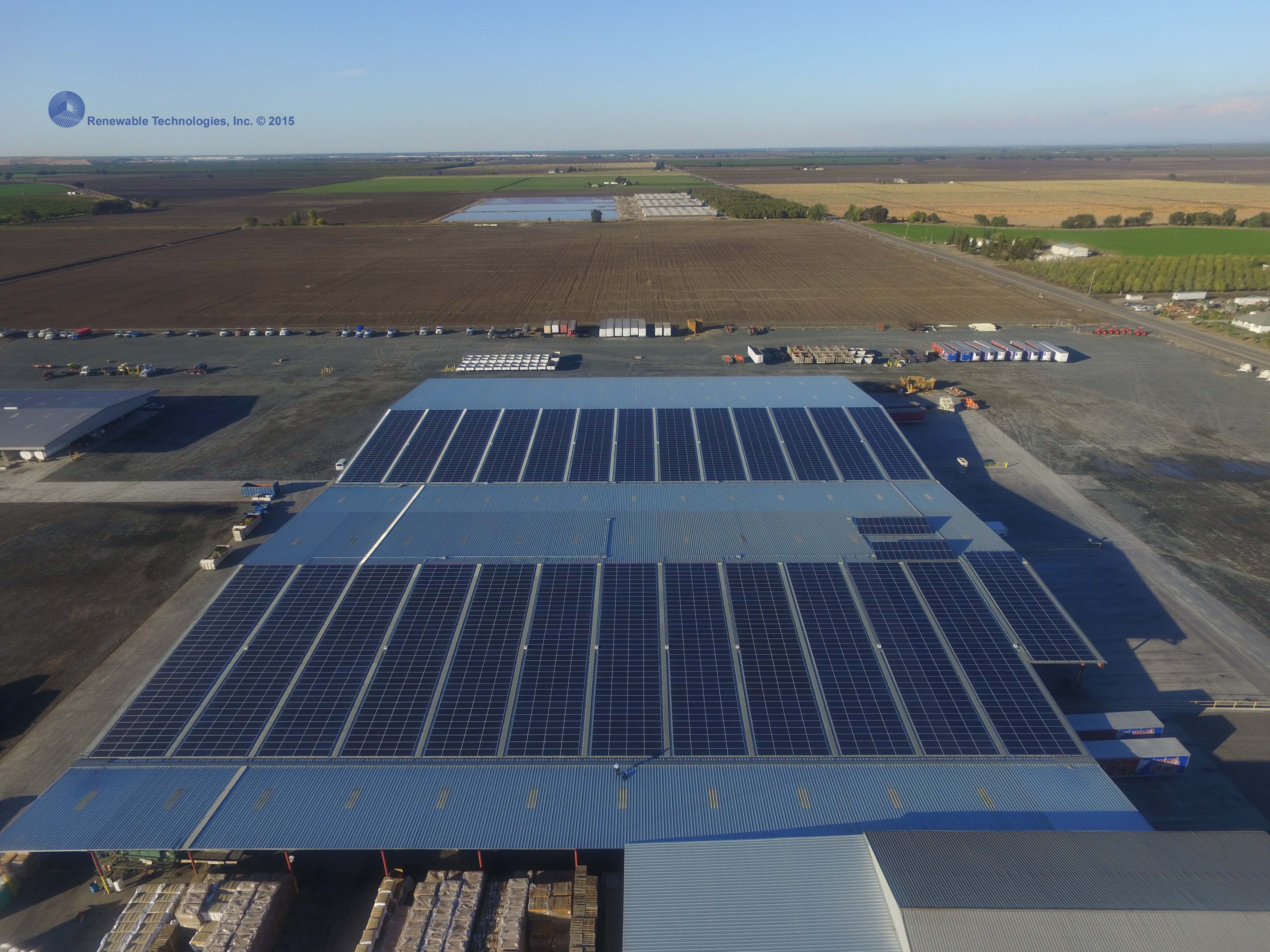
Family owned and operated since 1922, Van Groningen & Sons, Inc. has just completed construction of a 1 Megawatt PV Solar Energy System at their packing, cooling and processing facility located at their company headquarters in Manteca. Designed and installed by Renewable Technologies, Inc. (RTI) of Stockton, CA., the solar system is one of the first to take advantage of the Net Meter Aggregation Policy recently approved by the California Public Utility Commission, allowing for multiple meters to be offset by the production of a single PV solar production system.

RTI worked closely with Paul Hiemstra, warehouse manager at the facility to aggregate 26 electric meters, satisfying the electrical demand of the facility and numerous irrigation pumps across several hundreds of acres of farmland.

The system will generate over 1.4 million kilowatt hours of clean, reliable energy annually and sits atop two large processing buildings. The solar kilowatt hour production will offset approximately 1,034 metric tons of carbon dioxide, the equivalent greenhouse gas emissions produced by 218 passenger cars, the electricity usage of 142 homes or the carbon sequestered by 848 acres of U.S. forest in one year. This project marks yet another step forward in Van Groningen’s efforts toward sustainability, helping to ensure the continuance of the family farming tradition for many years to come.

Van Groningen & Sons, Inc. is closely linked to the growing, shipping and distribution of melons, sweet corn, nuts, pumpkins and fall décor. Their formula is to offer the highest quality products while conducting business with honesty, integrity and responsibility, a recipe that’s certain to last long into the future.

__________________

Links: Van Groningen & Sons

Photo Source:  Renewable Technologies, Inc., Ryan Van Groningen

2016-05-31T19:27:04-07:00November 9th, 2015|

Subsurface Drip Efficiency

Subsurface Drip Efficiency in Pomegranates

By Charmayne Hefley, Associate Editor

Subsurface drip irrigation, a more efficient form of water delivery, is growing in popularity and utilized on a widening range of crops. Claude James Phene, a research consultant for the UC Cooperative Extension, said subsurface drip efficiency is evident with both water and nitrogen in pomegranates.Pomegranate tree

Using a lysimeter, a big box on a calibrated truck scale that measures evapotranspiration, Phene can calculate the precise water requirement for pomegranates according to the soil moisture feedback indicated by the machine. Based on these calculations, Phene can make clear water recommendations to growers so they can accommodate the needs of their plants without exceeding them.

Because it is buried and targeted, subsurface drip irrigation also helps control weeds and reduce animal and traffic disturbances.

This six-year study has also demonstrated these drip lines prevent leaching—the loss of nutrients in the soil—that occurs with other types of irrigation systems. Phene explained, “The lysimeters are equipped with a drop-tube at the bottom so we can measure the nitrogen in any output to determine how much leaching occurs and to make recommendations on fertilizer.”

2016-05-31T19:27:04-07:00November 4th, 2015|
Go to Top