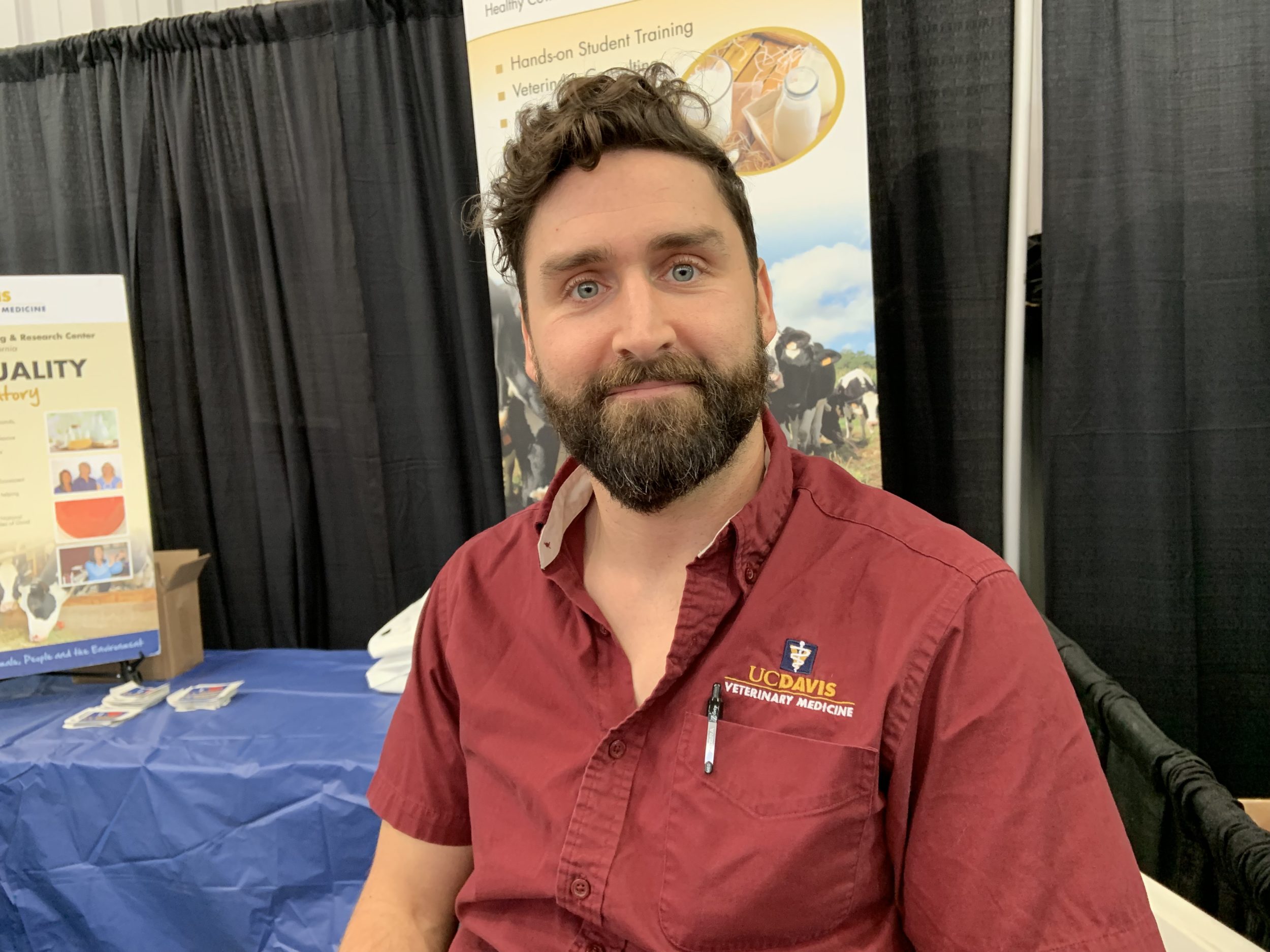
Tulare Center Trains UC Davis School of Veterinary Medicine Students

UC Vet Students Learn About Livestock Animals in Tulare

By Patrick Cavanaugh, Editor

VMRTC is the Veterinarian Medicine Training and Research Center located in Tulare. The facility is an extension of the UC Davis School of Veterinary Medicine. The site offers education and training to veterinarians by offering senior veterinary students and residents on-the-farm clinical medical training and residencies in dairy production medicine.

Nathan Brown, a UC Davis veterinary student, is working on practicals in and out of a hospital setting.

“We do rotations in the hospital and outside of the hospital. We have a teaching center and, in addition, we have our California Animal Health and Safety Laboratory System (CAHFS), which is involved with diagnosing foreign animal diseases,” Brown said. “That is sort of the main mission.”

“In the mornings, we do herd checks, we go out to different dairies. We palpate cows for diagnosis of pregnancy, and we’re under the supervision of some of the veterinarians that work at our center,” Brown explained. “In the afternoons, we work on a variety of different projects. One of the projects that we’re working on currently is milking frequency. We are looking at different variables that go into whether or not it’s profitable to move from either two to three times a day or three times a day to two times a day.”

Brown said that the students at the Tulare center are doing their livestock track through UC Davis. “We’re all in our fourth year. It’s been a wonderful experience. Tulare is a great place, and it’s good to see a different part of California.”

Students studying at the center decide which direction they will take regarding animal type or other medical pursuits.

“After our second year, we make a decision about whether we do small animals or large animals,” Brown said. “Some people do equines, other focus on zoo animals—there is a variety of options in our profession and that our school offers.

Brown is pursuing livestock medicine, but he has a commitment to the Air Force to do public health epidemiology for them.

Army veterinarians do clinical medicine for animals on the base. They focus on German shepherd dogs and horses, and they also do some food safety.

“As as a veterinarian in the Air Force, it’s essentially veterinary public health, and my role will be epidemiology on a base, so that’s actually more human focus, and food safety,” Brown said.

“If you kind of think about the historical roots of veterinary medicine, much of the role of veterinarians has been ensuring that food is safe for humans to consume, meaning that the animals are healthy before they get ready for human consumption,” Brown explained. “We must ensure that there’s no points of contamination so that all the food that people eat in this country is healthy and nutritious, and we don’t have to worry about disease.”

Most bases have a veterinary clinic, primarily staffed with army veterinarians.

“My hope is to do some amount of clinical practice at these clinics to sort of keep my veterinary skills relevant. And I’ve had some good advice from some epidemiologists who works at the CDC,” Brown said. “He told me that at least for him, it’s made him a better epidemiologist by keeping his clinical skills relevant because thinking about that differential diagnosis is really a big part of trying to find the cause of a disease.”

2021-05-12T11:17:08-07:00May 2nd, 2019|

Weedy Rice—Not as Simple as it Sounds

Weedy Rice is A Pesky Rice Type in Production Rice Fields

By Mikenzi Meyers, Associate Editor

Contrary to its name, weedy rice is not in fact weeds in rice—but it is presenting several challenges to California rice growers. To help farmers combat the pesky variety, UC Davis Ph.D. student Liberty Galvin and the horticulture and agronomy graduate group have conducted extensive research.

According to Galvin, the genetic and physiological properties of weedy rice are the same as the cultivated varieties consumers typically eat. So what’s the issue? Galvin said that besides the fact that weedy rice is off in its coloring, it’s nearly impossible to harvest.

“The issue is that the seed shatters, or basically falls to the ground. So when you go through and try to harvest it, the grain does not get collected in the harvester,” Galvin explained.

Although right now it seems that commercially growing weedy rice is not an option, there are ways to prevent it. Galvin’s research found that drilling the seeds at least two inches into the soil will eliminate seed germination or emergence in the field. This is especially useful in California, where tillage is done only to prepare the field, not plant the rice itself.

Galvin said that while growers can produce their own rice seed, it has to be certified by the California Crop Improvement Association or a Rice Seed Quality Assurance Program.  In all cases, growers are required to plant only certified rice seed so there is no opportunity for traces of weedy rice to enter the soil.

“That is why tillage depth is so important, because that’s how you reduce your seed bank,” she said.

2021-05-12T11:05:04-07:00April 30th, 2019|

Building a Relationship Between Consumers and Ag Industry

There Are Ways to Gain Trust Among Consumers

By Mikenzi Meyers, Associate Editor

Bridging the gap between consumers and their food has been an ongoing battle that research shows can only be won by trust. Charlie Arnot with the Center for Food Integrity has looked further into what it really takes to gain trust among consumers.

Arnot said that studies conducted alongside Iowa State University showed that there are three main drivers in creating a relationship with consumers: influencers, competency, and confidence in shared values. Further research revealed that of the three main variables, confidence in shared values proved to be the most important—but this can be a difficult goal to accomplish.

“Agriculture has a historical mantra of ‘We’re Feeding the World,’ but most consumers just don’t care, and it’s not a justification for more industrialized food production,” Arnot said.

This resistance towards industrial farming is largely due to food being so readily available to the public.

Arnot suggests taking the approach of addressing known consumer concerns such as food safety, nutrition, and treatment of animals, to name a few.

“Addressing those concerns is going to be the most effective strategy we can have in building trust in who we are and what we do in agriculture today,” he said.

2019-04-29T17:01:37-07:00April 29th, 2019|

Alliance For Food and Farming Launches New Website!

New Safefruitsandveggies.com Website Will Improve Visitor Experience

News Release

The Alliance for Food and Farming (AFF) has launched an updated safefruitsandveggies.com website with new content and to improve visitors’ experiences on the increasingly popular site.

“The safefruitsandveggies.com website now receives tens of thousands of visitors each year,” said Teresa Thorne, AFF Executive Director.  “We want to continue to improve the site, retain our visitors, and attract new users.  The newly formatted site will help us to do that.”

New sections include “A Dozen Reasons to Eat Fruits and Veggies,” and “Five Facts About Produce,” which are based upon popular blog posts.  These sections provide quick and easily-retained information about the benefits of eating fruits and veggies as well as the safety of organic and conventional produce.

The Safety Standards section of the website, which provides comprehensive information about the stringent regulations governing the approval and use of organic and conventional pesticides, has also been updated.

“This has become among the most visited sections of safefruitsandveggies.com because all the pesticide regulation information from various government agencies can be found in one place,” Thorne said.  “Instead of going through multiple searches and websites to learn more about these regulations, people can just come to safefruitsandveggies.com.”

Still to come are web pages specifically designed for nutritionists and dietitians to help them answer produce safety questions from consumers, their customers, and clients.

“This new web page was actually requested by dietitians, and we are excited to have their input as we build the content,” Thorne said.

“Since research shows consumers find dietitians and nutritionists are among the most credible sources when it comes to pesticide residues and produce safety, it is important they have readily usable information,” Thorne added.

Among the most visited website section continues to be the residue calculator, which shows consumers they could literally eat hundreds to thousands of servings of a fruit or veggie in a day and still not have any health effects from residues.

“All of the website content is either based upon peer reviewed research or on analyses by experts in the areas of toxicology, risk analysis, nutrition and farming,” Thorne said.  “Consumers can also view 40 videos featuring farmers and scientists, as well as information about peer reviewed studies.”

The AFF works to provide credible, science-based information so consumers can make the right shopping choices for themselves and their families.

“The safefruitsandveggies.com website is the cornerstone of our efforts,” Thorne said. “By providing facts about produce safety and countering misinformation, we hope to remove fear as a barrier and encourage increased consumption of all forms of produce.”

2021-05-12T11:05:04-07:00April 24th, 2019|

Charlie Arnot: A Better Way to Talk To Consumers About Ag

Listening to Customers Concerns Will Help With Skepticism

By Patrick Cavanaugh, Editor

There are biases against large-scale businesses, according to Charlie Arnot, CEO of The Center For Food Integrity. He said that listening to customers concerns will help with the skepticism.

“The fundamental bias we see against size and scale is a belief that the larger companies, the larger entities, will put profit ahead of public interest. We know that’s not true,” Arnot said. “Those of us who work in agriculture … know that the people—the men, and women who work in agriculture—are terrific. They’ve got values that resonate. They’re committed to doing what’s right. But because of the size, the scale of agriculture today, it raises greater questions.”

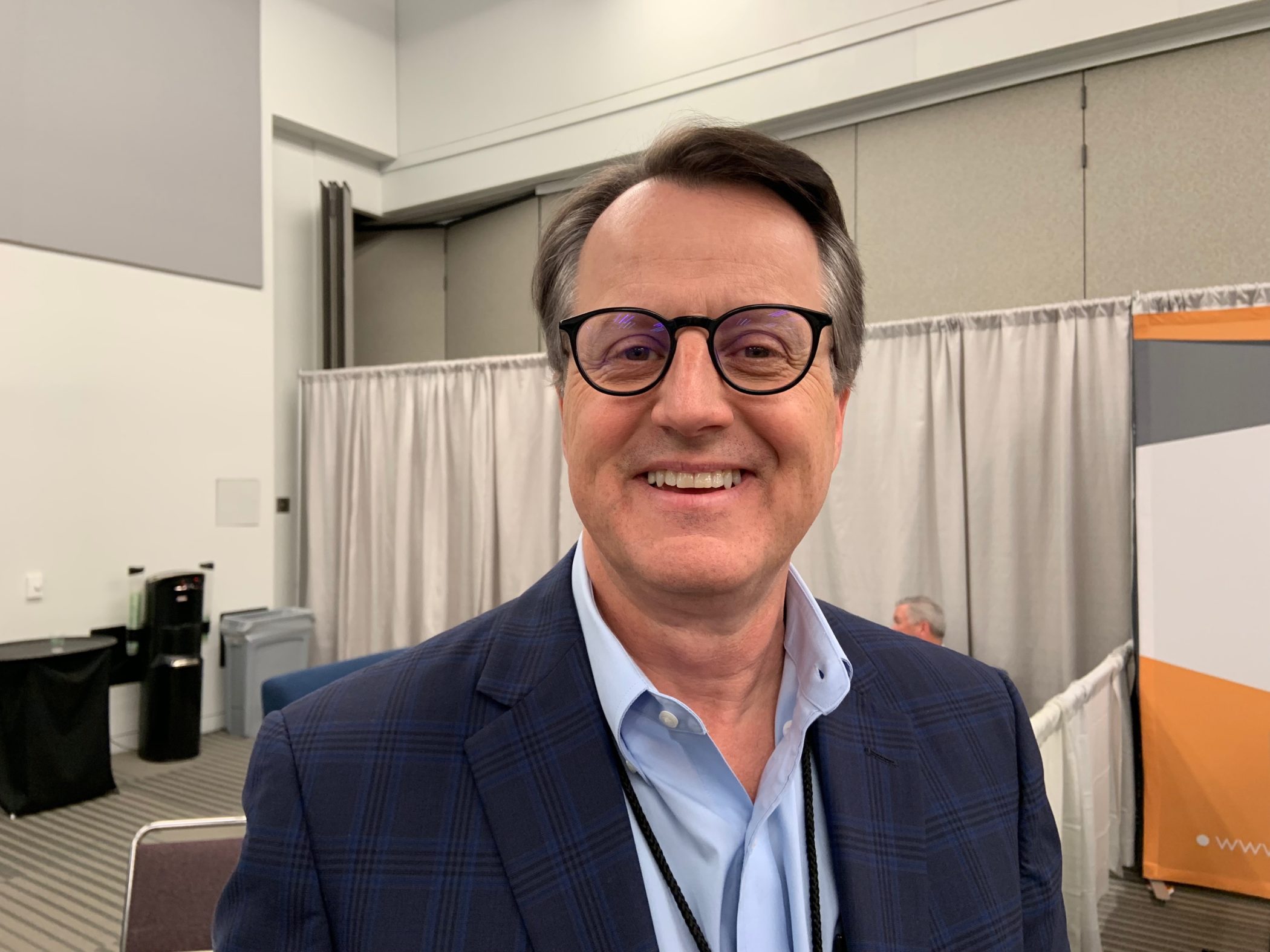
Charlie Arnot, CEO of The Center For Food Integrity

Arnot explained that this means that the ag industry needs to embrace that consumer skepticism and be willing to address those questions and not be defensive.

“We want to help people understand that yes, the size and scale has changed, but our commitment to do what’s right has never been stronger.

Consider the adage, “it’s better to make a friend than win an argument.”

“And when you get into that conversation, do you want to win an argument or do you want to win a friend?” Arnot asked. “You know, what’s important to you? And frequently if we listen hard enough, we can hear people’s values. We can listen to what they’re talking about and find that place of connection.”

“So when someone says, you know, ‘it makes me uncomfortable to see all the pesticides and the spraying on all the produce in California. I don’t think it’s safe.’ We can either defend pesticides and applications of crop protection chemicals, or we can listen to say, okay, well [what] I heard them say is they care about safe food.”

“Terrific. I care about safe food. Let’s have a conversation about our commitment to safe food as opposed to a conversation about trying to defend pesticides or crop protection chemicals,” Arnot explained.

He said that consumers have many needs when they’re making decisions about food. “Historically, we’ve thought about their rational needs. We’re going to give them information, but they also have social and emotional needs that they’re trying to meet as well.”

“They want to feel good. They want to have that emotional reinforcement [that] they’ve made the right decision for their families. They want to have confidence and feel good [that] they’ve decided to buy food that’s going to be safe and nutritious,” Arnot said. “They want to get that social reinforcement when they bring it out of the bag, when they talk to their friends, when they post a picture on Instagram or Facebook about what they’re doing. They want people to reinforce [that] they made the right choice about what they purchased.”

For more information on the Center For Food Integrity: http://www.foodintegrity.org/


2019-04-19T15:47:57-07:00April 19th, 2019|

Winning on Reducing Food Waste Month

In U.S., One-Third of all Available Food Goes Uneaten Through Loss or Waste. 

News Release Edited By Patrick Cavanaugh

Recently, the U.S. Environmental Protection Agency (EPA), the U.S. Department of Agriculture (USDA), and the Food and Drug Administration (FDA) kick off Winning on Reducing Food Waste Month by calling for greater collaboration with public, private, and nonprofit partners as well as state and local officials to educate and engage consumers and stakeholders throughout the supply chain on the need to reduce food loss and waste.

In the U.S., more than one-third of all available food goes uneaten through loss or waste. Food is the single largest type of waste in our daily trash. In recent years, great strides have been made to highlight and mitigate food loss and waste, but the work has just begun. When food is tossed aside, so too are opportunities for economic growth, healthier communities, and environmental prosperity—but that can change through partnership, leadership, and action. Further elevating the importance of this issue, the recent announcement follows a Presidential Message from President Trump acknowledging the month of April as Winning on Reducing Food Waste Month and encouraging public action and participation from all sectors.

“Reducing food waste and redirecting excess food to people, animals, or energy production provide immediate benefits to public health and the environment. I am proud to join President Trump and my federal partners in recognizing April as Winning on Reducing Food Waste Month,” EPA Administrator Andrew Wheeler said. “We are working closely with our federal partners and stakeholders across the nation to reduce the amount of food going to landfills and maximize the value of our food resources.”

“USDA alone cannot end food waste, it will require partners from across the supply chain working together on innovative solutions and consumer education. We need to feed our hungry world, and by reducing food waste, we can more wisely use the resources we have. I am pleased President Trump identified this issue as one of importance, and I look forward to USDA’s continued work with our agency partners at EPA and FDA to change behavior in the long term on food waste,” U.S. Secretary of Agriculture Sonny Perdue said.

“With 1 in 6 people getting a foodborne illness every year in the U.S. and up to 40 percent of food left uneaten, it’s understandable why food safety and food waste are major societal concerns,” FDA Deputy Commissioner Frank Yiannas said. “The FDA is working to strengthen its collaboration and coordination with the EPA and USDA to strategically align our federal efforts between the two issues to better educate Americans on how to reduce food waste and how it can be done safely.”

As part of the month’s observances, on April 9, EPA will host a live-streamed event with USDA and FDA. Additional joint agency actions will be announced at the event regarding the Winning on Reducing Food Waste Initiative. At the event, a panel of food waste stakeholders will share how state and local communities can join the federal government in reducing food waste and loss.

USDA, EPA, and FDA invite public and private partners to participate in Winning on Reducing Food Waste Month through the following:

  • Join the conversation: Share your efforts with the #NoWastedFood hashtag in your social media posts throughout the month.
  • Educate your community: Learn about USDA, EPA, and FDA programs and resources to reduce food loss and waste.
  • Be a U.S. Food Loss and Waste 2030 Champion: Join other corporate and business leaders who have made a public commitment to reducing food loss and waste in their U.S. operations by 50 percent by the year 2030.

The Winning on Reducing Food Waste Initiative is a collaborative effort among USDA, EPA, and FDA to reduce food loss and waste through combined and agency-specific action. Individually and collectively, these agencies contribute to the initiative, encourage long-term reductions, and work toward the goal of reducing food loss and waste in the United States. These actions include research, community investments, education and outreach, voluntary programs, public-private partnerships, tool development, technical assistance, event participation, and policy discussion.

2019-04-08T16:37:18-07:00April 8th, 2019|

Attorney Suggests That Meters Go on Pumps Now for SGMA

Meters Could Help From a Legal Standpoint

By Mikenzi Meyers, Associate Editor

There are different options available to make the implementation of the Sustainable Groundwater Management Act (SGMA) a bit easier on farmers. Lauren Layne of Baker, Manock & Jensen is helping her clients in the Central Valley carry out the SGMA Act in the most beneficial way possible.

“We want to see the Central Valley thrive. So we represent irrigation and water districts who are the local agencies that are forming these groundwater sustainability agencies, and I serve as a council to a number of those groundwater sustainability agencies as well,” explained Layne.

According to Layne, a lot of farmers are considering fallowing certain land to put in recharge projects that will allow them to regulate irrigation, while simultaneously being beneficial to the groundwater basin as a whole.

Layne also highly encourages growers to install meters or transducers to monitor how much water is being used, and what the groundwater table looks like.

“Data is very, very, important from a legal standpoint. It’s important to have the information as a backup for any argument we’re going to make,” she said.

If the cost of installing a meter is an issue, Layne is working on an incentive program that will grant funding to farmers and incentivize them to put meters on.

2019-04-04T16:37:04-07:00April 4th, 2019|

Americans Need to Eat More Fruits and Vegetables

After Nearly 25 Years, It’s time to Advocate for Consumption

News Release From SafeFruitsAndVeggies.com

There is so much good stuff to say about organic and conventional produce, from studies which clearly show the safety of both to decades of research that illustrate the disease-prevention aspects of these nutrient-dense foods.  Plus, farms and farming companies continue to develop innovative, convenient fruits and vegetables, which are helping to increase consumption.

But while we are making some headway, only one in 10 Americans eat enough produce according to the Centers for Disease Control.  Why?  Because barriers to consumption still exist. One of those barriers is safety fears generated by certain groups who inaccurately disparage the more affordable and accessible forms of produce.

Among the longest and biggest offenders comes from an activist group that annually releases its so-called “dirty dozen” list.  Since 1995, this group’s fear-based ‘marketing against’ tactic disparaging the most popular produce items has been used in an attempt to promote purchasing of organic products.

Look, we completely understand advocating for your members when the information is credible and the science is strong.  The AFF advocates on behalf of organic and conventional farmers of fruits and vegetables and the safety of their products every day.  But when you raise unfounded fears based upon unsupportable science about the only food group health experts universally agree we should eat more of, it is time to revisit your approach.  Especially when peer reviewed research is showing this tactic may result in low income consumers stating they are less likely to purchase any produce—organic or conventional—after learning about the “dirty dozen” list.

Put another way, according to these research findings, this activist group may actually be marketing against their own constituents’ organic products by releasing this list.

To summarize, the “dirty dozen” list is scientifically unsupportable, it may negatively impact consumers’ purchasing decisions, and it’s possibly even detrimental to the very products the list authors are trying to promote.   After almost 25 years, it is time to retire this tactic in favor of more creative “marketing for” strategies that encourage consumption and doesn’t scare consumers.

2021-05-12T11:05:04-07:00April 3rd, 2019|

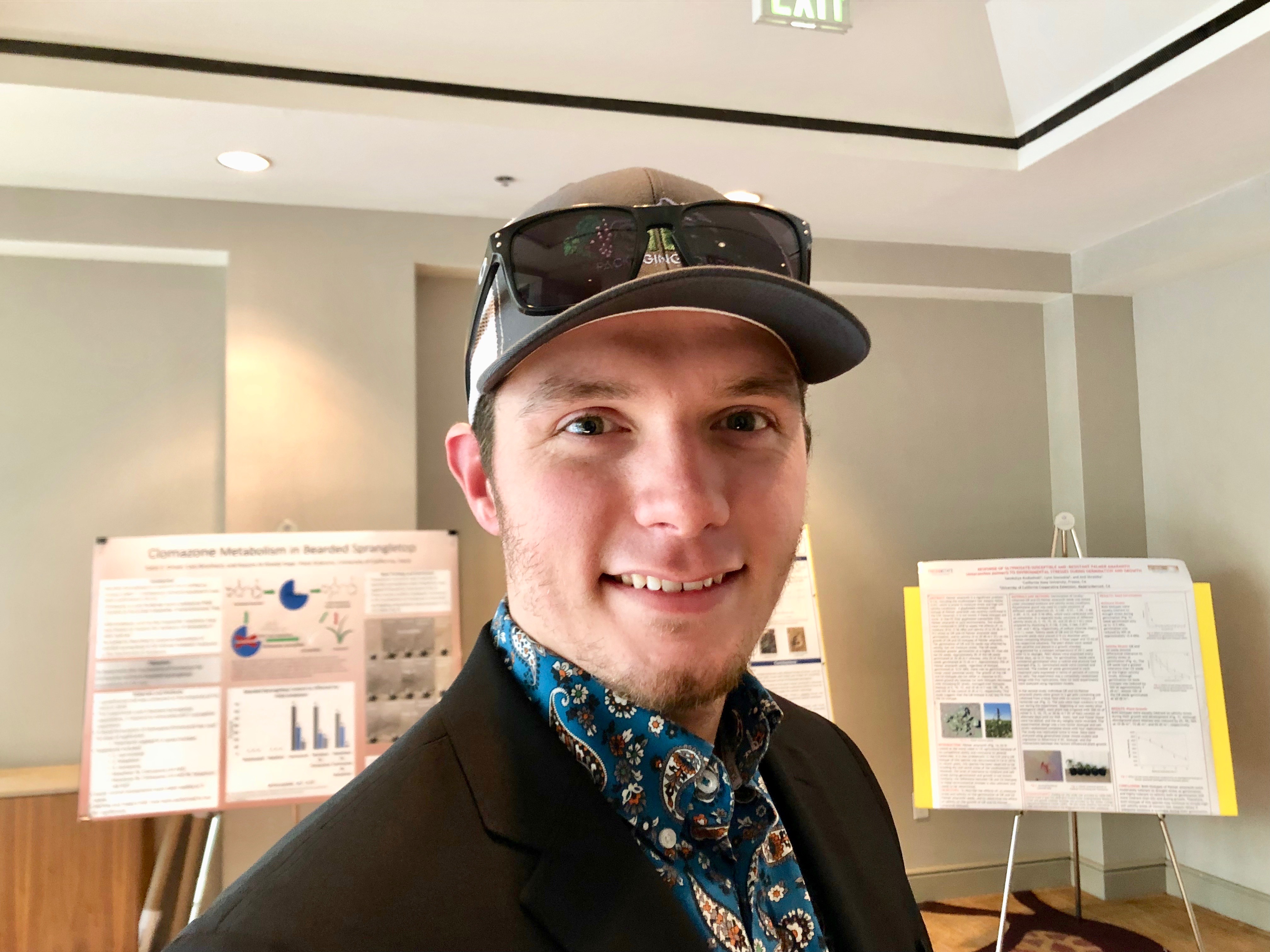
Study: Remote Sensing of Weeds on Vineyards Has Merit

Aerial Sensing Of Weeds Saves Time and Labor

By Jessica Theisman, Associate Editor

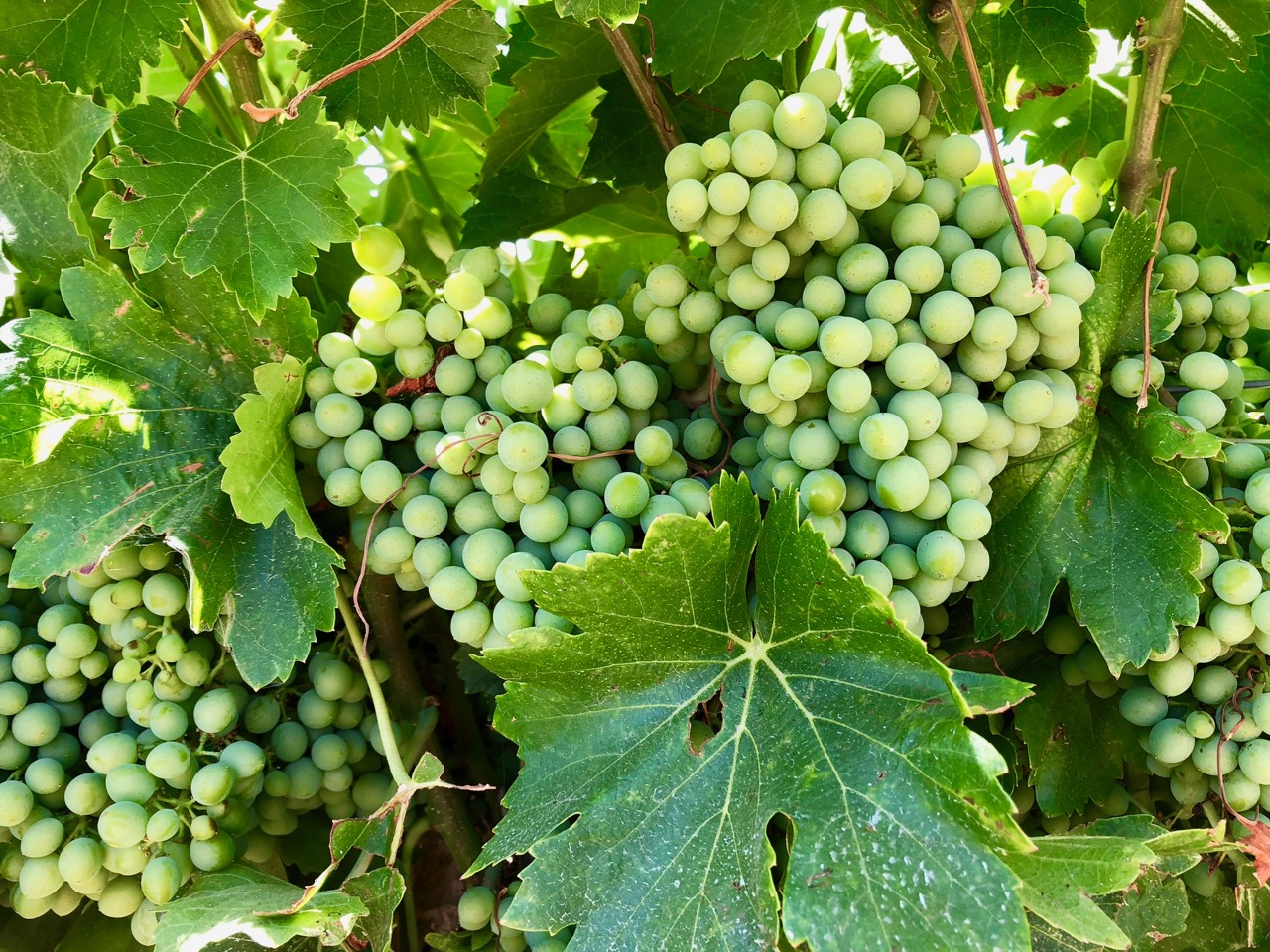
There is a potential use of remote sensing with drones and vineyard weed management. Working on that research is Cody Drake, a senior at California State University, Fresno. He’s working with Luca Brillante, an assistant professor in the Department of Viticulture and Enology. Anil Shrestha is chair and professor, also in the Department of Viticulture and Enology at Fresno State. Drake’s research is at a vineyard in Napa County.

“The goal of my research is to make weed management practices in vineyards a little more efficient,” Drake said.

Currently, there is a lot of manpower, money, and time going into scouting for weeds and spraying.

“What we did with the drone is we wanted to map high-pressure weed zones to target spray in the field instead of spraying the entire field,” Drake explained.

This aerial scouting is hoping to become more efficient for time and labor.

“It’s all based on imagery. The drone gives us waypoints as to the areas where we need to spray. We have a company that’s called Drone Deploy, and they go through, and they stitch all the photos together,” Drake said.

Drake’s research has only been on vineyards so far, and his research has been proven to work.

“We did a 30-meter flight and a 10-meter flight, and that just shows the difference in how close you can get to identifying weeds species on the ground at a 30 meter height,” he said.

At 30 meters, it was very hard to tell which species was which. At 10 meters, the weeds were more identifiable.

“We would prefer to do another trial with a higher resolution camera. That way we can see the species, identify them a little easier and a little more efficiently,” Drake said.

By doing this, Drake and his team can pinpoint where the heavyweights are and just go spray that one area. For future research, they are going to try a camera with higher resolution to see if it can see through a denser vineyard.

2021-05-12T11:05:04-07:00April 1st, 2019|

New Series of Nitrogen Management Advice Available

UC ANR Publishes Nitrogen Management Advice for Fruit, Nuts, and Other Crops

By Pam Kan-Rice UC Agriculture & Natural Resources

California growers can download a new series of publications summarizing efficient nitrogen management practices from UC Agriculture and Natural Resources. The publications are designed to assist growers in complying with state regulations for tracking and reporting nitrogen fertilizer applied to crops, in an effort to prevent nitrogen from leaching into groundwater.

The science-based publications are associated with a series of trainings for growers and Certified Crop Advisers to develop efficient nitrogen management practices, an effort coordinated by UC ANR’s California Institute for Water Resources.

“Our role is to provide farmers, agricultural consultants and policymakers the best science possible for making decisions on managing and protecting California groundwater,” said Doug Parker, director of the water institute.

The free publications—created from training materials, lessons learned from the training sessions and from additional UC research—can be downloaded at http://ucanr.edu/nmgmtpublications.

The following publications are now available for download:

·         Principles of Nitrogen Cycling and Management

·         Irrigation and Nitrogen Management

·         Nitrogen Management for Nut Crops

·         Nitrogen Management for Deciduous Fruit and Grapes

·         Nitrogen Management for Citrus and Avocado

·         Nitrogen Management for Cool-Season Vegetables

·         Nitrogen Management for Strawberry Production

·         Nitrogen Management for Processing Tomato

·         Nitrogen Management for Corn on California Dairies

The publications were authored by Parker of California Institute for Water Resources; Patrick Brown, professor in the UC Davis Department of Plant Sciences; Allan Fulton, UC Cooperative Extension advisor, Tehama County; Tim Hartz, UC Cooperative Extension specialist emeritus, UC Davis Department of Plant Sciences; Dan Munk, UC Cooperative Extension advisor, Fresno County; Daniel Geisseler, UC Cooperative Extension specialist, UC Davis Department of Land, Air & Water Resources; Michael Cahn, UC Cooperative Extension advisor, Monterey, Santa Cruz and San Benito counties; Richard Smith, UC Cooperative Extension advisor, Monterey, Santa Cruz and San Benito counties; Marsha Campbell, UC Cooperative Extension advisor emeritus, Stanislaus County; Sat Darshan Khalsa, UC Davis project scientist; and Saiful Muhammad, UC Davis graduate student.

Developed in 2014, the training program has been offered at 11 different locations around the state, most recently in Fresno. More than 1,000 Certified Crop Advisers have taken the training.

“Based on course evaluations, the percentage of participants with good-to-complete understanding of nitrogen management increased after the training,” Parker said. “In addition, the participants found the presenters very knowledgeable and informative. Most importantly, the majority of participants felt they were better prepared to address nitrogen mitigation regulatory requirements after the training.”

The nitrogen management training curriculum was developed by a group of UC ANR faculty, specialists and advisors. The first day focuses on the nitrogen cycle in crop production systems, nitrogen sources, irrigation and nitrogen management, and nitrogen budgeting. The second morning covers annual and permanent crops and nitrogen planning practices.

For more information on the nitrogen management training materials, visit http://ciwr.ucanr.edu/NitrogenManagement.

The Nitrogen Management Training and Certification Program is a joint effort between the California Department of Food and Agriculture, UC Agriculture and Natural Resources, California Association of Pest Control Advisers’ Certified Crop Adviser Program and the Regional Water Boards.

University of California Agriculture and Natural Resources researchers and educators draw on local expertise to conduct agricultural, environmental, economic, youth development and nutrition research that helps California thrive. Learn more at ucanr.edu.

2021-05-12T11:05:04-07:00March 28th, 2019|
Go to Top