Super PAC to Save Animals that Die in Wildfires, Part 2

Rachel Martin on Need for Super PAC to Save Forests, Wildlife, Ag

By Charmayne Hefley, Assistant Editor

Part 2:  Animals Needlessly Die in Fires

We are continuing our three-part series with Rachel Martin, the national chairperson of Homeland Security for the National Federation of Republican Women (NFRW), who is urging the creation of a political action committee (super PAC) to save forests, wildlife, and ag suffering from limited water allocations during this extensive drought.

“Agricultural agencies aren’t the only entities suffering from the lack of water allocations,” Martin explained. “Other agencies are also suffering due to the environmental regulations that prevent forest maintenance, such as logging, thinning of the forests and controlled burns. Curtailment of forest maintenance leaves thousands of acres of forest, as well as wildlife, vulnerable to larger, more numerous, and containment-resistant wildfires each year.

“When law enforcement evacuates homes, they have to force people out,” Martin said. “People fight to come back into get their pets—their dogs, their cats, their horses, livestock and any other animals they may have. But, oftentimes, residents don’t have the means to haul their animals with them; they may not have horse trailers. Sometimes, animals actually run free up into the mountains and can’t readily be caught. As I was specifically told by some law enforcement officials, those animals end up dying in the fires.”

Martin realized that once animal lovers learn of the suffering caused by the environmental regulations, they might consider joining the fight against the environmentalists. “I’ve been working with animal organizations and animal lovers. I’m one myself. I have quite a few pets, and I grew up around horses. Animal organizations and animal lovers alike can get in on this fight against the environmentalists.”

“Environmentalists are trying to protect species that actually aren’t even on the protected list yet; they’re almost on the protected list,” Martin stated. “Yet, in doing so, they just keep getting further and further away with from their original goal of protecting endangered species and pristine forests. They’re getting away with a lot more through politicians, too.”
2016-05-31T19:28:05-07:00September 8th, 2015|

Karen Ross on Ag Innovation

CDFA Secretary Karen Ross on Ag Innovation


The next big thing is always right around the corner. Karen Ross, secretary of the California Department of Food and Agriculture, said while that may be so, farmers should be consulted to help with ag innovation–the creation of the next big thing–so both farmers and innovators will benefit.

“Here’s what we need to go to the next generation of innovation, so come talk to us early; don’t just come and say ‘we’ve got your solution,’” Ross said. “We manage a vast biological system, a complex system on the farming side, that responds to fast-moving markets on the consumer side. So don’t divorce yourself from us in the industry. Truly understand what we need and how we put together all these complex moving parts to meet consumer needs and expectations in the marketplace.”

Ross said while farmers are always willing to listen to a new way of doing things, involving them in the process and providing access to the data that demonstrates the need for a new product would be more beneficial.

“Farmers are always open to ‘is there a better way?’” Ross said. “But they want the data. They like to see some demonstration of that data—which comes back to partnering with our academic institutions and Cooperative Extension. Don’t just come out and sell me something; show me the data; show me the demonstration projects. Let me kick the tires. Maybe, I’ll put in a few acres of that this year. It’s not just a sales job. You’ve got to partner with the farmer. And if you do, you’re going to come up with a much better product.”

2016-05-31T19:28:05-07:00September 3rd, 2015|

No-tillage Grows in California

The list of crops that have been successfully grown using no-tillage in California continues to increase with garbanzo beans being the latest addition, according to Jeffrey P. Mitchell, CE cropping systems specialist, University of California, Division of Agriculture and Natural Resources.

Harvest data from the Conservation Tillage Workgroup are now in for a 2015 garbanzo crop that was no-till seeded in January in the longstanding conservation agriculture systems study field in Five Points, CA, and these data indicate no difference in yield between the no-till with and without cover crop treatments and the standard till with and without cover crop systems. Garbanzo yields for the four systems averaged about 3,600 lbs / acre with no statistical differences seen between the four experimental treatments.

Other than an herbicide spraying in the fall of 2014 to knock down weeds, the no-tillage systems relied on zero tillage prior to seeding that was done with a John Deere 1730 6-row 30” planter. Conventional tillage consisting of several passes of a Wilcox Performer bed-shaping tillage implement was done to prepare planting beds in the standard tillage plots as would be commonly done in the region.

There is now a growing list of several crops, including processing tomatoes, cotton and dairy forage that have been successfully produced, both in research studies and on California farms, with economically viable yields using no-tillage seeding.

Additional information about this study is available at the Conservation Agriculture Systems Innovation Center (CASI) website and by contacting Jeff Mitchell at jpmitchell@ucdavis.edu.

Established in 1998, the Conservation Cropping Systems Workgroup is a diverse group of more than 1,500 farmer, University of California, California State University, USDA – NRCS, Resource Conservation District, public agency, private sector and environmental group members that have come together to promote conservation cropping systems in California.

Featured Photo Soure: Source: CASI (Conservation Agriculture Systems Innovation) Center, University of California, Division of Agriculture and Natural Resources

2016-05-31T19:28:05-07:00September 2nd, 2015|

Super PAC Needed to Save Forests, Wildlife, Ag, Part 1

Rachel Martin on Need for Super PAC to Save Forests, Wildlife, Ag

By Charmayne Hefley, Associate Editor

Part 1:

This is part one of a three-part series with Rachel Martin, the national chairperson of Homeland Security for the National Federation of Republican Women (NFRW), on the importance of creating a political action committee (super PAC) to save forests, wildlife, and ag suffering from limited water allocations during this extensive drought.

Martin said a super PAC must be created to combat the environmentalists who have been lobbying in Washington and Sacramento for years and to improve conditions for all constituencies. The resulting environmental regulations have prevented forest maintenance, such as logging, thinning of the forests, and controlled burns, which has increased the likelihood and severity of wildfires that burn thousands of acres each year and kill the animals environmentalists are trying to protect.

“I’ve been working with public safety as well as a lot of animal activists since ’99,” Martin said, “and I know that with ag, it’s been a fight for the last 30-plus years with the environmentalists and the Environmental Protection Act. Ag alone is not the only affected group of agencies or businesses. People don’t often think about how the lack of water significantly affects California Department of Forestry and Fire Protection (CAL FIRE), the U.S. Forest Service, and law enforcement agencies as well. We need to come together.”

“Law enforcement agencies and the U.S. Forest Service have told me the environmentalists are actually hurting and killing a lot of the creatures they stand to protect,” Martin said. “Other animals die during those fires, and they’re dying the most horrible deaths—which is death by fire.”

2016-05-31T19:28:06-07:00August 31st, 2015|

2014 Fresno County Crop Report Sets Record Production

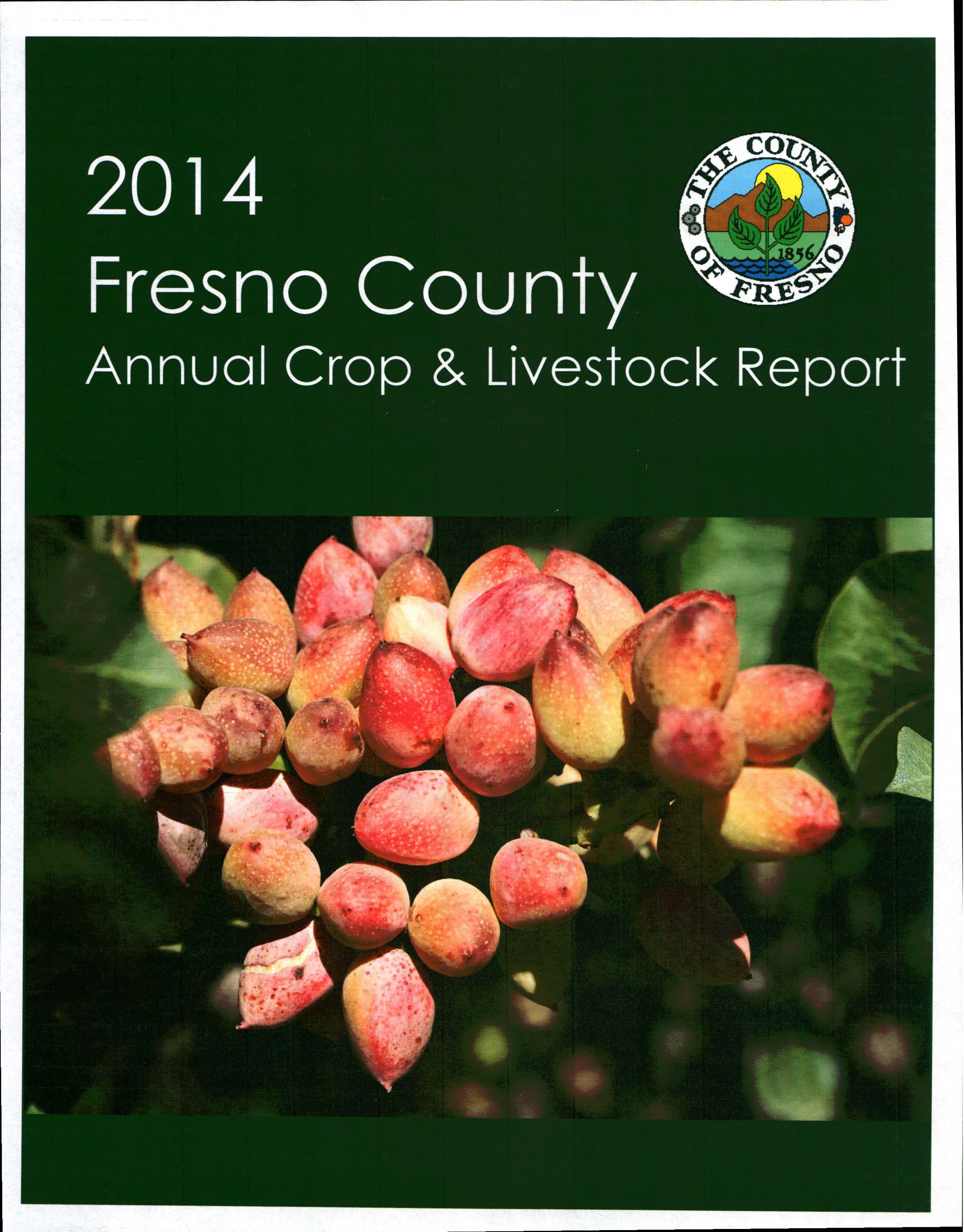
2014 Fresno County Crop Report Sets Record Production — $7 billion+

Les Wright, Agricultural Commissioner/Sealer submitted the following information to Karen Ross, California Department of Food and Agriculture Secretary, TODAY accompanied by the 2014 Fresno County Crop Report showing record production.

It is my pleasure to submit the 2014 Fresno County Agricultural Crop and Livestock Report. This report is produced in accordance with Sections 2272 and 2279 of the California Food and Agriculture Code, and summarizes the acreage, production, and value of Fresno County’s agricultural products. The figures contained herein represent gross returns to the producer, and do not reflect actual net profit.

Jacobson, Wright and Matoian

Photo, from left, Ryan Jacobson, Fresno County Farm Bureau CEO, Les Wright, Fresno County Ag Commissioner and Richard Matoian, American Pistachio Growers Executive Director

This report is a testament to the resiliency and determination of the Fresno County agricultural industry. For the first time ever, the gross value of Fresno County agriculture exceeds seven billion dollars. Almonds remain the number one crop at a value of 1.3 billion dollars with grapes a close second at $905 million.

The total gross production value of Fresno County agricultural commodities in 2014 was $ 7,039,861,000, a 9.26 percent increase from the 2013 production value of $6,443,236,500.

Increases were seen in:

  • vegetable crops (0.47% = $5,599,000)
  • fruit and nut crops (13.16%= $422,664,000)
  • nursery products (46.89%= $20,022,000)
  • livestock and poultry (31.48% = $301,144,000)
  • livestock and poultry products (22.09% = $116,299,000
  • apiary (17.39% = $10,738,000)
  • industrial crops (107.05% = $3,795,500).

Decreases in:

  • field crops (-36.20%= -$149,822,000)
  • seed crops (-14.67%= -$5,823,000).

I would like to express my appreciation to the many producers, processors, and agencies, both private and public, who supported our efforts in producing this report. I would also like to thank all my staff, especially Fred Rinder, Scotti Walker, Angel Gibson, Vera Scott-Slater, and Billy Hopper. Without their hard work and valuable input this report would not be possible.

Pistachios, featured on the cover of the 2014 Fresno County Crop Report, were Fresno County’s seventh top crop last year, with a value of nearly $380 million dollars.

The top nut—and crop, for that matter—was almonds, followed by grapes, poultry, milk, cattle and calves, tomatoes, pistachios, garlic, peaches and cotton.

Also included in the report was this quote from President John F. Kennedy:

Our farmers deserve praise, not condemnation; and their efficiency should be cause for gratitude, not something for which they are penalized.

2016-05-31T19:28:06-07:00August 25th, 2015|

Trinity Reservoir Releases Water

U.S. Bureau of Reclamation Releases Shared Water From Trinity Reservoir Despite Making Claims Of “California’s Historic Drought”

The San Luis & Delta-Mendota Water Authority (Authority) along with Westlands Water District, according to their press release, has filed a lawsuit in federal court to stop the Bureau of Reclamation (Reclamation) from releasing Central Valley Project (CVP) water from the Trinity Division to the Klamath River.
The U.S. Bureau of Reclamation said releases started Friday from Lewiston Dam on the Trinity River, the Klamath’s primary tributary, and would continue into late September.SLDMWA logo
Yesterday, Reclamation announced the release of up to 88,000 acre-feet of CVP water from Trinity Reservoir in the hope of aiding returning non-listed Chinook salmon with the optimism of diminishing the effect of a naturally-occurring disease endemic known as “Ich” (pronounced “ick”) to the Klamath River system to which the Trinity River is connected. This action, which is outside of Reclamation’s authorized place of use, is a repeat of a similar action taken last year with the intention to help avoid an outbreak which has only been documented to have occurred once in 2002. Since 2000, a significant supply of water has been set aside each year from the Trinity Reservoir for fishery protection purposes. Specifically, over the past four years, this has equated to more than 200,000 acre-feet of water lost that was literally flushed down the Lower Klamath River.
“As our state is faced with a water supply crisis affecting every sector of people, businesses, and communities, an action like this is unthinkable. This will cause irreparable damage to drought-stricken communities already facing water restrictions,” said Dan Nelson, executive director of the San Luis & Delta-Mendota Water Authority.
The CVP and State Water Project (SWP) provide water for more than 25 million Californians who depend upon a reliable water supply. In the 50-year history of the Projects, water deliveries have never been lower–the CVP is experiencing its second year of a zero water allocation and the SWP sits at a mere 20 percent water allocation.
Reclamation is once again choosing to ignore the harms of its actions through the issuance of a “Finding of No Significant Environmental Impact” (FONSI) that hasn’t been properly analyzed. Further, Reclamation’s decision to release 88,000 acre-feet of CVP water for the Klamath River is a sad irony given that Reclamation is currently unable to meet its legally-mandated obligations within the CVP and SWP.
 Westlands Water District_logo
“The hardworking people of the State of California have been directed by state and federal agencies to conserve water in the form of dying lawns, fewer showers, unplanted fields, trees uprooted or turning brown, and community wells drying up. Yet Reclamation, which has been unable to deliver any water to farmers, has decided to release tens of thousands of acre feet in an arbitrary manner that the courts have previously held to be unlawful.” said Tom Birmingham, general manager of the Westlands Water District. “The fact that 88,000 acre-feet can be casually released without regard to the potential impacts on the environment, including at risk-species in the Sacramento River and the Delta, is a gross mismanagement of the state’s water supplies. The action filed today is intended to compel Reclamation to comply with its mandatory duties,” said Birmingham.
“During a time when we are experiencing the worst water management challenges in decades, when communities and agriculture throughout the state are suffering severe impacts that have negatively affected our economy, the labor force and the environment, the decision by the Bureau of Reclamation to repurpose precious Central Valley Project water resources to augment Klamath flows for non-endangered fish, an action that is of questionable benefit, is both irresponsible and incomprehensible. While the needs of cities, family farms, and endangered species that rely on CVP resources continue to go unmet, the reallocation of the Project’s limited supply of water defies all logic,” said Jeff Sutton, general manager of the Tehama-Colusa Canal Authority, an organization that represents seventeen Sacramento Valley water districts that hold CVP water service contracts, that are also highly critical of the action being undertaken by the Bureau of Reclamation.
The water planned for release is enough to farm 31,000 acres of food, or to serve the domestic needs of more than 175,000 families for an entire year. The devastating effects of the drought will be felt for decades to come especially if arbitrary decisions like these continue.
2016-05-31T19:28:06-07:00August 21st, 2015|

New Medfly Quarantine

A portion of San Diego County was placed under Medfly quarantine earlier this week following the detection of 4 adult Mediterranean fruit flies (Medflies) in the La Mesa area.  The United States Department of Agriculture (USDA), the San Diego County Agricultural Commissioner, and CDFA are working collaboratively on this project.

The quarantine area in San Diego County measures 93 square miles, bordered on the north by Prospect Avenue; on the south by Mount Miguel Road; on the west by Fairmount Avenue; and on the east by Vista Grande Road.  A link to the quarantine map may be found here: www.cdfa.ca.gov/plant/medfly/regulation.html.

To eradicate the infestation, the release of sterile male Medflies began on August 10, at a rate of 250,000 flies per square mile per week.  The new release area is approximately 59 square miles.  In addition, properties within 200 meters of detections are being treated with an organic formulation of Spinosad, which originates from naturally-occurring bacteria in soil, in order to eliminate any mated females and reduce the density of the population. Finally, fruit removal will occur within 100 meters of detection properties in order to remove any fruit infested with eggs and larvae.

The quarantine will affect any growers, wholesalers, and retailers of susceptible fruit in the area as well as local residents. Home gardeners are urged to consume homegrown produce on site and not move it from their property.  These actions protect against the artificial spread of the infestation to nearby regions where it could affect California’s food supply and our backyard gardens and landscapes.

In the eradication program,  sterile male Medflies are brought to San Diego County from the joint CDFA/USDA sterile insect rearing facility in Los Alamitos, which prepares sterile files for release everyday over the Los Angeles basin.  The sterile release program has a proven track record of eradication in southern California.  Sterile male flies mate with fertile female flies in the environment but produce no offspring.  The Medfly population decreases as the wild flies reach the end of their natural life span with no offspring to replace them, ultimately resulting in the eradication of the pest.

The Medfly can infest more than 250 types of fruits and vegetables, causing severe impacts on California agricultural exports and backyard gardens alike.  Residents who believe their fruits and vegetables are infested with fruit fly larvae are encouraged to call the state’s toll-free Pest Hotline at 1-800-491-1899.

2016-05-31T19:28:06-07:00August 21st, 2015|

European Farmland Under Pressure

European Farmland under Pressure Due to Regulation and Diversion

By Laurie Greene, Editor

Jose Gomez Carrasco, executive sales manager for AGQ Labs and Technological Services based in Oxnard, is in charge of covering a large area that includes the U.S., Mexico and Central America. Noting global concern regarding how farmland is being used, particularly European farmland, Carrasco said, “There’s a growing population of around 150,000 or 170,000 new mouths every day to feed.” Carrasco said agricultural production on land designated for agricultural use in every country, worldwide, is being diverted to bio-ethanol, or bio-mass, or different renewable energy use, so the availability of agricultural products for food is diminishing.

Carrasco stated this progression needs to be moving in the opposite direction, “especially because there are other issues that are making production more challenging, such as water scarcity, soil erosion and the use and price of agro-chemicals, inputs and fertilizers, all of which are being controlled and monitored more and more.”

“The regulation of crop protection materials is intended to help everyone in the food supply chain,” he continued, “all the way from the grower to the consumer; however, sometimes these regulations can be quite burdensome.”

“In some cases regulations are not for the benefit of all,” Carrasco explained; “just for some. So in markets such as the European Union where the [maximum threshold] number of molecules registered has diminished from 1,000 to 300 or 400 in the last decade, we’re finding a lot of this regulation comes from Germany.” Carrasco said they are leaving a lot of farmers with no agro-chemicals in their arsenal, especially in Spain, Portugal, and Greece, all in southern Europe.

2016-05-31T19:28:07-07:00August 11th, 2015|

Senate Water Bill Hopeful

Senate Water Bill Introduction is a Glimmer of Hope for Water Agencies

FRESNO, CA – Last week’s introduction of Senator Dianne Feinstein’s legislation, the California Emergency Drought Relief Act of 2015, is welcome news for the people of the State of California and the Central Valley enduring another devastatingly dry year. Once again, multiple Central Valley water agencies joined together to express their unified voice in support of an expeditious passage of this Senate water bill. This bill comes on the heels of the introduction and passage by the House of Representatives of H.R. 2898, the Western Water and American Food Security Act of 2015.

 “We are encouraged by Senator Feinstein’s actions with the introduction of this legislation. There is no time to lose as the damaging effects of the drought continue to wreak havoc on local communities, businesses, farms and farmworkers in the San Joaquin Valley and other regions of the State. Immediate solutions are needed, and the District looks forward to working with Members of both the House and Senate to find a reasonable solution that will benefit our great State.”

–Don Peracchi, Chairman of the Board, Westlands Water District


“The South Valley Water Association thanks Senator Feinstein for introducing the California Emergency Drought Relief Act of 2015 and encourages the balance of the Senate to make quick work in passing the bill immediately upon return from the August recess. This is a further important step to get legislation that will help those many farms and communities in California who are going without water. We look forward to the members of Congress resolving key differences between the California Emergency Drought Relief Act and H.R. 2898, the Western Water and American Food Security Act of 2015, and finding real water supply solutions. The members of the South Valley Water Association stand ready to assist in any way we can.”

–Dan Vink, Executive Director, South Valley Water Association


“The San Joaquin River Exchange Contractors Water Authority thanks Senator Feinstein for the introduction of the California Emergency Drought Relief Act of 2015. We realize this is another important step to passing a bill out of the Senate later this year that provides a meaningful legislative solution to the long-standing water supply shortages that is crippling the state. We are optimistic that members of Congress and the Senate can resolve the key differences in this bill, and the previously passed House Bill H.R. 2898, the Western Water and American Food Security Act of 2015. The Authority looks forward to working with our legislative leaders to pass legislation that benefits all of California.”

–Steve Chedester, Executive Director, San Joaquin River Exchange Contractors Water Authority


“There is no more important issue facing the Valley than the drought. It is a statewide crisis with the most direct and severe impacts in the Valley. The Kern County Water Agency appreciates Senator Feinstein’s and Senator Boxer’s efforts to help reduce the drought’s terrible impacts by introducing a bill in the Senate that can improve water supplies for farms and cities. We are anxious for the House and Senate to start working on a compromise between Congressman Valadao’s bill and the bill in the Senate, and we encourage the Senate to take swift action on the Feinstein/Boxer bill so that process can begin.”

–Ted R. Page, Board President, Kern County Water Agency


“No area of the State, and perhaps the nation, has suffered more disproportionately the harmful stress of chronic water supply shortages. The San Luis & Delta-Mendota Water Authority is appreciative of the effort of Senators Feinstein and Boxer on the recently introduced California Emergency Drought Relief Act of 2015 bill in the Senate. This bill is not only important to the San Joaquin Valley, but it is also vital for the entire state of California. We encourage the Senate to act swiftly, and encourage both the House and Senate legislators to begin work immediately on a meaningful compromise bill to ensure that long-awaited and much-needed relief is realized.”

–Dan Nelson, Executive Director, San Luis & Delta-Mendota Water Authority


 “Friant Water Authority welcomes the introduction of Senate Bill 1894, the California Emergency Drought Relief Act of 2015, and we thank Senator Feinstein and her staff for all their efforts in bringing this bill forward. The immediate task is to pass Senate legislation so that work can begin to craft a compromise with the House-passed legislation. Our farms and communities have suffered more under these water cutbacks than any other area in the nation. Our people are desperate for solutions that will provide real water for our area. This bill is a critically important step in the process of developing compromise legislation that can be signed into law by the President this year. As the bill advances, Friant looks forward to working with our representatives on both sides of the aisle to achieve drought legislation that will provide real relief for the 2016 water year and beyond.”

–Eric Borba, Chair, Friant Water Authority

2016-05-31T19:28:08-07:00August 6th, 2015|

Alliance Against Food and Farmer Disparagement

The Alliance for Food and Farming Counters Food and Farmer Disparagement

By Patrick Cavanaugh, Laurie Greene and Courtney Steward, CaliforniaAgToday

Experts around the world agree that eating more fruits and vegetables is the best thing we can do to reduce disease, prevent obesity, and improve our health. But sometimes consumers need to know more about organic and conventional fruits and vegetables so they can make the right shopping choices for themselves and their families.

The Alliance for Food and Farming (AFF), based in Watsonville, is a non-profit organization comprised of both organic and conventional farmers that delivers credible information to consumers about the safety of organic and conventional fruits and vegetables.

According to Teresa Thorne, with AFF, “Many organizations such as Friends of the Earth (FOE), and the Environmental Working Group (EWG) are at odds with AFF for providing science-based and peer-reviewed information to consumers so they can make good shopping choices for their families.”

Friends of the Earth logo“Whether consumers purchase organic or conventional produce, both are safe,” Thorne said. “Health experts say simply that we should be eating more. Decades of nutrition science and health experts everywhere support the recommendation to eat more organic and conventional produce every day for better health. So, it is a little puzzling why FOE and some of the other activist groups would be concerned about that message. But, apparently they are.”

“So, what we are trying to do,” explained Thorne “is present accurate and more balanced information for consumers. Our Board of Directors, nearly 7 years ago, established that calling our healthy and safe produce “dirty” or “toxic” has to stop. We are not going to allow the disparagement of these nutritious products and the disparagement of the farmers who are working hard every single day to provide these healthy products to consumers, to stand.”

Thorne said, “So, AFF got in gear to stop it, largely by going toe-to-toe with the EWG’s so-called ‘Dirty Dozen’ list—one of the main vehicles of product disparagement. Not long ago, when the EWG published the list, nearly all newspapers, television networks and cable channels gave it widespread media coverage in major media markets and publications.”

AFF has achieved some success by introducing peer-reviewed science from experts into consumer media, with the credible message that both organic and conventional produce are safe, healthful, and people should eat more of them every day. “Just in the course of the last six years of the campaign,” said Thorne, “we’ve seen coverage of the EWR list diminish to the extent that in 2015, only one daily newspaper in Ohio covered the story. So their message is mostly limited to blogs for those who are very friendly to their message.”

ewg logo


Aside from the “Dirty Dozen” list, the EWG website does support the same scientific research as the Alliance:

Should we eat more fruits and vegetables?

…The health benefits of a diet rich in fruits and vegetables outweigh the risks of pesticide exposure. Eating conventionally grown produce is far better than skipping fruits and vegetables. And with EWG’s Shopper’s Guide™, consumers don’t have to choose between pesticides and healthy diets.

Do all these pesticides mean I shouldn’t eat fruits and vegetables?

No, eat your fruits and vegetables! The health benefits of a diet rich in fruits and vegetables outweigh the risks of pesticide exposure. Use EWG’s Shopper’s Guide™ to reduce your exposures as much as possible, but eating conventionally grown produce is better than not eating fruits and vegetables at all.

Shouldn’t I try to buy everything organic?

EWG recommends buying organic whenever possible.

…However, we know that organics are not accessible or affordable for everyone, so we created the Shopper’s Guide™ to help consumers make the healthiest choices given their circumstances.

…EWG always recommends eating fruits and vegetables, even conventionally grown, over processed foods and other less healthy alternatives.

SafeFruitsandVeggies logo

AFF claims on its website:

We have an obesity epidemic and current media and internet reporting is increasing fears consumers have about eating fruits and vegetables and is lowering the faith people have in the government regulations implemented to protect them.  It is inaccurate to suggest that organic is the only safe choice when it comes to selecting safe fruits and vegetables; because there is no scientific consensus to substantiate this claim.

-See more at the Alliance’s website, SafeFruitsandVeggies.com.

Thorne believes the Alliance’s success has lead to another activist group, Friends of the Earth (FOE), taking them on. Thorne said FOE is trying to discredit the Alliance by calling it a “front group”.

In its “Spinning Food” report, published in June 2015, the FOE reports:CFBF logo

While the Alliance presents itself as a science-based resource on the safety of organic and conventional produce, its funding comes from trade groups for industrially grown apples, citrus, pears and grapes, among other industry groups.

The “leading corporate Board Members or Donors” of the Alliance are listed as:

-California Farm Bureau Federation

-Western Growers

-Produce Marketing Association

Western Growers logo


Wikipedia defines a front organization as “any entity set up by and controlled by another organization, such as intelligence agencies, organized crime groups, banned organizations, religious or political groups, advocacy groups, or corporations. Front organizations can act for the parent group without the actions being attributed to the parent group.”

Thorne stated, “We’re not a front group. We are who we are—very transparent. The entire tax return is posted on the “About Us” section of the AFF website, as well as:

Who is Behind the Alliance for Food and Farming?   andPMA Logo    How is the Alliance for Food and Farming funded?

“But they never attack the scientific content we present,” stated Thorne, “and that really underscores our science is good and solid. They only try to discredit the organization itself with those unfounded ‘front group’ allegations.”

2016-05-31T19:28:08-07:00July 31st, 2015|
Go to Top