3rd in a Series on Mental Health on Farm

Part 3 Mental Health on the Farm:

Isolation in Farm Country

Resources are provided at the end of this post.

In light of Mental Illness Awareness Week last week, Karen Markland, Division Manager for the Fresno County Department of Behavioral Healths Planning, Prevention and Supportive Services, talked extensively with California Ag Today Editor, Laurie Greene, about members of the local agricultural industry who could be going through significant emotional suffering due to the drought and environmental water restrictions impacting their livelihoods.

Editor: Is there anything unique about how farmers and farmworkers suffer from stress?

Markland: In our experience with farm-working populations, they have a couple of strikes against them. They are geographically isolated in rural areas; they are probably linguistically isolated as well, as their native language is typically not English; and, they are culturally isolated in that many of our cultures believe in not talking about sick minds or sick feelings. Plus there is transportation barriers. Our county is so large that it is very difficult for rural workers to receive any services. And so, we think it is a combination of things that discourage people from reaching out for help.

Editor: Are there financial issues or constraints?

Markland: What we have found is anytime we we use Mental Services Act dollars, we have to do it based on what the community wants. The stakeholders have brought up not a financial barrier, per se, but a transportation barrier. They tell us, “I can’t afford a car. I can’t afford the taxi from Kerman to Fresno or Parlier to Fresno.” They see it as a transportation barrier.

Editor: Is this population at risk?

Markland: There have at least two suicides in the agricultural community, a landowner and a farmworker. That is too many. It is unacceptable, but it has brought to light some uncomfortable subjects that we have to try to make more comfortable. When individuals feel that stressors become more difficult to manage, thoughts of wanting to harm themselves and not wanting to continue or to fight through, become stronger.

Editor: What can you do for people who feel this way?

 Markland: We are concerned about the farmworker who wakes up to such serious depression or anxiety and who has to fight through their day. That is no quality of life. So, we have a couple of resources. One that we are proud of right here in Fresno is the Central Valley Prevention Suicide Hotline 1-888-506-5991. This is a 24/7 hotline that has all language capabilities. So no matter what your language, we are here for you. This is a local number. The reason I keep saying local is that the person who picks up that phone call understands the culture of our valley—that we we have farmworkers facing dire drought conditions that others in California do not encounter with the same potential catastrophic loss; and the anxiety behind that, and the longevity of that—that it is not a one-week problem. This isn’t a breakup with a person; this is a long-term problem. So having local people manage the hotline is a wonderful resource.

Editor: Of course, farmers and farmworkers outside of Fresno County may have a similar resource in their counties. (Please refer to resources listed at the end of this article.) Could you tell us how successful has the Fresno County hotline been?

Markland: They are a crisis hotline; plus they are there just to help talk to people who are depressed or anxious. We do “talk-down” calls and rescue calls. This hotline has saved over 53 lives in active rescues in the last 12 months. Individuals have called the hotline as their last resort, and we’ve been able to activate emergency medical services and save their lives. In addition, we do follow-up calls.

Editor: What about follow-up calls?

Markland: If a person calls our hotline, and they have a safely plan, and the staff on the call feels they are safe, they’ll do a follow-up call in two days. Staff will ask if they have stuck with their safety plan, how they are feeling, and if they accessed the support systems they wanted to, because we really are dedicated to having a healthy community.

The Fresno Department of Behavioral Health is dedicated to supporting the wellness of individuals, families, and communities in Fresno County who are affected by, or at risk of, mental illness and/or substance use disorders through cultivation of strengths toward promoting recovery in the least restrictive environment.County of Fresno Logo

The Fresno Department of Behavioral Health provides mental health and substance abuse services to adults within the County of Fresno. The programs within our department focus on delivering the highest quality of service. There are over 300 professionals and staff dedicated to providing services in both metropolitan and rural areas. The diversity of our staff has helped us create a department that is sensitive to cultural differences and attempts to bridge the language barriers with our consumers. 

2016-05-31T19:27:07-07:00October 12th, 2015|

Outlook on California Poultry

Bill Mattos: Outlook for California Poultry Industry

By Charmayne Hefley, Associate Editor

California’s poultry industry has a positive outlook for the coming year despite the recent outbreak of the highly pathogenic avian influenza plaguing the rest of the nation’s poultry industry. Bill Mattos, president of the California Poultry Federation, said the coming year will see chicken overtaking beef.

“We’re learning from a lot of economists that we are going to have an exciting year for poultry next year and into the future,” Mattos said. “It looks like chicken is taking over beef next year, and all of poultry will be ahead of the red meats. We love our beef and pork friends, but we’re passing them. It looks like the healthfulness of chicken and the capacity to grow locally—everything in California—is looking good for the poultry industry. And we’re excited. We think the chicken and turkey industries will have a good year coming up.”

And although the price of corn is still higher in California versus nationally, Mattos said this industry is still doing well. “We still pay about a dollar or more a bushel for corn in California. But prices are outstanding compared to what they were two or three years ago, so our companies are making some money.”

With the flyways, or bird migration, coming back this fall, Mattos said the California poultry industry is prepared with increased biosecurity on their farms and ranches to prevent an avian influenza outbreak. Mattos said, “It’s very important that we make sure our companies are locking down their facilities—keeping visitors off and maintaining a biosecurity that’s first in the nation—because any type of bird flu that could invade here and spread would devastate the marketplace.”

____________________

California Poultry Federation

2016-05-31T19:27:07-07:00October 9th, 2015|

Cornell Kasbergen On Federal Milk Marketing Order

Continued Coverage of Milk Hearing

Dairyman Cornell Kasbergen: We Need Federal Milk Marketing Order

By Patrick Cavanaugh, Deputy Editor

Cornell Kasbergen, a dairyman in Tulare County, is fed up with the flawed California State Milk Marketing Order. So much so, that he and other dairymen and women have a great desire to switch to the Federal Marketing Order.

This idea is presently front-and-center in Clovis, CA as USDA officials are holding an historic hearing that may extend into early November.

“It started three to four years ago when our milk prices were dramatically less than those in the rest of the country, and we wanted to get our industry on a level playing field. It has been a lot of work getting the co-ops together, but we are just at the beginning of this whole process.”

Having the USDA here is, in itself, a big beginning,

Kasbergen has worked hard to drum up interest in the idea. “When I was a co-op board member at Land O’Lakes, Inc. [a national, farmer-owned food and agricultural cooperative milk cooperative], we worked with other dairy co-ops and their members to get educated.  We discovered, for the last three to four years, California’s whey value in its milk pricing formula deviated from national prices, and California producers were losing money. Once we realized we were leaving a lot of money on the table—over a million dollars a day—it opened people’s eyes. That’s why we are having this hearing.”

“The California Department of Food and Agriculture intentionally left the state’s whey prices lower than the rest of the nation, and though we’ve been petitioning them over and over again to rectify the issue, they have failed,” said Kasbergen. “That’s why we have gone this route in getting our milk prices formulated by the federal government rather than by the state. Our state has really let us down.”

“The CDFA has taken hundreds of millions of dollars out of the dairy farmers’ pockets, the loss is killing the dairy industry in California,” said Kasbergen.

2016-05-31T19:27:07-07:00October 9th, 2015|

Water Rally Calls for Action

Water Rally Calls for Action, More Voices

By Brian German, Associate Broadcaster

At the recent “Take Back our Water Rally” in Mendota, hundreds gathered to call on Governor Brown to recognize the impact of not just the drought, but the bureaucratic decisions that have had devastating consequences for California farmers. Leadership at the water rally called for action and more voices in the plea for change.

Aubrey Bettencourt, executive director of California Water Alliance, shared some points she made a the rally, “My challenge to this audience was to understand there is a void of leadership. We have a governor who says he is handling this, and he is not. We have no recovery plan for how to get out of this drought. How do we get out of the crisis?  There has been no pathway to recovery, neither from the federal government, nor the state government.” Finally, last month, a group of 47 legislators, both Republican and Democratic, called for a special legislative session.

Bettencourt pointed out the Ag industry is not alone in having been adversely affected by the water constraints. “We all need to communicate to our elected officials,” she said, “that we need a path to relief. My challenge to the audience was to help them realize that because the drought is now statewide and regulatory constraints have drastically cut the regular water supply, we are all—ag and urban communities—even the environmental conservation community—feeling the effects. While we’ve been in this situation for years, and years, and years, we need to expand our base and build our army.”

Many attendees are concerned about the use of the Endangered Species Act to cut water supplies that Central Valley farmers depend on in order to increase populations of a fish that can just as easily be grown by the thousands in hatcheries.

Calling to educate those outside of agriculture to advocate for change in water policies, Bettencourt remarked, “Help those who are unfamiliar with the importance of supply, or more importantly, the lack of supply, to understand why they are frustrated, what is really going on, and how California’s water supply really works. Let’s activate them to being an additional voice to ours; encouraging many voices from diverse locations saying the same thing is the only way the agricultural community, and all stakeholders in California, will ever be heard,” she said.

While forecasters are still optimistic El Niño will deliver heavy rainfall, Bettencourt says California’s water issues will continue unless there is a change in the legislature. She emphasized it would take a big push from more than just the agricultural sector to demand the change that is needed. “It is a numbers game,” she explained. “When you look at the population in California, the bulk of the voters are in the Bay Area, along the Coast and in Southern California. If you add up the registered voters of all the agricultural counties in California, the total is not enough to offset even one of those three heavily populated areas. So the sole hope we have to maximize the only two opportunities for input we can control—our voice and our vote—is to get new voices and new votes,” Bettencourt said.

2016-05-31T19:27:08-07:00October 7th, 2015|

Dairyman Xavier Avila on Federal Milk Marketing Order

Continued Federal Milk Marketing Order Hearing Coverage

Kings County Dairyman, Xavier Avila Worked Hard to Get Federal Milk Marketing Order on the Docket 

By Laurie Greene, Editor

Xavier Avila, a dairyman in Kings County, is monitoring the USDA Federal Milk Marketing Order (FMMO) Dairy Hearing in Clovis very closely. “Well, I was one of the ones who pushed for it five or six years ago. It’s kind of dear to me to get it done,” he said.

Avila explained, “As a kid growing up in the sixties and seventies, all my family members who were in the dairy business talked about how bad it was before the orders. Milk needs to be picked up everyday, so it it’s really easy to mess the market up if you don’t pick up a guys’ milk or threaten not to pick it up. So the California marketing order was established to bring order to California milk.”

Avila said the California marketing order worked for many years when dairies across the country were making the same amount of money per hundredweight. But prices are not equal now, and California dairy farmers are getting paid much less than those other parts of the country.

“We set up a solution on end-product pricing. Yet in California, the CDFA was not following the rules. If the rules had been followed, we wouldn’t have a need to go to the FMMO,” said Avila. “But CDFA just wouldn’t follow the rules regarding end-product pricing and the USDA does follow the rules; so it is just a simple matter of going with the people who are following the rules.”

“For the past ten years,” Avila said, “our whey prices have been much less than the national whey price, so the California dairy industry has lost billions of dollars.”  “It’s really simple. There are six pounds of whey per every 100 pounds of milk. Basically for the last few years, whey was 60 cents/pound. Doing the math, 60 cents times 6 pounds; you come up with a total of $3.60 for the whey in each 100 pounds of milk. With the California Milk Marketing Order, we were paid just 25 cents towards that total and the plant kept the rest. The Federal order is basically the reverse; not quite, but almost the reverse.”

Avila is bullish on the California dairy industry’s conversion to a FMMO. “I think it’s going to happen. Nothing is for certain, but the industry is united. Milk is the same everywhere, and I think it is in California dairy farmers’ hands because we are going to vote on this. Whenever you produce the same product and earn far less for it, it is inevitable that something is going to happen.”

Avila noted it will take some time, “but I knew that from the start, it would not be quick and easy. We are looking at anywhere from one to two years,” Avila said, affirming his belief the California dairy industry can hang on for two years. “We’ve got not choice. Now with the drought, there are other crops you can do better with. Some dairy farmers will leave the business just because they have something better to do than milk cows. So we see this as saving the California dairy industry,” Avila said.

Click here to view Video of Xavier Avila, September 22, 2015.


2016-05-31T19:27:08-07:00October 6th, 2015|

Food Security – Inspections on Imports, Part 2

Rachel Martin on Food Security – Inspections on Imports, Part 2

By Charmayne Hefley, Associate Editor


This is the final segment of a two-part series with national chairman of Homeland Security for the National Federation of Republican Women, Rachel Martin on food security  – Inspections on imports into the United States.

Due to budget cuts, as reported in Part 1, the Department of Homeland Security inspects only 1 in every 60 containers arriving in the U.S. This ratio brings up two issues, according to Martin: (1) the threat of terrorism and (2) concern over food safety. Failure to properly inspect imported containers exposes American citizens to toxins in imported goods that don’t meet the same regulatory standards as food products produced in the United States.

“When you’re doing things en masse,” Martin said, “and the [containers with imported food] are not being inspected, many dangers can come into the country that can kill people—especially the elderly and kids because we know they are more susceptible to bacteria and chemical toxins.”

While she is aware of the potential for accidents and mistakes in food safety, Martin said risking the safety of our country and citizens by inspecting only a limited number of imported containers to save money is more harmful than helpful. “Accidents are going to happen with any food,” Martin said, “even with when I cook for myself in my own kitchen. I may undercook my meal, and there is a possibility I can get food poisoning that way.”

Martin said the Obama administration’s budget cuts have hurt Homeland Security’s inspection rate on food imports. “Number one, it’s not right, there are so many regulations here that we have to deal with,” Martin said. “And number two, it’s wrong that these containers are not inspected because people can become very ill and be killed by food toxins that come into the country in the absence of inspection. ‘Not to mention, the terrorists, bombs, weapons and anything else that is dangerous that could be on those containers.”


2016-05-31T19:27:08-07:00October 5th, 2015|

Americans Support Endangered Species Act Reform

Americans Support Endangered Species Act Reform, Survey Says

Nothing is more priceless and more worthy of preservation than the rich array of animal life with which our country has been blessed.”
-President Nixon, upon signing the Endangered Species Act

The Endangered Species Act of 1973 (ESA) was signed on December 28, 1973, according to the National Oceanic and Atmospheric Administration website and provides for the conservation of species that are endangered or threatened throughout all or a significant portion of their range, and the conservation of the ecosystems on which they depend. The ESA replaced the Endangered Species Conservation Act of 1969. Congress has amended the ESA several times.

The California Endangered Species Act (CESA), per the California Department of Fish and Wildlife, states that all native species of fishes, amphibians, reptiles, birds, mammals, invertebrates, and plants, and their habitats, threatened with extinction and those experiencing a significant decline which, if not halted, would lead to a threatened or endangered designation, will be protected or preserved. The California Department of Fish and Wildlife will work with all interested persons, agencies and organizations to protect and preserve such sensitive resources and their habitats.

American Farm Bureau issued the following press release:

Most Americans think the Endangered Species Act is outdated and needs to be revised, a survey by Morning Consult shows. The poll conducted in early August adds impetus to congressional efforts to overhaul the increasingly outdated 1970s-era statute.

The survey shows:
• 63 percent of Americans support modernizing the ESA;
• 62 percent of Americans believe the act should help with species recovery, as opposed to merely cataloguing changes in their populations;
• 69 percent of Americans want the federal government to offer resources to third parties to help species recovery; and
• 49 percent of Americans believe that state or local authorities, rather than the federal government, lead in recovery of endangered and threatened species. Only 31 percent of Americans favor the federal government taking the lead.

“The intent of the Endangered Species Act is inspiring, but results have been less so,” American Farm Bureau President Bob Stallman said. “Farmers, ranchers and environmentalists agree that we must save wildlife facing preventable extinction, but the current recovery rate of less than 2 percent shows the law is a failure.

“Today, many landowners hesitate to establish habitat that would help endangered species. That’s so because the law itself makes it impractical for them to use their land once they have made the effort to help in the first place. The ESA can and must be modernized to protect endangered species and respect private property rights. Neither agriculture nor the endangered species have time to wait.”

A statistical summary of the poll can be found here. Detailed questions and answers can be found here.

2016-07-23T16:04:51-07:00October 1st, 2015|

Import Food Safety, Part 1

Import Food Safety: Only 1 in 60 Containers Is Inspected

By Charmayne Hefley, Associate Editor


This is the first in a two-part series with Rachel Martin, the national chairman of Homeland Security for the National Federation of Republican Women, on import food safety in the United States.

Food safety is a crucial element in the production of food, and many government regulations exist to keep our food safe for people to eat. Yet, Martin explained, those regulations don’t necessarily reach imported food. Specifically, she said, “Due to budget cuts under the Obama administration, only 1 in 60 containers arriving in the U.S. is inspected by Homeland Security.”

Martin’s initial reaction to this statistic was to consider the possibility that terrorists could smuggle in weapons, chemicals and themselves into the United States.

“The second thing that came to mind was food safety,” Martin said because as we grow less food domestically, we import more food. “We’re already overregulated here in California—not only in the United States, but it’s worse here—with mandated inspections, regulations on our food and regulated chemicals, spraying, pesticides and so forth. Yet when food enters the United States, the majority of it isn’t even inspected.”

Martin said her own daughter has been affected by the risks of importing food that is not inspected by or grown under strict U.S. standards set for the United States.

“My daughter’s first job was at a local water park when she was 17-years-old, slicing limes to make juice for the kids there,” said Martin. “The limes were imported from Mexico. My daughter developed a rash on her arm from chemicals that were applied to the limes that looked like she had third-degree burns. It went away in a couple of months, but to this day—she’s now 23—it  returns on a random basis.”

2016-05-31T19:27:09-07:00October 1st, 2015|

Armyworms Invade Rice

Luis Espino: Armyworms Invade Rice

By Charmayne Hefley, Associate Editor

Armyworm Larvae

Larva of the armyworm, Mythimna unipuncta.
Photo by Jack Kelly Clark, UC IPM.

Farmers face many threats to their crops on a daily basis. Luis Espino, rice farm advisor UC ANR Cooperative Extension, Colusa County, said rice farmers are on the lookout for two caterpillar infestations during the year when armyworms invade rice fields. “The first one occurs sometime in June,” Espino said. “At that time all they do is just eat the foliage, and you can usually see it when you walk into a field. Nevertheless, the rice has a very good capacity to recover from that type of injury.” Espino’s UC Rice Blog explains it is difficult to accurately estimate yield losses due to early armyworm damage because it can reduce tillering, delay the crop, and cause uneven maturity.

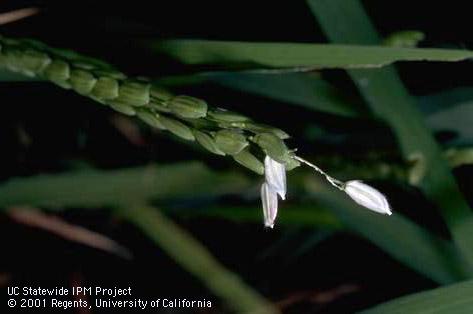
“Heading” occurs when the rice plant prepares to enter its reproductive phase. The first sign, called the ‘booting’ stage, is when the leaf stem that conceals the developing panicle bulges. Then the tip of the developing panicle emerges from the stem and continues to grow. Rice is said to be at the ‘heading’ stage when the panicle is fully visible. Flowering begins a day after heading has completed. As the flowers open they shed their pollen on each other so that pollination can occur. Flowering can continue for about 7 days.  (Source: Rice Development, Ricepedia.) 

“The second infestation usually occurs in mid- to late-August when the rice is heading out,” Espino said. “At that time, armyworms can feed on the panicles, [causing the kernels to dry before filling], resulting in blanks [without kernels to harvest] on the panicles and broken panicle branches. That’s when armyworms are more important.”

Espino said that the first infestation this year was relatively large, making it harder for the treatments to control the armyworms as they devastated the rice fields. “There were some areas in fields where the rice was down to the waters,” Espino said. “so all the foliage was consumed, and sometimes only a little stem was left standing.”

During the second armyworm infestation, however, Espino said the rice fields were not as badly affected as they had been in the first attack. “We did see some fields with armyworm injury,” Espino said,“ and some farmers had to treat their fields. The numbers were just so big that the treatments were not controlling them.”


Resources:  

2016-05-31T19:27:09-07:00September 30th, 2015|

Water and Nitrogen Use Research

Andre Biscaro on Water and Nitrogen Use Research

By Charmayne Hefley, Associate Editor


Many jobs exist solely for the improvement of agriculture. Andre Biscaro, agriculture and environmental issues advisor at the UC Division of Agriculture and Natural Resources, Cooperative Extension, Los Angeles and Ventura Counties said his job is to find ways to improve water and nitrogen use in fertilizing crops such as strawberries and celery.

“We’re measuring how much nitrogen the plant takes in and at what time,” Biscaro said, “so we can make more accurate recommendations for nitrogen fertilizers. It’s the same for water. We’re monitoring the crop growth of the strawberry plants—how deep the roots go and how the canopy develops—so we can make more accurate water recommendations. We’re assessing fields in Santa Maria and we are implementing the second phase here in Ventura County, Santa Maria and Watsonville.”

Biscaro is researching in strawberries and celery how to push salts in the soil beyond the root zone, the point beyond which plants will generally seek water unless they are stressed. “It’s essential to install soil moisture sensors at the end of your root system,”Biscaro said, “to make sure the soil is saturated every time you irrigate and then you need to push the water down. And it’s also really important to calculate the amount of water you’re applying because a lot of growers are irrigating without knowing how much water they are applying.”

“We calculate the leaching fraction [the portion of irrigation water that infiltrates past the root zone] based on the sensitivity of the crop to salinity and to the salinity of the water,” Biscaro explained. “And by only knowing how much water you’re applying, you can add a certain leaching fraction to your crop,” Biscaro said.

Nitrogen and water

2016-05-31T19:27:09-07:00September 29th, 2015|
Go to Top