The Story of Rising Fertilizer Prices

High fertilizer prices in the past year have increased costs for farmers, but for some crops more than others. Multiple potential causes could explain these price increases, stemming from both supply and demand factors. If farmers respond to high prices by using less fertilizer per acre, it will provide an environmental benefit in the form of less nitrogen and phosphorus in streams, rivers, and lakes.

By Aaron Smith, DeLoach Professor of Agricultural Economics in the Department of Agricultural and Resource Economics at UC Davis.

https://s.giannini.ucop.edu/uploads/pub/2022/02/24/v25n3.pdf 

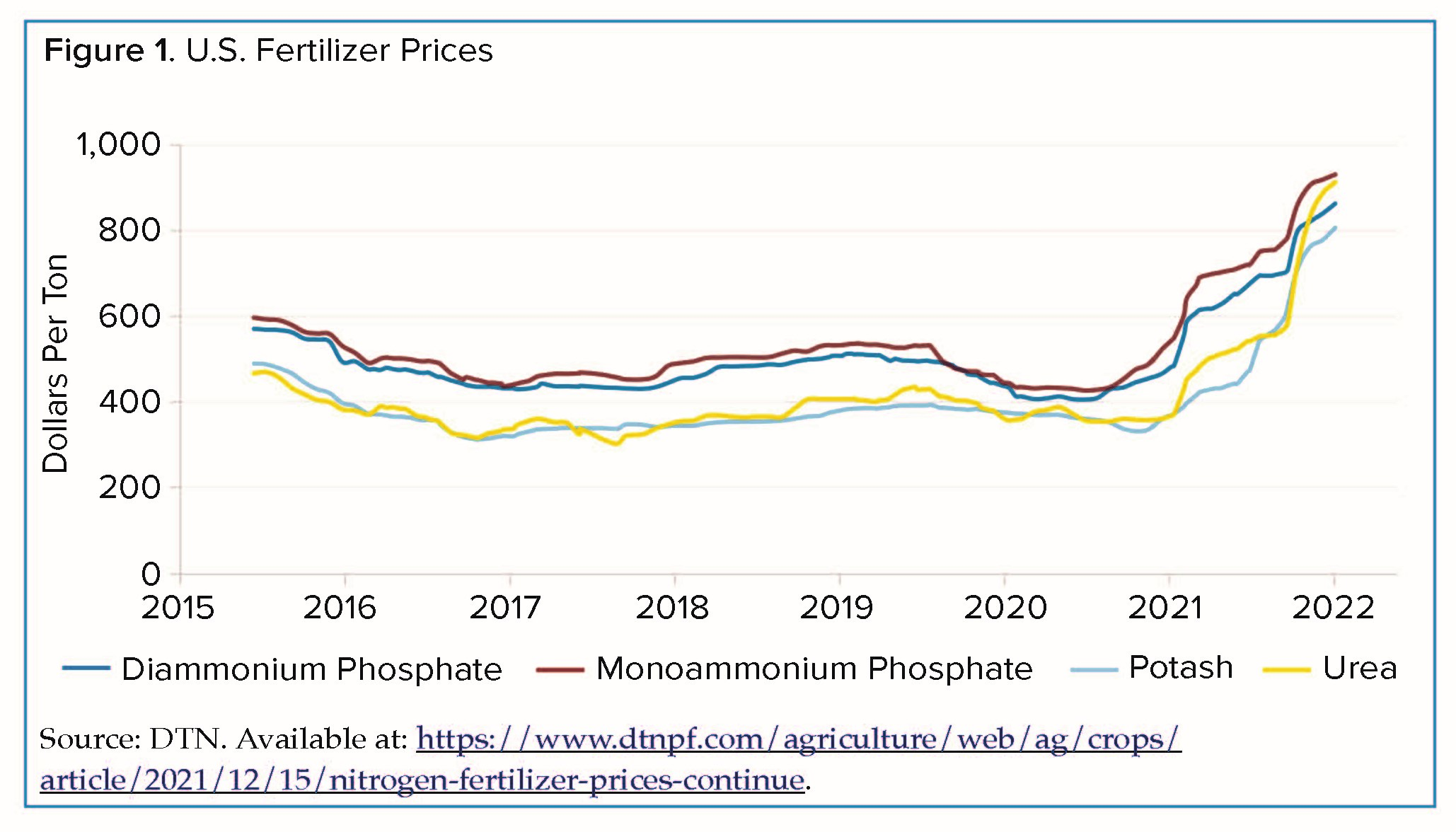
Fertilizer prices approximately doubled between the summer of 2020 and the end of 2021. Prices had been relatively stable in the prior five years at around $500 per ton for phosphate products (phosphorus) and just below $400 per ton for potash (potassium) and urea (nitrogen). In January 2022, phosphate products hit $900 per ton, and potash and urea prices were $800 per ton (see Figure 1).
What caused these price increases, and how much do they matter?

Agricultural Fertilizers

Most fertilizers deliver one or more of the following macronutrients to plants: nitrogen (N), phosphorus (P), or potassium (K).

Nitrogen makes up three-quarters of the air we breathe and is essential in plant growth. However, atmospheric nitrogen needs to be converted to ammonia (NH3) before it is accessible to plants. This conversion process, known as fixation, occurs naturally through bacteria and archaea that live in the soil or in the roots of some plants. Animals also produce ammonia by eating nitrogen-laden plants and excreting manure.

These natural processes typically do not produce enough ammonia for crops to reach their maximum potential. The invention of the Haber-Bosch process in 1909 enabled the production of synthetic ammonia by reacting nitrogen with hydrogen under high heat and pressure. U.S. nitrogen producers use natural gas as an energy source in this process.

Phosphorus helps plants grow by promoting photosynthesis and other functions important for development. Phosphorus fertilizers are typically produced by mining phosphate rock and treating it with sulfuric or phosphoric acid, causing a chemical reaction that converts it to a form that can be absorbed by plants.

Potassium strengthens plants, making them resistant to disease and higher in quality. Potassium fertilizers are created by mining potash from deep underground, similar to table salt. Chemical reactions convert it into a form usable by plants.

It is impossible to apply the exact amount of fertilizer that plants require, and there is a perception that many farmers over-apply fertilizer because they fear yield and profit losses from applying too little. This extra fertilizer is sometimes called “insurance nitrogen.”

Nitrogen and phosphorus that are not taken up by plants often end up in waterways, where they can cause a massive overgrowth of algae, known as an algae bloom. Certain types of algae emit toxins that are absorbed by shellfish. Consuming these tainted shellfish can lead to stomach illness and short-term memory problems. Drinking or coming into contact with toxins from algae blooms can cause stomachaches, rashes, and more serious problems. Algae blooms also reduce the recreational value of lakes and rivers.

U.S. Fertilizer Consumption

Nitrogen fertilizer use increased by a factor of four from 1960–1980, as shown in Figure 2. This increase coincided with dramatic increases in crop yields. In the 1970s, high agricultural commodity prices created a farm boom in which farmers planted more acres to crops and increased fertilizer applications.
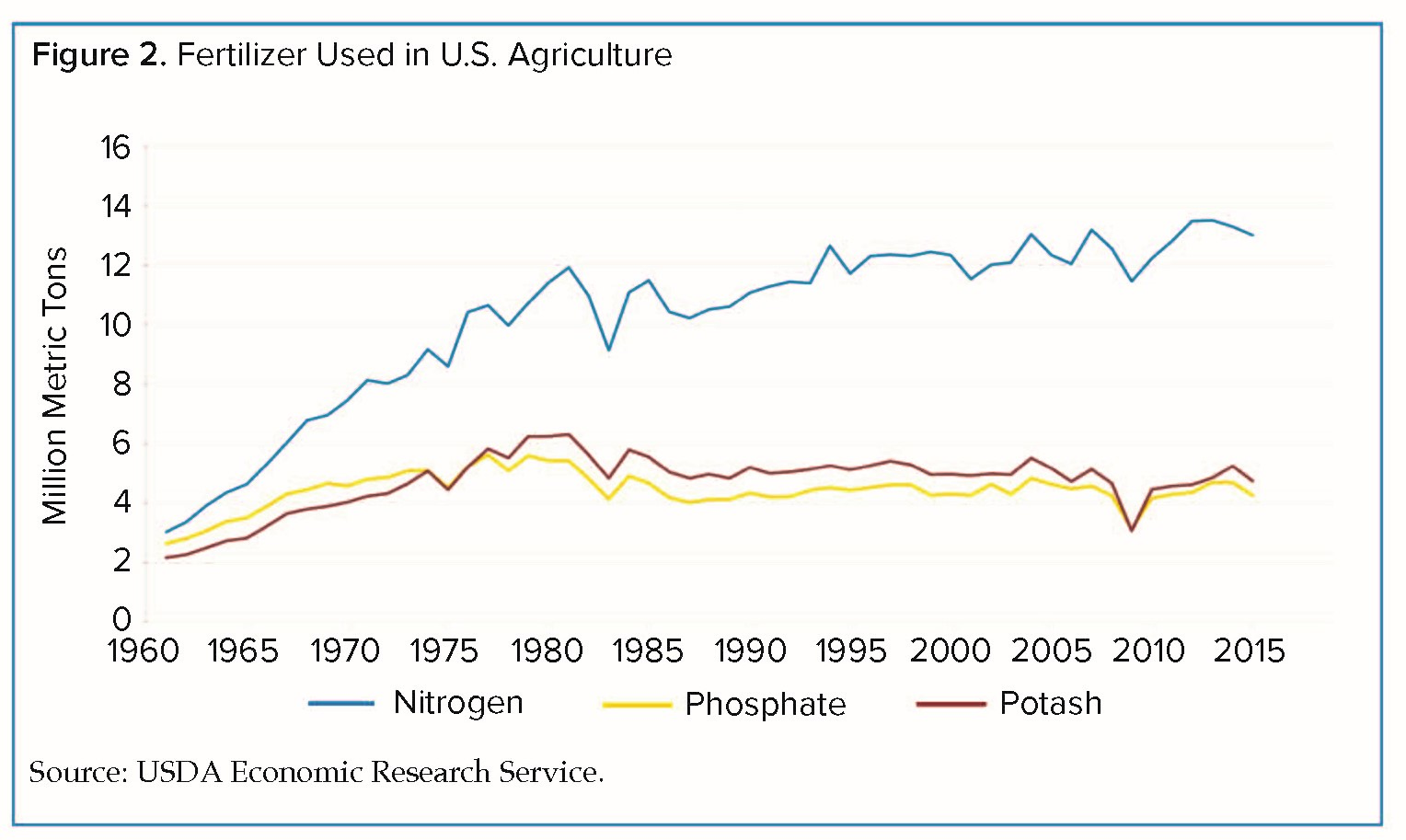
After a slight drop during the farm crisis of the early 1980s, nitrogen fertilizer use has increased steadily, but at a slower rate than in the 1960s and 1970s. Phosphate and potash use has been relatively constant since 1985. Use of all fertilizers dropped substantially in 2009 after fertilizer prices increased fivefold during the 2008 commodity boom—a much larger increase than in 2021.

Nitrogen is by far the most used agricultural fertilizer by weight. It now makes up almost 60% of all fertilizer used, whereas phosphate and potash each comprise just over 20%. However, the trends in phosphate and potassium use mirror those in nitrogen, perhaps because many farmers apply multi-nutrient fertilizers.

Two facts provide insight into the role of fertilizer in the U.S. farm economy. First, corn uses about 45% of each fertilizer type, yet it takes up only a quarter of all cropland—90 out of about 390 million cropland acres in the nation. Second, in 2020 fertilizer made up 35% of operating expenses for corn growers—more than any other crop. Fertilizer is a major expense for the biggest crop in the nation, so the 2021 fertilizer price increases will significantly raise the cost of growing it.

As Figure 3 shows, fertilizer makes up more than 25% of operating expenses for several other major crops, including barley, oats, sorghum, and wheat. Between them, these crops use an additional 50 million acres each year.
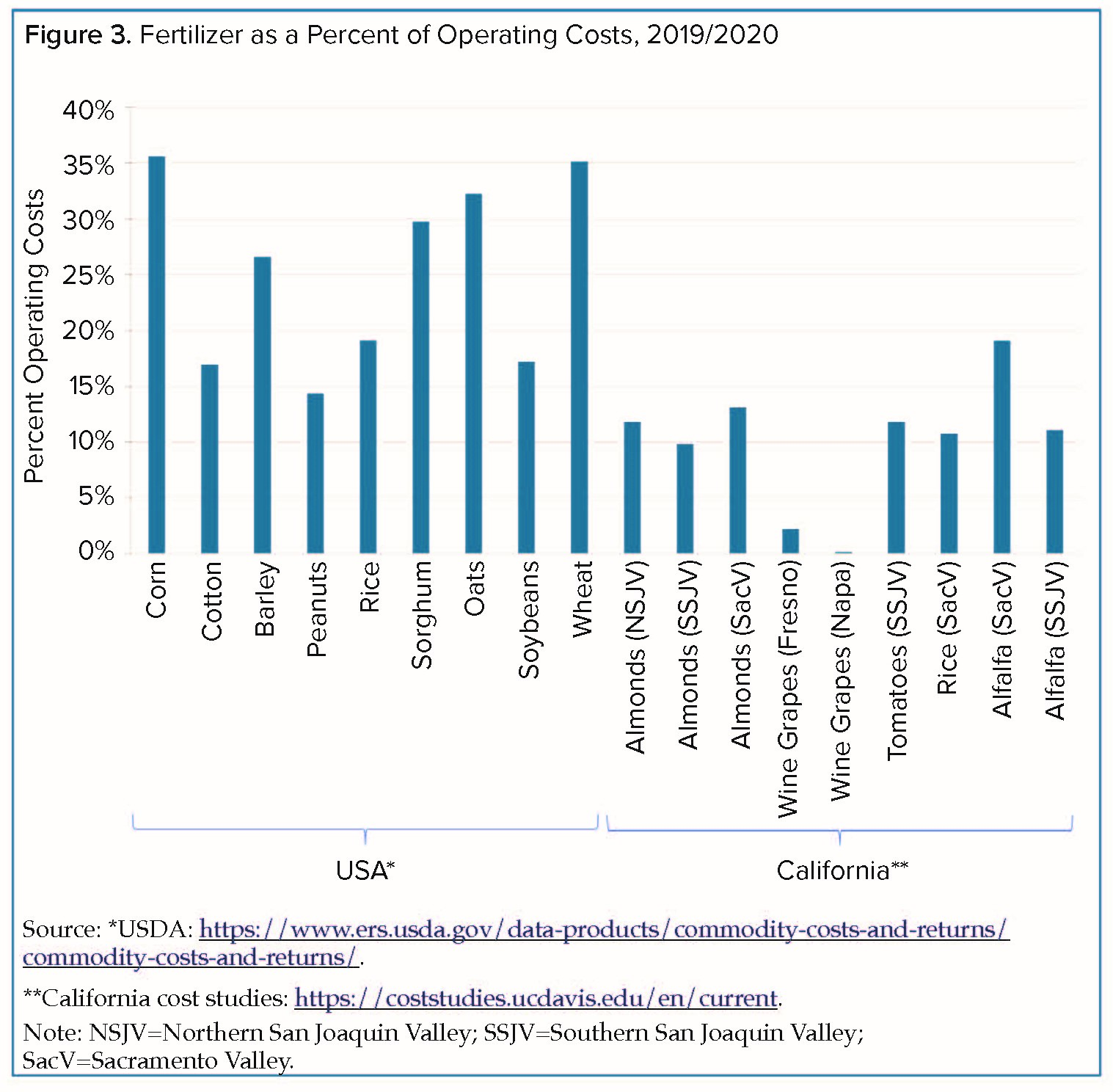
In percentage terms, fertilizer is a much smaller expense for major California crops than the major national crops. It makes up about 10% of the cost of growing almonds, less than 2% of the cost of growing wine grapes, and 11% of the cost of growing processing tomatoes.

These percentages are useful for understanding the salience of fertilizer price increases for farmers. A jump in the price of one of your largest expense items will be noticed.

However, these percentages obscure the amount of fertilizer used on each crop because major national crops such as corn are relatively inexpensive to grow. Most corn is grown without irrigation, which saves the cost of acquiring and pumping water. Corn also requires little labor, especially now that tractors practically drive themselves.

According to cost and return studies by the University of California, bearing almonds cost $3,000–$4,000 per acre per year, which is about 10 times as much as growing corn in Illinois. So, although they spend a smaller percentage of their budget on fertilizer, California almond growers spend about three times as much per acre on fertilizer as Illinois corn growers, including about 25% more on nitrogen and multiple times more on potassium.

Fertilizer Production 

Fertilizers are produced throughout the world and traded heavily between countries. Figure 4 shows that the United States currently produces about 85% of the ammonia it uses, most of which becomes nitrogen fertilizer, and it produces 90% of the phosphate rock it uses, most of which becomes phosphate fertilizer. It imports 90% of its potash.
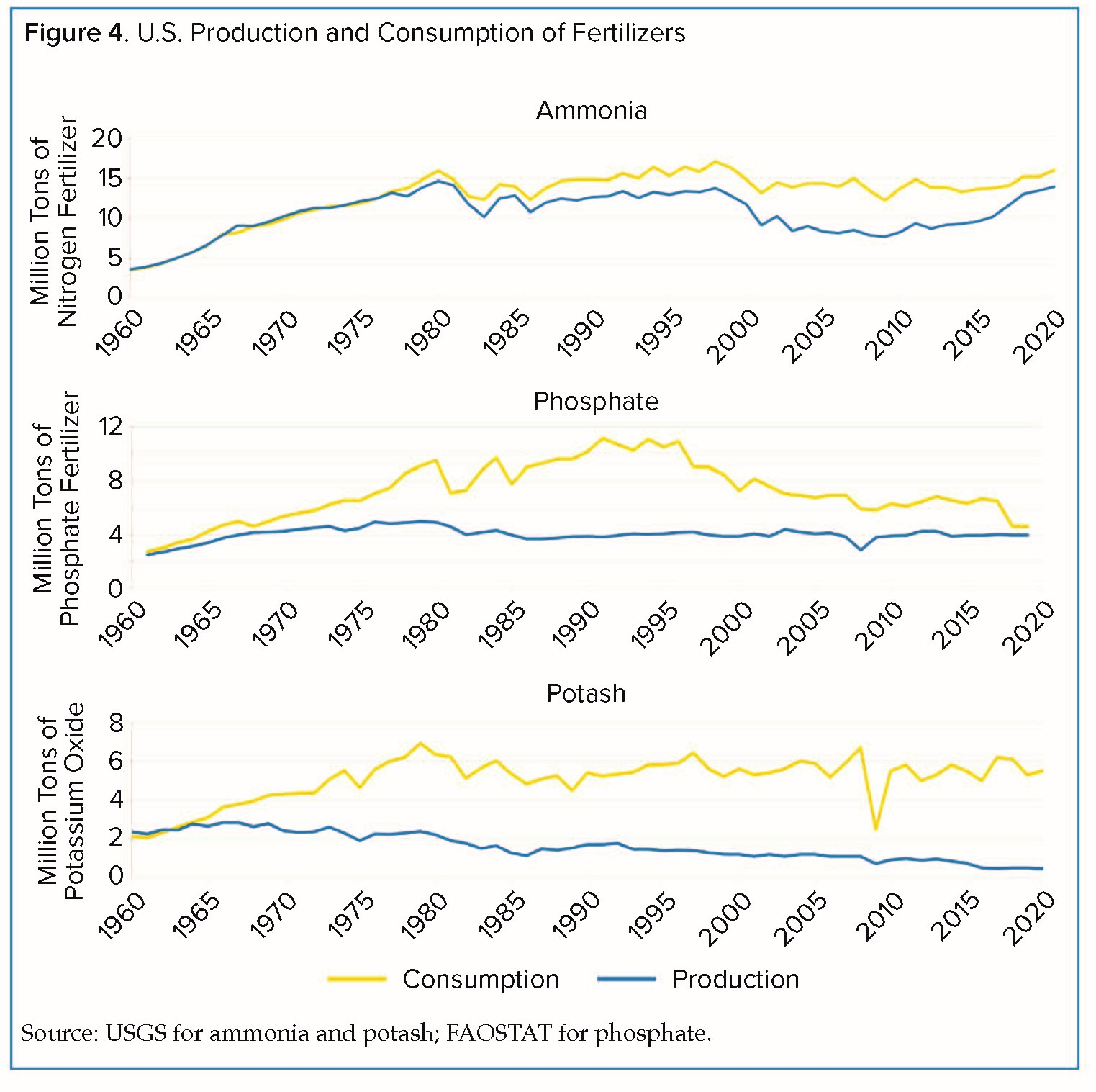
Most U.S. ammonia production capacity is in Louisiana, Oklahoma, and Texas—close to natural gas fields. Natural gas constitutes about 80% of the cost of producing ammonia. Domestic production declined substantially from 2000 to 2010, a period when U.S. natural gas prices were historically high. In the latter part of this decade, two major producers merged as part of a period of consolidation in the industry.

After 2010, the deployment of hydraulic fracturing (fracking) increased the supply of natural gas and thereby lowered the cost of production dramatically. Fertilizer prices, however, remained high in this period and U.S. firms enjoyed large margins. In the last five years, production has rebounded, as more plants were built to take advantage of cheap natural gas.

Ammonia imports have mirrored domestic production, increasing as production declined between 2000 and 2010 before declining when production rebounded after 2016. Two-thirds of U.S. imports come from Trinidad and Tobago, and most of the remainder comes from Canada.

U.S. potash production has declined by 80% since 1965. Most of the remaining U.S. production comes from deep mines in southeastern New Mexico. Most potash imports come from Canada, which is the world’s largest producer by a significant margin.

Most domestic phosphate is mined in Florida and North Carolina, although there is also some production in Idaho and Utah. U.S. phosphate production declined steadily from 1980–2019, but phosphate fertilizer use in U.S. agriculture remained relatively constant over this period.

Each year between 1980 and 2019, the  U.S. exported about half its phosphate production, mostly to Canada and Mexico. As production declined, the U.S. maintained domestic consumption by increasing imports, mostly from Morocco, Russia, and Israel. In March 2021, the U.S. International Trade Commission ruled that imports from Morocco and Russia had affected the U.S. producers adversely, and they imposed countervailing tariffs ranging from 9% to 47%.

The U.S. Geological Survey (USGS) is an excellent source for data on mineral commodities, and I use this source for ammonia and potash in Figure 4. For phosphate, USGS reports data on phosphate rock, which is the product that is extracted from mines. Production and consumption of phosphate rock shows an incomplete picture of the phosphate fertilizer market. Each ton of phosphate rock generates about 0.2 tons of fertilizer. The U.S. imports some phosphate rock, mostly from Peru, which domestic firms make into fertilizer. In addition, the U.S. imports a significant amount of phosphate fertilizer. Thus, Figure 4 presents phosphate fertilizer data from FAO rather than phosphate rock data from USGS.

Prices

So, why have prices increased? To answer this question, I consider supply- and demand-side factors.

On the supply side, U.S. natural gas prices doubled between the summer of 2020 and the end of 2021, which significantly raised the cost of nitrogen production. Energy is also a component of phosphate and potash mining costs, but it is much less important in the production of these products than for nitrogen. For this reason, the increasing price of natural gas cannot fully explain the fact that all fertilizers increased in price by a similar percentage.

Weather events also disrupted nitrogen supply, including the freeze in Texas in February 2021 and Hurricane Ida in August 2021. There were also some supply disruptions due to COVID-19. However, these events caused only a temporary reduction in production and so do not explain a sustained price increase. Moreover, these events did not hit phosphate and potash production regions.

Also on the supply side, shipping costs increased dramatically in 2021, especially on shipments from Asia to North America. However, most fertilizer imports to the U.S. come from the Americas and would be less affected by shipping costs.

On the demand side, crop prices are high. Corn, soybean, and wheat prices increased by 60% from the summer of 2020 through the end of 2021. High crop prices incentivize farmers to apply more fertilizer per acre, which would place pressure on fertilizer prices.

The high crop prices did not spur a substantial increase in acreage in 2021, and it is too early to know whether we will see an acreage increase in 2022. However, an increase in demand from farmers planning to expand acreage in response to high crop prices is a plausible factor behind rising fertilizer prices.

Conclusion 

Predicting commodity prices is a fool’s errand. When natural gas and agricultural commodity prices come down, I would expect fertilizer prices to also come down.

When the price of a pound of fertilizer exceeds the expected increase in revenue from spreading it on the field, it is not profitable to use that pound. Fertilizer prices have increased by more than most crop prices, so in 2022 producers have an incentive to apply less fertilizer per acre. If farmers do apply less fertilizer per acre, it will provide an environmental benefit in the form of less nitrogen and phosphorus in streams, rivers, and lakes.

Moreover, to the extent that farmers apply more than the recommended amount of fertilizer as insurance against low yields, reducing use in 2022 provides an opportunity to experiment and to learn how much such insurance is necessary.

 

2022-03-14T16:07:26-07:00March 14th, 2022|

Congressman Valadao Secures Funding to Improve Central Valley Communities in Annual Government Funding Bill

On Wednesday, March 9, Congressman David G. Valadao voted in support of the Fiscal Year 2022 Appropriations Package. H.R. 2471 provides $1.5 trillion in discretionary resources across the 12 Fiscal Year 2022 appropriations bills. Congressman Valadao, a member of the House Appropriations Committee, secured several wins for the Central Valley in the annual spending package.

“I came to Congress to deliver results for the Central Valley, and I’m proud that my work on this year’s annual spending bill includes direct funding for local law enforcement agencies, infrastructure projects, clean water for our communities, and Lemoore Naval Air Station,” said Congressman Valadao. “Importantly, this bill includes funding for WIIN Act water storage projects, increases national security spending, funds our police, and secures funding to address the ongoing border crisis. This is by no means a perfect bill, but it is the result of bipartisan cooperation to keep our government running and provide critical support for our communities.”

Congressman Valadao submitted several community project funding requests. The following were included in the final bill:

  • $3 million to rehabilitate 10 miles of the Avenue 95/96 Farm to Market Corridor between Terra Bella and Pixley within Tulare County to improve goods movement, shorten travel times, and improve air quality.
  • $1 million in the Department of Justice for Lemoore Police Dispatch Center project to improve response times to emergency calls and increase overall safety and security.
  • $3 million to the Community Action Partnership of Kern for the Kern Food Bank Expansion to better respond to food insecurity and provide increased support and assistance to some of the poorest communities in Kern County.
  • $3.04 million for Earlimart Public Utility District to install a new sanitary sewer line that would increase wastewater collection capacity and a well treatment improvement project to provide safer and improved drinking water to Earlimart.
  • $413,000 in the Department of Justice for Kings County Deputy Sheriffs’ Body Camera project to fund the purchase and deployment of body-worn cameras for 200 officers.
  • $3 million for Mt. Whitney Avenue Complete Streets to provide safe, walkable infrastructure by reconstructing the road and repairing curbs, gutters, sidewalks and storm drains.

Congressman Valadao was proud to back the following initiatives that were included in the bill:

  • Championing rural communities, agriculture, and water for the Central Valley:
    • $117.25 million for Bureau of Reclamation WIIN Act water storage projects.
    • Continues funding for NIFA and provides an additional $1 million for ARS to prioritize broad spectrum research for soil fumigant alternatives.
    • Language to exclude incarcerated persons from rural development populations.
    • $1.25 billion in Section 502 Direct, Single Family Housing Loans within the Rural Housing Service.
    • $28 million in Section 514 Farm Labor Housing loans under the Rural Housing Service.
    • $1.4 billion is provided for Rural Water and Wastewater Direct Loans, $50 million in guaranteed Water and Wastewater Loans, and $653 million for loan subsidies and grants within the Rural Utilities Service.
    • $490 million is provided for Water and Waste Disposal Grants, an increase of $27 million, within the Rural Utilities Service.
  • Supporting our military, law enforcement, and keeping communities safe:
    • $75.07 million for Lemoore Naval Air Station to complete Hangar 6 Phase 2, which will allow NAS Lemoore to support the mission requirements for the F-35.
    • $413,000 in the Department of Justice for a Kings County, California, Deputy Sheriffs’ Body Camera project.
    • $512 million for Department of Justice Community Oriented Policing Services (COPS) programs, including $246 million for COPS Hiring grants.
    • $674.5 million for the Department of Justice Byrne Justice Assistance Grant (JAG) program.
    • $276 million is provided for border technology, including mobile, autonomous surveillance technology, cross‐border tunnel threats, and geospatial capabilities.
    • $296.6 million of the Office of National Drug Control Policy High Intensity Drug Trafficking Areas program.
  • Supporting education and Central Valley families:
    • $11.03 billion for Head Start in the Administration for Children and Families.
    • $3 million for Migrant and Seasonal Head Start Quality funding in the Administration for Children and Families.
    • $5,835 for the maximum Pell grant award in the Department of Education.
    • $1.14 billion for the TRIO program in the Department of Education.

$14 million is provided for Education Grants for Hispanic Serving Institutions, an increase of $2.5 million

2022-03-10T09:48:49-08:00March 10th, 2022|

Pistachio Growers Unite at Industry Annual Conference

Record numbers in attendance as growers assess future challenges and opportunities

By American Pistachio Growers

The next five years for American pistachio growers presents challenges and great opportunity, prompting a call for unity at the industry’s Annual Pistachio Conference, which kicked off March 1 in Carlsbad, CA. More than 1200 attendees—an industry record–from three states participated in the conference, which kicked off with a panel of growers who discussed the next five years, as production ramps up.

A grower panel underscored three topics on growers’ minds: accelerating production of pistachios between 2022 and 2026; keeping doors open to American pistachios in key export markets like India; and ongoing pest battles. They emphasized that, while the three topics present challenges, the industry’s trade association, American Pistachio Growers , has proven efficacy in addressing each issue and there could be tremendous opportunity over the next five years with a united industry.

According to data analyzed by Sacramento economist Dennis H. Tootelian, Ph.D., California growers will produce 6.9 billion pounds of pistachios over the next five years, 2.4 billion more than they produced in the previous five-year period from 2017-2021. APG, as the trade association representing the U.S. industry, has kept pace with building consumer demand for the increased volume in recent years in targeted export markets, which he says has helped to support grower pricing in the face of rapid production. Tootelian showed that in countries where APG focused their marketing efforts, exports have grown 36% a year compared to 17% in countries with no APG marketing emphasis.

Tulare County grower Dominic Pitigliano, past Chair of APG and a grower panelist, said, “Ten years ago, APG identified the export markets with the greatest growth potential and our intense focus on those markets has paid off in building consumer demand.” 

The grower panel discussed India as a prime growth market for U.S. pistachios where continued marketing could boost opportunities in the years ahead. India possesses the market conditions necessary for a growth market — rising population, growing per capita income, and increasing consumption of pistachios.

Tootelian projects that in 2022 consumers in India will consume 272,000 pounds of pistachios per day, and by 2026, they will be buying 410,000 pounds per day.  

APG, which is funded by assessments from growers and government grants, has leveraged those dollars to boost exports and address impediments to trade in the form of tariffs and nontariff barriers. The grower panel underscored the importance of having APG continue to play a strong role to keep the door open in India.

“APG packs a one-two punch in export markets,” said APG Chair, Dennis Woods. “Getting tariffs reduced or eliminated is the first step, followed by marketing programs that enlighten consumers about the health benefits of American pistachios. The strategy works as long as we all work together,” noting the organization has 64 dedicated growers from three states who volunteer on the APG Board and committees. 

While marketing ever larger crops will command the industry’s attention in coming years, so too will challenges that come from the surge in pistachio orchards in California. The Navel Orangeworm (NOW), the major pest threat to pistachios, has been fought with a plethora of tools —- costly inputs, winter sanitation programs, and mating disruption techniques. Tootelian estimated that growers will spend $1.8 billion in total NOW management costs in the next five years.

APG has led the industry effort to use a novel tool in the fight against NOW — a U.S. Department of Agriculture facility in Phoenix that rears sterile Navel Orangeworm moths for aerial distribution over a few thousand acres of pistachios and almonds in Kern County. APG helped to secure $8 million in federal funds for the pilot project, but the USDA has recommended an additional $21 million per year to expand the project. The Phoenix facility was instrumental in rearing sterile pink bollworm moths that led to the successful eradication of the cotton pink bollworm in California in 2018. 

“I know at the very least we can suppress Navel Orangeworm because we had similar success in the cotton industry,” said Ted Sheely, a pistachio and cotton grower who chairs the NOW Action Committee, the industry advisory committee that government requires in such situations. “We need to continue to push hard for the $21 million per year that will be required to keep the Arizona facility going and expand the program to the extent that we need it. Navel Orangeworm
is an industry-wide concern, and we need APG to secure the funding to support this program.”

“APG’s leadership has envisioned the future and how we should position the industry for success,” said APG President Richard Matoian. “As the industry’s trade association, we need every grower to participate in APG in order to fund our ability to make our future plans reality. We’ve done a good job so far, and we’re optimistic about the next five years.”

2022-03-03T10:46:35-08:00March 3rd, 2022|

Grape Experts Give Workshops on Drought Preparedness, Red Blotch

By UCANR

Grapevine Drought Preparedness Workshop

Grape growers and other industry members interested in grape production and water management in vineyards are invited to UC Cooperative Extension’s Grapevine Drought Preparedness Workshops.

The workshops will be held in person on Friday, March 4, in San Luis Obispo and Friday, April 1, in Hopland.

Registration is $50 and includes a full day of live instruction from UC Cooperative Extension viticulture and grapevine experts. Lunch will be provided.

For more information and to register, visit https://ucanr.edu/sites/ShortCourse17.

UC Davis Grapevine Red Blotch Disease Symposium

On Wednesday, March 16, UC Cooperative Extension and the UC Davis Department of Viticulture and Enology will host a Grapevine Red Blotch Disease Symposium 9 a.m.-3:30 p.m.

Red blotch disease in grapevines, which can dramatically reduce the value of winegrapes, harms plants by inhibiting photosynthesis in the leaves. Infected vines are unable to conduct water effectively, leaving sugar that is created by photosynthesis stuck in the leaves instead of in the berries.

This event will be presented both in person at the UC Davis Conference Center and livestreamed for those unable to attend in person.

Presentations will cover the role of treehoppers, treatments, mitigation strategies, the impact of the disease on the composition of wine, and more.

Registration is $250 for the in-person symposium at UC Davis and $150 for the livestream. An application for 3.5 CCE units has been submitted to California Department of Pesticide Regulation and is pending approval.

To see the agenda and to register, visit https://wineserver.ucdavis.edu/events/uc-davis-grapevine-red-blotch-disease-symposium.

2022-02-24T09:14:03-08:00February 24th, 2022|

Westlands Water District Statement on Initial CVP Water Allocation

Today the Bureau of Reclamation announced an initial allocation of 0% for Westlands Water District and other south-of-Delta Central Valley Project (CVP) irrigation contractors. This is the fourth time in the last decade the south-of-Delta irrigation contractors have received a 0% allocation. Despite significant precipitation in the fall and early winter, the 2021-22 water year is likely to be classified as dry. January and February were exceptionally dry. The District is disappointed with the allocation but is aware that hydrologic conditions, including low CVP reservoir storage conditions at the beginning of the water year and record low precipitation in January and February, and Reclamation’s obligation to meet Delta water quality and outflow standards imposed by the State Water Resources Control Board, prevent Reclamation from making water available under the District’s contract.

Within Westlands, the continued drought conditions in 2021 resulted in over 200,000 acres fallowed, countless lost jobs, and thousands of acres of food unharvested. The circumstances in 2021 and those facing us in 2022 demonstrate the need invest in infrastructure to better manage the State’s water resources, which includes increased capacity to capture water when its available for transport and use in times of drought. California needs new storage, both surface and groundwater, and improved conveyance facilities. The state must also establish effective water policies that enable adaptive management of the system to maximize the beneficial uses of water throughout the State. Despite the current lack of precipitation, the District is focusing on comprehensive approaches to ensure a sustainable water future.

In spite of the current drought, the District continues to plan, pursue, support, and implement regional and local projects to ensure a sustainable water future for the families that live and work in and around the District. And, as always, the District will look to the coming months with the hope of improved precipitation and an increased allocation.

2022-02-23T12:21:51-08:00February 23rd, 2022|

Congressman Valadao Statement on Bureau of Reclamation’s Central Valley Project Initial 2022 Water Allocation

Today, Congressman David G. Valadao released the following statement in response to the Bureau of Reclamation’s (Reclamation) initial 2022 water allocation announcement for Central Valley Project (CVP) contractors. Reclamation announced an initial allocation of 0% for South-of-Delta agricultural repayment and water service contractors. They also announced an initial allocation for Municipal and Industrial repayment and water service contractors of only 25% of their historic use.

“This unacceptably low water allocation is a devastating blow to small community agricultural producers throughout the Central Valley. The livelihoods of these people and our global food supply depend on the industry,” said Congressman Valadao. “The Central Valley farming community has endured drought conditions, burdensome regulations, and below adequate water allocations for years. This community is resilient, but the fact remains that our farms will not survive without a reliable water supply for South-of-Delta agriculture. This dire situation emphasizes the need for more storage capacity so we can capture water when we have surplus. California’s water supply allocations must reflect the needs of these farmers and producers so they can continue providing food for the nation. This is alarming and unwelcome news to communities that have continued to suffer from issues like the ongoing supply chain crisis.”

Central Valley agriculture contractors rely on meaningful allocations from Reclamation for their yearly planning. Central Valley farmers and communities have endured disproportionately low water allocations for many years, with contractors receiving well below their contracted supply even during wet years. As a lifelong dairy farmer, Congressman Valadao has experienced firsthand the challenges and frustrations surrounding this issue. He has consistently called for CVP allocations to reflect the needs of the agriculture community, the backbone of the Central Valley economy. Read more on Congressman Valadao’s work on California water issues here.

2022-02-23T11:38:17-08:00February 23rd, 2022|

Almond Board of California Announces 2022 Elections

By Almond Board of California

Elections for the Almond Board of California (ABC) Board of Directors have kicked off for the 2022-2023 crop year with the call to all candidates to file their petitions or declarations of candidacy by April 1, 2022.

There are two independent grower positions and one independent handler position on the ABC Board of Directors to be decided in voting that starts April 21 and ends May 26. Alternate seats for those spots are also open.

To be considered for an independent grower or alternate seat, candidates must be a grower and must submit a petition signed by at least 15 independent almond growers (as verified by ABC). Independent handler and alternate candidates must declare their intention in writing to ABC.

All petitions and declarations must state the position for which the candidate is running and be filed by mail with ABC at 1150 9th St., Suite 1500, Modesto, CA 95354. The deadline for all filings is April 1. Potential candidates who’d like more information can contact Toni Arellano at tarellano@almondboard.com.

“The ABC Board of Directors is such an important and vital part of our industry,” said ABC president and CEO Richard Waycott. “It guides the work of the Almond Board and is key to overseeing the welfare of the industry and of more than 7,600 growers and 100 handlers.”

The ABC board sets policy and recommends budgets in major areas, including marketing, production research, public relations and advertising, nutrition research, statistical reporting, quality control and food safety.

Getting involved provides an opportunity to help shape the future of the almond industry and to help guide ABC in its mission to promote California almonds to domestic and international audiences through marketing efforts, funding and promoting studies about almonds’ health benefits, and ensuring best-of-class agricultural practices and food safety.

ABC encourages eligible women, minorities and people with disabilities to consider running for a position on the Board of Directors to reflect the diversity of the industry it serves.

2022-02-18T08:33:15-08:00February 18th, 2022|

Real California Milk Spotlights Foodservice Innovation With 2022 Events For Professional Chefs

4th Annual Pizza Competition, CADairy2Go and Cal-Mex Invitational Events Showcase On-Trend Recipes and Techniques Using Real California Cheese and Dairy Products

By California Milk Advisory Board

The Foodservice Division of the California Milk Advisory Board today announced the kickoff date for the 4th Annual Real California Pizza Contest, the return of the CADairy2Go competition and the rollout of a new culinary event focusing on Cal-Mex to round out its foodservice events for 2022.

The 4th annual Real California Pizza Contest, a search for the best pizza recipes using cow’s milk cheeses from California, gets underway on March 1st. Professional chefs and pizzaiolos from throughout the U.S, can enter their innovative recipes from March 1 through April 24, 2022, for a chance to make it to the bake-off final on June 22, 2022, in Napa, Calif. and compete for up to $25,000 in prize money.

The CADairy2Go Invitational is inspired by chefs and foodservice operators who made quick, creative pivots to adjust their menus for the takeout and delivery model during the disruption caused by the pandemic. Now in its 2nd year, the event will feature culinary professionals representing a variety of foodservice backgrounds, such as major restaurant chains, independent restaurants, ghost kitchens and food trucks who will gather in October to compete for a chance at up to $5,000 for their innovative To-Go recipes.

The inaugural Cal-Mex Invitational, scheduled for August, captures creations from chefs who specialize in the culinary and flavor fusion of California and Mexican cuisines.

“Cheese is at the heart of culinary innovation – from creative pizzas to flavorful to-go and fusion dishes. As the leading producer of Hispanic-style cheese and dairy products, we’re excited to add the Cal-Mex Invitational to our foodservice outreach program and to see what the chef’s develop,”

said Mike Gallagher, Business and Market Development Consultant for the CMAB. “These competitions offer a tremendous opportunity to partner with culinary professionals to spotlight their creativity using our sustainably sourced Real California dairy products.” 

California is a reliable, consistent source of sustainable dairy products used by chefs throughout the world. As the nation’s largest dairy state, California boasts an impressive lineup of award-winning cheesemakers and dairy processors, that are helping to drive dining innovation.

California leads the nation in milk production and is responsible for producing more butter, ice cream and nonfat dry milk than any other state. The state is the second-largest producer of cheese and yogurt. California milk and dairy foods can be identified by the Real California Milk seal, which certifies they are made with milk from the state’s dairy farm families.

2022-02-16T08:56:00-08:00February 16th, 2022|

Western Ag Processors Association’s Priscilla Rodriguez Completes Prestigious Ag Leadership Program

By Western Agricultural Processors Association

A journey began on October 10th, 2019 that lasted for more than 27 months, and finally came to a conclusion for the Association’s Director of Regulatory Affairs, Priscilla Rodriguez, on February 5, 2022.

This journey covered a span of more than 27 months, and included meetings that covered more than 125 days, not including travel and study time. It included trips to Atlanta, GA, and Washington, DC, as well as Germany, Poland and the Czech Republic. Rodriguez was one of 24 members of the historic Class 50 of the California Agricultural Leadership Foundation program who completed their program where it began at California State University – Fresno on February 5th.

Disrupted by the Covid Pandemic, but not deterred, Class 50 weathered the storm to complete their program this past month. Rodriguez had the distinct honor addressing the commencement for Class 50 by giving the opening speech. In her comments, she began by stating “We started this program as strangers, quickly became friends and ultimately family. The bonds and friendships created through the program will continue on for years to come. We may all have different stories, but one thing is true for all of us. This program made a lasting impact through the books we read, people we met and the unforgettable experiences we lived.” She ended her opening remarks by encouraging her classmates “As we move forward in our lives, I challenge us to continue to be open minded, inquisitive, empathetic, passionate, resilient, and grateful, and leave your impact on your families, communities, ag industry, and the world.”

Truly words to live by, not just for her colleagues, but for all of us.

Association President/CEO Roger Isom remarked after the event, “Priscilla was made for the CALF program and the CALF program was made for her. The Association is incredibly proud of her for this accomplishment and her speech is indicative of her growth, and just the type of leader she has started to become.  The Association and the agricultural industry are lucky to have her.”

2022-02-15T09:21:55-08:00February 15th, 2022|

Applications Available for California Ag Leadership Program’s Class 52

By California Agricultural Leadership Foundation 

Applications are now being accepted for Class 52 of the California Agricultural Leadership Program (CALP). Applicants should be mid-career growers, farmers, ranchers and/or individuals working in other areas of California’s diverse agriculture industry.

The Ag Leadership Program, operated by the California Agricultural Leadership Foundation (CALF), is considered to be one of the premier leadership development experiences in the United States. More than 1,300 men and women have participated in the program and are influential leaders and active volunteers in agriculture, communities, government, business and other areas.

“As we open the application process for Class 52, we are committed to selecting a group of fellows who represent California’s large and very diverse agriculture industry,” said CALF President and CEO Dwight Ferguson. “Our unique curriculum, personalized coaching and a dedicated focus on lifelong learning enables us to produce leaders who benefit their communities, their companies and California agriculture as a whole.”

The 17-month fellowship focuses on mid-career professionals who have a high capacity to lead, a passion for California agriculture and an interest in self-growth and seeing their communities thrive. The program includes approximately 55 days of formal program activities. Four partner universities—Fresno State, UC Davis, Cal Poly San Luis Obispo and Cal Poly Pomona—deliver comprehensive, diverse and high-impact curriculum designed to improve leadership skills. As a valuable extension to the monthly seminars, fellows participate in national and international travel seminars and receive individualized leadership development coaching.

CALF invests more than $50,000 per fellow to participate in the Ag Leadership Program. The costs are underwritten by individual and industry donations. Candidates are strongly encouraged to talk with Ag Leadership alumni about the program and to attend an informational event. All events will adhere to state and local guidelines for safety and health. 

Detailed program information and the phase one application are available online at www.agleaders.org/apply. Phase one of the three-phrase application process is due no later than April 27, 2022. Individuals are encouraged to complete the application as soon as possible.

2022-02-14T15:30:22-08:00February 14th, 2022|
Go to Top