Regulations

Breaking News: Contracted Contractual Water Deliveries Could Plummet

Breaking News: 

Promised Water Deliveries Could Plummet

Delta Smelt Among Many Reasons for Pumping Constraints

By Emily McKay Johnson, Associate Editor

Farmers in the federal water districts of Fresno and Kings Counties were granted only five percent of their contracted water this year; yet they are at risk of getting even less due to pumping constraints. Jason Peltier, executive director of the San Luis & Delta-Mendota Water Authority, a Los Banos-based federal water district explained, “The original forecast had full pumping in June, July, August, and September.

“Because of the temperature constraints and because of the water quality standards,” Peltier stated, “we’ve been operating only one or two pumps. There’s just not enough water flowing south to meet the U.S. Bureau of Reclamation’s (Reclamation) obligations to the exchange contractors, the [wildlife] refuges and the urban agencies, along with the 5% allocation to the ag services contractors,” he noted.

SLDMWAPeltier is concerned for those in the Central Valley, and water agencies are working frantically to find answers. “We’re working on it,” Peltier affirmed. “We’ve got a lot of engineers and operators preparing spreadsheets and analyzing both the variables and what changes could be made to avoid lower water levels at San Luis Reservoir.”

Commenting on this year’s deliveries, Peltier stated, “No doubt we’re in an unprecedented operating environment. Here we are, eight months into the water year, and we just got a temperature plan for Lake Shasta—that is driving the whole operation—the project. Limiting releases like they are in the temperature plan [designed keep the water cold to protect winter-run salmon eggs]at least we thoughtwould allow Reclamation to hold the commitments they made. But we’re on razor’s edge right now,” Peltier explained.

Peltier described how the process is holding up water release, “The National Marine Fisheries Service wants to keep as much water in storage as possible, in order to keep the cold water cool as long as they can. This is all to protect the winter-run salmon eggs that are in the gravel right now, protect them until the weather turns cool and things naturally cool down. Then they can release water. Shasta’s been effectively trumped by another million-acre feed because of this temperature plan.”

Peltier further noted that the Lake Shasta temperature plan has not allowed water to flow into the Sacramento River. It has severely impacted growers in Northern California on a year when the northern part of the state received above average rain and snowfall during the winter.

“People diverting off the river in the Sacramento Valley have had their own water level issues. There hasn’t been enough water coming down the river to get elevation enough adequate for their pumps. There’s been a lot of ground water pumping,” he said.

The nearly extinct Delta Smelt has been a longstanding issue for those affected by California’s drought. After the past five years of sacrifice, even more water is being taken from agriculture and cities to help save the fish from extinction.

“We’ve got the California Department of Fish and Wildlife wanting significant increases in delta outflow over the summer, supposedly for the benefit of delta smelt, another operational complexity that is sadly not based on any science that we could see. The agencies have their beliefs, and they have the power,” said Peltier.

Featured photo: Jason Peltier, executive director of the San Luis & Delta-Mendota Water Authority.


California Ag Today will update readers on Bureau of Reclamation announcements about the 5% contracted water delivery federal water district growers were expecting.

2021-05-12T11:05:53-07:00July 12th, 2016|

Jasieniuk on Weed Evolution

Tracking Herbicide Resistance in Weed Evolution  

By Emily McKay Johnson, Associate Editor


Marie Jasieniuk, professor and weed scientist at UC Davis College of Agricultural and Environmental Sciences, discussed her groundbreaking research, “I work on the population genetics and evolution of agricultural weeds and invasive plants,” she said. “We use molecular tools to look at the origins and spread of weeds. We also use molecular tools and genetic studies to understand the evolution of herbicide resistance in weeds,” Jasieniuk added, “to be able to propose management approaches that reduce the likelihood of further evolution and spread of resistant weeds.”

UC Davis Annual Weed Day 2016

UC Davis Annual Weed Day 2016

Jasieniuk and her team identify the origins of invasive plants, and determine how they were introduced. “We study how they were introduced, how they have spread and whether they have been introduced multiple times. Again, if we understand how they’re spreading, we can do something to try to stop the spread,” she said.

Italian rye grass, a weed Jasieniuk is currently studying, is problematic because it is resistant to Roundup, a popularly used weed and grass killer by growers. “UC ANR Cooperative Extension specialist, now emeritus, Tom Lanini, and I sampled over 100 locations of Italian rye grass and tested them for resistance to Roundup ten years ago,” she said about the project, funded by USDA. “Last year, we re-sampled all of those sites, and we’re re-testing to see if there’s been an increase or a decrease or no change in resistance to glyphosate, to Roundup,” she said.

Roundup isn’t the only weed and grass killer available on the market. “We’re looking at resistance to three other herbicides,” she said. Working with growers to determine the most efficacious weed treatments that also reduce the likelihood of wood resistance to herbicides,” Jasieniuk explained, “We interview growers about their herbicide use, non-chemical approaches, and integrated management techniques to identify management practices that correlate highly with low or no resistance,” she explained.

Resistance management is found to be more effective with a rotation of various herbicides. “What you want to do is rotate different types of herbicides with different modes of action,” Jasieniuk said. “Perhaps do tank mixes and incorporate non-chemical approaches as well,” she added.

Eliminating weeds can be as simple as disking and digging them out with a shovel when there are only a few. “I think, in many cases, this would have done a lot to prevent new weeds from coming in and certainly resistant weeds from spreading,” she noted.

2021-05-12T11:05:53-07:00July 11th, 2016|

BREAKING NEWS: California Water Authorities Sue U.S. Bureau of Reclamation

The following is a joint statement by Jason Peltier, executive director of the San Luis & Delta-Mendota Water Authority and Tom Birmingham, general manager of the Westlands Water District on today’s filing of a lawsuit to compel the U.S. Department of the Interior, Bureau of Reclamation to reassess its Endangered Species Act (ESA)-related actions.

U.S. Bureau of Reclamation Fails to Consider the Environmental Impacts of Biological Opinions Which Have Been Devastating Communities

FRESNO, CA-TODAY the San Luis & Delta-Mendota Water Authority (SLDMWA) and Westlands Water District (WWD) filed a lawsuit in federal court to compel the U.S. Bureau of Reclamation (“Reclamation”) to examine the effectiveness of the existing measures intended to protect endangered species, the environmental impacts of those measures, and whether there are alternatives to those measures that would better protect both endangered fish species and California’s vital water supplies.

San Luis & Delta-Mendota Water Authority The existing measures, adopted in 2008 and 2009, are based on biological opinions issued under the Endangered Species Act.  The measures are responsible for the largest redistribution of Central Valley Project and State Water Project (water supplies away from urban and agricultural uses and have jeopardized the water supply for waterfowl and wildlife refuges.  Since 2008 and 2009, the farms, families, cities and wildlife that depend upon Central Valley Project and State Water Project water supplies have suffered substantial environmental and socio-economic harm from the reduced water deliveries caused by the existing measures, with little apparent benefit for fish.

Reclamation adopted the existing measures without any review under the National Environmental Policy Act (NEPA).  Federal courts, including the United States Court of Appeals for the Ninth Circuit, held this action violated NEPA, and Reclamation was ordered to perform environmental review.  The Ninth Circuit Court of Appeals wrote:

It is beyond dispute that Reclamation’s implementation of the Biological Opinions (BiOp) has important effects on human interaction with the natural environment.  We know that millions of people and vast areas of some of America’s most productive farmland will be impacted by Reclamation’s actions.  Those impacts were not the focus of the BiOp….  We recognize that the preparation of an Environmental Impact Assessment (EIS) will not alter Reclamation’s obligations under the ESA.  But the EIS may well inform Reclamation of the overall costs – including the human costs – of furthering the ESA.

The court-ordered review provided Reclamation a rare opportunity to reexamine the necessity for and the benefits of the existing measures, as well as the resulting impacts on the environment and water supplies, potential alternative measures, and new information and studies developed since 2008 and 2009.  It provided Reclamation an opportunity to make a new and better-informed choice.

Unfortunately, Reclamation neglected to take advantage of that opportunity. In November 2015 Reclamation completed an EIS that did not examine whether the measures are necessary or effective for protecting endangered fish populations.  Instead of analyzing the existing measures, Reclamation accepted them as the status quo.U.S. Bureau of Reclamation

The EIS did not identify any mitigation for the water supply lost to these measures, despite current modeling that estimated how the existing measures would reduce the annual water delivery capabilities of the Central Valley Project and State Water Project. Loss was estimated to be over 1 million acre-feet on a long-term average and in spite of years of harm caused by implementing the measures.

Nor did the EIS try to identify alternatives that could lessen these impacts.  Reclamation attempted to minimize the impacts of lost surface water supply by unreasonably assuming the lost supply would be made up from increased pumping of already stressed groundwater supplies.  In its Record of Decision issued January 11, 2016 Reclamation announced that it would continue on with the existing measures, and provide no mitigation.

It is inexplicable that Reclamation would pass up the opportunity to reassess the existing measures and make a much more careful and robust analysis than what is found in the EIS.  NEPA requires no less.

The lawsuit filed today seeks to compel Reclamation to do the right thing and perform the analysis it should have.  If successful, the lawsuit may ultimately result in measures that actually help fish, and identify mitigation activities or alternatives that lessen or avoid water supply impacts that millions of Californians in the Central Valley Project and the State Water Project depend on.

Many of those affected reside in disadvantaged communities and are already struggling to pay for a water supply made scarce by layers of other, yet equally ill-advised bureaucratic regulations.  California’s water supply is too precious for Reclamation not to make the best informed decision it can.

2021-05-12T11:00:52-07:00July 8th, 2016|

Duarte Nursery Loses Battle Against Army Corps Of Engineers

Ruling in Favor of Army Corps is Game Changer for Agriculture

By Patrick Cavanaugh, Farm News Director and Laurie Greene, Editor


Startling California family farmer, John Duarte, president of Duarte Nursery, Inc., his attorneys, and others who have also kept a close watch on the case, Duarte was dealt a serious blow recently in the biggest fight of his life—the right to farm his own property. This legal outcome may portend a game changer for American agriculture as a whole.


Background

Duarte Nursery and the U.S. Army Corps of Engineers (Army Corps) have been engaged in a long legal dispute over private property rights since the family purchased a 450-acre agricultural property in Tehama County in 2012 and planted wheat that fall.

As reported in, “Duarte Farmland Under Siege,” (California Ag Today, March 11, 2016), John Duarte recalled, “The property is in some slightly rolling grasslands, and has some minor wetlands on it, vernal pools, vernal swales. Like most grasslands, wheat areas and wheat plantings, we had a local contractor go out and plow the field for us, 4-7 inches deep, and we flew on some wheat seed for a winter wheat crop in 2012.”

The U.S. Army Corp of Engineers accused the farm of “deep ripping” the property (three feet deep), “which we were not,” Duarte said. Legal action ensued with the Army Corps issuing a cease and desist notice in early 2013, according to Duarte, without evidence or basis for their accusation. Duarte Nursery attorneys, under the Freedom of Information Act, requested evidence of deep ripping, the assumption that apparently warranted a cease and desist notice.

Without responding, according to Duarte, the Army Corps sustained the cease-and-desist notice without a hearing and without evidence. “They obstructed our farming operations indefinitely,” Duarte said in March 2016.


Current Scenario

Duarte’s attorneys are now scrambling to prepare and file appeals to Eastern District Federal Court Judge Kimberly Muller’s June 10 ruling that by plowing his land to grow wheat, Duarte could pollute vernal pools on his land, violating the Clean Water Act.

Pacific Legal FoundationOn behalf of Duarte Nursery, Pacific Legal Foundation attorneys have moved for reconsideration or certification for immediate appeal on several Clean Water Act issues. “We expect a decision from the court any day on this motion, which will determine whether Duarte Nursery can immediately address the trial court’s legal errors in the appellate court, or will have to go through a trial first on whether the government is entitled to a penalty.” (Source: “Duarte Nursery seeks immediate appeals in Clean Water Act case,” Tony Francois, Pacific Legal Foundation, June 30, 2016)


Reaction to the Ruling

California Farm Bureau Federation and Pacific Legal Foundation attorneys had great confidence that Duarte would be vindicated in the action brought by the Army Corps several years ago. “They are just astounded,” Duarte said. “I thought we might have to go to trial on some of our issues, but I did not think we would lose our issues and have the judge rule against us on the other side,” he said.

Duarte clarified, “We are talking about farming activity that only occurred on rolling land—land with dismal vernal pools and flails.” Duarte noted there is no controversy as to whether this tillage was four to six inches deep. “Both sides agreed this is four to six inch deep tillage. Both sides agree that this property had farmed wheat before,” he said.


Legal Implications

“The Army Corps’ position is they don’t know how long is too long, but at some point if you haven’t farmed wheat, you lose your ability to continue farming wheat,” Duarte continued. “As it is a rangeland, you cannot plow your ground without a permit from the Army Corps, which they’re not going to grant because there are wetlands,” he said.

John Duarte, president of Duarte Nursery.

John Duarte, president of Duarte Nursery.

“All of the Food Security Act protections for farming—our ability to idle ground and then bring it back into production—to ensure available food production resources—are gone,” Duarte said. “This is a very extreme ruling. It’s extreme of the law in a lot of different ways. It’s a game changer for agriculture. We’re meeting with Paul Wenger, the president of the California Farm Bureau and seeing what they want to do. I think it’s on a lot of folks’ radar,” said Duarte.

“According to the Clean Water Rule definition of “Waters of the United States” (WOTUS), everything is a wetland and farmers are not exempt,” Duarte stated. “Any tillage that the Army Corps, by their own standards, does not deem to be an ongoing agricultural operation, farmers have liability. Their settlement discussions were in the $5 million to $6 million range, and we’re talking about shallow tillage through vernal pools that covered maybe fourteen or sixteen acres over this property. We can show that those vernal pools are completely intact,” noted Duarte.

Duarte noted that consultants have been at the land to inspect the vernal pool wetlands that concern the Army Corps of Engineers, and have confirmed that all the biology has been restored. “It’s all wetland plants across the vernal pools. They’re not topographically damaged,” said Duarte. “We didn’t re-contour them, we didn’t till them, we didn’t grade them, we didn’t deep rip them such that the restrictive layers of soil no longer perched water—none of that,” he emphasized.


A Game Changer for Ag

“Every property owner should be concerned,” Duarte warned. “Basically, what they’re saying is if wheat is profitable for a window of time because of whatever market or geopolitical reasons, you can farm wheat. If you stop farming wheat for a decade because it’s not profitable, or because you have a lease with a cattleman who’s paying you decent money, or you just don’t have the capital to plant wheat, or you just don’t want to plant wheat, then you will lose the right to farm it in the future. You cannot adjust your farming enterprises to the markets or to your business plans or you will lose your right to farm.”

Duarte believes that the ultimate goal of the Army Corps of Engineers is to be able to tell you what you can and can’t do with your land on any given day. “They want simple control over how you use your property and discretion over what property is put into permanent habitat and what property remains rangeland. They do not believe that private landowners have any inherent right to farm their property to meet market demands.”

As for the ruling, Duarte said he plans to appeal it. “This ruling is in many ways right in the face of several completions that have come down in court last week,” he said. “A lot of this ruling hinges on the opinion in Rapanos v. United States, where senior Associate Justice of the Supreme Court of the United States Anthony Kennedy said wetlands either have to be navigable waters of the United States or tributaries or related.

As summarized in, “The Practical Application of the Significant Nexus Test: The Final Waters of the US Rule,” (by Lowell M. Rothschild, National Law Review, June 8, 2015):

The significant nexus test requires a determination of whether the water in question – alone or in aggregation with other similarly situated waters in the region – significantly affects the chemical, physical or biological integrity of a traditionally navigable or interstate water or the territorial sea (with “significant” meaning “more than speculative or insubstantial.”). The “region” is the watershed that drains to the nearest traditionally navigable or interstate water or the territorial sea, and waters are “similarly situated” when they function alike and are sufficiently close to function together in affecting downstream waters.
supreme court building

“That was one judge, who had none of the other eight judges agreeing with him,” said Duarte. Nevertheless, Duarte said Justice Kennedy was not correct. “We had four judges that said navigable is navigable. If the Clean Water Act says it exempts, it defines what jurisdictional waters are navigable waters in the United States, and then it defines what jurisdictional waters are. If you look in the Clean Water Act, it says that plowing shall never result in a discharge into waters of the United States,”  said Duarte.

“The language in the exclusion of the Clean Water Act is very clear. What this case tells us is that no regulatory legislation can be created with language that is durable to give private parties any protection with the government,” Duarte explained. “There’s no language clear enough that over time will be undermined by agency rule making and judges that give American public any protection against the government.”

“I don’t know how we will solve problems legislatively in the future,” he remarked. “I don’t know that any responsible Congress can pass a law that restricts activity, no matter what the protections,” Duarte said, clearly frustrated. “The Clean Water Act’s protections are incredibly clear. It is not badly worded. The protections are in there. The protections are careful; they’re clearly articulated; they’re very strong, and they’re completely obliterated,” he said.

Duarte is disappointed and has a long way to go in the appeals process. “All I can say is: Warning to all farmers across the land—this is what can happen. We’re just not strong enough, nor is it right for us to carry this entire thing; my family has already spent $1.5 million defending this case, and it’s likely to go to $2 million. We are going to be looking for help.”

___________________

2016-07-23T17:16:17-07:00July 7th, 2016|

Temperance Flat Dam Brings Five Valley Counties Together

Key July 1 Signing Ceremony to Launch Temperance Flat Dam Process

by Patrick Cavanaugh, Farm News Director

Mario Santoyo, executive director of the San Joaquin Water Infrastructure Authority (SJWIA), which represents the five-county joint powers of authority in the Central San Joaquin Valley, has announced an important event will launch the process needed for Temperance Flat Dam: the Temperance Flat Project Partnership Agreement Signing Ceremony outside Old Fresno County Courthouse overlooking Millerton Lake at 10 a.m. sharp on Friday, July 1, 2016.

USBR Water“This is a major event, a significant milestone in terms of the process to get Temperance Flat Dam built.” Santoyo said. “In essence, it is a partnership between the new joint powers of authority and the U.S. Bureau of Reclamation, and, more specifically, their study team who worked on the technical studies and the feasibility reports for Temperance Flat.”

Merced, Fresno, Kern, Kings and Tulare Counties are joining forces with leaders of cities, Tribes, and other agencies to begin this significant move towards building the Temperance Flat Dam. “Working together, we are going to put the application together and submit it to the California Water Commission for their consideration for funding through Proposition 1, Chapter 8,” Santoyo said.  “It’s a solid statement that needs a signature.”

“It’s a memorandum of understanding between the Bureau of Reclamation and the joint powers of authority,” he said, “that defines the scope of work. In essence, it’s full cooperation between their technical people and our joint powers of authority. Our people are tailoring the application to the state to optimize funding. Keep in mind, we’re talking big dollars here; we are not talking a million or a hundred million; we are talking a billion.”

Temperance Flat Dam would create nearly 1.3M acre-feet of new water storage, according to the SJWIA, 2.5 times the current capacity of Millerton Lake, and would be a part of the Federal Central Valley Project.

“Chapter 8, which is the storage chapter in Prop 1, has $2.7 billion in it,” Santoyo explained. “Projects that are submitted for funding are limited to up to 50% of the capital costs of their project. If we were to take Temperance Flat, for instance, that’s going to cost somewhere around $2.8 billion. The maximum you could ask from the state is $1.4 billion, but we don’t expect that because there is a lot of competition. There’s not enough dollars to go around. We’re hoping to shoot for somewhere around $1 billion.”

“I see [the July 1 event] as being historic,” Santoyo reflected, “because it is one of the most critical things to happen—to be able to build Temperance Flat, as well as a good opportunity to be at a place where history’s being made.”

__________________________

For more information, contact Mario Santoyo at 559-779-7595.

Featured image: Mario Santoyo, executive director of the San Joaquin Water Infrastructure Authority (SJWIA)

2021-05-12T11:05:53-07:00June 29th, 2016|

Timorex Gold, Broad-spectrum Biofungicide

Biofungicide Timorex Gold to Help Western Vegetable Growers Fight Disease Pressure

By Patrick Cavanaugh, Farm News Director

The U.S. EPA has approved Timorex Gold, a new broad-spectrum reduced-risk biopesticide that is already a leading biofungicide in Latin America to control black sigatoka, a leaf-spot fungal disease on bananas, for various domestic crops such as tomatoes, strawberries, as well as other berries, cucurbits, grapes, tree nuts, and lettuce.

Stockton photo Strawberries & Blueberries beautiful!Timorex Gold is well positioned for American crops because it is known to be effective on powdery mildew and Botrytis on strawberries and tomatoes, plus bacterial blight on tomatoes.

Sarah Reiter, country manager of STK Stockton, an innovative Israeli company that opened its U.S. headquarters in Davis, CA. “We are very excited about the products performance we are seeing in areas where it is registered,” said Reiter. “We are happy with the label the EPA granted us. We still await registration in California and anticipate it next year or possibly late this season.”

Reiter noted the highly effective active ingredient in Timorex Gold, the plant extract Meluleuca alternifolia, or tea tree oil, gives growers a powerful new tool to control both bacteria and fungi diseases. “We know growers do not have a lot of choices for bacterial control,” said Reiter, “so any new active ingredient is a good thing. This product has the added bonus of being a fungicide too.”

“Timorex Gold has been established as a primary control product for sigatoka because it performs so well,” Reiter commented. “Growers use it because of its profile, and it’s easy to use. And while the product is a biopesticide, once the growers get it in their hands, they tend to forget it’s a biopesticide because it performs as if it is a synthetic material.”

timorexgold STK Stockton Group“As an industry we have been looking for this for quite a long time,” Reiter reflected. “While biologics have been around for a century, historically, growers would have to give up some levels of control in order to implement them into a conventional program. We do not see that loss when using Timorex Gold against sigatoka disease.”

“Our expectation in the U.S. is that growers will see that same high level of performance when they use the product here,” Reiter said. “And since Timorex Gold is a biological, there is no concern for Maximum Residue Level (MRL) data because there is no residue on the crop. The product will have very short re-entry intervals (REIs) and preharvest intervals (PHIs), as well as flexible application intervals, a strength that growers like because it gives them a lot of flexibility to implement the product into their program when they need to instead of having to manage REIs and PHIs.”

In addition, Timorex Gold has a very low designation of FRAC 7¹, which means the product has a unique mode of action that can be used in alternate succession with other fungicide modes of action to prevent the development of resistance.

Concurrently, STK Stockton continues to invest heavily in its new technology pipeline with the intention of bringing more innovative biopesticides into different markets. As part of these efforts, the company has recently announced the appointment of Shay Shaanan as the new vice president R&D, leading the company’s activities. The former global development manager of the fungicides division at ADAMA (formerly Makhteshim Agan), Shaanan has over 15 years of experience in research and commercialization of crop protection products.

“Having Shay join our team marks another significant milestone in our growth strategy. It reflects our commitment to advance our technologies and provide the agriculture industry with new solutions for sustainable agriculture.” explained Guy Elitzur, CEO of STK Stockton. “Shay will lead our R&D and will be of enormous value in moving our company forward. Additionally, we will be looking for in-licensing partners, including bio companies in the U.S. to broaden our product offerings.” said Elitzur.

The products of Stockton will be sold under the Syngenta brand for Botrytis and Powdery Mildew in ornamentals globally. The biofungicide technology complements the comprehensive fungicide portfolio of Syngenta and will help to provide its customers with innovative sustainable tools for disease resistance management.

“We are very excited about this agreement,” Elitzur commented, “as Syngenta is the perfect partner for our new products in ornamentals.”

________________________________

¹FRAC is a Specialist Technical Group of CropLife International (CLI) that provides fungicide resistance management guidelines to prolong the effectiveness of “at risk” fungicides and to limit crop losses should resistance occur.

The main aims of FRAC are to:

  1. Identify existing and potential resistance problems.
  2. Identify existing and potential resistance problems.
  3. Collate information and distribute it to those involved with
    fungicide research, distribution, registration and use.
  4. Provide guidelines and advice on the use of fungicides to reduce the risk of resistance developing, and to manage it should it occur
  5. Recommend procedures for use in fungicide resistance studies.
  6. Stimulate open liaison and collaboration with universities, government agencies, advisors, extension workers, distributors and farmers.
2021-05-12T11:05:54-07:00June 28th, 2016|

Call for Action to Oppose Overtime Bill AB 1066

Overtime Bill AB 1066 Needs Immediate Opposition

By Laurie Greene, Editor

California Assembly Bill (AB) 1066 to change overtime requirements for agricultural workers is returning as a “gut and amend”* measure scheduled for a hearing in the Senate Labor and Industrial Relations Committee on June 29, 2016. Emily Rooney, president of the Agricultural Council of California (Ag Council), is urging the agricultural industry to tell the State Senate TODAY how this bill would hurt farmworker wages.

California Senate SealCalifornia already requires agricultural employers to provide overtime pay to farmworkers after they work 10 hours in one day and 60 hours in one week, which recognizes the flexibility that farmers and employees need given the variable nature of farming and seasonal labor. Authored by Assemblywoman Lorena Gonzalez (D-San Diego), AB 1066, phases in a new overtime wage law requiring California farmers to pay agricultural workers overtime after eight hours in one day or 40 hours in one week by the year 2022.

Rooney says AB 1066 adds an unnecessary regulatory burden on the agricultural industry, and, combined with the recently passed $15 minimum wage law, makes it difficult for farmers in the state to remain competitive. “We do need six democrats to vote with us to oppose the bill, which will be a challenge,” said Rooney. “The Senate is left of center, at least compared to the Assembly, but we are working very hard to secure those votes and just hope that the bill doesn’t get back to the Assembly.”

Rooney said the Assembly killed a similar bill earlier this month. “It is very disappointing that the bill has been repackaged and presented to the Senate as a gut and amend bill, AB 1066,” she said. “The new bill was basically reintroduced less than two weeks after we defeated it in the Assembly.”

agricultural-council-of-california-logo140Rooney stressed the importance that the Senate not approve AB 1066, because should the Senate approve it, the bill would go back to the Assembly because both houses are needed to pass the bill. “And while the earlier bill failed in the Assembly, we are not sure that it would fail again,” she said.

There are Assembly legislators who voted against it before, who are willing to vote against it again, said Rooney, “but the timing of it is really unfortunate. We expect that while the legislators are on summer recess in July, they may have time to build up support for the bill. It’s the end of session, and we have a number of challenges to defeat the bill; but we are hopeful that if the California Senate does not defeat it, the Assembly will,” said Rooney.


Rooney suggested those who oppose AB 1066 go to the post, “Oppose Gut & Amend Legislation to Change Ag Overtime Wage Requirements” on the Ag Council Action Center webpage“to easily send an opposition letter to their state legislator.


*GUT AND AMEND, according to the California State Legislature Glossary of Legislative Terms describes when amendments to a bill remove the current contents in their entirety and replace them with different provisions.


Featured Photo:   Emily Rooney, president Agricultural Council of California


2016-07-05T17:41:30-07:00June 27th, 2016|

New IPM Work on Brown Stink Bug

New IPM Approach to Brown Stink Bug In Desert Cotton

By Patrick Cavanaugh, Farm News Director

This year, the UC Division of Agriculture and Natural Resources, Cooperative Extension, Riverside County began an Integrated Pest Management (IPM) program to control Euschistus servus, or brown stink bug, a problem in Southern California’s cotton production areas.

Vonny Barlow

Vonny Barlow, a UC Cooperative Extension farm advisor in Riverside County

Vonny Barlow, a UC Cooperative Extension farm advisor in Riverside County began evaluating brown stink bug in cotton last year, and he received additional funding this year from a National Institute of Food and Agriculture (NIFA) grant administered through North Carolina State University, to continue his research this year. Barlow just hired two interns to work with brown stink bug in the Palo Verde Valley in Southern California.

The pest was known to exist in Arizona for about eleven years, but was not a critical issue until about three years ago, when it moved into California. California cotton growers had to spend a lot of money to spray to manage the insect, and it just wasn’t economically feasible.

“In many areas in the south, the brown stink bug pierces into the cotton boll with its proboscis-like mouthpart—a stiff, short straw,” said Barlow. “Once the cotton boll is pierced, the brown stink bug tries to feed on the cotton seed. The problem is the puncture allows bacteria to enter and boll rot to set in. Boll rot is the issue because it lowers yield quality; without boll rot, the brown stink bug is much more of a manageable pest.”

Spraying is not the answer to control the bug, according to Barlow. “We are going to look at an area-wide pest management approach by just essentially surveying the pest control advisers (PCAs) and growers about cropping that is near or even some miles away from cotton,” he said. “Where is the brown stink bug showing up? When did it show up? Is it moving? When are you going to harvest? Is it moving into the cotton? That way, we can give the cotton growers a better idea of when they should start management practices for brown stink bug, instead of just routinely calendar-spraying every two weeks.”

“We hope to predict when brown stink bug will move into cotton. Farmers who just harvested wheat should expect it will come into your field within the week. Start scouting; it is another very good IPM tactic to reduce sprays and to better manage pests,” said Barlow.

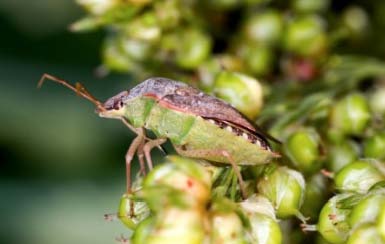
Featured image: Brown Stink Bug (Source: Brown Stink Bug (Source: “Chemical Efficacy Trial using Select Insecticides against Brown stink bug, Euschistus servus on Commercially Planted Cotton” by Vonny Barlow, University of California, Agricultural and Natural Resources, Riverside County, April 2016 issue of “Postings from the Palo Verde” newsletter)

2021-05-12T11:05:54-07:00June 23rd, 2016|

VIDEO: Other Stressors, Not Pumps, Leading to Delta Smelt Decline

VIDEO: Wasted Freshwater in Failed Attempt to Save Delta Smelt and Salmon

By Laurie Greene, Editor

Other Stressors, Not Pumps, Leading to Delta Smelt Decline,” a video produced by Western Growers, explains why the communities, business, and farmland in the Central Valley and southward still experience regulatory water cutbacks that are extreme in some cases, while 3 billion gallons of extra freshwater flow out to sea in the failing effort to save the Delta Smelt from extinction.Western Growers logo

The VIDEO addresses this loss of freshwater unused by California residents and businesses still suffering from both drought conditions and environmental water cutbacks and that could have gone into water storage.

Decline in California Fish Population and Delta Smelt, Salmon

Western Growers accuses government agencies in charge of managing California’s water of restricting the Delta pumps far beyond what is required by the law. “As a result,” the association said, “billions of gallons of El Niño water have been flushed out to sea. Shutting down the pumps has not helped the Delta smelt and salmon recover, and government regulators are ignoring other stressors such as predation, invasive species and wastewater discharges.”

Delta Smelt Troll 2016

Delta Smelt Troll, Survey 6, 2016: “There were no Delta Smelt collected.”

______________________

Western Growers, founded in 1926, is a trade association of California, Arizona and Colorado farmers who grow, pack and ship almost 50% of our nation’s produce. Their mission is to enhance members’ competitiveness and profitability by providing products and services with agriculture in mind. Services include Affordable Care Act (ACA) compliant health benefits for farmworkers, cost-saving and environmentally-focused logistics, food safety initiatives and advocacy for members. 

They ask, “If you enjoy fruits, vegetables and nuts, support our members and the produce industry.”

Featured Photo: Delta smelt by metric ruler (Source: USFWS)

2021-05-12T11:05:55-07:00June 10th, 2016|

The Fight Against the Asian Citrus Psyllid

California Citrus Mutual on the Fight Against the Asian Citrus Psyllid and HLB

By Laurie Greene, Editor

On Saturday, June 4, 2016, Patrick Cavanaugh, California Ag Today’s farm news director, hosted iHeart Media’s Ag Life Weekend show on “Power Talk 96.7 FM Fresno and 1400 AM Visalia stations, sitting in for broadcaster Rich Rodriguez. Cavanaugh’s invited guests included Alyssa Houtby, director of public affairs, and Chris Stambach, director of industry relations for the Exeter-based California Citrus Mutual, to discuss the status of the state’s citrus industry amidst the ACP and HLB Infestation.Ag Life Weekend

The Asian Citrus Psyllid (ACP), certainly the number one pest for California citrus, can spread a bacterium known as Huanglongbing (HLB) that is fatal to citrus trees. As of 2016, 22 trees in the state have been infected with the fatal disease and had to be destroyed. The entire citrus industry of California has been and continues to be concerned that the ACP could take down the citrus industry, as it has in Florida.

Alyssa Houtby explained that the fight against ACP in California “is going well, we hope. The Florida citrus industry has been completely decimated by HLB; an estimated 90 percent of their acreage is infested with this disease.”

Asian Citrus Psyllid Evidence on New Growth (Source: California Ag Today

Asian Citrus Psyllid Evidence on New Growth (Source: California Ag Today)

“Here in California,” Houtby continued, “we saw it crop up in residential citrus before we saw it in commercial citrus. All of the HLB finds, to date, have been in the Los Angeles Basin.” Houtby said they are working diligently to keep the psyllid population down to decrease the exposure of trees to HLB.

The California citrus industry spends approximately $15 million annually on an ACP assessment program, which includes extensive public outreach. Part of the research entails trapping the pest, conducting survey work in the regions in question, applying treatments in residential areas, and managing a delimitation survey around the area of Los Angeles where the disease has populated.

“That means that we’re scouting very consistently,” explained Houtby, “looking for other trees with the disease and pulling those trees out as soon as we find them. We are doing everything we can here in California to keep the pest and disease from spreading—now that we have it,” she noted.

Alyssa Houtby, director of public affairs, California Citrus Mutual

Alyssa Houtby, director of public affairs, California Citrus Mutual

“The California industry has always been one to use a proactive approach,” Houtby elaborated. “We saw what happened in Florida, and we realized really early on that we couldn’t stand by and wait for this disease to find us. We had to actively go look for it and find it—before it found commercial citrus—and we’ve done that.” Regarding the 22 trees in the state that have been destroyed thus far, Houtby said, “It could be a lot worse if we weren’t as proactive as we are.”

When locating a positive ACP find in a residential area, Houtby noted, generally speaking, homeowners have mostly been compliant. “There are pockets in this state where folks don’t like government coming in, knocking on their door and asking to spray their trees with pesticides. We understand that. It’s an opt-in/opt-out scenario here. We’re not forcing homeowners in most cases to treat their trees.”

Chris Stambach

Chris Stambach, director of industry relations for California Citrus Mutual

“But that’s a different situation if HLB is present,” she emphasized. “Then we do. We get a warrant, and we go in and treat the surrounding trees. If we’re treating in response to an ACP find, homeowners can opt out, but overwhelmingly, they don’t. They support our program. They understand that citrus is a part of the California heritage, they like their citrus trees, and they want to keep them in their yards. They understand that the alternative to not treating is that tree will eventually die if it becomes infected. We’ve worked really hard to communicate to the general public about the seriousness of this issue. We’re pleased with the results.” Houtby said.

Chris Stambach discussed the importance of homeowners having a general understanding of the ACP, so if they find something unusual in their citrus tree, they know to call the local ag commissioner.

Stambach detailed ACP and HLB specifications to increase homeowners’ understanding about their beloved citrus trees. “HLB is symptomatic, but it takes a long time for those symptoms to show up in the tree,” said Stambach. “You really have to know what you’re looking for because some fertilizer deficiency issues in the tree will mimic what HLB looks like.”

“Though the ACP is a really tiny little bug, there are some key signs the public can look for,” explained Stambach. “You want to look for that psyllid and the little tubules it excretes on the new flush of growth—pretty much right there at the end of the terminals where all that new growth comes in the springtime and in the fall. That’s key to California, because there are only certain times of the year when that ACP is actively feeding on the citrus tree.”

California has a real benefit over the Sunshine State, where they have to spray 12 times a year to keep the psyllids at bay. “It hasn’t been effective for [Florida],” noted Stambach. “We had a couple of growers out this last winter to our Citrus Showcase. They planted new trees, 4 years old, and although they spray 12 times a year, their orchards are 100% infected with HLB. That’s the devastation that this insidious disease can bring. It’s really difficult to get your hands around it because it takes so long to be able to detect it.”

Another benefit for California citrus, according to Houtby, is, “We have a lot of areas in the state where we don’t have to spray at all because we can use beneficial insects. That’s just the great part about farming in California.”

Asian Citrus Psyllic Yellow Trap 2 (Source: Citrus Pest & Disease Prevention Program)

Asian Citrus Psyllic Yellow Trap (Source: Citrus Pest & Disease Prevention Program)

Houtby and her team often look to Florida for ideas and recommendations on what has worked for them, what hasn’t and what citrus growers here can do to prevent the disease from taking hold of their citrus. She clarified that 90 percent of the Florida citrus market is used for juice production; whereas, California is a “fresh-oriented industry, meaning that over 90 percent of our product goes into the fresh market.”

Although California citrus looks for recommendations from Florida, “here in California, there are a lot of things that we can’t afford to do because of the [fresh] market that we’re serving,” said Houtby.”  That is what we’re fighting so hard to maintain because we cannot sustain as long as Florida has; we don’t have the luxury of sending a bad-looking piece of fruit into the marketplace like Florida can, because they just juice it. Knowing that, we’re working really hard to never get to the point that Florida has reached.”

As if the dire situation in Florida couldn’t be any worse, they battled with “another deadly bacterial-based citrus disease, citrus canker, brought in from the far reaches of the world,” Stambach said. “That’s a concern we always have with importing citrus. When we import Argentine lemons, for example, we risk our domestic plant health by exposing orchards to a lot of plant diseases they have that we don’t. We want to keep those out of our country,” noted Stambach.

Abandoned citrus trees also pose problems for the industry; they can be sanctuaries for ACP. “If those trees are dead, that’s not a problem. They may look bad, but if they are not living, that’s not a problem. It’s when those trees aren’t cared for, aren’t sprayed in a normal routine, and there is a flush of new growth, the trees provide a sanctuary for the psyllids,” he said.

Abandoned Citrus

Abandoned Citrus

“And ACP are very good at finding citrus. They’ll target the perimeters of new growth on the very first citrus they find. Boom, they’re right on it,” he noted.

“Those abandoned groves create a real problem, particularly when they’re in close proximity to other commercial acreage or even homeowners,” he said. Neglected neighborhood citrus trees can become ACP sanctuaries. “ACPs will feed on them and move on to another tree, and feed there,” Stambach explained. “All that time, if an ACP is infected with the HLB bacteria, it will spread that disease, with a latency period of 2 to 5 years.”

Stambach and his team are working on a critical program in Southern California to remove abandoned citrus trees. “Sometimes it’s just getting a hold of the landowner and making them aware of the situation,” he said. “Our county ag commissioners are really key in contacting those people. We’ve had growers go in and spray their neighbor’s orchard to help them out. There are a lot of different ways to attack that problem.”

Compared to counties in the San Joaquin Valley, Riverside and Ventura Counties typically have a big-ag urban interface, which means there is a lot of acreage intermixed with home sites—small homes with citrus trees. Stambach said, “It’s not really commercial production, but it’s a significant amount of acreage with a number of trees that don’t get treated.”

“We’ve gotten some support from some of our partners in the chemical industry. Bayer CropScience has stepped up and worked with us to put together a program. We’re really happy. We’re working hard to take [ACP and HLB] out.” Stambach said.

“Fresno has even found ACPs in residential areas,” commented Houtby on the Central Valley situation. “ACPs are endemic in Southern California, but we’re still at a point in the Central Valley at which we can control these populations and knock them down really quickly when they arrive here.”CA Citrus Mutual

Houtby points to the Central Valley’s vulnerability when citrus plant material is moved over the grapevine or from the Central Coast. “We ask that homeowners, and the citrus industry as well, not move plant material out of Southern California into the Central Valley,” she stated. “The psyllid lives on that plant material and not on the fruit. If you’re going to buy a citrus tree, buy it at a local plant nursery or a local Home Depot or Lowe’s. Don’t buy it in Southern California and drive it to the Central San Joaquin Valley,” she urged.

“Our biggest task for homeowners is that they cooperate when the California Department of Food and Agriculture knocks on the door and wants to look at their trees,” Stambach said. “That is the best way you can help us win this battle against the ACP.”

Homeowners can learn how to protect their citrus trees at:

CaliforniaCitrusThreat.org

U.S. Department of Agriculture

California Department of Food and Agriculture

University of California Cooperative Extension

Contributors to this report include Patrick Cavanaugh and Emily McKay Johnson.

2021-05-12T11:05:56-07:00June 6th, 2016|
Go to Top