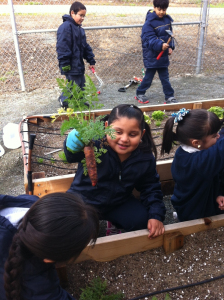
Northern California elementary school students to visit White House Garden

By: Monique Bienvenue; California Ag Today Social Media Manager/Reporter

Today, five students from Willow Cove Elementary School will join First Lady Michelle Obama to harvest vegetables from the White House Garden and work with chefs to turn them into a healthy meal.

Willow Cove Elementary School is part of the Pittsburg Unified School District in Contra Costa County. The students are attending the event in recognition of the Farm to School programs the district has implemented. The district now has eight school gardens, incorporates local produce in school cafeterias, and provides nutrition education in the classroom as well as after-school programs.

The school’s garden began last year, when second-grade teacher Elba Ramirez requested milk crates to start a small classroom garden. Instead, district child nutrition director Matthew Belasco offered to build a larger garden with raised beds.

Ms. Ramirez and her students planted and cared for the garden throughout the year and then harvested the vegetables, which were served in the cafeteria.

CDFA’s Office of Farm to Fork has been working closely with Pittsburg Unified’s Food Service Department to develop these programs and incorporate more locally grown food in district cafeterias. The office is also working with Pittsburg and surrounding school districts to directly connect them with nearby farmers to provide local food.

“I am so pleased that the White House has recognized the Pittsburg Unified School District for all the hard work it has put into its amazing farm to school program,” said CDFA Secretary Karen Ross. “It helps connect our students with food grown right here in California and, to the extent possible, from Contra Costa and surrounding counties. CDFA and its Office of Farm to Fork is committed to these types of programs. They teach our kids about where their food comes from while giving them access to healthy foods, and they support California farmers and ranchers.”
2016-05-31T19:32:20-07:00October 14th, 2014|

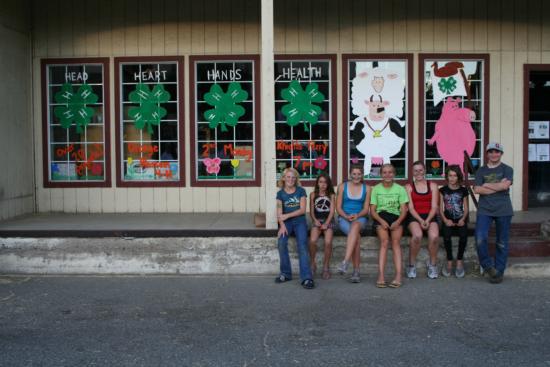
Head, Heart, Hands & Health – The 4-H Pledge

The 4-H Pledge Means Dedication

By: Monique Bienvenue; Cal Ag Today Social Media Manager/Reporter


At a glance, one might not think twice about that four-word pledge. But to countless individuals, that short, simple phrase represents dedication to 4-H, a prestigious organization devoted to teaching America’s youth the skills necessary to become successful outside the classroom.

Agriculturally-based, 4-H began in the 1800s as a way for students to communicate new and innovative farming techniques to those who were disconnected from university campuses. Eventually, this education trend caught on and in 1902 the first 4-H club was formed.

4h-pledge, 4-H Head Heart Hands HealthThe Cooperative Extension System was later created in 1914, and in partnership with the National Institute of Food and Agriculture under the United States Department of Agriculture, 4-H was officially nationalized. Clubs were established all across the United States.

4-H


Today, there are hundreds of children involved in 4-H. From health issues to food security, there isn’t an issue that these young, energetic individuals aren’t taking on.

For more information about 4-H, visit their website at http://www.4-h.org.

2016-10-13T14:36:53-07:00October 13th, 2014|

USDA report outlines opportunities in the emerging bioeconomy

Source: Monique Bienvenue – Cal Ag Today Social Media Manager/Reporter

Agriculture Secretary Tom Vilsack announced that the U.S. Department of Agriculture (USDA) has released a comprehensive report synthesizing current literature that explores opportunities in the emerging bioeconomy. The report, entitled Why Biobased?, was created as a precursor for a more comprehensive economic study to be released in the coming months by the USDA BioPreferred program on the economic impacts of the biobased products industry.

“This new report presents the opportunities U.S. agriculture and forests have in the emerging bioeconomy,” said Vilsack. “The recent inclusion of mature market products into the BioPreferred program strengthens our commitment to the U.S. biobased economy and brings together two of the most important economic engines for rural America: agriculture and manufacturing.”

Synthesizing findings from existing government, academia, and non-governmental organizations, the new report explores how government policies and industry business-to-business sustainability programs are driving the biobased economy. The report further demonstrates that the biobased economy is, in fact, growing and it offers great potential for increased job creation in numerous sectors across the U.S.

For instance, one report cited concludes that biobased chemicals are expected to constitute over 10 percent of the chemical market by 2015. Another report in the study concludes that there is a potential to produce two-thirds of the total volume of chemicals from biobased materials, representing over 50,000 products, a $1 trillion annual global market.

On the heels of this completed study, the USDA BioPreferred program has awarded a contract for a more in-depth economic study of biobased products and economic impacts, including research on job creation and economic value. It will be the first federally-sponsored economic report of its kind targeting the biobased products industry in the U.S. Congress mandated the upcoming study in the 2014 Farm Bill.

The USDA BioPreferred program works to increase the purchase and use of designated biobased products through a preferred procurement initiative for federal agencies. Designated products may also carry the voluntary consumer label.

The voluntary “USDA Certified Biobased Product” label is designed to promote the broad-scale marketing of biobased products to consumers. As of September 2014, USDA has certified over 1,940 biobased products in more than 187 product categories for the label. Certified and designated products include construction, janitorial, and grounds keeping products purchased by Federal agencies, to personal care and packaging products used by consumers every day.

The Biotechnology Industry Organization (BIO) has estimated that U.S.-based jobs for the renewable chemicals sector will rise from approximately 40,000 jobs in 2011, which represents 3%-4% of all chemical sales, to over 237,000 jobs by 2025. This employment level would represent approximately 20% of total chemical sales.

2016-05-31T19:33:22-07:00October 9th, 2014|

USDA Expands Access to Credit to Help More Beginning and Family Farmers

Source: Monique Bienvenue – Cal Ag Today Social Media Manager/Reporter

Agriculture Deputy Secretary Krysta Harden announced that the U.S. Department of Agriculture (USDA) will improve farm loans by expanding eligibility and increasing lending limits to help more beginning and family farmers.

As part of this effort, USDA is raising the borrowing limit for the microloan program from $35,000 to $50,000; simplify the lending processes; updating required “farming experience” to include other valuable experiences; and expanding eligible business entities to reflect changes in the way family farms are owned and operated. The changes become effective Nov. 7.

“USDA is continuing its commitment to new and existing family farmers and ranchers by expanding access to credit,” said Harden. “These new flexibilities, created by the 2014 Farm Bill, will help more people who are considering farming and ranching, or who want to strengthen their existing family operation.”

The microloan changes announced today will allow beginning, small and mid-sized farmers to access an additional $15,000 in loans using a simplified application process with up to seven years to repay. These efforts are part of USDA’s continued commitment to small and midsized farming operations, and new and beginning farmers.

In addition to farm related experience, other types of skills may be considered to meet the direct farming experience required for farm loan eligibility such as operation or management of a non-farm business, leadership positions while serving in the military, or advanced education in an agricultural field. Also, individuals who own farmland under a different legal entity operating the farm now may be eligible for loans administered by USDA’s Farm Service Agency (FSA).

Producers will have an opportunity to share suggestions on the microloan process, and the definitions of farming experience and business structures through Dec. 8, 2014, the public open comment period.

FSA is also publishing a Federal Register notice to solicit ideas from the public for pilot projects to help increase the efficiency and effectiveness of farm loan programs. Comments and ideas regarding potential pilot projects will be accepted through Nov. 7, 2014.

Since 2010, USDA has made a record amount of farm loans through FSA — more than 165,000 loans totaling nearly $23 billion. More than 50 percent of USDA’s farm loans now go to beginning farmers. In addition, USDA has increased its lending to socially-disadvantaged producers by nearly 50 percent since 2010.

These programs were made possible by the 2014 Farm Bill, which builds on historic economic gains in rural America over the past five years, while achieving meaningful reform and billions of dollars in savings for taxpayers. Since enactment, USDA has made significant progress to implement each provision of this critical legislation, including providing disaster relief to farmers and ranchers; strengthening risk management tools; expanding access to rural credit; funding critical research; establishing innovative public-private conservation partnerships; developing new markets for rural-made products; and investing in infrastructure, housing and community facilities to help improve quality of life in rural America.

2016-05-31T19:33:22-07:00October 9th, 2014|

Air Board ag exempt truck deadline of Jan. 31 , 2015

By: Monique Bienvenue – Social Media Manager/Reporter
Owners of on-road heavy-duty diesel agricultural trucks that qualify for an identifying AG sticker have until Jan. 31, 2015 to register with the California Air Resources Board (CARB). With streamlined and slightly-increased mileage limits, CARB is reopening the registration period for those farmers who have not reported and claimed their ag exemption.
The agricultural vehicle provisions:
  • Delay compliance for vehicles that operate less than specified mileage thresholds and for a limited number of specialized trucks.
  • Apply to diesel trucks and buses with a manufacturer gross vehicle weight rating greater than 14,000 pounds, thus excluding pickups.
  • Include agricultural vehicles such as trucks and buses owned by log harvest operations or farming businesses and certain trucks that are not farmer owned but are dedicated to supporting agricultural operations.
  • Do not apply to truck tractors that enter ports or intermodal rail yards or transport marine cargo. These vehicles must comply with the Drayage Truck regulation.
Things to keep in mind:
  • ARB regulations require diesel trucks and buses that operate in California to be upgraded to reduce emissions.
  • Newer heavier trucks and buses had to meet PM filter requiremetns on January 1, 2012.
  • Lighter and older heavier trucks must be replaced starting January 1, 2015.

 
The regulation applies to nearly all privately and federally owned diesel fueled trucks and buses and to privately and publicly owned school buses with a gross vehicle weight rating (GVWR) greater than 14,000 pounds.  The regulation provides a variety of flexibility options tailored to fleets operating low use vehicles, fleets operating in selected vocations like agricultural and construction, and small fleets of three or fewer trucks.   

For other information about this regulation, other diesel engine regulations, or training programs, please contact an ARB diesel representative at 866-6DIESEL (866-634-3735) or visit the Truck Stop website.  This regulation does not apply to drayage trucks that transport marine containers. 

2016-05-31T19:33:22-07:00October 7th, 2014|

Fingerprint of climate change on California drought

Source: Angela Fritz; The Washington Post 

Researchers studying the fingerprint of human-caused climate change on extreme weather events in 2013 have found that it played a role in half of the events that they looked at, including the California drought and extreme heat events.

Climate change attribution — figuring out what role climate change is playing in our weather events — is a very difficult science. There are so many moving parts: ground-level weather conditions, large-scale atmospheric patterns, and global teleconnections, like El Nino, that influence weather worldwide. And a changing climate can influence all of them (or none of them) in any given moment.

Nonetheless, given how costly weather disasters have become, the question of how extreme events could be changing is possibly the most important question to ask in climate change. So each year, scientists take a look back at the way change change could have impacted a few notable extreme events, and publish their findings in the Bulletin of the American Meteorological Society.

One study in the report, which was released on Monday, concluded that “global warming has very likely increased the probability” of the large-scale atmospheric patterns that have played a role the current, historic California drought – a strong, persistent ridge of high pressure over the western U.S. has essentially blocked the region from being impacted by storms coming off the Pacific.

That ridging pattern, which lead to few precipitation events, was made more likely by the presence of human greenhouse gas emissions, the study says.

Two other studies that dug in to similar aspects of California drought were less eager to point the finger at human-caused climate change.  Both studies looked at the role of warm ocean waters in the Pacific, and its relationship to California precipitation. While warm sea surface temperatures in the northeast Pacific would cause the dry ridging pattern over the western U.S., it would also act to cause heavier precipitation events over California by increasing the humidity.

While that’s not the outcome California saw in 2013 and the beginning of 2014, scientists say its enough of a question mark to remain uncertain on whether or not this event would have occurred without global warming.

However, it’s important to note that these studies looked at very specific, individual factors of the drought. California could be looking at its warmest year on record in 2014, but heat — which has a much more clear link with climate change, and acts to intensify and prolong a drought – was not considered in any of the studies looking at the California dry spell.

While drought remains somewhat of a question mark, scientists are most confident that the risk of 2013′s extreme heat events was made larger by human-caused climate change. All of the studies that looked at the extremely hot summers or heat waves around the globe concluded that climate change played some role in dialing up the temperature.

Australia, in particular, was severely impacted by heat extremes in the southern hemisphere summer of 2012-2013. The year was the hottest on record for the country, and subjected Australians to numerous heat waves and a drought that cost the government approximately $300 million USD. All of the studies that examined Australia’s summer temperatures found that climate change played a significant role in the heat, with one study even concluding that it has increased the risk of the event by two to three-fold.

“The results from the Australia studies are rather striking,” said Peter Stott of the Met Office Hadley Center in the U.K., and an editor in the report compilation in a press briefing. “It’s almost impossible, it’s very hard to imagine, those temperatures in a world without climate change.”

Hot summers and heat waves in New Zealand, Korea, China, and Japan were also examined, and determined to be influenced by climate change, and one group suggested that the Korea summer heat wave was made 10 times more likely by human-driven climate change.

The link between heavy precipitation events and human-caused climate change in 2013 appear to be more ambiguous.

Researchers who looked at the extreme precipitation events of 2013 found varying results — two studies found that human-caused climate change increased the likelihood of heavy precipitation events in the U.S. and India, while another two found no discernible link between the extreme precipitation events in Europe and climate change. One study, which addressed the extreme flooding event in Colorado in September 2013, found that the probability of such an event has even decreased in climate change.

Unsurprisingly, scientists found that the occurrence of cold waves — long periods of abnormally cold weather — have become much less likely in the presence of global warming. In particular, scientists looked at the extremely cold winter of 2013 in the U.K., finding that the probability of that event has dropped 30-fold.

2016-05-31T19:33:22-07:00October 7th, 2014|

Hartnell College Hosts Agroterrorism Training

UC Davis has announced that Hartnell College, in the Salinas Valley, is hosting a series of six agroterrorism training courses. David Goldenberg from the UC Davis, Western Institute for Food Safety and Security will be at the helm of these U.S. Department of Homeland Security (DHS) courses.

Goldenberg, Acting Program Manager and Coordinator for Field Training at WIFSS, pointed out that the Agricultural Business and Technology Institute at Hartnell is partnering with WIFSS to conduct the agroterrorism training courses, which kicked off on September 5. These courses emphasize the importance of awareness of and preparedness for disasters that can affect the agricultural industry. Preparedness includes having a response action plan in which all community members and organizations have a coordinated disaster response strategy.

The remaining classes are:

• Oct. 10, AWR 155: Principles of Frontline Response to Agroterrorism and Food System Disasters, 8 a.m. to 3 p.m.

• Oct. 17, AWR 156: Principles of Planning and Implementing Recovery (6 hours), 8 a.m. to 3 p.m.

These agroterrorism courses delivered at Hartnell are geared toward traditional first responders as well as community emergency planners, public health officials, and members of the agricultural community including county officials, local farmers and ranchers who are interested in training addressing potential threats to food safety and food security.

2016-05-31T19:33:22-07:00October 6th, 2014|

WIFSS Animals in Disasters Courses Piloted in Sonoma

2015 WIFSS Animals in Disaster Course Series

Source: Chris Brunner; UC Davis Western Institute for Food Safety and Security


Without coordinated response, awareness and resources, those animals left behind in a natural or man-made disaster most often do not survive. The Western Institute for Food Safety and Security (WIFSS) offers a series of Animals in Disasters courses that help prepare first responders and community members for animal-related emergencies.

WIFSS instructors, Tracey Stevens, deputy director, Animals in Disasters Project, and Dr. Michael Payne, dairy Ooutreach coordinator, piloted two new Department of Homeland Security Animals in Disasters courses this summer in Sonoma, California.

Class participants in “Emergency Animal Sheltering: Veterinary Considerations” learned skills and knowledge on how to establish an emergency animal shelter, and how to safely shelter and reunify animals that have been displaced during a disaster. In the “First Responder Guidelines for All Hazards Large Animal Emergency Evacuation” class, emergency personnel were provided instruction on safe approaches to emergency evacuation of large animals.

First responders, county officials, animal services personnel, veterinarians and other individuals can look forward to the 2015 WIFSS Animals in Disaster Course series which, in addition to the two courses above, will include:

  • Guidelines for Establishing an Emergency Animal Shelter: Veterinary Considerations – CE approved
  • Loose Livestock, Injured Wildlife and Humane Euthanasia of Animals for First Responders
  • First Responder Guidelines for Equine Emergencies – Level 1
  • Veterinarian Integration into Multi-Agency Emergency Equine Rescue and Disaster Response – CE approved

View WIFSS Animals in Disasters for announcements of course dates and registration information.

2021-05-12T11:17:15-07:00October 1st, 2014|

Drought’s impact on crops

Source: Dale Kasler; The Sacramento Bee

It’s harvest time in much of California, and the signs of drought are almost as abundant as the fruits and nuts and vegetables.

One commodity after another is feeling the impact of the state’s epic water shortage. The great Sacramento Valley rice crop, served in sushi restaurants nationwide and exported to Asia, will be smaller than usual. Fewer grapes will be available to produce California’s world-class wines, and the citrus groves of the San Joaquin Valley are producing fewer oranges. There is less hay and corn for the state’s dairy cows, and the pistachio harvest is expected to shrink.

Even the state’s mighty almond business, which has become a powerhouse in recent years, is coming in smaller than expected. That’s particularly troubling to the thousands of farmers who sacrificed other crops in order to keep their almond orchards watered.

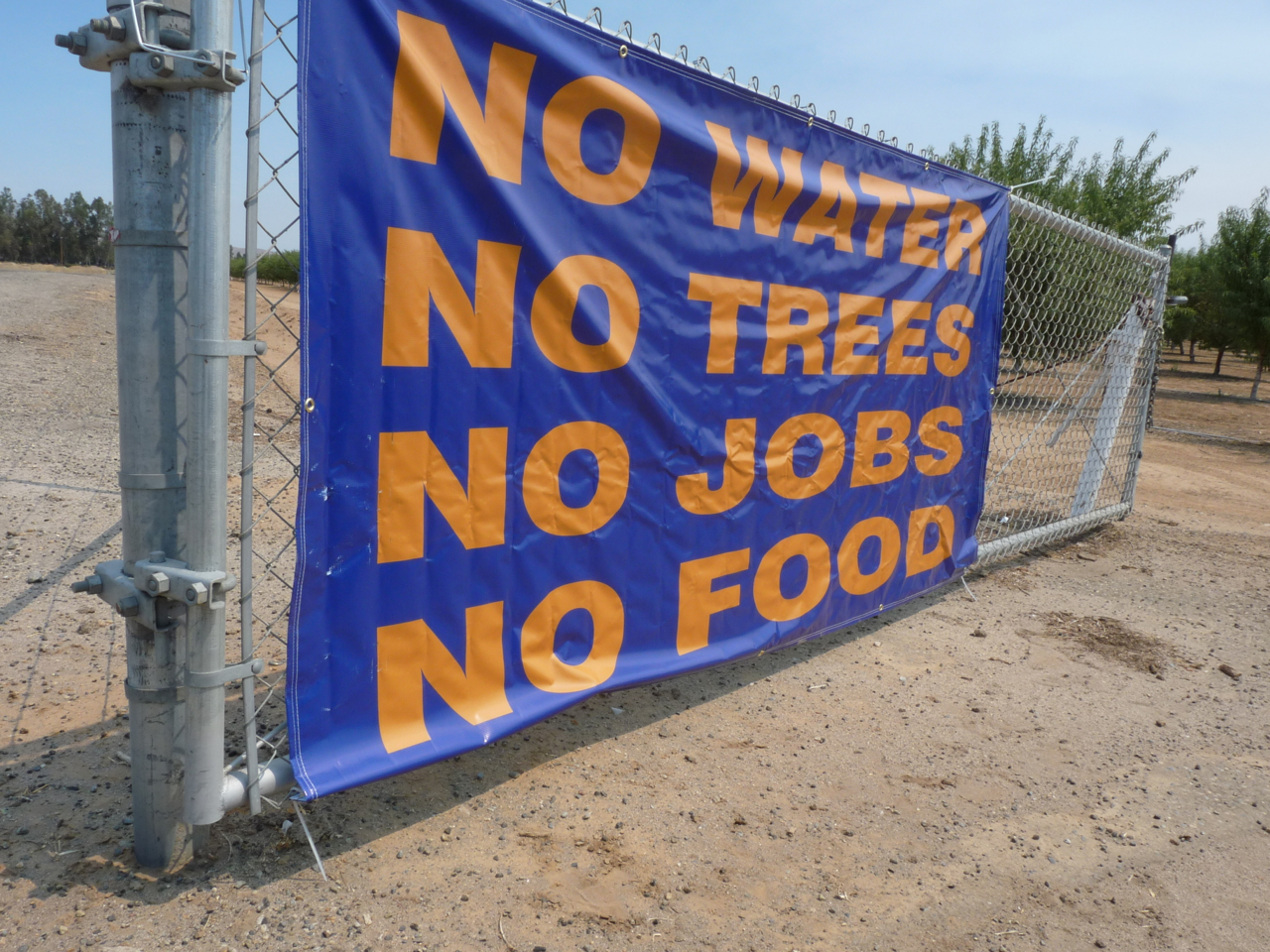
While many crops have yet to be harvested, it’s clear that the drought has carved a significant hole in the economy of rural California. Farm income is down, so is employment, and Thursday’s rain showers did little to change the equation.

An estimated 420,000 acres of farmland went unplanted this year, or about 5 percent of the total. Economists at UC Davis say agriculture, which has been a $44 billion-a-year business in California, will suffer revenue losses and higher water costs – a financial hit totaling $2.2 billion this year.

Rising commodity prices have helped cushion at least some of the pain, but more hurt could be on the way. With rivers running low and groundwater overtaxed, the situation could get far worse if heavy rains don’t come this winter.

“Nobody has any idea how disastrous it’s going to be,” said Mike Wade of Modesto, executive director of the California Farm Water Coalition, an advocacy group based in Sacramento. “Is it going to create more fallowed land? Absolutely. Is it going to create more groundwater problems? Absolutely.

“Another dry year, we don’t know what the result is going to be, but it’s not going to be good,” Wade said.

Central Valley residents don’t have to look far to see the effects. Roughly one-fourth of California’s rice fields went fallow this year, about 140,000 acres worth, according to the California Rice Commission, leaving vast stretches of the Sacramento Valley brown instead of their customary green.

“We’d all rather be farming, as would everybody who depends on us – the truck drivers, the parts stores, the mills,” said Mike Daddow, a fourth-generation rice grower in the Nicolaus area of southern Sutter County.

Daddow opted to fallow 150 of his family’s 800 acres this year and counts himself lucky. “We did better than a lot of people,” he said.

Last week, Daddow was gearing up for the harvest, which begins Monday. It was pleasantly warm, but the faint smoky smell from the King fire was another unwelcome reminder of the parched season of discontent.

“It affects me, yes, I will have less profit,” he said. “It affects hourly workers. If there’s no ground to till, I can’t hire them to do anything.”

Daddow hired just six workers during spring planting, instead of the usual nine or 10.

Calculating total job losses related to the drought is difficult, especially in an industry in which many workers are transient and much of the work is part time. The state Employment Development Department, drawing from payroll data, said farm employment has dropped by just 2,700 jobs from a year ago, a decline of less than 1 percent.

But experts at UC Davis say they believe the impact is more severe. Richard Howitt, professor emeritus of agricultural economics, said he believes the drought ultimately will erase 17,000 jobs. He bases that, in part, on the increased number of families seeking social services.

The human cost shows up at rural food banks, which are reporting higher demand for assistance from farmworkers and their families. At the Bethel Spanish Assembly of God, a church in the Tulare County city of Farmersville, the number of families receiving food aid every two weeks has jumped from about 40 last year to more than 200. Farmersville, a city of 10,000, is at the heart of a region that grows an array of crops, from lemons to pistachios to grapes.

“Some of them are working … but they’re not putting in the hours,” said the Rev. Leonel Benavides, who is also Farmersville’s mayor. Thanks to state-funded drought relief, the church has been able to meet the increased demand – and then some.

“Instead of just two boxes, we give them three,” Benavides said.

The effect goes beyond the farm fields. N&S Tractor, which sells Case IH brand farm equipment throughout the Central Valley, has seen business tail off as farmers conserve cash.

“It’s not just our dealership,” said N&S marketing director Tim McConiga Jr., who works out of the company’s sales office in Glenn County. “You talk to John Deere, you talk to Caterpillar, everyone is going to tell you their numbers are down.”

The drought has had varying impacts on different areas of the state, depending in part on who has first dibs on the dwindling water supply. Some growers have stronger water rights than others. Generally speaking, Sacramento Valley farmers have had it easier than their counterparts south of the Sacramento-San Joaquin Delta, where the cutbacks have been more severe.

The Modesto and Turlock irrigation districts are delivering about 40 percent of their usual amounts. The Merced Irrigation District is far worse off, as are many of the West Side areas supplied by the federal Central Valley Project. The Oakdale and South San Joaquin irrigation districts have not had large cutbacks, but leaders worry about a dry 2015.

Regardless of geography, many growers have had to make difficult choices about which fields to water, leaving portions of their farms idle.

Bruce Rominger of Winters, chairman of the California Tomato Growers Association, made the decision to push ahead with his tomato crop at the expense of other commodities. With tomatoes selling for a robust $83 a ton, vs. about $70 a year ago, it was a matter of simple economics.

“Other crops are not getting the water,” said Rominger, who owns and leases a total of about 5,000 acres. “We sacrificed some alfalfa, we sacrified some sunflowers, we sacrificed quite a bit of rice. We fallowed 25 percent of our farm.”

Much of the processing tomato crop goes to canneries in Modesto, Oakdale, Escalon and Los Banos.

Choosing to focus on one crop doesn’t guarantee victory. Even the $4 billion almond industry – the great success story of California agriculture in recent years – could not be shielded from the drought’s effects.

As worldwide demand for almonds has boomed, prices have soared past $4 a pound and farmers have responded with more supply. Orchard plantings have continued unabated, even this year. With water supplies running low, many almond growers set aside other commodities to keep their orchards going.

Even so, the almond yield declined. Blue Diamond Growers, the big farmer-owner almond cooperative based in Sacramento, predicts that production in California will fall this year to around 1.9 billion pounds when the harvest is complete in a few weeks. That compares with the 2 billion pounds harvested last year and the U.S. Department of Agriculture’s forecast, released in late June, that this year’s crop would total 2.1 billion pounds.

What went wrong? Almonds are one of the thirstiest crops around, and there wasn’t enough water to generate big yields.

“I don’t think there was anyone who used as much (water) as they normally do,” said Dave Baker, director of member relations for Blue Diamond. The hot spells in June and July “stressed the trees even further” and curtailed production, he said.

With California accounting for 80 percent of global almond supply, Baker said he’s worried about being able to meet demand. “We have a growth industry,” he said.

Blue Diamond has plants also in Salida and Turlock, and several smaller processors are in or near Stanislaus County.

The lack of water last spring likely also has stunted navel orange production in the San Joaquin Valley, where harvest is expected to begin in a few weeks.

“We’re expecting some kind of damage to the crop,” said Alyssa Houtby, spokeswoman for California Citrus Mutual, a grower-owned association based in Tulare County. “We didn’t have the water in those key months.”

Economist Vernon Crowder, a senior vice president with agricultural lender Rabobank, said farmers went into this difficult season with a couple of advantages: Most commodity prices have risen in recent years, and most growers are in pretty good financial shape as a result. But another dry year could bring more serious hardship, he said.

“They have a little bit of cash to withstand this,” Crowder said. “They’re going to get through it. The real question is what is going to happen next year.”

Similar questions are being raised in the California wine industry, which produces much of its volume in the Modesto area. The last two grape harvests were extraordinarily strong, leaving an overhang of product that should help offset the slight declines in this year’s harvest. “Pricing should be steady,” said industry consultant Robert Smiley, a professor emeritus of business at UC Davis.

That doesn’t eliminate fears that next season’s crop could shrink substantially. Craig Ledbetter of Vino Farms, a Lodi grape producer, had enough water this year but said he’s afraid he’ll receive “curtailment notices” from the state signaling significant cutbacks in next season’s water supply.

“I’m very nervous about water,” said Ledbetter, who also raises wine grapes in Sonoma County. “If we don’t have a rainy winter, I can pretty much guarantee we’re all going to be receiving curtailment notices. If that happens, we’re going to be concerned about keeping the vine alive rather than harvesting it.”

2016-05-31T19:33:23-07:00September 30th, 2014|

California Citrus Mutual to Contribute $150k to Water Bond Campaign; $50k to Latino Outreach

California Citrus Mutual (CCM) will directly contribute $150,000 to the campaign to pass Proposition 1, the water bond measure.

The CCM Board of Directors voted unanimously to support the measure in order to secure a reliable and sustainable water supply for California agriculture and communities across the state.

“We are in a state of unprecedented crisis in terms of water supply,” says CCM President Joel Nelsen.  “CCM worked closely with members of the legislature to create a long term solution path for the State’s water infrastructure and sustainability needs.  It is essential to the future of agriculture in California that voters approve Proposition 1 this November.”

Proposition 1 includes $2.7 billion to build additional water storage that will alleviate pressure upon Millerton Reservoir and water users on the Friant-Kern Canal in critical drought years such as this.  Approximately 58% of U.S. fresh citrus is grown by farmers in the Friant service area who received zero surface water allocation from the Central Valley Project for the first time in the project’s history this year.

“CCM’s contribution of $150,000 is an investment in our future, and the future of California,” says CCM Board Chairman Kevin Severns.  “It is critical that voters understand the importance of the issue and vote to pass Proposition 1.”

Additionally, CCM has committed $50,000 to the “El Agua es Asunto de Todos” (Water is Everybody’s Business) outreach campaign to raise awareness among the Latino community about the importance of a reliable water supply for California’s economy and jobs.

“CCM is proud to support the ‘El Augua’ campaign in its effort to empower the Latino community to support policy that creates water for California,” concludes Nelsen.

2016-05-31T19:33:23-07:00September 29th, 2014|
Go to Top