Tasteful Selections Opens Cal Green Potato Facility

Tasteful Selections Opens Cal Green Potato Facility in Arvin, CA

By Patrick Cavanaugh, Associate Editor

Bob Bender, a partner with CSS Farms, in Watertown, South Dakota, came out to Kern County several years ago to grow many different crops including chip potatoes, garlic, onions and bell peppers, as well as black-eyed peas. “We were looking for an opportunity in California to diversify our company so that we were not so dependent on the chip potato income.”

Bender said he was always looking for crops in which he could diversify, and in 2007, he had the opportunity to grow some baby, bite-sized potatoes for a Canadian company. “This worked out well for a few years, and then we decided in 2009 to pack the baby potatoes under our own CSS Farms label,” Bender said.

“That business started taking off a lot bigger than we expected, and in 2010, we saw that the business was growing to be too much for us to handle. We needed some marketing help because we did not know  much about it,” said Bender. “Plus, we were packing everything in 50-pound cartons, and we knew there would have to be more margin to the product if we sold directly to retail.

Bob Bender, Tasteful Selections

Bob Bender, Tasteful Selections

“That’s when we teamed up with the Wysocki family, owners of the Bancroft, Wisconsin-based RPE Company and experts in packing and marketing,” said Bender. “The marketing took off, and they built our first packing shed in a leased facility in Bakersfield. They sold product in smaller mesh bags for the consumer retail market under the Tasteful Selection brand,” noted Bender, who is now president and general manager of Tasteful Selections.”

Fast forward to March. 18, 2015 when CSS, along with RPE, and Stevens Point, Wisconsin-based Plover River Farms Alliance, Inc. partnered together and opened a new, stainless steel, 200,000 square foot facility in Arvin, near Bakersfield—all dedicated to Tasteful Selections specialty potatoes.

The expansion increases Tasteful Selections’ production capacity from eight to 12 packaging lines, doubles the potato washing capacity and adds more shipping docks and improved refrigeration and storage to meet the company’s double digit growth (over the past five years), leading the specialty potato category.

In all, the company sells eight flavors of potatoes in one-, two- or three-bite sizes, plus offers a medley of flavors in each bite size. The potatoes have unique flavors, creamy textures and tender skins. The products are pre-washed, so consumers do not have to clean or peel the product. And the small sizes equate to faster cooking times.

“Fifty percent of our team is marketing, so we’re not just growing and packing the potatoes. RPE handles all of our marketing and sales, which has been so instrumental in our growth,” said Bender, who now oversees the day-to-day operations in California. RPE has been a tremendous asset to Tasteful Selections; the fact that we are in all fifty states, in 52 percent of all grocery stores, with growth in every store, says a lot about RPE,” Bender noted.

The fact that the facility was built with all stainless steel components is an invaluable addition to our operations and food safety protocols.  The facility’s design honors Cal Green Certification Standards. The Cal Green Certification ensures that we are maximizing our efficiency while reducing our environmental impact. Not only does this benefit us, it also helps the surrounding communities in promoting water savings, environmental responsibility, cost effectiveness and a healthier place to live and work for its currently 257 employees.

Tasteful Selections

Tasteful Selections

Milt Carter is CEO and President of CSS Farms, which grows all the potatoes for Tasteful Selections. “We are co-owner of the company, along with RPE, and the grand opening of our facility is a big day for us as we continue our journey to bring unique potatoes to the potato category and to the table,” said Carter.

“We particularly like the qualities of our baby potatoes, including unique flavors and better taste than the average potato. The uniform sizes we pack allow for uniform cooking times, making cooking easier for the consumer. And the growth we have seen reflects that consumers really like them.”

“When we started Tasteful Selections in 2010, we knew we had something amazing, and even we were surprised by the success that we had,” said Russell Wysocki, President and CEO of RPE. “The opening of this new plant shows that we are consistently investing in our future in specialty potatoes,” he said.

“The new plant will allow us to bring in new product lines, do a better job in precise-sizing, and maintain our high quality standard,” noted Wysocki. “On the farm, Bob and Milt bring us five separate crops a year; we have the ability to deliver the freshest potatoes with the best quality to our customers throughout the country and throughout the season.”

“The one-, two- or three-bite Tasteful Sections potatoes in the one pound or 1.5 pound bag are very popular with consumers.” said Wysocki. “It use to be that you would sell a lot of potatoes in a 10-pound bag, but that’s getting a lot harder to do. However, this product offers consumers a package from which they can get multiple meals, without taking five weeks to consume and perhaps resorting to the garbage can to get rid of them.”

“The baby potatoes are immature potatoes, before they grow bigger, but they still contain all the nutrients found in the larger potatoes,” said Wysocki.

Carter explained, “Our signature flavor Honey Gold baby potatoes are proprietary to Tasteful Selections, and they have a very unique flavor. A high percentage of people the taste distinctive in taste tests, and most like it very much.”

“It’s a great product,” noted Wysocki. “We basically took product that was being discarded in the market 10 years ago. We saw the quality of what was culled, and we felt it was something significant we could bring to the marketplace. So we considered the possibility, then brought it to market, and we have had phenomenal growth,” he said.

2016-05-31T19:30:24-07:00May 17th, 2015|

Mario Santoyo On Allocating Enviromental Water to Cities and Farms

All Sectors Of California Have Had to Reduce Water Usage, Except the Environment

By Kyle Buchoff, Correspondent

Mario Santoyo is the Assistant General Manager of the Friant Water Authority as well the Executive Director of the Latino Water Coalition. He suggests the environment give up some of its water, like the other sectors in California, to free up supply for cities and farms that are suffering this year.

He told California Ag Today, “This is the fourth year of a serious drought and the second year of what I call ‘double zeros,’ meaning zero water allocation on the West Side and zero allocation on the East Side of the Central San Joaquin Valley. Historically, a year of double zeros has never happened, much less a second year of it. This translates to the worst possible condtion for agriculture in the Central Valley—ever,” Santoyo said.

“At this point there is clearly nothing we can do relating to Mother Nature; she’s going to do what she’s going to do. But the fact is, it is not just Mother Nature causing this drought; human involvement in the operations and management of water has resulted in this level of crisis,” he said.

Santoyo emphasized that the environment must be considered in any  water usage allotment, but “to the degree that there are no requirements to justify the level of the water that it needs, unlike municipal and agricultural allocations, that is not reasonable,” Santoyo noted.

“So as we move further down the drought road in terms of farmer hardship, we’ve tried to appeal to policymakers to rethink how environmental water is being used. We’ve talked to legislators in Washington D.C. and we are talking with the Governor Brown.”

“The governor has implemented a 25 percent water reduction for municipalities, and of course you cannot receive less than a zero water  allocation for agriculture, so a similar cutback to environmental water use is warranted,” Santoyo said. “It is very reasonable, given the dire circumstances we all face, that everyone share in the pain. Reductions in  environmental water could be reallocated to the communities and farms to ease at least some of the pain.”

Santoyo hopes that state and federal legislators will help to reallocate some of the water supply this summer.

2016-05-31T19:30:25-07:00May 12th, 2015|

Sustainable Farming: Let’s Focus on a Farm’s Performance, Not its Size

In case you missed it, we are posting the article, “Let’s Focus on a Farm’s Performance, Not its Size,” with permission, from Environmental Defense Fund’s Growing Returns blog.

By  | BIO
Lettuce

Credit: Flickr user Dwight Sipler

What comes to mind when you think of a “family farm?” You’re probably picturing a bucolic spread of less than 100 acres, with a red barn, farmer in overalls, and cows grazing a big pasture. What about the phrase “corporate farm” or “?” Do you see a giant, impersonal and industrial-looking operation?

Unfortunately, these common (mis)perceptions are regularly promoted in everything from TV ads to online chats. But the reality is that “big” does not equate to “bad,” and “small” doesn’t necessarily mean “good” when it comes to sustainable farming. In fact, it’s the wrong debate altogether.

What really matters is performance, not size.

Today is National Agriculture Day, celebrated annually on March 18, and this year’s theme is sustaining future generations. If we’re going to meet the needs of a rapidly growing population, we’re going to need large and small farms alike. And no matter their size, they’ll need to minimize their impacts on the natural systems that sustain us all.

Addressing the myth

It’s a myth that large farms can’t be sustainable, just as it’s a myth that all family farms are small and better for the environment.

Take Christine Hamilton, for example, whose family farm produces corn, soybeans, winter wheat and cattle across 14,000 acres in South Dakota. For years she’s been participating in USDA conservation programs, using no-till practices, planting trees to limit erosion, and utilizing variable rate technologies to improve the environment and her yields.

There are also places like Fair Oaks Farms, which milks over 500 cows … an hour. To make their large operation more sustainable, Fair Oaks pumps methane from its livestock to an on-site natural gas station that compresses it into fuel for the farm’s fleet of 40 milk trucks.

Many small-farm operations implement sustainable practices as well. A perfect example is Full Belly Farms, a 400-acre organic farm in Northern California that won last year’s prestigious Leopold Conservation Award. But I’ve visited small farms where livestock roam freely into streams, soil erosion destroys riverbanks, and nutrient management plans are nonexistent.

Sharing responsibility4.1.1

In the U.S., agriculture already occupies 51 percent of our land, uses 80 percent of the [Nation’s consumptive*] water, and is responsible for 8 percent of our greenhouse gas emissions. And in the coming decades U.S. farms will be responsible for producing even more food. In order to make agriculture a plus for the environment, farm practices will need to change.

Of course, we have to keep in mind the context here. Mid-size and large-scale family farms account for 8 percent of U.S. farms but 60 percent of the value of production, so in order to bring sustainable agriculture to scale, they will have to do the bulk of the work. But small farms have a much higher share of production for specific commodities in the U.S. – they account for 56 percent of domestic poultry production, for example – so we’ll need their leadership, too.

Regardless of size, all farms need to:

  • Minimize the loss of nutrients and soil to air and water through nutrient optimization strategies such as conservation tillage.
  • Use water as efficiently as possible.
  • Improve soil health through strategies such as cover crops.
  • Avoid plowing up ecologically important lands.
  • Fence livestock out of streams and implement management plans to maintain healthy grazing lands and avoid overgrazing
  • Use strategically placed filters to capture excess nutrients.

It’s time we shift the public debate and get everyone on board the sustainability train. Arguing about a farm’s size won’t deliver environmental benefits. In the end, it’s all about performance.

_______________________________________

*“California Ag Today added Nation’s consumptive” from the original USDA text and offers the following definitions:

Consumptive water use” is a use of water that removes the water from the system so that it cannot be recovered for reuse by some other entity. Consumptive uses may be beneficial or non‐beneficial. A beneficial consumptive use would be crop evapotranspiration.

(Source: Agricultural Water Use in California: A 2011 Update 3 © Center for Irrigation Technology November 2011)

Evapotranspiration (ET) is the amount of water transpired by plants, retained in plant tissues, and evaporated from plant tissues and surrounding soil surfaces.

(Sources: (1) California Water Plan Update 2009 Glossary. Department of Water Resources. Resources Agency. State of California; (2) Agricultural Water Use in California: A 2011 Update 3 © Center for Irrigation Technology November 2011)

If the basis for the discussion is water consumptively used by only agricultural, municipal & industrial users, then agriculture’s share would be estimated in the range of 80 percent of the total. However, if the percentage is based on dedicated water, which includes environmental uses, then agriculture’s share is more in the range of 40 percent.

(Sources: (1) California Water Plan Update 2009 Glossary. Department of Water Resources. Resources Agency. State of California; (2) Agricultural Water Use in California: A 2011 Update 3 © Center for Irrigation Technology November 2011)

Dedicated water – as defined by the California Department of Water Resources (DWR) is “water distributed among urban and agricultural uses, used for protecting and restoring the environment, or storage in surface water and groundwater reservoirs. In any year, some of the dedicated supply includes water that is used multiple times (reuse) and water held in storage from previous years. This is about 40 to 50 percent of the total annual water supply received from precipitation and imported from Colorado, Oregon, and Mexico.”

Context: Water Portfolio”1 (Source: Agricultural Water Use in California: A 2011 Update 3 © Center for Irrigation Technology November 2011)

Dedicated water includes water flowing in the Wild and Scenic Rivers. Many partially used or unrestricted rivers could have been significantly diverted for use by municipal & industrial and/or agriculture. However, these waters have been dedicated by law to the environment. Other examples of dedicated water are the 800,000 acre‐feet/year reallocated back to the environment by the Central Valley Project Improvement Act (CVPIA) and the 647,000 AF/year reallocated back for Trinity River restoration of that river’s fishery.

(Sources: (1) Record of Decision. Trinity River Mainstem Fishery Restoration. Final Environmental Impact Statement/Environmental Impact Report. U.S. Department of the Interior. December 2000; (2) Westlands Water District vs. U.S. Department of Interior. Case Nos. 03‐15194, 03‐15289, 03‐15291 and 03‐15737. Argued and Submitted Feb. 9, 2004 ‐ July 13, 2004, United States Court of Appeals, Ninth Circuit)

_______________________________________

The Environmental Defense Fund (EDF) works directly with businesses, government and communities to create lasting solutions to the most serious environmental problems. EDF’s Growing Returns Blog posts news about the organization’s goal of meeting growing demands for food in ways that improve the environment.

2016-05-31T19:30:26-07:00March 21st, 2015|

Slowdown at West Coast Ports Stops, Restarts at Port of Oakland, and Stops. . .

Port of Oakland Work Stoppage Ends

By Laurie Greene, CalAgToday reporter

Despite the tentative 5-year coast-wide contract agreement reached on February 20, 2015, between the International Longshore and Warehouse Union (ILWU) and its 20,000 members at 29 West Coast ports, and the Pacific Maritime Association (PMA) , which represents management for the ports and shipping lines there, ILWU Local 10 has repeatedly engaged in illegal work stoppages at the Port of Oakland, according to PMA, and brought operations to a standstill yesterday at Oakland International Container Terminal, the largest terminal in the Port.

PMA reports that ILWU Local 10 has repeatedly refused to allow yard crane operators to work as directed, reports PMA. These workers are essential to the movement of cargo in and out of the port. The terminal in question follows standard industry practice of hiring two workers for every yard crane – the same as at every other terminal at the port. Yet, ILWU Local 10 refused to allow yard cranes to operate unless that number was increased to three. This is a demand that Local 10 made and dropped during negotiations that led to the tentative agreement.

PMA also claims that Local 10 also refused to allow longshore utility workers to lock and unlock connecting devices between chassis and containers. The use of steady utility workers to perform this work is a longstanding practice at every terminal in the port. And while Local 10 made a demand in bargaining to change this practice, they dropped it in the tentative agreement.

“These repeated work stoppages by Local 10 – which run counter to the tentative agreement reached after more than nine months of negotiations – are the sort of counterproductive activity,” according to PMA, “that has become commonplace in Oakland over the years. Local 10’s current actions are damaging to the PMA member companies, to the shippers whose containers are idled, and to the reputation and future of the Port of Oakland.”

According to a CNN Money report TODAYMelvin Mackay, president of the ILWU Local 10 at Oakland, denied the union was engaged in the job action and blamed the shutdown on the Pacific Maritime Association (PMA) sending workers home.

“It’s a ploy by the PMA. These members come to go to work,” said Mackay. “But the companies are telling the members to operate the machine with no safety man on the ground. The members want safety. That’s the bottom line.”

An arbitrator ruled the union was engaged in an illegal strike that shut down most of the Oakland operations yesterday, affecting the container terminal — the key operation at the port.

The Oakland port handles the third greatest volume of containers of all West Coast ports–linchpins to trade between the U.S. and Asia– after only the ports of Los Angeles and Long Beach, which are the nation’s largest ports. It is the sixth largest container port nationwide.

American Shipper reported TODAY, “U.S. container imports are down more than 5 percent in 2015, with the nearly the entire drop attributable to West Coast ports, according to statistics released Wednesday by the trade data firm Zepol Corp.”

2016-05-31T19:30:27-07:00March 12th, 2015|

New National Network for Women in Agriculture

USDA Creates New National Mentoring Network for Women in Agriculture

By Agriculture Deputy Secretary Krysta Harden

To be a woman in agriculture is to face a unique set of challenges. And because I know all too well the trials that women can face as they look to take on leadership roles, I made it a goal as USDA’s Deputy Secretary to start a community for women leaders in agriculture.

This past fall, I held a White House discussion with farmers, agribusiness, academics and youth leaders about the opportunities that exist to help advance women in agriculture to leadership positions. Since that meeting, the response has been overwhelming. Women from all walks of life and every sector of the agriculture supply chain are empowering one another, and they’re sharing beautiful photographs and touching stories about how they’ve done it.

Today, I am announcing the creation of the Women in Agriculture Mentoring Network. This newly established network is designed to support and engage women across all areas of agriculture and to foster professional partnerships between women with shared backgrounds, interests, and professional goals.

We have created an e-mail address, agwomenlead@usda.gov, for you to share your suggestions, stories and other snippets on how we can build a new generation of women leaders in agriculture. By e-mailing us, you will automatically be added to the Women in Agriculture Mentoring Network.

I am truly excited by the passion and confidence I continue to see in women in agriculture across the country. In the office, on the road, I am constantly stopped by young women looking to find mentorship, or current leaders looking to lift up our next generation. Now, with our new network, you can.

This is just the first step in giving women the tools they need to be successful agricultural leaders. Keep sharing your stories using #womeninag and stay tuned for more information on the Women in Agriculture Mentoring Network.

Madeline Schultz, cofounder of the Women in Agriculture Learning Network, posted TODAY:

The online community at Women in Agriculture Learning Network looks forward to partnering with USDA on this new initiative! The Deputy Secretary’s commitment to rural women and to this new project further validates and recognizes the important roles women take on from leadership on cooperative boards to managing the family farm.


2016-05-31T19:30:29-07:00February 23rd, 2015|

The Water Education Foundation Announces Four New Board Members

New Water Education Board Members Includes Sixth Generation Valley Farmer

Jennifer Bowles,executive director of the Water Education Foundation Board of Directors, announced  four recently-elected members: Cannon Michael of Bowles Farming Company, Kim Delfino with Defenders of Wildlife, Jennifer Persike with the Association of California Water Agencies and Christopher Park with CDM Smith.

Elected in December, the four will join the rest of the Foundation’s board members at its next meeting in March. Their positions were effective Jan. 1, said Bowles, who is not related to Cannon Michael and his family’s farming operation.

“The staff and current board of the Water Education Foundation are happy to welcome new board members from diverse sectors of the water world,” said Bill Mills, president of the Foundation’s board of directors. “Our new board members will bring a wealth of knowledge and enthusiasm, and we look forward to their input in shaping our bright future.”

The Foundation, an impartial, nonprofit organization, is governed by a volunteer board of 33 members representing a broad cross-section of water, education, business, environmental and public interest communities. Typically, they serve three-year terms. The Foundation’s mission is to create a better understanding of water resources and foster public understanding and resolution of water resource issues through facilitation, education and outreach.

Founded in 1977, the Foundation is a vital source of nonpartisan, in-depth information about water resource issues in California and the West. Taking a steady pulse of the water world, the Foundation provides a vast repertoire of educational materials, products and services such as tours of key water sites in California and Nevada, conferences, flagship bimonthly magazine, Western Water, and Project WET (Water Education for Teachers).

The new board members are:

Cannon Michael: A sixth-generation farmer, Michael is president of Bowles Farming Company headquartered in Los Banos, CA. He oversees an 11,000-acre farm where the company grows cotton, fresh market and processing tomatoes, field crops and other commodities.

Michael’s great-great-great-grandfather was Henry Miller, a German immigrant whose partnership with Charles Lux became known as Miller & Lux and resulted in the build-up of landholdings in the San Joaquin Valley to more than 1 million acres.

Kim Delfino: As the California Director of Defenders of Wildlife, Delfino develops and directs the organization’s work across the state, including determining policy and program work in wildlife, land use, water and energy issues.

She is a gubernatorial-appointed member of the California Water Commission and serves on various coalitions and planning efforts, including the California Roundtable on Agriculture and the Environment, Salton Sea Coalition, the California Rangeland Conservation Coalition and the Desert Renewable Energy Conservation Plan Stakeholder Committee. Her policy expertise lies in state and federal endangered species, land use planning, water and other natural resource laws.

Jennifer Persike: As Deputy Executive Director for external affairs and operations at the Association of California Water Agencies, Persike oversees the association’s teams that work to advance ACWA’s image/brand, issues, policies and delivery of service to members. On the operations side, she oversees the association’s functions and activities related to finance, facilities, human resources, information technology, member services/events, communications and regional outreach

During her 25-year tenure at ACWA, Persike has held the positions of director of strategic coordination and public affairs, director of communications and outreach, director of communications and human resources, and manager of public affairs.

Christopher Park: Christopher Park, American Institute of Certified Planners’ certified, is a Water Resource Planner with CDM Smith in Sacramento.

Park has nine years of experience focusing on environmental impact assessment and permitting for both local and statewide water planning projects for clients that include the Bureau of Reclamation, Federal Emergency Management Agency, U.S. Army Corps of Engineers, the Santa Clara Valley Water District and the Cambria Community Services District.

Park joins the Foundation’s Board of Directors as the representative from the William R. Gianelli Water Leaders Class, of which he was a member in 2014.

2016-05-31T19:30:30-07:00February 19th, 2015|

Happy Chinese New Year!

Happy Chinese New Year!Hang the red lanterns, gather your citrus fruits, and cook your noodles. It’s time to welcome the lunar Year of the Sheep!

Chinese New Year (or Lunar New Year) is the most important traditional Chinese holiday, and is celebrated around the world. The celebration starts on the second new moon after the winter solstice, which is on January 31 this year, and goes on for 15 days. During this time, also known as the Spring Festival, those who celebrate visit temples to pay respect to their ancestors and pray for good fortune in the coming year. Small red envelopes of money are given to children as a token of good luck and prosperity. And, like most any family-centered holiday, everyone gathers around for a family feast, making Chinese New Year one of the biggest food holidays of the year.

Food is definitely a focus of Chinese New Year celebration, but it’s more than just nourishment. In Chinese traditions, foods served during the festival have auspicious meanings. Chinese traditions are rich with wordplay and symbolism. Some of the dishes and ingredients have names that sound similar to words and phrases referring to good wishes.

For example, “Kumquat” literally means “golden orange.” Symbolizing wealth and prosperity, the little citrus fruits, and sometimes the tree saplings, are given as gifts during Chinese New Year. Other “wealthy” fruits include Oranges and Tangerines. The larger citrus like Pummelos and Grapefruits symbolize abundance, prosperity, and family unity.

Happy Chinese New Year!

Happy Chinese New Year!

Another item that represents good fortune is Daikon or Asian Radish. In one Chinese dialect, the word for radish is a homophone for “good fortune.” This is why the savory radish cake is traditionally eaten during Chinese New Year celebration. But Daikon is more versatile than that. It can be added to soups and stews, steamed, or eaten fresh, chopped up or thinly shaved into salads.

Daikon could be a part of the mixed vegetable dish that represents family unity. This typical stir-fry is made with a touch of oyster sauce for business success and a mix of vegetables like Baby Bok Choy for close family ties, and Woodear and Shiitake Mushrooms for longevity.

The ultimate longevity blessing, however, comes from the noodles. Long and uncut, they symbolize long life. While Chow Mein is a traditional choice, other Asian noodles like Yakisoba are used for pan-fries and stir-fries, and Udons are used in soups. Shrimp may be added for liveliness and pork for abundance of blessings.

One of the many Chinese New Year wishes translates to “May your happiness be without limit.” With good eating like this, it definitely is the beginning of a very happy year!

Kung Hei Fat Choy! (Happy New Year and be prosperous!)

2016-05-31T19:30:30-07:00February 19th, 2015|

Grape Commission Awards Education Grants

Schools in the table grape growing regions of California’s San Joaquin and Coachella valleys are benefiting from grants awarded this academic year.

In total, 36 education grants worth up to $750 were awarded by the California Table Grape Commission on behalf of California’s table grape growers. The funded projects will be implemented in the current academic year and will reach over 4,000 students.

“California’s table grape growers have been supporting local education for years,” said Kathleen Nave, president of the commission. “This program is one of the ways table grape growers give back to the communities in which they live and work.”

Examples of the projects include raised garden boxes for children with special needs, inspiring youth through chess and music, programming robots, growing grapes, and modern microscopy and cell metabolism.

The Innovation in Teaching education grant program was created in 1993 to support innovative educational projects in the table grape growing regions of California’s San Joaquin and Coachella valleys.

For more information, go to www.grapesfromcalifornia.com/EducationGrants.php.

2016-05-31T19:30:30-07:00February 17th, 2015|

Fresno County 4-H Hosts Color Me Green 5K Run

On March 14, 2015, Fresno County 4-H members will host Color Me Green 5K Runs at California State University, Fresno. Fresno County 4-H is partnering with the Fresno State’s Jordan College of Agriculture and Science Technology for the Color Me Green 5K Run.

The Color Me Green 5K Runs are five kilometer runs designed to encourage youths and community members to increase their physical activity while also having fun! During each run, participants are showered with colored dye as they pass through each marker point. This run, hosted by 4-H youth members and Fresno State students, will be great opportunity for communities to come together and celebrate healthy living and being physically active.

 Through the Color Me Green 5K Runs, 4-H youth members and Fresno State students will encourage the health of Fresno County. In addition to planning, organizing, and leading the run, 4-H clubs and youth members will host interactive 4-H booths highlighting various project areas.

Online registration opened on February 1, 2015. Here is the link for the registration: http://ucanr.edu/colormegreenfresno4h


2016-05-31T19:30:31-07:00February 10th, 2015|

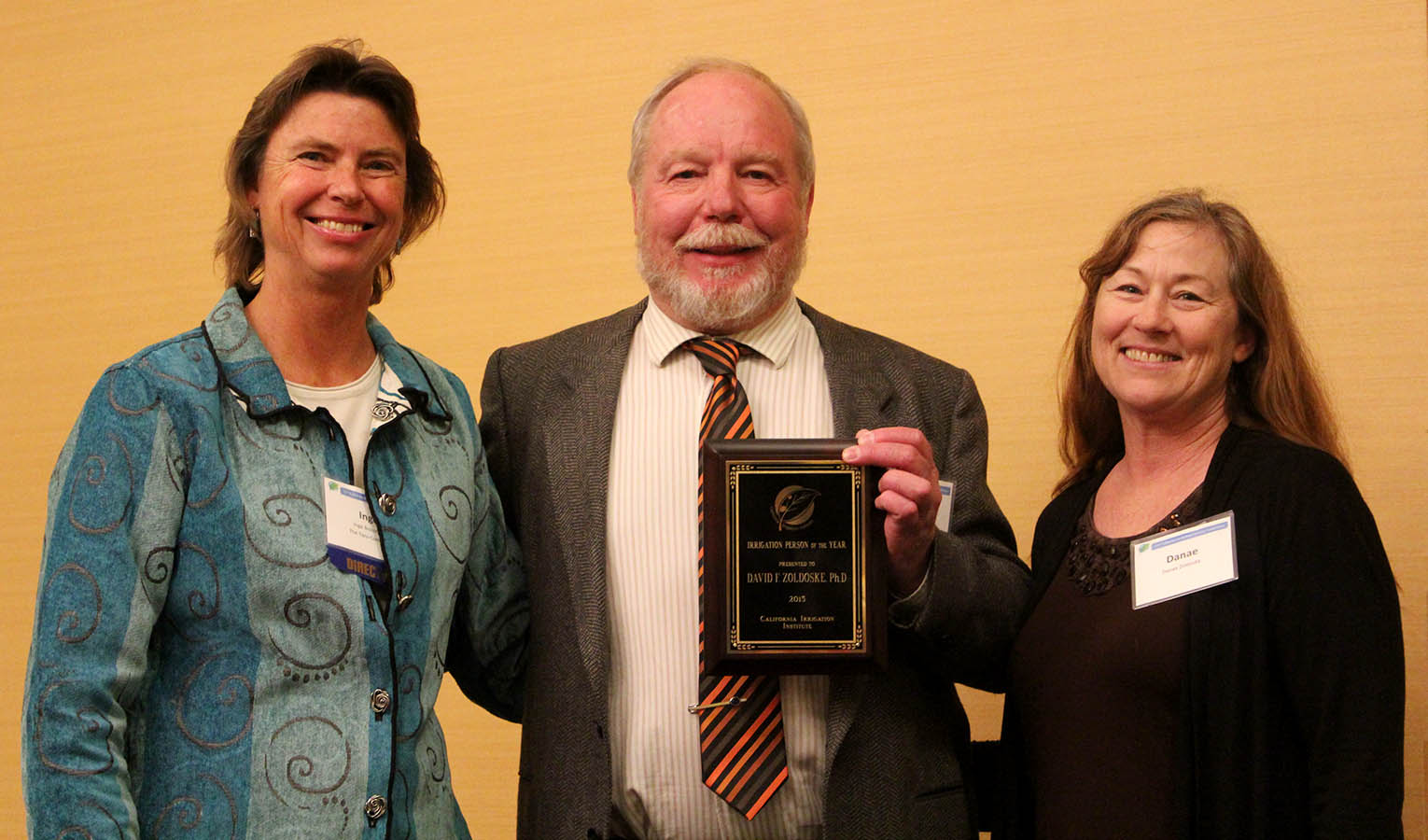
Zoldoske honored as state’s Irrigation Person of the Year

The California Irrigation Institute recognized Dr. David F. Zoldoske as its Person of the Year at its 53rd annual conference on Feb. 2-3 in Sacramento.

Zoldoske, director for the Center for Irrigation Technology at Fresno State, is the 36th recipient of the award sponsored by the state’s oldest independent forum on irrigation and water.

“On behalf of the board of directors, it is a pleasure and honor to bestow this award upon our friend and colleague, Dr. Zoldoske,” said Inge Bisconer, California Irrigation Institute board member and past president. “He has worked tirelessly for decades to promote water and resource use efficiency in agricultural and urban applications in California and beyond. We are fortunate that he chose to apply his passion, energy, skill and expertise to help address one of the most important topics of our generation: water.”

Zoldoske is the third recipient with Fresno State ties. Winston Strong, former plant science and mechanized agriculture professor was recognized in 1985 for his pioneering work in sprinkler testing, and former Center for Irrigation Technology director Kenneth Solomon was honored in 2004.

The annual conference brings together water experts, government agency representatives, water district managers, innovative farmers, urban water managers and commercial interests to focus on pressing water issues, explore innovative solutions, and discuss results of research and practical experience in the field.

Zoldoske was recognized with a similar national award in November 2013 as the Irrigation Association’s Person of the Year.

Fresno State has been involved in irrigation testing and research for more than 60 years, and Zoldoske has played a key role for four decades. He started his irrigation career as a graduate student research assistant before beginning work as a full-time research technician in 1983.

In 1994, he was named director of the center that is internationally-recognized as an independent testing laboratory, applied research facility and educational resource.

“It’s an honor to be recognized by a group representing all of California’s irrigation partners,” Zoldoske said. “The award is more of a recognition of our talented staff and all their successful and hard work. We have been tied closely with the California Irrigation Institute since the 1980s, and look forward to working with them for many years to come.”

2016-05-31T19:30:31-07:00February 5th, 2015|
Go to Top