Avian Influenza Mapping Plan to Prevent CA Outbreaks

High Pathogenic Avian Influenza Mapping Plan (HPAI) to Prevent Outbreaks in California

By Patrick Cavanaugh, Deputy Editor

In 2014 and 2015, the outbreak of High Pathogenic Avian Influenza (HPAI) caused unprecedented damage to the mid-western commercial poultry industry, requiring the depopulation of 48 million birds, particularly turkeys and laying hens. There were isolated cases in last autumn in California as well. Migrating birds, generally considered to be the source of HPAI, move throughout the state in their flyways this time of year.

USDA Pacific Flyway Map

USDA Pacific Flyway Map

Maurice Pitesky, a UC Cooperative Extension population health & reproduction assistant specialist with an appointment in poultry health and food safety, emphasized the importance of the flyways, “These global flyways that waterfowl use to move north and south and back again every single year are like freeways. And in those freeway lanes, different birds interface with each other.  So, we might have a Pacific flyway that covers California, but that Pacific flyway can interface with the East Asian and Australian flyway in the Northern Arctic. If you look at the genetics of the strains that were found in North America, especially in California, the genetics match some of the HPAI found in South Korea for example,” Pitesky said.

The Avian Influenza Mapping Plan is like overlaying maps of birds’ flying patterns for an early warning system for commercial operations. Pitesky observed, “We’re really just scratching the surface in how we can utilize maps with respect to surveillance and risk-mapping. For example, if I can locate on a map, where waterfowl, flooded rice fields, or wet fields are, and I can also determine where commercial poultry operations are, then I can start understanding which operations are at highest risk.”

I can triage my focus, outreach, and biosecurity efforts to those farms that are most closely located.

“New techniques are available so our national network of weather radar can actually be leveraged, and that data can be utilized remotely to understand in real time where waterfowl are hanging out. Eventually we can use that information to warn farmers in real time if there are migrating waterfowl near their farm,” he said.

2016-05-31T19:27:03-07:00November 18th, 2015|

Trade Agreement Big for State

Trans-Pacific Partnership Trade Agreement Will be Boon for California

By Laurie Greene, Editor

On Friday, Nov. 6, Agriculture Secretary Tom Vilsack told California Ag Today the released full text of the Trans-Pacific Partnership Trade Agreement shows that it will be boon for California Exports. Vilsack said, “You’re close to the market, you have ports that access and serve those markets, and you have the products those markets want—whether they are fruits and vegetables or tree nuts,” Vilsack noted. “In fact, we just released a report on our exports as they exist today. Obviously tree nuts are a big export opportunity. We saw significant growth there as well; it is now an $8.8 billion market and California certainly plays to that,” he said.

Vilsack said the trade deal is all about better access, “The fact that tariffs are going to be eliminated in a number of these countries that we do business with will level the playing field for our fruits, vegetables and tree nuts. It is going to open up enormous opportunities for us.”

Vilsack also said these increased exports will definitely increase jobs in California, “This agreement will add and anticipated $120 to $130 billion in U.S. export opportunities, of which agriculture is roughly 9%, so you do the math; it is billions of dollars in additional trade. California is going to get their fair share. It will impact employment because every billion dollars in ag sales supports 6500 good paying jobs, and these are jobs that currently pay about 18% more in benefits than non-export-related jobs.”

President Obama intends to sign this legislation, but first, Congress is poring over the text to make their concerns or support known. Then they will have an up or down vote, but no amendments can be added to the bill.

Again, California specialty crop growers stand to benefit greatly from this trade bill. Ag leaders are urging Congress to pass it and all California commodity trade groups are solidly behind it as well.

2016-05-31T19:27:04-07:00November 10th, 2015|

Subsurface Drip Efficiency

Subsurface Drip Efficiency in Pomegranates

By Charmayne Hefley, Associate Editor

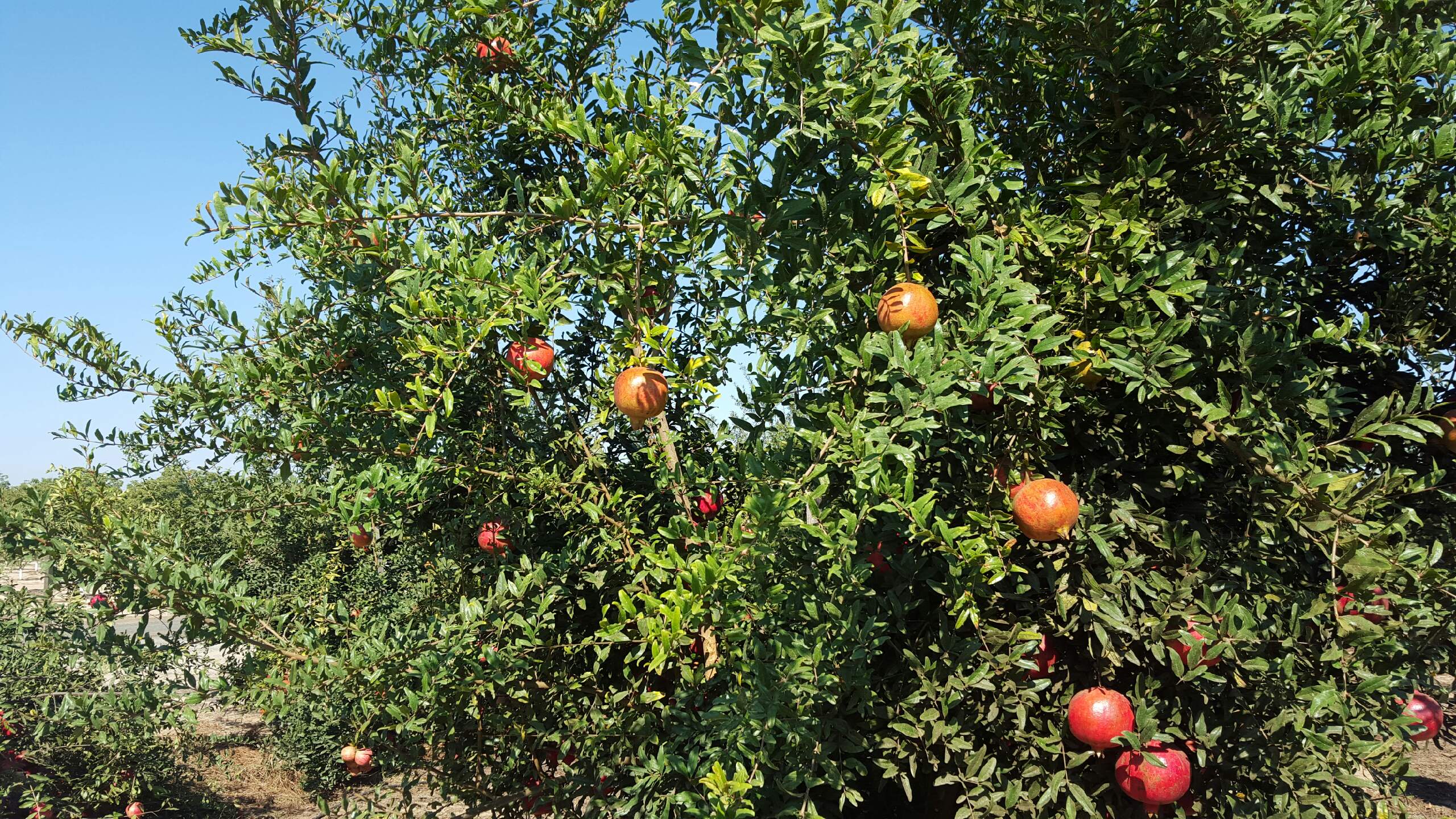
Subsurface drip irrigation, a more efficient form of water delivery, is growing in popularity and utilized on a widening range of crops. Claude James Phene, a research consultant for the UC Cooperative Extension, said subsurface drip efficiency is evident with both water and nitrogen in pomegranates.Pomegranate tree

Using a lysimeter, a big box on a calibrated truck scale that measures evapotranspiration, Phene can calculate the precise water requirement for pomegranates according to the soil moisture feedback indicated by the machine. Based on these calculations, Phene can make clear water recommendations to growers so they can accommodate the needs of their plants without exceeding them.

Because it is buried and targeted, subsurface drip irrigation also helps control weeds and reduce animal and traffic disturbances.

This six-year study has also demonstrated these drip lines prevent leaching—the loss of nutrients in the soil—that occurs with other types of irrigation systems. Phene explained, “The lysimeters are equipped with a drop-tube at the bottom so we can measure the nitrogen in any output to determine how much leaching occurs and to make recommendations on fertilizer.”

2016-05-31T19:27:04-07:00November 4th, 2015|

Health Benefits of Pomegranates

Dong Wang on Health Benefits of Pomegranates

By Charmayne Hefley, Associate Editor


As the demand for healthy food items increases, farmers are choosing from among a larger diversity of crops to grow. Dong Wang, research leader with the United States Department of Agriculture Research Service in Parlier, spoke at the 2015 UC Kearney Ag Research and Extension Center (KARE) & USDA-ARS Pomegranate Field Day last week.

Wang said “the International Society of Horticultural Sciences[1] organized a conference in 2013 on pomegranates and other minor fruits. Attendees from about 20 countries presented their pomegranate research findings on crop production, yield, quality, and genetic aspects of different species, including cultivars. They also presented findings relating to health benefits and the biochemistry of pomegranate products.”

Researchers and experts in California and around the world continue to explore producing a plant variety with the genetic potential for higher yield. And while increased marketable yield is important, Wang said researching pomegranate health benefits and phenolics—compounds with antioxidant propertiesmay be more beneficial than the absolute yield, “so people are researching multiple aspects of the topic.”

Dong Wang, research leader with the USDA-Agriculture Research Service in Parlier

Dong Wang, research leader with the USDA-Agriculture Research Service in Parlier

While the U.S. has a relatively small market for fresh pomegranates, pomegranate juice and secondary products, which are more common in the U.S., help to increase the fruit’s marketable yield. Wang explained some Americans eat fresh arils atop salads and other dishes, but those not-so-perfect on-the-surface pomegranates will still be desirable for the fresh market because they still contain beneficial compounds when processed. This research on phenolics, vitamins, and other compounds found in the fruit has been performed not only on the juice and the arils, but also in high-concentrate peels.

The International Society of Horticultural Sciences organized a conference in 2013 on pomegranates and other minor fruits. Conference attendees from about 20 countries presented their pomegranate research findings on crop production, yield, quality, and genetic aspects of different species, including cultivars. They also presented findings relating to health benefits and the biochemistry of pomegranate products.”

As a result of the 2013 International Society of Horticultural Sciences Conference in 2013 on pomegranates, Wang co-authored a proceedings book published by the International Society of Horticultural Sciences in July 2015. Co-written with Zhaohe Yuan, Nanjing Forestry University and Erik Wilkins, Paramount Farming Company, the volume, “Proceedings of the Third International Symposium on Pomegranate and Minor Mediterranean Fruits,” covers the following major areas of research and state-of-the-art technology: Physiology and Biochemistry, Secondary Metabolism and Human Health, Integrated Pest Management and Disease Control, Marketing and Economics, Genetic Resources and Breeding, Cultivation Techniques, and Post-harvest Technology. According to the USDA, “The book serves as the largest collection of the most current knowledge on pomegranate science and technology in the world.”[2]

_____________________________________

[1] International Society of Horticultural Sciences

[2] USDA ARS


2016-05-31T19:27:05-07:00October 30th, 2015|

CEO Council on Sustainability and Innovation Launched

Agribusiness CEOs and Bipartisan Policy Center Launch CEO Council on Sustainability and Innovation


Washington, D.C. – Leading agribusiness CEOs announced TODAY they are joining together with the Bipartisan Policy Center (BPC) to launch the CEO Council on Sustainability and Innovation to improve agriculture and food production sustainability.

Leaders of DuPont, Elanco, Kellogg Company and Land O’ Lakes joined the Council, which will research, collect and amplify innovative approaches in the agribusiness industry, over the next several months, to combat and adapt to the realities of increasing climate volatility, a growing population, and other threats to a stable food supply.

“In the next 35 years, experts anticipate demand for animal protein will climb by 60 percent as the population grows in size and affluence. Already demand for milk, eggs and poultry is outpacing anticipated expectations,” said Jeff Simmons, president, Elanco. “We can’t just rely on the public sector to address these challenges. The private sector must deliver innovative solutions that can help farmers sustainably meet our global food needs.” 

“Achieving a sustainable future food supply and responding to the challenges posed by climate change are dependent on our collective actions,” said John Bryant, chairman and ceo, Kellogg Company. “Kellogg and others in our industry have a role to play in sharing innovative solutions and inspiring others to progress along their own sustainability journey.”

“To feed a growing global population, the food and agriculture industry must continue to increase agricultural productivity while facing climate variability and resource constraints,” said Chris Policinski, president and ceo of Land O’Lakes, Inc. “By working together, we can be more effective and efficient partners to enable a sustainable and productive supply chain.”

“The cost and availability of food is an issue of critical importance to all Americans,” said Jason Grumet, president, BPC. “The council will help kickstart a more robust national conversation about what’s already being done to promote sustainable food production and what more needs to be done.”

Although there is extensive industry research into various sustainability practices, there is little collective understanding of the strategies being deployed, nor is there public appreciation of adaptation challenges, mitigation opportunities, and the importance of agriculture in what must be a global conversation. The council will highlight and promote these innovative efforts.

The council’s work will culminate in a public report to be released in 2016.

2016-05-31T19:27:05-07:00October 29th, 2015|

Rossi Tackles MRL Harmonization

Lois Rossi Tackles MRL Harmonization

By Patrick Cavanaugh, Deputy Editor

Lois Rossi, who signed off on nearly all crop protection products at the United States Environmental Protection Agency (EPA) for nearly 37 years, spoke to attendees at the recent Maximum Residue Levels (MRL) Harmonization Workshop in San Francisco. Rossi gave her thoughts on the need for MRL harmonization throughout the world.

Rossi was responsible not only for the registration of all conventional pesticides but also for the re-evaluation of approximately 400 active ingredients. Since 2004, she served on the Codex Committee on Pesticide Residues (CCPR) and was a member of the US delegation to the Organization for Economic Cooperation and Development (OECD) Working Group on Pesticides and the Registration Steering group.

“There are process challenges from Korea, Taiwan, the EU, and Japan,” said Rossi, adding some are so difficult that not much can be done because of policy and regulation challenges. “Of course,” she explained, “I will suggest some harmonization opportunities, of which there are a plethora, and there is even a new one now with the Crop Group MRL. Just as you think you nailed that MRL calculator, somebody comes up with a different way,” she noted.

Rossi said at some point the industry needs to figure out how to tackle more of its impediments. “We have tackled some, but I don’t think everyone is there yet.” Rossi suggests information is probably the hardest hurdle to manage because there are so many foreign journals and varieties of global websites. “Like I said,” she explained, “the global MRL database has certainly been a lifesaver for many of us. But to keep up with regulations and procedures from countries to which our growers export commodities is somewhat of a full-time job for many, let alone those whose livelihoods depend on exports or who are dealing with MRLs.”

Determining and understanding different data requirements are also challenging. Rossi noted registrants struggle to determine not only how many field trials a particular country requires, but whether they can be conducted within or outside of the country. Some countries require six, some four. Some regulations vary if it’s a minor crop or a major crop. Rossi said keeping up with these requirements, updated testing methods, NGOs doing their own testing, as well as improved technologies that measure smaller amounts of residues is difficult. So, going to one place to figure it all out would be great.

“And then there is the wonderful world of Codex*, particularly with its capacity limitations. Rossi believes the Codex process has improved, but not its capacity. “That’s pretty much as old as Codex is,” she said.

“Some countries have default MRLs that differ, and some have private standards, which will take hold if the public loses confidence in the public standards and the national processes,” Rossi said. “So countries are establishing their own MRLs because of public pressure; consumers want safe food and they want their government to guarantee them safe food. If that confidence is lost, you will probably still have standards, but you will probably have less control because you are going to have private standards.”

*”The Codex Alimentarius or “Food Code” was established by FAO and the World Health Organization in 1963 to develop harmonized international food standards, which protect consumer health and promote fair practices in food trade.”  Source: C O D E X  A L I M E N T A R I U S, http://www.codexalimentarius.org/)

2016-05-31T19:27:05-07:00October 27th, 2015|

Record Walnut Crop

New Record Walnut Crop:  575,000 Tons

By Patrick Cavanaugh, Deputy Editor


In a recent interview with Dennis Balint, executive director and ceo of the California Walnut Board, Balint discussed the Board’s promotion efforts on what has become another record walnut crop, grown on approximately 300,000 acres in the state.

California Ag Today (CAT): Despite the drought, the valiant walnut growers of California have produced yet another record crop of 575,000 tons, up one percent from 2014’s crop, and crop quality is reported to be excellent. How does that relate to overall supply?

Balint: This increase represents 5,000 additional bearing acres. Last year, the world availability was up about 140,000 tons higher than the previous year. We knew that we could absorb incremental production of 20,000 or 30,000 tons a year; however, 140,000 tons was a bit of a surprise. Couple that with the fact that China’s economy isn’t today what it was a couple of years ago. That has hurt us a bit.Walnut trees

So at any rate, that means we are going to have a record total of availability this year, and I think we are going to see prices moderate. Now, the really good news is the industry had some foresight in approving a huge budget to market the product, so we’ll be having a serious marketing campaign in the 2015-2016-crop year.

CAT: Walnut consuming promotions?

Balint: The board will continue promoting walnuts with print and television campaigns, as well as public relations efforts through Edelman Public Relations. That will continue on two fronts; one is consumer appeal, like recipes, and just raising overall awareness regarding the versatility of walnuts; but second and most importantly, Edelman is in charged with promoting health. Health continues to be a very important card in promoting our product to consumers and health professionals as well.

CAT: It is always good that people think of health when they think of walnuts!

Balint: Yeah they do. It is amazing how that number has changed over the years.

CAT: Is eating more, better?

Balint: You know we have a daily range. When we do studies, researchers will always look at the composition of the product and, depending on what they are expecting, they will adjust accordingly. So we have studies that are based on 1 ounce, 1.5 ounces, and 2 ounces daily. So it really depends on the end points they choose to look at.

We try to never talk about compounds because we like to talk about the whole walnut, but occasionally researchers who are deconstructionists suspect a particular compound. Then we have to analyze it down to the nitty-gritty so somebody can put it in a pill. When that happens on occasion, researchers say, “Well, we really need to feed 2 ounces.” And in some cases, 2 ounces in the short-term works very well. In the long-term, being practical, 1 to 1.5 ounces is good.

CAT: Please go back to the advertising budget. Is it mainly domestic?

Balint: It is all domestic. The export program will remain intact—no changes there. We will still have good programs in a number of countries overseas, but all of the increased production is going into the domestic market.

CAT: Do we need to increase per capita consumption to handle the oversupply issue?

Balint: That is a good question. What we need is the following: We estimate, and we don’t have hard numbers, not much more than one in five households is purchasing and using walnuts on a regular basis. So that leaves a lot of room for growth. Our campaign has been designed to appeal to light and non-users, and not just the core consumer who is already loving walnuts and buying them on a regular basis, to expand our user base.  We are doing so by presenting walnuts as an ingredient in salads, vegetable side dishes, entrees, and of course as a snack. As a matter-of-fact, we are waiting on copy testing results in the next week or two.

CAT: Good. And walnuts make everything better and that’s what it is all about, isn’t it?

Balint: Absolutely. Walnuts are a little added touch that makes food not only more interesting because of the color, texture, and taste, but also because it is healthful. All of our ads are going to have the heart check logo. I want to reemphasize health research will still capture a lot of media on its own. That will continue, ‘no reduction there.

CAT: Are the ads in food or fitness magazines primarily?

Balint: Food magazines, primarily. We have four executions of print ads and two television commercials. We are waiting for the test results for the ads. The copy testing we have done also includes what the experts call rapid eye movement. By observing people’s eyes, we’ll know when consumers like or don’t like a word or a phrase, or think something is plausible or implausible. We will also know where their glance goes, how long it stays there and where it goes next.

This will help us structure the commercial to eliminate some of those “down spots” and focus on things that capture their attention. We will be reaching 95% of adults between the ages of 25 and 54 with this campaign on average 26 times per person over a period of about five months.

CAT: Wow, you are running it on some big television programs?

We’ll be going after different segments. For example, we have scheduled morning television segments like “Live with Kelly & Michael,” “Rachael” with Rachael Rae, and pillar events. A pillar event might be a broadcast on E! Network such as “From the Red Carpet at the Academy Awards” or an event in the sporting world. But that is not a focus. We will also include standard shows like “The Big Bang Theory” and so on.

Television will be in ten key markets, and I don’t have the list in front of me. But we will also continue our aggressive social media program. We have a couple of new ideas that I think will capture people’s interest.California Walnut Commission logo

CAT: Tell us about the campaign with the wrapped truck that looks like a walnut.

Balint: We converted a food truck to look like a walnut by wrapping it with walnut texture and contoured the boxy truck into a rounded walnut shape. So when it is parked in downtown Manhattan or Washington D.C., the truck with those affixed contours makes quite a spectacle.

CAT: So what were you doing with that truck? Did you hand out information?

Balint: We made information available, facilitated games, hosted walnut cracking, and most importantly, served an ice cream sandwich made out of yogurt, walnuts and chocolate graham crackers. We had samples of walnuts as well.

CAT: What is your health research strategy? Are you working with key researchers to compare eating walnuts with not eating any nuts?

Balint: Our health research strategy depends on the target. Remember, walnuts are the only good food source of Omega-3; most nuts have no Omega-3. We like to test the whole walnut in a lot of our studies. Sometimes we will find an indication that one compound is more important than another; but we recently finished a study with 27 scientists for our annual meeting. They look at what we have done, what we are doing, and what we should do next. So it is not just guesswork, it is a carefully thought-out program that focuses on areas of greatest interest to scientists.

One thing I will tell you is one day before the meeting began, we had six key scientists come in for what we call a “brainstorming session.” We asked them to tell us how to make our program better: the way we run our health research program, the way we run the conference and so on. The unanimous opinion of the six in attendance was not to change a thing. They said basically the program is a model for what should happen in health research, because we don’t go into research with a preconceived notion. We don’t go in and say, “Researcher, please raise your hand and provide us with a positive result on this disease.” We follow the science.

CAT: What are your biggest markets abroad?

Balint: China of course is huge. But other very strong markets include Germany, Japan, Korea, Spain and Turkey. China slipped this past year, of course, and we are all scratching our heads because we hear a lot about China. But their economy is a little soft. They had a crackdown on the gray market, which hurt business a little bit because some of the product that goes into China finds its way there through either Hong Kong or Vietnam. So China’s utilization this year was down. It is too early to tell whether they will return or continue at the same pace they experienced in 2014-15. We just don’t know yet.

CAT: Are you promoting the health message in these foreign countries?

Balint: Yes, and it is a really interesting situation. In countries that have a tradition of walnut-use like China, only about 40% of our messaging is health-related because they have known it is healthy for a thousand years. Whereas, in Japan, when a big story breaks accompanied by some television coverage, our sales will spike like you can’t even believe. So, it differs by market.

Here in the U.S., it is very high, as in Germany and Spain. Turkey is building and India as well, but slowly. We have some issues there; India is a market in which they too grow lots of walnuts, but we are slowly but surely making some headway.

The Korean market opened in 1994, but it was 2001 before we had any meaningful number of shipments. You have to be patient with some of these markets to be able to dismantle some of the trade barriers.

CAT: Are there any markets in South America?

Balint: Years ago, in the 90’s, there was an effort in Brazil and Argentina. Now, Chile grows walnuts, Argentina grows some, Brazil still grows a few. The Mercosur* pact down there (a special trading pack between South American countries) is a problem because the Mercosur countries trade duty-free. So we are at a disadvantage. We’re contra-seasonal. Last, but not least, we have a tariff burden. So we tried it for a couple of years, but decided there were better places to invest.

CAT: Well, it’s interesting. We don’t see South America being a big market for almonds or pistachios yet either.

Balint: It’s true; they grow Brazil nuts and, as I said, walnuts. Chile, as a matter-of-fact, is increasing their plantings. As their plantings increase, their initial sales will remain within the South American continent. When they get into the summer, especially late summer, they will sell what they have left into markets like Korea, and if they can, France and Germany. They basically go into our markets and try to sell in advance of our crop.

CAT: How are California growers doing? They are going through another year of drought, and I’m sure you are worried….

Balint: Everyone is, and we are all waiting for the other shoe to drop. Here we are with another record crop, and we know the reason for that. It’s because five or six years ago, somebody planted more walnuts, and they are coming online now. It appears as though we are trying to grow more walnuts in the middle of the drought, though the fact of the matter is those trees went in the ground long before water scarcity became as bad as it currently is.

CAT: Exactly, Fresno County just released their numbers last month and broke a record 7 billion dollars. Kern County and Tulare County broke records as well. In terms of ag value, we are not taking such a hit, mainly due to high nut prices.

Balint: Even before I was in the commodity business, I used to work for a company in Massachusetts called William Underwood Company. They had B&M (Burnham & Morrill Company) Baked Beans, Underwood Deviled Ham and other meat spreads. That is where I learned about commodities.

We had an economist on staff to predict the prices of navy beans, fatback**, sugar, ham hocks, and chicken. I learned it was much easier for the chicken guy year to year; he would just have more chickens to count! The bean people could have more beans. What about the walnut people? If the trees weren’t in the ground, they were not going to get more walnuts.

________________________________

*Mercosur or Mercosul (Spanish: Mercado Común del Sur, Portuguese: Mercado Comum do Sul, Guarani: Ñemby Ñemuha, Southern Common Market) is a sub-regional bloc. Its full members are Argentina, Bolivia, Brazil, Paraguay, Uruguay and Venezuela. Its associate countries are Chile, Peru, Colombia and Ecuador.

Source: Wikipedia, the free encyclopedia


**Fatbackthe fat, usually salted, from the upper part of a side of pork

Source:  Dictionary.com


2016-05-31T19:27:06-07:00October 21st, 2015|

Milk Marketing Order in CA Worries Other Dairy States

By Kyle Buchoff, Assistant Editor

Tom Van Nortwick, owner and publisher of Agribusiness Publications in Fresno for the last 35 years, has been attending the USDA dairy hearing in Clovis to adopt a Federal Milk Marketing Order in California. Van Nortwick warned that should California go with the Federal Milk Marketing Order, the move could hurt prices for all milk producers across the nation.

“Dairymen in other parts of the country have expressed concern that if California dairymen were paid more for their milk, they may go ahead and produce more milk,” Van Nortwick said. “California is a milk-making machine with comparatively fewer dairies. More milk on the market has been proven to create volatility and huge price fluctuations up or down, depending on demand. So California producers’ getting paid more and producing more milk would reduce the price of all milk throughout the country.”

“We found that 2-3% too much milk in the market at any one time can create up to a 40% reduction in price paid to producers,” Van Nortwick explained. “And of course, California is not the only overproducing state; Wisconsin, Minnesota and other midwestern states are also overproducing at this time.”

Van Nortwick also pointed out, “Domestic demand is strong, but exports have shrunk by about 50%, which is about 8% of last year’s market. So when you add an 8% oversupply of milk volume to the market as we broach the time for holiday season orders, and there are strong indications that inventories of milk, butter, powder, and cheese are rising across the country, prices paid to producers will fall.

“Nobody needs prices to go any lower,” stated Van Nortwick. “Our counterparts in New Zealand, Australia, and the European Union are suffering mightily, even more than we are, with record-setting low prices because they think they can just produce more than they can sell. If you produce more than you can sell, you are going to take a hit, and unfortunately it is the producers who end up taking that hit.”

2016-05-31T19:27:06-07:00October 19th, 2015|

Joe Marchini, Mr. Radicchio

Joe in truckJoe Marchini Brings Radicchio to California

By Patrick Cavanaugh, Deputy Editor

Joe Marchini, of J. Marchini Farms, was born in 1938 to Italian parents who farmed and packed tomatoes in Le Grand, Calif. Marchini has lived and worked in that locale for his whole life, exemplifying a high level of spirit and accomplishment.

His father, Florindo Marchini, brought his family over from Tuscany in 1920.” They settled in Le Grand because Florindo’s brother was already living there when Florindo first arrived. Before long, Florindo met a long time grower by the name of Carlo Giampaoli who invited Marchini to grow tomatoes and bell peppers with him. So Giampaoli took Florindo Marchini under his wing, and his brother as well, and established their farm, Giampaoli-Marchini Company. Together, they packaged tomatoes under the Live Oak brand because they actually packed the produce by hand in the shade of a live oak tree that still thrives there today!

Florindo’s son, Joe Marchini, was around seven when he began working at the packing shed stamping produce boxes. “I would sit on a box,” he said, “and as they came down the line, I used a little stamp pad to size tomatoes 6/6, 7/7, 7/8, 5/6, 4/4, 3/4. I only worked about 3-4 hours a day, and that was it. The older I got, the more I became involved in different things, from stamping, to packing, to wrapping tomatoes in cellophane paper and putting them in a box.”

The tomatoes were packed green and transported back east by train in ice cars. “They weren’t pink ones; no, they were dead green! They knew when to pick them, when the gel formed inside of the tomatoes,” Marchini said. “They could tell by the color and the shine of the tomatoes, and that’s what the pickers were supposed to pick. They were going to break soon. It took about a week, running day and night, to get to New York on steamer trains.”

“The early farming venture was comprised of 150 acres, which was a lot of acreage with horses,” said Marchini. “In the fall, we would travel to Gustine and cut tulles and bamboo for our tomato stakes.”

“My two brothers, Richard and Leonard Marchini, went to school with me. None of us could speak any English; we only spoke Italian,” Marchini said. So they all learned English in a small schoolhouse with two classrooms and one teacher.

“My dad grew tomatoes on that land for two years and then planted 40 acres of almond trees. The almonds were harvested green and then dried down by air.” Of course this was before mechanical shakers were used to harvest, so it was done with mallets and tarps. “It was very tough work,” noted Marchini, “and the price of almonds was less than 60 cents a pound.” Marchini credits Blue Diamond Growers, a cooperative he joined, with marketing the almonds so prices could increase.Radicchio


Mr. Radicchio

Not satisfied with growing only tomatoes and almonds, Joe Marchini was always looking for something new to grow. In 1962 on a trip to Italy, Joe noticed fields of radicchio, a leafy Italian chicory and relative of endive, in the Venice area and found the crop was selling well in Italian grocery stores. He said, “I liked the crop and thought it would grow well in California, so I smuggled in little packages of seeds.”

Unfortunately, the seeds he brought back did not grow well. “Radicchio production wasn’t perfected and the source I had in Italy did not tell me what season the seeds were for.” Marchini’s radicchio would grow and form green leaves but not make a head. So Marchini went back to Italy, 40 miles southeast of Venice, to talk to growers, but no one would talk. “I certainly could not tell the guys that I was going back to the U.S. to grow the crop,” he said.

Marchini finally found a couple of growers to ship a 100-pound sack of seeds to San Francisco for him. “I picked up the bag, planted the seed and the same thing happened—it didn’t grow.” He called the Italian growers and asked how many different radicchio varieties they were growing. They told him eight varieties. “I asked them why they sent me only one variety, why they did not tell me when to plant the seed, and if they wanted me to buy more seed, they had better tell me what varieties to grow,” he said.

“Since I spoke Italian, the growers started to open up. Eventually, I brought them to the U.S., and we partnered up to grow radicchio. I even sent them to Mexico because they thought they could produce an earlier crop than in California,” Marchini said. After reaching mediocre success for about four years in Mexico, they moved back to California to work with Marchini, now without a partnership.

The company now productively farms in Mexico with the right seed. “We farm in Mexico for the winter crop in February, March and April. But before we started growing in Mexico, in the late 1970s, we started in Salinas and then in the San Joaquin Valley. The Italian growers knew what to plant and we got all the varieties in the right mode that would do well. The Italians wanted to be partners again and I declined it because I had kids coming up, but I told them that I would buy all the seeds from them, and they were making good money. So they ended up disclosing the secret in the whole deal of growing radicchio. So without them, and me speaking Italian, we would have never gotten started. We are still friends today and I’m still buying seed from them,” Marchini said.

Over the years, Marchini has worked with his son Jeff to plant the right seed at the right time. They learned which varieties could handle different climates, such as going into the heat, and coming out of the heat, and they emerged with 6 or 7 dependable varieties.

“So we plant six varieties in the fall, one week after the other. We can have radicchio in the San Joaquin Valley from November until March, and we harvest seven days a week.

His processors want radicchio 12 months out of the year, so Marchini’s company manages harvesting to fill the sales pipeline 12 months a year. “And we never run out of it,” he said.

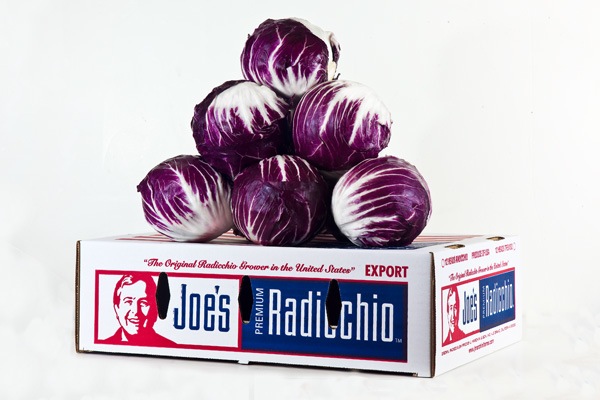
Joe's Premium LogoToday, Marchini uses about 12 different labels, including his own image on the ‘Joe’s Premium Radicchio’ box, for the domestic market and select export markets. “We let global importers pick their own labels. J. Marchini ships all over the world now, including Italy, and has a large percentage of the market in Japan, Korea and Taiwan. “They love the color of radicchio in a blend,” he said.

J. Marchini deals with nearly every processor in California including Taylor Farms, Apio, Fresh Express, Dole, Earth Bound, and Ready Pac, year-round, with production from Kern to Merced counties and Mexico.

Managing all this production with Joe and his son Jeff (the third generation), are grandchildren Marc and Nic and Francesca (fourth generation), with the fifth generation coming along with Gabriella, Maximus and little Giuseppe, named after his great-grandfather Joe (Giuseppe). Marc and Francesca work in the sales and post-harvest side of the business. Nic works in the farming operation side of the business. Jeff oversees the company as a whole.

Overseeing production, and especially the harvest of the radicchio throughout the growing regions, including Mexico, is Alejandro Calderon, Joe Marchini’s right hand since day one. Jenny MacAfee, a key person in the sales department, has been on board for the last 20 years.

Today Marchini farms three main radicchio varieties: Castelfranco (white head with red polka dot specks), Treviso (elongated red with white ribs), and Palo Rosa (red head type with white veins). “We do a three-pack deal in the wintertime with all three varieties together, but we also grow many other varieties,” said Marchini.

J. Marchini Farms’ production operation, based in Watsonville, a great climate for radicchio in the summer months, includes 2,000 acres spread between the Central Valley, the Coastal areas and Mexico.

The Central Valley fall and winter nighttime temperatures are cool, and radicchio production, five lines down the row on 80-inch beds, is about 20,000 pounds per acre, with most of it on drip or sprinkler.

The operation also grows almonds, walnuts, fresh figs and other crops, “but radicchio has been a good ride,” said Marchini. “We have had ups and downs with the crop, but overall it has provided a good cash flow,” he said.


For the last three years, Joe Marchini has been dealing with Squamous Cell Carcinoma (the second most common form of skin cancer) and has undergone multiple surgeries and treatments. His love for his family and his incredible passion for farming keep him going.

_______________

J. Marchini Farms

2016-05-31T19:27:06-07:00October 16th, 2015|

ALRB on Entering Private Property

ALRB on Entering Private Property to Educate Workers:  Is the ALRB going too far?

By Patrick Cavanaugh, Deputy Editor

The California Agricultural Labor Relations Board (ALRB) wants to enter private property farmland for the purpose of educating farmworkers on their rights as farm laborers in California. Of course, farmers want their workers to be happy and content with their work and that means knowing and understanding their rights as farmworkers.

“But the ALRB is going too far,” said attorney Ron Barsamian of Barsamian & Moody in Fresno, which represents many agricultural businesses throughout California in labor and  employment law.

“I wanted to get into some pragmatic issues that I feel have not been considered. For instance, the lack of efficiency in trying to get access to all these different ranches is just not going to work,” said Barsamian. “You are going to have staff tied up forever. I don’t think they have taken into account the different geographical areas, the different ag sectors. For instance, are you going to spend as much time educating two or three people working at a dairy as you would a crew of 50-60 people?”

2016-05-31T19:27:06-07:00October 15th, 2015|
Go to Top